A Proven Framework
Tens of thousands of companies in dozens of countries have used the Four Decisions to align their leadership teams around people, strategy, execution, and cash, the four areas where growth companies either scale or stall.
Credentials: Scaling Up Certified Coach
Scaling Up is the growth methodology Verne Harnish built from decades of research into high-growth companies. It centers on four decisions every company has to get right: people, strategy, execution, and cash. The certification followed ten years of running these tools inside my own Inc. 500 company.

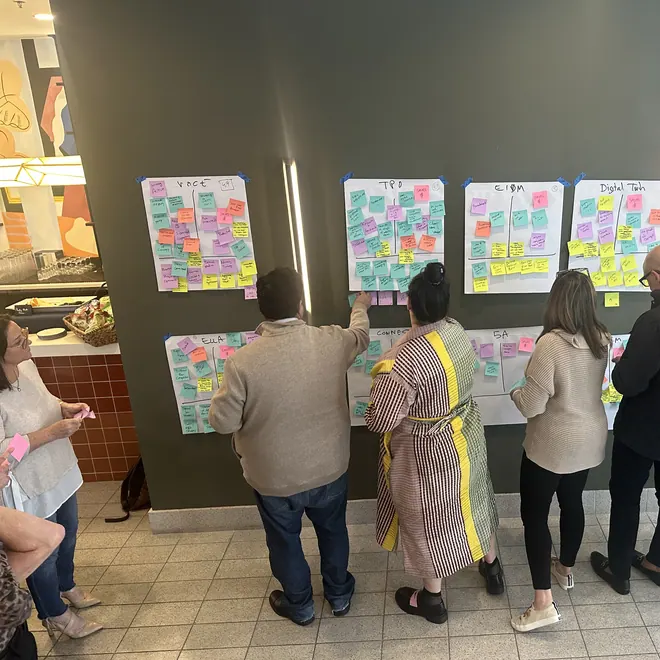

Scaling Up gives a leadership team a common language, a shared set of tools, and a rhythm for using them. It replaces a stack of disconnected methods with one system the whole team runs.
Tens of thousands of companies in dozens of countries have used the Four Decisions to align their leadership teams around people, strategy, execution, and cash, the four areas where growth companies either scale or stall.
The One-Page Strategic Plan and the Rockefeller Habits Checklist are working documents, not theory. They create clarity, drive accountability, and turn a strategic vision into daily operating discipline.
Annual, quarterly, weekly, and daily meetings keep the plan in front of the team. Priorities and metrics get reviewed on a schedule, so the strategy stays alive between offsites instead of fading by March.
Two frameworks work together. The Four Decisions cover where scaling companies succeed or stall. The Rockefeller Habits create the execution rhythm that turns those decisions into daily action.
The right people in the right seats, with clear accountability and alignment around company priorities.
A differentiated strategy that creates a real competitive advantage and drives profitable growth. ROADMAP12 is built on this work.
The disciplines, priorities, and meeting rhythms that turn strategy into consistent daily action across the company.
Managing cash so it fuels growth rather than constrains it, and understanding the levers that speed it up or drain it.
Ten practices high-growth companies use to stay aligned, captured on the One-Page Strategic Plan that keeps strategy, priorities, and metrics on a single working document.
The method fits growth-stage companies that have moved past survival mode and now feel the weight of their own complexity.
Leaders are busy and capable, but pulling in different directions. Decisions get relitigated and priorities shift every few weeks.
The company competes on effort rather than on a clear position, and the team cannot say in one sentence why customers choose it.
Revenue climbs while cash gets tighter, and no one on the leadership team owns the forecast.
The company runs on the founder's instincts and attention. Moving from entrepreneurial hustle to systematic growth is the next step.
Scaling Up keeps its coaching community small relative to the number of companies using the framework, and the bar to join it is high.
Certification takes more than fifty hours of intensive training. That includes deep study of the system, the toolset, and case studies, multi-day in-person sessions with senior coaches and trainers, and simulated coaching engagements with direct feedback.
It ends with a ninety-minute oral examination before a panel of senior coaches, with no notes or supporting materials. The exam works through complex client scenarios to test real command of the Four Decisions under pressure, not the ability to recite them.
I knew these tools as a CEO long before I coached them.
I first met Verne Harnish and the Rockefeller Habits through the Entrepreneurs' Organization and the Entrepreneurial Masters Program at MIT. Over the following decade I applied the framework in my own software agency through five consecutive years on the Inc. 500/5000 list, before a successful exit in 2013.
Three applications made the biggest difference. The People tools defined clear roles and responsibilities across our leadership team. The Strategy work gave us real differentiation in a crowded market. The quarterly priorities focused the whole company in a way earlier planning never had.
When I certified in 2016, I brought that decade of practice plus more than ten years as a Lean/Agile coach. I also hold other certifications in exit planning, behavioral assessment, and performance, so Scaling Up gets combined with other methods when a situation calls for it rather than forced onto every problem.
Founders and executives who brought Scaling Up into their companies with a coach beside them.
"I met him through the Scaling Up Masterclass while trying to implement the methodology alone, and quickly realized a coach would accelerate my growth. His support was key to successfully implementing Scaling Up and Metronomics."
"I chose Bruce after reviewing all Scaling Up certified coaches based on his professional services experience, knowledge of Agile principles, and people skills. Having had many strategic coaches, Bruce is far above the rest."
"What sold me was his experience as a founder and CEO. He understands what it's like in the driver's seat. My leadership team has worked with Bruce for several years, and he's enabled us to set clear strategy and dramatically increase accountability."
The Scaling Up tools run inside ROADMAP12, the Strategic Planning Program: a clear twelve-month plan, the few priorities that actually matter, and the quarterly rhythm that keeps the whole team executing it.
Activity is not progress. ROADMAP12 gives you a clear twelve-month plan, the few priorities that actually matter, and the cadence to keep the whole team executing the same strategy.
Straight answers on the method, the certification, and how the work runs. Anything not covered here is a good topic for a strategy call.
Scaling Up is a growth methodology built by Verne Harnish around four decisions every growing company has to get right: people, strategy, execution, and cash. It pairs those decisions with the Rockefeller Habits and the One-Page Strategic Plan, so a leadership team works from one shared set of tools and a steady meeting rhythm instead of a stack of disconnected methods.
Certification takes more than fifty hours of intensive training, including multi-day in-person sessions with senior coaches and simulated coaching engagements with direct feedback. It ends with a ninety-minute oral exam before a panel of senior coaches, with no notes, built around complex client scenarios. The bar is high on purpose, and the certified community stays small.
Both give a growing company an operating system, but they suit different moments. EOS is a simpler, more prescriptive system that many companies use to put basic structure in place. Scaling Up goes deeper on strategy and cash, with tools like the One-Page Strategic Plan, which suits companies that already have structure and now need real differentiation and disciplined execution to keep growing.
No. Some companies install the full system with its planning rhythm and tools. Others take the pieces that solve the problem in front of them, most often the One-Page Strategic Plan, quarterly priorities, or the cash work, and fold them into how they already run. It also gets combined with Metronomics, exit planning, or Predictive Index data when a situation calls for it.
It fits growth-stage companies that are past survival mode and starting to feel the weight of their own complexity. Common signs are a leadership team pulling in different directions, a strategy that competes on effort instead of a clear position, growth that eats cash, and a company that still runs on the founder's instincts. If two of those sound familiar, the framework has something to offer.
The quickest way to start is a thirty-minute strategy call on your situation, with no pitch. It shows whether the full system, a few of its tools, or something else fits best. Most Scaling Up work runs inside ROADMAP12, the twelve-month program for building a strategy the leadership team actually executes.
Columns from Inc.com on the strategy, planning, and growth problems the Four Decisions are built to solve. Read more in the Inc.com column and in Field Notes.

Growing quickly requires a focused strategy. Five steps to get there.
Read the article
Quarterly planning meetings are where strategy turns into priorities. How to run them well.
Read the article
The obstacles that stall growth at each stage, and the strategies that get a company past them.
Read the articleA strategy call is the quickest way to tell whether Scaling Up fits your company, whether that means the full system or a few of its tools. Thirty minutes on your situation, with no pitch.
Seven connected systems, from culture and team cohesion to strategy, execution, and cash, run as one framework. The leadership team works from a single system rather than juggling methods that never connect.
Business goals, personal goals, and financial goals get planned together so each one reinforces the others, instead of three advisors working three separate plans that collide at the closing table.
The PI Behavioral Assessment rests on hundreds of validation studies over six decades of commercial use and meets the European standard for reliability, validity, and fairness in psychological testing.