Metronome Implementation Roadmap: How to Phase In Your Management System
Most software rollouts stall because teams switch everything on in month one. Phase Metronome in over a year, one habit at a time, and move to the next layer only when the last one holds.
By Bruce Eckfeldt

TL;DR
The Metronome Implementation Roadmap is how I bring the Metronome software into a leadership team over its first year. Most rollouts fail because every module goes live at once and the old spreadsheet never dies. This roadmap adds one layer at a time: rhythm, measure, plan, people, then strategy. Each phase ends when its exit criteria are met, not when the calendar says so. You walk away with a clear sequence, named owners, and a team that runs the business from one system.
The Tool
Most leadership teams buy management software with real hope. The demo looks great. Every module solves a problem they have. So they turn it all on in month one, load every priority and metric they can think of, and wait for the discipline to follow. Three months later the dashboard is stale, the real tracker is still a spreadsheet, and the software has become one more thing to update.
The problem isn’t the software. It’s the rollout. This roadmap is how I phase Metronome, the software platform built around the Metronomics system, into a leadership team over its first year. By the end of that year, the team uses every core tool in Metronome and runs the business from it. Metronome becomes the management system, not a reporting layer sitting on top of another one.
Why Rollout Order Beats Features
A management system is a set of habits before it is a set of screens. The weekly meeting, the metrics review, the quarterly planning session. Software can hold those habits. It can’t create them.
When you turn everything on at once, you ask a team to build six new habits in parallel. None of them get the attention they need. The team quietly keeps the old spreadsheet because it still works, and now there are two systems. Nobody trusts either one.
The cost shows up in a familiar way. Priorities pile up and sit at yellow for weeks. Metrics go stale by week three because nobody knows who updates them. The coach becomes the only person chasing updates. And the CEO asks for status by email instead of opening the tool, which tells everyone else the tool is optional.
Phasing fixes this. Each phase adds one layer of the system on top of a habit that is already working. You never stack a new layer on a habit that hasn’t formed yet.
How the Five Phases Work
The roadmap has five phases. Each one has a clear job.
- Rhythm. Run the daily huddle, the weekly leadership meeting, and quarterly priorities in the tool.
- Measure. Put the numbers that matter in the tool, each with an owner.
- Plan. Build the One Page Plan and run quarterly planning live in the tool.
- People. Connect roles, scorecards, and reviews to the plan.
- Strategy and annual planning. Run annual planning in the tool and make the three-year strategy visible.
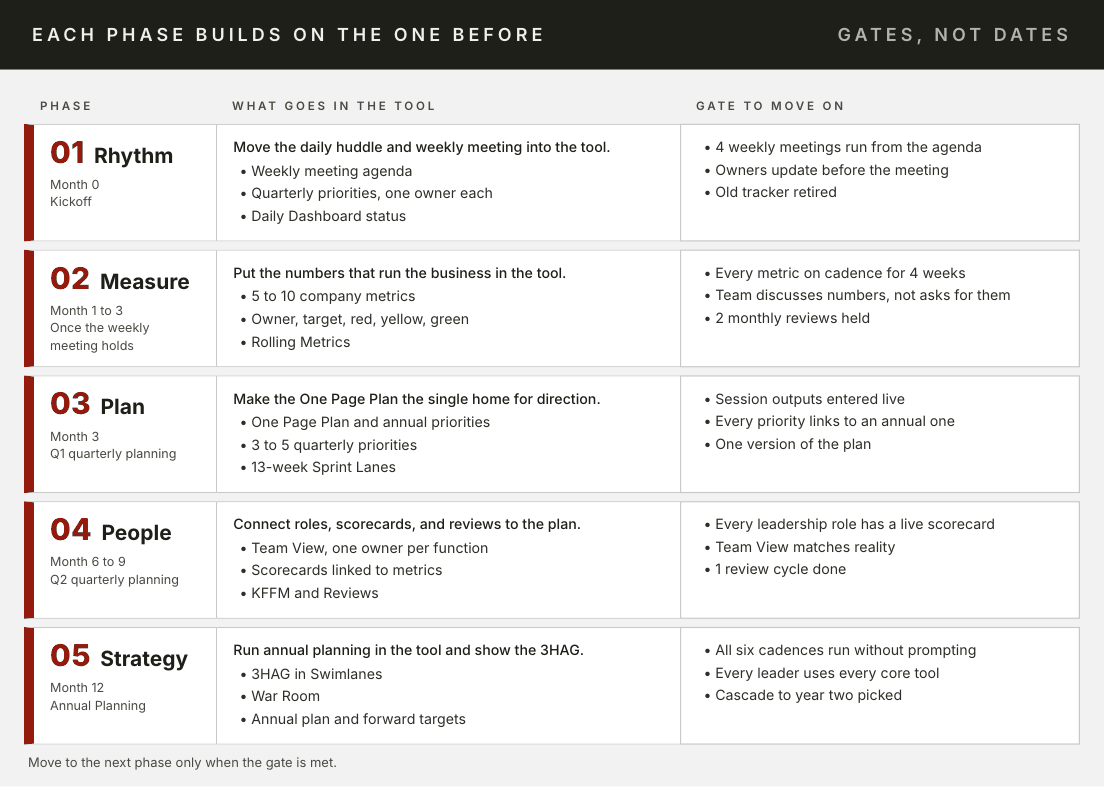
The rule that holds it together is simple: gates, not dates. A phase ends when its exit criteria are met, not when the calendar says so. Moving on early stacks a new layer on a habit that hasn’t formed. In the ideal case, Phase 1 starts at Kickoff and Phase 5 lands at the first Annual Planning session, twelve months later. At each quarterly session, I check the gates and hold the next phase until they are met.
Four roles make it work:
- The coach sets the sequence, checks each gate, and prepares for sessions from what is in the tool.
- The implementation lead owns the rollout inside the company. This is usually the Integrator or COO. They are the admin, they train the team, and they chase adoption between sessions.
- The CEO models the behavior. If the CEO updates the tool and runs meetings from it, the team follows. If not, nothing else in this roadmap holds.
- The leadership team updates their own priorities and metrics on the agreed cadence.
One more piece of context. Metronome is the shared leadership layer, not your finance system. The detailed cash engine, your widget forecast, cash conversion cycle, and 13-week cash forecast, stays in a finance model outside the tool. Metronome holds the handful of numbers the leadership team watches, like operating cash and the key widget drivers. Someone updates those by hand from the finance model each month, so the list has to stay short.
When to Use It and When Not To
Use this roadmap when your leadership team is adopting Metronome and you want it to become the way the business runs, not a side project. It fits a team starting fresh at Kickoff, and it fits a team coming in sideways, mid-year or moving off another platform.
It is also useful as a diagnostic for a team that already bought the software and stalled. Walk back through the exit criteria, phase by phase. The first gate that isn’t met is usually where the rollout broke.
Don’t use it as a calendar. The months in the session map are the ideal case, not a commitment. A team that hits a gate early moves on early. A team that misses one stays put. And don’t use it to roll out to the whole company at once. Year one is about the leadership team. Bringing the tool to the next level of leaders is year-two work, and it only works once the leadership team is running the business from the tool themselves.
Working Through the Five Phases
The downloadable roadmap has the full setup checklist for every phase. Here is what each phase is really about, and what tells you it’s done.
1. Rhythm. The daily huddle and the weekly leadership meeting move into Metronome first. These two meetings are where accountability lives, so they are the habit every later phase builds on. Name the implementation lead before anything else, then load the current quarterly priorities, each with one owner and a due date. Run the weekly meeting from the Metronome agenda, on screen. Capture action items and stucks in the tool during the meeting, not after. Then retire the old tracker. Exit criteria: the huddle runs every working day from the Daily Dashboard, four consecutive weekly meetings run from the agenda, every owner updates status before the meeting without a reminder, and nobody keeps a parallel copy.
2. Measure. The numbers that run the business go into the tool, and every one gets an owner who updates it on a set cadence. Agree on five to ten company metrics, mixing leading and lagging indicators. Give each one a target and red, yellow, and green thresholds. Confirm where each number comes from and who pulls it. This is also when the monthly review starts, up to an hour with all functional leaders, using Rolling Metrics to see the year-to-date trend. Exit criteria: every metric updated on its cadence for four straight weeks, the team discussing the numbers instead of asking for them, and two monthly reviews held.
3. Plan. The One Page Plan becomes the single home for the company’s direction, and the next quarterly planning session runs live in the tool. Enter the plan from the Kickoff work: core purpose, BHAG, 3HAG, and the annual plan. In the session, close out last quarter’s priorities, set three to five company priorities each linked to an annual priority, and enter the 13-week Sprint Lanes as sub-priorities with named owners. Every leader enters their own priorities before leaving the room. Exit criteria: one full quarterly session run with outputs entered live, every quarterly priority linked to an annual one, and the One Page Plan in Metronome as the only version anyone references.
4. People. Roles, scorecards, and reviews connect each person’s job to the plan. This is where the tool starts answering who owns what, and whether they are delivering. Build the Team View from the accountability chart, functions first, then names. Confirm every function has exactly one owner. Create a scorecard for each leadership role and link it to the metrics that role owns. Weekly 1:1s start here, led by the direct report from their priorities, metrics, and scorecard. Exit criteria: every leadership role has a scorecard linked to live metrics, the Team View matches how the company actually runs, and one review cycle is complete.
5. Strategy and annual planning. The first Annual Planning session runs in the tool, and the three-year strategy becomes visible there. Roll the 3HAG forward and build it out in Swimlanes. Set the new annual plan and first quarterly priorities in the tool. Build the War Room as the visual home of the strategic plan. Then prepare the cascade: pick the first teams below the leadership team to bring in during year two. Exit criteria: all six meeting cadences run from Metronome without the coach prompting them, and every leadership team member uses every core tool from Phases 1 to 4.
There is no second implementation year. Once Phase 5 is complete, the work shifts to deepening use, cascading the tool, and adopting new features as Metronome releases them.
Three Ways Teams Start
Most teams don’t start at a clean Kickoff. These three starting points are composites, written to show how the same roadmap bends to fit where a team actually is.
The clean start
A leadership team of seven starts at Kickoff with no system at all. Priorities live in a slide deck and metrics live in the CFO’s head. This is the ideal case. Phase 1 launches at Kickoff, and the account is set up, the team added, and the first priorities and metrics entered before the session ends. The daily huddle feels awkward for two weeks, then sticks. Phase 2 starts once the weekly meeting holds. By the Q1 session, both gates are met and the team runs its first quarterly planning live in the tool.
The platform switch
A team has run Ninety for two years and wants to move. Their rhythm is solid, so the risk isn’t habit, it’s language and history. They cut over at a quarterly session and migrate the current quarter, not the history: open priorities, active metrics, and open action items, plus year-to-date metric history so Rolling Metrics shows a trend from day one. Both systems run in parallel for no more than two weeks. They still start at Phase 1, but they move through Phases 1 and 2 in weeks, not months. The hardest part is vocabulary. They keep saying Rocks and Issues. We map the old terms to the new ones in the first weekly meeting, then hold the new language.
The mid-year spreadsheet team
A team engages in the middle of the year, running everything from a shared spreadsheet. Spreadsheets are the most common starting point and the easiest migration. Most of the cleanup is deciding which rows are still live priorities. The year-one clock starts when Phase 1 starts, not when the engagement starts. Their first session after Phase 1 turns out to be Annual Planning, so we run Phase 3 at that session and hold Phase 5 for the following Annual.
Where This Breaks Down
If I were watching your team roll out Metronome, these are the things I would flag.
Turning everything on at once. Every module is live in month one, and nobody uses most of them. Hide the modules the team won’t use yet in company settings, and switch them on when their phase arrives.
Running two systems. The tool gets updated, but the real tracker is still a spreadsheet. As long as the old tracker lives, the team will trust it more. Retiring it is a Phase 1 exit criterion for a reason.
Too many priorities. Fifteen or more priorities, most of them yellow for weeks. The tool makes this visible, which is the gift. Use that visibility as the case to cut the list at the next quarterly session.
Metrics no one can update. Dashboard numbers go stale by week three. A metric nobody updates is worse than no metric, because the team stops trusting the dashboard. Load only metrics with a working data source and a named owner.
No internal owner. The coach is the only person chasing updates. That doesn’t last past the first quarter. Name the implementation lead before setup starts.
The CEO on the sidelines. The CEO asks for updates by email instead of opening the tool. Everyone notices. Make the CEO’s own updates a Phase 1 expectation, not a nice-to-have.
Your Next Step
Download the full roadmap. It has the setup and run checklists for all five phases, the meeting rhythm table, the year-one session map, the leader competencies with their training videos, and the migration notes for teams coming from Ninety, Align, or spreadsheets.
Then do three things before setup starts. Name your implementation lead. Agree that the CEO runs the weekly meeting from the tool, on screen, starting week one. And pick the date you will retire the old tracker. Those three decisions do more for adoption than any feature in the software.
Downloads
- Guide, PDF, 11 pages Metronome Implementation Roadmap
The full year-one roadmap. Roles, the meeting rhythm, setup and exit criteria for all five phases, common traps, the session map, leader competencies, and migration notes.
Get a Free Review Call.
Tell me how Metronome Implementation Roadmap went, or what you want to get out of it, and we will talk it through on a free 30-minute call: what it showed, what to work on first, and whether coaching would help.
Request a Free Review Call
This is a free 30-minute call with me to go through your Metronome Implementation Roadmap results. Add a few notes below on how it went and what you want a second opinion on, and attach anything useful. I read everything before we talk, so the call starts from your answers, not the basics. We look at what your answers show, where they are thin or unclear, and what to work on first. You leave with a clear next step, whether or not we work together after. There is no cost and no sales pitch.
- Send your notes. Add them below, with any files.
- I read it and reply. You get a few times to talk.
- We meet for 30 minutes. Free, focused on your answers, with a clear next step.
Your worksheet goes only to me. I read every request myself and reply with times to talk.
Use It With These.
Playbook tools rarely work alone. Each of these connects to Metronome Implementation Roadmap, either as a step that comes before it or as the place its answer goes next.
Meeting Rhythms
Phase 1 installs the daily huddle and the weekly meeting. Meeting Rhythms designs the full set of cadences the roadmap moves into the tool.
Coming to the Playbook
Role Scorecards
Phase 4 builds a scorecard for every leadership role and links it to live metrics. This is the tool behind that step.
Open the toolOne Page Strategic Plan
Phase 3 makes the One Page Plan the single home for your direction. Build the plan well before you put it in the tool.
Coming to the PlaybookThe Coach Behind the Playbook.
The Playbook is the set of tools I use with leadership teams, written up so you can run them yourself.

Bruce Eckfeldt is a business coach and strategic advisor to founder-CEOs of growth-stage companies and a former Inc. 500 CEO. He writes a column for Inc.com, hosts the From Angel to Exit podcast, and is the author of Springboard, a founder's guide to selling your company. Connect with him on LinkedIn.
Keep Going.
More on this topic from the Inc.com column, Field Notes, and The Playbook.

Having a Goal Is Not the Same as Having a Strategy. Here's Why
Goals without a strategy go nowhere. Strategy defines the path that gets you to the goal.
Read the article
The 5 Most Common Mistakes Leaders Make When Crafting a Business Strategy
The common strategic planning mistakes that block clear execution, and how to avoid them.
Read the article
Master the Art of Quarterly Planning With These 7 Steps
A disciplined quarterly planning process aligns the team and speeds up strategic execution.
Read the article
Does Your Business Have a Rhythm or a Founder Pushing the Boulder?
When the founder is the engine of execution, the business can't run without them, and buyers see the risk. How the Firefighting Trap hides behind effective leadership, and what a real operating rhythm looks like.
Read the post
Your Team Is in Meetings All Day, So Why Does No One Know the Plan?
Constant meetings feel like planning, but they rarely connect to a plan. The Meeting Mirage, and the annual, quarterly, monthly, weekly, and daily rhythms that turn activity into alignment.
Read the post
Red, Green, Wow: How to Set Performance Metrics for Senior Leaders That Actually Work
Most CEOs can spot clear failure or clear excellence but can't write down the line between them. The Red, Green, Wow framework for setting thresholds that make senior leader performance measurable.
Read the postGet the Next One.
Every new post and playbook lands in Better, Faster, my weekly newsletter for founder-CEOs, along with questions for your team and a book worth reading.