From Angel to Exit Episode 19
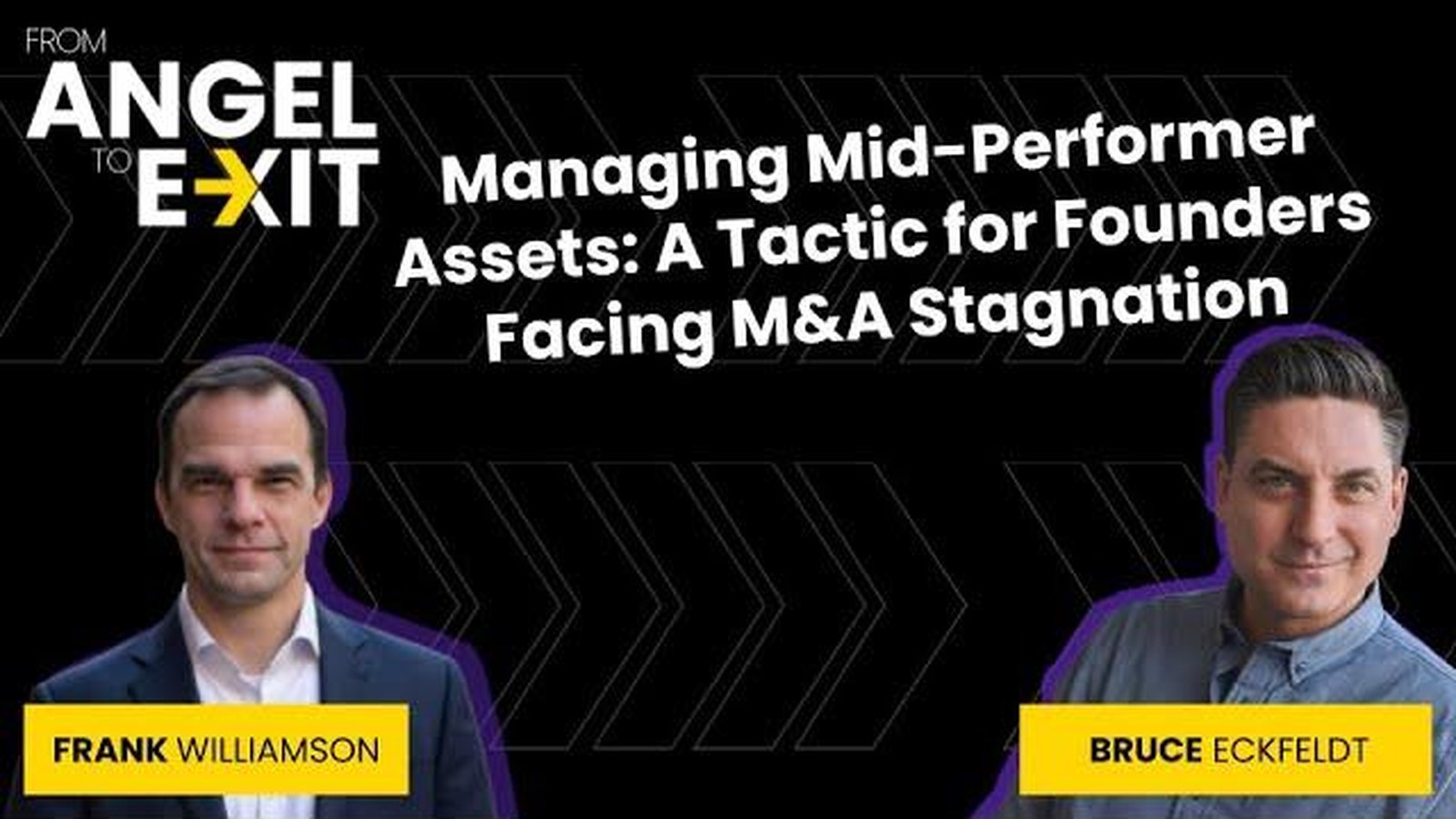
Managing Mid-Performer Assets: A Tactic for Founders Facing M&A Stagnation
Frank WilliamsonCEO, Oaklyn Consulting
Listen to the Episode.
Play the full conversation right here, or pick a chapter to jump straight to that moment. Prefer your own app? Every episode is on Spotify, Apple Podcasts, and the rest.
About This Episode.
Start with the key takeaways, the ideas worth bringing back to your leadership team. Then read the full story of the conversation, or use the chapters above to jump straight to the moment that matters most to you.
- If your business can't run without you for two weeks, it's likely not a saleable asset.
- Separate the "owner" and "operator" roles early to prepare for a successful exit.
- Mid-performing companies need strategic storytelling and market testing to attract buyers.
- Investor pressure often stems from their own fund timelines, not just company performance.
- Framing early buyer outreach as partnerships creates rapport without prematurely signaling a sale.
- Distinguish between VC (growth-focused) and PE (buyout-focused) when planning capital strategy.
- A full sales funnel, multiple potential acquirers, is key to creating leverage in dealmaking.
- Founders must proactively lead the narrative around exit timing, valuation, and deal structure.
Frank Williamson, CEO of Oaklyn Consulting, joins Bruce Eckfeldt to explore what happens when a business stagnates, performing decently, but not meeting growth or exit expectations. He shares real-world insights on managing misaligned cap tables, preparing for strategic exits, and dealing with investor pressure. Frank offers clear tactics to transform underperforming assets into saleable opportunities, making this episode a must-listen for founder-CEOs navigating the murky middle of the M&A landscape.
Watch the Video.
Prefer to see the conversation? The full episode plays right here on the page, so you can watch while you follow the takeaways or read along with the transcript. Every episode of From Angel to Exit is also on my YouTube channel, along with short clips from each conversation.
About the Guest.
The background behind the conversation, and where to find this guest online.
Frank Williamson
CEO, Oaklyn Consulting
Frank Williamson is CEO of Oaklyn Consulting. He helps companies that are performing decently but stuck, working through cap table issues, investor pressure, and the path to a sale.
- Website
- oaklynconsulting.com
- linkedin.com/in/fwilliamson
Full Transcript.
The complete conversation, lightly edited for readability. Open it to read along, or search the page for a topic or a name.
Read the full transcript
Bruce EckfeldtWelcome, everyone, to From Angel to Exit. I'm Bruce Eckfeldt, I'm your host. Our guest today is Frank Williamson. He is founder and CEO at Oaklyn Consulting. We're going to have a really interesting conversation today, not only about the whole growth and exit process, but about what happens in some of these portfolios when you have assets that aren't performing as well and you need to figure out what to do with them.
I think it's going to be a great conversation for folks thinking about exiting, to understand the other side of this: when you're dealing with private equity, with funds that are supporting or buying into these companies, which become part of a portfolio with expectations. What happens with those expectations as companies perform or don't perform? So I'm excited for a little inside baseball on what happens on the investment banking side, and excited to get into this with Frank and understand some of the history and some of the options. So with all that, Frank, welcome to the program.
Frank WilliamsonBruce, it's great to be here. Thanks for having me.
Bruce EckfeldtIt's a pleasure. Before we dive in, let's talk a little about your background. How did you get into this space professionally? Give us a little of the backstory.
Frank WilliamsonI've been some form of investment banker for my whole career, which is 30 years or so now. I started out in an analyst job, went on to do public company work, spent some time completing deals for a venture-backed company, ran a traditional boutique, and for the last eight years I've been running Oaklyn Consulting, which is a specialized M&A boutique.
Bruce EckfeldtJust so people understand your role as an investment banker, I always joke that it's really not about investment or about banking. Practically, what do you do with these companies? What does the job actually look like?
Frank WilliamsonThat's a great point. The thing to keep in mind, as most of your founders know from raising capital, but also from selling or buying companies, is that it's a complicated, year-long negotiation with multiple offers and counteroffers. What investment bankers do in that context is help project-manage that long, involved negotiation, especially focusing on the financial part.
Bruce EckfeldtAny particular focus in terms of industries, situations, sizes, or geographies? Where have you operated mostly?
Frank WilliamsonThe reason we formed Oaklyn Consulting was to serve a part of the market that wasn't being well served, and that's relatively small, relatively complex deals. The normal way investment bankers work is they charge a commission at the end of a nine- or 12-month project. If they're being smart about their own business, they're very careful about whom they take on, because you need a deal that's going to close on time and not be a time sink. We build time into our deal fees so we can help the part of the market that's not otherwise well served. So our world is smaller, more complicated deals, usually meaning lots of social issues.
Bruce EckfeldtI found this with my own company and with several clients I've worked with. If you're under $50 million, it's just tough. The bankers are taking a cut, and it's the same amount of work selling a $100 million company as a $10 million company, so they'd rather go find the $100 million companies. Do you have any models for structuring the market by company size and how the deals end up working? We go everywhere from business brokers all the way up to big M&A shops doing billion-dollar deals. How do you stratify the market?
Frank WilliamsonThat's right. I think that $50 million cutoff, measured on enterprise value, is a pretty good way to think about it. There are lots of people serving the middle market or lower middle market who want to cut off their project revenue at $800,000 or $1 million in fees. If they're being smart, they're probably discounting that by half for risk. They're saying, "I need to make some yield on my time to get it done." And you're absolutely right. It's about the same amount of time regardless of deal size.
Business brokers create value a little differently from investment bankers. They create value by identifying owners of relatively small businesses who want to sell and putting a listing for them where buyers can see it. That makes it much easier for a buyer looking to buy a business than calling everybody to see if they want to sell. But they're operating a business that looks a lot like real estate listings.
People who call themselves M&A advisors or investment bankers are doing something where, I guess, the right analogy is a real estate auctioneer. You're trying to get multiple people there at one time to make a bid, and you're reaching out to find people, as opposed to having the company show up at the watering hole where people are looking to buy things.
Bruce EckfeldtYou make the market rather than just plugging people into an existing market. I'm curious what work actually goes into this. What's the heavy lift for an investment banker in finding those potential suitors and managing the process? What's the hard part?
Frank WilliamsonI think the big thing people can't do themselves is the role of a Sherpa, for lack of a better term, on a year-long journey. The whole thing is a negotiation, from the time you first raise with someone, "Hey, what could we potentially do together?" until the deal is done.
The hardest part of that negotiation is having more than one choice at the same time. Do you have more than one buyer, or a buyer plus a good no-deal option, so you actually have choices? The next hardest part is keeping the thing on schedule rather than having a forever conversation about how we could theoretically do something. And the third hardest thing, once you've done all the work to negotiate a business deal, is preserving value from the letter of intent, the business terms, to the closed deal at the end, and not having the buyer nick away at the deal you thought you had.
Having someone who can see that journey ahead of time adds a lot for the typical founder. So partly, that's what the investment banker does. They're the guide for that journey. Second, they're the financially minded person who deals with company buyer types all the time, so they know the questions a rational buyer needs answered, and they can help you early to get your story organized so the buyer can make a quick decision.
Bruce EckfeldtThis is interesting, and I'd love to get your insights. I talk a lot about the things that drive valuation and then the things that drive buyability, what makes a company viable to buy. There are companies where it's a great company with great underlying fundamentals and great opportunity, but it's just not organized and presented in a way that lets a buyer see those things.
Frank WilliamsonThat's a way to think about it.
Bruce EckfeldtAnd sometimes there are structural things that mean they can't buy it. There are blockers that either prevent it or make it so complicated to buy that they'd rather move on to another option. What are some of the key things earlier-stage founder-CEOs running these companies need to think about in terms of what ultimately drives valuation and the ability to actually sell the company?
Frank WilliamsonThat's a great question. This doesn't apply to people who've raised money before and have outside investors. But if you think about owner-operators, there are a lot of great jobs that are self-employed jobs. They look like a company, but they're a job. Actually, that's a lot of what business brokers are selling: an opportunity to go do a job. You can buy your way into a set of customers and a brand and so forth, but it's really not a company you're buying. It's an opportunity to have a job.
So one thing is to think about whether what you're running is a job or a saleable thing. If it's a job, use your profits to pack away savings and happily dissolve the thing when the time comes. Don't even try to sell it. Just wind it down.
If it's a saleable thing, and again, this is not for people who've already taken investment money from outsiders, I think the guidance is to think about this concept of being an owner-operator and start to get clear with yourself that there's an owner role and an operator role. The owner gets to sell the business. So even if it's just you wearing both hats, it's you in the owner role who chooses to sell the business, when to do it, and how to do it. In an ideal situation, the operator doesn't totally know or care.
That's the extreme. If we picture you or me, Bruce, trading a share of Apple, it doesn't keep Tim Cook up at night that we rotated the owners of Apple. With little companies, things are mixed together, even in the starkest cases. But the people who get really, really good at selling businesses separate owner and operator with intention.
Bruce EckfeldtOne of the tests I give CEOs is, "If we put you on a two-week vacation where you can't talk to anyone, what happens to your company?" If your company basically dissolves, you've got a job. If it keeps running, maybe we have a sellable asset here. It's a litmus test of how well you've separated ownership from actually operating the company.
Frank WilliamsonThat's right. You are the operator.
Bruce EckfeldtLet's talk about the case where you now have investors. A lot of these folks have raised capital and have a cap table, with people who have put money into the company. I always say if someone's going to put money into a company, they need to get it out at some point. They have some kind of expectation. When you work with companies with a cap table, what's the process by which expectations get set about return of capital, time frames, and things like that?
Frank WilliamsonThat's a great point. I think it gets set in the choice of security people are buying in with. There are lots of local investors in different cities and towns who, say, back restaurant owners. They put in some kind of security that looks sort of like debt, and they expect to get cash back out of it over time. They're not looking for some big hit 10 years in the future. That kind of angel is looking to have someone build a great business, and then they get redeemed out, everyone declares victory, and they recycle the money into something else. Those, by the way, are wonderful sponsors of small businesses all over the country and the world.
Bruce EckfeldtYou need them. But they're primarily looking at some kind of annuity or distribution stream over time.
Frank WilliamsonThey want their original cash plus something else back. They're looking for some version of principal and interest coming back. Then there are people investing in what's intended to be a saleable company, and they're not looking for cash back. They're looking for the sale of the company at some point in the future. That means from day one, there's some level of discussion about "I'm building a company that fits into some bigger organization's operation, an organization that's presumably acquisitive." I'm moving along a path where the way people get their money back is through a transaction event. In really rare circumstances, it's going to be an IPO, but I think it's better to think of most founders who are building for an exit as exiting through an acquisition.
Bruce EckfeldtSo they realize their equity value in some kind of payout, potentially with some retained equity or some kind of earnout, and the remaining people on the cap table basically get cashed out in that transaction and recoup their capital so they can reinvest it in whatever's next. Tell us a little about the difference, because people throw around VC and private equity and all these terms. Practically, what are the differences between having a venture capitalist on the cap table versus private equity? How do those affect the dynamics differently, and what do they expect in terms of outcomes?
Frank WilliamsonI think about an angel or venture investor putting money in where the money is mostly going to be used for sales and marketing. In a really mature situation, what they're doing is funding sales and marketing against some kind of product where there's already a formula: "I put in this many dollars of marketing spend, and I'll get this much more in client contracts." You can think about that a lot with software businesses, where people can pretty well work out customer acquisition cost and lifetime value per customer. They can say, "If I spend $10 more on CAC, I'm going to get $50 more in long-term contracts."
What's often called private equity is sometimes also called buyout. What people are doing in that case is buying a cash-flowing business, using as much debt as they can. They're focused on changing the ownership, running the business well, maybe doing some other things that fit their skills, like buying more businesses to add on, and then selling it again later after using the cash to pay down the debt. What their cash is not going toward is funding sales and marketing. With businesses acquired directly by a private equity fund, the cash goes to buy out existing owners rather than into the company to fund sales and marketing. Operations are already funding sales and marketing at those companies.
I guess there's a third category that often gets called private equity, which is: I've got a small business, and I'm going to sell it to a larger business that's owned by an institutional shareholder of some kind, probably a private equity fund. In that case, you're just selling to a bigger company. It doesn't totally matter to you day to day who owns the bigger company. You're providing something so the bigger company can say, "Is this going to give me new customers for my same products, or a new product for my same customers? Can I grow that way?"
Bruce EckfeldtSo say I'm a professional services group with maybe $20 million in top line. We're doing well, and it's growing. At a general level, what are the avenues I should think about in terms of types of buyers and sale situations? What are my options?
Frank WilliamsonI think you've got three options to look at. Venture capital probably isn't one of them, because it's really designed for something where there's a recipe of sales and marketing dollars equals more contract revenue, and you need the cash to keep going.
First, if you've really hit a level of maturity and your owner and operator roles are separate, the owner sells to an investment fund and can keep growing it. Second, you've probably got a professional services firm, or a related product-type business in the industry you serve. And third, you've got some kind of financing structure that enables the people who will be working in the business in the future to buy out the people leaving it. That can be financed a bunch of different ways, but often it's over time. The predominant scenario is probably a bigger organization that's somehow strategically adjacent to what you're doing.
Bruce EckfeldtSo you have a particular niche, geographic focus, set of customers, or capability that would add to their broader offering. They tuck you in, and you continue to operate the business more or less as designed.
Frank WilliamsonRight. I'll give you a great example that's come up among some professional services firms. There's a private equity-backed platform company whose business is providing management services to companies owned by private equity firms. They've got a particular scale and style, and they offer temporary sales management, marketing, and back-office support. They have a whole suite of business administration functions on an outsourced basis for the private equity industry. The way that business can grow is, "Let me pick up an outsourced sales operation. Let me pick up a market segmentation operation. Let me keep adding more products to sell to my customers."
Bruce Eckfeldt"I've already got these customers. They have other needs. Let me find services that meet those needs and make it a more holistic solution." Classic.
One of the things I wanted to talk with you about is what happens when things aren't going so well, or at least not performing as expected. I know you do a lot of this work, where you have an investor on the cap table with certain expectations about company performance, who has built their financial models on hitting certain targets by certain dates, and the company is just not performing. It's not a disaster, but it's not doing what they expected. They're trying to figure out what to do with it. The company has some options and some future, but maybe not what they originally planned.
And then you have various players. People on the cap table who may or may not be aligned. Potentially a founder-CEO who's still involved and still has some equity. Management. How do you deal with situations that aren't going as expected? How do you size these things up, and how do you work with companies to figure out what to do with these assets?
Frank WilliamsonThat's a great question, because we do a lot of work in the early-stage venture community. The rule of thumb for venture funds is that one or two investments out of a whole fund make the fund's returns. They're the 10x or 20x returners. A typical fund is going to have 20-ish investments, and let's say 10% or 15% of them, so two or three, go to zero. That leaves a bunch of investments in the middle that neither took off nor went to zero.
First off, investors have a fair amount of patience, but they are momentum players. So the companies with the most momentum get the most attention. In reality, what has probably happened first is some level of neglect. And then, and I imagine your founders listening will sympathize, what has happened next is a more and more tense relationship.
Let's say someone hired to run sales just didn't work out. It was a big-company sales rep in a small-company setting, and it turned out not to be what everyone hoped. That knocked people off their expected trajectory by two years. So now you've got this small business with investor-backed expectations of exponential growth, and you're in year five or six when you thought you'd be four times as big as you are, and you're turning over sales leadership and trying to get it going again.
Well, everybody's tense. So the first thing to navigate is how not to let it get you down, and similarly, how not to engage your investors in a fantasy at the same time. There's not an investment banker role in that, but it certainly is the reality for the founder as you wade through a tense relationship, especially with the money-oriented directors on your board. Their job, honestly, is to get their money back, so they're going to be the ones who push you most.
What I recommend most is to have some patience and empathy for the money person, who is probably not working for themselves but has other investors behind them, and to appreciate that they legitimately need an answer to "How will we get this money back?" If you can deal with that with patience, you can probably keep them in a dialogue.
What they're probably going to ask you to do is give a better answer than whatever you gave them at the last board meeting. So what's a better answer? A better answer is more specific about whom. And to the extent possible, it's more specific about when. It doesn't have to be six months from now, unless you're burning a bunch of cash. But it does need to be, "We think someone is interested in doing this kind of thing, and we've taken these steps toward building a relationship so that the ultimate buyer can see the value of what we're doing in the market."
Maybe you're competing with them and beating them in the market, in which case they can probably see it. But if it's something adjacent, a "they win when we win" rather than a "they lose when we win" scenario, then it really becomes a question of getting out to those potential acquirers, in our view, not with a "Will you buy my company?" message, but with a "What can we be doing together that creates more value?"
Bruce EckfeldtSo a joint venture or collaboration.
Frank WilliamsonSome kind of joint effort. Ideally there's some revenue behind it in the short run, but also ideally there's a sense that "We could find tighter ways to work together."
What doesn't help, and understandably annoys investors, is to say, "There are five, but I haven't met any of them. In theory it would work, but I'm too busy doing other stuff to have gotten around to testing it." Or worse yet, "There are some, but I don't know how many people could do it."
Bruce Eckfeldt"We suspect there are some people out there."
Frank WilliamsonRight, exactly. So the first thing is to make a list. Who could it logically be? Then treat it like sales. If you've got a list of prospects, go qualify their interest. Go out and talk to them. Find a way to get in front of them with this broad discussion about how you can work together. Then you've got some real input about what you can do.
And I might add, let's say an investor says, "We really need to get on with this, and I want you to talk to an investment banker I know who has done other things for me and my portfolio." That conversation with the investment banker is going to be the same conversation: "Let's think logically about where this company would fit." Between the investment banker, who's a participant out in the market, and you, the founder, you work through what conversations you've had in which you can generate some demand for the company as a vendor, a partner, or an acquisition target. So you can do it yourself pretty easily, and you should.
Bruce EckfeldtHow do those conversations go? What's your suggestion or strategy for approaching some of these options? I've certainly seen this: "Okay, we see a couple of bigger players. Maybe we're a geographic add for them, or a customer base, or something." I find it can be a little dicey or complicated to have these conversations. Any suggestions on how to approach these prospects?
Frank WilliamsonIt is. Generally speaking, there are two avenues into a bigger company. One avenue is through divisional or product leadership: "Hey, as you're thinking about how you sell in the marketplace, what could we do that adds something to that?" The other way in is through finance or corporate development leadership, if it's an acquisitive company. There's an asterisk: if the other company is owned by a fund, you can always go to the fund, because their job is to scout acquisitions. But in the end, it's really management's decision.
It tends to be the case that if you're running a business that provides a complementary product to someone else, your easiest way in is probably whoever you're going to see in the marketplace and at conferences, probably product management or division leadership. You can start to sound them out: "Hey, is there something I ought to be talking about?" Maybe you get no urgency. The normal place an investment banker's network will take someone is to finance leadership, or to corporate development if it's a staffed function.
The thing to appreciate in both cases is that once it becomes a discussion about some kind of deal or venture investment inside the bigger company, those conversations intersect. If the investment banker goes into corp dev and says, "Is this something you'd like to look at?", the corp dev person, whose job is to screen acquisitions and to some extent joint ventures, takes that idea to divisional management and says, "Is this something we'll spend time on together?" If it comes in through divisional management, somewhere down the road, if it starts to become an acquisition-like discussion, they'll go to finance and say, "Here's something we think we ought to look at." So they come together behind the scenes.
So if you've got the right team on your end and you're close to thinking about an exit, maybe there's an investment banker type on the team. If not, you've got your money-oriented investors, VC fund types, who can play the same role and hit the finance people at the bigger company. And you yourself, as the founder, can go hit product management and division leadership.
Bruce EckfeldtTackle it from both sides. What makes those kinds of deals work, and what gets in the way? When you actually get into "How would we combine these things? What's the synergy? Where are the obstacles?", what typically comes up?
Frank WilliamsonNumber one is creating a situation that seems urgent enough that people need to act on it. I think the right analogy is sales as a starting point. What makes a sales conversation work? I uncovered something about someone's need that was urgent enough that they want to take action on it. You can think about these conversations as really being like sales, as long as they're business development conversations. "I'm going to do some kind of venture," because I can do more than one of those.
Once it becomes a "sell my company" conversation, you only get to sell your company one time. In that case the analogy gets a little weaker, but it's still there. You have to find a reason for someone to be attentive. But you've got another lever you don't have with business development: you can create a sense of scarcity. How do you create scarcity as a way to catalyze action? You have to have more than one conversation going.
Bruce EckfeldtExactly. A competitive environment.
Frank WilliamsonRight. You create a competitive environment. To go back to the sales analogy, sales go better if the top of your funnel is full. One way or another, you need more than one conversation going.
Bruce EckfeldtHow does this typically play out with a board, in terms of whether the deal is good enough? Various people may have different expectations or thresholds they need to hit to do the deal. Some people want to stay in: "Let's try for another year or two. We can probably get a better offer. Maybe we can turn things around." Others say, "I just want out, because I want to redeploy this capital. I have another opportunity that's better." How does that typically play out?
Frank WilliamsonEarly in my career, I had the role of staffing corp dev for a publicly traded company. Every single summer, with the help of an investment banker, we would have a board meeting where we looked at other M&A deals in the marketplace, our stock valuation, and our own business plans, and that prompted a conversation with the board: "Are we serving the shareholders better by selling now or by not selling? Which is the better outcome?"
I think anytime there are professional investors who need to think through that math, some kind of periodic view into that decision needs to happen. It's the right time to do it when selling is better for us than not selling. That means people have to have some projection of the future, and some discussion about how much to discount it back, in order to quantify those things. In the end, it's the owners' and investors' decision: "I'm better off with the transaction now than with a transaction later, or with just holding." That relative value is the whole decision.
Now, you brought up an overlay to that, which is the investor's own needs, unrelated to the company. They may say, "Look, it might be better to sell later, but I need the money back now." So it isn't about whether it's better or worse from the company's perspective. It's strictly from the investor's perspective: "I'm at the end of my fund. I want to close this thing down."
Bruce EckfeldtExactly. We always ask at the beginning of the deal, on the acquisition side, where the buyer is in their fund, because that changes how people buy. The same thing happens on the sell side. They may want to hold on, or they may want to do it quickly.
Frank WilliamsonSame thing happens on the sell side. In my world, we do some distressed work, and we think about distressed companies and distressed owners. There's no catalyst for a deal like a distressed owner. It has nothing to do with the quality of the company. It just has to do with the owner needing money, or needing to be out for some reason.
Let's say some venture fund isn't raising its next fund, and the staff at the fund are getting to retirement age. They just want to be out. "Clean this thing up. Get me out." Those are small businesses too, for the most part. So again, be sensitive to and empathetic with that need. They've got their own needs, and sometimes that's going to force a change in the cap table. Ideally, you organize it so it doesn't really change the organization. It only changes the ownership.
Bruce EckfeldtI think it's an interesting one, and it certainly comes up early, when you do the initial deal: understanding the investors, their motivation, where they are in their fund, what they're looking for, and what time frames. That goes so much into figuring out valuation and deal terms, how deals are going to be structured, and ultimately who you want on your cap table.
Frank, this has been a pleasure. I know there's probably another hour of conversation we could have on a lot of these things, but we're getting to time. If people want to find out more about you and the work you do, what's the best way to get that information?
Frank WilliamsonOur website, oaklynconsulting.com, is by far the best way. There are lots of client stories on the website and lots of articles with tips and tricks, so I'd send everyone there. Reaching me through the contact us portion of the website is a great way to get in touch as well.
Bruce EckfeldtGreat. I'll make sure the links are there. I've looked at several of the articles, and it's really good stuff. I highly encourage everyone to go check it out. There are good case studies and good details there. Thank you, Frank. It's been a pleasure. Thanks for being on the program today.
Frank WilliamsonLikewise, Bruce. Really honored to be here.
Never Miss an Episode.
Know the moment a new episode goes live. Subscribers also get a say in future guests and the topics we cover.
Other Related Episodes.
More conversations that connect to this one. Or browse the full archive by topic or by guest.

Neil Schaffer
What it really takes to exit well, and why preparation starts a thousand days out.
Listen and Read
Walter Paulsen
Lessons from turning down an offer and decades of founding, scaling, and selling in Silicon Valley.
Listen and Read
Suren Kapse
How founders can get clear on the exit they want and prepare to close it.
Listen and Read