From Angel to Exit Episode 52
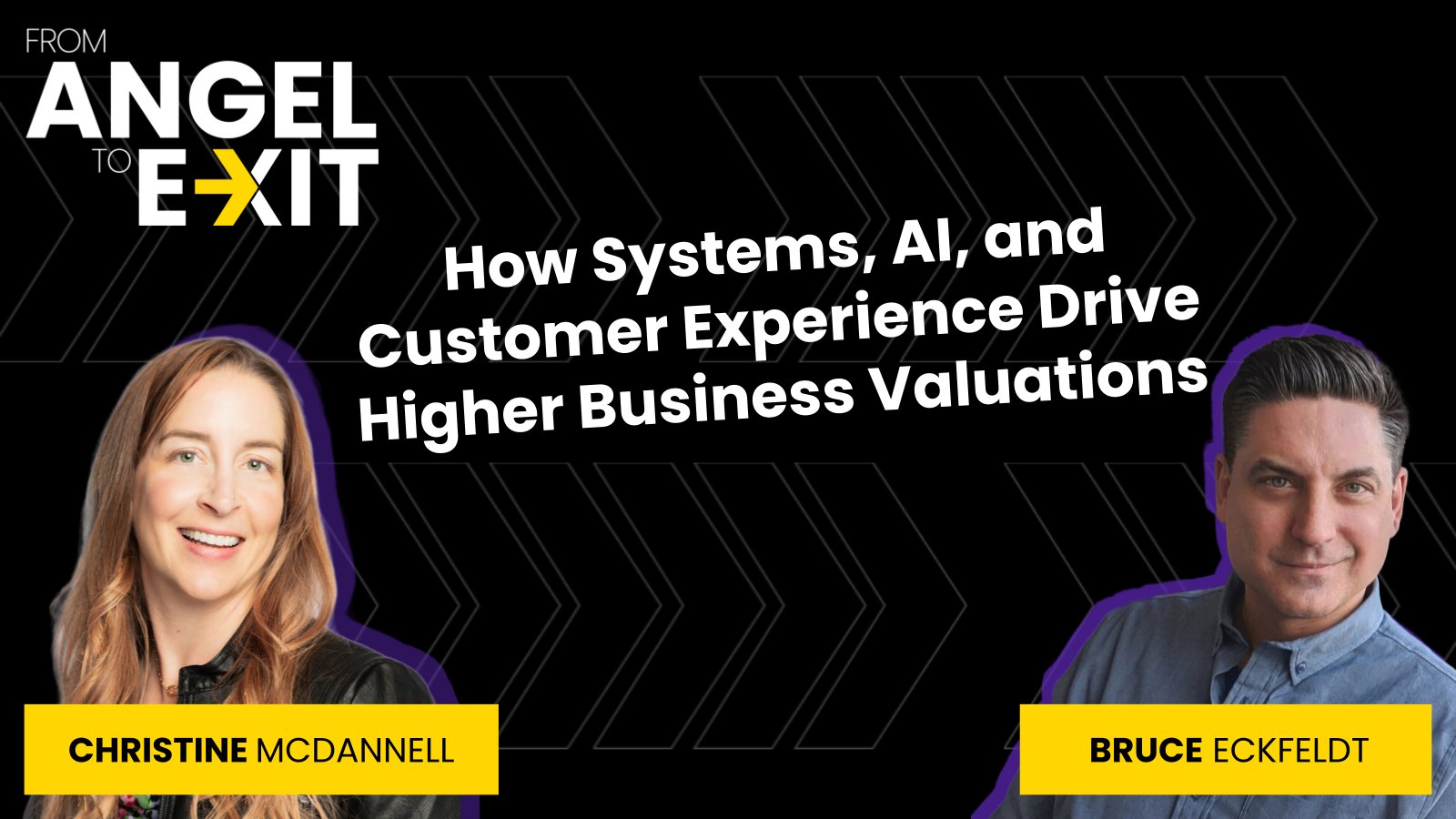
How Systems, AI, and Customer Experience Drive Higher Business Valuations
Christine McDannellFounder, The Magnolia Firm
Listen to the Episode.
Play the full conversation right here, or pick a chapter to jump straight to that moment. Prefer your own app? Every episode is on Spotify, Apple Podcasts, and the rest.
About This Episode.
Start with the key takeaways, the ideas worth bringing back to your leadership team. Then read the full story of the conversation, or use the chapters above to jump straight to the moment that matters most to you.
- Build businesses that operate without the founder to maximize exit value.
- Customer experience and company culture create long-term competitive advantages.
- Documented systems dramatically improve operational efficiency and buyer confidence.
- AI is rapidly changing valuations across service businesses and digital agencies.
- Founders often underestimate the emotional impact of selling their business.
- Bootstrapping teaches capital discipline that often creates stronger companies.
- Operational improvements before selling can significantly increase buyer interest.
- Planning your next purpose before exiting helps avoid post-sale depression.
What makes a business truly valuable to buyers? According to serial entrepreneur and The Magnolia Firm founder Christine McDannell, it isn't just revenue, it is how independently the business operates without its founder.
Christine shares her remarkable entrepreneurial journey, beginning with a $300 house cleaning business that grew into San Diego's largest privately owned cleaning company before being successfully sold. Since then, she has launched ten startups across industries including wellness, luxury automotive, technology, SaaS, digital marketing, and business brokerage, giving her firsthand experience on both sides of acquisitions.
Throughout the conversation, Christine explains why founders should focus less on their eventual exit price and more on building exceptional businesses. Strong customer service, documented systems, repeatable processes, company culture, and leadership teams consistently increase both operational efficiency and buyer confidence.
Bruce and Christine also dive into one of the least-discussed aspects of exits, the emotional transition. While many entrepreneurs expect financial freedom to solve everything, Christine explains why founders often struggle after selling because their identity and purpose become deeply connected to the business. Having a meaningful next venture can make all the difference.
The discussion also explores current trends shaping today's M&A market. Christine shares how artificial intelligence is rapidly changing buyer expectations, affecting valuations across service businesses while creating new opportunities for founders who successfully integrate AI into their operations. She also discusses common valuation mistakes, why many owners overestimate their company's worth, and why operational improvements before going to market can significantly improve outcomes.
Whether you're years away from selling or actively preparing for an acquisition, this episode provides practical insights into building companies that buyers genuinely want, and preparing yourself for what comes after the transaction.
Watch the Video.
Prefer to see the conversation? The full episode plays right here on the page, so you can watch while you follow the takeaways or read along with the transcript. Every episode of From Angel to Exit is also on my YouTube channel, along with short clips from each conversation.
About the Guest.
The background behind the conversation, and where to find this guest online.
Christine McDannell
Founder, The Magnolia Firm
Christine McDannell is a serial entrepreneur and the founder of The Magnolia Firm. She helps founders build companies that run without them, so they are worth more to buyers.
- Website
- themagnoliafirm.com
Full Transcript.
The complete conversation, lightly edited for readability. Open it to read along, or search the page for a topic or a name.
Read the full transcript
Bruce EckfeldtWelcome, everyone, to From Angel to Exit. I'm Bruce Eckfeldt, I'm your host. Our guest today is Christine McDannell. I'm excited for this. Christine has had several businesses and has been involved in several projects over the years. She has a lot of experience in this area, and I'm sure she has a lot of good stories. She's also working a lot with founders and entrepreneurs in the process, so she has a lot of insight into the market, what some of the challenges are, and some of the things founders run into. So I'm excited to hear her stories and her advice. With all that, Christine, welcome to the program.
Christine McDannellThanks for having me, Bruce. Super excited. I haven't been on a podcast in a bit, so this will be fun.
Bruce EckfeldtGood to get you back in. Before we dig into all the business stuff, I'd love to hear some personal background. How did you get into business? Tell me the backstory.
Christine McDannellGirl with the lemonade stand, for sure. Girl selling the candy bars out of the backpack and getting in trouble. I was born to be an entrepreneur. I started my first company at age 23, and that was a house cleaning company, with $300, because I had a bunch of debt. I bartended at night and cleaned every single day for a year and a half, the high-rises in downtown San Diego. That was my start.
I got my real estate license right out of high school, so I skipped the college thing and saved my dad a lot of money. He was a blue-collar worker. He had an HVAC company of his own, and he would have gone into a lot of debt. I was 16, a junior in high school, and I said, "Dad, save your money. I'm going to be successful without going to college." Luckily, it worked out.
Bruce EckfeldtI love it. Did you have any role models or early influences on entrepreneurship and being a business owner?
Christine McDannellFor sure, my father, in the sense of how hard a worker he was. How disciplined. Out the door at 7:00 AM every single day, fixing air conditioners in 100-degree weather where I grew up. So for sure, I modeled that. He didn't teach it. It was funny. It was just from him modeling it, I guess, and that's huge. My work ethic came from there.
He was self-employed, so even as a kid I'm like, "Dad, hire employees. Dad, get a big billboard." He never wanted to go big, ever, so he was just self-employed. He ended up having a few employees towards the end. But I wouldn't say he was an entrepreneur, to be honest. I'd say he was self-employed.
Bruce EckfeldtThere's a big difference. Tell me a little about the first business. Why cleaning? Did you see an opportunity? Was something presented to you? Why get into that business?
Christine McDannellI was still in high school doing property management, and right when I turned 18, I got my real estate license. So I was in real estate and property management until I was 23, and I could not work for others. I could not work in corporate, and I haven't since. Everything was so inefficient, and I'm always looking for efficiencies. I'm trying to fix systems, and you can't. It's just, "Nope, corporate says we have to do it this way." I'm like, "I can't deal."
Again, I had no money, so it was: what kind of company do you start with no money? I still remember sitting in the car downtown, looking around at these huge high-rises being built in 2003, and I was just like, "Who's going to clean all these?" So I hired two women who only spoke Spanish, and I only spoke English, and that was fun. Of course, I had to learn Spanish very quickly. The three of us went and cleaned every day, and then I grew it into the largest privately owned cleaning company in San Diego after five years, and then exited it and started the next company.
Bruce EckfeldtWhen you started the company, was the ambition, the goal, to exit? Did you have timeframes or dollar amounts? I'm curious about that vision.
Christine McDannellGreat question. I'm so lucky that I naturally have this big imagination. It's insane. When I'm cleaning these toilets, I'm not thinking, "Oh, this sucks, cleaning a toilet." I'm thinking, "I'm going to build the largest cleaning company. I'm going to have a team. I'm not going to have to clean. I'm not going to have to work." And at the end, that was the case. I had a manager in place. I just did the marketing, because that's my favorite hat. I barely worked any hours towards the end.
So there's never been a timeline for any exit I've had of my own, and there's never been a dollar amount. It's when I'm over it, when I'm ready for the next company. And I usually dovetail it, so I'll start the next one before I even exit. That's my excitement.
Bruce EckfeldtI love it. I envision the spreadsheet you had of dollars per toilet and toilets per month, for how you're growing the business.
Christine McDannellIt was 37 employees at the end of the day, when I exited. What was funny is that I actually wanted 60. I had the number 60 employees in my head for some reason, but 37 was plenty.
Bruce EckfeldtIt's funny, the metrics people use for business growth or business objectives or milestones. I find every business has a different unit they use to scale the business or talk about where the business is in terms of size. Tell me about that exit. Was it an easy process? Was it hard? Did you have to find a buyer? Did the buyer come to you? What was that first experience like?
Christine McDannellGreat question. I did have a broker on that deal, because I genuinely thought you had to have one to sell a company. I was in my 20s, and I'm like, "I don't know what to do." He was decent. There are a couple of things I definitely would have done differently. They're always trying to pressure you to lower the price. I said no. I got a lowball offer. He told me on the phone, and he said, "Well, I'm going to fax it over." Fax, back then. I'm like, "Don't waste your time. I'm not taking it. It needs to be full price."
And then the biggest mistake: we put 90-day training in there, and he said, "Oh, Christine, they're never going to take it. You'll be out the door in two weeks. You have a manager, you're never there. You don't need training, and the manager's going to stay." And I'd already started the next company. And what do you know? That buyer, a first-time buyer who came out of the mortgage industry, wanted all 90 days, full time. So we had to renegotiate that, and I'm like, "Oh, why was that in there?" For my clients, I never put that in. It's two months max, and it's a block of hours the person can use whenever they want.
Bruce EckfeldtWhat were your learnings from that first business that you applied to the second business? Any big, "I'm not doing this again," or, "I've got to make sure I do this again"? What were the takeaways from that experience?
Christine McDannellI've been really lucky. I've read so many books and studied so much: customer service, all sorts of things. Pour Your Heart Into It is probably my favorite book. That's Howard Schultz, Starbucks. I met him in person about five years ago, and I was a little starstruck. I ran up and told him how that book changed every company I had, especially my first.
Customer service is huge. I've got to get five stars on Yelp and Google for every single company I've owned, and they've mostly been service businesses, B2C. So that was big: customer service, your team, your culture. And that was before the trend of "culture's important." It wasn't back then, but it was important to me. So it was: your customers are not always right. You've got to have your employees' backs. They're right. I have crazy stories where I was like, "That's not cool. I'm going to call the client." And the girls were like, "No, it's okay. It's okay." I'm like, "It's not okay. I'm calling. I'm firing them."
Bruce EckfeldtTell us about the business after that. You said you dovetailed it. How did that play out?
Christine McDannellI did a social media firm right after, in 2010, when Facebook was a fad. We were selling to business owners, and B2B is very difficult for me. I'm usually not a fan. I started it with a boyfriend at the time. He had a horrible job. I could hear his boss screaming at him on the phone, and I'm like, "You've got to quit. You've got to get out of there. I could just whip up a new company. Let's do tech. Let's do social media." It was very hard back then. And it's very hard to do with a boyfriend. I've had a couple of businesses with boyfriends.
Bruce EckfeldtOh, yeah.
Christine McDannellSo the joke is, "If you date Christine, at least you end up with a business out of it."
Bruce EckfeldtYou put that on your profile.
Christine McDannellI should, maybe. I think it's been three times total, and those businesses never worked out. I've had 10 startups total. Any partnership is very difficult. So I gave it to him. I just said, "Give me 10 grand. I can live on that for a couple of months," which was not fun in San Diego, because I was not living on that before. I had a lot more. He still has the business to this day. He's so grateful. I've heard him speak about it on podcasts, and I'm like, "Oh, that's nice." He gives me so much credit, and he shouldn't, but he has it.
So then the spa was right after that. I was like, "Give me 10 grand, I'll live on it, and I'll start a business from scratch." And I actually sold $15,000 worth of spa memberships before signing the lease on the building.
Bruce EckfeldtInteresting. Tell me about that. Was that a strategy? Was that just necessity in the situation?
Christine McDannellI have an amazing business mentor, Henry Evans, who's been my mentor forever, since 2010. He gave me the idea. And again, that was before memberships, before the Massage Envys of the world. There was no such thing as a wellness spa doing a monthly membership and an annual membership.
Bruce EckfeldtInteresting. What's the through line in some of these businesses? You said a lot of them are service-based. Is that just because you're focused on customer service? What has been your guiding principle as you've looked at these businesses?
Christine McDannellI love customer service. I know not many people do. I love sales and customer service and marketing. Those are my hats. Every single business was a need in the marketplace that I saw wasn't being met. Every single one. The wellness spa, again, was before the trend of wellness. Colon hydrotherapy was what we built the spa around. There wasn't anything spa-based for it. It was a very clinical setting for that treatment. And then we did infrared saunas. Nobody knew what that was. So it was a lot of education in 2012. We did organic skincare. We did massage. We did a French-themed spa. A lot of spas back then were Asian-themed, especially in San Diego.
So with every company, every single one, I'm like, "Why isn't there a cleaning company that's pet-friendly?" So we'd bring little doggy treats. We'd let people leave their pets at home. One that used green cleaning. It was called Cleanology. Each one has been so fun.
Bruce EckfeldtAs you've started these businesses, what has your approach been in terms of how you've set them up or run them, relative to the exit? Are there any learnings, habits you've built, or strategies you've used to start the businesses in a way that makes them easier or better to exit from eventually?
Christine McDannellGreat question. It's funny, each one seemed to follow about a five-year trend, and I know why. At that point, you've got a team, you've probably got three managers. It would take about five years, for me anyway, because I'd bootstrap, to get it so dialed that they didn't need me anymore. I remember I went to Europe for a month, and that's when I came back and listed Eco Chateau for sale, because they had their biggest sales month, which I was bummed about, because I'm such a salesperson.
Bruce EckfeldtI want them to be independent, but I hate it when they do well without me.
Christine McDannellRight? They broke the 100 grand mark that month, which was a big deal. I was in Europe for the month, and my friend was like, "This is the part every business owner wants, and you're sad about it." And I came back and listed it.
So the thing I've carried, that I want the audience to hear, is that I was really good about never thinking, "I want to exit for this dollar amount." Of course you build a company with systems in place so you can exit. It was Christine's Cleaning Service in the beginning. Nobody's going to buy that. So we rebranded.
Bruce EckfeldtWell, except another Christine.
Christine McDannellExactly. Great point. So we rebranded. I always said, "Okay, I can't wrap the business around my face." Even with The Magnolia Firm, if you look, it says I'm the owner, but it's not wrapped around me personally. That's huge. So it was really great. Everybody, this is where you concentrate: building an amazing company with an amazing reputation, systems, team, and culture. Please just do that, because I'm seeing too many founders focusing on the exit, and that's just not going to get you through every single day.
Then, when I had my tech company in 2018, unfortunately I was dealing with investors. When you're raising capital, you have to have that exit in mind, because they care about that. So I did get distracted with that, which was unfortunate, because I knew better. But in the tech world, all anybody talks about is their exit.
Bruce EckfeldtThere are a couple of things in there I wanted to get at. One is systems and processes. What has been your strategy for developing those? I always find there's a bit of a balance. You don't want to overburden the company with processes and bureaucracy, where everything has to be a checklist and you can't do anything without going to the document. But on the flip side, you need some standards. You need repeatability. You need a process you can improve on. How have you found the balance? Are there any techniques that tell you where you are on that scale and keep you centered?
Christine McDannellI know. Now I'm jealous, because I had all those years when it was such a hard process to create these SOPs, standard operating procedures, and these playbooks manually. We were really good at it, and we still are. One of my team members is working for my friend's brokerage simultaneously. We're really good friends. And he's like, "He doesn't have a playbook," but my friend says, "We have a lot of systems in place."
My playbooks are written. This was always my rule of thumb: you need to write the playbook as if a 10-year-old would follow it, genuinely. Back in the day, it was these huge binders. I gave that to the new owner, and that was a game changer, that I had that. I'm jealous now because of Claude.
Bruce EckfeldtYeah, exactly.
Christine McDannellIt's so easy. Record with Granola, get all our steps recorded, put the transcript into Claude. It's a piece of cake now.
Bruce EckfeldtThere's no excuse.
Christine McDannellNo, zero. And if anybody listening wants, I can show you how you would do it.
Bruce EckfeldtThat's a key one. I want to go back to another one you mentioned, which is a little more subtle. You were in Europe, you had your best month ever, and there was some discomfort with that. There's this identity connection, this fusion with the business. I think a lot of entrepreneurs struggle with this. They do want independence. They don't want their company to need them, but they also want their company to need them. How have you navigated this? When has it come up for you, and how have you navigated this personal attachment to the business, either during the growth process or during a sale?
Christine McDannellYes. We're doing a LinkedIn Live soon with Nancy, who's an amazing therapist, a PhD. She's incredible. She coaches my clients, because my clients get very depressed, and it never hits them until a month later. They swear it's not going to happen. "No more employees. No more stress. A bunch of money in the bank. I'm going to be retired." A month later, they get super depressed because they've lost their purpose, and their business was extremely tied to their identity. For some of them, it's been 10 years, 20 years. You had all these people coming to you for answers, and they looked up to you.
For me, I'm lucky enough that I'm dovetailed into the next venture. I have my next purpose. Honestly, I've never gotten depressed after any of the businesses I've exited. But you're right, there was a little bit of that: I was needed, and then I wasn't needed. It was weird. It was like, "This is great. This is amazing." But I was sad for some reason.
Bruce EckfeldtI think we are purpose-driven creatures. We want to have things to do. We want to have an impact on the world, and business has become a huge tool for that. When we either get ourselves out of the business from a day-to-day point of view or actually sell the business, this is a pretty common story for entrepreneurs. And honestly, it doesn't matter how much the money is. I've talked to people who've had hundreds of millions of dollars in exits and still end up facing the same thing. It's not like enough money will solve it. In fact, enough money probably means you were so committed to the business that it's even more of a transition for folks.
Christine McDannellExactly. And what I'm saddest about still, and it's been over a year now, is that the husband and wife who bought Eco Chateau in 2017 closed it last year. They fired everybody, and they didn't call me, when I so easily could have either rescued it myself or found somebody to take it over. He just had too much pride, is what I hear, to call and tell me, and they completely shut it down. That was last May. It's still upsetting me. I have dreams about it.
Bruce EckfeldtThe attachment continues. Was it just business performance? Do you know what happened?
Christine McDannellI get the scoop, because I'm still friends with the girls and with the manager. I guess it was overspending: vacations, new cars, et cetera. He opened a third location, and he walked me through it. He showed it to me, and the rent was probably astronomical. It was in a retail center. I would never do that. So it was a bummer.
Bruce EckfeldtI hate to say it, but I use this phrase: when someone buys your business, they buy the right to run it into the ground if they want. You do have to let go of it, and unfortunately, that's not an uncommon story. Sometimes businesses do not survive post-sale. Give us some of the other examples of businesses you've done, and some of the stories.
Christine McDannellA luxury car rental business, but that was my hobby business. I call it a hobby business when it breaks even. That's a hobby. I love cars, and I've bought a few amazing cars, especially when I exit. So we got a bunch more, and we started renting them out in San Diego. It's great networking, too, especially exotic cars. That was a fun business. It dovetailed out of the spa, because again, I wasn't working much and I had money, and I'm like, "Let's do something else."
Then I went into tech, and that was the hardest three years of my life. We got into Techstars Amsterdam, which was amazing, about four months in, so I got to live in Europe. That was amazing, but it was 90-hour weeks. It was crazy. It was a real estate SaaS platform for the co-living industry. I published the first book in the space, and I was speaking, and I became an influencer, and I did not want to be an influencer. I prefer to be behind the scenes. That was Kindred.
And that buyer didn't do anything with it either. It got acquired in 2021 by a company out of LA, and they sat on it, and now the website and the domain are gone. I'm like, "Oh, I hate when that happens."
Bruce EckfeldtAgain, you sell it, and they do whatever they want with it at that point. They own it. There was a little bit in the story there about selling the business and having the cars and flipping into the exotic car rental. I sometimes find that when entrepreneurs start their first company, it's very scrappy. They're often doing it without much money, or they really have to take some risks to do it. The second time, a lot of times they've got some cash, and that's a very different situation in which to start companies. Have you noticed a difference in how you approach it, or in the challenges, when you've had some success and have some capital to start the next company? Has that changed what you've started and how you've started it, versus the scrappy, "I've got $300 and need to figure out how to make a company around it"?
Christine McDannellAmazing question. I love bootstrapping, and I've learned it the hard way, when I didn't do it once. I just love it, and I purposely do this weird thing where I'll have a bunch of money and then I just load it into the company, and I have zero dollars. I love the climb. So if I'm at the top of the hill, I'll purposely wipe out and put the money into the business, or start a new business and put it all in there.
I've done that both ways. I sold the cleaning company for six figures and then dumped a bunch into a social media company. All I needed was a laptop. Why did I spend all that money? I just blew so much money. I made so many bad mistakes wasting money. So I prefer to bootstrap, to be honest. With the tech company, I sold the spa, dumped all the money into the tech company, and then raised capital from others. It made it easier to raise capital, because I had such a big chunk in. But again, I probably spent more, and spent it less well than I would have if I'd bootstrapped. So each time, I bootstrap.
And then starting a brokerage firm, because now we're leading from the tech company to the brokerage firm. I'm sure I forgot a couple of businesses in this whole 23-year journey, because I've done a lot of acquisitions too. I've done a lot of roll-ups. I bought three other spas and rolled them in. I bought two other cleaning companies and rolled them in. I love grabbing market share that way. I could get killer deals grabbing companies that way.
So tech, and then leading to the firm, and with the firm, you need zero money to start. A brokerage firm, you're just... I did my first deal and got a big check. So it's been fun to start a business where you don't need capital.
Bruce EckfeldtI do find there are really two different situations, and oftentimes two different entrepreneurs. Scrappy, bootstrapping entrepreneurs just think differently. They see different opportunities. They find leverage in different ways, versus entrepreneurs who raise a bunch of money. Sometimes, if I've got a lot of money, it means I need to spend a lot of money. That's not necessarily always the case, but there's certainly pressure to deploy capital.
Tell me a little about the acquisition side, because I always find that interesting. When you acquired companies, you talked about market share, but was this a strategic growth strategy versus organic growth? How did you make these decisions? How did it come up? And what did you learn being on the acquiring side of these deals, after being on the sell side?
Christine McDannellI defend. I don't do earn-outs on any of my own deals. It's cash up front. So I defend my sellers like you wouldn't believe, as if it were my own deal. Because I've done it, I know I can do it for them, to the point where I'm trying to negotiate more money for them, and they're even saying, "Christine, it's fine. It's fine. Leave it." I'm like, "No, guys, I can't sleep at night if I know there's still money on the table."
Same with the training. Like I said, it's very minimal training, especially if my owner is not... I can justify it: "My owner is working five hours a week. They don't need to train you forever." And we put in this great clause that if it goes beyond the hours, beyond the time period, then it's a $250 an hour consulting fee, so my owner's protected and not getting harassed forever. And they still want to be a resource. They're not going to ride off into the sunset. So if you need them for a quick question, sure. Same with my businesses. That owner would call me even two years later, and I would always call him right back.
So those are some lessons. I'm going to defend. I don't want earn-outs. They're so risky for my owner. I think I've only done it once. A seller carry I'm okay with, with a personal guarantee, but only up to 20% of the purchase price, and again, only if they're paying full price, or if my owner would have walked away with less anyway. Then it works. So those are some strategies where I'm coming up to bat for them and protecting them.
Bruce EckfeldtGive us the last couple of years. Where have you focused? I know you're working with a lot of entrepreneurs now, helping them with their businesses and the exit process. What has your focus been? What types of companies have you worked with?
Christine McDannellIt's been so much fun lately, because now I can jump in and do actual exit consulting, go in there and fix things. Unfortunately, some businesses are just coming down. So it's: let's get in, let's start fixing things with AI. Let's offer AI services. Let's add it on. If you're an SEO company, and there's one I'm speaking with, actually a couple, can we add on AEO and GEO, which is what's being used right now by the LLMs?
The last five clients we've had coming in, and these are great companies, found me on Claude. They found me on GPT. That's literally my number one source. We put a lot of work into the back end. That's why it's working. So those are some trends I'm seeing right now.
But the exit side, me helping them with their company, I have the bandwidth right now, so it's fun to jump in and really make big changes within three months, six months. Fast. Let's fix it real quick. Let's hustle for three months, and then boom, put you on the market. But we've got to get this trend up. I won't take a business on a downward trend. I cherry-pick my listings. I only take five at a time. Sometimes I'm on a wait list. But usually it's mainly tech companies. Again, I'm passionate about service-based businesses, but I'd just rather sell tech, for sure. It's much easier.
Bruce EckfeldtWhy? Because the buying side is out there, there's demand, and they know how to do it?
Christine McDannellYes. I have a massive database of buyers waiting on unprofitable tech companies. Anybody listening, come to me. I've had five offers on every listing lately, so that's four people who lost out, who have money, and who are waiting. The biggest thing is the buyer pool. If I take a brick-and-mortar, which I've done a couple of times and regretted each time, say a San Francisco brick-and-mortar business, the buyer pool has got to be near San Francisco. With a tech company, they could be international. They could be anywhere in the US, and they always are. One's in one state, one's in another.
Bruce EckfeldtWhat are people wanting to buy? What have you noticed on the demand side in terms of the types of companies they're interested in? What does the profile look like?
Christine McDannellWhen I started my firm five years ago, it was big time digital marketing agencies. Digital marketing agencies were hot. People were doing roll-ups. You'd have an SEO company and a website development company and so on, and you could just roll them up if you wanted to.
That is totally different now. Now those buyers are coming to me to resell the businesses. SEO is a great example. That's one of them. A website development firm, and they added SEO after they bought the business, which is great. And I'm like, "Please just offer these AI services." And they're doing it, which is great. If I can say AI in the ad...
Bruce EckfeldtOh yeah, I know. It's a little absurd right now.
Christine McDannellI sold some a couple of years ago, and the second I could put AI in the title, "This is a company offering AI," or "AI-enabled," blah, blah, blah, they would just sell. So it's, "Okay, guys, let's coach you through this. Let's get that done." Website development, phew. I've coded. I made a beautiful website for my AI implementation club. I run an AI implementation club here in Austin, for fun, and the site I made is insane. It was so easy with Claude Cowork. It's insane.
Bruce EckfeldtIt is pretty absurd. What have you noticed about who's wanting to sell? Why are they selling? Any trends or themes you see in the market?
Christine McDannellIt's been this way for the five years. Usually they're either starting their family, because a tech founder is typically in their mid-30s, or they already have little ones and really want to be home more for the kids. That's probably the number one reason, believe it or not. Or they're pregnant. One we sold, she said, "Is there any way you think we can close before I have the baby?"
Bruce EckfeldtGet it done in nine months.
Christine McDannellYeah, and we did. She was already six months along, and she asked, "Can we close?" And we did, a month before. I can sell them quickly, luckily. And again, that's because I only take five at a time. I have friends who have 20 listings and can't sell a single one, because they're all over the place.
Bruce EckfeldtYou don't have the concentration to be able to hit the demand side.
Christine McDannellExactly. Another trend, obviously, is starting their next venture. That's a big one. And another trend I'm seeing right now, unfortunately, and it even happened yesterday, so I'll talk about it, is that they're doing their own valuation. They're going to an LLM like GPT or Claude to do their valuation. Super smart. I would do the same. Do it. Go for it. But please contact us. After this happened yesterday, I said to the team, "Can we just give out a prompt, our skill, on how to do their valuation?" Because it wants to make you happy, of course.
It valued a business with $150K net at $6 million. I had a Zoom meeting set up, and I had to tell them in advance. I said, "I don't want to say your baby's ugly." Well, first I said, "Do you own the real estate?"
Bruce EckfeldtYeah, exactly. How much is your real estate worth? $5.5 million in real estate and $500,000 in company valuation.
Christine McDannellSo they didn't. I said, "How much equipment? How much real estate? Where did this number come from? I have to tell you, this is the multiple it's going to be. Before we get on a Zoom and I tell you to your face, I need to tell you right now." I did that, and that was a month ago.
They used Claude Cowork to get it, and they sent me the report. What Claude Cowork was valuing was so far out. I've never seen anything like it. It was valuing each team member's annual salary and adding that to the value of the company. Have you ever seen that?
Bruce EckfeldtNo, I haven't seen that happen.
Christine McDannellNo. And there were other weird ways it came up with it. So we rewrote it, and they laughed. They said, "We get it. We get it. Okay, here's what it's really worth," which is not a lot. Under a million. So they got it.
And then yesterday there was another one: $250K net, "I want $5 million." Straight up, I said, "Hey, did you plug this into AI?" She said, "No, I came up with the number. If Elon could get a 90x multiple, we can get a 10x." I'm like, "This is a service-based business. It's not software."
Bruce EckfeldtWhat else do you notice sellers are unprepared for or don't think about, when they come to you and you have to do a little education with them?
Christine McDannellThis is contrarian to everybody else. Again, because I move fast, I just want to get to market and fix this thing. If their finances are a mess, I see advisors saying, "Oh, we need one to two months. We need this much money to fix your finances," and this and that. We're going to do it fast. They definitely need fixing. I have yet to see a founder who has super clean books. You laugh, because you know. It doesn't matter how good their CPA or bookkeeper is. And then we're going to recast with the add-backs, of course. So I have no problem immediately jumping in and fixing their finances. And they're always embarrassed. Don't be embarrassed. No entrepreneur likes bookkeeping.
Bruce EckfeldtExactly. If your books are perfect, then something else is wrong.
Christine McDannellThat's true.
Bruce EckfeldtIt probably means you weren't focused on the right thing at some level.
Christine McDannellExactly, and that's me too. I have a great bookkeeper, but I was three months behind reviewing my QuickBooks each month, because I'm selling. That's all I care about. So that's a big trend.
What else are they fixing? The face of the company. That's one recently, where the founder was all over the website and the business was so wrapped around them. I'm like, "Take your face off the website. Let's strip you out of the business as fast as we can." That's a big one. I think those are the two biggest things a buyer is just going to balk at.
Bruce EckfeldtIn terms of the deals themselves, what have you noticed in terms of particular buyer demands or seller demands that make deals complicated or problematic? Where are the challenges in the sale process right now?
Christine McDannellLet me see. Non-competes can be really sticky, so we're actually doing them up front, which is great. I'm getting it in writing from the owner in advance, and we're putting it in the data room, so the buyer is super clear. In the Bay Area, there was a hair salon, and two days before closing, she obviously can't open another hair salon for three years. Okay, that's understandable. It can't be within this radius. Totally understandable. At the 11th hour she said, "But what if I want to work at a hair salon down the street?" Again, I'm a business intermediary. I'm looking at both sides. I was looking at it as if I were the buyer, and I agreed with him. Your team will move with you.
Bruce EckfeldtExactly. All your clients will just walk down the street.
Christine McDannellI know. So she walked away from all that cash. It was full price, all cash. It was overpriced. There's no way I could get that again.
Bruce EckfeldtThat's an interesting one. In those cases, what do you chalk that up to? Getting full value should be okay. Was she still attached to the work, still attached to the clients, still attached to the team? I find that founders who haven't really done the emotional and mental work to prepare for the sale will find all sorts of reasons to sabotage a deal.
Christine McDannellI've heard that. I keep hearing that. I don't think it was the case here. I think she wasn't super keen on the buyer. I think if it had been an incredible, perfect buyer, she would have been happy with it, because that was the original plan. She said, "I'll come back and work at that salon." She'd work for the new owner. That was the original plan, but then she was like, "Oh, I don't know if I can work for him."
He didn't have any experience in a hair salon whatsoever, and he put his house on the line. He took a second mortgage. So I was nervous for him. I thought, "Okay, this is not good." That's why, when it blew up, I was like, "It was probably for the best." So I don't think she was super attached. She wanted to have another child. That's why she was doing it. But then she wasn't sure. She was a little older, so she was unsure. She said, "What if I don't have another child? Then I'm going to want to do hair again."
Bruce EckfeldtI find that so much of this work, as advisors, is not just about the business and the finances of the business, but about the motivations. What does the seller ultimately really want to do? The more we can figure that out and have a clear picture of the post-exit life they want, the more it can drive the sale process: "These are the deals we'll take, and the deals we won't." If we can figure that out early, we can avoid some of these last-minute situations that can really sideline deals.
Christine McDannellI love that that's your work too, because we had talked before, and I love that that's what you come in and do: coach them so they're so excited about the next venture or the next adventure. I haven't had a single seller sabotage, luckily. Again, that one was a unique case. They're ready. When they come to me, they're ready, like, yesterday.
Bruce EckfeldtGood. And your focus going forward? Where do you see the market going? Anything interesting you're working on these days? What does the future look like?
Christine McDannellIt's sad that with so many businesses coming to me, I've had to say no. I've been a business owner for 23 years. I have a very blessed, easy life now, a very charmed life. I travel the world, I've lived overseas, and I don't work crazy hours. Again, I'm available. My clients can text me any hour of any day. They know that. But I don't work insane hours anymore.
As for the market, unfortunately, I'm seeing all these decreases in tech. I'm seeing their industries disappear. I'm having hard conversations. One person, 24 team members, a creative digital agency out of New York, with massive clients, six-figure clients, who are now using tools like Six Field and Remotion. These are big brands that are holding. They're in a holding pattern. She said it used to take three weeks to close them, and now it's going to take six months. They're holding out for six months because things are moving too fast.
So she has 24 employees and has to let 12 of them go. She's putting it off, and I'm like, "You have to rip the Band-Aid off." I had to let team members go last summer because of AI myself. I know it's hard. It sucks. Those are the trends right now. Otherwise, she's going to be out.
What's happening right now is that all the people I talked to a year ago, I said to them, "I don't want to be biased, but you've got to list now. You can use any advisor you want, because it sounds biased coming from me, but AI is going to take your industry over. I'm telling you." "No, but our clients love us." And those are the ones calling me right now. These same people are calling me right now, and I can't sell them.
Bruce EckfeldtThank you so much. This has been a pleasure. I really appreciate the time. If people want to find out more about you and about Magnolia, what's the best way to get that information?
Christine McDannellI live on LinkedIn, so Christine McDannell on LinkedIn. Otherwise, you can check out our website, themagnoliafirm.com. I'm happy to speak with you and happy to coach you through wherever you're at. I love reverse engineering exits. A lot of people do that with a price in mind: "Okay, let's see what we need to do now to get there." And then just the honest truth. I'm not going to BS you. I'm going to tell you the bad news. It sucks, but I have to.
Bruce EckfeldtReality is usually the best place to operate from. This is great. Thank you again for taking the time, Christine.
Christine McDannellOf course, Bruce. Thanks for having me.
Never Miss an Episode.
Know the moment a new episode goes live. Subscribers also get a say in future guests and the topics we cover.
Other Related Episodes.
More conversations that connect to this one. Or browse the full archive by topic or by guest.
Yarin Gaon
Why more products, customers, and revenue streams can lower value, and what to build instead.
Listen and Read
Rick McPartlin
Why buyers care where your revenue comes from, whether it repeats, and how the business can grow it after the deal.
Listen and Read
Dan Bauer
What makes a business valuable to a buyer, and the everyday decisions that quietly make an exit harder.
Listen and Read