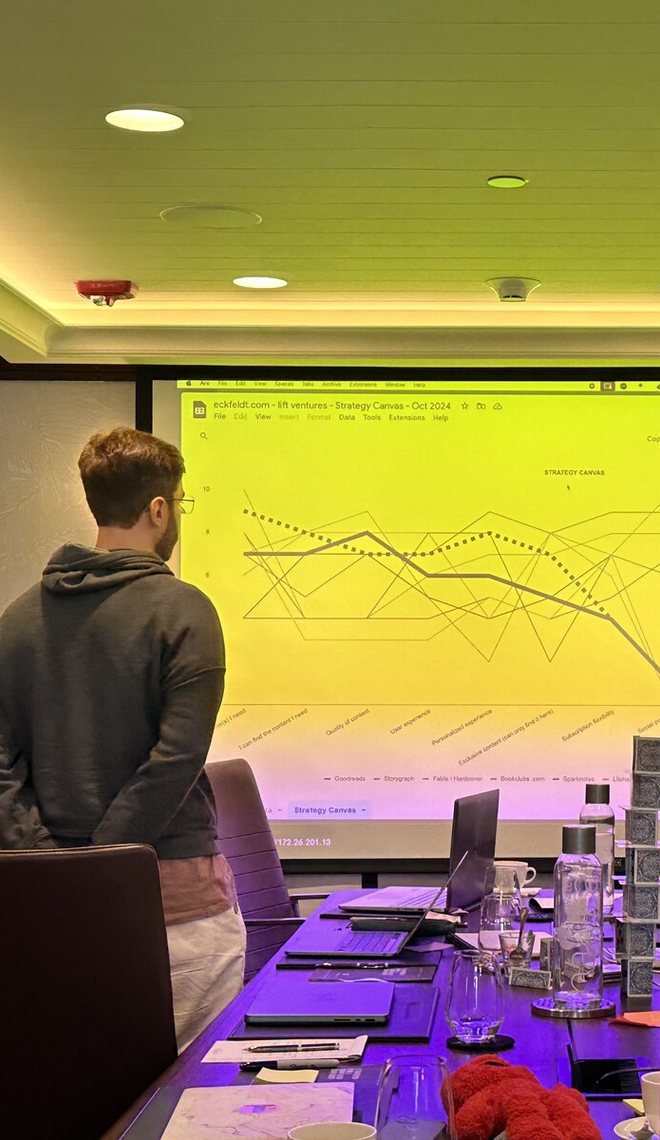
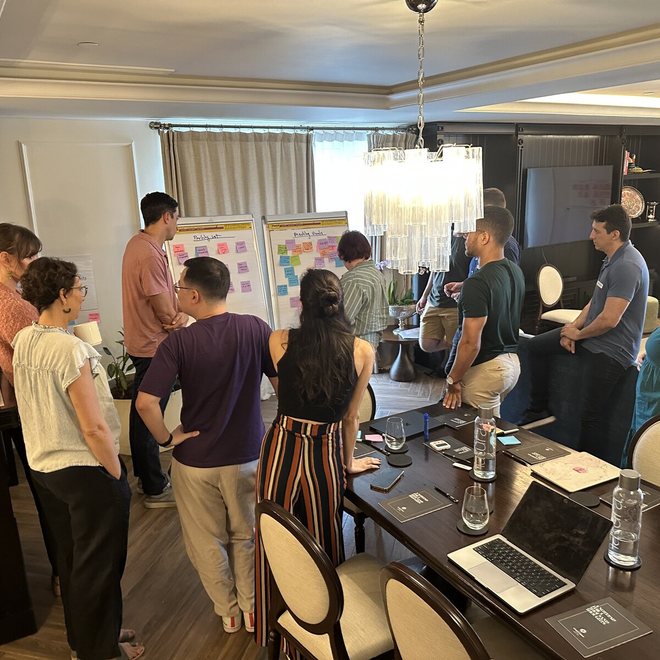
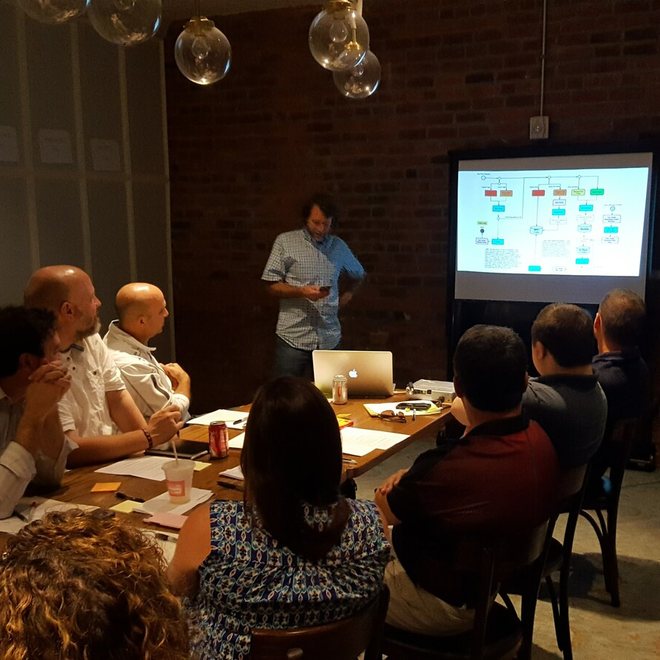
I speak to founder and CEO audiences on scaling past founder dependence, building a leadership team that runs without you, and getting the exit right on both the company side and the personal side. Most of my rooms are EO, YPO, Vistage and WPO chapters and forums, industry associations, growth conferences, and company leadership offsites. Nine sessions, three lengths, and I rebuild every one of them for the room it is going into.
Keynotes of 60 to 90 minutes, workshops of 2 to 3 hours, and full days of 6 to 7 hours.
Three Themes
Exit, value, and strategy, each available at every length and rebuilt for the room.
Preparation
A participant survey before every workshop, and interviews before every full day.
Signed Books
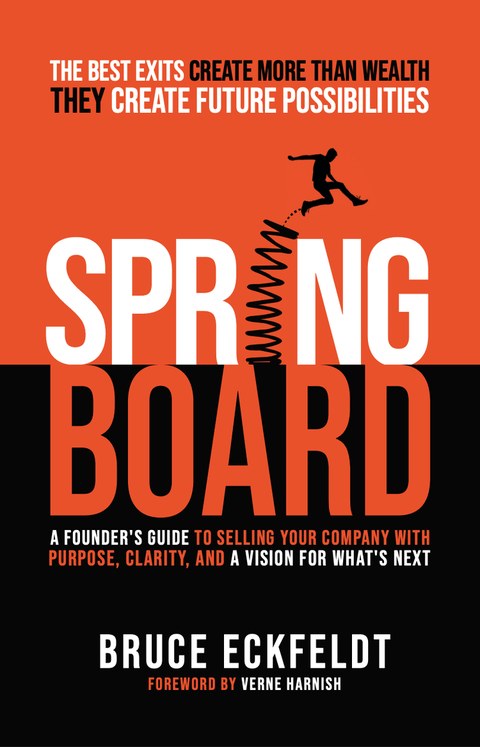
Thirty signed copies of Springboard come with every booking, included in the fee.
Speaking: Topics
Fifteen Topics, Three Categories.
The nine sessions further down are the packaged versions. Underneath them sits a wider body of material, and most bookings end up as some combination of it, shaped on the planning call. These are the topics I speak on, grouped the way I think about them.
Leadership
From Founder to CEOThe shifts in the job itself, and why the instincts that built the company stop working at scale.
Building a Real Leadership TeamWhy a group of strong managers is not a leadership team, and what actually closes the gap.
Right People, Right SeatsUsing behavioral and cognitive data to make seat decisions on evidence rather than on tenure.
Accountability Without MicromanagingScorecards, decision rights, and holding the line without standing over anyone.
Productive ConflictGetting the real disagreement into the room, settled, and out of the hallway afterward.
Strategy
Strategy Is a Set of ChoicesWhy a revenue target is not a strategy, and what a real one actually contains.
Picking a Core CustomerThe single decision that makes almost every other decision in the business easier.
The 80 Percent Confidence RuleA decision model for founders who either move too early or wait for certainty that never arrives.
The Twelve-Quarter RoadmapLong enough to matter and short enough to plan, and how the two ends connect.
Knowing What to StopWhy the stop list is harder to write than the start list, and worth considerably more.
Exits
The Exit Is Two JobsPreparing the company and preparing yourself, and why skipping the second one causes the regret.
What Buyers Actually Pay ForThe specific things acquirers discount, and what each one costs you at the table.
Founder DependenceThe largest single discount on the price, and the slowest thing to unwind before a sale.
Surviving Due DiligenceWhat gets scrutinized, what kills deals, and how to be ready before anyone starts asking.
Life After the SaleIdentity, purpose, and the calendar problem almost nobody warns a founder about.
If your room needs something adjacent to one of these, it is usually a question of framing rather than new material. Tell me what they are dealing with and I will tell you honestly whether I am the right person for it.
Keynotes, 60 to 90 Minutes
One Room, One Idea They Can Act On.
Built for evening chapter events, association breakouts, and conference sessions, in rooms from fifteen people to three hundred and up. I build a live element into each one, so the room leaves having produced something rather than having listened to something. The virtual version runs sixty minutes and works best under about forty people.
Exit
Springboard: How to Sell Your Company Without Losing Yourself
Most founders spend years preparing the company and almost no time preparing themselves. The result is a wave of post-sale regret that has very little to do with the size of the check. I reframe the exit as a launching point rather than an ending.
✓Why most post-exit regret is a readiness problem, not a valuation problem
✓How to recognize the identity trap that keeps founders in too long, or pushes them out too fast
✓A scored view of your own exit readiness, completed in the room
The room leaves with a number on themselves, which is not a conversation most founder audiences have had before.
Value
What Buyers Actually Pay For
Buyers do not pay for revenue. They pay for revenue that keeps showing up after the founder walks away. I break down what acquirers actually value, where founder dependency quietly discounts the price, and how to run a company that is always ready to sell and never needs to.
✓The specific things acquirers discount, and what each one costs at the table
✓Where your company still depends on you, mapped honestly
✓How to build transferable value now without committing to a timeline
It works for a room that is nowhere near selling, because everything that raises the price also makes the company easier to run.
Strategy
Why Your Strategic Plan Isn't Working
Most strategic plans are not wrong. They are just disconnected from what the team does on Monday. I close the gap between the long-range goal and the actual quarter, using a planning rhythm built for companies that are past startup and still founder-led.
✓Why plans stall in the handoff from annual goals to quarterly work
✓How to set a long-range goal specific enough to change decisions this week
✓One quarterly priority, drafted with an owner and a metric before you leave
Everyone walks out with one thing written down that has a name and a number attached to it.
Workshops, 2 to 3 Hours
The Room Does the Work.
Built for chapter half-days, forum workshops, association learning sessions, and internal leadership meetings. Rooms of twelve to forty, with the sweet spot around fifteen to twenty-five, seated at tables of five or six. Every one of these runs on a pre-event participant survey, and I build the results into the session and show them live in the room.
Exit
Exit Readiness Workshop
A working session for founders who know a sale is coming in the next few years and have not yet done the preparation. Participants score their own readiness across both the business and the personal side, then find the gaps that would cost them the most in a deal.
✓A completed readiness score across business value, operations, and personal preparation
✓The two or three gaps most likely to reduce your price or kill your deal
✓Three specific moves to start on in the next ninety days
Best for a group with a real time horizon, where the abstract version of this conversation has already happened.
Value
Value Gap Workshop
Every company has a gap between what it is worth today and what it could be worth with the right work. This workshop finds it. Participants map their value drivers, locate where value is leaking, and leave knowing which fix pays back first.
✓A map of where value is being created and where it is leaking
✓Which value drivers acquirers weight most heavily in your category
✓A ranked list of fixes, ordered by payback rather than by effort
No exit timeline required, which makes it the easier sell to a room that is not ready to talk about selling.
Strategy
Strategy and Priorities Workshop
Teams rarely fail on effort. They fail on agreement about what matters most. I move a group from a long-range goal to next quarter's priorities, with owners and metrics attached, in a single sitting.
✓A drafted long-range goal the group actually agrees on
✓The few priorities that matter next quarter, and the ones to stop
✓Owners, metrics, and dates assigned before the session ends
Works for a peer group of founders each working their own plan, or for one leadership team working a shared one.
Full Day Programs, 6 to 7 Hours
A Day That Ends in a Plan.
Six to seven hours, for a company leadership day or a peer group cohort day. All three run on pre-work interviews rather than just a survey, so I can open the day on the real issues instead of spending the morning finding them. All three produce a written summary afterward with decisions, owners, and dates.
Exit
Exit Readiness Intensive
A full day for a founder group serious about a sale in the next few years. The morning is honest diagnosis across readiness, company value, and personal criteria. The afternoon turns that into a sequence, naming what to fix, in what order, on what timeline.
✓A complete readiness picture across the company, the deal, and the founder
✓Personal criteria for a deal, defined before anyone is at the table
✓A sequenced plan with a clear first ninety days
Built for a founder cohort of eight to twenty.
Value
Value Creation Day
A full day on the gap between what the business is worth today and what it could be worth. The morning maps value drivers and finds where value leaks, including the dependencies nobody wants to name. The afternoon turns that into a ranked set of fixes with owners and a timeline.
✓A clear picture of what the business is worth now and what is holding the number down
✓The dependencies, concentrations, and gaps that acquirers discount most heavily
✓A ranked build plan, ordered by payback, with owners and dates attached
Built for a single leadership team of six to fifteen, or a founder cohort up to twenty. No exit decision required.
Strategy
Strategy Day
A full day with one leadership team. The morning is an unflinching look at where the business actually stands and what the market rewards. The afternoon converts that into a goal, a short list of priorities, and the accountability structure to hold them.
✓Shared agreement on where the business stands, including the parts nobody says out loud
✓A long-range goal and the quarterly priorities that ladder up to it
✓Owners, metrics, dates, and the cadence that keeps them alive
Built for a single leadership team of six to fifteen.
Speaking: The Proof
What Organizers Say.
The people worth hearing from here are not the attendees. They are the chairs, the founders, and the executives who booked the session and had to answer for how it went. These are theirs.
"He kept the CEOs fully engaged throughout the session, encouraging them to think deeply about their businesses in new ways. As the WPO Chair, I found his preparation and communication leading up to the event made my role much easier."
Dr. Sandi WebsterWPO Chair
"He brought a wealth of insightful ideas, carefully tailoring the agenda and content to perfectly fit our team's unique needs. His practical advice and tools offered clear, actionable strategies that have already transformed how we approach key account management."
Nelson TepferFounder and CEO, ProCFO Partners
"I was initially concerned about whether our agenda could be meaningfully covered in a single session. Under his facilitation, we covered an astonishing amount of ground without feeling rushed, and the team left much more aligned, energized, and equipped with a road map for the future."
Troy PrinceFounder, Wall Street Bound
"He developed a comprehensive survey and took the time to meet individually with each of the participants. This thoughtful prep work not only helped him understand our unique strategic challenges, it also allowed him to establish rapport and trust with each of us."
Nelson TepferFounder and CEO, ProCFO Partners
"His approach created a safe space for addressing difficult topics, allowing us to have candid, necessary discussions that strengthened our alignment as a leadership team."
Mario IgnazzitoChief Product Officer, Dedagroup North America
"These tools, coupled with his facilitation expertise, ensured our leadership team was aligned and equipped to translate vision into action."
Paul RicciCEO, Best Egg
"He has a unique ability to get right to the heart of an issue and extract practical solutions."
Ren TuckerCEO, Maverick
"What surprised me about working with Bruce was how quickly we got to core issues and root causes."
Kelly FaetaniniFounder and Designer, Kelly Faetanini
"Bruce possesses a rare ability to cut through the noise and identify the core issues that drive, or hinder, business valuation."
Norman RosenbergCEO, Lutron Shades
Different rooms, the same pattern, a group that arrived skeptical about how much could be covered and left with something written down. These excerpts are the short version. The full recommendations, and more of them, are on LinkedIn in each person's own words.
Speaking: The Speaker
I Built It, Scaled It, and Sold It.
The point is not the resume. Your audience is not hearing theory. They are hearing what actually happened, including the parts that did not go well.
I trained as an architect at McGill, which is where I learned to trace a problem back to its real source rather than the place it happens to show up. That habit turned out to matter more than the drafting. I spent the decade after graduation in New York, leading digital product strategy and technology teams for brands including Motorola, WebMD, and Prada.
In 2003 I founded my own Lean/Agile software agency. It spent five consecutive years on the Inc. 500/5000 list, and I worked through every problem that comes with scaling a professional services firm. The leadership team that outgrows itself. The founder who quietly becomes the bottleneck. The plan that never survives contact with the quarter. I sold the company through an acquisition in 2013.
Preparing the company for that sale took years. Preparing myself took almost none, and the gap between those two numbers is most of what I have spent the decade since writing and talking about. It is also why my exit material is as much about the founder as it is about the balance sheet.
Speaking: The Book
The Book Behind the Sessions.
Springboard is the source material for my exit sessions and the reason most organizers reach out in the first place. It argues that selling well is two jobs, preparing the company and preparing yourself, and that skipping the second one is where post-exit regret actually comes from.
"Springboard is one of the most honest and strategically grounded books I've read on exits."
Shannon Byrne SuskoFounder & CEO, Metronomics
"All founders and business owners should be required to read Springboard. Far too often, they retire without a plan."
Bill SnowManaging Director, FOCUS Investment Banking
"This is not just a book about exiting a business. It is a guide for using an exit as a true springboard into a meaningful next chapter."
Gregg LedermanNYT Bestselling Author, Brand at Work
Thirty signed copies come with every booking, included in the fee. For a larger room, additional copies are available at cost.
Speaking: How Booking Works
From First Call to the Day Itself.
Every booking starts with a conversation rather than a contract. It takes three steps, and nothing about the day is a surprise to either of us.
01
Talk Through the Event
We talk through your event, who is going to be in the room, and what you actually need them to leave with, which is usually a more specific answer than the one people arrive with.
02
Shape the Session
From there we pick the topic and the length that fit, and I shape the takeaways around your group rather than the last group. A chapter of founders three years from an exit needs a different session than a leadership team heading into a planning year, even when the subject line is the same.
03
Settle the Details
Then we settle the practical side, the date, the format, the materials, and what happens before and after the session. You get a written outline ahead of the date, so nothing about the day is a surprise to either of us.
Common Questions
Questions Organizers Ask.
The practical answers chairs and event planners usually need before booking. Anything else is easy to cover on the planning call.
What topics do you speak on?
I speak on three themes for founder and CEO audiences: exits, company value, and strategy. Sessions cover preparing the company and the founder for a sale, what buyers actually pay for, founder dependence, building a real leadership team, and turning a long-range goal into quarterly priorities. Every session is rebuilt for the room rather than delivered off the shelf.
What session formats and lengths are available?
Every theme comes in three lengths: keynotes of 60 to 90 minutes, workshops of 2 to 3 hours, and full days of 6 to 7 hours. Keynotes include a live element so the room produces something. Workshops run on a pre-event participant survey, and full days on pre-work interviews. For podcast interviews and panels, the media kit has bios, topics, and headshots.
Can you speak at a virtual event?
Yes. The virtual keynote runs sixty minutes and works best for groups under about forty people, so the live element still lands. Workshops and full days are built for in-person rooms, where tables of five or six can do real work together. Whether a longer format can work virtually for your group is a question worth raising on the planning call.
What kinds of audiences do you speak to?
Most of my rooms are founder and CEO audiences: EO, YPO, Vistage, and WPO chapters and forums, industry associations, growth conferences, and company leadership offsites. Keynote rooms range from fifteen people to three hundred and up, and workshops from twelve to forty. Full days are built for a single leadership team or a founder cohort of up to twenty.
Do you travel for speaking engagements?
Yes. I am based in the New York City area and travel for in-person events. Travel and logistics get settled along with the date, format, and materials once we have talked through the event, and you get a written outline ahead of the day, so nothing about it is a surprise to either of us.
How much does it cost to book you, and how do I start?
Fees depend on the format, the length, and the preparation involved, and they come up in the first conversation once I understand the event. Every booking includes thirty signed copies of Springboard. To start, send a few details through the inquiry form or write to speaking@eckfeldt.com, and we will set up a short call.
Speaking: Book the Date
Let's Talk About Your Event.
Send a few details about your event and your audience. If email is easier, write to speaking@eckfeldt.com. It reaches me the same way.
Speaking Inquiry
Send me a few details about your event and your audience, and we will set up a short call to talk through what the session should do for the room.
Your Information
Your Event
I read every one of these myself and answer quickly on fit and availability, including an honest answer when I am not the right person for your room. Nothing here is a commitment, and plenty of these conversations end with a recommendation to someone else.