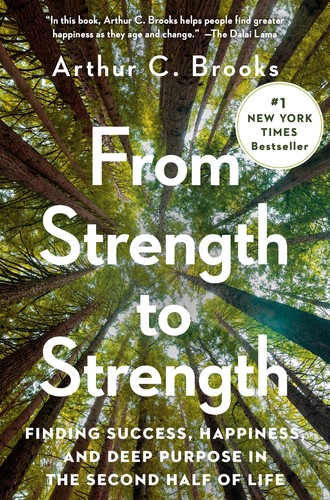
From Strength to Strength
Finding Success, Happiness, and Deep Purpose in the Second Half of Life
Decline in one set of abilities coincides with growth in another. The task of the second half of life is not to fight the falling curve but to move deliberately onto the rising one, which means trading raw problem-solving for wisdom, teaching, and love.
A book summary and review by Bruce Eckfeldt
Overview
From Strength to Strength argues that professional decline arrives far earlier than high achievers expect, that the pain of it is proportional to the prestige already won, and that the standard response of working harder guarantees misery. The book opens with a scene Brooks witnessed on a night flight from Los Angeles to Washington, DC, in the summer of 2012, shortly after his forty-eighth birthday. An elderly man of great public accomplishment told his wife he might as well be dead, then beamed minutes later when the pilot said he had admired him since childhood. Brooks calls the pattern the striver’s curse. People who work to be excellent find their decline terrifying, their successes increasingly unsatisfying, and their relationships thin.
The argument rests on Raymond Cattell’s distinction between two intelligences. Fluid intelligence, the ability to reason and solve novel problems, peaks early and falls from the thirties and forties. Crystallized intelligence, the ability to use a stock of knowledge accumulated over a lifetime, rises through the forties, fifties, and sixties and barely declines. Brooks argues that the career curve most strivers ride is the fluid intelligence curve, that bending it is nearly impossible, and that the available move is to jump to the second curve by shifting from innovating to teaching, synthesizing, mentoring, and counseling.
The book is built on nine years of reading across social science, brain science, philosophy, theology, and history, on interviews Brooks describes only as hundreds of leaders, and on his own decision to resign the presidency of a Washington think tank in the summer of 2019. Its prescriptions are subtractive rather than additive. Break the addiction to success, chip away at wants rather than accumulate achievements, contemplate decline directly instead of denying it, rebuild neglected relationships, start a spiritual practice, and share weakness openly.
Decline in one set of abilities coincides with growth in another. The task of the second half of life is not to fight the falling curve but to move deliberately onto the rising one, which means trading raw problem-solving for wisdom, teaching, and love.
Chapter Summaries
Chapter 1: Your Professional Decline Is Coming (Much) Sooner Than You Think
The opening chapter argues that decline in high-skill work is scheduled rather than distant, arriving for most people between the late thirties and the early fifties, and that the higher the peak the more painful the fall. Brooks names two mechanisms. The prefrontal cortex, the last brain region to mature and the first to degrade, loses effectiveness in middle age, which impairs working memory, rapid analysis, and creative innovation. Alongside it runs what he calls the principle of psychoprofessional gravitation, under which the agony of decline is directly proportional to the prestige already achieved and to emotional attachment to that prestige.
- Benjamin Jones of the Kellogg School of Management at Northwestern University studied major inventors and Nobel winners across more than a century and found the most common age of great discovery is the late thirties. Working with a coauthor on highly cited physicists, chemists, and medical researchers, he found the peak age since 1985 is fifty for physics, forty-six for chemistry, and forty-five for medicine.
- Dean Keith Simonton of the University of California, Davis, fitted curves to large data sets on creative and scholarly careers and found productivity peaks roughly twenty years after career inception. He also measured professional half-lives, the point at which half of a lifetime’s work is complete. Poets reach it at 15.4 years, novelists at 20.4, mathematicians at 21.7, geologists at 28.9. The arithmetic lets a reader locate a personal peak rather than assume one.
- Field-specific decline is documented rather than asserted. Writers decline between about forty and fifty-five. Financial professionals peak between thirty-six and forty. Air traffic controllers face mandatory retirement at fifty-six. One Canadian study covering 80 percent of the country’s anesthesiologists found physicians over sixty-five were 50 percent more likely than doctors under fifty-one to be found at fault for malpractice.
- Brooks presents the entrepreneurial evidence with the disagreement intact. He reports that Harvard Business Review found founders of ventures backed with a billion dollars or more in venture capital cluster between twenty and thirty-four, and that other scholars dispute this and put the average age of founders of the highest-growth start-ups at forty-five. He notes that even by the most optimistic estimate only about 5 percent of founders are over sixty.
- The chapter’s mechanism for why the treadmill accelerates is a triple whammy. Humans cannot bank past glory for present satisfaction, so ever-larger successes are required to avoid dissatisfaction. Abilities to deliver them are declining. The attempt to stay even produces workaholism, which strips away the relationships that would cushion the fall.
- Charles Darwin is the case of decline mismanaged. He published On the Origin of Species at fifty in 1859 and stagnated afterward, in part because Gregor Mendel’s work on genetics appeared in an obscure German journal Darwin never saw and lacked the mathematics to use. Darwin wrote to a friend that he had everything to make him happy and contented but that life had become very wearisome to him. He died a national hero and unhappy.
Chapter 2: The Second Curve
Chapter Two supplies the book’s central structural claim. The success curve strivers ride is, for practical purposes, the fluid intelligence curve, and a second curve has been rising behind it the whole time. Drawing on the British psychologist Raymond Cattell, who published Abilities: Their Structure, Growth, and Action in 1971, Brooks argues that the strategy is not to bend the first curve but to jump to the second. In practice the jump means shifting from invention to instruction, and the chapter contrasts Darwin, who never looked for the second curve, with Johann Sebastian Bach, who found it.
- Cattell’s own definition is that fluid intelligence is the decontextualized ability to solve abstract problems, while crystallized intelligence represents a person’s knowledge gained during life by acculturation and learning. Brooks translates it plainly. When you are young you have raw smarts. When you are old you have wisdom.
- Field peak ages track the mix of the two intelligences rather than age itself. Theoretical mathematicians peak early. Applied mathematicians peak much later because their work combines existing ideas. Historians, the assemblers of accumulated fact, peak 39.7 years after career inception, which places a scholar who finishes a doctorate at thirty-two still short of her peak in her sixties.
- Teaching is the general-purpose second curve because it rewards verbal skill and the ability to explain accumulated information. Brooks cites a study in The Chronicle of Higher Education showing the oldest college professors tended to have the best teaching evaluations in their departments, with humanities professors rated lowest early and improving into their sixties and seventies.
- Brooks states the institutional counterargument rather than avoiding it. Administrators observe measurable drops in research productivity among long-tenured faculty who occupy positions that could hire younger scholars. His answer is to reframe the design problem. The question is not how to make an older person produce like a younger one but how to shift the work portfolio toward teaching without loss of professional status.
- Cicero, writing De Officiis in the last year of his life, is the chapter’s classical authority. He argued that the physical labors of the old should be reduced and their mental activities increased, and that they should use counsel and practical wisdom to be of as much service as possible to their friends, to the young, and above all to the state. Brooks extracts three claims from this. Later life is for service, its gift is wisdom, and its natural ability is counsel.
- Bach is the model of the successful jump. His son Carl Philipp Emanuel mastered the baroque but preferred the emerging classical style, and as fashion turned, the father was displaced. For the last decades of his life and a century afterward, C. P. E. was considered the greatest of the Bachs, and Mozart’s line that Bach is the father and we are the children referred to the son. Rather than resent it, J. S. Bach spent his last ten years on The Art of Fugue, written as a teaching text, and died working on it.
- Brooks names two reasons people fail to jump. They do not know the first curve bends down naturally, so they conclude something is wrong with them. And they do not know a second curve exists. He also names the honest price. The second curve is often less lucrative and less prestigious than the first.
Chapter 3: Kick Your Success Addiction
Chapter Three argues that decline is agonizing for strivers because they have turned themselves into objects whose only value is achievement, and because they are addicted to the approval that achievement buys. Money, power, and prestige are forms of applause, applause stimulates dopamine, and the dopamine high decays within a day or two. Pride, fear of failure, perfectionism, and social comparison then freeze the person in place, because failure would mean losing the objectified self they built. Brooks argues that recovery begins with an admission rather than a change of job.
- The chapter’s diagnosis is self-objectification. Brooks notes that scholars define it as viewing oneself from a third-person perspective that does not consider one’s full humanity, and that judging self-worth by professional standing lowers both self-worth and life satisfaction. The anchor interview is a highly successful financier who told him that maybe she would prefer to be special rather than happy.
- The workaholism material is aimed at executives. Brooks reports the Harvard Business Review finding that the average American CEO works 62.5 hours per week against 44 for the average worker, and he adds that he doubts he ever worked less than sixty hours a week in his decade as a chief executive. The psychologist Wayne Oates coined the term in the 1960s and defined it in 1971 as the compulsion or the uncontrollable need to work incessantly.
- Brooks refuses the standard defense directly. Leaders tell him they have no choice if they want to do their jobs adequately, and he says plainly that he does not buy it. He cites the consistent economic finding that marginal productivity collapses beyond eight or ten hours a day, which makes the fourteenth hour close to worthless, and states the cycle as a loop. Workaholism feeds fear and loneliness, and fear and loneliness feed workaholism.
- The psychotherapist Bryan E. Robinson’s work on workaholism and family relationships shows workaholics reproducing the patterns of estrangement that alcoholics do. The addict feels misunderstood and becomes secretive, the spouse feels neglected, and dissolution often follows.
- Fear of failure is the striver’s dominant emotion rather than desire for victory. Brooks cites a 2018 survey in which 90 percent of CEOs admit fear of failure keeps them up at night more than any other concern, and notes the irony that people who strongly fear failure take little pleasure from actual accomplishment because they are motivated by not messing up rather than by winning.
- Success is positional, which is why it never satisfies. Social scientists have shown for decades that positional goods do not produce happiness, and Brooks reports that the Dalai Lama told him people have ten fingers but buy twenty rings. Arthur Schopenhauer, writing in 1851, supplies the image. Wealth is like sea water. The more we drink, the thirstier we become, and the same is true of fame.
- Brooks discloses the limit of his own evidence. He states that there have been no studies of happiness and competence when people professionally self-objectify, and that he is reasoning by analogy from research on physical self-objectification, which is itself concentrated almost entirely on women. He also admits he would have scored a perfect five on his own success-addiction quiz when he began the project.
Chapter 4: Start Chipping Away
Chapter Four reframes satisfaction as a fraction. Satisfaction is what you have divided by what you want, and strivers manage only the numerator. Brooks traces the mechanism to homeostasis, a term introduced by the physician Walter Cannon in his 1932 book The Wisdom of the Body. The brain re-equilibrates after every reward, so the buzz decays, the baseline drifts toward what Brooks calls anti-success, and constant wins become necessary just to avoid feeling like a failure. Because ability is falling while wants keep growing, the dissatisfaction problem compounds the decline problem. The prescription is subtractive.
- The chapter’s founding image came from a guide at the National Palace Museum in Taiwan, standing before a Qing dynasty jade Buddha, who told Brooks that in the East the art is believed to exist already and the job is to reveal it, because it becomes visible not when something is added but when the parts that are not the art are taken away.
- Thomas Aquinas supplies the taxonomy the chapter runs on. People who choose the worldly path choose four substitutes for God: money, power, pleasure, and honor. Brooks stresses that honor is the least obvious and the most dangerous for accomplished people, because Aquinas meant fame and its insidious cousins, prestige and admiration, the favorable attention of people who matter.
- Siddhartha Gautama is the non-Western parallel, and the point Brooks draws is precise. Six years of self-starvation and renunciation produced no insight. What emerged under the Bodhi tree was that release from suffering comes not from renouncing things but from release from attachment to them, which is why the Middle Way rejects both ascetic extremism and indulgence.
- Loss aversion explains why subtraction is harder than addition. Brooks credits the prospect theory work of Daniel Kahneman of Princeton University with Amos Tversky, which established that people are far more affected by losing something than by gaining the same thing. Shedding a title, a business line, or a possession therefore registers as loss even when the arithmetic favors it.
- Abd al-Rahman III, emir and caliph of Cordoba in tenth-century Spain, is the set piece. At about seventy he wrote that riches and honors, power and pleasure had waited on his call, then counted the days of pure and genuine happiness that had fallen to his lot. They amounted to fourteen.
- Brooks concedes that understanding the mechanism protects no one. Philip Brickman, the psychologist who coined the term hedonic treadmill and who showed that lottery winners gain no lasting satisfaction, died by suicide. Tony Hsieh, the founder of Zappos and author of Delivering Happiness, died in 2020 at forty-six after a long period of drug abuse and self-destructive behavior.
- The one named contemporary success case is a founder. Luther Kitahata, a California computer scientist who started seven companies, chased extrinsic rewards, got them, and was immediately unsatisfied each time, began chipping away at his wants around fifty. He told Brooks his brain had not been wired to be motivated by passion, meaning, and purpose but had previously been wired to be motivated by fear. He left the career, took less money and less fame, and reports that he is loving his life.
Chapter 5: Ponder Your Death
Chapter Five argues that fear of professional decline is a disguised fear of death, and that the only reliable escape is direct repeated exposure rather than resistance. If work is identity, then declining ability reads as dying, which is why Brooks says the default strategy is to rage against it and work harder until the wheels come off. He names that strategy after Dylan Thomas’s 1951 poem and argues it fails because raging is the very skill that carried the striver up the fluid intelligence curve. The mechanism for escape is desensitization.
- The chapter opens on a lunch with a CEO almost exactly Brooks’s age who said he would not decline, he would just go harder and harder until the wheels came off. Brooks reduces the plan to four words. Work, work, work, croak.
- Exposure therapy is the chapter’s central mechanism, and Brooks notes it is firmly established as the best treatment for fears and phobias, working through what psychologists call desensitization, in which repeated contact makes the repellent thing ordinary. His analogy is direct. If you are morbidly afraid of snakes, the treatment is snakes.
- A 2017 study published in Psychological Science had volunteers imagine they were terminally ill or on death row and write fictional blog posts, then compared those against writing by people actually dying or facing execution. The imagined writing was three times as negative as the real writing, which Brooks reads as evidence that death is more frightening in the abstract than in the concrete. He flags the result as counterintuitive and it rests on a single study.
- Legacy engineering is attacked directly. Brooks reports that many people in the end stages of their careers talked with him about how they wanted to be remembered, and his verdict is that it does not work because people move on. One retired CEO told him that in just six months he went from Who’s Who to Who’s He. Marcus Aurelius had already made the argument, observing that some have not been remembered even for a short time, others became the heroes of fables, and others have disappeared even from fables.
- Jonathan Swift’s struldbrugs, the Luggnaggian immortals of Gulliver’s Travels who continue aging without dying and are declared legally dead at eighty, give Brooks the image of the professional struldbrug. The person who refuses to admit being past his prime becomes ineffective and is treated with a mixture of pity and contempt.
- The résumé virtues and eulogy virtues distinction, which Brooks takes from David Brooks’s The Road to Character and flags as the work of a friend and no relation, is the chapter’s constructive move. Résumé virtues are professional and require comparison with others, so they decay along with fluid intelligence. Eulogy virtues are ethical and require no comparison, so they can keep compounding.
- The chapter closes on the one place the death analogy breaks. Death is faced alone. Decline need not be, and should not be. The problem is that many people do decline alone because they let relationships wither on the way up, which leaves no human safety net when the change comes.
Chapter 6: Cultivate Your Aspen Grove
Chapter Six argues that relationships are the load-bearing structure that makes decline survivable and the second curve possible. The image comes from a Colorado aspen stand, where each apparently individual tree is one shoot from a single root system. Brooks adds the redwood, which grows to 275 feet on roots only five or six feet deep and stays upright because it grows in dense groves where the roots intertwine and fuse. The argument is that crystallized intelligence is itself predicated on interconnection, because wisdom requires an outlet, and that leaders are structurally the most exposed to isolation.
- The Harvard Study of Adult Development, begun in 1938 with 268 Harvard men including John F. Kennedy and later paired with the Glueck Study of 456 disadvantaged Boston youths, produced seven controllable predictors of aging well: not smoking, not abusing alcohol, healthy body weight, physical activity, an adaptive coping style, lifelong learning, and stable long-term relationships. Its longtime director George Vaillant reduced the finding to three words. Happiness is love.
- Robert Waldinger, the study’s current director, states the version most useful to a reader in the middle of a career. The lessons are not about wealth or fame or working harder and harder, and the people who were most satisfied in their relationships at fifty were the healthiest at eighty.
- Leader loneliness is treated as a structural condition rather than a personality flaw. Brooks reports a Harvard Business Review finding that half of CEOs experience loneliness on the job and most believe it hinders their performance, and that studies link leader loneliness to burnout. The cause is not lack of contact, since no one spends more time in meetings than a chief executive, but the impossibility of deep connection with people under one’s authority.
- Four findings explain the mechanism. A 1972 study found subordinates lose their sense of free will about friendship with a boss, because unfriendliness carries risk. More recent research shows subordinates objectify leaders as dispensers of power, information, and money. A 2003 study found subordinates treat superiors like childhood authority figures. And later research found leaders deliberately distance themselves so they can appraise performance fairly, which Brooks states plainly. If you may have to fire someone, you are unlikely to form a tight bond with that person.
- The distinction that gives the chapter its teeth came from Brooks’s son Carlos, then twelve or thirteen, on a fishing trip. Told that a caller was a friend, Carlos asked whether he was a real friend or a deal friend, and explained that his father knew lots of important people and did favors with them, which is not the same thing. Brooks maps this onto Aristotle’s ladder in the Nicomachean Ethics, from friendships of utility through friendships of pleasure to perfect friendship, and admits his own utility basket was the fullest and that he was lonely as a result.
- Marriage is neither necessary nor sufficient. Analysis of the Harvard data shows marriage in itself accounts for only about 2 percent of subjective well-being later in life, and what matters is relationship satisfaction rather than duration. Brooks reports that the loneliest category of all is married people with an absent spouse, and directs the finding at workaholics. A 2007 University of Michigan study found that having at least two close friends, meaning at least one who is not the spouse, was associated with higher life satisfaction and lower depression.
- A 2009 University of Rochester study of 147 recent graduates sorted their stated goals into intrinsic, centered on deep enduring relationships, and extrinsic, centered on money, possessions, power, or fame. After a year, people generally achieved their goals, which Brooks flags as important on its own. Those with intrinsic goals were happier. Those with extrinsic goals reported more shame and fear and more physical complaints.
Chapter 7: Start Your Vanaprastha
Chapter Seven argues that the jump to the second curve requires a metaphysical reset and not only a career reset. The map comes from the four ashramas of Hindu philosophy, explained to Brooks over two hours in February 2018 by the guru Sri Nochur Venkataraman, known to his disciples as Acharya, in Palakkad near the Kerala and Tamil Nadu border. The mechanism is detachment. Staying in grihastha, the stage of career and accumulation, is the same error as clinging to the fluid intelligence curve. Vanaprastha, from the Sanskrit for retiring into the forest, begins around fifty and shifts life toward wisdom, teaching, and faith.
- Acharya’s diagnosis of the man on the plane is the chapter’s hinge. He failed to leave grihastha and was addicted to the rewards of the world, so his self-worth still came from professional successes many years earlier, and any glory available to him now was a shadow of past glory.
- The theologian James Fowler, in his 1981 book Stages of Faith, studied hundreds of subjects and found that young adults are often repelled by what seems arbitrary or morally retrograde in religion and by its inability to explain suffering, while older people become tolerant of its ambiguities and begin to see beauty and transcendence in it. Brooks tells the reader whose interest in the transcendent is rising in midlife that this is not a symptom but a schedule.
- Brooks declines the standard mediating explanations for why religious and spiritual adults report more happiness and less depression. His own explanation is a mechanism of attention. Focusing on transcendent things puts a small world into context and takes the focus off the self, and he confesses that most days his own thinking is a repetitive loop about himself.
- The practice does not have to be religious. Brooks notes the growing interest among young people in Epicurus, Epictetus, Seneca, and Marcus Aurelius, taken up not for intellectual reasons but because they find meaning and happiness in it.
- Three barriers are named with a remedy each. Pride, which Brooks illustrates through Nicodemus, the Pharisee who came to Jesus at night, and through Carl Rogers on self-concept, since a settled identity as a religious none is as committed a position as any faith and changing it is humiliating. Childish images of religion, answered by reading serious thinkers such as Aquinas rather than cross-referencing an adult question to a childhood cartoon. And the tyranny of time, illustrated by an elderly friend whose one true regret was not having gotten around to his faith.
- Pilgrimage is the on-ramp Brooks actually used, walking two weeklong portions of the Camino de Santiago. He is explicit that it is not an adventure, with no danger beyond the occasional village dog and no challenge beyond blisters from twenty kilometers a day. The interior noise torments the walker for about three days and then subsides, and the walk harmonizes mind and body into a steady pace.
- Brooks reports four specific effects of the walk: relief from the hedonic treadmill, because the Camino is about walking rather than arriving, rightsizing, aided by the Dalai Lama’s reminder to him that he is one of seven billion, a daily intention dedicated to the good of another person and ending in a concrete resolution to act, and gratitude, practiced as a nightly walk during the coronavirus lockdowns.
- The chapter is candid about its own evidence. Brooks admits he searched for depth on the ashramas in books, online, and among Indian friends and never found much, that a great deal of deep Hindu philosophy has resisted globalization, and that he considered leaving the chapter out because discussions of religion invite justified suspicion. He states his own Catholicism plainly so readers can discount him accordingly.
Chapter 8: Make Your Weakness Your Strength
Chapter Eight argues that openly shared weakness is a source of strength rather than a liability to conceal. Two mechanisms carry the argument. Connection, because strengths and elite credentials are by definition rare and therefore a barrier to relatability, while weakness is universal and is the only reliable currency of deep connection. And meaning, because suffering that is given meaning and shared produces growth and creative originality rather than lasting damage. Brooks argues that the goal is not courage in the face of exposure but defenselessness, and that the payoff for a striver is finally being able to relax.
- Saint Paul is the framing case, and Brooks calls him the most successful entrepreneur in human history for organizing an itinerant preacher’s teachings into a coherent theology now followed by more than two billion people. Writing to the church in Corinth about AD 55, Paul reported that his plea to have a thorn in his flesh removed was answered with the claim that power is made perfect in weakness, and concluded that when he is weak, then he is strong.
- Brooks argues that Paul disclosed the thorn not to attract pity but to show followers he was flawed and mortal, and to claim that as his real strength rather than his force of will and oratorical gift. He contrasts this with Paul’s Stoic contemporaries, who taught that grief and anger are senseless and should be borne silently, and argues that Paul’s openness is what has kept the faith legible as authentic human experience for two thousand years.
- Brené Brown’s Daring Greatly is cited for the case that walling ourselves off does damage, and Brooks then pushes past it. His addition is that defensiveness is the problem and defenselessness the goal, and that the master does not merely dare greatly but uses inevitable failure and decline as the channel for human connection.
- The evidence on leaders is directly applicable. Studies show that organizational leaders are happier and are perceived as more effective by subordinates when they are vulnerable and human, while defensive or aloof leaders reduce trust, are unhappier, and are less effective. Research on nurses who are open with patients about their own lives shows the nurses more absorbed in their work and the patients more engaged in their care, with better outcomes.
- Brooks’s own disclosure is the worked example. He earned his college degree by distance learning at about thirty and hid it for years as an academic and then as a think tank president, fearing exposure as a fraud in a world where it seemed everyone had gone to Harvard or Princeton. When higher education attacked a proposal for a ten-thousand-dollar bachelor’s degree, he wrote about his own in The New York Times, braced for derision, and received hundreds of notes from nontraditional students instead. His conclusion is that elite credentials impress but cannot connect, because elite means few people share the distinction.
- The counter to Freud is stated with the concession attached. Freud held that trauma from pain and loss is always harmful, and Brooks concedes that deleterious trauma is real among sufferers of abuse and post-traumatic stress before arguing it is not the norm. He cites an influential 2009 article in Psychological Review by the evolutionary psychologists Paul W. Andrews and J. Anderson Thomson arguing that sadness survived evolution because it improves assessment of social reality and reduces self-flattery.
- Meaning costs pain, and the price is measurable. In a 2018 study, two psychologists at Western Illinois University asked college students to report their emotions and the meaningfulness they attached to their education and relationships, and summarized the result as meaning involving negative affect and worry about loss.
- Beethoven is the extended case, with both the failure and the adaptation. As his hearing went he kept performing and banged the keys so hard that his friend Ludwig Spohr wrote of the poor deaf man pounding until the strings jangled. He then adapted, gauging timbre by holding a pencil in his mouth against the soundboard and avoiding notes outside his remaining range. A 2011 analysis in the British Medical Journal found that notes above 1568 Hz made up 80 percent of the string quartets he wrote in his twenties and less than 20 percent in his forties. In his last decade, completely deaf, he wrote his best quartets, the Missa Solemnis, and the Ninth Symphony. Brooks marks the limit himself, noting it would be naïve to think Beethoven appreciated the artistic freedom his deafness granted him.
Chapter 9: Cast into the Falling Tide
Chapter Nine argues that the midlife transition is a fertile period to be entered on purpose rather than a crisis to be survived, and that the only real failure is not participating. The metaphor comes from an old fisherman on the Oregon coast who told Brooks, at about eleven, that the fish bite on the falling tide because the outgoing water stirs up plankton and bait fish, and that the only mistake available during a falling tide is not having your line in the water. Brooks concedes that liminality is genuinely disorienting, argues the evidence says most people come through it well, and offers four lessons and one instruction.
- The midlife crisis is treated as a story rather than a law. Gail Sheehy’s Passages sold five million copies on the strength of 115 interviews, and the term itself was coined by the psychiatrist Elliott Jaques in the early 1960s. According to an interview with Jaques’s widow it was a tiny early piece of work he did not want to talk about twenty or thirty years later. The 1995 Midlife in the United States longitudinal study at the University of Wisconsin produced the correction, summarized by the psychologist Margie Lachman. Most people do not have a crisis.
- Bruce Feiler’s 2020 book Life Is in the Transitions supplies the base rates. Feiler interviewed hundreds of people and found that a significant life change occurs on average every eighteen months, that most transitions are involuntary, and that 90 percent of the time people ultimately report the transition was a success in the sense that they came through without permanent setback.
- Brooks reports his own liminality without softening it. He resigned the think tank presidency in the summer of 2019, a move he calls almost unheard-of in his business, and for two years he and his wife were disoriented and lonely. He would wake and mentally prepare for a day at the old office before remembering he was in Massachusetts rather than Maryland, and noticed that even his signature seemed to have changed.
- John DeLorean is the negative model, drawn from Sheehy’s most famous case. After visiting the retired former president of General Motors in 1969 and finding a hollow and lonely man who only wanted to reminisce, DeLorean asked himself why he was doing all this when he was just one of the machines that would eventually be scrapped. He then divorced his wife of fifteen years, remarried twice younger, lost weight, dyed his hair, had surgery, founded a car company that built slow and badly made cars, and in 1982 at fifty-seven was arrested attempting to sell fifty-nine pounds of cocaine to a federal agent.
- Cincinnatus is the positive model. Dictator of Rome under siege in 458 BC, he led Rome to victory, stayed in power long enough to see stability return, then resigned abruptly and retired to his small farm. Brooks argues that had he held on he would be a footnote, an ineffective and unpopular ruler, and that he is remembered as great precisely because he was not afraid to walk away.
- Chip Conley is the contemporary founder case. He started Joie de Vivre Hospitality at twenty-seven, ran it for more than two decades, and by his late forties was burned out and said he felt as if he were in a prison. He sold the company with no plan, consulted to Airbnb expecting to supply hospitality expertise, and found himself dispensing wisdom instead. The founders called him their modern elder, which he initially resented. He founded the Modern Elder Academy in 2018, which now runs weeklong cohorts of fourteen to eighteen people with an average age of fifty-three.
- The four lessons are stated as constraints on the next move. Identify your marshmallow, since a reader suffering from success has already passed Walter Mischel’s 1972 delayed gratification test and the live question is what the next reward is meant to be. The work itself has to be the reward, because instrumentalizing it guarantees looking past it to the next payoff. Do the most interesting thing available, with interest as the test rather than enjoyment, since a 2017 study of 1,357 people found that enjoyment seekers had less passion for their work and changed jobs more often than meaning seekers. And accept that the change need not be a straight line, with scholars at the University of Southern California identifying four career patterns and the spiral pattern, a series of mini careers each building on the last, fitting the second curve.
- Brooks reports the marshmallow caveat rather than suppressing it, noting that later researchers showed the follow-up results involved family background and socioeconomic circumstances rather than willpower alone.
About the Author
Arthur C. Brooks is a professor of management practice at Harvard Business School and a professor of the practice of public leadership at the Harvard Kennedy School, where he joined the faculty in 2019. He spent twelve years as a professional classical French hornist, including with the Annapolis Brass Quintet and the City Orchestra of Barcelona, and taught at the Harid Conservatory at Lynn University before leaving music. He completed a bachelor’s degree in economics by distance learning, added a master’s in economics at Florida Atlantic University, and earned a doctorate in policy analysis at the Pardee RAND Graduate School. He taught at Georgia State University and then held the Louis A. Bantle Chair at the Maxwell School at Syracuse University before serving as president of the American Enterprise Institute from January 2009 to June 2019. He has published roughly sixty peer-reviewed articles and fifteen books, and wrote the How to Build a Life column at The Atlantic. This book grew out of a July 2019 Atlantic essay of the same title as its first chapter.
The credibility of the book rests on two things Brooks actually has, and readers should be clear about what they are. The first is his own career, which supplies a documented early professional decline as a musician, a decade running a large organization at eighty-hour weeks, and a voluntary resignation from a presidency at fifty-five that let him test the argument on himself. The second is unusual access, including interviews he describes as hundreds of leaders from heads of state to hardware-store owners, along with conversations with the Dalai Lama, Robert Waldinger, and the guru Sri Nochur Venkataraman. His formal training is in economics and policy analysis rather than psychology, neuroscience, or gerontology. He is a synthesizer of other people’s research on aging rather than a primary researcher in the field, and the interview base is never described with a sample frame, a count by field, or a selection method.
Key Takeaways
1) The decline you fear is decline in one specific capacity, not in your value.
The book’s most useful structural move is to separate two abilities that most people experience as a single thing called being good at your job. Fluid intelligence, the capacity to reason and solve novel problems at speed, peaks early and falls from the thirties and forties. Crystallized intelligence, the capacity to use an accumulated stock of knowledge, rises through the forties, fifties, and sixties and barely declines. Once the two are separated, the felt experience of getting worse becomes legible as a shift in the mix rather than a general verdict.
- Brooks offers himself as the illustration, noting that he is better at telling a story from data than he was earlier in his career while sometimes struggling to follow the mathematics in his own research from twenty years ago.
- The mechanism sits in the prefrontal cortex, the last brain region to mature and the first to degrade, which is why rapid analysis, multitasking, and creative innovation suffer first while vocabulary and synthesis keep growing.
- Brooks’s practical inference from the same mechanism is unglamorous. Older adults can recover cognitive effectiveness by turning off the phone and the music and working somewhere completely quiet.
2) The pain of decline is proportional to the prestige you accumulated.
Brooks calls this the principle of psychoprofessional gravitation, and it is the book’s explanation for why the most accomplished people suffer the most. The agony is related to the height of the peak already reached and to emotional attachment to that peak. Low expectations protect a person, as does genuine nonattachment. Sustained excellence combined with deep identification with it does the opposite. The claim reframes decline as an identity problem rather than a performance problem.
- Carole and Charles Holahan of the University of Texas at Austin studied hundreds of elderly people who had been publicly identified as highly gifted early in life and concluded that learning at a younger age of membership in a study of intellectual giftedness was related to less favorable psychological well-being at age eighty.
- Brooks concedes the alternative reading of the same study, that it may simply show it is hard to live up to high expectations, which is an unusual concession for a book leaning on the result.
- The 1996 Olympic gold medal gymnast Dominique Dawes gave Brooks the working form of the insight, saying that her Olympic self would ruin her marriage and leave her kids feeling inadequate, and that living as though every day is an Olympics only makes those around her miserable.
3) Working harder is not a strategy, it is the symptom.
The book’s sharpest claim about executives is that the response strivers reach for first is the one that cannot work. Brooks argues that workaholism is not a virtue with a cost but an addiction with a payload, because what the workaholic craves is not work but the approval that success buys. The loop is self-sealing. Work crowds out relationships, and with nothing else left, work is all that remains.
- Brooks reports the Harvard Business Review finding that the average American CEO works 62.5 hours a week against 44 for the average worker, and states that economists consistently find marginal productivity collapses beyond eight to ten hours a day.
- He rejects the no-choice defense explicitly, having spent a decade as a chief executive himself, and states the causation in both directions. Workaholism feeds fear and loneliness, and fear and loneliness feed workaholism.
- The former Formula One driver Alex Dias Ribeiro supplies the endpoint. Unhappy is he who depends on success to be happy, because for such a person the end of a successful career is the end of the line, and there will not be life after success.
4) Satisfaction is a fraction, and strivers only ever manage the numerator.
Brooks replaces the instinctive equation, in which satisfaction means continually getting what you want, with a ratio of what you have to what you want. The reason accumulation fails is homeostasis. The brain re-equilibrates after each reward, the buzz decays, and the baseline drifts down until constant wins are required simply to avoid feeling like a failure. Because wants proliferate unmanaged while ability declines, satisfaction can fall while the person is still climbing.
- The prescription is subtractive rather than additive, drawn from a museum guide in Taiwan who told Brooks that the art is revealed by taking away the parts that are not the art rather than by adding something.
- Aquinas’s four idols, money, power, pleasure, and honor, give the taxonomy of what to subtract, and Brooks argues that honor, meaning prestige and the favorable attention of people who matter, is the one accomplished people most consistently underestimate.
- Brooks concedes that knowing the mechanism protects nobody. Philip Brickman, who coined the term hedonic treadmill and showed lottery winners gain no lasting satisfaction, died by suicide.
5) Relationships are the structural precondition for the second curve, not its reward.
The aspen grove is the book’s central image because the apparently individual tree is a shoot from a shared root system. Brooks argues that crystallized intelligence has no outlet without other people, so wisdom without relationships is not a curve at all. The Harvard Study of Adult Development supplies the evidence, and the specific failure mode of successful people is arriving at the top with a withered root system, holding many deal friends and almost no real ones.
- George Vaillant, who directed the Harvard study for decades, reduced eighty years of longitudinal data to a claim about love, and named two pillars of happiness, love and a way of coping with life that does not push love away.
- The loneliness of leadership is structural rather than circumstantial. Brooks reports that half of CEOs experience loneliness on the job and most believe it hinders their performance, and that the cause is the impossibility of peer friendship with people under one’s authority rather than any lack of contact.
- Daniel Kahneman and colleagues, asking working women to reconstruct their days, found the boss to be the single most negative interaction partner of the working day, which explains why the leader’s social experience inside her own company is thinner than the meeting calendar suggests.
6) Shared weakness is the only currency that buys deep connection.
Brooks argues that strength cannot create closeness because it is by definition rare, and that elite accomplishment impresses without connecting. Weakness is universal, so it is the only reliable channel. He distinguishes his position from Brené Brown’s by arguing that the goal is not courage in the face of exposure but defenselessness, and adds a second mechanism. Suffering that is given meaning and shared produces growth and originality, while suffering merely recounted does not.
- The research on leaders is unambiguous in the book’s telling. Vulnerable and human leaders are happier and are rated more effective by subordinates, while aloof or defensive leaders reduce trust and are less effective.
- Beethoven’s late quartets, the Missa Solemnis, and the Ninth Symphony were written in complete deafness, and Brooks argues the loss made him less responsive to prevailing fashion and more responsive to the music in his own head.
- Brooks marks the honest limit of his own case, writing that it would be naïve to think Beethoven appreciated the artistic freedom his deafness granted him, and that he probably went to his grave regretting the loss.
7) Walking away early is what makes the second half work, and almost nobody does it on time.
The transition chapter argues that the fertile period is the falling tide and that the only real mistake is not having a line in the water. Brooks pairs Cincinnatus, who resigned at the peak and is remembered as great because of it, against John DeLorean, who mistook a reset for reinvention through consumption and fraud. The obstacle he names is not the plan but the identity. Quitting means letting go of the professional life that answers the question of who you are.
- Bruce Feiler’s interview work found that significant life change arrives on average every eighteen months, that most transitions are involuntary, and that 90 percent of the time people ultimately judge the transition a success.
- Brooks reports fading affect bias, the research finding that people come to see important past events, even unpleasant ones, as net positives over time, and argues this is not a cognitive error because most transitions do bear some fruit.
- The book’s whole argument compresses into the seven words of its conclusion, which Brooks offers as a formula to be practiced against instinct rather than in accordance with it. Use things. Love people. Worship the divine.
Strengths and Limits
The book’s strength is that it converts a vague dread into a dated and mechanistic problem, then supplies a structural answer rather than an attitude. The Cattell distinction between fluid and crystallized intelligence does real work, because it explains both the loss and the compensating gain in the same frame, and Simonton’s professional half-lives let a reader calculate a personal peak instead of guessing at one. Brooks is also unusually willing to publish the evidence against himself. He presents both the Harvard Business Review clustering of billion-dollar-backed founders between twenty and thirty-four and the competing scholarly finding that the average founder of the highest-growth start-ups is forty-five. He reports the critique of the marshmallow test he relies on, notes that Elliott Jaques distanced himself from the midlife crisis he coined, offers the alternative reading of the Holahan giftedness study, and concedes that Philip Brickman and Tony Hsieh both understood this material and died badly anyway. The Bach and Darwin pairing is the most effective single device in the book, because it holds nearly every variable constant except the management of decline. The chapter on leader loneliness is the most directly applicable material in the management literature on why people at the top of organizations cannot make friends inside them.
The book’s limits are its evidence base and its reach. The interview foundation is described only as hundreds of leaders with no sampling frame, no counts, and no selection method, and a large share of the most vivid material comes from anonymous sources: the man on the plane, the Wall Street financier, the software entrepreneur, the blind psychologist, the friend with the gift decades, and two emailing correspondents. Brooks states the central gap himself, noting that no studies exist of happiness and competence under professional self-objectification and that he is reasoning by analogy from research on physical self-objectification concentrated almost entirely on women. Several load-bearing claims rest on one study or on loose attribution in the prose. The prescriptions in the second half are largely personal practice rather than tested intervention, and Brooks says so of the reverse bucket list, of the Camino, and of the monthly review. The spiritual chapter is the least portable, since the ashrama framework arrives through a single teacher, Brooks admits he could not find depth on it in print, and the closing formula’s third term has no secular substitute. The book also assumes throughout that the reader has the financial freedom to accept less lucrative and less prestigious work, a condition it never examines.
My Take
The diagnosis holds, and it holds hardest for the founder-CEO. Brooks is describing a person whose company was built on his own pattern recognition, speed, and appetite for novel problems, which is precisely the bundle that fluid intelligence supplies and precisely the bundle that starts thinning in the forties. What I see in the seat is exactly the loop he names. The founder senses he is a half-step slow, concludes the answer is more hours, and the extra hours buy him worse decisions and a thinner bench. The principle of psychoprofessional gravitation is the most useful thing in the book for this reader, because it explains why the succession conversation goes sideways so often. The resistance is not about valuation or timing. The pain scales with everything he has already won, which means the strongest operators have the hardest transitions.
The book plays very differently depending on what the founder owns. If the enterprise value sits in a system, a brand, and a management team, the second curve is a genuine option and Brooks reads like a strategic plan. If the enterprise value sits in the founder’s own relationships and judgment, the same chapters read as a liquidation notice, because moving to wisdom and counsel is exactly what a buyer is paying to remove. That is the version of this book worth reading twice. It also lands differently by structure. A private owner can take a less lucrative and less prestigious role on his own timetable. A sponsor-backed CEO usually cannot, and the whole argument compresses into a conversation about what the next role is after the hold period. Brooks never addresses the reader for whom stepping back means repricing the asset.
The strongest outside objection is empirical and it lands on Chapter One. Pierre Azoulay of MIT Sloan, Benjamin Jones of Northwestern Kellogg, J. Daniel Kim of Wharton, and Javier Miranda of the Census Bureau examined 2.7 million American founders and reported in the March 2020 American Economic Review: Insights that the mean age of founders of the fastest-growing one in a thousand new ventures is 45.0, that the probability of success rises with age, and that prior industry experience predicts it. Brooks cites Jones repeatedly on innovation peaks and reports the founder finding as a dispute, then keeps his conclusion. My read is that both are right about different things. Solo invention peaks early. Building a company that scales rewards accumulated judgment, which is crystallized intelligence doing commercial work rather than an exception to the theory. That reconciliation matters, because it means the founder-CEO is not on the same schedule as the theoretical physicist.
What the book leaves incomplete is the mechanics of the jump. Brooks is excellent on why to move and thin on what to move into, and the answer he keeps returning to, teaching, is his own answer rather than a general one. David Epstein’s Range finishes that job. Its work on match quality, late specialization, and the difference between kind and wicked learning environments explains why accumulated breadth compounds in exactly the messy conditions a growth company operates in, which gives the second curve a business case rather than only a personal one. Read Brooks for the diagnosis and the timing. Read Epstein for what the next twenty years actually get spent on.
Discussion Questions
For CEOs
- Which parts of my current contribution depend on speed and novel problem solving, and which depend on accumulated judgment? If I list my last ten significant decisions, which category did each one draw on?
- Using Simonton’s arithmetic, roughly twenty years after career inception, where does my own peak fall, and how does that date compare with the date I have privately assumed?
- If I answer Brooks’s five success-addiction questions honestly, how many do I answer yes to, and what would my spouse say if asked the same five about me?
- Which of Aquinas’s four attachments, money, power, pleasure, or honor, actually has the most control over me right now? If the honest answer is honor, what specific recognition am I unwilling to give up?
- How much of the company’s enterprise value currently depends on relationships and judgment that live only in me, and does that number make the second curve a strategic option or a repricing event?
- Who are my two or three real friends, excluding my spouse, and when did I last talk with each of them in depth about something other than work?
- If I had one year left in my career and my life, what would come off next month’s calendar immediately, and what does the fact that it is still on there tell me?
- What is the role I would actually want in this company five years from now, and have I ever described it out loud to my board, my spouse, or my likely successor?
For Teams
- Which roles on this team are built primarily on fluid intelligence and which on crystallized intelligence, and are we assigning work to the right people accordingly?
- Where are we losing money to avoidable mistakes that someone with more experience would have seen coming, and do we have anyone in the room whose job is to see them?
- Are we in the hybrid state Brooks warns about, where the founder has verbally stepped back from operating decisions but every consequential call still routes through him?
- For each senior leader, is their portfolio shifting toward teaching and building others as they gain tenure, and does our compensation and status system reward that or penalize it?
- Where does this leadership team confuse deal friends with real friends, and what does that mean for how much candor we can actually expect in this room?
- What would we do differently in the next two quarters if we assumed the CEO’s direct involvement would be half of what it is today?
- Which of us has recently admitted in this room to being worse at something than we used to be, and what happened to that person afterward?
- If the founder announced a transition to a counsel and mentoring role in eighteen months, what are the three capabilities we would need to build first, and who owns each one?
Practical Tools
1. Two Curves Contribution Audit
The book’s central structural claim is that fluid and crystallized intelligence are separate capacities on opposite trajectories, and that the felt experience of getting worse is usually a shift in the mix rather than a general decline. This audit makes the mix visible for one specific person in one specific role, which is what turns the theory into a decision about where to spend the next five years. Use it when you notice yourself slower than you used to be, before any conversation about succession or role redesign, or when a senior leader with long tenure is producing less than their reputation implies.
How it works:
- List the last ten significant decisions or contributions you personally made. Be specific enough that a colleague would recognize each one.
- Classify each as drawing primarily on fluid intelligence, meaning speed, novel problem solving, and analysis under time pressure, or on crystallized intelligence, meaning pattern recognition, synthesis, judgment, and explanation.
- For each item, note whether you were the only person in the company who could have made that contribution, and if not, name who else could.
- Calculate the split. Then estimate the split from five years ago on the same basis.
- Identify the fluid-intelligence items that someone else could now do as well or better, and name that person for each one.
- Identify the crystallized-intelligence items that no one else in the company can currently do, and decide whether the answer is to keep holding them or to teach them.
You leave with two lists rather than a general anxiety. One is work to hand off, with a named person against each item. The other is work only you can do, which becomes the shape of the role you are moving toward. The conversation shifts from whether you are declining to which half of your portfolio is appreciating.
2. Success Addiction Screen
Brooks argues that the conventional workaholism screen misses the root, because most readers of his book would answer yes to all three standard questions while genuinely enjoying their work. He replaces it with questions aimed at secrecy, depletion, and defensiveness, and adds five aimed at self-worth. The point is not a diagnosis but a conversation you are currently avoiding. Use it privately once, then again with your spouse or a trusted peer, and specifically before any decision about slowing down that you have been deferring for more than a year.
How it works:
- Answer Brooks’s three workaholism questions honestly. Do you fail to reserve energy for the people you love and stop working only when you are completely spent? Do you sneak work in when your spouse leaves the house and put it away before they return? Does it make you anxious and unhappy when someone suggests time away from work, even when nothing urgent is pending?
- Answer his five success-addiction questions. Do you define your self-worth by your title or professional position? Do you quantify success in money, power, or prestige? Are you unable to see clearly, or uncomfortable with, what comes after your last professional success? Is your plan to go on and on without stopping? Do you dream of being remembered for your professional accomplishments?
- Note that Brooks’s own scoring rule is severe. One yes on the five means you are probably a success addict, and he says he would have scored five out of five when he began the project.
- Ask the person closest to you to answer the same eight questions about you, without seeing your answers first.
- Compare the two sets. Do not defend the gaps. Write down the three largest ones.
- Write the admission in your own words, following the pattern Brooks borrows from the first step of Alcoholics Anonymous. Name the problem, state that what you have been doing is not working, and state that you are willing to be less special in worldly terms.
The gap between your answers and your spouse’s answers is the finding, not the score. When the exercise works, you stop arguing about hours and start talking about what the hours are buying, and the change you have been deferring acquires a date.
3. Reverse Bucket List
Brooks’s argument is that listing what you want is temporarily satisfying because it stimulates dopamine, and that it creates attachments that generate dissatisfaction as they grow. His inversion is to list the wants deliberately and then detach from them one at a time by comparing each against the things that will actually produce satisfaction. He presents it as personal practice rather than tested intervention, and he runs it annually on his birthday. Use it on an annual cadence, or when you notice that hitting a goal produced a smaller lift than the last one.
How it works:
- List your current worldly wants and attachments honestly, sorted under Aquinas’s four headings of money, power, pleasure, and honor. Do not list things you do not actually want. Go to the weaknesses you would rather not name.
- Imagine yourself five years from now, genuinely at peace and living with purpose, and picture saying so out loud to the person closest to you.
- Name the forces most responsible for that future state. Brooks names faith, family, friendship, and work that is inherently satisfying and serves others.
- Return to the first list. For each item, ask how it competes with those forces for your time, attention, and money.
- Confront each item directly and say the words. This is not evil, but it will not bring me the happiness and peace I seek, and I do not have time to make it my goal. I choose to detach myself from this desire.
- Return to the list of forces that produce real satisfaction and commit specific time and energy to each one in the coming quarter.
The observable signal is what disappears from your calendar and your spending in the following quarter without argument. The list itself matters less than the fact that a want you had never examined has been named, priced against something you care about more, and set down.
4. Idol Ranking
Brooks calls this a party game, which understates it. Aquinas held that people on the worldly path substitute four things for God, money, power, pleasure, and honor, and Brooks argues that honor is the one accomplished people consistently underestimate because it hides behind a denial about money. Ranking them from least to most powerful forces the honest answer to surface last. Use it alongside the reverse bucket list, or whenever you catch yourself saying that the money is not the point.
How it works:
- Write the four attachments down: money, power, pleasure, and honor. Understand honor as Aquinas meant it, which is fame and its cousins, prestige, admiration, and the favorable attention of people who matter.
- Rank them from the bottom up. Start with the one that attracts you least and work upward, which is easier than starting from the top.
- The item left at the top is your idol. Brooks’s own worked example lands on the admiration of others, which he says he is a little ashamed of and which always pulls at him and never satisfies.
- Name three specific things you currently do primarily to feed that top item. Be concrete. Name the board seat, the speaking slot, the deal, the title.
- For each one, estimate the annual cost in hours and in relationships.
- Choose one to stop this year, and tell someone who will hold you to it.
The ranking is only useful if the top answer embarrasses you slightly. When it does, the three activities you named stop looking like obligations and start looking like choices, and one of them comes off the list within the year.
5. Nine States Of Professional Decline
Brooks argues that fear of professional decline is a species of fear of death, and that the established treatment for a fear is exposure rather than avoidance. Theravada monasteries in Thailand and Sri Lanka practice maranasati, a meditation on nine states of one’s own corpse, and Brooks adapted it into nine states of professional death that he works through deliberately. The mechanism is desensitization. Repeated concrete contact makes the feared thing ordinary, which is what releases the handcuffs to the first curve. Use it when the transition you know you need keeps not happening.
How it works:
- Sit with the nine states in order, envisioning each one specifically rather than abstractly. I feel my competence declining. Those close to me begin to notice I am not as sharp as I was. Other people receive the attention I used to receive. I have to reduce my workload and step back from work I once did easily. I am no longer able to work. People I meet do not know me for my previous work. I am still alive, but professionally I am no one. I lose the ability to communicate my ideas. I am dead, and no longer remembered for my accomplishments.
- Do not argue with any state or reassure yourself out of it. The point is contact, not resolution.
- Note which of the nine produced the strongest reaction. That one is carrying most of the fear that is holding your decisions in place.
- Add the monthly companion review. On the Sunday before the first of each month, ask how you would structure the coming month if you had one year left in your career and your life, what would be on the list, and what you would choose not to worry about.
- Compare that month to the month you actually have scheduled. Move one thing.
- Repeat monthly. Brooks’s claim is that the exercise stops being frightening and starts being clarifying somewhere in the repetition.
The signal is that a conversation you have been unable to have becomes possible. When the nine states stop producing panic, the succession discussion, the role change, or the handoff stops feeling existential and starts feeling like a scheduling problem.
6. Real Friends Audit
Brooks’s son Carlos gave the book its most useful distinction on a fishing trip, asking whether the caller was a real friend or a deal friend and pointing out that his father knew many important people and did favors with them. Brooks maps this onto Aristotle’s ladder from friendships of utility through friendships of pleasure to perfect friendship, and admits his own utility basket was the fullest and that he was lonely as a result. For a chief executive the risk is structural rather than personal, since peer friendship with people under your authority is close to impossible. Use it now, and again before any transition that removes you from the company.
How it works:
- Name two or three real friends. Then remove your spouse from the list.
- For each remaining name, answer two questions. When did you last talk with this person in depth? Would you be comfortable calling them if you were in serious trouble?
- If you struggled to name two, or have not spoken in months, or would not make the call, you are most likely counting deal friends as real friends.
- Sort your ten most frequent non-family relationships into Aristotle’s three baskets of utility, pleasure, and genuine friendship. Note which basket is fullest.
- Pick two names to move up a basket, and schedule one conversation with each in the next thirty days that is not about work, a deal, or a favor.
- Redirect one recurring social occasion away from logistics and toward substance. Brooks and his wife deliberately steered dinner conversation away from vacation plans and house purchases toward happiness, love, and belief, and report that it deepened some friendships and revealed which ones would not deepen.
Two things become visible within a quarter. Which relationships respond when you invest in them, and which do not, which tells you where to stop spending. The test Brooks cares about is whether the list of people you would call in a crisis is longer than it was, and whether anyone on it is not your spouse.
7. Next Chapter Design
The transition chapter argues that the failure mode is not choosing badly but not participating, and that the fertile period is the falling tide. Brooks reproduces the Modern Elder Academy’s questions for designing the next phase and adapts an allocation exercise from Clayton Christensen’s How Will You Measure Your Life, whose underlying point is that people good at marginal thinking always marginalize the things without a short-run payoff. Use it once the decision to change is made and the shape of the change is not, or annually as a check on drift.
How it works:
- Answer the four Modern Elder Academy questions for your next phase. What activities will you keep? What will you evolve and do differently? What will you let go of? What new activities will you learn?
- Convert them to dates. What will you commit to in the next week, in the next month, within six months, and what will the first results look like in a year?
- Apply the interest test rather than the enjoyment test to each candidate activity. Ask whether the work is deeply interesting to you, which the research Brooks cites associates with durable engagement more reliably than enjoyment does.
- Write out the people with whom you need a stronger relationship, and next to each name write what they need from you that only you can provide.
- For the three people closest to you, write the three things you most want for them, then ask whether your time, money, and attention are actually going into those things and whether you model them yourself.
- Allocate the time in advance rather than at the margin. Brooks’s own examples are unglamorous and specific. Leave work on time. Leave the work at the office. Be home for dinner.
- Assume a spiral rather than a straight line. Lower your expectations on compensation and prestige, and choose work that builds on the skills of the career you are leaving.
You end with dated commitments rather than an intention, and with a named next role rather than an exit. The signal that it is working is that the people around you can describe your next chapter in a sentence, and that the first week’s commitment actually happened.
Further Reading
- Arthur Brooks’s July 2019 essay in The Atlantic, Your Professional Decline Is Coming (Much) Sooner Than You Think, which is the piece the book grew out of and the shortest route to the core argument.
- The Harvard Study of Adult Development, for the primary source behind the relationships evidence in Chapter Six, including its current publications and the Glueck cohort.
- Age and High-Growth Entrepreneurship by Pierre Azoulay, Benjamin F. Jones, J. Daniel Kim, and Javier Miranda in American Economic Review: Insights, March 2020, for the Census-based finding that the mean age of the highest-growth founders is forty-five and that success probability rises with age.
- Robert Waldinger’s TED talk, What Makes a Good Life, for the Harvard study director’s own summary of the longitudinal findings Brooks relies on.
- Midlife in the United States, the University of Wisconsin longitudinal study that produced the finding that most people do not experience a midlife crisis, which Brooks uses to dismantle Gail Sheehy’s claim.
- The Modern Elder Academy, founded by Chip Conley in 2018, for the program built around the transition Brooks describes in Chapter Nine and the source of the next-chapter questions.
Share This Review

Bruce Eckfeldt is a business coach and strategic advisor to founder-CEOs of growth-stage companies, a former Inc. 500 CEO, and the author of Springboard. More book reviews →
These summaries present Bruce Eckfeldt’s analysis of business and leadership books for founder-CEOs and leadership-team members of growth companies. Each one identifies the ideas most relevant to decision quality, strategy, and leadership capacity, notes where the evidence is weak, and suggests practical ways to test what is worth testing. All ideas, stories, and quotations belong to the original author and to the people they cite. The assessments and recommendations are Bruce’s. It is a companion to the book, not a substitute for reading it.
To learn more about Bruce’s programs, request other book summaries, or get in touch, contact booksummaries@eckfeldt.com.
Get the Next Review.
A new book review lands in Better, Faster, my weekly newsletter for founder-CEOs, along with one practical essay and questions for your team.