The Psychology of Selling
How to Sell More, Easier, and Faster Than You Ever Thought Possible
The top twenty percent of salespeople earn eighty percent of the money because they operate from a different self-concept, not because they use different techniques. Change what the reps believe about themselves and the numbers change.
A book summary and review by Bruce Eckfeldt
Overview
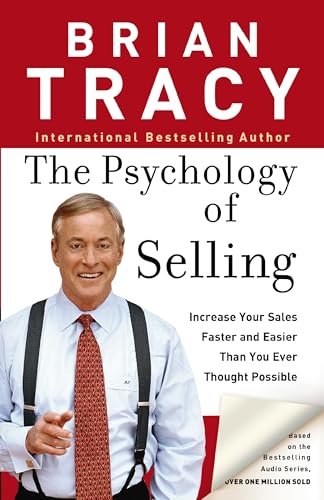
The Psychology of Selling is Brian Tracy’s distillation of the sales training he developed over four decades and delivered to more than a million salespeople through his Sales Mastery program. The book began as an audio program and became the print reference for what Tracy calls the inner game of selling. His central claim, which the book returns to in every chapter, is that sales results are eighty percent psychological and twenty percent technical. Tracy grounds the argument in the Pareto Principle applied to sales forces. In every large sales organization studied, the top twenty percent of salespeople earn eighty percent of the money, and the top twenty percent of that top group, roughly the top four percent, earn eighty percent of the earnings within it. Out of every hundred salespeople, four earn as much as the other ninety-six combined.
Tracy’s explanation for the gap is self-concept. Top performers believe themselves to be top performers before their numbers justify the belief, and the belief drives the behavior that produces the results. The book walks through the operating consequences of that claim across eight chapters covering goal-setting, buyer motivation, prospecting, appointment-getting, presentation, closing, objection handling, and the ten habits Tracy attributes to the top four percent. For a founder-CEO whose sales team is not producing, the book’s value is that it names the specific behaviors and beliefs the top-quintile reps share, in language concrete enough to hire for, coach against, and measure.
The top twenty percent of salespeople earn eighty percent of the money because they operate from a different self-concept, not because they use different techniques. Change what the reps believe about themselves and the numbers change.
Chapter Summaries
Chapter 1: The Inner Game Of Selling
The opening chapter establishes the eighty-twenty distribution as the operating fact the rest of the book explains. Tracy argues that the gap between top and average performers is not talent, territory, product, or training. It is self-concept, which he defines as the sum of what a salesperson believes about themselves, their profession, and their prospects. He introduces the winning-edge idea. Small differences in a few critical skills, done consistently, compound into large differences in income.
- Tracy cites the Pareto pattern documented across large sales forces. Twenty percent of reps earn eighty percent of commissions, and the top four percent of a hundred-person sales force earn as much as the other ninety-six combined. The distribution holds across industries.
- Self-concept operates as a performance ceiling. A rep’s sales income tends to stay within ten percent of what the rep believes is normal for someone like them. Raise the self-concept and the income follows. Leave it in place and no amount of training moves the number.
- The winning-edge principle says that a horse that wins by a nose takes home ten times the prize of the horse in second place. Small skill differences, applied to the same number of at-bats, produce disproportionate income differences over a career.
- The implication for a CEO is that hiring for self-concept and coaching to raise it is the highest-leverage move in the sales function. Product training and process training work on the twenty percent that matters least.
Chapter 2: Set And Achieve All Your Sales Goals
Chapter Two operationalizes goal-setting for salespeople. Tracy’s method, adapted from Earl Nightingale and Napoleon Hill, is a seven-step sequence he insists on. Decide the specific income, write it down by hand, set a deadline, list what has to happen, organize the list into a plan, take action the same day, and do something every day. The chapter’s premise is that vague income goals produce vague behavior. Precise numeric goals, revisited daily, produce the sequence of daily activities that hit them.
- The income-to-activity translation is the operational core of the chapter. Decide the annual income. Work backward to the sales required, then the monthly, weekly, and daily revenue targets, then the specific activities in calls, presentations, and closes needed to produce them.
- Tracy is dogmatic that goals must be handwritten and reread every morning and every night. Unwritten goals are wishes. The daily rereading is the mechanism that keeps the goal live enough to influence which activities the rep chooses first.
- The method turns income into a management problem the rep can solve, rather than a wish tied to territory or luck. The activities that produce the income are inside the rep’s control. The income itself follows.
- For a CEO, the immediate application is to require every quota-carrying rep to publish their income goal, the daily activity math behind it, and the weekly cadence that produces it. The exercise separates reps who can operate a plan from reps who cannot.
Chapter 3: Why People Buy
Chapter Three is Tracy’s treatment of buyer motivation. He argues that people buy for their reasons, not the seller’s, and that the salesperson’s first job is to identify which reason is dominant for the specific prospect. Features and benefits matter only after the dominant motive is known. Tracy lists eight recurring buying motives and gives the salesperson the instruction to frame the entire conversation through the one that this buyer cares about most.
- The eight buying motives Tracy names are to make money, to save money, to save time, to avoid effort, to gain comfort, to increase pleasure, to reduce risk, and to gain prestige or recognition. In business-to-business selling, make money, save money, and reduce risk are the most common dominant motives.
- The hot-button idea is that one of the eight matters more than the rest for this specific buyer. The salesperson’s job is to find it through questions, then frame every feature and benefit through that single lens. Feature dumps that ignore the hot button do not persuade.
- Tracy applies the Pareto Principle inside the sale. Eighty percent of the buying decision hangs on twenty percent of the benefits offered. Identifying that twenty percent for a specific buyer is more productive than reciting all the features.
- For a CEO, the operational question is whether reps in the field can name the dominant buying motive for the last three deals they closed. If they cannot, the team is selling features and hoping. Hope is not a repeatable process.
Chapter 4: Creative Selling
Chapter Four addresses prospecting and the strategic side of the salesperson’s work. Tracy frames prospecting as the activity that fills the funnel and argues that most sales problems trace back to insufficient prospecting done too late. He introduces the four principles of marketing strategy applied to a rep’s book of business. Specialization, differentiation, segmentation, and concentration. Each is a question the rep must answer before deciding where to spend the next hour.
- Specialization asks what the rep is uniquely good at selling and to whom. Differentiation asks what advantage the rep brings that a comparable rep in a comparable role does not. Segmentation asks which customers most need what the rep specializes in. Concentration asks where the rep will focus effort given the answers to the first three.
- Tracy’s hundred-calls method addresses the confidence problem in prospecting. When activity stalls, commit to a hundred cold outreaches with no attachment to the outcome of any individual touch. The volume rebuilds the base rate and breaks the avoidance loop.
- The chapter argues that eighty percent of a rep’s prospecting energy should go to the top twenty percent of accounts in the territory. Time equally distributed across accounts is a common error. Concentration on the accounts most likely to close large is the higher-return move.
- The implication for a CEO is that pipeline coverage problems are usually not capacity problems but concentration problems. Reps working the wrong accounts at the right pace produce the same pipeline as reps working the right accounts at half the pace, minus the deals.
Chapter 5: Getting More Appointments
Chapter Five is about turning prospecting activity into meetings with decision-makers. Tracy argues that the appointment is sold first, before the product. Reps who conflate the two send too much information in the first outreach and reduce the reason to meet. The chapter gives six rules for getting through to decision-makers and positions the appointment call as a distinct skill from the sales call itself.
- Sell the appointment, not the product. The purpose of the first call or email is to secure the meeting. Product detail belongs in the meeting. Sending it up front gives the prospect enough information to say no without meeting.
- Positioning the appointment as a high-stakes conversation, worth the prospect’s time, increases the acceptance rate. Positioning it as a chance for the rep to explain what the product does reduces it.
- Persistence and volume are the durable variables. Reps who make more outreach attempts per week get more appointments, and reps who follow up after the first no get most of the meetings that were possible to get.
- For a CEO, the appointment-set rate per outreach is a diagnostic worth tracking separately from the close rate. A rep with a healthy close rate but a low appointment-set rate is spending too much of the pitch too early.
Chapter 6: The Power Of Suggestion
Chapter Six is about the environment and the presentation of the seller. Tracy argues that most of a buyer’s response to a salesperson is subconscious and driven by cues the seller controls. Appearance, posture, voice, the setting of the meeting, and the ambient signals of competence and credibility. The chapter is a checklist of the cues that raise perceived professionalism.
- The eight suggestion levers Tracy names are being positive and cheerful, practicing the presentation, dressing for success, choosing pleasant surroundings, grooming, upgrading the physical office, working from a clean desk, and doubling personal productivity through preparation.
- The dress-and-appearance argument is that a person’s initial reaction to a stranger is largely subconscious. Cues that read as professional lower resistance and shorten the time to trust. Cues that read as sloppy or unsure add friction the conversation then has to overcome.
- The environmental argument is that the meeting setting affects the outcome. Quiet spaces without physical barriers between seller and buyer, without visible distractions, and without desk-behind-the-seller staging produce more control of the conversation.
- For a CEO, the operational read is to inspect the physical environment the sales team uses to meet prospects, the collateral it sends, and the way it appears on video. The subconscious cues are the ones easiest to fix and least often audited.
Chapter 7: Making The Sale
Chapter Seven is Tracy’s sales-call structure, the operational spine of the book. He gives an eight-step sequence covering the phases of a full sales conversation, from prospecting through follow-up. He introduces the feature-benefit-relevance presentation formula, the trial-close pattern, and the four buyer personality types the rep should recognize and adjust to.
- The eight steps in the sales call are prospecting, establishing rapport in the first ninety seconds, identifying needs through questions, presenting the solution mapped to those needs, answering objections, closing, getting resales and referrals, and following up.
- The feature-benefit-relevance formula is: because of the feature, you can gain the benefit, which means the specific relevance to this buyer. Tracy’s example is that because of the pixel technology, you can view the screen from any angle, which means everyone at your party enjoys the game.
- The trial-close pattern is to check throughout the presentation whether the buyer is following and ready to move. Trial closes are questions like, does this make sense so far, or, is this the kind of thing you were looking for. They catch misalignment early rather than at the end.
- The four personality types Tracy names are the analytical, the driver, the amiable, and the expressive. Reps who read the type and adjust pace and content perform better than reps who deliver a single presentation to every prospect. For a CEO reviewing pipeline calls, the flexibility question is a useful diagnostic.
Chapter 8: 10 Keys To Success In Selling
The closing chapter lists the ten habits Tracy attributes to the top four percent of salespeople. It reads as the summary chapter of the book and the disciplines the rest of the material was building toward. Each key is short and each connects back to the self-concept argument that opened the book.
- The ten keys are: get serious about being the best, identify the limiting skill that holds back the rest, get around the right people, take care of physical health, visualize yourself as one of the best, practice positive self-talk, take positive action, commit to lifelong learning with thirty minutes of reading a day in the field, follow the leader by studying top performers, and pay any price for success.
- The limiting-skill idea is that a single weak skill can bottleneck performance even when the other skills are strong. Identifying and fixing it produces disproportionate gains. For most reps, the limiting skill is prospecting or closing.
- The peer-group argument is that a rep’s performance regresses toward the average of the five reps they spend the most time with. This is a leadership question about who sits next to whom in the sales floor plan, who partners with whom on deals, and who mentors whom.
- The lifelong-learning key operationalizes the self-concept claim. Reading thirty minutes a day in the field, over five years, produces the level of competence that distinguishes the top four percent. This is the maintenance mechanism the whole book depends on.
About the Author
Brian Tracy was a Canadian-American motivational speaker and sales trainer who spent five decades running Brian Tracy International in Solana Beach, California. He wrote or coauthored more than eighty books, including Eat That Frog, Maximum Achievement, Advanced Selling Strategies, and No Excuses. Before founding his training company, Tracy sold products door-to-door, sold automobiles, sold office products, and rose through several sales organizations to VP of sales at a development company with ninety-five salespeople under his direction. That operating background is what makes The Psychology of Selling credible as a rep-level manual rather than a theory book.
The book’s authority rests on Tracy’s claim that more than a million salespeople have gone through his Sales Mastery program in eighty-plus countries, and on the fact that his training was field-tested against commission-carrying reps whose earnings were the audit. Readers should note that Tracy was a professional motivator as well as a sales trainer, and the book leans on affirmation-and-visualization language that some readers find off-putting. The mechanics of goal-setting, buyer motivation, prospecting math, presentation structure, and closing patterns are the material that will still be useful in any language. The self-help register can be skimmed.
Key Takeaways
1) The top twenty percent of your sales team is your sales team.
The Pareto pattern Tracy documents is that twenty percent of reps produce eighty percent of revenue, and that the top four percent produce as much as the bottom ninety-six combined. If the pattern holds in your company, the operating implication is severe. Most of the sales-management attention, comp design, coaching time, and headcount investment should go to the top quintile, and most of the hiring effort should be to add reps who can join it. The rest is drag on the system that produces the revenue.
- Rank your quota-carrying reps by trailing-twelve-month closed revenue. Draw the line at the top twenty percent. Confirm the distribution matches Tracy’s claim before basing decisions on it.
- Reps in the bottom half of the distribution usually consume more manager time per dollar of revenue than reps in the top quintile. That is a leadership-attention misallocation.
- The performance gap does not close through general training programs. It closes through selective hiring, focused coaching of high-potential reps, and disciplined removal of chronic underperformers.
2) Self-concept is a hiring and coaching variable, not a personality trait.
Tracy’s central operating claim is that a rep’s sales income tracks their belief about what someone like them earns. The claim is testable in an interview and coachable in the field. Reps who describe themselves as high performers who happen to be early in their career respond differently to a slump than reps who describe themselves as average. The interview signal is what the rep says about themselves unprompted. The coaching lever is the language leaders use when a rep is losing.
- In hiring, ask candidates to describe their best month and their worst month. The language they use about themselves in the worst month is a stronger signal than the numbers from the best.
- When coaching, notice which reps attribute a lost deal to a controllable variable and which attribute it to the market, the product, or the buyer. The attribution pattern predicts the recovery pattern.
- Tracy argues that self-concept is learned behavior and that the top four percent were built through practice, not born to it. The evidence he offers is anecdotal, but the operating implication is that coaching investment on high-potential reps is defensible.
3) Reps sell to the buyer’s dominant motive, or they do not sell.
Tracy’s eight-motive framework is that any given buyer has one dominant reason for considering the purchase. The salesperson’s job is to identify it through questions, then frame every feature through that single lens. In business-to-business selling, the dominant motives are usually to make money, to save money, or to reduce risk. Reps who cannot name the dominant motive for a specific deal are selling features and hoping the buyer connects the dots. Most do not.
- The eight motives Tracy lists are to make money, to save money, to save time, to avoid effort, to gain comfort, to increase pleasure, to reduce risk, and to gain prestige or recognition.
- The Pareto pattern applies inside the sale. Eighty percent of the buying decision hangs on twenty percent of the benefits offered. Identifying that twenty percent is the presentation move.
- For a CEO reviewing pipeline, the diagnostic is whether reps can articulate the dominant motive for the specific deal in their own words. Vague answers are the signal that the discovery work has not been done.
4) Income goals convert to daily activity math or they do not convert.
The seven-step goal-setting method in Chapter Two is the book’s most practical operating tool. Take an annual income goal, work backward to required revenue, then monthly, weekly, and daily targets, then to the specific activities in calls, presentations, and closes needed to produce them. The exercise turns a wish into a schedule. Reps who can operate the math have a repeatable performance system. Reps who cannot are running on hope.
- The translation chain is annual income to annual revenue to monthly revenue to weekly activity. Each stage forces the rep to state the assumption that connects it to the next.
- Handwriting the goal and rereading it daily is the mechanism Tracy insists on. The rereading is what keeps the daily activity choice tied to the annual number.
- The exercise doubles as a rep-selection filter. Reps who cannot produce a coherent activity math for their number reveal a planning gap in the interview phase.
5) Prospecting is the concentration problem, not the capacity problem.
Tracy’s four marketing principles applied inside a rep’s territory, specialization, differentiation, segmentation, and concentration, are the underused mental model of the book. Most reps distribute prospecting effort roughly evenly across accounts. Tracy’s argument is that eighty percent of prospecting energy should go to the top twenty percent of accounts, and that the reps who make that concentration explicit outperform the reps who do not, on the same weekly hours.
- Specialization, differentiation, segmentation, and concentration are the four questions each rep should answer for their book of business before deciding what to do this week.
- The hundred-calls method addresses the confidence side of the same problem. When prospecting activity stalls, a hundred cold outreaches with no attachment to any single outcome rebuild the base rate.
- For a CEO, pipeline-coverage problems are usually concentration problems. Reps working the wrong accounts at the right pace produce the same pipeline as reps working the right accounts at half the pace, minus the deals.
6) The appointment is a distinct sale from the product.
The most common outreach error Tracy names is conflating the appointment call with the sales call. Reps who send the product story up front reduce the reason to meet. Reps who sell the appointment as a high-stakes conversation, worth the prospect’s time, secure the meeting and preserve the pitch. The distinction is small in language and large in results, and it applies to modern channels. Email outreach, LinkedIn, video prospecting, and cold calls.
- Sell the appointment first. The purpose of the first outreach is to book the meeting. Product detail belongs in the meeting.
- Persistence and volume are the durable variables. Most appointments come from the second, third, or fourth touch. Reps who quit after the first no cede most of the meetings that were possible to get.
- The appointment-set rate per outreach is a diagnostic that separates from the close rate. A rep with a healthy close rate but a low appointment-set rate is overselling the product up front.
7) The presentation structure is trainable, and most teams do not train it.
Chapter Seven’s eight-step sales call and the feature-benefit-relevance formula are trainable structures that most sales teams assume their reps already have. They do not. Reps promoted from other roles, reps hired from other industries, and reps who learned by observation rather than instruction typically have gaps in one or more of the eight steps. The gap is invisible until deals stall at the same phase repeatedly.
- The eight steps are prospecting, rapport, needs identification, presentation, objections, close, referrals, and follow-up. Every rep should be able to name them and to explain what they do in each phase.
- The feature-benefit-relevance formula is: because of the feature, you can gain the benefit, which means the specific relevance to this buyer. Reps who leave off the relevance step present features and hope the buyer connects the dots.
- The trial-close pattern, asking during the presentation whether this makes sense so far, catches misalignment early. Reps who wait until the end to discover the buyer disengaged twenty minutes ago are working from a broken feedback loop.
Strengths and Limits
The book’s strength is that it is grounded in Tracy’s operating experience running sales for a ninety-five-person team and in the base rates he draws from studying large sales organizations over decades. The eighty-twenty distribution he opens with is not a hypothesis. It is what shows up in almost every sales-force distribution once it is measured. The chapter on why people buy is the most substantive piece of the book, and it gives a specific vocabulary a sales leader can use to audit whether the team can articulate buyer motivation deal by deal. The eight-step sales-call structure and the feature-benefit-relevance formula are as trainable as the book claims, and they work on modern channels with little adjustment. The goal-to-activity math in Chapter Two is the book’s most durable contribution, because it separates reps who can operate a plan from reps who cannot, and that separation predicts most of the variance in top-quintile revenue.
The limits are real. The book leans heavily on affirmation-and-visualization language that some readers find hokey, and Tracy’s self-concept argument, while empirically reasonable, is stated more insistently than the evidence in the book supports. Almost all of the book is transactional selling with an individual buyer, not complex enterprise selling with a buying committee, and the material on modern buyer research, digital channels, procurement, legal review, and multi-threaded stakeholder mapping is absent because it was not part of the 2004 sales environment. The advice on dress, office environment, and personal grooming is dated in places, though the underlying principle about subconscious cues holds. The book is written to the individual salesperson, not to the CEO or the head of sales, so a founder-CEO reading it as an operating manual has to do the translation work. The predictable failure mode is a CEO who reads the book, buys the audio program for the sales team, and then does not build the management systems, hiring filters, and coaching cadence that would turn the material into practice.
My Take
This book is more than twenty years old and its underlying diagnosis still holds. The eighty-twenty distribution across sales forces is not a Tracy invention. It shows up any time a growth-stage CEO actually ranks their reps by trailing revenue. The self-concept argument is harder to prove, but the operational point is not. Reps who describe themselves as top performers when they are losing recover faster than reps who describe themselves as average when they are winning. In my experience with founder-led sales teams in the five-to-fifty-million-dollar range, the goal-to-activity math in Chapter Two is the single most useful exercise in the book, because it separates the reps who can operate a plan from the reps who cannot, and that separation predicts almost everything else.
The book plays very differently across contexts. In a transactional inside-sales business, field-services company, or industrial distribution business selling to an individual buyer, most of the mechanics still apply with minor updates. In modern enterprise SaaS with a buying committee of six to ten stakeholders, procurement involvement, and a formal security review, Tracy’s model is only a starting point. The dominant-motive discovery still matters, but it has to be done across multiple stakeholders with different motives, and the trial-close pattern gets replaced by mutual action plans and multi-threaded stakeholder mapping. The dress-and-office chapter is the most dated section of the book and can be skimmed without loss.
The most credible outside critique of Tracy’s approach comes from Neil Rackham, whose SPIN Selling research at Huthwaite found that many of Tracy’s classic closing techniques actually reduce close rates in large complex sales. Matthew Dixon and Brent Adamson push the point further in The Challenger Sale, where CEB’s research on more than six thousand reps found that self-concept and relationship-building were poor predictors of top performance in complex B2B, and that a specific behavior profile they call the Challenger was the strongest predictor. My read is that Rackham and Dixon are correct for enterprise, and Tracy is closer to correct for transactional and mid-market selling. Both are true inside their operating range.
Read Tracy first for the rep-level mental model and the goal-to-activity math. Read Chet Holmes’s The Ultimate Sales Machine second for the sales-management systems Tracy assumes are already in place. If your company sells complex B2B with a buying committee, read Rackham’s SPIN Selling and Dixon and Adamson’s The Challenger Sale before you install any of Tracy’s closing techniques. If your company sells transactional with an individual buyer, Tracy’s chapters on discovery, presentation, and closing are still the fastest way to raise the floor on a mixed sales team.
Discussion Questions
For CEOs
- Does the twenty-eighty distribution hold across our sales team, and if so, what is our current management-time allocation across the top and bottom quintiles?
- For each of my top three sales reps, can I state in one sentence what their operating self-concept is, and does the sentence match the language they use about themselves?
- In the last three deals we closed and the last three we lost, can the rep on the deal name the buyer’s dominant motive from Tracy’s eight-motive list in one sentence?
- Which of my current reps have an income goal expressed as an activity math they can operate, and which have income goals expressed as a wish?
- Is our team’s prospecting concentrated on the top twenty percent of accounts in each territory, or is it distributed roughly evenly, and how would I know the difference?
- Do we track appointment-set rate per outreach as a separate metric from close rate, and if not, what would we learn by adding it?
- Has our sales presentation been trained against a specific structure such as Tracy’s eight-step model, or is each rep improvising from what worked in their last role?
- If self-concept is the primary performance variable, are we hiring for it, and what specific question in our interview process would surface it?
For Teams
- For each of our top three deals in flight, can the rep on the deal name the buyer’s dominant motive in one sentence, and can they show where in the presentation they confirmed it?
- In our current pipeline, which reps are working the top twenty percent of accounts and which are distributing effort evenly, and what would change if we reallocated?
- How many touches on average does it take to book a first meeting in our current market, and which reps quit at the first no?
- Which of our reps can produce the annual-to-daily activity math for their number, and which cannot?
- In the last quarter, which reps improved most, and can we attribute the improvement to a specific coaching intervention or to a change in self-concept?
- Where in our sales-call structure do deals stall most often, and does the stall point match the phase most of our reps say they find hardest?
- Is our sales onboarding teaching a specific structure for the call, or is it product training with the expectation that reps figure out the structure from watching others?
- What one skill, if fixed in our bottom-half reps, would produce the largest revenue gain, and are we currently coaching against it?
Practical Tools
1. Sales Team Pareto Audit
Tracy’s central data claim is that twenty percent of reps produce eighty percent of revenue in every sales force studied. The audit tests whether the claim holds in your company and forces the management-attention allocation to match the revenue distribution. It converts a general sense that the top reps carry the number into a specific reallocation of coaching time, comp design, and hiring priority. Run it once a year in the quarter before annual planning, or immediately when revenue is missing plan and the cause is not obvious.
How it works:
- Rank every quota-carrying rep by trailing-twelve-month closed revenue.
- Compute the share of total revenue produced by the top quintile and the bottom quintile. Compare to Tracy’s twenty-eighty claim.
- For each rep, compute a rough manager-hours-per-dollar-of-revenue ratio using the hours the manager estimates spending with each rep. The ratio usually inverts the revenue ranking.
- Publish the current management-time allocation and the target allocation for the coming quarter to the sales leaders.
- Decide which bottom-quintile reps are on a defined improvement path with a specific coaching intervention and a review date, and which are on a defined exit path.
The sales leadership team can name where the top quintile is spending time this quarter, where the bottom quintile is spending time, and what specific coaching intervention or exit decision applies to each bottom-quintile rep. Reallocation of coaching hours and comp accelerators shows up in the next quarter’s numbers, not just in the deck.
2. Buyer Motive Deal Review
Tracy’s eight-motive framework in Chapter Three is the fastest diagnostic for whether reps are selling on discovery or on hope. Reps who can name the dominant motive for a deal in one sentence are running the sale. Reps who cannot are demonstrating the product and waiting to see what happens. Use the review in weekly or biweekly pipeline meetings, especially for deals in the top-of-pipeline stages where the discovery work should already have been done.
How it works:
- Ask each rep to name the dominant buying motive for each of their top three open deals, in one sentence, using the language of Tracy’s eight motives. Make money, save money, save time, avoid effort, gain comfort, increase pleasure, reduce risk, or gain prestige.
- Ask the rep to name the specific evidence from a discovery conversation that supports the answer.
- Compare the answer to the way the rep has positioned the product in the last customer-facing collateral. The presentation deck, the proposal, or the follow-up email.
- Score alignment on a three-point scale. Motive named clearly and positioning matches, motive named vaguely or positioning mismatches, or motive not named.
- For every deal that scores below the top level, name the specific discovery question the rep will ask on the next call and the date of that call.
Within two review cycles, reps enter the meeting with the motive already named and the evidence prepared. The review conversation shifts from what is the deal about to what changes if the motive is not what we thought. Deals that were stuck at proposal move or get disqualified, and pipeline quality tightens.
3. Income Math Publication
Chapter Two’s translation from annual income to daily activity is the book’s most operational tool. Requiring every rep to publish the math turns income goals from private wishes into a shared operating plan, and the exercise itself surfaces the reps who cannot operate a plan. Both outputs are useful. Use it in the first month of every fiscal year, at the start of a new comp plan, or when onboarding a new rep in the first thirty days.
How it works:
- Ask each quota-carrying rep to state their annual income goal, including base salary, commission, and any bonus, in one number.
- Ask the rep to work backward from the income goal to the annual revenue required at the current comp rate. State the assumption if commission structure is tiered.
- Divide by twelve, then by four, then by five to reach the required monthly, weekly, and daily revenue.
- Convert daily revenue to daily activity. Outreaches, meetings, presentations, and closes, using the current conversion rates in the CRM.
- Publish the individual math to the rep’s manager. The rep and manager sign off on the plan and set a monthly review date.
By the end of the first month, every rep has a documented activity plan that connects to a specific income outcome. Reps who cannot produce the math are visible to their manager, and the coaching or exit conversation happens in month one rather than month nine. The exercise doubles as an early-warning signal for new hires who look strong on paper but cannot operate a plan.
4. Top Twenty Percent Prospecting Reset
Tracy’s concentration principle in Chapter Four is that eighty percent of prospecting energy should go to the top twenty percent of accounts in a territory. Most reps distribute effort evenly by default. The reset makes the concentration explicit, and the follow-up audit checks that behavior actually changed. Use it when pipeline coverage is below target, when reps are complaining about territory, or after a territory redesign to establish the new concentration pattern.
How it works:
- Ask each rep to rank the accounts in their territory by expected annual contract value, using the criteria specialization, differentiation, segmentation, and concentration from Chapter Four.
- Identify the top twenty percent of accounts by count.
- Compare against the last four weeks of prospecting activity in the CRM. Compute the percentage of outreach hours spent on the top-twenty accounts.
- Set a target for the coming four weeks. Eighty percent of outreach hours to the top-twenty accounts is Tracy’s target. Adjust for territory size and market structure.
- Review the ratio weekly for four weeks, then monthly, and track whether pipeline coverage from the top-twenty accounts improves.
Within four weeks the ratio of top-twenty prospecting hours to total outreach hours moves toward eighty percent, and the pipeline generated from those accounts shows in the CRM inside one sales cycle. Complaints about territory shift from a size argument to a concentration argument, which is the more productive conversation.
5. Eight-Step Call Structure Audit
Tracy’s eight-step call structure in Chapter Seven is trainable and most teams do not train it. The audit compares each rep’s actual call sequence against the standard and surfaces the phase where deals most often stall. The finding drives the coaching agenda. Use it once a year in a sales offsite, when close rates are declining, or as part of new-rep onboarding in the first sixty days.
How it works:
- Publish the eight steps to the sales team. Prospecting, rapport, needs identification, presentation, objections, close, referrals, and follow-up.
- Record or observe three live customer calls per rep, or use recent recorded calls from the CRM if available.
- Score each call against the eight-step structure. Note the phases the rep skipped or rushed and the phase where the buyer disengaged if any.
- Aggregate across reps to find the phase most often skipped or rushed. That phase is the training agenda for the coming quarter.
- Rebuild the section of the sales playbook that covers the weak phase, then run a team rehearsal against the new material before the next customer-facing week.
Reps can name the eight steps, identify where in the sequence they are on any live deal, and adjust when the buyer signals a jump. Deals stall at the same phase less often quarter over quarter, and onboarding for new reps compresses because the shared vocabulary is already installed.
6. Self-Concept Interview Filter
If Tracy’s central claim is correct, self-concept is the primary hiring signal and most interview processes do not capture it. The filter adds a specific question pair designed to surface how the candidate talks about themselves in a loss, which is the state that predicts recovery in the field. Use it in every sales-hiring loop for quota-carrying roles, and especially in the final-round interview conducted by the hiring manager or head of sales.
How it works:
- Ask the candidate to describe their best month in their most recent sales role, with specific numbers and specific deals.
- Ask the candidate to describe their worst month in the same role, with specific numbers and specific deals.
- Listen for the attribution pattern in the worst-month answer. Note whether the candidate attributes the loss to a controllable variable, an uncontrollable variable, or a mix.
- Score the answer on a three-point scale. Controllable attribution and specific recovery plan, controllable attribution without a specific plan, or uncontrollable attribution.
- Combine the score with the candidate’s demonstrated technical selling skills and prospecting math. A candidate who scores at the top on self-concept but lacks prospecting discipline is worth training. The reverse is not.
The interview loop consistently identifies candidates whose self-concept matches the role level. Post-hire ninety-day retention improves and first-year quota attainment among new reps improves within two cohorts. Hiring managers stop arguing about likability and start arguing about attribution, which is the more predictive signal.
7. Limiting-Skill Coaching Plan
Tracy’s limiting-skill idea in Chapter Eight is that a single weak skill can bottleneck performance even when the other skills are strong. The plan names the weak skill for each rep, sets a specific coaching intervention, and reviews progress against a defined measure. It concentrates coaching time on the intervention most likely to move the number. Use it quarterly for every rep, and at the start of any performance-improvement conversation, before any exit decision, to test whether the rep can be recovered.
How it works:
- For each rep, name the one skill that most limits current performance. Common candidates are prospecting, discovery, presentation, objection handling, and closing.
- Confirm the diagnosis with two data points. A CRM metric that reflects the skill, and a call review that isolates the behavior.
- Set a specific coaching intervention. Script practice, live-call shadowing, recorded-call review, or paired selling with a top-quintile rep.
- Set a review date thirty days out and a measurable target for the CRM metric.
- Review the metric at thirty days. If the metric moved, extend the intervention or move to the next limiting skill. If it did not move, escalate to a defined performance-improvement conversation.
Coaching conversations focus on one behavior at a time rather than a general assessment. The CRM metric that reflects the target skill moves within thirty to sixty days, or the rep moves to a defined exit path. Managers who cannot name a single limiting skill for a rep reveal a coaching-diagnosis gap that is easier to fix than a talent gap.
Further Reading
- Brian Tracy International’s Sales Mastery program, the training that this book distills into print, for the audio, video, and coaching materials Tracy developed for individual reps and sales teams.
- Neil Rackham’s SPIN Selling, based on twelve years of research at Huthwaite on 35,000 sales calls, for the complex-B2B counterpart to Tracy’s transactional model. SPIN is the reference for large-deal discovery and challenges some of Tracy’s closing techniques directly.
- Robert Cialdini’s Influence, the academic reference on the persuasion mechanisms that operate under Tracy’s suggestion and closing chapters. Cialdini’s six principles map cleanly onto Tracy’s tactical advice and give the psychological grounding Tracy asserts but does not always defend.
- Chet Holmes’s The Ultimate Sales Machine, a parallel operating manual for sales leadership at growing companies, with a stronger treatment of the management systems Tracy assumes are already in place.
- The Pareto Principle applied to management, popularized in Richard Koch’s The 80/20 Principle, for the broader body of work that supports Tracy’s opening claim about revenue distribution in sales organizations.
Share This Review

Bruce Eckfeldt is a business coach and strategic advisor to founder-CEOs of growth-stage companies, a former Inc. 500 CEO, and the author of Springboard. More book reviews →
These summaries present Bruce Eckfeldt’s analysis of business and leadership books for founder-CEOs and leadership-team members of growth companies. Each one identifies the ideas most relevant to decision quality, strategy, and leadership capacity, notes where the evidence is weak, and suggests practical ways to test what is worth testing. All ideas, stories, and quotations belong to the original author and to the people they cite. The assessments and recommendations are Bruce’s. It is a companion to the book, not a substitute for reading it.
To learn more about Bruce’s programs, request other book summaries, or get in touch, contact booksummaries@eckfeldt.com.
Get the Next Review.
A new book review lands in Better, Faster, my weekly newsletter for founder-CEOs, along with one practical essay and questions for your team.