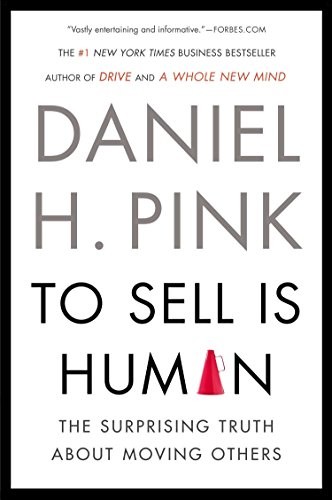
To Sell Is Human
The Surprising Truth About Moving Others
Everyone is in sales now, whether they carry a quota or not. The old ABC of Always Be Closing has been replaced by a new ABC of Attunement, Buoyancy, and Clarity, and the practical skills that move others are Pitch, Improvise, and Serve.
A book summary and review by Bruce Eckfeldt
Overview
To Sell Is Human is Daniel Pink’s argument that selling is no longer a specialized function concentrated in commissioned salespeople. His central data point, drawn from a 2012 survey of more than seven thousand American workers that Pink commissioned with the Qualtrics research firm, is that one in nine workers is in traditional sales and the other eight in nine spend roughly forty percent of their time on what Pink calls non-sales selling: persuading, convincing, and moving others without a commercial transaction. Teachers moving students, doctors moving patients, entrepreneurs moving investors, and managers moving employees all fall inside the definition.
Pink’s argument for why the world changed rests on three shifts: entrepreneurship as a default career path, elasticity of job roles that combine functions once split across specialists, and the growth of the Ed-Med sector where education and healthcare workers spend most of their time moving others. He argues these three shifts have moved the buyer-seller relationship from caveat emptor, buyer beware, to caveat venditor, seller beware, because information asymmetry is gone. The framework is then organized as a How to Be part covering the three durable qualities of the new sales, and a What to Do part covering the three practical skills that operationalize them.
Everyone is in sales now, whether they carry a quota or not. The old ABC of Always Be Closing has been replaced by a new ABC of Attunement, Buoyancy, and Clarity, and the practical skills that move others are Pitch, Improvise, and Serve.
Chapter Summaries
Chapter 1: We Are All In Sales Now
Part One opens with the data claim that drives the rest of the book. Pink’s commissioned survey of more than seven thousand American workers found that roughly one in nine workers is in formal sales, unchanged from a century earlier, and that the other eight in nine spend an average of forty percent of their time moving others without a commercial transaction. Whatever job description the worker holds, close to half their time is spent selling.
- Pink reports that the average non-sales worker in the survey spent forty-one percent of their working hours moving others, and considered that time crucial to their success. Non-sales selling is not a marginal activity but the largest single category of what most professionals actually do.
- The one-in-nine ratio for formal sales roles has held roughly stable across a century of Bureau of Labor Statistics data, contradicting the common assumption that automation and the internet have eliminated sales work. What changed is that the other eight in nine are now selling too.
- The buyer-side change is that information asymmetry has collapsed. Pink names the shift from caveat emptor to caveat venditor as the underlying condition. Buyers arrive to the conversation informed, which changes what a seller does inside it.
- The implication for a founder-CEO is that sales training is no longer a department expense. It is a general-workforce investment, because the customer success team, the product team, the finance team, and the founder herself are all in the moving-others business most of the time.
Chapter 2: Entrepreneurship, Elasticity, And Ed-Med
Chapter Two explains the three structural forces that pushed sales into every job. Entrepreneurship is the default career path for a growing share of the workforce, and every entrepreneur sells constantly. Elasticity of skills means roles combine functions once split across specialists, so a developer sells roadmap, a designer sells vision, and a finance lead sells resource allocation. The Ed-Med sector, education plus healthcare, is now the largest employment category in the American economy, and both fields are dominated by non-sales selling.
- Pink cites Kauffman Foundation and Bureau of Labor Statistics data showing the rise of small firms and self-employment. Kauffman’s data at the time of writing showed roughly twenty-two million Americans running businesses that had no employees other than the owner. Each of them sells every day.
- Elasticity of skills means the old lines between functions blur. Product managers pitch strategy internally. Engineers pitch technical direction. Marketers pitch positioning to sales. The organization runs on continuous internal persuasion, most of it uncoached.
- Ed-Med, education and healthcare combined, surpassed manufacturing as the largest employment sector in the United States around 2001. Both fields spend most of their working time moving others: teachers move students, doctors move patients, administrators move both.
- For a growth-company CEO, the operational read is that most of the persuasion work in the company is invisible to the sales function and largely untrained. The performance ceiling on this internal persuasion is set by the least-skilled manager in the company.
Chapter 3: From Caveat Emptor To Caveat Venditor
Chapter Three closes Part One with the buyer-side story. For most of commercial history, sellers held more information than buyers, and that asymmetry made sleazy tactics economically rational. Information parity, driven by the internet, review sites, and easy comparison shopping, has flipped the incentive. Sellers who deceive lose future business faster than they gain from the current sale. Pink argues this is not a moral change. It is an economic one, and it forces seller behavior to shift whether the seller likes it or not.
- Pink cites data from J. D. Power, Consumer Reports, and Yelp showing that buyers now arrive to the transaction with more product information than the seller. Car shoppers reach the dealer having decided on the make and model. Software buyers read the reviews before scheduling the demo.
- The seller’s advantage under information parity is not more information but better judgment. What the buyer cannot self-serve is help clarifying their own situation, framing the problem correctly, and choosing among options that all look reasonable on the spec sheet.
- This is where the book’s later argument about problem-finding comes from. If buyers can already solve their stated problem, the seller who wins is the one who identifies the unstated problem underneath.
- For a founder-CEO, the implication is that sales-team training built for the old asymmetry, focused on product knowledge and objection handling, is training for a world that no longer exists. The buyer already knows the product. Retraining should target problem-finding and clarity, not answering objections.
Chapter 4: Attunement
Part Two opens the new ABC framework. Attunement is the ability to bring one’s actions and outlook into harmony with other people and the context. Pink argues it replaces the extrovert-outsells-introvert folk theory, which the research does not support. He introduces three rules of attunement, each grounded in a specific research finding.
- Rule one is to increase power by reducing it. Adam Galinsky and colleagues at Northwestern Kellogg showed that low-power participants in negotiation experiments read the room more accurately than high-power participants. In sales, assuming the lower-power position sharpens perspective taking.
- Rule two is to use the head as much as the heart. William Maddux and Galinsky found that cognitive perspective-taking, thinking about what the other person thinks, outperformed pure emotional empathy in negotiation outcomes. Feeling with the buyer is less useful than modeling the buyer’s mental state.
- Rule three is to mimic strategically. The chameleon effect, subtle mirroring of posture and speech, measurably increases trust, tip size, and negotiation success. Pink cites work by Tanya Chartrand and John Bargh at NYU on the underlying mechanism.
- Pink also cites Adam Grant’s Wharton research finding that ambiverts, individuals with a mix of introvert and extrovert traits, outsell strong extroverts. The extrovert sales advantage is a folk theory. The data does not support it, and the operational implication is to hire for perspective-taking rather than for personality type.
Chapter 5: Buoyancy
Chapter Five covers the second quality: how to stay afloat in what Pink, borrowing from a Boston Fuller Brush salesman he shadowed, calls the ocean of rejection. Buoyancy is a combination of grit and outlook, and Pink argues it can be trained through specific techniques before, during, and after a sales interaction.
- Before a sales conversation, Pink recommends interrogative self-talk. Ibrahim Senay and Dolores Albarracin at the University of Illinois showed that asking yourself Can I do this? outperforms declaring to yourself I can do this, because the question surfaces actual strategies while the declaration surfaces only confidence.
- During the conversation, Pink draws on Barbara Fredrickson’s positivity-ratio research finding that a three-to-one ratio of positive to negative emotional experiences predicts flourishing, and applies it to sales interaction with the caveat that too much positivity registers as insincerity.
- After a rejection, Pink cites Martin Seligman’s work on learned optimism and explanatory style. When something bad happens, ask whether it is permanent, pervasive, and personal, and find intelligent ways to answer no to each. The explanatory style predicts recovery.
- The enumerate-and-embrace practice makes rejection concrete. Count the nos received in a week. The count is almost always lower than the felt total. Keep a physical reminder of a big rejection as evidence that quitting was not the response.
Chapter 6: Clarity
Chapter Six is the most consequential in the book. Clarity is the capacity to help others see their situations in fresh and revealing ways and to identify problems they did not know they had. Pink argues that in a world of information parity, problem-finding matters more than problem-solving. The seller’s job is to surface the problem underneath the stated problem.
- Pink draws on Jacob Getzels and Mihaly Csikszentmihalyi’s research at the Art Institute of Chicago on problem-finders versus problem-solvers. Students they classified as problem-finders in art school produced more original work and more successful careers. The finding generalizes to sales.
- Two irrational-scale questions help clarify a prospect’s own motivation. On a scale of one to ten, how ready are you to make this change? Then, why didn’t you pick a lower number? The second question forces the prospect to argue their own case for change.
- Pink lists five frames that reshape perception without changing facts: the less frame (fewer choices), the experience frame (framing purchases as experiences rather than possessions), the label frame (naming a group so it acts like the name), the blemished frame (mentioning a small negative before the positives), and the potential frame (framing future potential rather than past record).
- Beyond finding the problem, the seller has to give the buyer a clear path to action. Pink cites Howard Leventhal’s tetanus-shot experiments at Yale showing that fear-arousing messages produced action only when paired with a specific map and time. Clarity without a next step is decoration.
Chapter 7: Pitch
Part Three opens with the pitch, updated for a world where nobody has time for the elevator speech. Pink argues that the traditional one-minute pitch is dead because attention is scarcer and channels are more varied. He offers six pitch forms, each suited to a different channel or purpose. All six are grounded in the same underlying claim: the purpose of a pitch is not to close but to start a conversation.
- The one-word pitch. Pink cites Maurice Saatchi’s advocacy for one-word equity as the ultimate positioning: what single word do you own in the buyer’s mind? The practice is to write a fifty-word pitch, reduce it to twenty-five, then to six, then to one.
- The question pitch and the rhyming pitch. Ask a question when the arguments are strong enough that the buyer will answer in your favor. Rhyming increases believability because processing fluency, the ease of understanding a phrase, raises perceived truth. Matthew McGlone at Lafayette College showed that rhyming aphorisms are rated as more accurate than the same claims rephrased.
- The subject-line pitch and the Twitter pitch. Subject lines that succeed appeal to utility or curiosity, and specificity beats generality. Twitter pitches should stop at one hundred twenty characters, leaving room for others to pass them on.
- The Pixar pitch. Emma Coats, a former Pixar story artist, distilled the studio’s story structure into a six-sentence pattern that begins Once upon a time and ends Until finally. Pink argues it is the most durable pitch form because narrative is how humans transmit meaning.
Chapter 8: Improvise
Chapter Eight moves from prepared pitches to unscripted conversations. Pink borrows three rules from improvisational theater, drawing on Keith Johnstone’s Impro and on interviews with the improv troupe Second City in Chicago. The rules translate the mechanics of improv into the mechanics of a sales conversation.
- Hear offers, do not wait to speak. In improv, an offer is anything the other performer contributes: a line, a gesture, a premise. In sales, an offer is anything the buyer says. Listening for offers means holding attention on the buyer rather than on the pitch script running in the seller’s head.
- Say yes and, not yes but. The yes-and construction accepts the buyer’s premise and adds to it. Yes-but rejects the premise and forces the conversation backward. Applied to objection handling, yes-and turns what would have been an argument into a co-created path forward.
- Make your partner look good. In improv, the working assumption is that the performer’s job is to make the other performer look better. In a sales conversation, this is the disposition that produces long-term relationships. It is also, Pink argues, the disposition that produces the highest short-term close rates.
- The improv rules operationalize attunement, which was defined abstractly in Chapter Four. Hearing offers is perspective-taking. Yes-and is strategic mimicking of the buyer’s premise. Making your partner look good is the low-power posture that reads the room more accurately.
Chapter 9: Serve
The final chapter distills the whole book to two principles: make it personal and make it purposeful. Pink argues that the durable through-line of modern selling, whether commercial or non-commercial, is that the seller is in service of the buyer’s outcome. Serving is not a soft alternative to selling. It is what selling has become under information parity.
- Make it personal by making the transaction human. Pink cites an experiment by Adam Grant and colleagues where radiologists shown a photo of the patient they were reading a scan for wrote more thorough reports. The photo made the transaction personal, and the quality of work rose without any other change.
- Make it purposeful by attaching the transaction to the buyer’s larger purpose. Pink cites Grant’s work with university-fundraising callers who spent five minutes with a scholarship recipient before starting their calls. The exposure more than doubled the callers’ subsequent earnings on behalf of the fund.
- Serving is the operational answer to the question the book opens with. If everyone is in sales now, and if information parity makes deception unprofitable, the durable strategy is to actually help the buyer, and to make that help visible in the specific transaction.
- For a founder-CEO, the closing implication is that the sales function’s purpose is now the whole company’s purpose. If the sales team is serving buyers, the product team, the customer success team, and the founder have to be doing the same. If they are not, the buyer notices the gap and the sales conversation cannot repair it.
About the Author
Daniel H. Pink is an American author and speaker who writes about work, behavior, and management. Before writing full time he worked as chief speechwriter for Vice President Al Gore from 1995 to 1997, and previously in the U.S. Department of Labor and on Capitol Hill. He holds a bachelor’s degree from Northwestern University and a law degree from Yale. His earlier books include Free Agent Nation, A Whole New Mind, Drive, When, and The Power of Regret. To Sell Is Human was his fifth book and reached number one on the New York Times business list and the Wall Street Journal business list on release.
Pink is a science journalist rather than a sales practitioner, and the book’s authority rests on the research he synthesizes rather than on his own field experience. The commissioned Qualtrics survey underneath the one-in-nine claim is proprietary to the book and is the piece most often cited from it. Readers should note the source of the authority. Pink is a strong reporter of behavioral-science research applied to work, and the specific practices in the book are grounded in named studies with named researchers. He is not an operator giving you what worked in his territory, and he does not present the book as such.
Key Takeaways
1) Non-sales selling is roughly forty percent of every non-sales job.
Pink’s commissioned Qualtrics survey of more than seven thousand American workers found that non-sales workers spend forty-one percent of their time moving others, and that they consider that time crucial to their success. If the pattern holds in a given company, the training budget, hiring criteria, and performance reviews for every non-sales function should reflect that most of the work is persuasion. Most companies design non-sales roles as if persuasion were a small part of the job. Pink’s data says it is roughly half.
- The one-in-nine ratio for formal sales roles has been stable across a century of BLS data. What changed is that the other eight in nine are also selling now, just without the title.
- For a growth-company CEO, the implication is that customer success, product management, engineering leadership, and finance are all sales roles most of the time. The performance ceiling on this internal and external persuasion is set by the least-skilled manager.
- Sales training investment historically concentrates in the quota-carrying part of the business. Pink’s data suggests the return on general-workforce sales training is higher, because eighty-eight percent of the workforce is doing the activity without any training at all.
2) Information parity has flipped the buyer-seller relationship.
Pink names the shift from caveat emptor to caveat venditor as the underlying condition of modern selling. Buyers arrive to the conversation informed, and sellers no longer hold a durable information advantage. The old sales-training focus on product knowledge and objection handling was training for a world where the seller knew more than the buyer. That world is gone. What sellers can offer now is judgment: framing the problem correctly, choosing among options that all look reasonable, and clarifying the buyer’s own situation to the buyer.
- The seller’s remaining advantage under information parity is not information but perspective. The buyer cannot self-serve help clarifying their own situation.
- Sales scripts and playbooks built around answering objections are answering a question buyers no longer ask. Buyers who wanted the objection answered answered it themselves before the conversation started.
- The shift changes the hiring profile. Reps who thrived under information asymmetry by knowing more than the buyer are less useful than reps who thrive by asking better questions than the buyer knew to ask.
3) The new ABC is Attunement, Buoyancy, and Clarity.
Pink’s replacement for Always Be Closing is a framework grounded in named research. Attunement is Adam Galinsky’s work on perspective-taking. Buoyancy is Martin Seligman on learned optimism and Barbara Fredrickson on positivity ratios. Clarity is Getzels and Csikszentmihalyi on problem-finding. The framework is trainable, and each element maps to a specific behavior that a manager can observe, coach, and hire for.
- Attunement is measured by whether the rep can accurately describe the buyer’s point of view, not by whether they empathize with the buyer emotionally.
- Buoyancy is measured by the rep’s recovery time after a lost deal, and by whether the explanatory style they use points to permanent, pervasive, personal causes or to controllable and specific ones.
- Clarity is measured by whether the rep identifies a problem the buyer did not know they had, or whether the rep solves the problem the buyer stated on the first call. The first is the higher-margin sale.
4) Ambiverts outsell extroverts. Hire for perspective-taking, not personality.
One of the book’s most cited findings is Adam Grant’s Wharton study of three hundred forty outbound-call-center reps, which found an inverted-U relationship between extroversion and sales performance. Ambiverts, individuals in the middle of the extroversion-introversion range, outsold both strong extroverts and strong introverts. The extrovert-outsells-introvert folk theory does not survive the data. This has direct implications for how sales teams are hired and onboarded.
- Grant’s ambivert reps in the sixtieth-to-seventieth percentile of extroversion earned an average of one hundred fifty-five dollars per hour, compared to one hundred twenty-five for strong extroverts and one hundred fifteen for strong introverts. The gap is meaningful and reproducible.
- The mechanism, Pink argues, is that strong extroverts talk over the buyer and miss offers, while strong introverts hesitate to make offers of their own. Ambiverts do both.
- The hiring implication is to stop selecting for the loudest voice in the room. Interview practices that reward extroversion are selecting for the wrong variable.
5) Problem-finding is now higher-leverage than problem-solving.
Pink’s argument in the clarity chapter is that under information parity, buyers arrive to the conversation with a stated problem they have already tried to solve. What they cannot self-serve is the problem underneath the problem. The seller who identifies that unstated problem is the seller who wins the deal and sets up the higher-margin follow-on. Reps who race to solve the stated problem are competing on features against competitors who look identical on the spec sheet.
- Getzels and Csikszentmihalyi’s finding that art students classified as problem-finders had more original work and more successful careers generalizes to sales work. The finding predates the sales application, which is what makes it credible.
- The two irrational-scale questions, on a scale of one to ten how ready are you, then why didn’t you pick a lower number, are the fastest field diagnostic for surfacing the problem underneath. The prospect argues their own case for change.
- The five frames Pink names, less, experience, label, blemished, and potential, reshape perception without changing facts. The blemished frame in particular is counterintuitive. Mentioning a small negative first raises the credibility of the positives that follow.
6) The elevator pitch is dead. Learn the six replacements.
Pink argues the one-minute prepared pitch is a relic of a slower attention environment. The six pitch forms he documents cover the channels and situations modern buyers actually encounter: the one-word pitch, the question pitch, the rhyming pitch, the subject-line pitch, the Twitter pitch, and the Pixar pitch. Each has a specific use, and Pink argues a professional should practice all six and choose based on the situation, not the memorized default.
- The one-word pitch tests whether the seller knows what their offer is. Reduce a fifty-word pitch to twenty-five, then six, then one. The one that survives is the answer.
- The Pixar pitch, Once upon a time X, Every day Y, One day Z, Because of that A, Because of that B, Until finally C, is the most durable form because narrative is how humans transmit meaning. It scales from a two-sentence pitch to a full product story.
- Matthew McGlone’s rhyming-aphorism research is why the rhyming pitch works. Processing fluency, the ease of understanding a phrase, raises perceived truth. The finding is uncomfortable but reproducible.
7) The mechanics of improv are the mechanics of a modern sales conversation.
Pink’s three improv rules, hear offers, say yes and, make your partner look good, translate the abstract framework of attunement into observable behavior. In a sales conversation, an offer is anything the buyer says. Listening for offers means holding attention on the buyer rather than on the pitch script. Saying yes and turns objections into co-created paths forward. Making the partner look good produces the long-term relationships that under information parity are the durable source of new business.
- Hearing offers is the field-level version of perspective-taking. It is trainable in a two-hour workshop with a live improv coach and stays with reps longer than any script.
- Yes-and is the fastest single-sentence upgrade to objection handling. Most objection-handling scripts are yes-but by default, and buyers hear the pushback.
- The disposition to make the partner look good is the same disposition Pink argues underlies the shift to serving. It is not a soft alternative to closing. It is the operating mode that produces closes under information parity.
8) Serving is the operating mode. Make it personal and make it purposeful.
The book’s closing argument is that under information parity, the durable seller strategy is to actually help the buyer and to make that help visible in the specific transaction. Pink calls this serving, and grounds it in Adam Grant’s fundraising-call experiment where a five-minute conversation with a scholarship recipient more than doubled subsequent call-center revenue. Serving is not a moral upgrade to selling. It is the economically dominant strategy when the buyer holds equal information.
- Make it personal by making the transaction human. Grant’s radiologist study, where reading a scan with a photo of the patient produced more thorough reports, generalizes. Personal exposure to the outcome raises the quality of the work.
- Make it purposeful by attaching the transaction to the buyer’s larger purpose. The fundraising-call experiment showed a doubling of subsequent revenue from a five-minute exposure. The size of the effect is what makes the finding operational.
- For a founder-CEO, the closing implication is that the sales function’s purpose is now the whole company’s purpose. Sales cannot serve buyers if the product and customer-success teams are not aligned to the same outcome.
Strengths and Limits
The book’s strength is that it takes a folk theory of selling, that sales is a personality trait held by a small number of specialized people, and replaces it with an evidence-backed operating model that applies to the whole workforce. Pink is a strong reporter of behavioral-science research. The named studies underneath the framework, Galinsky and Maddux on perspective-taking, Chartrand and Bargh on mimicry, Seligman on learned optimism, Getzels and Csikszentmihalyi on problem-finding, Grant on ambiverts and prosocial motivation, McGlone on rhyming, Coats on Pixar story structure, are each reproducible in their original contexts, and the book cites them precisely enough that a reader can chase the source. The six-pitch chapter is the piece most cited in practice, because the forms are immediately useful. The reframe that under information parity problem-finding matters more than problem-solving is the single most durable contribution, and it is supported by better evidence than most sales books offer.
The limits are real. Pink is a journalist rather than an operator, and the book leans on research findings that are cleaner in the lab than in the field. The Qualtrics survey underneath the one-in-nine claim is proprietary to the book and has not been independently replicated. Ambivert findings are reproducible in specific contexts but less well established across selling types. The book is also organized around individual-seller behavior, not around sales-team design or management systems, so a reader who wants an operating manual has to do the translation to hiring, compensation, coaching cadence, and CRM structure. Almost all the examples are transactional or short-cycle relational sales. Complex B2B with a buying committee and a nine-month cycle is not the world the framework was tested in. Finally, the book was written in 2012, before the current wave of AI-assisted buyer research, product-led growth, and revenue operations. The information-parity argument holds and is arguably stronger now, but the pitch and improv material would be a different book if written today.
My Take
The diagnosis in this book has aged unusually well. Information parity is stronger now than it was in 2012, and the reframe from problem-solving to problem-finding is the single most useful piece of language I bring into sales-team conversations at growth-stage companies. Most of the sales teams I work with at the five-to-fifty-million-dollar range are still training their reps against a world where the seller knows more than the buyer. That world is gone, and the reps who thrive now are the ones who ask better questions than the buyer knew to ask. Pink names this cleanly, and he grounds it in named research rather than sales-guru assertion.
The book plays differently across contexts. In a founder-led SaaS company where product-led growth already means the buyer arrives educated, the pitch and improv chapters read as table stakes and the serving chapter reads as strategy. In an industrial or professional-services company where the rep still holds a meaningful information edge, the pitch chapter is the piece that changes things fastest. Complex B2B with a nine-month cycle and a buying committee is where the framework is thinnest. The mechanisms translate, but the specific tactics in the book were tested on shorter cycles and the reader has to do the translation to enterprise deal shape.
The most credible outside objection comes from Neil Rackham, whose SPIN Selling research is the reference on question-based discovery in complex B2B. Rackham would argue that Pink is describing tactics tested primarily on transactional and short-relationship sales, and that in enterprise deals the seller’s job still includes deep product education for a buying committee where most members have not read the material. Rackham’s point lands. The reframe from problem-solving to problem-finding is right, but the assumption that all buyers arrive equally informed underestimates how much translation work still happens inside enterprise accounts.
For readers who want the operating manual this book does not fully deliver, read this one first for the argument and the vocabulary, then read Matthew Dixon and Brent Adamson’s The Challenger Sale second for the complex-B2B operating model. Challenger Sale is the sharpest counterpoint to Pink’s serving thesis, and the two frameworks read best together. Serving is the disposition. Teach, tailor, and take control is the enterprise mechanic.
Discussion Questions
For CEOs
- What share of my senior leadership team’s time is spent in non-sales selling, and how does our training investment in those leaders reflect that share?
- Are we still hiring and training our sales team as if we hold the information advantage, and if so, what specifically would change under information parity?
- For each of my sales reps, which of the new ABC qualities, Attunement, Buoyancy, or Clarity, is the binding constraint on their performance, and are we coaching against it?
- In our current sales hiring, are we selecting for extroversion as a proxy for sales capability, and what would selecting for perspective-taking look like?
- On our most important open deals, has the rep identified a problem the buyer did not know they had, or are they solving the problem the buyer stated in the first call?
- How consistent is the pitch across my senior team, and would all of them produce the same one-word answer about what we do?
- Where in the company is objection handling still yes-but, and what would change if we trained the team on yes-and instead?
- What is the single buyer outcome the whole company is organized around, and can every leader articulate their function’s contribution to it?
For Teams
- In our top three open deals, can we name the buyer’s stated problem and the deeper problem underneath, and is our positioning aimed at the deeper one?
- Where in our current sales conversations are we still working from the assumption that the buyer needs us to explain the product, and is that assumption still true?
- Which of our reps has the strongest attunement, and what specifically do they do that the others do not?
- When we lose a deal, do we explain the loss using permanent, pervasive, personal causes, or using specific and controllable ones, and how does that affect the next attempt?
- For our most important initiative, can each of us produce a one-word, question, rhyming, subject-line, Twitter, and Pixar pitch, and are they consistent across the team?
- Where in our objection-handling script are we saying yes-but by default, and what would the yes-and version sound like?
- How often do our customer conversations begin with the two-question scale exercise, and what would change if we required it in the first meeting on every deal?
- What does it look like in practice when our sales team serves the buyer, and can we point to a recent deal where serving changed the outcome?
Practical Tools
1. Non-Sales Selling Time Audit
Pink’s central data claim is that non-sales workers spend forty percent of their time moving others. The audit tests whether the claim holds in a given company and converts the finding into a specific training and hiring conclusion, reframing sales training from a departmental expense to a general-workforce investment. Run it once, before any decision to invest in sales training that spans functions beyond the sales team, and again whenever a non-sales leader consistently underperforms on internal influence for reasons that are not clear.
How it works:
- For each senior leader outside the sales function, list the activities they spend the most time on in a normal week: meetings, one-on-ones, board prep, hiring interviews, all-hands, customer calls, and vendor conversations.
- For each activity, classify it as informational, operational, or persuasive. Persuasive means the leader is trying to change what someone else thinks or does.
- Sum the persuasive share for each leader. Compare against Pink’s forty-one percent benchmark.
- For leaders where the persuasive share is above the benchmark, note whether they have received any structured persuasion training, and note their observable quality on the new-ABC dimensions.
- Publish the audit to the leadership team. Decide the specific training investment for the coming year, and the specific hiring criteria change for the next senior hire.
The leadership team can name which of them spend most of their week in persuasion, and the training-investment plan reflects that share. New senior hires are evaluated on perspective-taking, buoyancy, and clarity alongside domain expertise, and the persuasion capability of the top of the company stops being invisible.
2. Problem-Finding Discovery Drill
Pink’s argument that problem-finding matters more than problem-solving is the most immediately operational claim in the book. The drill installs the two-question scale exercise as a required opening for discovery calls and measures whether reps consistently surface a deeper problem than the buyer originally called about. Use it when deals are stalling at proposal, when reps are competing primarily on features, or when the sales cycle has shortened but the average deal size has declined.
How it works:
- In every first discovery call, require the rep to run the two-question scale exercise. On a scale of one to ten, how ready are you to solve this problem? Then, why didn’t you pick a lower number?
- Log the buyer’s answers in the CRM as free text, in the buyer’s own words.
- In the next call, require the rep to name a problem underneath the stated problem, and to state how they arrived at it. If the rep cannot, the discovery is not complete.
- Track two metrics: the share of deals where a deeper problem was named by the second call, and the average deal size for deals where the deeper problem was named versus deals where only the stated problem was addressed.
- Review the metrics monthly with the sales manager. Reps who cannot consistently reach the deeper problem are on a coaching plan.
Within two quarters, most deals in the pipeline have a named deeper problem in the CRM, and the average deal size for those deals is measurably larger than for deals that address only the stated problem. The pipeline stops stalling at proposal because the conversation happened earlier.
3. Six Pitch Practice
Pink’s six pitch forms are directly practicable and expose positioning drift faster than any strategy document. When each senior leader is required to produce all six for the company’s most important current initiative, the variance shows the positioning problem the leadership team has not yet resolved. Use it at a leadership offsite, before a major launch or fundraise, or when the leadership team’s story about the company appears inconsistent to buyers or investors.
How it works:
- Choose the single initiative or offering the team most needs to sell in the coming quarter.
- Ask each senior leader to prepare all six pitch forms independently: one-word, question, rhyming, subject-line, Twitter (one hundred twenty characters or less), and Pixar (six-sentence structure).
- Compare the responses in a live session. Note the variance across leaders on each form.
- For each form, converge on a single version the team commits to using. The one-word pitch is the hardest and the most valuable.
- Publish the agreed six pitches to the team. Require every subsequent external communication about the initiative to draw from them.
The leadership team leaves with six agreed pitches and a shared understanding of what the initiative is. External communications from different leaders sound like the same company. The one-word pitch survives contact with buyers.
4. Yes-And Objection Rewrite
Pink’s improv-rules argument makes yes-and the most immediately practical substitution in sales conversations. Most objection-handling scripts are yes-but by default, and buyers hear the pushback. The rewrite converts the top-ten objections in the playbook to yes-and versions and drills them into the team. Use it when close rates are declining at similar deal shape, when objection handling is a common coaching topic, or as a standing exercise in monthly sales training.
How it works:
- Extract the ten most common objections the reps encounter from the CRM notes or a survey of the sales team.
- For each, capture the current default response. Note whether it is yes-but or yes-and in structure.
- Rewrite each response as yes-and: acknowledge the buyer’s premise, then add a specific piece of information or an alternative frame that moves the conversation forward.
- Drill the new responses in role-plays until reps use them naturally in live calls. This takes two to three sessions of thirty minutes each.
- Track the objection-handling success rate for two months after the rewrite, measured as the share of deals where an objection surfaced and the deal moved forward within one week.
Objections turn into next steps instead of deal stalls. Reps report that the yes-and structure feels natural after the initial awkwardness, and the objection-handling success rate moves within one quarter.
5. Ambivert Hiring Filter
Adam Grant’s inverted-U finding is that ambiverts outsell strong extroverts and strong introverts, and that most sales interview processes select for extroversion by default. The filter adds a specific perspective-taking exercise to the interview loop, which measures what Pink argues actually predicts sales performance. Use it in every sales-hiring loop for quota-carrying roles. It fits into a standard interview loop in about twenty minutes of the final-round interview.
How it works:
- Prepare a two-paragraph description of a hypothetical buyer, including role, context, and the situation prompting a purchase consideration.
- In the final-round interview, hand the candidate the description and give them five minutes to read it.
- Ask the candidate to describe, in one paragraph and out loud, the buyer’s point of view: what the buyer is worried about, what the buyer already knows, and what the buyer wants from a first conversation.
- Score the answer on three dimensions: accuracy of the buyer’s stated concerns, identification of something the buyer might not have said out loud, and clarity of the seller’s next step given the buyer’s position.
- Combine the perspective-taking score with the candidate’s demonstrated selling skills and prospecting math. Weight perspective-taking at least equal to the other two.
The interview loop consistently selects for perspective-taking rather than for the loudest voice in the room. Post-hire ramp time shortens, and first-year quota attainment improves within two hiring cohorts.
6. Serving Alignment Session
Pink’s closing argument is that serving is the operating mode, not just the sales-team mode. If the sales team is serving buyers and the product team is not, buyers notice the gap and the sales conversation cannot repair it. The session aligns sales, product, and customer success around a single buyer outcome, and names the specific behaviors each function will change to serve it. Use it once a year, or when customer-success and sales-team narratives about the buyer diverge visibly, or when NPS and win-rate metrics move in opposite directions.
How it works:
- Choose a single buyer outcome the company is organized around: the outcome the buyer is trying to produce, not the outcome the company is trying to sell.
- In a single session with sales, product, and customer-success leaders present, state the outcome and list the specific ways each function currently supports or fails to support it.
- For each function, name the top two behaviors that would change if the function were fully aligned to the buyer outcome, and the specific mechanism that would surface if the alignment slipped.
- Publish the outcome statement, the behavior changes, and the mechanism to the company.
- Review at each quarterly business review. The review question is whether the buyer outcome moved, not whether the function’s own metrics moved.
The sales, product, and customer-success teams tell the same story about what the buyer is trying to accomplish. When a buyer surfaces a gap, the cross-functional response is fast because the shared outcome is named.
7. Enumerate And Embrace Rejection Practice
Pink’s buoyancy chapter is the piece of the book most often skipped and most often needed. The enumerate-and-embrace practice, drawn from Martin Seligman’s learned-optimism research, gives reps a specific weekly ritual for processing rejection. It replaces the ambient dread that erodes prospecting activity with a concrete count and a specific reframe. Use it when prospecting activity is declining without a change in target list, when reps are stalling after early no responses, or during any quarter with an expected surge in outbound activity.
How it works:
- Each Friday, ask each rep to count and log the number of no responses they received during the week. Cold outreach, discovery-call rejections, and lost deals all count.
- Ask the rep to identify the single hardest rejection of the week, and to write one sentence naming the specific cause. Score the cause statement on three dimensions: is this permanent, is it pervasive, is it personal? The rep should answer no to each.
- For the rejections where the honest answer is yes to one or more, name a specific action the rep will take next week to address the underlying cause.
- For the biggest rejection of the quarter, keep a physical or digital reminder on the rep’s desk. The point is not to dwell on the rejection but to record that quitting was not the response.
- Review the practice with the sales manager quarterly. The pattern of causes over time is the coaching input.
Reps enter Monday with an accurate count of the week’s rejections rather than an inflated felt total. Prospecting activity holds through slumps. The manager has a clear pattern to coach against rather than a general sense that the rep is struggling.
Further Reading
- Adam Grant’s Give and Take, the Wharton professor’s book on prosocial motivation, which extends the serving argument Pink closes with. Grant’s research underlies the ambivert-outsells-extrovert finding and the fundraising-call experiment.
- Martin Seligman’s Learned Optimism, the foundational book on the explanatory style that underlies Pink’s buoyancy chapter. Seligman’s permanent-pervasive-personal framework is the mechanism the rejection practice draws on.
- Emma Coats’s Twenty-Two Rules of Storytelling, the Pixar story artist’s blog series that Pink cites as the source of the Pixar-pitch structure. Coats’s rules are the most compact statement of narrative craft in general circulation.
- Keith Johnstone’s Impro, the classical text on improvisational theater that underlies Pink’s improv chapter. Johnstone’s treatment of status, offers, and spontaneity is the source material for the three improv rules.
- Daniel Pink’s personal website, which archives the book’s tools, the practice-your-six-pitches PDF, and the Sales-Doctors quiz. The tools are free and directly usable.
Share This Review

Bruce Eckfeldt is a business coach and strategic advisor to founder-CEOs of growth-stage companies, a former Inc. 500 CEO, and the author of Springboard. More book reviews →
These summaries present Bruce Eckfeldt’s analysis of business and leadership books for founder-CEOs and leadership-team members of growth companies. Each one identifies the ideas most relevant to decision quality, strategy, and leadership capacity, notes where the evidence is weak, and suggests practical ways to test what is worth testing. All ideas, stories, and quotations belong to the original author and to the people they cite. The assessments and recommendations are Bruce’s. It is a companion to the book, not a substitute for reading it.
To learn more about Bruce’s programs, request other book summaries, or get in touch, contact booksummaries@eckfeldt.com.
Get the Next Review.
A new book review lands in Better, Faster, my weekly newsletter for founder-CEOs, along with one practical essay and questions for your team.