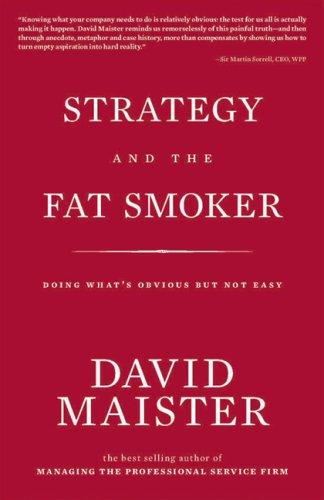
Strategy and the Fat Smoker
Doing What's Obvious But Not Easy
Real strategy is not analytical insight. It is resolve. Compared to others, do more of what everybody already knows they should do. The tools are management practices, not planning frameworks.
A book summary and review by Bruce Eckfeldt
Overview
Strategy and the Fat Smoker is David Maister’s synthesis book, drawn from twenty-five years of consulting to professional service firms and organized into nineteen chapters. The central metaphor is stated in the title. Everyone knows a fat smoker should quit smoking and lose weight. Most fat smokers know it, too. They still do not do it. Maister argues that most business strategy failures have the same shape. Firms know what they should do. They can name it precisely. They still do not do it. The gap is not analytical. It is behavioral, cultural, and managerial. The book is Maister’s attempt to name why the gap persists and what actually closes it.
The formulation is compact and often quoted. Real strategy lies not in figuring out what to do, but in devising ways to ensure that, compared to others, we actually do more of what everybody knows they should do. The book’s audience is the leadership of professional service firms, legal, accounting, consulting, advisory, and by extension any founder-led business whose product is knowledge work and whose people can walk out the door. Maister’s specific claim is that strategy in these firms is a problem of organizational design and management practice, not of positioning or analysis. He develops the argument across four sections. Strategy, which is about resolve and about saying no. Client relationships, which are the durable source of the firm’s economics. Management, which is where the culture is actually built one person at a time. And a closing synthesis on the multi-office firm and what Maister calls the three P’s, passion, people, and principles.
Real strategy is not analytical insight. It is resolve. Compared to others, do more of what everybody already knows they should do. The tools are management practices, not planning frameworks.
Chapter Summaries
Chapter 1: Strategy and the Fat Smoker
The opening chapter names the central metaphor and the book’s core proposition. Strategic planning fails for the same reason New Year’s resolutions fail. The rewards of the change are in the future. The disruption, discomfort, and discipline required to earn those rewards are immediate. Firms know what they should do and cannot bring themselves to do it. Maister argues the only meaningful strategic debate is which diet the firm is actually ready to get on.
- Real strategy is not figuring out what to do. Most firms have already figured that out. Real strategy is devising ways to ensure that, compared to others, we actually do more of what everybody knows they should do.
- The rewards of strategic action are in the future. The costs, in disruption, discomfort, and discipline, are immediate. Almost every strategic failure comes from the imbalance between the two.
- Strategic planning’s outcome should be resolve, not analytical insight. If a planning process ends with a smarter document and no commitment to change behavior, it has failed.
Chapter 2: Strategy Means Saying No
The second chapter argues that a firm with no criterion for turning business away has no strategy. Strategy is deciding whose business you will not accept, which markets you will not serve, and which services you will not provide. Maister draws on Wickham Skinner’s focused-factory work and argues that the only competitive advantage is courage. The chapter names the specific behavior that separates firms with strategy from firms with a sales function.
- If you can’t afford to say no until you are successful and distinguished, you’ll never be successful and distinguished. Maister names this as the defining paradox of professional-firm strategy.
- Any business that tries to deliver all four virtues of quality, cost, variety, and speed is doomed. The wider the customer group and the broader the service range, the less customized any offering can be.
- The test of a strategy is what the firm will not do. A strategic plan that lists only what the firm will pursue is not a strategy. It is an expansion plan.
Chapter 3: It's Not How Good You Are, It's How Much You Want It
The third chapter argues that most firms perform at the level their commitment allows, not the level their capability allows. Raising capability without raising commitment produces no change in performance. Raising commitment usually raises performance quickly. Maister uses his own career as illustration and lands on drive and determination as the ingredients most predictive of sustained professional success.
- Firms perform at roughly the level their commitment supports, not the level their capability allows. Raising capability alone produces no measurable improvement.
- Lifelong drive and determination beat early credentials over a career. Rebounding from failure and renewing effort is the pattern that distinguishes the professionals Maister has watched succeed.
- The question is not whether the firm is capable. The question is whether the firm wants the outcome badly enough to accept the specific discomfort required to earn it.
Chapter 4: Are We In This Together?
The fourth chapter names the precondition for any strategic move. Strategy cannot be executed if the top leadership does not share a world view. A five-person leadership team where two members are running different plays will destroy any strategy set for them, regardless of how well the strategy is designed. Maister argues the alignment work must be done before the strategic work begins, and it usually is not.
- The alignment test is whether the top team can look each other in the eyes and commit to the specific decision rules the strategy requires. If any member cannot, the strategy will not hold.
- Members of the top team who are not committed to the strategy must be removed quickly. This is Maister’s most direct recommendation and the one leaders most consistently fail to act on.
- The precondition work is not motivational. It is a specific conversation about the operating rules, the trade-offs, and the behaviors each member of the top team is committing to hold to.
Chapter 7: The Friendship Strategy
Chapter seven, one of the book’s most quoted, argues that trusted business relationships are built on the same mechanics as personal friendships. Attention, interest, generosity of time, follow-through, and the willingness to say things the other person does not want to hear. Maister argues the trusted advisor is not the one with the ready answer. The trusted advisor is the one who asks questions well, listens, and makes the other person want to talk about themselves.
- Trusted relationships are built on friendship mechanics. Attention, interest, generosity of time, and the willingness to say hard things. None of these are transactional and none of them scale through processes.
- The trusted advisor is not the one with the ready answer. The trusted advisor is the one who, through questions and a conversational style, puts the other person at ease and engages in a real dialogue.
- The willingness to say hard things is the signature of a trusted relationship. Advisors who only tell the customer what the customer wants to hear are not trusted. They are convenient.
Chapter 10: Why Most Training Is Useless
Chapter ten is Maister’s provocation about leadership development. Firms that spend heavily on training programs while leaving the measurement, coaching, and consequences systems unchanged produce trained employees who continue behaving as before. Training in isolation almost never changes behavior. Behavior change requires explicit expectations, individual coaching over months, measurement of the behavior, and consequences for compliance and non-compliance.
- Behavior change requires four elements. Explicit expectations. Individual coaching. Measurement. Consequences. Training programs by themselves supply only the first, and often not even that.
- The specific alternative Maister develops in the next chapter, A Great Coach in Action, is one manager working with one person over months. The work is done one person at a time and cannot be delegated to a program.
- People will never live up to higher standards than their manager exhibits. The manager’s personal example is the ceiling, and no training program can raise the ceiling above the manager’s own behavior.
Chapter 13: Accountability: Effective Managers Go First
Chapter thirteen names accountability as Values In Action and argues that accountability systems fail unless the manager holds themselves to the standard first. If the standard is that people arrive prepared to meetings, the manager is the first to arrive prepared. If the standard is that commitments are kept, the manager’s commitments are kept without exception. Going first is not symbolic. It is what makes the standard actually operate.
- Accountability is Values In Action. It is not a system or a document. It is the specific behavior of specific people, starting with the manager.
- The manager is the first person the accountability applies to. Any manager who invokes accountability for the team while exempting themselves destroys the system.
- The willingness to hold oneself to the same standard as the team is the leadership disposition Maister argues most partner-selection processes fail to test for.
Chapter 15: The One-Firm Firm Revisited
Chapter fifteen returns to Maister’s most-cited earlier article and revises its argument twenty-two years on. Firms that build institutional loyalty and shared operating standards outperform firms that operate as collections of individually loyal practices. The premium is real and comes from the coordination the one-firm structure enables. The cost is that some highly productive individuals will not accept the operating standards and will leave. Maister covers selective recruiting, alumni management, lateral hiring, and compensation as the operating levers.
- The one-firm firm outperforms the warlord model of loosely federated star performers. The premium is real and comes from coordination, cross-selling capacity, and the institutional loyalty the model produces.
- The model requires selective recruiting, careful alumni management, restrained lateral hiring, and compensation schemes that reward institutional contribution. Skipping any of these erodes the model quickly.
- The stress of boom times is what breaks the one-firm firm. Rapid growth pulls the firm toward the warlord model unless the leadership actively holds the operating standards.
Chapter 18: The Chief Executive's Speech
Chapter eighteen provides an actual speech template. The CEO names the strategic choice, names the trade-offs, names what will not be done, and commits publicly. The speech covers values and principles, the role of the partner, accountability, evaluations, managers, and clients. The chapter is not motivational rhetoric. It is a set of specific operating commitments the leadership team can be held to and that the rest of the organization can reference.
- The speech names the strategic choice, names the trade-offs, names what will not be done, and commits publicly. Drafting it forces the specific choices the strategy has been ducking.
- The speech is a set of operating commitments, not motivational language. Each commitment is specific enough that the leadership team can be held to it in the next quarterly review.
- Every subsequent operating conversation refers back to the speech. Without a public commitment of this kind, the strategy remains an internal document with no accountability surface.
Chapter 19: Passion, People, and Principles
The closing chapter is Maister’s synthesis. Have passion, real passion, for the work you do. Care for and develop the individual people who do it. Set principles you actually operate by and hold to them without exception. The three P’s are the operating architecture of firms that produce sustained superior performance in the professional-service context. The three interact. Passion without principles produces energy without direction. Principles without people produces bureaucracy. People without passion produces comfortable mediocrity.
- The principles are the specific decision rules the leadership actually operates by, not the stated values in the marketing collateral. The test is whether the leadership can name the last time a principle was applied against short-term financial interest and the principle won.
- Care for and develop the individual people. Maister argues this is not soft management. It is the specific commitment that produces both the retention and the capability the firm’s economics depend on.
- Passion is not enthusiasm. Passion is the willingness to keep doing the difficult work when the enthusiasm is gone. It is closer to commitment than to emotion.
About the Author
David Maister was born in London in nineteen forty-seven and became a United States citizen in two thousand six. He studied mathematics, economics, and statistics at the University of Birmingham, took a master’s in operations research at the London School of Economics, and received a doctorate in business administration from Harvard Business School in nineteen seventy-six. He was on the faculty of the University of British Columbia for two years and of Harvard Business School from nineteen seventy-nine to nineteen eighty-five, when he left academia for full-time consulting. He retired from consulting in two thousand nine and lives in Boston.
Maister is widely regarded as one of the leading authorities on the management of professional service firms. Tom Brown named him in the top forty business thinkers in two thousand two. His earlier books include Managing the Professional Service Firm, considered the field’s foundational text, True Professionalism, Practice What You Preach, The Trusted Advisor with Charles Green and Robert Galford, and First Among Equals with Patrick McKenna. Strategy and the Fat Smoker was published in two thousand eight and represents the synthesis of his consulting career. The book draws on a series of essays and articles Maister posted online across two thousand five to two thousand seven, revised and expanded into nineteen chapters.
Key Takeaways
1) Real strategy is resolve, not analysis.
The book’s central claim, and the one Maister returns to in nearly every chapter. Most firms have figured out what they should do. Their strategy documents are coherent. Their positioning is defensible. They still do not do the things the documents say. The gap between knowing and doing is the actual strategic problem. Closing it requires resolve, which Maister treats as a specific management capacity, not a personality trait. Resolve is built through commitment, measurement, accountability, and consequences, and it can be raised or lowered by the specific practices the firm’s leadership actually operates.
- The rewards of strategic action are in the future. The costs, in disruption, discomfort, and discipline, are immediate. Almost every strategic failure comes from the imbalance between the two.
- Strategic planning’s outcome should be resolve, not analytical insight. If a planning process ends with a smarter document and no commitment to change behavior, it has failed.
- Firms perform at roughly the level their commitment supports, not the level their capability allows. Raising capability without raising commitment produces no change in performance.
2) Strategy means saying no.
Maister argues that a firm with no criterion for turning business away has no strategy. Every firm can pursue every opportunity, and firms that do end up with no strategic distinction. Strategy is deciding whose business you will not accept, which markets you will not serve, and which services you will not provide. The difficulty is not analytical. Any leadership team can name the opportunities that do not fit the strategy. The difficulty is behavioral. Saying no to real revenue in front of you, in favor of hypothetical revenue that might come later from better-fit opportunities, is the specific discipline strategy requires.
- If you can’t afford to say no until you are successful and distinguished, you’ll never be successful and distinguished. Maister names this as the defining paradox of professional-firm strategy.
- Any business that tries to deliver all four virtues of quality, cost, variety, and speed is doomed. The wider the customer group and the broader the service range, the less customized any offering can be.
- The test of a strategy is what the firm will not do. A strategic plan that lists only what the firm will pursue is not a strategy. It is an expansion plan.
3) Client relationships are built on the mechanics of friendship.
Maister’s second-most-quoted chapter argues that trusted business relationships are built on the same formula as personal friendships. Attention, interest, generosity of time, follow-through, and the willingness to say things the other person does not want to hear. Firms that treat relationships as revenue-generation tools produce weaker economics than firms that treat relationships as ends in themselves. The paradox is that treating the relationship as the goal produces more revenue than treating revenue as the goal. Maister’s operating recommendation is that firms measure and reward relationship investment explicitly, not just billings.
- The trusted advisor is not the one with the ready answer. The trusted advisor is the one who asks questions well, listens, and makes the other person want to talk about themselves.
- Most professionals say they want long-term relationships and behave as though they want a one-night stand. The behavioral test is whether the professional invests time with no immediate revenue prospect.
- The willingness to say hard things is the signature of a trusted relationship. Advisors who only tell the customer what the customer wants to hear are not trusted. They are convenient.
4) Most training is useless without the surrounding system.
Maister’s provocation is that firms that spend heavily on training programs while leaving the measurement, coaching, and consequences systems unchanged produce trained employees who continue behaving as before. Training in isolation almost never changes behavior. The behavior change requires the surrounding system, including explicit expectations, individual coaching over months, measurement of the behavior, and consequences for compliance and non-compliance. The training itself is a small component, and by itself it does almost nothing. The chapter reads as a critique of the leadership-development spending patterns of most professional-service firms.
- Behavior change requires four elements. Explicit expectations. Individual coaching. Measurement. Consequences. Training programs by themselves supply only the first, and often not even that.
- The specific alternative Maister develops is the great coach in action. One manager working with one person over months. The work is done one person at a time and cannot be delegated to a program.
- People will never live up to higher standards than their manager exhibits. The manager’s personal example is the ceiling, and no training program can raise the ceiling above the manager’s own behavior.
5) Accountability means the manager goes first.
Maister names accountability as Values In Action, and argues that accountability systems fail unless the manager holds themselves to the standard first. If the standard is that people arrive prepared to meetings, the manager is the first to arrive prepared. If the standard is that commitments are kept, the manager’s commitments are kept without exception. Going first is not symbolic. It is what makes the standard actually operate. A manager who exempts themselves from the standard destroys it for everyone under them, regardless of what the accountability system on paper says. The chapter is one of the book’s most direct challenges to leadership behavior.
- Accountability is Values In Action. It is not a system or a document. It is the specific behavior of specific people, starting with the manager.
- The manager is the first person the accountability applies to. Any manager who invokes accountability for the team while exempting themselves destroys the system.
- The willingness to hold oneself to the same standard as the team is the leadership disposition Maister argues most partner-selection processes fail to test for.
6) Passion, people, and principles are the operating architecture.
The book’s closing synthesis. Have passion, real passion, for the work you do. Care for and develop the individual people who do it. Set principles you actually operate by and hold to them without exception. Maister argues these three P’s are not motivational rhetoric. They are the operating architecture of firms that produce sustained superior performance in the professional-service context. The three interact. Passion without principles produces energy without direction. Principles without people produces bureaucracy. People without passion produces comfortable mediocrity. All three, held together, produce the firms that outperform over decades.
- The principles are the specific decision rules the leadership actually operates by, not the stated values in the marketing collateral. The test is whether the leadership can name the last time a principle was applied against short-term financial interest and the principle won.
- Care for and develop the individual people. Maister argues this is not soft management. It is the specific commitment that produces both the retention and the capability the firm’s economics depend on.
- Passion is not enthusiasm. Passion is the willingness to keep doing the difficult work when the enthusiasm is gone. It is closer to commitment than to emotion.
7) Top-team alignment is the precondition, not the outcome.
Maister argues that strategy cannot be executed if the top leadership does not share a world view. A five-person leadership team where two members are running different plays will destroy any strategy set for them, regardless of how well the strategy is designed. The precondition for strategy is a top team that has sat together, looked each other in the eyes, and agreed to the same operating rules. If any member of the top team has not signed up for the journey, no amount of systems, speeches, or planning will get the organization there. The alignment work must be done before the strategic work begins, and it usually is not.
- The alignment test is whether the top team can look each other in the eyes and commit to the specific decision rules the strategy requires. If any member cannot, the strategy will not hold.
- Members of the top team who are not committed to the strategy must be removed quickly. This is Maister’s most direct recommendation and the one leaders most consistently fail to act on.
- The precondition work is not motivational. It is a specific conversation about the operating rules, the trade-offs, and the behaviors each member of the top team is committing to hold to.
Strengths and Limits
The book’s strength is that Maister refuses the compromise most business books make. He argues that the strategic problem in almost every professional-service firm is not analytical. It is behavioral, cultural, and managerial, and it is located in specific people at the top of the firm who do not want to do the hard things they know they should do. Most business books soften this argument. Maister does not. He also refuses the companion compromise, that better systems will fix it. His alternative is that the manager goes first, models the behavior, holds themselves to the standard, and does the coaching one person at a time. This is uncomfortable reading for anyone whose management practice relies on programs and processes rather than on personal example. The applications are specific enough to be tested against real leadership behavior. The three P’s, the friendship strategy, the discipline of saying no, the accountability chapter, and the chief executive’s speech all translate into concrete commitments a leadership team can be held to. The book is short, at roughly two hundred and seventy pages, and the chapters can each stand alone, which makes it a useful reference volume for a leader who wants to revisit one theme at a time.
The limits are real. The book is written for professional-service firms, and its examples, legal, accounting, consulting, and advisory, do not always translate cleanly to product-based businesses or to founder-led companies whose economics come from products rather than from customer relationships. Readers outside the professional-service context will have to do the translation work themselves. The book was compiled from a series of essays and articles, and the composition shows. Some chapters overlap, and the argument occasionally circles rather than progressing linearly. Readers looking for a single sequenced framework will find the book’s structure less satisfying than its individual chapters. Maister’s diagnostic is also stronger than his prescription. He is precise about why firms fail to execute their strategies. His prescriptions, while sound, are more general and require the reader to construct the specific operating changes their firm needs. Readers who want the specific mechanics of running a professional firm should read this alongside Maister’s earlier Managing the Professional Service Firm, which is more prescriptive.
My Take
This is the book I hand to founder-CEOs whose strategy off-sites produce a thick document and no behavior change. Maister’s diagnosis holds exactly for the market I work in. The gap between what a five-to-fifty-million-dollar company’s leadership team knows it should do and what it actually does is almost never analytical. It is a resolve problem, and resolve is built through the specific practices Maister names. The chapter on saying no, the accountability chapter, and the chief executive’s speech are the three I return to most often in my advisory work.
The book plays differently across contexts. In a professional services firm, legal, accounting, consulting, or advisory, the whole book applies directly and the language carries. In a product company, whether SaaS or industrial, the friendship-strategy chapter and the one-firm-firm chapter need translation, and the reader should think in terms of the top account relationships and the operating culture rather than the partner model. For founder-CEOs approaching exit, the accountability and manager-goes-first chapters are the single best diagnostic I have found for whether the leadership team can run the company without the founder. If the manager exempts themselves from the standard, no acquirer will pay for the operating system.
The sharpest outside objection comes from Rita McGrath, who has argued for years that commitment to a fixed strategy is what kills firms in transient markets. Her critique lands for early-stage or platform-shift contexts, where the discipline of saying no can become the discipline of missing the pivot. It lands less for the growth-stage market I work in. Most of my clients do not have a strategy commitment problem in McGrath’s sense. They have the Maister problem. They have a strategy on paper and a leadership team that will not hold to it under quarterly pressure.
The book Fat Smoker leaves incomplete is the operating manual. Maister is exact on why firms fail to execute and general on how to build the system that would make execution reliable. Read Fat Smoker first for the argument. Then read Patrick Lencioni’s The Advantage for the top-team alignment mechanics Maister names as the precondition, and Verne Harnish’s Scaling Up for the operating rhythm that turns commitment into weekly behavior. The combination is what my growth-stage clients actually run.
Discussion Questions
For CEOs
- For each of the top three commitments your current strategy requires the leadership team to hold to, which specific behaviors in the last quarter would signal you are actually holding to them, and which behaviors would signal you are not?
- What is your firm’s explicit criterion for declining business, and when was the last time you actually declined a real revenue opportunity because it did not fit that criterion?
- For your firm’s ten most important customer relationships, how much time have your senior partners invested in the last quarter that was not billable and had no immediate revenue prospect? What does that number tell you about how you actually treat relationships?
- For the behavioral standards you hold your team to, arriving prepared, keeping commitments, having the hard conversations, are you meeting the same standards without exception, and if not, what does that do to the standards?
- In your last three major training or leadership-development initiatives, what percentage of the behavior change the training was designed to produce is still visible in daily practice six months later, and what does that say about the surrounding system?
- Which members of your top leadership team have plainly not signed up for the current strategy, and what would it cost you to keep them in position through the next twelve months versus to move them out?
- For each of the three principles you say govern your firm, can you name a specific recent decision where the principle was applied against short-term financial interest and the principle won?
- If you had to draft the chief executive’s speech Maister describes, in which you named the strategic choice, the trade-offs, and what will not be done, could you deliver it today without hedging, and if not, what is the specific hedge?
For Teams
- Compared to our stated strategy, what are we actually doing more of, and what are we actually doing less of? Where is the biggest gap between what we say and what we do?
- What business have we accepted in the last twelve months that our strategy says we should have declined, and what would it have cost us to say no?
- For our most important customer relationships, do we invest time that is not immediately billable and has no immediate revenue prospect, and if not, what would change if we did?
- In our daily practice, which of our stated values are we actually operating by, and which are on the marketing collateral but not in our behavior?
- For each of the standards our managers hold us to, are our managers meeting the same standards without exception, and where they are not, what does that do to the credibility of the standard?
- When was the last time we invested in a customer relationship that produced no measurable short-term revenue, and what happened to that relationship over the following two years?
- In our last leadership-development or training investment, what specific behavior was the investment supposed to produce, and how much of that behavior is now visible in our daily work?
- If our top team was asked to name the three principles that govern this firm, would we give the same three answers, and would we be able to name a recent decision where each principle was applied against short-term interest?
Practical Tools
1. The Say No List
Maister argues that a firm with no criterion for turning business away has no strategy. The Say No List is the operational form of the criterion. It names the types of business, customers, sectors, project shapes, or engagement structures the firm has committed to declining, and it publishes the list so that individual partners cannot quietly accept the misaligned work. Use it when the firm’s strategy is stated but partners continue accepting work that does not fit, or when the leadership team is drifting into revenue opportunities that dilute the strategic focus.
How it works:
- Draft the list. Include specific business types, customer profiles, sectors, or engagement structures that do not fit the current strategy. Aim for six to ten items, specific enough that a partner can look at a real opportunity and know whether it belongs on the list.
- Review with the leadership team. For each item, ask each partner whether they commit to declining it the next time it appears. Any partner unwilling to commit is the strategic obstacle. The list waits until the obstacle is resolved.
- Publish the list. Distribute to the leadership team and to whoever else in the firm makes acceptance decisions. Post it where it will be seen weekly.
- Set a review cadence. Every ninety days, review the list against the opportunities the firm has accepted. For each accepted opportunity that conflicted with the list, name specifically why the list was overridden and what the override cost.
- Update the list. As the strategy sharpens, the list sharpens. A stable list is a sign the strategy is holding. A frequently overridden list is a sign the strategy is not.
The firm’s leadership team can point to specific opportunities declined in the last quarter because of the list, and can point to how the freed capacity was redirected to the strategic priorities. The strategy is no longer just a document.
2. Top-Team Alignment Conversation
Strategy cannot be executed if the top leadership does not share a world view. The alignment conversation is the specific working session that surfaces whether each member of the top team is committed to the same operating rules. Maister argues this work must be done before the strategic work begins, and that most firms skip it and then wonder why the strategy does not execute. Use it before any major strategic move, when a previous strategy has failed to execute, or when the leadership team’s behavior in operating reviews is inconsistent with the stated strategy.
How it works:
- Name the three to five operating rules the strategy requires the top team to hold to. Write them as specific behaviors, not as principles. For example, we decline any engagement under a threshold size, or we invest twenty percent of senior partner time in relationships without near-term revenue.
- Convene the top team in one room. Ideally without other staff present. Present the operating rules one at a time. For each, go around the table and ask each member to commit publicly to holding to the rule, or to name the specific objection.
- Work each objection. Where a member cannot commit, understand why. Sometimes the rule needs adjustment. Sometimes the member is not aligned with the strategy and the strategy has to change or the member has to leave.
- Publish the operating rules with the commitments. The written commitment, from each named member of the top team, is what the accountability system will refer back to.
- Set a ninety-day review. At each review, name the rules that were held to and the rules that were not. For each rule not held to, name the specific member and the specific incident. This is the accountability the rest of the firm’s accountability will build on.
The top team leaves the conversation aligned on specific behavioral commitments, with each member’s commitment in writing. Subsequent strategic execution is measurably faster and holds through operating pressure. The strategy stops being a document and becomes a set of specific commitments the top team is operating under.
3. Relationship Investment Audit
Firms that manage relationships to maximize short-term revenue produce weaker long-term economics than firms that manage relationships as ends in themselves. The audit surfaces whether the firm’s stated commitment to relationships is real, by measuring the specific behavior, non-billable time invested in customer relationships with no near-term revenue prospect, against the firm’s stated priorities. Use it when the firm’s stated strategy emphasizes long-term relationships but the compensation and measurement systems reward billings, or when senior partners are visibly under time pressure and relationship investment is being squeezed.
How it works:
- List the firm’s top ten customer relationships. For each, name the senior partner responsible for the relationship.
- For each relationship, ask the responsible partner to estimate the hours invested in the last quarter that were not billable and had no immediate revenue prospect. This includes time spent understanding the customer’s business, introducing them to useful contacts, sharing analysis or insight that was not requested, and simply being present without an agenda.
- Compare the totals across partners. Note the pattern. Which partners invest meaningfully, and which are net revenue-extractive from their relationships? The pattern is usually visible and rarely surprising.
- Redesign the measurement. Add relationship-investment time as an explicit measure in partner reviews. Set a target, not a punishment. Aim for a percentage of senior partner time, perhaps ten to twenty percent, dedicated to non-billable relationship investment.
- Track the outcome over eighteen months. Relationships that receive investment produce measurably more revenue, better retention, and better referral flow than relationships that do not. The economics support the investment, and the measurement makes the investment happen.
Senior partners can name the specific non-billable investments they made in each of their top relationships in the last quarter. The firm’s revenue mix shifts toward the invested relationships. Retention improves. The stated commitment to relationships becomes visible in the compensation system.
4. Manager Goes First Standards Review
Accountability systems fail when the manager exempts themselves from the standard. The Manager Goes First review is the specific practice of checking the manager’s own behavior against the standards the manager holds the team to, and either raising the manager’s behavior or removing the standard. Maister’s argument is that no accountability system can function on paper if the manager is not the first person the accountability applies to. Use it when the team’s engagement scores are low despite a formal accountability system, when the manager is receiving pushback on standards they hold the team to, or as a quarterly discipline for any manager committed to their own development.
How it works:
- List the top three behavioral expectations the manager holds the team to. Examples. Arrive prepared to meetings. Keep commitments without exception. Have the hard conversation before it becomes a bigger problem. Return communications within a stated time frame.
- For each expectation, ask specifically whether the manager has met the same standard without exception in the last thirty days. Not roughly. Not most of the time. Without exception.
- Where the manager has not met the standard, choose one of two responses. Raise the manager’s behavior to the standard. Or remove the standard.
- Communicate the change to the team. If the manager has raised their behavior, say so specifically. If the standard has been removed, say so specifically and explain why. Do not leave the team holding to a standard the manager has quietly exempted themselves from.
- Repeat quarterly. The review is not a one-time exercise. It is the discipline that keeps the accountability system honest.
The manager can name the specific behaviors they hold the team to, and can point to their own recent behavior as evidence they are holding to the same standard. Team engagement rises because the standard is credible. The accountability system produces the behavior it was designed to produce.
5. Chief Executive’s Speech Draft
Maister provides an actual speech template. The CEO names the strategic choice, names the trade-offs, names what will not be done, and commits publicly. The speech is not motivational rhetoric. It is a set of specific operating commitments the leadership team can be held to. Drafting it forces the specific choices the strategy has been ducking. Use it when the firm’s strategy is stated but not committed to publicly, when a new strategic direction requires the organization to align, or as a discipline for the CEO to force clarity on their own strategic choices.
How it works:
- Name the strategic choice in one sentence. What is the firm choosing to be. Not what it is choosing to do, but what it is choosing to be. If the sentence cannot be written in fifteen words, the choice is not clear yet.
- Name the trade-offs. For each strategic priority, name what the firm is choosing not to do, not to serve, not to be. Be specific. General trade-offs are not trade-offs.
- Name the operating commitments. Three to five specific behaviors the leadership team is committing to hold to for the strategy to work. These are the commitments the accountability system will refer back to.
- Draft the speech. Roughly two to three pages, spoken aloud. Include the choice, the trade-offs, the commitments, and a specific plan for what happens in the next ninety days.
- Test it with the top team before delivering it. If any member of the top team cannot commit publicly to the operating commitments in the speech, the speech cannot be delivered until the alignment is resolved.
- Deliver it. Publicly, to the whole organization. Post the text. Refer back to it in every quarterly review.
The organization can name the strategic choice, the trade-offs, and the operating commitments a month after the speech. Leadership behavior in the following months is measurably consistent with the commitments. The strategy stops being an internal document and becomes a shared understanding of what the firm is choosing to be.
6. One Person At A Time Coaching Plan
Training separated from measurement, coaching, and consequences almost never changes behavior. Maister’s alternative is the great coach in action. One manager working with one person over months, on specific behaviors, with specific feedback. The coaching plan operationalizes the alternative. Use it after a training program has failed to produce the intended behavior change, or in place of a training program when the behavior change matters enough to justify the manager time it requires.
How it works:
- Name the specific behavior the coaching is designed to produce. Not a capability. A behavior. For example, running the pre-call preparation checklist before every customer meeting, or having the difficult performance conversation within seven days of the trigger event.
- Identify the person the coaching is for. One person. Not a group. If multiple people need the coaching, each has their own separate coaching relationship.
- Schedule the sessions. Weekly, thirty to sixty minutes, for at least twelve weeks. The cadence is what makes the behavior change hold.
- In each session, name the specific instances of the behavior since the last session. What was done well, what was done poorly, what will be done differently in the coming week. Not general reflection. Specific instances.
- Measure the behavior across the twelve weeks. Not the person’s self-report. The actual behavior, observed by the manager or by peers. Adjust the coaching to the specific gap.
- At the end of twelve weeks, assess whether the behavior has become durable practice. If yes, close the coaching. If not, extend or escalate the consequence.
The person’s specific behavior changes measurably over the twelve weeks and holds after the coaching closes. The manager builds a template for future coaching relationships. The firm produces trained employees who actually practice the behavior, which is what the training program was supposed to produce and could not.
7. Three P’s Operating Check
Passion, people, and principles are Maister’s closing synthesis. They interact. The operating check is the specific annual exercise of assessing whether all three are present in the firm’s actual operations, and where any of them has quietly weakened. The check surfaces the drift before the drift becomes strategic damage. Use it once a year, in the leadership team’s annual planning cycle, or when the firm’s performance is holding but the team’s energy is declining, which is usually the first sign a P is drifting.
How it works:
- Passion. Ask each member of the leadership team to describe, in specific language, what excites them about the firm’s work this year. Compare answers. If the answers are generic or if any member cannot answer, passion has drifted.
- People. For each member of the leadership team, ask how many hours they have invested in the development of a specific person in the last quarter, and name the person and the specific development activity. If the answers are small or general, people has drifted.
- Principles. Ask each member to name the three principles that govern the firm’s decisions, and to name a specific recent decision where the principle was applied against short-term interest and the principle won. If the answers differ across the team or the recent examples are absent, principles has drifted.
- Identify which of the three P’s has drifted the most. Design one specific operating change to strengthen it over the next ninety days. Not a program. A specific behavior change in the leadership team.
- Repeat the check in ninety days. Track whether the drift has been corrected. The three P’s are not achieved once. They are maintained continuously.
The leadership team can name specifically what excites them, who they are developing, and what principles they are operating by, with recent examples for each. Where any of the three is weak, the team has identified it and has a specific operating change in flight. The firm’s cultural architecture is under active maintenance rather than drifting toward mediocrity.
Further Reading
- David Maister’s Managing the Professional Service Firm, the foundational text for the field and the reference volume Fat Smoker builds on. Read alongside Fat Smoker for the mechanics of running a professional firm, where Fat Smoker focuses on the leadership behaviors.
- David Maister, Charles Green, and Robert Galford’s The Trusted Advisor, the book-length development of the friendship strategy Maister sketches in Fat Smoker’s chapter seven. The definitive book on how professional-service relationships are actually built.
- David Maister and Patrick McKenna’s First Among Equals, on managing peers in professional service firms. Complementary to Fat Smoker on the specific difficulty of managing highly capable independent-minded professionals.
- Patrick Lencioni’s The Advantage, which develops the top-team alignment argument Maister makes in the Are We In This Together chapter into a full framework. The natural companion for readers who want the operating detail on how to build the alignment Maister argues is the precondition for strategy.
- Jim Collins’s Good to Great, which develops several of the leadership dispositions Maister names, particularly the disciplined-people, disciplined-thought, disciplined-action sequence. Reads well alongside Fat Smoker for the same underlying argument that the difference between firms is behavioral and cultural, not analytical.
Share This Review

Bruce Eckfeldt is a business coach and strategic advisor to founder-CEOs of growth-stage companies, a former Inc. 500 CEO, and the author of Springboard. More book reviews →
These summaries present Bruce Eckfeldt’s analysis of business and leadership books for founder-CEOs and leadership-team members of growth companies. Each one identifies the ideas most relevant to decision quality, strategy, and leadership capacity, notes where the evidence is weak, and suggests practical ways to test what is worth testing. All ideas, stories, and quotations belong to the original author and to the people they cite. The assessments and recommendations are Bruce’s. It is a companion to the book, not a substitute for reading it.
To learn more about Bruce’s programs, request other book summaries, or get in touch, contact booksummaries@eckfeldt.com.
Get the Next Review.
A new book review lands in Better, Faster, my weekly newsletter for founder-CEOs, along with one practical essay and questions for your team.