Trillion Dollar Coach
The Leadership Playbook of Silicon Valley's Bill Campbell
No leader builds an enduring company alone. The manager's real work is to build the team that builds the company, and coaching is the discipline through which that team is built.
A book summary and review by Bruce Eckfeldt
Overview
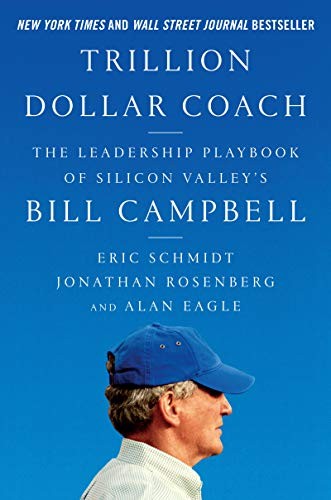
Trillion Dollar Coach is a portrait of Bill Campbell, the former Columbia football coach who became the most influential executive coach in modern technology, and an attempt to distill his practice into rules other leaders can apply. Campbell worked closely with Steve Jobs, coached Google under Larry Page, Sergey Brin, Eric Schmidt, Sundar Pichai, and Jonathan Rosenberg, and advised leadership teams at Apple, Intuit, and dozens of other companies until his death in 2016. Schmidt, Rosenberg, and Eagle wrote the book to preserve what Campbell taught them and to argue that his method is teachable rather than idiosyncratic.
The book alternates biography with principles, drawn from more than eighty interviews with executives Campbell worked with, and cross-referenced against organizational research on trust, psychological safety, and team performance. Its central operating claim is that the leadership team is the strategic asset, and that the manager’s job is to build the community around it. Trust, candor, and genuine care are treated as operating disciplines, not soft cultural aspirations.
No leader builds an enduring company alone. The manager’s real work is to build the team that builds the company, and coaching is the discipline through which that team is built.
Chapter Summaries
Chapter 1: The Caddie and the CEO
The opening chapter traces Campbell’s route from head football coach at Columbia to operating executive at Kodak, Apple, and Intuit, and then to full-time coach of Silicon Valley’s most valuable companies. The point of the biography is not the arc. It is that his coaching effectiveness came from having been an operator himself, and that his credibility with founders rested on refusing equity, refusing publicity, and treating the work as a calling.
- The method worked because Campbell had run companies. Executives accepted challenge from someone who had been on their side of the desk, and would have rejected the same challenge from a professional adviser with no operating history.
- He refused stock and speaking fees from the companies he advised. The refusal was operational, not moral. It removed the incentive to tell founders what they wanted to hear.
- The book’s method rests on interviews with more than eighty leaders Campbell worked with, which the authors cross-check against academic research on trust and team performance. That structure produces a stronger evidence base than the typical management memoir, though it still selects on outcomes.
Chapter 2: Your Title Makes You a Manager. Your People Make You a Leader.
The argument of this chapter is that authority and leadership are different, and that leadership is earned through operating practices, not granted by title. The mechanism is specific. When people trust that a manager runs meetings well, resolves conflict openly, and cares whether they succeed, they bring problems earlier and disagree more directly, and the manager’s decisions get better as a result.
- The one-on-one and the staff meeting are the two highest-leverage forums a manager owns. Campbell insisted that both start with a personal check-in he called a trip report. It sounds soft. Its function is to establish that the manager treats people as people before as roles, which is the precondition for candor later.
- Campbell used a fixed five-topic structure for one-on-ones: job performance, peer relationships, management and leadership, innovation and best practices, and any aberrant behavior. The structure keeps the conversation from collapsing into a status report and forces attention onto the parts of a leader’s work that most often decay silently.
- Consensus is presented as a failure mode. Campbell’s rule was to force debate, then decide. Waiting until everyone agrees produces slower decisions and worse ones, because the loudest voice or the least controversial option wins by default.
- First principles are the tool for resolving conflict. When two capable leaders disagree, the manager restates the principles the company has committed to, and asks which option better serves them. This is faster than adjudicating personalities and produces decisions the losing party can accept.
Chapter 3: Build an Envelope of Trust
Trust is treated here as the operating precondition for everything else in the book. The authors reference Google’s Project Aristotle finding that psychological safety was the single strongest predictor of team performance, and argue that Campbell built that safety deliberately. The chapter’s mechanism is that candor is only useful when it lands on a foundation of demonstrated care.
- Campbell worked only with people he considered coachable. His criteria were honesty, humility, perseverance, and a willingness to learn. This is not a personality preference. It is a filter that determines whether feedback will produce growth or defensiveness, and the wrong hire cannot be developed into being coachable.
- Free-form listening is the practice of giving the person in front of you complete attention, no phone, no agenda, no rehearsed next question. Campbell used it to surface what the executive actually thought before offering any view of his own. The mechanism is that people revise their own thinking when they hear themselves out loud without interruption.
- Radical candor was combined with real affection. Campbell was famous for profanity and for telling executives directly when they were wrong, and equally famous for calling to check in when a family member was sick. The book’s claim is that the two are the same practice. Candor without care reads as contempt. Care without candor reads as flattery. Both fail.
- Aberrant genius is tolerated only up to a point. Campbell’s rule was that a disproportionately talented person could be given more latitude, but not to the point of damaging the team. The line is behavior that causes other strong people to leave.
Chapter 4: Team First
The team is treated as the unit of performance, not the individual. Campbell’s operating instinct when a difficult problem appeared was to work the team dynamics before the operational content of the problem. The reasoning is that most persistent business problems are downstream of team problems, and solving the surface issue without fixing the team just moves the problem to the next quarter.
- Work the team, then the problem. Before treating a difficult cross-functional issue as strategic or technical, ask whether the right people are in the room, whether their roles are clear, and whether the team has the relational capacity to resolve the disagreement. If not, no strategy meeting will fix it.
- Identify the top issue first. Campbell often asked leadership teams to name the single most important thing they were working on, and if the answers diverged, that was the meeting. Alignment on priority is treated as prior to any discussion of how.
- Pair unlikely colleagues on projects. This was a deliberate practice, not a preference. Cross-functional trust is built by shared work, not by team-building exercises, and Campbell used stretch assignments to build peer relationships that later carried disagreements without breaking.
- Kill politics by naming the elephant. In one Google board meeting the authors describe, Campbell interrupted a tense conversation about a difficult executive by simply naming the tension aloud. The point is that unnamed tension controls the meeting until someone names it, and the manager is the person expected to do it.
- Cover the bases. After a hard decision, Campbell called every person materially affected, individually and quickly, to explain the reasoning. This closes the gap in which people learn about decisions from someone else and read the delay as disrespect.
Chapter 5: The Power of Love
The chapter’s argument is that companionate love, the affection between colleagues who have worked together for years, is an operating variable. It correlates with lower absenteeism, higher engagement, and stronger performance under pressure, and Campbell cultivated it deliberately. The mechanism is that trust is a stock that pays out most when the company is under stress, and it has to be built during ordinary times.
- Ask about people’s lives outside of work, remember what they said, and follow up. Campbell’s practice was to know spouses and children by name, and to check in when he knew something was hard. This is not sentiment. It is what allows the same person to deliver difficult feedback later without permanent damage.
- Cheer demonstrably. His signature was applauding at meetings for other people’s successes. The public visibility is the point. Private recognition is easily missed, and public recognition changes what the rest of the team believes matters.
- Build communities inside and outside the company. Campbell’s annual Super Bowl trip and his Sunday dinners were not networking. They were the mechanism by which loyalty and trust compounded over years, and by which executives from competing companies stayed willing to help each other.
- Protect founders. Campbell believed founders held something no successor could replicate, which he described as the vision and the soul of the company. His practice was to help founders develop into operators rather than replace them, and he was skeptical of boards that reached for a professional CEO too early.
Chapter 6: The Yardstick
The closing chapter reframes success. Campbell measured his life by the number of great leaders he had helped develop, not by wealth or title. The authors use Schmidt’s own transition out of Google’s chairmanship to make the point that senior leadership is lonely, that mentorship is scarce at that level, and that the only durable legacy is the leaders left behind.
- The yardstick is the number of leaders you built. Any other measure of a manager’s career, including revenue delivered or title held, is downstream of whether the people around them are more capable than when they arrived.
- Provide emotional support during transitions. When a long-tenured CEO steps down, or a founder sells the company, or a leader moves to a new role, the technical questions get attention and the human ones do not. Campbell’s practice was to invert that priority.
- The method is teachable. The book’s practical claim is that Campbell’s approach is not a personality. It is a set of habits any manager can adopt, and the authors present the book as an argument that every manager should try.
About the Authors
Eric Schmidt served as CEO of Google from 2001 to 2011 and as executive chairman until 2017. Jonathan Rosenberg was senior vice president of products at Google from 2002 to 2011 and remains an adviser to Alphabet’s management team. Alan Eagle joined Google in 2007 and worked as a speechwriter to Schmidt and Rosenberg before running sales programs. The three previously co-authored How Google Works.
The credibility of Trillion Dollar Coach rests on the authors’ direct working relationship with Campbell for more than fifteen years. That access produced first-hand material and interviews with more than eighty leaders Campbell advised. It also creates the book’s principal weakness. The authors are describing a mentor to whom they were personally devoted, and the account is consistently generous. Read it with that framing in mind.
Key Takeaways
1) The leadership team is the strategic asset.
The book’s operating claim is that a company cannot outperform the quality of its leadership team over any meaningful horizon. Strategy, capital, and product all pass through the same small group of people, and if that group cannot debate, decide, and execute together, no other advantage survives contact with the market. Campbell’s work was to build that group, not to advise on the strategy the group produced.
- The manager’s first responsibility is to increase the capacity of the people on the team, not to supervise their work.
- Team quality is measured by how the team behaves in disagreement, not by how it behaves when everyone agrees.
- In a founder-led company, the leadership team either becomes independently capable or the company remains bounded by the founder’s bandwidth.
2) Trust is the operating precondition, not the culture chapter.
Google’s Project Aristotle, cited in the book, identified psychological safety as the single strongest predictor of team performance. The book’s contribution is to describe how a manager builds it deliberately, through free-form listening, direct candor paired with real care, and consistent behavior across public and private settings. Trust is treated as a stock that has to be built before it is drawn on, and it is drawn on hardest during a crisis.
- Free-form listening is a specific practice, not general attentiveness. No phone, no agenda, and no rehearsed next question until the other person has finished thinking.
- Direct candor is only useful if the receiver believes the sender cares about them. Reverse the order and the same words register as contempt.
- Coachability is the filter. Honesty, humility, perseverance, and willingness to learn determine whether feedback produces growth or defensiveness, and this filter belongs at the hiring stage, not later.
3) Work the team before the problem.
When a difficult cross-functional problem lands on the leadership team, Campbell’s instinct was to fix the team dynamics first and then the content. The reasoning is that most persistent operating problems are downstream of team problems, and solving the surface issue while the underlying team fault stays intact just moves the problem to a different quarter. This is especially true in growth companies, where the same six or seven leaders handle every major decision.
- Ask first whether the right people are in the room and whether their roles are clear.
- Name the elephant. Unnamed tension controls the meeting until someone names it.
- Cover the bases after a hard decision. People forgive difficult calls faster than they forgive learning about them from someone else.
4) Speaking last is a decision-quality practice.
Campbell taught senior leaders to hold their view until others had spoken. When the CEO speaks first, the debate degrades into agreement or into positioning against the CEO. When the CEO speaks last, other leaders develop the judgment to reason independently, and the CEO gets the information the room actually has rather than the information the room has predicted the CEO wants. The practice is not a substitute for clear decision rights. Speaking last improves the quality of debate. It does not resolve who owns the decision.
- The practice fails when the CEO’s non-verbal signals still front-run the debate. Neutral face and neutral phrasing are part of the discipline.
- The CEO can share the criteria in advance and still hold the specific view until the end. Anchoring on principles is not the same as anchoring on the answer.
- A CEO who never anchors the room can become hard to read, which slows the team. Setting decision rights and rubrics ahead of time is what keeps speak-last from tipping into ambiguity.
5) Community and companionate love are operating variables.
The chapter on love is the one that most often gets dismissed, and the one whose mechanism is easiest to defend. Companionate love, the affection between colleagues who have worked together for years, correlates with lower absenteeism and stronger performance under pressure, in the research the book cites. Campbell built it deliberately through the small acts of knowing families, showing up in hard moments, and cheering demonstrably for other people’s wins.
- Public recognition changes what the team believes matters. Private recognition rarely does.
- The behavior has to be genuine. Performed care is worse than no care, because it signals that care is a tactic.
- The habit compounds over years. Trust built during ordinary work is what allows a team to survive a bad quarter, a firing, or a difficult acquisition without fracturing.
6) Protect founders, and expect them to grow.
Campbell held an unfashionable view for his era. He believed founders carried something successors could not replicate, and his practice was to develop them into operators rather than replace them. He was skeptical of boards that reached for a professional CEO at the first sign of scaling difficulty. The reasoning is that the founder’s judgment on product, mission, and customer is often the company’s most durable edge, and the right answer is usually to build the operating capability around the founder rather than swap in someone new.
- The book is unusually clear on this point, and it runs against a common private-equity and board-consultant instinct.
- The counterweight is that some founders should not become operating CEOs, and the ones who cannot honestly assess this are the highest risk to the company.
- In an exit or succession context, buyers and successors ask a version of the same question. They want to know whether the business can perform if the founder becomes less central.
7) The yardstick is the leaders you built.
The book closes on Campbell’s own measure of success, which is the number of great leaders he helped develop. The point is not sentimental. It is that any other durable measure of a manager’s career is downstream of whether the people around them became more capable, and that in the long run the only legacy that survives is the humans left behind. For a founder approaching exit, this becomes literal. What survives the transaction is what the leadership team can do on its own.
- The measure is observable. In a talent review, ask which leaders on the team have materially grown in the last year, and what specifically they can now do that they could not before.
- This reframes the CEO’s time. The highest-value hour of the week is not the one that produces the most output. It is the one that produces the most leader development.
Strengths and Limits
The book’s strength is that it treats trust, candor, and care as operating disciplines rather than cultural aspirations, and it grounds each in specific and repeatable practices. The five-topic one-on-one, work the team before the problem, speak last, cover the bases after a hard decision, and the coachability filter are all directly usable. The evidence base is stronger than the average management memoir because the authors interviewed more than eighty leaders and cross-referenced the material against Google’s Project Aristotle research and related academic work on psychological safety. The book gives leadership teams plain language for practices most companies claim to want and few operate.
The limits are real. The account is written by three people who were personally devoted to Campbell, and the tone is consistently generous. Every difficult episode is resolved in Campbell’s favor and the counterexamples are missing. The context is also narrow. Nearly every principle is drawn from very large, well-funded, high-margin technology companies in a specific era. A profitable lower-middle-market company managing customer concentration, working capital, and eventual founder succession faces problems the book does not describe, and some of Campbell’s latitude with aberrant geniuses does not survive in a company where any senior departure damages the team materially. Trust is also not a substitute for formal operating disciplines. Unclear decision rights, weak accountability, poor talent fit, and an incoherent strategy do not resolve because the team likes each other. The predictable failure mode is a leadership team that installs the relational practices, feels better, and continues to relitigate the same decisions because no one has clarified who owns them.
My Take
The diagnosis holds. In the growth-stage companies I work with, the binding constraint is almost always the leadership team, not the strategy or the market. When a five-to-fifty million dollar company stalls, it is usually because the founder is still adjudicating decisions that a competent team could resolve without them, and the reason the team cannot resolve them is that the trust, the decision rights, and the meeting rhythm have never been installed. Campbell’s practices are directly applicable here, and the five-topic one-on-one and the speak-last discipline in particular are among the most useful pieces of operating hygiene a founder-CEO can adopt.
The book plays very differently across contexts. In a venture-funded technology company with high margins and durable talent, Campbell’s latitude with aberrant geniuses is affordable. In a lower-middle-market services or industrial company, one difficult senior person can materially damage a small team, and the same latitude is a liability. The book also assumes abundant talent supply and long tenure, and both are weaker outside the Silicon Valley bubble the book was written inside. Growth-stage CEOs should read the principles and be honest about which parts translate.
The most credible outside objection comes from Bob Sutton and Huggy Rao, whose work on scaling excellence argues that individual master coaches like Campbell are exactly the wrong model. Their point is that the practices Campbell modeled did not scale beyond his personal involvement, and that the book confuses one person’s unusual talent with a repeatable system. The objection lands for me. Campbell was a mentor, not a management operating system, and the book overreaches when it presents his habits as fully teachable. The habits are teachable. The judgment about when to apply which one is not.
The book that completes what this one leaves incomplete is Patrick Lencioni’s The Advantage. Read Schmidt, Rosenberg, and Eagle first for the argument that the leadership team is the strategic asset. Read Lencioni second for the operating discipline that installs it, particularly the leadership-team clarity questions and the meeting rhythm that force the practices Campbell modeled to show up on a calendar rather than in an individual’s presence. For the accountability and rhythm layer specifically, ScalingUp by Verne Harnish or Metronomics by Shannon Susko does the same job.
Discussion Questions
For CEOs
- Which decisions still default to me because I have not clearly delegated authority, or because the team does not yet have the capability or confidence to decide?
- Where am I confusing being indispensable with being effective?
- In my one-on-ones, how much time goes to status reporting versus increasing the leader’s capacity to think, decide, and act?
- Whose feedback do I avoid because I am worried about the relationship, and what is the business cost of continuing to avoid it?
- Do people on the leadership team experience my input as clarity, or as a signal that they should wait for my answer?
- If I were unavailable for thirty days, which decisions, relationships, or processes would become fragile? What does that reveal about the team’s readiness?
- Where is a lack of trust preventing a conversation the business needs us to have?
- How would a buyer or successor assess whether this business can perform if I am less central to day-to-day operations?
For Teams
- What is the single most important thing we are working on right now? Do all of us give the same answer without checking?
- Which recurring decisions do we relitigate because we have not agreed on the owner, the principles, or the escalation rules?
- What is the most important cross-functional issue we are currently treating as a people problem, when it may actually be a decision-rights problem?
- When we disagree in a meeting, does the disagreement stay in the room, or does it move to the hallway afterward?
- Where are we tolerating an aberrant genius past the point where the behavior is damaging the team?
- Which peer relationships on this team are still transactional after two or more years together, and what would change if we invested in them?
- When was the last time each of us initiated an uncomfortable conversation with a peer on this team?
- Can each of us clearly explain what we contribute to the enterprise-wide mission, beyond our functional responsibility?
Practical Tools
1. Leadership Independence Review
Campbell’s core operating claim is that leadership-team quality is the strategic asset, and that a company remains bounded by the founder’s bandwidth until the team can decide without them. This review converts that claim into observable operating changes rather than a vague intention to empower the team. Use it when the CEO is the default escalation point for too many decisions, or when the company is preparing for a growth transition, leadership-team redesign, succession, or exit-readiness work.
How it works:
- List the ten decisions that most often reach the CEO in a typical month.
- For each, name the intended owner, the actual decision-maker, and the reason the decision escalates.
- Classify the issue as a decision-rights gap, a capability gap, an information gap, a confidence gap, or an accountability gap. The gap type determines the intervention.
- Choose one or two decisions that should no longer reach the CEO within the next quarter.
- Define the decision standard, the escalation triggers, and the review date, and record them somewhere the team will see them.
The team leaves with a small number of explicit transfers of authority, each with an owner and a review date, rather than a general intention to delegate more. Ninety days later, those decisions no longer reach the CEO, and the first review usually reveals that at least one of the transfers was actually a capability gap rather than a decision-rights gap.
2. Five-Topic One-on-One
Campbell’s fixed structure keeps one-on-ones from collapsing into status updates. The five topics force attention onto the parts of a leader’s work that decay silently: peer relationships, management judgment, innovation, and aberrant behavior. These are the topics leaders avoid in status meetings and the ones that most predict how the leader will handle the next hard problem. Install it as the standing structure for every direct-report one-on-one, and use it especially with any leader whose recent one-on-ones have been dominated by updates and firefighting.
How it works:
- Job performance. What is going well, and where are the results below what you expected.
- Peer relationships. Which relationships are working, which are strained, and why.
- Management and leadership. Where is the leader stretched, and what capability are they actively building.
- Innovation and best practices. What is being learned, adopted, or discarded.
- Aberrant behavior. Anything the leader is tolerating on their team that they should not, or that others are tolerating from them.
The leader raises the peer-relationship and aberrant-behavior topics first, without prompting. That indicates the structure has become the actual mental model, not a form the CEO is running through. The topic that most often gets skipped is aberrant behavior, and the moment either side of the table starts avoiding it is the moment the conversation matters most.
3. Speak-Last Protocol
When the CEO’s early opinion anchors the discussion, other leaders’ judgment does not develop and the debate degrades into agreement or positioning. Speaking last preserves the information the room actually has, and gives leaders the repetitions required to build independent decision-making. Use it in cross-functional decisions where the CEO’s view is likely to anchor the discussion, and as a standing practice when a leadership team appears overly deferential.
How it works:
- Circulate the decision question and the relevant facts twenty-four hours before the meeting.
- Ask each relevant leader to state their recommendation and reasoning before the CEO speaks.
- Clarify at the top whether the group is advising, deciding, or being informed, and who owns the decision.
- Have the CEO speak last, and open by summarizing what they heard and where the reasoning diverges.
- Record the decision, its rationale, dissenting views, and the follow-up actions.
The CEO hears a recommendation they had not considered, from a leader who would not have raised it if the CEO had spoken first. Over time, the same leaders begin reasoning independently between meetings, and the standing question shifts from what does the CEO think to what does the evidence say.
4. Work the Team, Then the Problem
Most persistent operating problems in a growth-stage company are downstream of team problems. Solving the surface issue while the underlying team fault stays intact moves the problem into the next quarter under a new name. Working the team first is what keeps the same issue from returning. Use it whenever a hard operational, strategic, or customer issue is coming to the leadership team for the second or third time, and when the pattern of disagreement matters more than the specific facts on the table.
How it works:
- Ask whether the right people are in the room. If a decision-maker or an affected leader is missing, stop.
- Ask whether roles are clear on this issue. If two leaders think they own it, or if no one does, resolve that first.
- Name the underlying tension aloud. If the group has been avoiding a topic, say it yourself.
- Once the team is aligned on ownership and dynamics, work the content.
- After the decision, cover the bases. Call each person materially affected, individually, to explain the reasoning within twenty-four hours.
The same issue does not return to the leadership team in a different form the following quarter. The step that gets skipped most often is covering the bases. It is unglamorous, feels duplicative, and materially changes how the decision lands. The CEO cannot delegate it.
5. Coachability Filter
Campbell worked only with people he considered coachable, and defined coachability as honesty, humility, perseverance, and willingness to learn. Those traits are close to fixed by the time a leader reaches the senior team. The right place to apply the filter is at the hire, not later, because a candidate who lacks those traits does not develop them under pressure. Use it in every senior hiring decision, and in a talent review when deciding whether to invest development time in a struggling leader.
How it works:
- In interviews, ask for two examples of feedback the candidate initially disagreed with and later accepted. Listen for whether they can name what changed their mind.
- Ask what the candidate is currently trying to get better at, and how they would know if they had.
- Reference-check specifically for how the candidate handles being wrong.
- In a talent review, apply the same three questions to the leader in question before deciding whether to invest another cycle of development.
The company hires fewer leaders who present well and develop poorly, and stops spending development cycles on leaders whose traits are not compatible with the role. The cost of skipping this filter usually shows up at the twelve-month mark, when a leader who looked capable in interviews turns out to be closed to feedback and the seat has to be recut.
6. Team-First Loyalty Check
Campbell prized loyalty to the team over raw individual intelligence. In a growth company, the second loyalty test is silent. It shows up in whether disagreements survive in the room or move to the hallway, and in whether individual leaders trade the team’s priority for their function’s headcount, budget, or comfort. This exercise makes the test visible. Run it once a year at a leadership offsite, and when a new senior leader has been on the team for six months and their behavior in high-stakes decisions has not been tested yet.
How it works:
- Ask each leader to name the enterprise-wide result they are most accountable for, beyond their functional responsibility. If they cannot, that is the finding.
- Ask each leader to describe the most recent decision where they traded a functional interest for a team-wide interest.
- As a group, name the one issue on which the team is currently trading the team-wide interest for peace, or for a specific function’s comfort.
- Decide together what changes in the next quarter. Assign an owner.
At least two leaders name a specific decision where they gave something up for the team. Silence from the whole team is itself the finding. The exercise fails when the CEO answers first, or answers at all before the last leader has spoken. Every voice needs to be in the room before the CEO closes it.
7. Public Recognition Habit
The book’s argument about companionate love is that public recognition changes what the team believes matters, and that private recognition rarely does. Campbell’s signature practice was applauding at meetings for other people’s wins. The mechanism is that the CEO’s attention is the scarcest resource in the room, and where it lands publicly is what the team optimizes for next. Install as a standing practice in the weekly staff meeting, and use it especially in periods when the team is under pressure and recognition is likeliest to go missing.
How it works:
- Open every leadership meeting with two minutes of specific recognition, named to the leader.
- Recognize a decision, a trade-off, or a difficult call, not a personality trait or an outcome the leader did not control.
- Make it public. Recognition delivered privately does not do the same operating work.
- Follow up individually if the win required a real personal cost.
Team members begin recognizing each other without prompting, and the recognition is specific enough that outsiders would understand what actually happened. Performed recognition is worse than none. If the CEO cannot name what the leader did and why it mattered in one sentence, the recognition is skipped and the follow-up happens privately.
Further Reading
- Amy Edmondson on psychological safety and team learning, particularly The Fearless Organization and her Project Aristotle-adjacent research at Harvard Business School.
- Google’s re:Work archive on Project Aristotle, for the primary-source version of the psychological-safety findings the book cites.
- Kim Scott on Radical Candor, for the operating framework that most directly extends Campbell’s pairing of candor and care.
- Patrick Lencioni on team dysfunctions and organizational health, for a parallel argument that team quality is the strategic asset.
- Michael Bungay Stanier’s The Advice Trap, for the specific habit of holding advice long enough to let the other person think.
Share This Review

Bruce Eckfeldt is a business coach and strategic advisor to founder-CEOs of growth-stage companies, a former Inc. 500 CEO, and the author of Springboard. More book reviews →
These summaries present Bruce Eckfeldt’s analysis of business and leadership books for founder-CEOs and leadership-team members of growth companies. Each one identifies the ideas most relevant to decision quality, strategy, and leadership capacity, notes where the evidence is weak, and suggests practical ways to test what is worth testing. All ideas, stories, and quotations belong to the original author and to the people they cite. The assessments and recommendations are Bruce’s. It is a companion to the book, not a substitute for reading it.
To learn more about Bruce’s programs, request other book summaries, or get in touch, contact booksummaries@eckfeldt.com.
Get the Next Review.
A new book review lands in Better, Faster, my weekly newsletter for founder-CEOs, along with one practical essay and questions for your team.