The Great Game of Business
The Only Sensible Way to Run a Company
A company runs best when everyone understands how it makes money and generates cash, sees the score every week, and shares in the outcome, so financial literacy becomes the operating system rather than a finance function.
A book summary and review by Bruce Eckfeldt
Overview
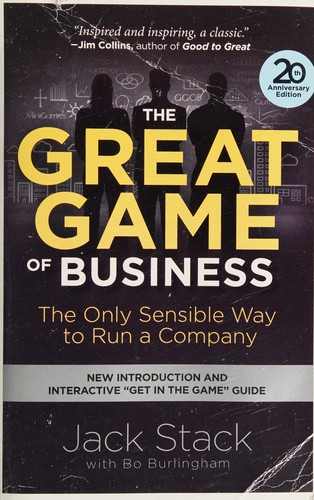
The Great Game of Business is Jack Stack’s account of how he and twelve fellow managers bought a failing International Harvester engine remanufacturing plant in Springfield, Missouri, in 1983 and kept it alive by teaching all 119 employees how the business made money. The company became Springfield Remanufacturing Corporation, or SRC. The system they built, which Stack calls the Great Game of Business, became one of the best-known forms of open-book management.
The book rests on one proposition. In Stack’s words, the best, most efficient, most profitable way to operate a business is to give everybody in the company a voice in saying how the company is run and a stake in the financial outcome, good or bad. Everything else follows from that: teach people the rules of business through the financial statements, let them keep score and follow the action, and give them a stake in the outcome through bonuses and equity.
First published in 1992, the book was reissued in 2013 in an expanded and updated edition. That edition adds an introduction on what happened in the two decades since, a section titled Does It Really Work or Is It Just a Bunch of Hype?, and a closing Get in the Game guide that pairs each chapter with questions for the reader’s own company. The twelve chapters move from why to teach people about money, through the tools of the Game, to ownership and a closing message to middle managers.
A company runs best when everyone understands how it makes money and generates cash, sees the score every week, and shares in the outcome, so financial literacy becomes the operating system rather than a finance function.
Chapter Summaries
Chapter 1: Why We Teach People How to Make Money
Stack tells the SRC origin story and introduces the two higher laws behind the Game: You Get What You Give, and It’s Easy to Stop One Guy, But It’s Pretty Hard to Stop 100.
- Stack reports that from 1983 to 1986, sales grew more than 30 percent a year. The company went from a loss of $60,488 in its first year to pretax earnings of $2.7 million, 7 percent of sales, in its fourth. By 1991, sales passed $70 million and the workforce had grown from 119 to about 650.
- SRC stock was worth 10 cents a share at the buyout and $18.30 by 1991. Stack writes that hourly workers who had been there from the start held as much as $35,000 each in the employee stock ownership plan, almost the price of a home in Springfield at the time.
- The basic rules are that there are only two critical factors in business: make money and generate cash. Safety, quality, and service matter, but Stack treats them as means to those ends.
- The biggest barrier is ignorance at three levels. Top management assumes people cannot understand the business. The shop floor blames every mistake on greed and stupidity. Middle managers are caught between the two.
- Stack tells new hires that 70 percent of the job is the work itself and 30 percent is learning how the company makes a profit. Weekly meetings go over the updated financial statements, and everyone writes the numbers down.
Chapter 2: Myths of Management
Stack argues that conventional management practice rests on myths that create distrust between managers and the people they manage.
- The first myth is that telling people the truth is dangerous. Stack argues that keeping people in the dark is what produces distrust.
- The second is that nice guys finish last. Stack writes that people who take advantage of others take themselves out of the game.
- The third is that a manager’s job is to come up with answers. In the Game, the team comes up with answers and the manager facilitates.
- Stack also rejects the ideas that promoting people quickly is a mistake and that people should just do their jobs without worrying about the big issues. People need big goals, he argues, and big goals carry them past small obstacles.
Chapter 3: The Feeling of a Winner
The chapter covers how to create a team that expects to win, starting with the credibility of management and the design of games.
- Stack lists lessons SRC learned about games and goals. Business is a team sport, so choose games that build a team. Be positive and build confidence. Celebrate every win. It has to be a game. Give everyone the same goals.
- Do not use goals to tell people everything you want them to do. Stack recommends two or three goals a year, each one achievable only by doing five or six things right.
- Pride and ownership come from winning together. Small wins, celebrated publicly, build the confidence to go after larger ones.
Chapter 4: The Big Picture
Stack treats the Big Picture as the source of motivation. It gives people the reason for the work and defines what winning means.
- Stack argues that most problems in business come from failing to show people how they fit into the Big Picture.
- Sharing it means giving everyone a course in the business and teaching them the numbers, not issuing a vision statement.
- The chapter covers moving people around the company so they see how departments depend on each other, avoiding mixed messages, and connecting with communities outside the company.
Chapter 5: Open-Book Management
Stack presents communicating through the numbers as the cornerstone of the Game. He argues that the more people know about a company, the better it performs.
- Information should be a means of education, not a power tool for intimidation or control.
- Financial statements have to be adapted for management use. Stack advises against relying on statements prepared for outside accountants and recommends breaking out the detail so each person can see how they affect the results.
- The chapter addresses the fear that competitors will learn too much and the fear of employees, and argues for taking the emotion out of the business by letting the numbers speak.
- SRC, like most open-book companies, does not share individual compensation figures.
Chapter 6: Setting Standards
Numbers become useful when people can compare them with a target. Stack calls those targets standards and introduces the critical number.
- A standard is the number to shoot for in any category being measured, whether a ratio, a percentage, or an absolute figure.
- The critical number is the one that, at any given time, will have the biggest impact on where the company wants to go. Stack writes that whether you know it or not, it will make or break your company.
- Standard costs for labor and materials let people see whether their work made or lost money against the target. Overhead absorption showed how much overhead each hour of work had to cover.
Chapter 7: Skip the Praise, Give Us the Raise
The chapter describes SRC’s bonus program, called STP-GUTR and pronounced Stop-Gooter. Stack argues that a good bonus program communicates goals by putting a bounty on them.
- Stick to two or three goals and take them from the financial statements. The goals should focus on making money and generating cash and should fix the company’s weaknesses.
- Set the baseline at the lowest level that still guarantees the company’s security. Above that, people should take home a significant share of the additional profit.
- Pay out often enough to keep people engaged. Stack recommends starting with a small pool that grows during the year so people have reason to keep going after every goal.
- The bonus is also an educational tool, because people learn the business by tracking what drives their payout.
Chapter 8: Coming Up with the Game Plan
Stack calls the annual game plan the heart of the Game. It is a set of projected financial statements, month by month, built with the whole workforce.
- Without a plan, people have nothing to compare their performance with and no way to recognize problems early.
- Planning is opened to the entire company so people own the result. Teams identify threats, weaknesses, and opportunities and set their own goals.
- Stack distinguishes a game plan from a budget. The plan is a shared commitment people help create, not a set of limits imposed from above.
- The chapter covers sales forecasting, sandbagging and lowballing, and how to adjust the plan during the year without undermining the Game.
Chapter 9: The Great Huddle
The Great Huddle is SRC’s weekly meeting to calculate the score on the game plan and the bonus goals.
- Around the room, each person reports the numbers for the line they own while everyone writes them down on scorekeeping forms. The chief financial officer then announces the tally.
- Putting names on the numbers gives every line of the income statement an owner.
- The Game runs on weekly, monthly, quarterly, and annual cycles.
- Stack’s advice for leaders: hold the huddle at the same day, time, and place, use a fixed format without making it boring, and avoid being the person with all the answers.
Chapter 10: A Company of Owners
Stack argues that a company of owners will outperform a company of employees, and presents equity as the last of five tools in the Game.
- The five tools are the standards, the bonus program, the annual game plan, the Great Huddle, and equity in the company.
- Equity teaches long-term thinking. People learn to read the balance sheet, understand how share value is calculated, and see what happens when a company is sold.
- The chapter covers how to play the Game without equity, and distinguishes participation from democracy. Everyone has a voice, but not every decision is a vote.
Chapter 11: The Highest Level of Thinking
The chapter applies the Game to the hardest long-term problems an owner faces, from benefit costs to creating opportunities for people.
- Stack uses the cost of health care and other benefits as an example of a problem employees can help solve once they understand the numbers.
- Creating new opportunities for people keeps the best performers growing inside the company.
- Stack distinguishes cash-flow generators from overhead absorbers. Every part of the business either produces cash or consumes it, and the distinction shapes decisions about where to invest.
Chapter 12: The Ultimate Higher Law: A Message to Middle Managers
The closing chapter speaks to middle managers, who Stack earlier described as caught between top management and the workforce.
- Stack covers how to get a boss to play the Game, and how to play it within one’s own area when the boss will not.
- The ultimate higher law, stated in the front matter, is that you get what you give. The chapter ends on having fun, which Stack treats as part of what makes the Game work.
About the Authors
Jack Stack is the founding CEO of SRC, now SRC Holdings, which grew out of the 1983 buyout of International Harvester’s Springfield plant. He received the Business Enterprise Trust Award in 1993 and also wrote A Stake in the Outcome. The Great Game of Business, Inc., an SRC subsidiary, teaches the method to other companies. Bo Burlingham is an editor-at-large of Inc. and the author of Small Giants and Finish Big.
Stack’s authority is operational. He built and ran the company the book describes for decades and reports its results firsthand. That is also the book’s main evidentiary limit. Its data come from SRC and from companies that adopted the Game, as reported by its creator.
Key Takeaways
1) Making money and generating cash are the only two end results.
Stack reduces business to two critical factors. Safety, quality, delivery, and service matter, but a company can excel at all of them and still fail. Teaching everyone the difference between profit and cash, and how their work affects both, is the foundation of the Game.
- Most employees do not know the difference between making money and generating cash.
- Stack’s people learn after-tax profit, retained earnings, equity, and cash flow.
- Every other goal is treated as a means to those two ends.
2) Ignorance is the biggest barrier between managers and workers.
Stack identifies ignorance at three levels: top management underestimating people, the shop floor misreading management, and middle managers caught between. Education through the financial statements is presented as the remedy, replacing threats and intimidation.
- People think profit is a dirty word and that owners pocket it.
- Few employees know that a large share of profit goes to taxes.
- Teaching the numbers closes the gap between management and the workforce.
3) The financial statements are the scoreboard.
Stack argues that businesses have long been run on financial statements and that the statements are the simplest management tool once people can read them. They have to be broken down so each person sees the lines they affect.
- Statements prepared for outside accountants are not enough for management.
- Names go on the numbers so every line has an owner.
- Everyone writes the numbers down at the weekly huddle.
4) A critical number focuses the whole company.
At any given time, one number will have the biggest effect on whether the company succeeds. Identifying it and setting a standard for it gives everyone the same target, which Stack sees as essential to avoiding mixed messages.
- Standards turn numbers into targets people can track.
- Two or three goals a year are enough.
- Each goal should require doing five or six things right.
5) A stake in the outcome makes the numbers personal.
The Stop-Gooter bonus puts a bounty on goals drawn from the financials. Equity extends the stake to the long term. Stack argues that both turn financial literacy from an abstract lesson into something people care about.
- The bonus baseline protects the company’s security first.
- Frequent payouts keep people engaged through the year.
- Equity teaches the balance sheet and long-term thinking.
6) Planning and meetings are where the Game is actually played.
The annual game plan sets the targets. The weekly huddle reports the score against them. Stack treats both as participatory rituals rather than management exercises, so people own the plan and see how it is going every week.
- The plan is month-by-month projected financial statements built with the workforce.
- Planning is a shared commitment, not a budget imposed from above.
- Weekly, monthly, quarterly, and annual cycles keep the Game moving.
7) Participation is not democracy.
Stack wants everyone to have a voice in how the company is run and a stake in the result. He separates that from voting on every decision. Managers still decide. What changes is that people understand why, and help shape the plan.
- The manager facilitates rather than supplying every answer.
- People support what they help create.
- A company of owners will outperform a company of employees.
Strengths and Limits
The book’s strength is that it is a working system, not a theory. Stack gives specific tools, including the critical number, standard costs, the Stop-Gooter bonus, the game plan, the huddle, and equity, and shows how they fit together. SRC’s results are concrete and reported in detail, and the method has spread widely. Slate’s Seth Stevenson reported in 2014 that an estimated 4,000 U.S. firms practiced open-book management. He also reported that SRC stock had risen from 10 cents a share to $348 by 2013. Stevenson relays an account from John Case of a hotel that shared daily occupancy with all staff and offered a bonus above 72 percent. Occupancy went from 67 to 85 percent within eighteen months.
The limits come from evidence and fit. Almost all the evidence comes from SRC and from practitioners, as Divitkos and Wasserstein note in a Yale case on open-book management. The book is rooted in manufacturing, where standard costs and overhead absorption are natural measures. Knowledge, software, and professional services firms need different translations. Stevenson notes that making the numbers understandable to every worker is a major stumbling block, and the method requires sustained teaching that many companies underestimate. The predictable failure is opening the books without the rest of the system: sharing statements without standards, a stake, or a weekly rhythm, then concluding that open-book management does not work.
My Take
The diagnosis holds. Most companies in the five-to-fifty-million range still run with a small group that understands the numbers and a much larger group that does not, and the gap Stack describes between owners, middle managers, and the front line is still the main reason good strategies stall. What I value most is how practical it is. The critical number, the bonus tied to the financials, and the weekly huddle are tools a leadership team can start using next quarter.
It plays differently across contexts. In manufacturing, distribution, and field services, where the line from daily work to gross margin is short, the Game translates almost directly. In professional services and software, the critical number tends to be utilization, retention, or pipeline coverage, and standard costs mean little. The weekly huddle carries over everywhere. The equity chapter carries over only where the owners are actually willing to share ownership, and a founder who is not should say so plainly rather than borrow the language.
The most credible outside objection comes from A. J. Wasserstein and Steve Divitkos at Yale, who used open-book management in a search fund acquisition. They write that most of the literature is written by boosters, that failures go unreported, and that ‘we have no hard data pointing to OBM as a value-enhancing tool for CEOs.’ They also suggest it may not be worth the effort for an owner planning a short hold. I take that seriously. My view is that the Game is a commitment that pays back over years, and a CEO with a two-year exit horizon should probably adopt the huddle and the critical number and stop there.
The book that completes this one is Stack’s own A Stake in the Outcome, written with Burlingham. The Great Game explains how to get people to think like owners. A Stake in the Outcome takes on equity, valuation, and succession, which is where the Game connects to the CEO’s own exit.
Discussion Questions
For CEOs
- What is our critical number right now, and would my leadership team name the same one?
- Which people in the company could explain the difference between our profit and our cash this quarter?
- Are we prepared to share the financials with everyone, and what specifically are we afraid will happen if we do?
- Does our bonus program pay out on two or three goals drawn from the financials, or on something else?
- What baseline of profit would guarantee our security, and how much above it would we share?
- Who builds our annual plan today, and who would we need to add for people to own it?
- Which parts of the business generate cash, and which absorb overhead?
- Am I willing to share equity, and if not, what other tools would give people a real stake in the outcome?
For Teams
- Which line on the income statement does our team affect most, and who here owns it?
- What would a weekly huddle on our numbers look like, and what would we report?
- What two or three goals would most strengthen the company if we hit them this year?
- Which of our current goals send mixed messages to people in other departments?
- What small win could we create and celebrate in the next ninety days?
- What standard should we hold ourselves to on our most important measure?
- Where do people in other departments misunderstand what we do, and how could moving people around help?
- What threats or weaknesses should go into next year’s game plan from where we sit?
Practical Tools
1. Critical Number Selection
Stack argues that one number at any given time will make or break the company, and that everyone should know it. Choosing it well gives the whole organization a single target and prevents mixed messages. Do this before starting a bonus program or a huddle rhythm, and revisit it at each annual plan.
How it works:
- List the company’s biggest weakness or threat in financial terms, such as low gross margin, poor cash flow, or customer concentration.
- Identify the one measure that would most improve the company’s security if it moved.
- Check that people across the company can see how their work affects it.
- Set a standard for the year and a baseline below which the company is at risk.
- Announce the number, the standard, and the reasoning to the whole company.
Every team can name the critical number and explain how its work moves it. Department goals line up behind one target instead of competing.
2. Weekly Huddle Rhythm
The Great Huddle is the weekly ritual in which line owners report their numbers against the plan and everyone writes them down. It is where the Game is actually played. Start it as soon as the critical number and the plan’s key lines are defined.
How it works:
- Assign an owner to each key line of the income statement and to the critical number.
- Set a fixed day, time, place, and format, and keep it short.
- Have each owner report the current number and the forecast for the period while everyone records them.
- Compare the totals with the plan and agree on what each team will do before the next huddle.
- Rotate facilitation so the leader is not the person with all the answers.
Variances surface within a week instead of at month end. People begin forecasting their own numbers and acting before the score moves against them.
3. Stake in the Outcome Bonus
Stack’s Stop-Gooter guidelines tie bonuses to two or three goals from the financials and protect the company’s security first. A well-designed program puts a bounty on the goals that matter. Design it after the critical number is set and before the annual plan is final.
How it works:
- Choose two or three goals from the financial statements, including the critical number.
- Set the baseline at the lowest profit level that still guarantees the company’s security.
- Decide what share of profit above the baseline goes into the bonus pool.
- Set a payout schedule frequent enough to keep people engaged, such as quarterly.
- Explain the math to everyone and report progress at every huddle.
People track the bonus goals without being asked, and the payout teaches them how profit and cash are produced. Bonuses rise and fall with results the company can afford.
4. High-Involvement Game Plan
Stack calls the annual game plan the heart of the Game. It is built as month-by-month projected statements with the whole workforce involved. Involving people in planning is what makes them own the targets. Run it at the start of each annual planning cycle.
How it works:
- Share last year’s results and the current Big Picture with every team.
- Ask each team to identify threats, weaknesses, and opportunities from its own position.
- Have sales build the revenue forecast and challenge it for sandbagging.
- Build month-by-month projected income statements and cash flow with line owners.
- Agree in advance how the plan will be adjusted if a major assumption changes.
The plan has owners for every major line and a forecast people believe. Mid-year surprises lead to an agreed adjustment rather than a reset.
5. Business Literacy Course
Stack’s remedy for ignorance is education. New SRC employees learn that 30 percent of the job is learning how the company makes money. A short internal course gives everyone enough literacy to play. Start with managers and supervisors, then extend it to the front line.
How it works:
- Build a short course on the income statement, the balance sheet, and the difference between profit and cash, using the company’s own numbers.
- Train managers and supervisors first so they can teach their own teams.
- Show each team the lines of the statements it affects.
- Add a quick quiz or exercise at a huddle each month to reinforce the concepts.
- Include the course in onboarding for every new hire.
People can read the scoreboard and explain how their work shows up on it. Huddle discussions move from what the numbers are to what to do about them.
6. Cash Generator Review
In the chapter on the highest level of thinking, Stack separates parts of the business that generate cash from those that absorb overhead. Looking at the company this way sharpens decisions about where to invest and where to fix. Run it annually before the game plan, and whenever a unit’s results drift.
How it works:
- Break the company into its units, product lines, or service lines.
- For each, estimate the cash it generated or consumed over the last year.
- Assign overhead using a consistent method and note which units absorb more than they cover.
- Decide for each unit whether to grow, fix, or rethink it.
- Share the results with unit leaders and tie the decisions to the next game plan.
Leaders see which parts of the business fund the rest. Investment shifts toward cash generators, and overhead absorbers get a specific plan or a hard decision.
7. Ninety-Day Game
Stack argues for celebrating every win and choosing games that build a team. Great Game of Business practitioners call short, focused contests MiniGames. A ninety-day game on one weakness creates an early win and builds confidence before the full system is in place.
How it works:
- Pick one operational weakness that moves the critical number, such as late invoicing or scrap.
- Set a clear target and a simple, visible scoreboard.
- Define a modest reward the team earns together if it hits the target.
- Track the score at every huddle for ninety days.
- Celebrate the result publicly and decide what game comes next.
The team fixes a real weakness and sees that the numbers respond to its effort. That early win builds support for the full Game.
Further Reading
- Seth Stevenson in Slate on open-book management, with SRC’s long-run results and the practical stumbling blocks.
- Divitkos and Wasserstein’s Yale case on open-book management in a search fund acquisition, the most candid practitioner critique.
- The Great Game of Business study guide, with chapter-by-chapter discussion topics.
- The Great Game of Business ten-step implementation approach, covering critical numbers, MiniGames, scoreboards, and High-Involvement Planning.
- SRC Holdings on how its open-book approach has developed since the book.
Share This Review

Bruce Eckfeldt is a business coach and strategic advisor to founder-CEOs of growth-stage companies, a former Inc. 500 CEO, and the author of Springboard. More book reviews →
These summaries present Bruce Eckfeldt’s analysis of business and leadership books for founder-CEOs and leadership-team members of growth companies. Each one identifies the ideas most relevant to decision quality, strategy, and leadership capacity, notes where the evidence is weak, and suggests practical ways to test what is worth testing. All ideas, stories, and quotations belong to the original author and to the people they cite. The assessments and recommendations are Bruce’s. It is a companion to the book, not a substitute for reading it.
To learn more about Bruce’s programs, request other book summaries, or get in touch, contact booksummaries@eckfeldt.com.
Get the Next Review.
A new book review lands in Better, Faster, my weekly newsletter for founder-CEOs, along with one practical essay and questions for your team.