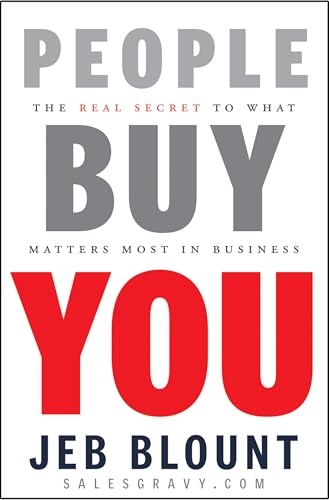
People Buy You
The Real Secret to What Matters Most in Business
When products, prices, and specifications converge, the buyer is no longer choosing a product. The buyer is choosing a person. The five behaviors that determine which person gets chosen can be trained, coached, and measured.
A book summary and review by Bruce Eckfeldt
Overview
People Buy You is Jeb Blount’s argument that in a commoditized economy the durable differentiator in a sale is not the product, the company, or the price. It is the salesperson. Blount spent twenty years selling before founding Sales Gravy, the training and staffing firm that has since become one of the most visited sales-specific websites in the world. The book distills what he observed across those years into a five-part model of the behaviors buyers use to choose between vendors when the offers are otherwise identical: Be Likable, Connect, Solve Problems, Build Trust, and Create Positive Emotional Experiences. Blount frames these as trainable behaviors, not personality traits, and structures the book so each lever gets its own chapter with specific practices and case examples drawn from his own career and from the field.
The book is written for a salesperson, but it applies at least as directly to a founder-CEO who is still the primary rainmaker for the company. In a five-to-fifty-million-dollar business the founder is often the person the largest customers actually bought, and the deals that closed did so on the emotional and relational contract, not on the specification sheet. Blount’s contribution is to name the behaviors that produce that contract precisely enough that a leader can teach them, coach them, and hire for them rather than treating them as innate charm. The closing chapter on personal brand extends the argument beyond a single sale to the reputational asset a leader builds over a career.
When products, prices, and specifications converge, the buyer is no longer choosing a product. The buyer is choosing a person. The five behaviors that determine which person gets chosen can be trained, coached, and measured.
Chapter Summaries
Chapter 1: From Information to Empathy
The opening chapter frames the paradigm shift Blount says every seller has to make. He recounts his own moment losing a large business-to-business deal to a competitor even after the buyer told him he was well liked and had given a strong presentation. The buyer chose the competitor because the competitor had uncovered a specific problem Blount had missed. Blount uses the story to open the argument that likability without substance is not enough, and that the twenty-first-century buyer expects the salesperson to be the source of differentiation itself.
- Blount cites Tim Sanders, the former Yahoo executive whose book Love Is the Killer App argued that in an information-saturated economy the differentiator moves from what you know to whether people want to work with you. Blount picks up that thread and applies it directly to sales.
- The chapter names the paradigm shift as a move from information to empathy. When every buyer can pull the same specification sheet from three vendors, the salesperson’s job stops being data delivery and starts being emotional and relational.
- The chapter’s implicit warning to founder-CEOs is that the pitch deck and the product demo have to earn a place in the conversation. What earns the place is the buyer’s answer to five silent questions the rest of the book addresses.
Chapter 2: Friends Buy from Friends and Other Urban Myths
Chapter Two dismantles the sales cliches Blount says get repeated as if they were laws. Friends buy from friends. People buy from people they like. The customer is always right. Blount argues that each of these is partially true and dangerously incomplete. Buyers do not buy from friends. They buy from sellers who solve problems friends could not. The chapter reframes the book’s central claim in a single line the reader will see repeated. People buy you, not your product, not your company, not your price.
- The chapter introduces the five silent questions every buyer is asking. Do I like you. Do you listen to me. Do you make me feel important. Can you solve my problem. Do I trust and believe you. Every subsequent chapter operationalizes one of the questions.
- Blount is direct that likability is the entry ticket, not the ticket itself. A seller the buyer does not like will not get the meeting. A seller the buyer only likes will not get the deal. Both propositions have to hold.
- The chapter names the five levers that will structure the book. Be Likable. Connect. Solve Problems. Build Trust. Create Positive Emotional Experiences. The levers operate together. A weakness in one is not compensated by strength in another.
Chapter 3: Be Likable
Chapter Three treats likability as the gateway to every other lever. Blount is explicit that likability is not personality. It is a set of behaviors any adult can practice: smile, be polite and respectful, be present, be enthusiastic and confident, and invest in your own mind, body, and spirit. He draws on Dale Carnegie for the underlying principles and pushes back against the caricature of the artificially upbeat salesperson.
- Blount uses the story of Brad, an equipment rental owner, and a well-dressed prospect who ground out a cigarette in the pine straw of his new landscaping as they walked into a ten a.m. meeting. Brad was cordial through the meeting and never took her calls again. The story illustrates how a single small behavior can destroy likability before the conversation begins.
- The chapter documents that people mirror emotional signals. Blount cites the field observation that nine of ten times a person will return a smile. The practical implication is that a salesperson controls the emotional tone of a meeting by what they walk in with.
- Blount separates likability from what he calls the salesperson voice, the artificially upbeat cadence buyers read as a signal that the seller is there to extract money. Authenticity is the antidote, and he treats it as a trainable behavior rather than a fixed trait.
- The chapter’s investment prescription is direct. Read business books. Listen to sales and industry podcasts in the car, what Zig Ziglar called Automobile University. Take care of physical energy. A likable salesperson is a rested, curious, healthy one, not a scripted one.
Chapter 4: Connect
Chapter Four moves from likability to connection. Blount argues that most salespeople confuse rapport-building tactics with real connection. The buyer who kept an ugly photograph on the wall specifically to watch salespeople humiliate themselves asking about it is the counterexample. Real connection comes from listening, asking easy questions first, remembering and using names, and staying connected between contacts.
- Blount tells the story of Jennifer, a college sophomore selling advertising for her school newspaper, who closed a Ford dealership on her first day after her editor told her not to bother. The owner spent most of the meeting explaining why he had stopped advertising. Jennifer listened, validated the frustration, and asked if she could be his contact. He told her he liked her and bought more ads.
- The chapter documents the eighty-twenty rule Blount teaches. Listen eighty percent of the time and talk twenty percent. The rule is a specific behavioral discipline against the average salesperson’s habit of dominating the meeting.
- Blount cites Thomas Freese’s Question-Based Selling for the principle that a question you ask matters more than anything you say. The chapter argues that the questions salespeople ask reveal how prepared they are, and preparation is read by the buyer as respect.
- The chapter treats connection as a between-meetings discipline, not a meeting-time performance. Handwritten notes, small acknowledgments, and remembering personal details are the mechanics. Blount recommends sending three to five handwritten notes a day.
Chapter 5: Solve Problems
Chapter Five is the shift from pitching to problem-solving. Blount lays out five rules for asking questions and treats empathy as the skill that lets a salesperson see beneath the surface answer. The chapter’s central case is Ken, the company president who interrupted Blount’s presentation to say every vendor sounded the same and that the previous vendor had shut down his production line the week before.
- Rule one. People will not tell you their real problems until they feel connected to you. The chapter ties this directly back to the likability and connection chapters, arguing that discovery is not a stage in a process but a consequence of relationship.
- Rule two. Ask easy questions first. Blount observes that most salespeople lead with the question they most want answered, which is the one the buyer is least ready to answer. Sequencing the questions is the mechanic.
- Rule three. People communicate in stories, not in bullet points. The buyer’s story about a supplier failure is more useful than any answer to a direct question about supplier satisfaction.
- Rule four. Follow the emotional cues to the real problem. Rule five. Never assume. Blount uses the Ken story to demonstrate that the presentation Bob threw on the floor produced the real conversation the deck was preventing.
- The chapter warns about what Blount calls icebergs. The stated concern is usually a fraction of the real one. The problem-solver’s job is not to answer the stated concern but to surface the one underneath it.
Chapter 6: Build Trust
Chapter Six treats trust as the compounding asset of a career. Blount uses Rena, a medical-device seller who worked entirely by phone and outsold three hundred field colleagues, as the reference example. Rena started with one physician and worked patiently to earn the second. The chapter argues that trust is built by consistent behavior over time, and that the salesperson is always on stage.
- Blount summarizes Rena’s approach in her own words. When customers trust you, the selling part is easy. She won her largest hospital account by delivering a specialized instrument set on time when a competitor could not, after two years of working with a single physician.
- The chapter names the status quo as trust’s competitor. A buyer who does not yet trust a new vendor will default to the current one even when the current one is failing. The seller’s job is to close the trust gap before asking for the switch.
- Blount treats listening as the primary trust-building behavior, not talking. Buyers extend trust to sellers who let them finish their sentences and reflect back what they said accurately. The behavior is unglamorous and measurable.
- The chapter is direct about admitting mistakes. Denise, the uniform-services seller, mistakenly mailed a Kodak promotion to a Fuji Film buyer named Ron. Ron told her to take it back with her. She sent a self-deprecating apology package with Fuji cameras. Ron replied, apology accepted, when do you want to come back. She got the account.
- Blount cites David Maister’s Trusted Advisor for the underlying model that trust is credibility plus reliability plus intimacy divided by self-orientation. The chapter is a practical operationalization of Maister’s ratio.
Chapter 7: Create Positive Emotional Experiences
Chapter Seven is the compounding-returns chapter. Blount treats every buyer interaction as a deposit or a withdrawal on what Stephen Covey called an emotional bank account. He cites the law of reciprocity, drawing on Robert Cialdini, and argues that small deposits over time create a balance that protects the relationship when a withdrawal is unavoidable.
- The chapter’s central story is Cheri, the executive of a client company, who met Blount at the San Jose airport at eight p.m. after a delayed flight, with a name sign, a birthday gift, water, energy bars, and a book he had mentioned in an earlier call. Blount reports that in the year that followed he did coaching and unbilled work for Cheri’s company that no invoice would have captured.
- The chapter documents the Bear Bryant photograph story. Bryant sent a signed photograph to a small-town restaurant owner during his first year at Alabama, with a note thanking him for the best lunch he had had. Years later the restaurant owner’s grandson signed with Alabama over Auburn because of that photograph. Bryant’s closing line is that it costs nothing to be nice.
- Blount cites Frank Beaudine’s Ultimate Success and Cialdini’s Influence for the underlying research on reciprocity. The mechanism is not a trade. It is a sustained pattern of giving that creates the reciprocal instinct on the other side.
- The chapter is specific about the mechanics. Handwritten notes within twenty-four hours of a meeting. Small unexpected gestures. Congratulations on personal milestones the seller has taken the trouble to remember. The mechanism is the discipline, not the size of the gift.
- Adam, the vendor who sent Cheryl a University of Kentucky basketball for her daughter to sign for his own daughter, is the how-to case. The gesture cost less than fifty dollars, respected the buyer’s no-gifts policy, and produced a bonus check of more than ten thousand dollars.
Chapter 8: A Brand Called You
The closing chapter turns from the sale to the seller. Blount cites Tom Peters’s 1997 Fast Company article A Brand Called You for the underlying argument that every professional is running a company of one. The chapter treats personal brand as the compounding asset that carries a career across roles, industries, and economic cycles.
- Blount cites Peters directly. Regardless of age, position, or business, we are all chief executives of our own companies, called Me Incorporated. The most important job today is to be head of marketing for the brand called You. The chapter takes that argument as its foundation.
- The chapter draws on Dan Schawbel’s Me 2.0 for the specific components of a personal brand. The mechanism is differentiation. What is the unique value proposition the market perceives, and is the message consistent across every platform.
- Blount is direct about online reputation. He tells the story of Perry, an MBA graduate whose job offer at a respected accounting firm was pulled after the hiring manager found five-year-old photographs of him at a college party. The photographs were tagged by someone else. The offer was still withdrawn.
- The chapter treats expert positioning as the highest-return personal-brand activity. Learn continuously. Teach, coach, speak, and write in your field. Publish where your buyers read. The compounding effect over a career is the buyer already knew who you were before the first call.
- The chapter closes with the argument that the personal brand is the ultimate expression of the book’s title. Buyers buy you. The seller’s job is to make sure the you in the market is one worth buying, and to manage it with the same discipline any brand receives.
About the Author
Jeb Blount is the founder and chief executive of Sales Gravy, the sales training and staffing firm he launched in 2006 after seventeen years in enterprise sales, including vice-president roles at Aramark Uniform Services. He is the author of more than a dozen books on sales and leadership, including Fanatical Prospecting, Sales EQ, Objections, and People Follow You. His podcast, the Sales Gravy Podcast, has been downloaded tens of millions of times. He speaks and trains for sales organizations at Fortune 500 companies, mid-market firms, and technology start-ups.
Blount’s credibility on this specific book rests on two things. First, he sold before he taught, and the stories in the book are drawn primarily from deals he lost or won himself and from the sales professionals he trained afterward. Second, Sales Gravy’s training data across tens of thousands of representatives lets him make behavioral claims with more evidence than most sales authors have. The limits are that the book predates the current wave of remote and asynchronous selling, and its examples are concentrated in field business-to-business sales rather than in inside sales, product-led growth, or channel motions.
Key Takeaways
1) In a commoditized market the buyer is choosing a person, not a product.
Blount opens with a story of his own loss. A large business-to-business prospect told him he was well liked and had given a strong presentation but chose a competitor who had uncovered a specific problem. The book’s premise is that when three vendors offer essentially the same product at essentially the same price, the buyer’s decision moves entirely to which salesperson they want to work with. That decision is made on five behaviors that can be trained and coached, not on personality.
- The five levers are Be Likable, Connect, Solve Problems, Build Trust, and Create Positive Emotional Experiences. They operate together, and a weakness in one is not compensated by strength in another.
- Blount cites Tim Sanders’s Love Is the Killer App for the underlying paradigm shift from information to empathy in the twenty-first-century economy.
- The five silent questions every buyer asks are: Do I like you. Do you listen to me. Do you make me feel important. Can you solve my problem. Do I trust and believe you.
2) Likability is a set of behaviors, not a personality trait.
The book’s most immediately useful reframing is that likability is trainable. Smile. Be present. Be polite. Match energy. Invest in your mind, body, and spirit so you arrive at the meeting with something to bring. Blount cites Dale Carnegie and observes that people mirror emotional signals. A salesperson who walks in flat produces a flat meeting. The behavioral discipline is what produces the perception, not the other way around.
- Blount is explicit that the salesperson voice, the artificially upbeat cadence, is the opposite of likability. Authenticity beats performance.
- The chapter argues that likability is the gateway to connection. A buyer who does not want to spend time with a seller will not open up to that seller.
- Small behaviors compound. Brad, the equipment-rental owner in the book, stopped taking a prospect’s calls after she ground out a cigarette in his new landscaping. The prospect never knew.
3) Real connection is listening, not scripted rapport.
Blount is direct that the rapport tactics most sales training teaches are the ones buyers see through fastest. The buyer who kept an ugly photograph on the wall specifically to watch salespeople humiliate themselves asking about it is the book’s counterexample. Real connection comes from listening ratios most salespeople do not hit, asking easy questions first, and staying connected between meetings with small acknowledgments.
- Blount’s rule of thumb is eighty percent listening, twenty percent talking. The rule is a discipline against the average salesperson’s habit of dominating the meeting.
- Jennifer, the college sophomore in Chapter Four, closed a Ford dealership on her first day because she let the owner spend most of the meeting explaining why he had stopped advertising and validated the frustration.
- The chapter recommends three to five handwritten notes per day as the between-meetings connection discipline. Handwritten because email and text are no longer scarce.
4) Discovery is not a stage. It is a consequence of relationship.
Blount’s problem-solving chapter is built on five rules for asking questions. Rule one is that people will not tell you their real problems until they feel connected. This is why discovery templates fail without the prior work. Ken, the company president in Chapter Five, said every vendor sounded the same and revealed the real problem, a competitor shutting down his line the week before, only after Bob threw the presentation on the floor and asked what perfect would look like.
- Rule two is ask easy questions first. Sequencing lowers the buyer’s defenses. Most salespeople lead with the question they most want answered.
- Rule three is that people communicate in stories, not in bullet points. The story about a supplier failure is more useful than any answer to a direct supplier-satisfaction question.
- The iceberg principle. The stated concern is a fraction of the real one. The seller’s job is not to answer the stated concern but to surface the one underneath it.
5) Trust is built by consistent behavior, not by claims of trustworthiness.
Blount uses Rena, the medical-device seller who worked entirely by phone and outsold three hundred field colleagues, as the reference. She started with one physician and worked patiently to earn the second. When customers trust you, she said, the selling part is easy. The book cites David Maister’s Trusted Advisor formula, trust equals credibility plus reliability plus intimacy divided by self-orientation, and treats the daily behaviors as the numerator and the pitch reflex as the denominator.
- The status quo is trust’s competitor. Buyers who do not trust a new vendor default to the current one even when the current one is failing.
- Denise, the uniform-services seller who mistakenly mailed a Kodak promotion to a Fuji Film buyer, won the account by owning the mistake with a self-deprecating apology package. Admission of error is a trust-builder, not a trust-destroyer.
- In a first sale there are no results yet, and the buyer has to trust behavior first. Blount treats the daily behavioral pattern, not a track record the seller does not yet have, as the primary trust-building instrument.
6) Emotional experiences are the compounding asset.
Blount treats every buyer interaction as a deposit or withdrawal on what Stephen Covey called an emotional bank account. He draws on Robert Cialdini’s law of reciprocity for the underlying mechanism. Small unexpected deposits over time create a balance that survives the inevitable withdrawal. Cheri meeting Blount at the San Jose airport with a birthday gift and water is the case. The gesture produced a year of unbilled work he would not otherwise have done.
- Bear Bryant’s photograph story is the compounding-returns example. A signed photograph and a thank-you note sent to a small-town restaurant owner produced a football recruit years later.
- Adam’s University of Kentucky basketball for Cheryl’s daughter cost less than fifty dollars, respected the buyer’s no-gifts policy, and produced a bonus check of more than ten thousand dollars.
- The recommended cadence is three to five handwritten notes a day, sent within twenty-four hours of the moment they mark. The discipline is what matters, not the size of the gesture.
7) The personal brand is the sale that lasts a career.
The closing chapter treats personal brand as the compounding version of the argument in the rest of the book. Blount draws on Tom Peters’s 1997 article A Brand Called You and Dan Schawbel’s Me 2.0. The premise is that every professional is running a company of one, and the reputational asset outlives any single role. For a founder-CEO whose company still relies on the founder’s own selling, the brand is the most important sales-development investment on the balance sheet.
- The mechanism is expert positioning. Learn continuously. Teach, coach, speak, and write in your field. Publish where your buyers read. Over years the effect is that the buyer already knew you before the first call.
- Online reputation is now an unavoidable component. Blount tells the story of Perry, whose accounting-firm job offer was pulled after five-year-old party photographs surfaced. The photographs were tagged by someone else, and the offer was still withdrawn.
- The mechanics of what to publish have changed since 2010, but the core argument that a reputation compounds has not. The chapter’s prescription is consistency of message across every platform on which the seller appears.
Strengths and Limits
The book’s strength is that it names the interpersonal work of selling precisely enough that it can be coached rather than left to charisma. Blount’s five levers are each backed by specific behaviors and case examples from his own selling career and from the field data at Sales Gravy. The Ken presentation story, Rena’s phone-only medical-device career, and Denise’s Kodak-to-Fuji-Film apology are memorable because they are specific and unflattering to the sellers involved. Blount’s insistence that discovery is not a stage in a process but a consequence of the relationship reframes the pipeline conversation. Deals that get stuck in due diligence are usually deals where the buyer never trusted the seller enough to reveal the underlying problem. The five silent questions the buyer is asking give the book a diagnostic spine, and the chapters operationalize each with named behaviors rather than abstractions.
The limits are real. The book was written in 2010, before LinkedIn’s current form, before the collapse of outbound cold email, and before the current wave of remote and asynchronous selling. Its examples are concentrated in field business-to-business sales rather than in inside sales, product-led growth, or channel motions, and the personal-brand chapter reflects the platform economy that existed then rather than the one that exists now. Blount is thin on the mechanics of team selling and on how the five levers translate when the buyer is a committee of six rather than a single purchasing manager. The book also assumes the seller controls the outcome, which is directionally right in a tie between vendors but understates the cases where the buyer’s structural constraints make the decision for them. The predictable failure mode is that leaders read the book, agree with it, and then keep running the sales process as a specification-driven pipeline rather than an interpersonal one.
My Take
This is the book I hand to founder-CEOs who tell me their company is losing deals the pipeline showed as won. Blount’s diagnosis holds. In the five-to-fifty-million market I work in, the founder is almost always the top seller, and the deals that close do so on a version of the five silent questions. What Blount adds is a way to name the behaviors precisely enough that the CEO can teach them to a second and third seller, rather than treating the CEO’s own conversion rate as a personality the company happens to own.
The book plays differently by context. In a services firm or an industrial business where the deal cycle is long and the buyer is one or two people, the model translates almost intact. In a SaaS or product-led company where the buyer is a committee of six and the first evaluator never talks to the seller at all, the levers still matter but the deployment surface is smaller. In those companies I read the five levers as coaching material for the account executive who joins late, not as an operating manual for the whole go-to-market motion. The chapter on personal brand is now dated on tactics but not on argument. What has changed since 2010 is what the brand-building activity looks like, not whether it compounds.
The most credible outside objection comes from Matthew Dixon and Brent Adamson in The Challenger Sale, whose CEB research argued that the highest-performing sellers are not the relationship builders Blount celebrates but the ones who teach the buyer something new and control the conversation. My read on the objection is that Dixon and Adamson are describing a different moment in the funnel. Blount is right about the moment of decision when two vendors have converged on price and product. Dixon and Adamson are right about the moment earlier, when the buyer is still framing what they need. The founder-CEO of a growth company usually needs both chapters, because the founder is playing both roles.
Where Blount underdelivers for my clients is on the operating rhythm that would make the five levers a company-wide discipline rather than the founder’s private practice. He describes what a great seller does and stops short of the management-system layer that installs the behavior across a team. Read People Buy You first for the argument that the seller is the differentiator. Read Cindy Solomon’s Rules of Woo or Mike Weinberg’s Sales Management. Simplified. second for the operating manual on installing the behavior across a sales organization. Read Chris Voss’s Never Split the Difference third for the specific vocabulary of tactical empathy the connection and problem-solving chapters point at but do not fully teach.
Discussion Questions
For CEOs
- For each of my three largest active deals, which of the five silent buyer questions are we currently answering yes to, and which are we not?
- Which of my top sellers, or my own selling, is strongest on likability and weakest on problem discovery, and how would I know before the deal is lost?
- How much of my own selling time is spent talking versus listening, and is the ratio the one I would coach a member of my team to use?
- For the last three deals we lost after a strong presentation, did the buyer choose a competitor because of a problem we did not surface, or because of a relationship the competitor had built we could not see?
- What is my company’s operating rhythm for handwritten notes, small gestures, and reciprocity-building acts, and is it the one I would install if we were starting from scratch today?
- What is my personal brand asset today, measurable in publications, speaking, and search results, and is it the one I want in place three years from now?
- Which of my senior leaders own customer relationships that would follow them if they left, and what would the enterprise value of the company do if any of those relationships walked out with them?
- As I prepare the company for a transaction or a leadership transition, how much of the sales performance is transferable to someone who does not have my relationships, and what needs to be built to make it transferable?
For Teams
- Of the five levers Blount names, which do we as a team do best, and which do we avoid because it feels less like real work than the mechanics of the deal?
- For our top three active accounts, can each of us state the underlying business problem the buyer is trying to solve, in the buyer’s own words?
- What is our average listening-to-talking ratio in a discovery call, based on the recording of our last five calls, and how does it compare to the top performers on the team?
- Which of our recent losses came from missing a problem we could have surfaced with one more question, and what would we do differently now?
- What is our operating rhythm for between-meeting connection, and is it a discipline or an intention?
- Where in our pipeline are we relying on the specification sheet to differentiate us and where are we relying on the salesperson, and does that match the buyer’s situation in each case?
- How much of our trust with each key account is anchored on one person, and what would happen if that person changed roles tomorrow?
- What are the two or three brand-building activities each of us should be doing that we are not, and who owns the calendar to make them happen?
Practical Tools
1. Five Silent Questions Deal Review
Blount frames the buyer’s decision as a set of five silent questions. Do I like you. Do you listen to me. Do you make me feel important. Can you solve my problem. Do I trust and believe you. Most sales postmortems document what the seller did. This review documents what the buyer answered. Use it in the next deal review, in a loss postmortem, or as a quarterly scan of the top ten active opportunities to identify where a specific answer is missing before the deal closes as a loss.
How it works:
- List the top ten opportunities in the pipeline, plus the last three deals lost.
- For each, ask the seller and one other person on the deal team to answer each of the five questions on the buyer’s behalf, with a yes, no, or unknown.
- For every answer that is no or unknown, name the specific behavior that would move it to yes and the seller who owns that behavior.
- For the losses, name which of the five was the deciding one, and what specifically would have to be different next time.
- Add the pattern to the team’s coaching plan. Individual sellers usually have a consistent weak lever across deals.
Within one quarter, the team stops arguing about product features in loss reviews and starts arguing about behavior. The specific unlocking action is named in the review, not left as a general lesson. Repeat losses on the same silent question surface a coaching need, not a competitive one.
2. Listening Ratio Audit
Blount’s rule of thumb is eighty percent listening, twenty percent talking. Modern conversation-intelligence tools measure this directly. The Jennifer story, the Ford dealership won on the first day because the owner did most of the talking, is the reference example. The gap between top and average sellers is almost always measurable in the transcript. Run the audit monthly when conversation-intelligence data is available, quarterly when it is not, and as an onboarding baseline for any new seller in the first ninety days.
How it works:
- Pull the last five recorded discovery calls for each seller on the team.
- Measure or estimate the talk-to-listen ratio for each. If a tool is not available, have the seller estimate it, and then have a peer review the estimate against the recording.
- Rank the team from lowest talking percentage to highest. Note the correlation with quota attainment. It is usually strong.
- For sellers above fifty percent talking, define a coaching plan focused on asking one more question before responding, and on Blount’s sequence of easy questions first.
- Rerun the measurement at ninety days. Behavior on this metric moves.
Within a quarter, the team’s average talking percentage drops by ten to fifteen points, and deal velocity in the mid-funnel improves. Sellers report that they hear things they had been talking over. The metric stops being a target and starts being a symptom of preparation.
3. Iceberg Discovery Questions
Blount’s iceberg principle is that the stated concern is a fraction of the real one. The Ken presentation story is the reference. Ken’s stated concern was that every vendor sounded the same. The real problem was that his previous vendor had shut down his production line the week before. The exercise builds the reflex to surface what is under the stated concern. Use it in every enterprise discovery call worth more than a defined threshold, in deal reviews for sellers who miss on qualification, and in founder-led deals where the founder’s product knowledge tends to short-circuit the buyer’s story.
How it works:
- For each active opportunity, write the buyer’s stated primary concern in one sentence, in the buyer’s own words.
- Draft three follow-up questions that would surface the underlying business impact of that concern. Each question should be answerable only by the buyer, not by the seller.
- In the next scheduled call, ask the three questions in sequence, and record the buyer’s answers verbatim.
- Rewrite the underlying problem statement based on the answers. Compare to the original.
- For every deal where the rewritten statement differs materially from the original, revisit whether the current proposal actually addresses the real problem.
Discovery calls produce buyer-specific problem statements the seller could not have written before the call. The proposal reflects the underlying problem in language the buyer recognizes as their own. Sellers stop reading questions from a card and start following the emotional cues the answers expose.
4. Handwritten Note Cadence
Blount recommends three to five handwritten notes a day. In an economy where email and text are free, handwritten notes are scarce enough to register. The mechanism is Cialdini’s reciprocity. Small deposits over time create the balance that survives an inevitable withdrawal. The discipline is what produces the compounding effect. Install it as an always-on operating rhythm for the CEO, the executive team, and top sellers. Introduce it in one function first, measure for two quarters, and expand from there.
How it works:
- Stock physical notes, stamps, and a book of addresses for every senior leader and top seller. Remove the friction of finding materials.
- Set an operating cadence. The starting point is three notes per week per leader, moving to five per week once the habit is established.
- Publish a short prompt list. Recent conversations. Milestones from LinkedIn. Publicly announced customer wins. Team members who did excellent work. Vendors who went above and beyond.
- Time-box the writing. Twenty minutes on the same day and time each week beats an aspiration to send notes when time allows.
- Track response rate for one quarter. Some notes will produce disproportionate returns. Note the accounts that responded and follow up.
Recipients begin referencing specific notes in later meetings, months after the note was sent. The senior team reports that customers open conversations warmer than they used to. The exercise fails when notes are written to check a box, so the discipline works only when the notes are real.
5. Personal Brand Investment Plan
Blount treats personal brand as the compounding version of every argument in the book. For a founder-CEO whose company still runs on the founder’s own selling, brand is the highest-return sales-development investment. Tom Peters’s A Brand Called You is the underlying reference. The plan makes the investment concrete enough to schedule. Run it once a year as part of annual planning, at the start of any explicit exit-readiness track, and when a leader transitions into a role where their reputation, rather than the company’s, opens doors.
How it works:
- Audit the current brand asset. Speaking engagements per year. Publications. Podcast appearances. Search results on the leader’s name. LinkedIn following. Referral requests received.
- Define the brand you want three years from now. Which conversations do you want to be invited to. Which audiences do you want to have reached. What would show up in a search of your name.
- Choose two or three activities that would compound. Speaking. Writing. A regular published channel. Doing more than three is usually the mistake. Consistency on two wins.
- Calendar and budget them for the coming year. Speaking dates on the calendar. A writing rhythm with an editor. A staff or vendor who handles logistics so the leader shows up prepared.
- Review annually against the three-year target, not against a single year’s output. Brand compounds slowly and unevenly.
By year two, the leader receives inbound requests, speaking invitations, and customer introductions that would not have arrived otherwise. Sales cycles on the top accounts get shorter because the buyer already knew who the leader was. The substance and voice remain the leader’s, and the production is what gets supported.
6. Trust Equation Deal Coaching
Blount cites David Maister’s Trusted Advisor equation. Trust equals credibility plus reliability plus intimacy divided by self-orientation. The equation gives a leader four separate things to coach rather than a single instruction to build more trust. Rena’s phone-only medical-device career is the case that shows how the four elements compound over time. Use the tool when a specific deal has stalled at a trust bottleneck, when onboarding a new seller into a founder-led account, or as a diagnostic for any deal review in which the buyer will not disclose the underlying problem.
How it works:
- For the deal, rate each seller involved on each of the four elements, one through five. Credibility. Reliability. Intimacy. Self-orientation.
- Identify the lowest score. Coach the seller on the specific behavior that would move it, rather than on the general theme.
- If self-orientation is the highest score, the seller is talking too much about the seller. If credibility is the lowest, the seller lacks the domain-specific proof the buyer needs.
- Rerun the assessment after two weeks and one specific coached behavior. Trust moves in observable increments when it moves.
- For accounts where the seller cannot move any of the four elements, consider changing the deal team, not the process.
The team’s deal reviews acquire vocabulary they did not have. The specific trust gap on any given deal becomes nameable rather than left as a general instinct that something is off. The equation remains a coaching tool, not a compensation tool.
7. Emotional Bank Account Ledger
Blount treats every interaction as a deposit or withdrawal. Adam’s basketball for Cheryl’s daughter cost less than fifty dollars and produced a bonus check of more than ten thousand. The Cheri airport pickup produced a year of unbilled work. The ledger makes the invisible pattern visible enough for a team to manage. Run it for the top ten accounts by revenue or by strategic importance, in quarterly account reviews, and in the run-up to any renewal or expansion conversation.
How it works:
- For each top-ten account, list the interactions in the last ninety days. Deposits are unexpected acknowledgments, resolved problems, and specific gestures. Withdrawals are missed deadlines, unreturned calls, and unresolved issues.
- Estimate the running balance. Accounts with negative or thin balances are renewal risks, regardless of what the customer-success dashboard says.
- For each thin-balance account, plan two specific deposits in the next thirty days. Small, specific, and unrelated to a sales ask.
- For each account with a large balance, identify the expansion conversation the balance now supports. Balance is the asset that enables the ask.
- Review at the next quarterly cadence. Track which deposits produced which responses. Not every gesture lands. The ones that do are worth repeating.
Renewals stop being a scramble in the final thirty days and start being the obvious next step of a pattern the customer already trusts. Expansion conversations open earlier because the balance is there to spend. The gestures that land are the ones that show the sender was paying attention, not the ones on a formula.
Further Reading
- David Maister, Charles Green, and Robert Galford’s The Trusted Advisor, the underlying source of the trust equation Blount cites, with a more thorough treatment of the four elements and their application in professional services.
- Robert Cialdini’s Influence, the reference on reciprocity and five other principles of persuasion that underpin Blount’s emotional-bank-account chapter.
- Neil Rackham’s SPIN Selling, the diagnostic-questioning framework Blount cites as the intellectual ancestor of his problem-solving chapter, based on Rackham’s research at Huthwaite across thirty-five thousand sales calls.
- Tom Peters’s 1997 Fast Company article A Brand Called You, the original source of the personal-brand argument Blount develops in his closing chapter.
- Sales Gravy, Blount’s training and staffing firm, where his ongoing writing, podcast, and training-data research on sales behaviors are published and updated.
Share This Review

Bruce Eckfeldt is a business coach and strategic advisor to founder-CEOs of growth-stage companies, a former Inc. 500 CEO, and the author of Springboard. More book reviews →
These summaries present Bruce Eckfeldt’s analysis of business and leadership books for founder-CEOs and leadership-team members of growth companies. Each one identifies the ideas most relevant to decision quality, strategy, and leadership capacity, notes where the evidence is weak, and suggests practical ways to test what is worth testing. All ideas, stories, and quotations belong to the original author and to the people they cite. The assessments and recommendations are Bruce’s. It is a companion to the book, not a substitute for reading it.
To learn more about Bruce’s programs, request other book summaries, or get in touch, contact booksummaries@eckfeldt.com.
Get the Next Review.
A new book review lands in Better, Faster, my weekly newsletter for founder-CEOs, along with one practical essay and questions for your team.