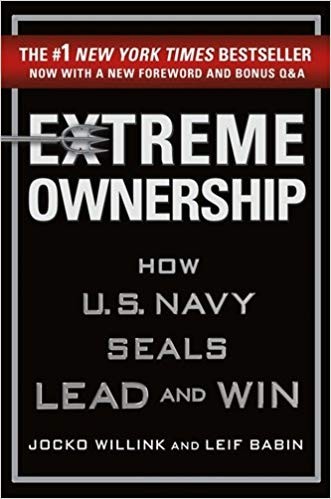
Extreme Ownership
How U.S. Navy SEALs Lead and Win
A leader owns every outcome in his or her world, including the failures of others, and teams perform to the standard the leader sets and tolerates.
A book summary and review by Bruce Eckfeldt
Overview
Extreme Ownership is a leadership book built from the 2006 Battle of Ramadi, where Jocko Willink commanded SEAL Team Three’s Task Unit Bruiser and Leif Babin led its Charlie Platoon. The authors take twelve lessons from that deployment and from SEAL training and translate each into the language of running a company. Every chapter follows the same three movements. A first-person combat narrative, signed by one of the two authors, sets up the lesson. A section titled Principle states it in general terms. A section titled Application to Business shows it at work in a company the authors advised through their firm, Echelon Front.
The book is organized in three parts. Winning the War Within covers the leader’s own mindset: ownership, standards, belief in the mission, and ego. The Laws of Combat set out four operating rules: Cover and Move, Simple, Prioritize and Execute, and Decentralized Command. Sustaining Victory covers planning, leading up and down the chain of command, deciding under uncertainty, and the balance between discipline and freedom. The 2017 edition adds a new foreword and a question-and-answer section drawn from readers’ questions.
A leader owns every outcome in his or her world, including the failures of others, and teams perform to the standard the leader sets and tolerates.
Chapter Summaries
Chapter 1: Extreme Ownership
The opening chapter argues that the leader is responsible for everything in his or her world, with no one else to blame. Willink tells of a friendly-fire incident in Ramadi in which a SEAL sniper team and Iraqi soldiers fired on each other in the confusion of a large operation. One Iraqi soldier was killed and a SEAL was wounded. Willink prepared a debrief listing every error made by others, then discarded it and told his commanders and his men that the fault was his alone because he was the commander.
- Ownership is defined as taking responsibility for outcomes the leader did not personally cause. Willink was not present at the building where the shooting occurred, and the errors were made by others. He argues that this is exactly what ownership means.
- The mechanism is credibility. Willink reports that taking the blame raised his commanding officer’s trust in him, and that spreading the blame would likely have cost him his command. Ownership signals that the leader will fix the problem, which is what superiors need to know.
- Blame shifts attention to the past, while ownership shifts it to the fix. Once Willink owned the failure, the debrief could focus on the procedures that would prevent it from happening again.
- The business application describes a vice president of manufacturing whose board-approved plan had stalled for a year and who had an explanation for every shortfall. Willink’s position was that the executive was the reason, and that the board presentation should open with what he would do differently.
Chapter 2: No Bad Teams, Only Bad Leaders
Babin argues that performance is set by the leader, not by the talent of the team. He uses a scene from Hell Week in SEAL training, where seven-man boat crews race carrying inflatable boats. Boat Crew II won nearly every race and Boat Crew VI finished last. When an instructor swapped the two boat crew leaders, Boat Crew VI began winning almost immediately, while Boat Crew II continued to perform well.
- The experiment isolates the leader as the variable. The men, the boats, and the exhaustion stayed the same. Only the leader changed, and the result changed with him.
- The strong crew kept performing after its leader left, which the authors use to show that good leaders build standards that outlast their presence.
- The chapter’s most quoted line is that what matters is not what the leader preaches but what the leader tolerates. A standard that is not enforced becomes the new standard.
- Leaders must believe the team can win, and must convey that belief. The losing crew’s leader blamed his men, and the men performed to that expectation.
Chapter 3: Believe
Willink argues that a leader must believe in the mission before asking anyone else to. Task Unit Bruiser was ordered to take poorly trained Iraqi soldiers on every operation, an order his men saw as dangerous. Willink himself resisted it until he asked enough questions up the chain to understand that building Iraqi capability was the only path to American forces leaving. Once he understood the reason, he could explain it to his team with conviction.
- Belief comes from understanding the reason behind a decision, not from obedience. Willink’s own skepticism changed only after he asked why the order existed.
- When a leader does not understand a decision from above, the responsibility is to ask until he or she does, not to pass skepticism down to the team.
- Teams cannot execute with conviction on a mission their leader visibly doubts. The doubt transmits, and execution suffers.
- The business application is general. Frontline leaders rarely see the strategic context that senior leaders see, so senior leaders must explain the why, and junior leaders must ask for it.
Chapter 4: Check the Ego
Willink argues that ego disrupts planning, blocks advice, and damages the relationships a team depends on. Task Unit Bruiser operated in a battlespace owned by Army and Marine units, and the SEALs succeeded by deferring to those units, sharing plans, and asking for help. Willink contrasts this with a newly arrived unit whose leaders refused to coordinate with others in the battlespace and which was removed from the fight.
- Ego shows up as the refusal to admit mistakes, accept advice, or share credit. Each of these cuts the leader off from information the team needs.
- Confidence is distinguished from ego. Confidence acknowledges what the leader does not know. Ego hides it.
- Supporting units that are treated with respect become willing allies. The SEALs depended on Army and Marine units for armor, medical support, and quick reaction forces, and earned that support by being humble partners.
- The authors present ego as the most common cause of the failures they see in companies, because it prevents the other principles from being applied.
Chapter 5: Cover and Move
The first Law of Combat is teamwork. Babin describes an operation in South-Central Ramadi in which his element and a second sniper team held separate positions. When his element moved back to base, he failed to coordinate with the second team so that one position covered the other’s movement. He calls it a failure of Cover and Move. The principle is that every element of a team must support every other, because the mission depends on the whole team.
- Departments and teams within an organization drift into treating each other as rivals. The authors argue that the real competition is outside the building, not inside it.
- Each team’s success depends on the others. When one fails, the mission fails, regardless of how well any single team performed.
- The business application describes a production manager who regarded another part of the company as an obstacle. Once he treated it as a partner and helped it succeed, downtime fell.
- The leader’s job is to keep each team focused on how it helps the others accomplish the shared mission, not on what the others are doing wrong.
Chapter 6: Simple
The second Law of Combat is simplicity. Willink describes a patrol whose planned route crossed several battlespaces and multiplied the coordination required. He argued for a shorter route kept inside a single area. Minutes after the patrol left, it was in a firefight, and because the plan was simple, support could reach it quickly. The principle is that plans and orders must be clear enough that every member of the team understands them.
- Complexity compounds when something goes wrong, and something always goes wrong. A simple plan is easier to adapt under pressure.
- The test of clarity is the most junior member of the team. If that person cannot explain the plan, it is not clear enough.
- It is the leader’s responsibility to make sure the team understands, and team members must feel free to ask questions when they do not.
- The business application describes a manufacturing plant whose bonus plan contained so many factors that workers could not see how their actions affected their pay. Simplifying the plan let them focus on the measures that mattered.
Chapter 7: Prioritize and Execute
The third Law of Combat is focus under pressure. Babin describes an operation in which his team was taking heavy fire, faced a suspected bomb at its only exit, and had a SEAL fall through a roof into an unknown space below. He resolved the situation by sequence rather than brilliance. The principle is that leaders facing many problems at once must pick the highest priority, put the team on it, and then move to the next.
- The authors compress the approach into a phrase: relax, look around, make a call. Stepping back from the immediate chaos is what lets the leader see the priority.
- Attacking several problems at once dilutes effort and usually solves none of them. Sequencing is what makes progress possible.
- Leaders can anticipate likely problems in advance and plan responses, which shortens the time needed to prioritize in the moment.
- Priorities shift as conditions change, so the leader must keep reassessing and must communicate the current priority up and down the chain.
Chapter 8: Decentralized Command
The fourth Law of Combat is delegation. Willink argues that no one can effectively lead more than six to ten people directly, so large operations must be broken into small teams led by junior leaders who make decisions on their own. This only works when those leaders understand the commander’s intent well enough to make the decision the commander would make. He illustrates it with an operation in which a misread building location nearly caused a second friendly-fire incident.
- Junior leaders must understand not only what to do but why. Intent is what lets them act when the plan breaks and no one is available to ask.
- Senior leaders must give subordinates clear boundaries and then trust them to act within those boundaries. Micromanagement defeats the purpose.
- Junior leaders are expected to come to their superiors with a plan rather than a question. The authors frame it as saying here is what I am going to do rather than asking what should I do.
- Decentralization frees senior leaders to focus on the strategic picture instead of tactical detail.
Chapter 9: Plan
This chapter argues for a repeatable planning process. It is told through a hostage rescue in Ramadi, planned and executed by Task Unit Bruiser with an assault force that included SEALs, bomb technicians, and Iraqi soldiers. The authors describe deliberately stripping down the mission briefing so it was clear to every participant, having subordinate leaders brief their own parts, and planning for likely contingencies. The hostage was rescued.
- Planning starts with the mission and the commander’s intent, stated simply. Every other element of the plan follows from it.
- Subordinate leaders and frontline members should build parts of the plan themselves. Ownership of the plan increases commitment to executing it.
- Contingencies should be identified in advance for what can be controlled, so the team can respond quickly when conditions change.
- Each operation ends with a debrief that captures lessons and feeds them into the next plan. The process improves only if lessons are recorded and used.
Chapter 10: Leading Up and Down the Chain of Command
This chapter argues that leaders must lead in both directions. Leading down means explaining to frontline members how their work connects to the larger mission, because those closest to the action rarely see the strategic picture. Leading up means pushing information to superiors so they can make good decisions and support the team. Babin describes his frustration at headquarters’ repeated questions, and Willink’s response that the questions meant the team was not giving headquarters enough information.
- When superiors ask too many questions or seem out of touch, the problem is usually that the leader below has not kept them informed. The fix is more communication, not resentment.
- Leaders can bring superiors closer to the front line so they understand conditions directly. Task Unit Bruiser began inviting headquarters staff to see operations.
- Leading up requires the leader to take ownership of the superior’s understanding, and to make requests in a way the superior can support.
- Leading down requires explaining the purpose behind decisions, not only the decisions themselves.
Chapter 11: Decisiveness amid Uncertainty
Babin argues that leaders must act on incomplete information rather than wait for certainty that will never come. He tells of being on a rooftop with the SEAL sniper Chris Kyle, who saw a figure with a scoped weapon in a nearby window and asked for permission to shoot. An Army company commander below pressed for the shot. Babin refused without positive identification and instead had the building checked. The figure turned out to be an American soldier.
- Decisiveness does not mean action for its own sake. Babin’s decisive act was to refuse an irreversible action quickly and to choose a reversible one instead.
- Certainty is never complete. A leader who waits for it will act too late. The task is to make the best call with what is known and adjust as more is learned.
- Pressure from others is not a substitute for information. The company commander’s urgency did not change what Babin could and could not confirm.
- Leaders must be prepared to make a call and to own the consequences, which links decisiveness back to the book’s first principle.
Chapter 12: Discipline Equals Freedom: The Dichotomy of Leadership
The final chapter argues that disciplined procedures create freedom rather than limiting it. Willink describes how his platoon’s early building searches were slow and disorganized. His assistant officer in charge designed a standard procedure that assigned clear roles. The team resisted it at first, but it made searches faster and more reliable and allowed them to change plans quickly. The chapter closes with the tensions a leader must balance, which became the subject of the authors’ next book.
- Standard procedures free a team to adapt, because everyone can fall back on them under stress and changes can be briefed as differences from the standard.
- Personal discipline follows the same logic. Willink’s example is the alarm clock: getting up when it goes off is the first test of the day.
- The team accepted the new procedure because Willink explained why it mattered rather than simply ordering it.
- The closing list of dichotomies includes being confident but not cocky, aggressive but not overbearing, and close to the team but not so close that one person matters more than the mission. The hardest pair is practicing Extreme Ownership while also practicing Decentralized Command.
About the Authors
Jocko Willink served twenty years in the U.S. Navy SEAL teams, enlisting as a young man and later commissioning as an officer. He commanded Task Unit Bruiser in Ramadi in 2006, was awarded the Silver Star and the Bronze Star, and later ran training for the West Coast SEAL teams before retiring in 2010. Leif Babin is a U.S. Naval Academy graduate who served as a SEAL officer, commanded Charlie Platoon in Task Unit Bruiser, and was awarded the Silver Star, two Bronze Stars, and the Purple Heart. He later served as an instructor for SEAL officers. Together they founded the leadership consultancy Echelon Front.
Their credibility on combat leadership is first-hand and unusually well documented, since the events in Ramadi and the men killed there are part of the public record. Their credibility on business is narrower. It rests on their advisory work after leaving the Navy, which the book presents through anonymized cases rather than named companies or measured results.
Key Takeaways
1) Ownership is defined by what the leader did not personally cause.
The book’s central claim is that the leader owns every outcome, including failures made by others while the leader was elsewhere. Willink’s friendly-fire debrief is the model. The errors were real and belonged to others, and he owned them anyway because he was the commander. The authors argue that this is what makes the principle useful. A leader who owns only his or her own mistakes has nothing to fix in the system.
- Ownership increased Willink’s credibility with his commanders rather than reducing it.
- Blame focuses the team on the past. Ownership focuses it on the fix.
- The book applies the same standard to executives who explain shortfalls rather than owning them.
2) Standards are set by what the leader tolerates, not what the leader says.
The Hell Week boat crew story isolates leadership as the variable that determines team performance. Swapping two leaders swapped the results. The authors argue that every standard the leader fails to enforce becomes the actual standard. The losing crew’s leader blamed his men, and the men met his expectation. The winning crew’s standards continued after its leader left.
- The same people perform differently under a different leader.
- Good leaders build habits that outlast their presence.
- Belief that the team can win is part of the leader’s job.
3) The four Laws of Combat run in a deliberate order.
Cover and Move establishes that teams must support each other. Simple establishes that every plan must be understood by the most junior person executing it. Prioritize and Execute establishes that problems are solved in sequence, not all at once. Decentralized Command establishes that decisions must be pushed to the leaders closest to the action. Each depends on the one before it. Delegation fails without clear plans, and clear plans fail without teams that support each other.
- The internal rival is a distraction from the external competitor.
- Complexity compounds when something goes wrong.
- Relax, look around, make a call.
- No leader can effectively lead more than six to ten people directly.
4) Decentralized Command depends on intent, not instructions.
The authors argue that junior leaders can make the right call without asking only when they understand the commander’s intent well enough to make the decision the commander would make. This places a heavy load on the senior leader to explain the why, and on the junior leader to come forward with a plan rather than a question. The structure works because intent travels further than instructions when conditions change.
- Clear boundaries make delegation safe.
- Here is what I am going to do replaces what should I do.
- Senior leaders gain room to focus on strategy.
5) Superiors’ questions are a signal of missing information.
Leading up and down the chain of command is treated as one discipline. When headquarters keeps asking questions, Willink tells Babin, the problem is not headquarters. The problem is that the team below has not given headquarters what it needs to understand the situation. The fix is to push information up and to bring superiors closer to the work, which eventually led to every mission the task unit proposed being approved.
- Leading up is an act of ownership, not of persuasion.
- Leading down means explaining purpose, not just passing on orders.
6) Decisiveness includes refusing an irreversible action quickly.
The Chris Kyle rooftop story is the deliberate counterweight to the friendly-fire story that opens the book. Babin was under pressure to authorize a shot. He refused without positive identification and chose a reversible action, checking the building, instead. The man in the window was an American soldier. The book’s version of decisiveness is acting on incomplete information while matching the action to what is actually known.
- Certainty never arrives, so waiting for it is itself a decision.
- Pressure from others is not information.
7) Every principle has an opposing pull that must be balanced.
The final chapter argues that discipline creates freedom, and then lists the tensions a leader must hold at once: confident but not cocky, aggressive but not overbearing, close to the team but not so close that any one person outranks the mission. The hardest of these is exercising Extreme Ownership while practicing Decentralized Command. The authors’ next book, The Dichotomy of Leadership, expands this list into its own argument.
- Standard procedures let a team change plans faster, not slower.
- A principle applied without its counterweight becomes a new failure mode.
Strengths and Limits
The book’s strength is its structure. Every principle is anchored to a specific, high-stakes event and then restated in general terms, which makes the ideas unusually memorable and easy to repeat inside an organization. The combat narratives are firsthand, detailed, and verifiable in their broad outline. The four Laws of Combat give leadership teams a compact shared vocabulary for teamwork, clarity, focus, and delegation. The book also does something many leadership books avoid. It closes by naming the tensions in its own advice, and treats balance rather than maximal application as the goal.
The business applications are the weakest part of the book. They are anonymized, described only by role and industry, and rarely report measured results, so the reader cannot judge how well the principles transferred. The military setting is also unusual in ways the book does not fully address. A SEAL commander operates with a clear mission, highly selected people, and a strong chain of command, conditions that most companies do not share. The book’s absolute framing of ownership leaves little room for problems that sit in systems no single leader controls, a gap the authors partly address in the closing chapter and in their later book.
My Take
The diagnosis holds. In founder-led companies between five and fifty million in revenue, the most common leadership failure I see is not a lack of ownership at the top. It is a leadership team that explains rather than owns, and a CEO who tolerates the explanations. Babin’s line about what a leader tolerates is the most useful sentence in the book for a growth company. The less obvious risk is the founder who reads the first chapter as permission to own everything personally. That founder becomes the bottleneck that Chapter Eight on Decentralized Command is warning against.
The book plays best in execution-heavy businesses with clear missions and visible failure, such as field services, construction, logistics, and manufacturing, where the combat analogy maps cleanly. In software and professional services, where problems are ambiguous and expertise sits below the leader, Simple and Prioritize and Execute travel well, but the absolute version of ownership can sit awkwardly with experts who need room to disagree. Owner-operated companies add another wrinkle. The founder owns the equity and often the outcome, so the real work is getting the next layer of leaders to own their results with the same intensity.
The most credible outside objection comes from Amy Edmondson’s research on psychological safety. Her work shows that teams learn when people feel safe to raise errors. Ownership modeled by the leader supports that. Ownership demanded from people who have not been given the authority or the safety to fix problems tends to produce silence and self-blame instead. The authors concede part of this in their own closing list of dichotomies, but the book’s stories are almost all told from the commander’s chair.
The adjacent book that completes this one is L. David Marquet’s Turn the Ship Around. Willink and Babin describe Decentralized Command as a principle. Marquet shows how to install it, with specific language and mechanisms for moving decisions to the people with the information. Read Extreme Ownership for the standard. Read Marquet for how to build an organization that meets it without routing every call through the CEO.
Discussion Questions
For CEOs
- What is one current shortfall in the business that you have been explaining rather than owning, and what would change if you opened the next leadership meeting by owning it?
- Which standards in the company are stated but not enforced, and what does your tolerance of them signal to the team?
- Which of your direct reports could make the decision you would make in their area without asking you, and which could not?
- Where are you personally the bottleneck because you have confused ownership with doing the work yourself?
- Which recent decision from you did the team execute without conviction, and did they understand why it was made?
- If your board or investors keep asking the same questions, what information have you failed to give them?
- Which of the four Laws of Combat is weakest in the company right now, and what is the cost?
- Where are you waiting for certainty on a decision that is reversible and should already be made?
For Teams
- Which internal team do we treat as an obstacle rather than a partner, and what would Cover and Move look like between us?
- Could the most junior person on each of our teams explain our top priority for this quarter in a sentence?
- When we last had a significant failure, did the debrief focus on who made the error or on what the leader owned and would change?
- What problems are we currently attacking in parallel that we should be solving in sequence?
- Do we come to the CEO with questions or with plans, and what would it take to shift that?
- Which of our standard procedures give us more freedom, and where does the absence of a standard slow us down?
- Where does ego, such as reluctance to admit a mistake or accept help, show up in how we work together?
- Which decision from above do we not yet understand well enough to explain to our own teams, and who will ask?
Practical Tools
1. Ownership Debrief
Willink’s friendly-fire debrief is the book’s model for responding to failure. He discarded a list of other people’s errors and opened by owning the outcome as the commander, which moved the conversation from blame to the fix and raised his credibility with his superiors. Use this after any significant miss, such as a lost account, a failed launch, a missed quarter, or a project that ran badly over, and especially when the leader responsible has already prepared an explanation.
How it works:
- The leader who owns the area opens the debrief by stating what happened and that the outcome is his or hers, without listing the errors of others.
- The leader names what he or she could have done differently in planning, communication, or oversight that would have changed the result.
- The team then walks through the timeline to identify contributing causes, framed as gaps in process or communication rather than as individual fault.
- The group agrees on the specific changes that will prevent a repeat, each with a named owner and a date.
- The leader reports the debrief upward with the same ownership framing.
Debriefs get shorter and more useful because no one is defending a position. Leaders below the CEO start opening their own reviews with ownership, and the number of repeat failures in the same area falls.
2. Standards Tolerance Review
Babin’s boat crew story and his line about what a leader tolerates argue that the real standard is the one the leader enforces. Every unenforced standard becomes the new standard. Use this review at the start of a planning cycle or when a leadership team notices that the same issues keep recurring despite repeated reminders.
How it works:
- Each leader lists the standards in his or her area that are stated but routinely missed, such as deadlines, response times, quality checks, or meeting preparation.
- For each, the leader names when he or she last let it slide and what message that sent.
- The team selects the three standards whose erosion costs the most.
- Each owner states how the standard will be enforced from now on and how the team will be told.
- The team reviews the three standards at the next two leadership meetings.
Leaders stop repeating the same reminders. Missed standards become rare enough that each one is discussed, and the team’s sense of what is acceptable moves up without a new policy being written.
3. Commander’s Intent Brief
Decentralized Command depends on junior leaders understanding intent well enough to make the decision the senior leader would make, and the Simple principle requires that the most junior person understands the plan. This brief combines the two. Use it at the launch of any significant initiative, or when a leader notices that subordinates keep coming back with questions the leader thought had been answered.
How it works:
- State the mission in a sentence and the reason it matters to the company.
- State the end state, what done looks like.
- State the boundaries, the decisions subordinate leaders can make on their own and the ones they must bring up.
- Have the most junior leader involved brief the plan back in his or her own words.
- Each subordinate leader briefs his or her own part of the plan to the group.
The number of check-in questions drops and the questions that do come up arrive with a proposed answer. Subordinate leaders begin saying here is what I am going to do rather than asking what they should do.
4. Relax, Look Around, Make a Call
Babin’s rooftop story shows that a leader facing several problems at once must step back, pick the highest priority, put the team on it, and then move to the next. Attacking everything at once solves nothing. Use this in a leadership meeting when the agenda is a list of fires, or when a quarter starts with more initiatives than the team can carry.
How it works:
- List every open problem or initiative on the table without debating them.
- Ask which single item, if resolved, would most improve the situation or unblock the others.
- Assign the team’s best resources to that item and agree on what progress looks like by the next meeting.
- Hold the rest of the list without action unless an item becomes urgent.
- At the next meeting, reassess and pick the next priority.
Meetings end with one clear priority instead of a long list of partial commitments. The top item gets finished faster, and leaders stop reporting progress on many things and completion on none.
5. Cover and Move Review
Cover and Move argues that teams within an organization must support each other because the mission fails if any team fails. The book’s production manager improved results by treating another part of the company as a partner rather than an obstacle. Use this review when two functions, such as sales and operations or product and customer success, are blaming each other for missed results.
How it works:
- Bring the two team leaders together and state the shared outcome both depend on.
- Each leader names what the other team needs from his or her team to succeed.
- Each leader names one thing his or her team has been doing that makes the other team’s job harder.
- The two leaders agree on two or three specific commitments to support each other.
- Review progress together at a set date, with the shared outcome as the measure.
The language between the two teams shifts from they to we. Escalations to the CEO about the other team decline, and the shared metric starts to move.
6. Leading Up Information Push
Willink’s response to Babin’s frustration with headquarters is that repeated questions from above mean the team has not given its superiors enough information. Leading up is an act of ownership. Use this when a leader feels second-guessed by the CEO, or when the CEO feels second-guessed by the board or investors.
How it works:
- List the questions the superior has asked repeatedly over the last month.
- For each, identify the information that would have answered it before it was asked.
- Set a regular update that delivers that information in advance, in the format the superior uses.
- Invite the superior to see the work directly at least once, such as a site visit, a customer call, or a working session.
- After a month, review whether the number of questions has fallen.
The superior asks fewer and better questions, approvals come faster, and the relationship moves from oversight toward support.
Further Reading
- Echelon Front, the leadership consultancy Willink and Babin founded, which publishes the authors’ current material and applications of the principles.
- The Dichotomy of Leadership, the authors’ 2018 sequel, which expands the final chapter’s list of tensions into a full argument about where each principle stops.
- Amy Edmondson’s research on psychological safety in teams, the strongest evidence base for how ownership cultures can support or suppress learning.
- Stanley McChrystal’s Team of Teams, a larger-scale account of decentralized command drawn from the Joint Special Operations Command in Iraq during the same period.
- W. Edwards Deming’s Out of the Crisis, the classic argument that most performance problems sit in systems that only management can change.
Share This Review

Bruce Eckfeldt is a business coach and strategic advisor to founder-CEOs of growth-stage companies, a former Inc. 500 CEO, and the author of Springboard. More book reviews →
These summaries present Bruce Eckfeldt’s analysis of business and leadership books for founder-CEOs and leadership-team members of growth companies. Each one identifies the ideas most relevant to decision quality, strategy, and leadership capacity, notes where the evidence is weak, and suggests practical ways to test what is worth testing. All ideas, stories, and quotations belong to the original author and to the people they cite. The assessments and recommendations are Bruce’s. It is a companion to the book, not a substitute for reading it.
To learn more about Bruce’s programs, request other book summaries, or get in touch, contact booksummaries@eckfeldt.com.
Get the Next Review.
A new book review lands in Better, Faster, my weekly newsletter for founder-CEOs, along with one practical essay and questions for your team.