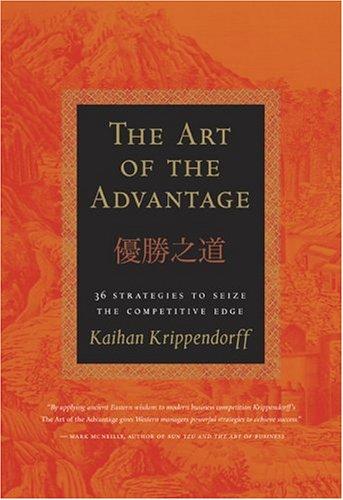
The Art of the Advantage
36 Strategies to Seize the Competitive Edge
Competitive strategy has more moves in it than the Porter and BCG frameworks name. The Thirty-Six Stratagems, developed by Chinese generals across fifteen centuries, catalogue an additional set that Western training misses. The book teaches the vocabulary and applies each stratagem to a business case.
A book summary and review by Bruce Eckfeldt
Overview
The Art of the Advantage argues that most Western strategic thinking is a subset of a larger system that ancient Chinese generals catalogued more than fifteen centuries ago. Kaihan Krippendorff, a former McKinsey consultant, spent five years analyzing roughly three hundred competitive campaigns and mapping each to one of the Thirty-Six Stratagems, a Chinese military text whose oldest surviving version dates to the sixteenth century and whose stratagems trace back to earlier warring-states periods. The book presents each stratagem in a business context, supported by roughly sixty company case examples spanning Frontline in tankers, Wal-Mart in small-town retail, Hero Honda in Indian motorcycles, Apple in music players, Virgin in transatlantic aviation, Southwest in domestic airlines, and Coca-Cola Enterprises in bottling.
The thirty-six stratagems are grouped into four parts that name the underlying strategic principle. Ying Yang Polarity treats opposites as complementary and moves through the opposite of the obvious response. Wu Wei, translated as go with the flow, acts on the situation rather than against it. Wu Chang, or continuous change, prepares for the fact that competitive advantage is temporary. Shang Bing Wu Bing, indirect action, wins by attacking where the competitor is not looking. The premise of the book is not that Eastern strategy is better than Western strategy. It is that Western strategy has fewer categories, and that adding thirty-six well-defined moves to the strategic vocabulary produces more options in the specific moment when a leader has to choose one.
Competitive strategy has more moves in it than the Porter and BCG frameworks name. The Thirty-Six Stratagems, developed by Chinese generals across fifteen centuries, catalogue an additional set that Western training misses. The book teaches the vocabulary and applies each stratagem to a business case.
Chapter Summaries
Chapter 1: Ying Yang Polarity
The first nine stratagems treat opposites as a pair and choose the response that moves against the obvious one. Give ground to take ground. Trade a small thing for a large thing. Draw an opponent into a position that neutralizes his strength. Make friends of distant enemies to weaken the near one. Krippendorff opens this part with Frontline founder John Fredriksen, who bought supertankers when everyone else was selling and grew Frontline from fifty-five million to two and a half billion dollars in revenue and twenty-five percent share of the supertanker spot market.
- Stratagem one, to catch something first let it go. Fredriksen’s counter-cyclical tanker purchases work because owners under pressure sell at prices that assume the current cycle continues. The stratagem names the move that a rising owner is designed to miss.
- Stratagem two, exchange a brick for a jade. Give the opponent something small and visible to draw a large and durable concession. Krippendorff uses acquisition premium structures as a business example, in which a seller accepts an above-market price in exchange for earn-out terms that are worth more over time.
- Stratagem three, invite the enemy onto the roof, then remove the ladder. Draw the competitor into a position from which retreat is expensive. The Apple iPod case, in which Apple locked up Toshiba’s small hard drive capacity through a multi-year exclusive purchase, is the reference example. Sony had built the market and could not match the drive.
- Stratagem five, befriend the distant enemy to attack the nearby one. Wal-Mart’s small-town strategy did not attack Sears directly. It occupied towns that Sears did not want and cooperated with regional suppliers Sears had ignored. By the time Wal-Mart met Sears in the same market, Sears was the smaller competitor.
- The part’s underlying claim is that Western strategy defaults to head-on responses, and that this default is what makes the opposite responses profitable when they work.
Chapter 2: Wu Wei
The second part, translated as go with the flow, groups stratagems ten through eighteen. They act on the situation rather than against it. Remove the source of the opponent’s power rather than the opponent. Close the exit rather than chasing what has already left. Substitute your position for the opponent’s rather than fighting for territory. Krippendorff uses Minnetonka’s Softsoap, Hero Honda in India, and Microsoft’s iterative product releases to illustrate how the underlying mechanism operates in commercial competition.
- Stratagem ten, remove the firewood from under the pot. Minnetonka locked up two years of plastic pump-dispenser supply before launching Softsoap in nineteen eighty, so that Procter and Gamble and Colgate-Palmolive could not enter the liquid-soap category on the same timeline. The competitors had the brand, the distribution, and the money, but not the pumps.
- Stratagem eleven, shut the door to capture the thief. Close the routes by which a competitor could exit or reposition. Coca-Cola Enterprises’s nineteen eighty-six consolidation of its bottler network into a single anchor bottler removed the local bottler flexibility that PepsiCo had been exploiting for regional pricing.
- Stratagem fourteen, beat the grass to startle the snake. Provoke a reaction that reveals the competitor’s position. Krippendorff describes several examples in which a small competitor’s price signal or product announcement was used to force the market leader to disclose its own plans.
- Stratagem twelve, borrow a corpse to raise the spirit, in Krippendorff’s ordering. Take an idea that has failed for someone else and rebuild it under new conditions. Krippendorff uses Microsoft’s willingness to release adequate first versions and iterate as an example of a firm operating on this principle. Sony and Apple in their earlier form did not.
- Stratagem seventeen, seize the opportunity to lead the sheep away. Hero Honda’s Indian joint venture built the largest motorcycle-dealer network in India, five thousand dealers, in a country where competitors had assumed distribution was the constraint. The stratagem is the move that acquires the resource the competitors did not think to compete for.
Chapter 3: Wu Chang
The third part, continuous change, groups stratagems nineteen through twenty-seven. They assume competitive advantage is temporary and organize action around that fact. Wait rather than react. Sacrifice something valuable to defend something more valuable. Reveal weakness to draw the opponent into a costly response. Krippendorff illustrates this part with the Symbian alliance, in which Nokia, Ericsson, and Motorola formed a joint operating-system venture in nineteen ninety-eight and reached roughly seventy-five percent of handset operating-system share, and with Virgin Atlantic’s nineteen eighty-four launch against British Airways.
- Stratagem nineteen, watch the fire from across the shore. When two competitors are damaging each other, wait rather than intervening. The winner emerges weakened and can then be engaged on better terms. Krippendorff uses several tech-industry examples in which a third entrant benefited from the direct fight between the first two.
- Stratagem twenty, let the plum wither in place of the peach. Sacrifice a smaller position to protect a larger one. The move is deliberate and public, so that the opponent recognizes the concession and stops applying pressure elsewhere.
- Stratagem twenty-one, open the city gates. The empty-fort stratagem. Reveal apparent weakness to make the opponent suspect a trap and hold back. Virgin Atlantic’s low-cost positioning in nineteen eighty-four looked unserious to British Airways. Virgin reached ten million pounds of profit within five years while the incumbent under-invested in the response.
- Stratagem twenty-five, shed the skin like a golden cicada. Move the substance of the operation while leaving the shell in place, so that the competitor continues to attack a position you have already left. Krippendorff discusses this stratagem in the context of divisional restructures that continue to publish the old brand while the operating model has changed.
- Stratagem twenty-seven, feign madness but keep balance. Adopt behavior that competitors cannot model, so they cannot predict the next move. Krippendorff uses examples of founder-led companies whose apparent irrationality was in fact a strategic pattern the competitors could not decode.
Chapter 4: Shang Bing Wu Bing
The final part, indirect action, treats direct competition as the mode of last resort. Stratagems twenty-eight through thirty-six move around the opponent rather than through him. Threaten one place to force a response elsewhere. Repair one road openly while marching on another secretly. Create the appearance of a resource that does not yet exist so that the market treats it as real. Southwest Airlines and its point-to-point route network is the anchor example. Competitors could not copy the model because the existing hub-and-spoke investment made the response prohibitively expensive.
- Stratagem twenty-eight, point at the mulberry, curse the locust. Direct the pressure at one target to move the behavior of another. Krippendorff uses regulatory-lobbying examples in which a firm’s public pressure on a supplier or partner was in fact aimed at moving a competitor’s contract terms.
- Stratagem twenty-nine, clamor east, attack west. Publicly commit to one initiative to draw the competitor’s attention there while the actual move goes elsewhere. Southwest’s route entries followed this pattern for a decade, with public commentary about targets the airline had no intention of pursuing.
- Stratagem thirty, openly repair the walkway, secretly march to Chen Cang. Announce one path while pursuing another. Krippendorff uses this stratagem in his treatment of acquirer strategy, in which the public target and the ultimate target are different companies.
- Stratagem thirty-two, create something out of nothing. Behave as though a resource, a capability, or a partnership already exists so that the market’s response makes it real. The Symbian alliance illustrates this. The consortium was declared before it was fully operational, and the declaration itself moved handset-maker behavior toward the outcome.
- Stratagem thirty-six, when losing, join with the strong. Sometimes running away is the best strategy. Krippendorff treats acquisition, joint venture, and licensing as legitimate applications of a stratagem that Western business writing tends to code as surrender.
About the Author
Kaihan Krippendorff is a former McKinsey consultant and an American business writer of German and Egyptian descent. He holds an engineering degree from the University of Pennsylvania and an MBA from Columbia Business School and London Business School, and has since founded the Strategy Learning Center in Miami, which trains executives in strategic thinking. He is the author of five books, of which The Art of the Advantage is the first, and has written for Fast Company, Harvard Business Review, and Inc.
The book’s method is unusual in that Krippendorff analyzed roughly three hundred competitive campaigns as raw material before writing, and drew the case examples from that base rather than selecting cases to fit an argument. That method gives the book its wide industry range and its resistance to the Silicon Valley bias that runs through most strategy writing of the period. The book was published in two thousand three, and the case dates in the text run from the mid nineteen eighties through two thousand two. Readers should apply the underlying stratagem pattern rather than the specific historical facts to more recent markets, where network effects and platform economics have shifted the competitive terrain the cases were drawn from.
Key Takeaways
1) The Western strategy vocabulary is a subset, not the full set.
The book’s central operating claim is that Western business-school strategy training covers a small number of moves. Porter’s five forces, the BCG matrix, and Ansoff’s grid produce categories, not moves. The Thirty-Six Stratagems name moves. A leader trained only in the frameworks can articulate the position but not choose the move. Adding the stratagem vocabulary increases the number of options available in a specific competitive moment, which is where strategy actually gets made.
- The four parts group the stratagems by underlying principle: polarity, flow, continuous change, and indirect action. Each principle names a way of relating to competitive force, not a market position.
- Krippendorff analyzed roughly three hundred campaigns to select the sixty case examples in the book. The classification is empirical, not aesthetic.
- The book is compatible with, not opposed to, Porter and BCG. Position analysis identifies where you are. Stratagems identify what to do next.
2) Attack where the competitor is not looking.
The part titled indirect action, Shang Bing Wu Bing, is the largest single contribution the book makes to Western business practice. Krippendorff’s case work shows that competitive wins in the growth-company range come more often from moves the incumbent did not model than from moves the incumbent modeled and lost. Southwest, Virgin, Hero Honda, Wal-Mart, and Frontline each won by moving somewhere the incumbents were not defending, and by locking in the position before the response could form.
- Southwest’s point-to-point network was cheaper for Southwest because it did not have hub-and-spoke sunk cost. It was expensive for the majors to copy because they did.
- Wal-Mart entered small towns Sears did not want. By the time the competitors met, Sears was competing on Wal-Mart’s cost structure.
- Hero Honda built five thousand Indian motorcycle dealers before competitors treated distribution as the constraint. The dealer network was the moat.
3) Lock in the resource before the competition names it.
Several of the strongest cases in the book share a mechanic. Identify the constraint that will bind the market later, and lock up the supply before the competitors recognize the constraint. Minnetonka locked up plastic pumps for two years before Softsoap launched. Apple locked up Toshiba’s small hard drive capacity for the iPod. Hero Honda locked up dealer relationships in India. The move is not clever positioning. It is early identification of what the market will need to buy and cannot have.
- The resource lock-in works when the resource is scarce relative to the anticipated demand and when supply cannot scale as fast as demand.
- The mechanism is common in commodity inputs, in specialized manufacturing capacity, in geographic distribution, and in exclusive talent contracts.
- The failure mode is locking up a resource the market does not turn out to need. The cost of the wrong bet is the working capital tied up in the unused resource.
4) Sometimes the best move is not to move.
The Wu Chang part, continuous change, names several stratagems in which the correct response is delay. Watch the fire from across the shore. Await the exhausted enemy. Let the plum wither in place of the peach. Krippendorff argues that Western management culture rewards visible activity, and that this reward is often what turns a recoverable market position into a permanent loss. The competitive advantage comes from restraint, not from action, when the market itself is doing the work.
- Watching two competitors damage each other before entering is the pattern behind several late-mover wins in enterprise software and consumer internet.
- Deliberate sacrifice of a smaller position to defend a larger one is a discipline founder-CEOs tend to fail at, because every position feels central when they built it.
- The empty-fort stratagem, showing apparent weakness so the opponent suspects a trap, is uncomfortable in a culture that rewards public strength.
5) Alliances can substitute for direct combat.
The last stratagem in the book, when losing, join with the strong, is Western business’s most under-used strategic move. Krippendorff makes the case that acquisition, joint venture, and licensing are not defeats. They are stratagems, chosen moves that convert a losing position into a valuable one. The Symbian alliance is presented as the reference example. Three handset makers that could not individually beat a coming platform threat combined to become the platform themselves, and reached roughly seventy-five percent operating-system share before the smartphone displacement.
- The move requires early recognition that a position is losing. Founders tend to hold positions past the point where the alliance option is still available on good terms.
- The transaction structure is a technical question. The strategic question is whether the alliance produces a more defensible position than the standalone one, not whether the deal terms are attractive.
- The alternative to the alliance is often the loss of the position altogether, which is why Krippendorff frames the stratagem as a competitive move rather than a concession.
6) The stratagems are memorable because they are named.
One of the underrated features of the book is the naming discipline. Each stratagem has a short, concrete title that a leadership team can use in the moment. Beat the grass to startle the snake. Shut the door to capture the thief. Openly repair the walkway, secretly march to Chen Cang. Krippendorff argues that the naming is what makes the vocabulary usable under pressure. A leader does not have time to consult a framework in a competitive moment. A named stratagem is easier to recognize and invoke.
- The named stratagem functions as a shared vocabulary that a leadership team can use to align on a chosen move without a long analytical justification.
- The names’ origins in Chinese warring-states history give them a specificity that modern business jargon does not carry.
- Krippendorff’s argument for adoption is not that the leader must memorize thirty-six titles. It is that the vocabulary should exist in the team’s shared language so that any leader can invoke it when relevant.
7) The book is a companion to strategic thinking, not a substitute for it.
The Art of the Advantage does not tell a leader what to do. It expands the set of moves the leader can consider. That is a deliberate limit. Krippendorff argues that strategic advantage comes from the specific match between the moment and the move, not from a general prescription. The book’s contribution is therefore to widen the option set. The judgment of which stratagem fits the moment is still the leader’s.
- The book is a reference text. The right way to use it is to keep it accessible and consult specific stratagems when facing a specific competitive question, not to read it once and remember all thirty-six.
- The case studies are illustrative, not prescriptive. Two different companies can apply the same stratagem in the same market and get different results, because execution and timing are the second half of the equation.
- The book pairs well with a positioning framework. Use Porter or Ansoff to name the situation and Krippendorff to name the possible responses.
Strengths and Limits
The book’s strength is that it expands the strategic vocabulary in a specific, testable way. Most Western strategy writing offers frameworks that name positions and categories. The Thirty-Six Stratagems name moves. Krippendorff’s discipline of matching each stratagem to a verified business case gives the vocabulary an empirical grounding that most Eastern-strategy business books do not have. The Frontline, Wal-Mart, Hero Honda, Apple, Virgin, Southwest, and Coca-Cola Enterprises cases are precise enough to argue with, and the underlying claim, that indirect action produces more wins in the growth-company range than direct combat, is consistent with the empirical work Rita McGrath and others published later on transient advantage. The naming discipline gives a leadership team a shared vocabulary for competitive moves, so the named stratagems function as a communication tool in the room where the decision is being made.
The limits are real. The book was written in two thousand three, and the case dates run from the mid nineteen eighties through two thousand two, before network effects, platform economics, and multi-sided marketplaces became the dominant competitive shape of many industries. Readers should apply the stratagems rather than the case mechanics to businesses that operate on those newer dynamics. The book is also uneven across parts. The polarity and indirect-action parts are strong. The Wu Wei and Wu Chang parts rely more heavily on stretched interpretations of the case examples, and some of the mappings between stratagem and case will not persuade a reader who knows the case well. Krippendorff’s later book Outthink the Competition tightens several of these mappings. Finally, the book is a reference text, not a narrative. Readers looking for a continuous argument will find the structure disjointed. The right way to use it is to consult specific stratagems when facing specific competitive questions.
My Take
The diagnosis in this book still holds. Most founder-CEOs I work with have a strategic vocabulary of maybe six or seven moves. They compete head on, they cut price, they raise capital, they hire aggressively, they enter an adjacent segment, they buy a smaller competitor. Krippendorff’s contribution is to name thirty-six moves, and once you have read them you cannot un-see how narrow the default vocabulary is. That is the value. The book is a reference text I keep on the shelf and open at planning time, not a book I read cover to cover.
The play changes by context. For a growth-stage SaaS company, the Wu Chang stratagems, watch the fire from across the shore, feign madness but keep balance, are the ones I see underused. Founders in that market treat delay as failure and legibility as strength, and both instincts are wrong when the category is still forming. For an industrial or services business at the same revenue scale, the resource lock-up stratagems from Wu Wei carry more weight, because the constraints in those markets are physical or relational rather than purely competitive. The Frontline and Minnetonka cases still map cleanly. The Symbian case is now a period piece.
The most credible outside objection to Krippendorff’s project comes from Michael Porter, who would say that a stratagem catalogue without a positioning framework becomes a menu of clever tactics disconnected from any coherent competitive advantage. That objection lands. The book is weakest at the point where it should say when to use which stratagem, and it punts by saying the judgment is the leader’s. Richard Rumelt makes the same point more sharply in Good Strategy Bad Strategy, arguing that a strategy without a diagnosis and a guiding policy is just a list. My read is that Krippendorff is not offering a strategy. He is offering the vocabulary of moves, and the leader still owes the diagnosis before reaching for the move.
For a growth-stage CEO, this book pairs with two others. Read Rumelt first, for the diagnosis discipline that tells you what problem the stratagem is supposed to solve. Read Krippendorff second, for the expanded set of moves the diagnosis unlocks. If the market you are in has become transient, meaning the source of advantage keeps resetting, read Rita McGrath’s The End of Competitive Advantage third, because she extends the Wu Chang argument with post-two-thousand data and gives the operating rhythm for competing under temporary advantage. That sequence is more useful than any of the three read alone.
Discussion Questions
For CEOs
- Which of the four stratagem parts, polarity, flow, continuous change, or indirect action, do most of my company’s recent competitive moves fall into, and what does that pattern say about my strategic habits?
- For the competitor I most fear, which stratagem would the competitor’s strongest move against my company most likely follow, and which of my defenses is designed for a different move?
- Where is my company running directly at an incumbent when there is a route around the incumbent that would produce the same objective at lower cost?
- Which resource, input, capability, or distribution channel would become scarce if my current growth plan succeeded, and could I lock up supply now before competitors identify the constraint?
- Which of my current initiatives would be more valuable delayed by two or three quarters, and what would the competitive picture look like at that point?
- Where in my portfolio should I concede a small position to protect a larger one, and where am I holding a small position out of loyalty rather than strategic value?
- For each of my top three competitors, which stratagem would I be least prepared for them to use, and what is the reason for the unpreparedness?
- If my company faced a platform-scale threat that no single competitor in my current set could produce alone, would I recognize the moment when the right response is the last stratagem, to join with the strong?
For Teams
- Of the last five competitive decisions we made, how many came from moves the incumbents did not expect, and how many came from moves the incumbents were fully prepared for?
- For each of our top three growth initiatives, which stratagem does the initiative most closely resemble, and does the label match the way we describe the move to ourselves?
- Where in our operating plan are we treating direct combat as the default, when the market conditions favor an indirect move?
- What is one scarce resource in our market that we could lock up now on multi-year terms, and what would the working-capital cost be relative to the value of the position?
- Which of our recent public commitments were intended to move competitor behavior, and did the competitor’s response match what we hoped for?
- Where would delay of two quarters improve our position, and where would delay of two quarters cost us the opportunity?
- Which competitor is currently damaging another competitor in a way that would benefit us if we stayed out of the fight, and are we tempted to enter the fight anyway?
- In our current strategic playbook, which of the four stratagem parts is under-represented, and what would it take to build the missing moves into our repertoire?
Practical Tools
1. Stratagem Mapping Of Recent Moves
The fastest way to expose a leadership team’s strategic habits is to map its recent moves to the stratagem set. The distribution of moves across the four parts names the strategic range the team currently operates in, and the missing parts name the moves the team has never learned to make. Run this at the start of a strategic-planning cycle, at a leadership offsite, or after a competitive loss where the team wants to understand what happened.
How it works:
- List the ten most consequential competitive moves the company made in the last twenty-four months. Include product launches, pricing changes, geographic expansions, hires, and public positioning.
- For each move, assign the closest matching stratagem and the part it belongs to. Multiple leaders should do this independently.
- Compare the mappings. The moves that get the same stratagem name from every leader are the ones the team understands the same way. The moves that get different names are the ones the team is describing to itself inconsistently.
- Count the moves per part. A concentration in one part, usually polarity or indirect action for growth-stage companies, names the team’s strategic habit.
- Identify one stratagem from an under-represented part that the team could apply in the coming quarter.
The team leaves with an honest description of its strategic range and one specific stratagem to try. The exercise replaces general aspiration with a named move, and the pattern in the mapping usually names the team’s habitual strengths and the missing moves in the strategic repertoire.
2. Indirect Route Search
The Shang Bing Wu Bing part is the book’s largest contribution. Its central claim is that most growth-company wins come from moves the incumbent did not model. The search converts that claim into a specific question about a specific initiative. Use it whenever a proposed strategic move requires directly displacing an incumbent in an established market, or when the incumbent has demonstrated the ability to outspend and outlast a direct challenge.
How it works:
- State the strategic objective in a single sentence, separate from the currently proposed move to achieve it.
- List three routes to the same objective that would move around the incumbent rather than through it. Use the part’s stratagems as prompts: point elsewhere and act there, publicly repair one road and march on another, create the appearance of a resource that does not yet exist.
- For each indirect route, name the resource, capability, or partnership that would have to be true for the route to work.
- Compare the direct move and the three indirect options on time, cost, and defensibility twelve months after execution.
- Choose the option, or the sequenced combination of options, that produces the most defensible position twelve months out. Direct combat is often the wrong answer.
The team recognizes that the original direct move was a habit rather than a considered choice, and adopts one of the indirect options as the primary approach. The direct move becomes a fallback rather than the plan.
3. Resource Lock-Up Assessment
Several of the strongest case examples in the book share the same mechanic. Identify a scarce resource that will constrain the market at scale, and lock up supply before competitors identify the constraint. Minnetonka locked up pump-dispenser capacity. Apple locked up small hard drive capacity. Hero Honda locked up dealer relationships. Use this assessment in the twelve months before a major capacity expansion, geographic launch, or product-platform introduction, when the anticipated demand has not yet made the constraint public.
How it works:
- List the five inputs, capabilities, or distribution channels that your current plan would consume most heavily at three-times current volume.
- For each, estimate the supply capacity in the market and the time required for that supply to expand. Anything with an eighteen-month expansion cycle or longer is a candidate.
- For each candidate, estimate the total contract cost to lock up two to three years of supply above your near-term needs.
- Compare the working-capital cost of the lock-up to the strategic value of the position the lock-up would create.
- Choose one resource to lock up in the next two quarters. Negotiate before your expansion is public. Once the plan is announced, the price rises.
The company locks up a critical input on multi-year terms before competitors have reason to compete for it, and the resulting supply position becomes visible in the next scaling round when the constraint binds for everyone else.
4. Strategic Delay Discipline
The Wu Chang part argues that visible activity is often rewarded when restraint would have produced better results. This discipline forces the team to name the initiatives where delay would improve the position, and to defend the delay against the cultural bias toward motion. Use it once a quarter, in the review that immediately precedes budget approval for new initiatives, when the pattern of accepted proposals has been strongly biased toward action.
How it works:
- List the five most consequential initiatives currently in flight or scheduled to start in the next quarter.
- For each, state what would be true about the market, the competition, and the internal capabilities in six months if the initiative were delayed by two quarters.
- Identify which of the five would be materially improved by delay. Reasons include competitor moves that would clarify the terrain, market data that would resolve a current uncertainty, or internal readiness that has not yet matured.
- For each delay-eligible initiative, name the specific event or milestone that would trigger the resumption of the initiative. A delay without a trigger becomes an indefinite deferral.
- Delay one or two of the five. Communicate the delay explicitly, with the trigger, so the team does not treat it as a loss of momentum.
One or two initiatives are formally delayed with a trigger, and the delay is recognized as a strategic move rather than a failure of execution. The pattern of quarterly proposals shifts as the team learns that delay is a legitimate choice.
5. Competitor Move Anticipation
The stratagem vocabulary is symmetric. It applies to your competitors as easily as to you. The anticipation exercise uses the thirty-six stratagems as a checklist of moves each named competitor might make, and identifies the moves your current defenses are not designed for. Use it once a year in the strategic-planning cycle, and revisit whenever a major competitor changes leadership, raises capital, or announces a new strategic direction.
How it works:
- For each of your top three competitors, list the two or three stratagems that most resemble the competitor’s public strategic history.
- For each named stratagem, describe the specific move the competitor could make in your market and the resources it would require.
- For each move, assess whether your current defenses would slow it, prevent it, or leave you exposed.
- For the moves your defenses would not handle, list one specific pre-emptive action that would harden the position before the competitor’s move.
- Prioritize the pre-emptive actions by the combined weight of probability, damage, and cost of defense.
The team leaves with two or three specific defensive investments, each linked to a named competitor move rather than to a general anxiety about competition. The planning conversation replaces the generic threat assessment with a specific one.
6. Alliance Or Acquisition Framing
The last stratagem in the book, when losing, join with the strong, is under-used in Western business practice because it is coded as surrender. This framing separates the strategic question, whether the alliance would produce a better position, from the emotional question of what the alliance says about the founder’s ambition. Use it when a market threat, a platform shift, or a scale advantage held by a competitor makes the current standalone position materially harder to hold over a two-to-three-year horizon.
How it works:
- State the current standalone position and the specific threat that has made it harder to hold.
- List the two or three most plausible partners, acquirers, or acquisition targets that would produce a more defensible position when combined with your current business.
- For each candidate, describe the combined position, the strategic assets each side brings, and the transaction structure that would preserve those assets.
- Compare the combined position on defensibility, growth trajectory, and financial outcome for the founder or the shareholders against the standalone position under the identified threat.
- Decide whether to pursue the strongest option now, in the next twelve months, or hold as a fallback. Timing is often the strategic variable, not choice of partner.
The team makes an explicit choice about whether the current standalone position is the one to hold, rather than assuming it. If the alliance option is chosen, the outreach begins before the market recognizes the weakness that would raise the acquirer’s leverage.
7. Part Rotation In Quarterly Planning
Most leadership teams cluster in one or two of the four stratagem parts. This rotation forces the team to plan at least one move per quarter from each part across a full year, on the assumption that the team’s habitual clustering is what makes competitors’ behavior predictable. Use it once a year at the start of a planning cycle, and track the distribution across the four quarterly plans.
How it works:
- Divide the four parts across the four quarters of the planning year. Assign each part as the primary lens for one quarter.
- For the polarity quarter, plan one initiative that runs against the obvious response. For the flow quarter, plan one initiative that acts on the situation rather than against it. For the continuous-change quarter, plan one initiative that assumes temporary advantage and organizes for change. For the indirect-action quarter, plan one initiative that moves around a competitor rather than through it.
- Constrain each quarter’s initiative to the assigned part. If the team’s proposed move does not fit the part, replace it with one that does, or defer.
- Review at each quarterly boundary whether the assigned part produced a legitimate move, or whether the team defaulted back to its habitual parts.
- Adjust the rotation the following year based on which parts produced results and which the team could not populate.
By year end, the team has executed at least one move from each of the four parts and can name the strategic moves each part unlocked. The habitual clustering has been visibly broken, and the competitive playbook is wider.
Further Reading
- Sun Tzu’s The Art of War, in the Ralph Sawyer translation, for the earlier and more abstract treatment of the strategic principles the Thirty-Six Stratagems develop into specific moves.
- Kaihan Krippendorff’s later book Outthink the Competition, which restates the stratagem framework with more recent case examples and tightens some of the case mappings that Art of the Advantage stretches.
- Rita McGrath’s The End of Competitive Advantage, which develops the same argument about transient advantage that Krippendorff’s Wu Chang part names, with more empirical data from post-two-thousand markets.
- W. Chan Kim and Renee Mauborgne’s Blue Ocean Strategy, for a parallel treatment of indirect action, framed as market-creation rather than as stratagem selection.
- Harro von Senger’s The Book of Stratagems, the standard Western academic reference on the Thirty-Six Stratagems, which treats the original Chinese text without the business-case overlay.
Share This Review

Bruce Eckfeldt is a business coach and strategic advisor to founder-CEOs of growth-stage companies, a former Inc. 500 CEO, and the author of Springboard. More book reviews →
These summaries present Bruce Eckfeldt’s analysis of business and leadership books for founder-CEOs and leadership-team members of growth companies. Each one identifies the ideas most relevant to decision quality, strategy, and leadership capacity, notes where the evidence is weak, and suggests practical ways to test what is worth testing. All ideas, stories, and quotations belong to the original author and to the people they cite. The assessments and recommendations are Bruce’s. It is a companion to the book, not a substitute for reading it.
To learn more about Bruce’s programs, request other book summaries, or get in touch, contact booksummaries@eckfeldt.com.
Get the Next Review.
A new book review lands in Better, Faster, my weekly newsletter for founder-CEOs, along with one practical essay and questions for your team.