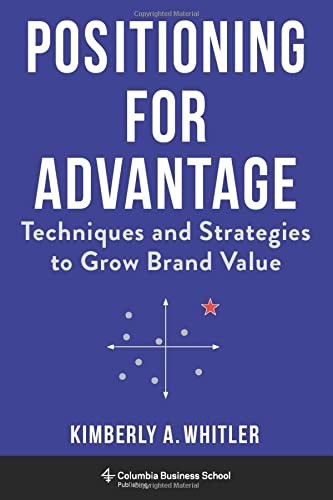
Positioning for Advantage
Techniques and Strategies to Grow Brand Value
Positioning is a strategic decision made at the top of the company, not a tagline invented by the marketing team. Get the positioning right and every downstream choice becomes easier. Get it wrong and no amount of tactical marketing rescues the brand.
A book summary and review by Bruce Eckfeldt
Overview
Positioning for Advantage argues that positioning is a strategic decision, not a marketing tagline. Kimberly Whitler, a UVA Darden marketing professor and former chief marketing officer at David’s Bridal and Beam Suntory, presents a framework built on the Marketing Impact Framework and nine supporting tools organized into four parts. An Introduction and Organizing Framework part covers the Marketing Impact Framework. Marketing Strategy Tools covers the Positioning Concept, the Brand Essence Statement, and Strategy Mapping Methods. Bridging Tools covers the Strategic Marketing Plan and the Creative Brief. Marketing Plan Tools covers the Marketing Technology Blueprint, Key Opinion Leader and Influencer Mapping, and Brand Measurement Methods. The book closes with a chapter on activating the tools through practice and implementation.
Whitler’s central argument is that most companies treat positioning as a post-hoc marketing task, arriving after the product is built and the pricing is set, when it should be the first strategic decision from which product design, pricing, distribution, and messaging all flow. She cites the finding that ninety percent of new products fail and attributes the failure to what she calls the theory-doing gap. Executives understand positioning conceptually but lack the concrete tools to convert the concept into operational decisions. The book is written for chief marketing officers, general managers, and founders who own brand outcomes and need a defensible process for making positioning choices. Whitler draws on two decades of executive experience at Procter and Gamble, PetSmart, David’s Bridal, and Beam Suntory, and on academic research she has published in the Journal of Marketing and Harvard Business Review.
Positioning is a strategic decision made at the top of the company, not a tagline invented by the marketing team. Get the positioning right and every downstream choice becomes easier. Get it wrong and no amount of tactical marketing rescues the brand.
Chapter Summaries
Chapter 1: The Marketing Impact Framework
Chapter One establishes the organizing framework for the whole book. Whitler argues that superior marketing outcomes result from a specific chain. Market insights and firm capabilities inform corporate strategy, which informs marketing strategy, which informs marketing plans, which produce perceptual advantage, brand equity advantage, and firm growth. The framework is her answer to the theory-doing gap, the inability of most companies to convert general marketing concepts into successful business practices.
- Marketing strategy consists of four choices. The vision for value creation and growth, the choice of target, the desired positioning territory, and the desired brand essence. All four must be made explicitly and coherently before marketing plans can be built.
- Marketing plans are downstream operational choices. Resource allocation, structural choices, program priorities, partnership choices, and go-to-market decisions. Whitler argues these become easier when the strategy above them is decided.
- Desired positional advantage is defined as the potential to occupy a place in target consumers’ hearts and minds that gives the company the ability to achieve superior market-share outcomes. This is not the same as differentiation. It is a specific claim about consumer perception.
- Whitler’s citation that ninety percent of new products fail frames the problem. She attributes the failure rate not to product quality but to the absence of a rigorous process for defining strategic positioning and connecting product decisions to it.
Chapter 2: The Positioning Concept
Chapter Two is the operational core of the book. The positioning concept is a structured document that identifies the consumer’s problem, the solution the brand is designed to provide, and the proof that the brand can deliver. Whitler treats the positioning concept as a tool for creating, testing, and perfecting brand ideas before any product is developed.
- A positioning concept has three parts. The consumer problem stated in the consumer’s own words. The solution statement that connects the brand’s offering to the problem. The support statements that provide proof the brand can deliver on the solution.
- The development process runs through seven phases. Identify the general area to pursue. Identify the consumer problem. Develop product or service solution statements. Develop support statements. Test and validate the final concept. Ensure concept-product fit. Commercialize the new concept. Whitler argues most companies skip phases one through four and jump directly to commercialization.
- A superior positioning concept must meet six criteria. Compelling. Relevant. Important to consumers. Differentiating. Ownable. Supportable by the product, service, or experience. Concepts that fail any of the six should not proceed to commercialization.
- Whitler treats positioning concepts as stand-alone documents developed through iteration and workshopping with consumers, partners, employees, and mentors. She argues against solo positioning work by a marketing director because the resulting concept lacks the internal and external stress-testing that surfaces its weaknesses.
Chapter 3: The Brand Essence Statement
Chapter Three covers the Brand Essence Statement, which Whitler treats as the blueprint from which product design, financing, delivery, and messaging all flow. It captures the intrinsic nature and indispensable quality that make a brand unique, compelling, and meaningful to a target. The Brand Essence Statement is created after segmentation, target definition, and positioning concepts, and it acts as a filter for every brand decision that follows.
- The Brand Essence Statement has four components. Foundation, covering brand values and personality. Impact, covering the rational and emotional benefits the brand will provide. Support, covering the reasons to believe. Brand essence, a summary statement of what the brand does for the target customer.
- The Brand Essence Statement can be a document, a picture, a video, or another communication vehicle. Whitler emphasizes that it is not the same as a tagline or a mission statement. It is a blueprint for designing the product itself, not just for messaging it.
- Authenticity and veracity are the mechanisms through which brands create trust. Whitler cites Rita Clifton, the branding specialist, and Kevin Roberts, former CEO of Saatchi and Saatchi, on the point that inauthentic brands are eventually caught out.
- The Brand Essence Statement should precede product design, not follow it. Whitler argues that most companies build products first and then attempt to construct a Brand Essence Statement around what they have already built. The result is a brand whose components do not reinforce each other.
Chapter 4: Strategy Mapping Methods
Chapter Four covers the strategy maps Whitler uses to communicate positioning choices across the organization. She argues that strategy documents are read by few and understood by fewer, and that visual maps travel further and stick longer. She presents four map types.
- The brand portfolio and resource management map shows how brands relate to each other within the company’s portfolio, and where resources are being concentrated. The map exposes brands that receive investment disproportionate to their strategic role, and vice versa.
- The consumer perspectives and preferences map shows the perceptual space consumers occupy, where the company’s brands sit within it, and where whitespace is available. Whitler uses laundry detergent examples throughout the chapter, including Tide, Wisk, All, Cheer, and Era, to show how brand differentiation is achieved within a single company.
- The competitive market dynamics map plots the competitive set on the same perceptual axes and identifies where competitors are converging, where whitespace exists, and where the company is over-differentiated or under-differentiated relative to the field.
- Strategy maps as a process is the fourth map. The process itself, done with the leadership team, is often more valuable than the resulting diagram, because it surfaces disagreements that would otherwise stay silent.
Chapter 5: The Strategic Marketing Plan
Chapter Five is the first bridging chapter, moving from strategy tools to implementation tools. Whitler builds on Derek Abell’s Strategic Marketing Planning, which introduced the three-cycle planning approach of long-range business definition, long-range functional strategies, and one-year plans and budgets. She argues that converting marketing strategy into an executable plan is more difficult than devising the strategy itself.
- A strategic marketing plan should include visions, objectives, strategies, tactics, and measures. Whitler treats it as a stand-alone document that reflects ruthless choice-making rather than a compilation of everything the marketing team intends to do.
- The strategic marketing plan should flow directly from the corporate strategic plan. Whitler argues that plans developed in isolation from corporate strategy produce misalignment between what marketing is optimizing for and what the company is trying to become.
- The most common failure mode is a marketing plan that reads as a project list rather than a set of choices. Whitler cites A. G. Lafley’s leadership at Procter and Gamble as the model. Lafley’s discipline was to force each business unit to name what it would not do, not just what it would.
- Marketing strategy should identify a marketplace position offering the greatest opportunity to create value for a chosen customer target. The chapter closes the loop back to positioning, arguing that the plan is meaningless without the position.
Chapter 6: The Creative Brief
Chapter Six covers the creative brief, the document that converts strategic positioning into instructions for specific marketing activities. Whitler argues that most creative briefs are written by agencies rather than by clients, and that this sequencing produces work that misses the strategic intent. Clients own the target consumer, the brand, and the business objectives, and clients should therefore write the brief.
- The creative brief has seven components. Project assignment. The situation. Objectives and success criteria. Customer insights. Communications strategy. Execution guidelines. Details and approvals. Whitler treats each as a separate discipline rather than a fillable field.
- The brief applies to more than advertising. Store design, brand communications, websites, events, logo design, and IT projects all benefit from a creative brief when they are downstream of a positioning decision. Whitler treats the brief as a translation layer between strategy and any customer-facing implementation.
- Whitler cites Howard Ibach’s How to Write an Inspired Creative Brief and Mark Duffy’s commentary on creative briefs to establish the tradition she is building on. The chapter integrates their operational advice with her strategic framing.
- The most common brief failure is vagueness about the target customer. Whitler argues that briefs describing broad demographic segments produce generic creative work, and that briefs describing specific behavioral or attitudinal segments produce creative that resonates.
Chapter 7: The Marketing Technology Blueprint
Chapter Seven is the first of three chapters covering marketing plan tools. The Marketing Technology Blueprint is a visual document, typically created with an enterprise architect, that maps how marketing technologies connect to drive customer experience. Whitler argues that most companies have made martech investments totaling billions of dollars without a blueprint, and that the resulting stack is duplicative, disconnected, and underused.
- The blueprint answers seven questions. What is the vision for customer experience and the customer journey. What is the desired state of marketing technology guiding the buyer journey. What is in place and what remains to be added. Is the existing technology being used. Has the existing technology been integrated. Are there duplications or unnecessary capabilities. What is the roadmap for data flow, capabilities, and customer experience.
- Whitler treats the blueprint as a joint deliverable of the chief marketing officer and chief information officer. Neither can produce it alone. The typical martech failure is a chief marketing officer buying tools without the enterprise-architecture discipline of integration.
- The chapter cites Salesforce, Oracle, and Amazon Web Services as the platform layers most organizations build on, and points to Aaron Shapiro, the founder and chief executive of Huge, on the customer-experience discipline that should drive the technology stack rather than the reverse.
- The blueprint’s operational value is not the diagram. It is that the process of producing it forces the marketing and technology leadership teams to confront the actual state of their stack, which is usually worse than either had believed.
Chapter 8: Key Opinion Leader And Influencer Mapping
Chapter Eight is the influencer chapter. Whitler treats influencer strategy as a positioning decision, not a media buy. The key question is which voices already carry credibility with the target audience and how to earn or acquire their endorsement. She distinguishes between key opinion leaders, who hold professional credibility, and social media influencers, who hold audience-based reach.
- Whitler uses the Tencent Next Idea campaign as a lead case. Tencent worked with Stephen Hawking and Chinese pop singer Karry Wang as influencers, pairing professional and celebrity credibility to reach different segments of the target audience.
- Casey Neistat is used as the example of the modern social influencer whose credibility rests on authentic voice rather than professional credential. Whitler argues that brands must decide which type of credibility they are buying and align with the influencer type accordingly.
- The Colin Kaepernick partnership at Nike is used to illustrate the risk and reward of a controversial influencer choice. Whitler treats it as a case in which the positioning choice, standing for something, was made deliberately and paid off because the brand’s target consumers were aligned with the position.
- The chapter cites Leadtail research on how brands select influencers and how influencers select brands. Whitler argues the selection is bidirectional and that brands often underestimate how carefully influencers vet the brands they endorse.
Chapter 9: Brand Measurement Methods
Chapter Nine is on measurement. Whitler argues that measurement should guide marketing strategy rather than merely report on it. Measurement systems that only track short-term campaign response miss the underlying brand-equity story and encourage tactical decisions that erode long-term value.
- A measurement system should track four areas consistently across brands. Consumer knowledge, meaning awareness and understanding. Consumer perception, meaning attitudes and associations. Consumer behavior, meaning purchase and loyalty. Financial valuation, meaning brand equity as a balance-sheet asset.
- Whitler cites Interbrand, Brand Finance, Millward Brown, and Kantar Retail as the external providers most companies use, and Fred Reichheld’s loyalty work at Bain and Company as the reference source for the behavior metric. She treats these as tools rather than definitive answers.
- The chapter introduces the brand attachment model developed by William Dillon, Dave Singleton, and Piotr Dworak. The model measures the degree to which consumers feel personally connected to a brand, and Whitler argues attachment predicts long-term equity better than short-term intent-to-purchase measures.
- The most common measurement failure is inconsistency across brands within the same portfolio. Whitler argues that different brands measured on different criteria cannot be compared, and that portfolio-level decisions become impossible without a common yardstick.
Chapter 10: Activating The Tools Through Practice And Implementation
Chapter Ten closes the book by returning to the theory-doing gap. Whitler argues that the tools in the preceding chapters do not produce positional advantage on their own. They must be activated through repeated practice and integrated into the operating rhythm of the marketing organization. The chapter is her attempt to make the framework operational rather than aspirational.
- The nine tools work as a system. A company that adopts the positioning concept without the Brand Essence Statement will produce concepts without blueprints. A company that adopts strategy maps without the strategic marketing plan will produce visualizations without commitments. Whitler argues the tools reinforce each other and that partial adoption is worse than no adoption.
- The organizational implication is significant. Whitler cites her research with Christine DeYoung at DHR International and Greg Welch at Spencer Stuart on the chief marketing officer role. The average tenure of a chief marketing officer is shorter than any other C-suite role, largely because chief executives lack a shared vocabulary for marketing strategy. The tools provide that vocabulary.
- The chapter revisits the Marketing Impact Framework as the integrating device. Every tool has a place in the framework, and the framework is the way to see how a specific decision in one tool ripples through the rest of the system.
- Whitler acknowledges the objection, common among senior marketers in category-leading consumer packaged goods companies, that her framework overstates the value of explicit tools and understates the value of tacit judgment developed over decades. She argues that tacit judgment is precisely what the tools are meant to preserve and transfer to the next generation of leaders.
About the Author
Kimberly A. Whitler is the Frank M. Sands Senior Associate Professor of Business Administration at the University of Virginia’s Darden School of Business. She holds a Ph.D. from Indiana University’s Kelley School of Business, an MBA from the University of Arizona’s Eller School of Business, and a B.A. from Eureka College. Before joining Darden in 2014, she spent nearly twenty years in general management, strategy, and chief marketing officer roles at Procter and Gamble, PetSmart, David’s Bridal, and Beam Suntory. She has published in Journal of Marketing, Harvard Business Review, MIT Sloan Management Review, and Academy of Management Journal, and is a senior contributor at Forbes. Her Forbes articles have accumulated more than five million views. She has co-authored a second book, Athlete Brands, on managing name, image, and likeness rights.
Whitler’s credibility on positioning rests on the combination of two decades of chief marketing officer experience and rigorous academic research on the marketing-strategy process. Her Journal of Marketing work on why chief marketing officers succeed or fail is cited throughout the book and provides the empirical foundation for her theory-doing gap argument. The book’s case material is concentrated in consumer packaged goods, consumer retail, and luxury goods, which is where Whitler’s operating experience is concentrated. Founders and general managers in software, professional services, and business-to-business industrial categories will find the framework directly applicable but will need to translate the case material to their own context.
Key Takeaways
1) Positioning is a strategic decision, not a marketing tagline.
Whitler’s central operating claim is that positioning belongs at the top of the company, not inside the marketing department. It defines the target consumer, the problem the brand solves, and the proof the brand can deliver. Every downstream decision, product design, pricing, channel, and message, is easier when the positioning is decided and harder when it is not. The theory-doing gap in most companies is not a lack of concepts. It is a lack of tools to convert positioning concepts into operational decisions.
- Whitler cites the finding that ninety percent of new products fail. She attributes the failure rate not to product quality but to the absence of a rigorous positioning process before the product enters development.
- Positioning is decided before product design, not after. The book explicitly reverses the sequence most companies use, in which product features are built first and positioning is retrofitted to fit them.
- A superior positioning concept must be compelling, relevant, important to consumers, differentiating, ownable, and supportable by the product. Concepts that fail any of the six criteria should not proceed to commercialization.
2) The Brand Essence Statement is a blueprint, not a slogan.
The Brand Essence Statement in Chapter Three is Whitler’s most-misunderstood tool. It is not a tagline, a mission statement, or a marketing manifesto. It is a blueprint that captures the intrinsic nature of the brand and guides product design, financing, delivery, and messaging. Whitler argues the Brand Essence Statement should precede product design, and that companies that build products first and construct a Brand Essence Statement afterward produce brands whose components do not reinforce each other.
- The Brand Essence Statement has four components. Foundation, covering values and personality. Impact, covering rational and emotional benefits. Support, covering reasons to believe. Brand essence, a summary statement of what the brand does for the target customer.
- The Brand Essence Statement is created after segmentation, target definition, and positioning concepts, not before. Whitler treats it as the third layer of the strategic-choice hierarchy, with corporate strategy on top.
- Authenticity and veracity are the mechanisms through which brands create trust. Whitler cites Kevin Roberts, former chief executive of Saatchi and Saatchi, and Rita Clifton on the point that inauthenticity is eventually detected and punished by consumers.
3) Strategy maps make positioning visible and portable.
Chapter Four’s strategy maps solve the operational problem that strategy documents are read by few and understood by fewer. Whitler presents four map types that visualize different dimensions of the positioning decision. The process of producing the maps, with the leadership team, is often more valuable than the resulting diagrams, because it surfaces disagreements that would otherwise stay silent.
- The brand portfolio and resource management map shows where investment is going across the brands the company owns, and often exposes brands that receive resources disproportionate to their strategic role.
- The consumer perspectives and preferences map plots brands on the perceptual space consumers occupy. Whitler uses the laundry detergent category, including Tide, Wisk, All, Cheer, and Era, to illustrate how differentiation within a portfolio is achieved.
- The competitive market dynamics map plots the entire competitive set on the same axes and identifies convergence, whitespace, and over-differentiation or under-differentiation against the field.
4) The client, not the agency, should write the creative brief.
Chapter Six’s most operational recommendation is that the creative brief should be written by the internal team, not the agency. The client owns the target consumer, the brand, and the business objectives, and the client should therefore own the brief. Whitler argues that when agencies write the brief, the resulting work often misses the strategic intent, and the discovery that it missed happens after the money is spent.
- The brief has seven components. Project assignment, the situation, objectives and success criteria, customer insights, communications strategy, execution guidelines, and details and approvals. Each is a discipline, not a fillable field.
- Whitler treats the brief as a translation layer between positioning strategy and any customer-facing implementation. It applies to advertising, store design, brand communications, websites, events, logo design, and IT projects.
- The most common brief failure is vagueness about the target customer. Broad demographic descriptions produce generic creative. Specific behavioral or attitudinal descriptions produce creative that resonates.
5) The martech blueprint is a joint CMO and CIO deliverable.
Chapter Seven’s Marketing Technology Blueprint is Whitler’s answer to the pattern of runaway martech spending she has documented at large companies. Marketing organizations have invested billions in technology to modernize marketing without the enterprise-architecture discipline that would make the stack coherent. The blueprint is a visual document produced jointly by the chief marketing officer and chief information officer that maps how technologies connect to drive customer experience.
- The blueprint answers seven questions covering vision, desired state, current state, usage, integration, duplications, and roadmap. Whitler treats the process of producing it as more valuable than the diagram itself, because it forces marketing and technology leadership to confront the actual state of the stack.
- The typical martech failure is a chief marketing officer buying tools without an integration plan. Whitler cites the pattern of marketing organizations owning dozens of tools that share less than half their intended data, produce duplicative capabilities, and are underused by the teams they were bought for.
- The blueprint should be a joint deliverable of the chief marketing officer and chief information officer. Neither can produce it alone, and companies that assign it to only one function reproduce the same siloed stack they were trying to replace.
6) Influencer strategy is a positioning decision, not a media buy.
Chapter Eight reframes influencer marketing from a tactical media choice to a strategic positioning decision. The question is not which influencer has the largest audience, but which voice already carries credibility with the target consumer, and what type of credibility that voice carries. Whitler distinguishes between key opinion leaders, who hold professional credibility, and social influencers, who hold audience-based reach.
- The Tencent Next Idea campaign used Stephen Hawking and Karry Wang together to reach different segments of a target audience with different credibility types. Whitler treats it as the model case for combining professional and celebrity credibility.
- The Colin Kaepernick and Nike partnership is treated as a deliberate positioning choice, not a marketing accident. Nike accepted the boycott risk because its target consumers were aligned with the position, and the return on the alignment exceeded the cost of the customers who left.
- The selection is bidirectional. Whitler cites Leadtail research showing that influencers vet brands as carefully as brands vet influencers, and that brands assuming they hold all the negotiating power often lose the influencers most worth having.
7) Brand measurement should guide strategy, not just report on it.
Chapter Nine argues that measurement systems focused on short-term campaign response miss the underlying brand-equity story. Consistent measurement across four areas, consumer knowledge, consumer perception, consumer behavior, and financial valuation, produces the diagnostic information needed to make portfolio-level decisions. Whitler treats inconsistent measurement across brands as the most-common failure and the one that most reliably paralyzes portfolio decision-making.
- Whitler cites Interbrand, Brand Finance, Millward Brown, and Kantar Retail as the external providers most companies use, and Fred Reichheld’s loyalty work at Bain and Company as the reference on the behavior metric.
- The brand attachment model from William Dillon, Dave Singleton, and Piotr Dworak measures personal connection to a brand and predicts long-term equity better than short-term intent-to-purchase measures.
- Different brands measured on different criteria cannot be compared. Whitler argues that portfolio decisions require a common yardstick, and that companies that skip this step end up making resource-allocation decisions on tenure and politics.
8) The nine tools work as a system, not a menu.
The closing chapter reinforces the argument that the nine tools reinforce each other and that partial adoption is worse than no adoption. A company that adopts the positioning concept without the Brand Essence Statement produces concepts without blueprints. A company that adopts strategy maps without the strategic marketing plan produces visualizations without commitments. Whitler treats the framework as an integrated operating system for marketing strategy.
- The Marketing Impact Framework from Chapter One is the integrating device. Every tool has a place in the framework, and the framework shows how decisions in one tool ripple through the others.
- Whitler’s research with Christine DeYoung at DHR International and Greg Welch at Spencer Stuart documents that chief marketing officer tenure is shorter than any other C-suite role, largely because chief executives and chief marketing officers lack a shared vocabulary. The tools provide that vocabulary.
- Whitler acknowledges the objection that her framework overstates explicit tools and understates tacit judgment developed over decades. She argues the tools are meant to preserve and transfer tacit judgment across generations of leaders, not replace it.
Strengths and Limits
The book’s strength is that it treats positioning as an integrated operating system rather than a marketing tactic. Whitler’s nine-tool framework is precise enough to argue with and specific enough to implement, and her Positioning Concept and Brand Essence Statement chapters give a chief marketing officer or founder a defensible process for making choices that are typically made by instinct. Her research on chief marketing officer tenure and the theory-doing gap grounds the argument in empirical work she has published in the Journal of Marketing and Harvard Business Review, which is unusual for a practitioner-oriented brand book. The insistence that the client, not the agency, should write the creative brief is a single discipline that surfaces which strategic questions the internal team actually owns. The strategy map chapter converts abstract positioning conversations into a concrete deliverable a leadership team can produce in a single working session.
The book’s limits are geographic and sectoral. Most of the case material comes from consumer packaged goods, consumer retail, and luxury goods, which reflects Whitler’s operating experience at Procter and Gamble, PetSmart, David’s Bridal, and Beam Suntory. Founders in software, professional services, and business-to-business industrial categories will find the framework directly applicable but will need to translate examples from Tide, Grey Goose, and Dyson into their own context. The book is also thin on the political work of implementing a positioning decision in a company where the existing product and pricing already contradict the position. Whitler treats the tools as if they can be installed cleanly, and the reality is that most positioning work happens on top of legacy commitments that constrain the choices. The predictable failure mode is a leadership team that adopts the vocabulary of the framework without doing the actual choice-making.
My Take
This is the book I recommend to founder-CEOs whose brand strategy is being run by whoever shows up to the marketing meeting. Whitler’s diagnosis is exact. Positioning in most growth-stage companies is not a strategic decision. It is a retrofit that happens after product, pricing, and channel are already set. The nine tools give a leadership team a vocabulary to make positioning the first decision rather than the last, which is where the real leverage sits.
The book plays differently across contexts. For a consumer packaged goods founder or a consumer retail chief executive, the cases from Tide, Grey Goose, Beam Suntory, and David’s Bridal read as directly applicable. For a business-to-business software or industrial founder in my client base, the framework holds but the cases require translation, and the reader will do more work getting from Whitler’s laundry detergent map to their own category. The tools that translate cleanest are the Positioning Concept, the client-written creative brief, and the martech blueprint. The Brand Essence Statement and strategy maps carry more consumer-brand baggage and take more adaptation.
The most credible outside objection comes from April Dunford, whose Obviously Awesome argues that positioning in business-to-business technology is a shorter, tactical exercise that a small team can run in a week, not a nine-tool operating system that assumes a full marketing organization. Dunford’s critique lands for early-stage software companies. Whitler’s framework starts to earn its weight above ten million in revenue, when there is enough marketing spend, enough product complexity, and enough portfolio conflict to justify the process discipline. Below that, Dunford is the better read.
Where the book underdelivers for my clients is on how to install the framework inside a company where product decisions have already been made and cannot be undone. Whitler treats the tools as if they can be adopted cleanly. In practice, most founder-CEOs are positioning on top of legacy commitments. Read Whitler for the strategic argument and the tool set. Read Roger Martin and A. G. Lafley’s Playing to Win second for the corporate-strategy layer that sits above positioning and forces the where-to-play and how-to-win choices Whitler’s framework assumes have already been made.
Discussion Questions
For CEOs
- For our top two or three brands or product lines, can each business owner produce a one-paragraph positioning concept in the format of consumer problem, brand solution, and proof, without preparation?
- Where in our company is positioning currently being made? Is it a leadership team decision, a marketing department decision, or is it being made downstream by product and pricing choices that have already been committed?
- Which of Whitler’s six criteria for a superior positioning concept, compelling, relevant, important, differentiating, ownable, supportable, does our current positioning fail?
- Do we have a written Brand Essence Statement for each strategic brand, and does product development actually flow from it, or was it constructed after the product was built?
- In our current marketing plan, can I name the two or three things we have deliberately chosen not to do, or is the plan a project list?
- Who currently writes our creative briefs, and if it is an agency rather than our internal team, what does that tell us about who actually owns our brand strategy?
- For our martech stack, could our chief marketing officer and chief information officer jointly produce a single blueprint that maps every tool, its owner, and its integration points, or would that exercise expose an unmanaged inventory?
- How aligned is our brand measurement across our portfolio? Could we make a resource-allocation decision between two brands using the same four measurement categories today, or are we comparing apples to oranges?
For Teams
- For our lead brand, what is the consumer problem, the brand solution, and the proof, stated in our target consumer’s own words rather than ours?
- Which of the four Brand Essence Statement components, foundation, impact, support, and essence, is our brand strongest on, and which is weakest?
- Where does our brand sit on the consumer perspectives map, and where do we want it to sit in two years? What would need to change in product, pricing, or messaging to move it?
- Who owns the creative brief for our most important upcoming campaign, and if the answer is the agency rather than us, what strategic questions are we outsourcing?
- Which of the seven martech blueprint questions could we not answer with confidence today? Which of them is the highest-leverage gap to close first?
- For every named influencer or endorser we have used in the last twelve months, what type of credibility did that voice carry, and does that credibility type reinforce our brand position?
- Which of the four brand measurement areas, knowledge, perception, behavior, and financial valuation, are we tracking consistently across our brands, and which are we tracking only for the brands with the loudest managers?
- Which of the nine tools do we run in name but not in practice, and what would change if we ran it seriously for one planning cycle?
Practical Tools
1. Positioning Concept Draft
The positioning concept is the operational core of the book and the single tool Whitler treats as most-often skipped. It converts a vague sense of what the brand does into a stand-alone document with three named components, and it forces the leadership team to write the target consumer’s problem in that consumer’s own words, which is where most positioning drift begins. Use it before any product-development cycle, before entering a new category, or when the leadership team cannot agree on what the company actually sells. It is also useful as diagnostic input to any repositioning conversation.
How it works:
- Identify the general area to pursue. This is the target consumer segment and category, not the specific product.
- Write the consumer problem in the consumer’s own words. Not a marketing paraphrase. The actual language a real customer would use.
- Write the solution statement that connects the brand’s offering to the consumer problem. Keep it to one or two sentences.
- Write the support statements that provide proof the brand can deliver. Named capabilities, credentials, prior outcomes, or product features.
- Assess the resulting concept against Whitler’s six criteria. Compelling. Relevant. Important. Differentiating. Ownable. Supportable. Any failure blocks progression.
The leadership team can produce the positioning concept from memory a month later. Product development and pricing decisions reference the concept explicitly. The concept survives contact with the target consumer, meaning consumers recognize themselves in the problem statement.
2. Brand Essence Statement Workshop
The Brand Essence Statement is Whitler’s blueprint for a brand, distinct from a tagline or mission statement. The session produces a working Brand Essence Statement for one strategic brand using the four-component structure from Chapter Three, and surfaces the leadership disagreement about brand identity that is usually left silent. Use it for any brand important enough to justify a full offsite, including a new brand launch, an acquired brand’s integration, a repositioning after a leadership change, or a brand where the leadership team cannot articulate what it stands for.
How it works:
- Draft the foundation. Brand values and personality. Three to five values, three to five personality attributes. Keep to what is true, not aspirational.
- Draft the impact. Rational and emotional impacts the brand provides. What functional job does it do. What emotional job does it do.
- Draft the support. Reasons to believe. Named capabilities, credentials, evidence.
- Draft the brand essence. One or two sentences summarizing what the brand does for the target consumer. This is the summary, not the tagline.
- Stress-test against Whitler’s criteria of authenticity and veracity. Where the Brand Essence Statement makes claims the brand cannot deliver on, revise until the claims and the reality align.
The leadership team leaves with a written Brand Essence Statement that every member can recite. Product design, financing, delivery, and messaging decisions in the following quarter reference the Brand Essence Statement explicitly. The document survives contact with the brand’s actual customers.
3. Consumer Perspectives Strategy Map
Whitler’s consumer perspectives map plots brands on the perceptual space consumers occupy. The exercise surfaces the market’s actual perception, exposes where competitors are converging, and identifies whitespace the leadership team can occupy. Done with the leadership team without preparation from the marketing department, it also exposes internal disagreement about the brand’s real position. Use it before a major repositioning, before entering a new category, or in a quarterly strategy review when competitive dynamics have shifted.
How it works:
- Choose two perceptual axes that matter to the target consumer. Not the axes the leadership team finds intuitive. The axes the consumer uses to sort brands.
- Have each leadership team member independently place your brand and each key competitor on the map, without discussion.
- Compare placements. Where the team agrees, the position is stronger than you thought. Where the team disagrees, the position is unresolved.
- Overlay consumer research if available. Where your team’s placement differs from the consumer’s, the internal narrative is out of sync with the market.
- Identify whitespace on the map. Not where you want to be. Where the competitive field is thin and the target consumer is underserved.
The leadership team leaves with a shared view of where the brand sits, where competitors are converging, and where whitespace exists. Product and campaign decisions in the following quarter reference the map. The exercise repeats annually and produces trend data on positional drift.
4. Client-Written Creative Brief
Whitler’s most operational recommendation is that the internal team should write the creative brief, not the agency. The client owns the target consumer, the brand, and the business objectives, and writing the brief internally forces the team to be specific about all three before the agency starts spending money. Use it for the next agency-produced marketing activity, whether advertising, website work, event design, or communications strategy. It is also useful as a discipline review whenever a recent campaign produced work that missed the strategic intent.
How it works:
- Draft the project assignment. What is the specific activity, and what is it designed to accomplish.
- Draft the situation. What is happening in the market, in the brand, and in the consumer’s life that makes this activity necessary now.
- Draft objectives and success criteria. Named, measurable, and time-bound. Not generic uplift.
- Draft customer insights. Specific behavioral or attitudinal descriptions of the target. Broad demographics fail here.
- Draft communications strategy, execution guidelines, and details and approvals. Hand the completed brief to the agency for creative development, not for strategy.
The agency’s creative work matches the strategic intent on the first pass. Fewer rounds of revision. Better creative quality because the target consumer is specifically defined. The internal team owns the strategic conversation and the agency owns the creative conversation, as intended.
5. Martech Blueprint Inventory
The Marketing Technology Blueprint from Chapter Seven is Whitler’s answer to the runaway martech pattern she documents. Marketing organizations own dozens of tools that share less than half their intended data, produce duplicative capabilities, and are underused. The inventory is the first draft of the blueprint and typically exposes an unmanaged stack the leadership team did not know it had. Use it before a major martech purchase, in an annual technology review, or when the chief marketing officer and chief information officer are trying to establish a shared vocabulary for future investments.
How it works:
- List every marketing technology tool the company currently pays for, however small. Include shadow-IT tools bought on individual credit cards.
- For each tool, name the owner, the primary use case, the data source, and the integration points with other tools.
- Identify duplications where two or more tools do the same job, and gaps where a customer-journey stage has no supporting tool.
- Ask the marketing team members whether they actually use each tool. Tools bought but not used should be flagged for consolidation or elimination.
- Present the completed inventory jointly with the chief information officer. Agree on the top three consolidation or integration priorities for the next twelve months.
The chief marketing officer and chief information officer share a common inventory. Duplicate tools are consolidated. Gaps are prioritized. Future purchases are evaluated against the blueprint rather than against an isolated feature list. Total martech spend often decreases without capability loss.
6. Influencer Credibility Audit
Chapter Eight reframes influencer strategy as a positioning decision. The audit converts that reframe into a specific review of every influencer or endorser the brand has used, sorting them by credibility type and asking whether that credibility reinforced or undermined the brand’s position. Use it annually, before renewing significant influencer partnerships, or when planning a new campaign that will rely on influencer or endorser reach.
How it works:
- List every named influencer or endorser used in the last twelve months. Include brand ambassadors, celebrity endorsers, and paid social influencers.
- For each, classify the credibility type. Professional credibility, celebrity credibility, or audience-based social credibility.
- For each, assess whether the credibility type reinforces or contradicts the brand’s current position. A quality brand aligned with a value-brand influencer is a mismatch, regardless of reach.
- Identify gaps. Which credibility types are absent from the current influencer set, and would filling them extend the brand’s reach into aligned audience segments.
- Prioritize additions, renewals, and terminations for the next twelve months.
Every influencer partnership can be defended against the brand position. The leadership team can name why each voice was chosen and what credibility type each brings. Renewals and terminations happen on strategic grounds, not on inertia.
7. Portfolio Measurement Standardization
Chapter Nine’s most operational finding is that portfolio decisions require a common measurement yardstick. Different brands measured on different criteria cannot be compared, and companies that skip this step allocate resources on tenure and politics. The standardization exercise installs the common yardstick. Use it in an annual portfolio review, before major resource-allocation decisions, or when the leadership team cannot agree on which brands to invest in and which to harvest.
How it works:
- Define the four measurement areas at the portfolio level. Consumer knowledge, consumer perception, consumer behavior, financial valuation.
- For each area, choose one or two metrics that will apply to every brand in the portfolio. Aided awareness, unaided association, purchase frequency, brand equity value are typical.
- Require each brand owner to produce the same metrics on the same cadence. Quarterly is typical.
- Present the metrics in a common format at portfolio reviews. Fix the format for at least one year to allow trend data to develop.
- Use the metrics as one input, not the whole decision, in resource-allocation conversations. Combine with qualitative judgment about strategic role.
The leadership team can compare brands on the same yardstick. Resource-allocation conversations shift from advocacy to evidence. Trend data develops over multiple years and exposes brands that are gaining or losing equity ahead of the revenue signal.
Further Reading
- Kimberly Whitler’s Journal of Marketing paper on why chief marketing officers succeed or fail, which provides the empirical foundation for the theory-doing gap argument and her research on chief marketing officer tenure.
- Derek Abell’s Strategic Marketing Planning, the earlier reference on the three-cycle planning approach Whitler builds on in Chapter Five.
- David Aaker’s Managing Brand Equity, the 1991 reference on brand equity as a strategic asset. Aaker’s five brand-building recommendations are cited across the measurement chapter.
- Al Ries and Jack Trout’s Positioning, the 1981 classic that established positioning as a marketing discipline. Whitler’s framework extends and operationalizes the concept the earlier book named.
- Howard Ibach’s How to Write an Inspired Creative Brief, cited in Chapter Six as the operational reference for brief writing that Whitler integrates with her strategic framing.
Share This Review

Bruce Eckfeldt is a business coach and strategic advisor to founder-CEOs of growth-stage companies, a former Inc. 500 CEO, and the author of Springboard. More book reviews →
These summaries present Bruce Eckfeldt’s analysis of business and leadership books for founder-CEOs and leadership-team members of growth companies. Each one identifies the ideas most relevant to decision quality, strategy, and leadership capacity, notes where the evidence is weak, and suggests practical ways to test what is worth testing. All ideas, stories, and quotations belong to the original author and to the people they cite. The assessments and recommendations are Bruce’s. It is a companion to the book, not a substitute for reading it.
To learn more about Bruce’s programs, request other book summaries, or get in touch, contact booksummaries@eckfeldt.com.
Get the Next Review.
A new book review lands in Better, Faster, my weekly newsletter for founder-CEOs, along with one practical essay and questions for your team.