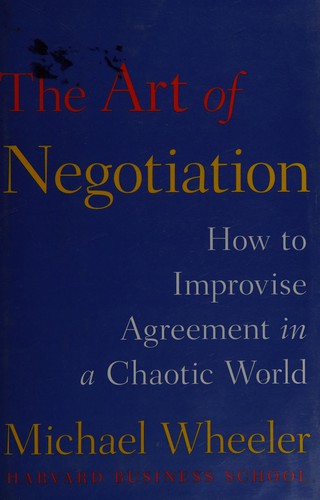
The Art of Negotiation
How to Improvise Agreement in a Chaotic World
Negotiation is an exploratory process in which interests and options are discovered rather than brought to the table, so the decisive skill is disciplined improvisation built on solid preparation, not adherence to a fixed plan.
A book summary and review by Bruce Eckfeldt
Overview
Michael Wheeler, a longtime Harvard Business School negotiation professor, argues that most negotiation advice describes a world that holds still. The standard playbook tells negotiators to identify interests, generate options, and know their best alternative before they sit down. Wheeler accepts those tools and then shows how quickly they break. Interests shift as the talk unfolds. Alternatives appear and vanish. The other side is learning and adapting at the same time. The negotiation is less a chess problem than a piece of jazz.
The book draws on Wheeler’s interviews with dealmakers, diplomats, mediators, and sports agents, on research about emotion and performance, and on fields outside negotiation, including military doctrine, improvisational theater, and jazz. It is organized in four parts. A Sense of Direction covers strategy before the table. Improvising covers the mindset and skills needed at it. Managing the Process follows a negotiation from opening to close. Mastery addresses creativity, learning from experience, and ethics.
The prescription is a cycle Wheeler states plainly in the opening chapter. Learn, adapt, and influence, all at once and continuously, while staying both calm and alert.
Negotiation is an exploratory process in which interests and options are discovered rather than brought to the table, so the decisive skill is disciplined improvisation built on solid preparation, not adherence to a fixed plan.
Chapter Summaries
Chapter 1: Embracing Chaos
The opening chapter sets Wheeler’s argument against the dominant teaching of the field. He credits Roger Fisher and William Ury’s Getting to Yes with reshaping how people think about negotiation, then lists what its framework assumes away. Real negotiations are fluid, information arrives late, and the other side may play by different rules.
- Wheeler restates the Getting to Yes principles of separating people from the problem, focusing on interests rather than positions, inventing options for mutual gain, using objective criteria, and knowing the best alternative to a negotiated agreement. He treats them as necessary but not sufficient.
- The book opens with Jay Sheldon, who tried to buy a neighboring cable television network. The owner wanted at least fifteen million dollars and Sheldon would pay no more than twelve. The gap reflected the seller’s greater optimism about the industry, so Sheldon proposed that the seller buy his business instead, and the seller agreed.
- The core problem is that interests and alternatives are not fixed inputs. A negotiator often learns what is possible, and even what is wanted, only by negotiating.
- Wheeler frames effective practice as three simultaneous activities. Learn about the other side and the situation. Adapt strategy as that learning arrives. Influence the other side’s perceptions while they are doing the same to you.
- The chapter also promises guidance on cases the standard model handles badly, including how to set a walkaway when there is no clear best alternative and how to read the other side’s moves as signals.
Chapter 2: A Map of the Pyrenees
The title comes from a story the organizational theorist Karl Weick popularized. A military detachment lost in a snowstorm in the Alps found its way back using a map that turned out to be of the Pyrenees. Wheeler uses it to make the case that a strategy’s main job is to get the negotiator moving and paying attention, not to predict the terrain.
- Wheeler draws three lessons from the soldiers. Confidence breaks paralysis, momentum creates information, and vigilance lets a team correct course as the ground reveals itself.
- A negotiation strategy is a map the negotiator drafts personally. It should capture current needs and fallback options, the other side’s likely circumstances, and an honest inventory of what is still unknown.
- Before negotiating, Wheeler poses threshold questions that conventional advice skips. Should I negotiate at all. Is now the right time. Should I hedge across options or commit to one path.
- The map only has to correspond roughly to reality. A rough map that prompts learning outperforms a detailed plan that tempts the negotiator to stop looking.
Chapter 3: Prospecting
The third chapter turns to goals. Wheeler covers how to set aspirations, weigh trade-offs among issues, assess the upside of a deal, and decide in advance when to walk away. His emphasis is on preparing for a range of outcomes rather than a single target.
- Wheeler introduces value ladders, a way of ranking possible outcomes from best to worst so a negotiator knows which concessions cost little and which cut deep.
- He pairs them with a prospect matrix that maps the negotiator’s own possible outcomes against the other side’s, which forces attention to what an agreement must offer the counterpart to be reachable.
- Imagining extreme scenarios, both the best and the worst plausible outcomes, widens the negotiator’s view of the zone of possible agreement and protects against settling early.
- The chapter weighs the costs and benefits of aggressive aspirations. High targets tend to raise results, and they also raise the risk of impasse and of regret after the fact.
Chapter 4: Plan B
Wheeler argues that the best alternative to a negotiated agreement is not a fixed number to be calculated once. It is a moving option that needs active management. The chapter sets out nine strategic principles for keeping a Plan B alive while pursuing Plan A.
- The principles cover having a Plan B, envisioning the end game, and adapting as conditions change. Wheeler pairs each with concrete examples from business and personal negotiations.
- He recommends benchmarks and trip wires, preset signals that tell a negotiator when progress has stalled enough to shift effort toward the alternative.
- Parallel negotiations with more than one counterpart preserve leverage and generate information about value, though they carry relationship costs if handled carelessly.
- Wheeler cautions that the fair test of a strategy is not whether it succeeded in one case. A sound plan can lose and a poor plan can win, so negotiators should judge the reasoning as well as the result.
Chapter 5: Presence of Mind
Part Two opens with emotion. Wheeler contrasts negotiators who relish the contest, such as the sports agent Donald Dell, with skilled professionals who dread it. He argues that emotional balance is a performance skill that can be developed, not a fixed trait.
- The goal is a set of paired states that seem to conflict. Wheeler asks negotiators to be calm and alert, patient and proactive, creative and grounded at the same time.
- Research Wheeler conducted with the psychologist Kimberlyn Leary found that even very successful people bring anxiety to the table, and that much of it stems from the uncertainty of negotiation and the fact that success is never wholly in their hands.
- Wheeler offers an emotional checklist to complete beforehand. How do I want to feel going in. What can throw me off. How can I recover. How do I want to feel when it is over.
- He draws on Deborah Kolb and Judith Williams’s advice to stay out of your own way and on Ellen Langer’s research on mindfulness, which help a negotiator notice an emotional hot button before reacting to it.
Chapter 6: The Swing of Things
This chapter makes the book’s central analogy explicit. Wheeler compares skilled negotiators to jazz musicians who work within a structure while responding in real time to the other players. He describes three aspects of improvising. Paying heed, comping, which means supporting the other players, and being provocative.
- Ed Sarath, former head of the jazz department at the University of Michigan, says that musicians should be eighty percent inside their comfort zone and twenty percent outside it. A player who is completely comfortable just recycles past performances.
- Provocation can be aimed at oneself or at others. John Coltrane played in unfamiliar keys because it made him think, and Gene Krupa’s wild drum solo woke up Benny Goodman’s stiff band at its 1938 Carnegie Hall concert.
- The sports agent Donald Dell describes shocking the teenage Moses Malone into attention when trying to dissuade him from signing with the American Basketball Association. Sometimes the other side has to be jolted before it will listen.
- Wheeler describes the diplomat Richard Holbrooke as a negotiator whose apparent jiving was in fact deliberate provocation used to move counterparts.
Chapter 7: Situational Awareness
Wheeler borrows from fields where people must act under uncertainty, including military command, chess, and sports. The chapter is about reading the negotiation as it unfolds and adjusting strategy without losing sight of the larger goal.
- Wheeler adapts the OODA loop, the observe, orient, decide, act cycle developed by the military strategist John Boyd, as a model for continuous adjustment at the table.
- He draws on the United States Marine Corps doctrine manual Warfighting for its treatment of uncertainty, initiative, and the need to act on incomplete information.
- In Wheeler’s version, observing covers the interpersonal dynamics and the context as well as the substance of the deal, and orienting means making sense of what has been observed before deciding.
- Situational awareness applies to hardball and collaborative negotiations alike. The same discipline of noticing and adapting serves a tough bargainer and a joint problem-solver.
Chapter 8: Openings
Part Three follows the arc of a negotiation, starting with its first moments. Wheeler compares transcripts of two pairs of veteran negotiators handling the same case to show how early exchanges set trajectories that are hard to change later.
- In the opening, three things are defined at once. Engaging establishes who the parties are to each other. Framing establishes what the negotiation is about. Norming establishes how the process will run.
- Wheeler notes that parties negotiate how to negotiate every time they sit down, whether they do it deliberately or not.
- Research on first impressions and physical affect, which Wheeler reviews, shows that early judgments of warmth and competence form quickly and resist revision.
- Labeling a conversation as a negotiation can itself make agreement harder by raising defensiveness, so the framing of the encounter is a strategic choice.
Chapter 9: Critical Moments
Some moments in a negotiation cannot be undone, such as an offer that cannot be withdrawn or a threat or outburst that changes the tone. Wheeler addresses how to recognize these moments and respond to them.
- Wheeler builds on Deborah Kolb and Judith Williams’s analysis of moves and turns, the power plays that shift a negotiation and the responses that redirect it.
- The chapter covers when and how to say no without ending the conversation, and when to say yes to keep momentum.
- Recovering from one’s own mistakes is treated as a core skill. A negotiator who names an error and resets often loses less than one who defends it.
- Negotiators can correct a mischaracterization, name a tactic out loud, or call a pause. Each response changes the game being played rather than escalating within it.
Chapter 10: Closing
The final process chapter addresses the end game. The central question is whether to accept an attractive proposal or press for more, and how to manage the last-minute changes and blowups that are common near agreement.
- Wheeler weighs the value of a deal in hand against the uncertain upside of continuing. Pressing for more can work, and it can also lose an agreement that was worth taking.
- The chapter covers whether, when, and how to say yes. Timing of acceptance carries signals about how much room was left.
- Late-stage emotional spikes are common, and Wheeler treats last-minute demands and outbursts as predictable rather than as evidence of bad faith.
Chapter 11: Silk Purses
Part Four begins with creativity. The chapter title refers to the proverb about making a silk purse from a sow’s ear. Wheeler shows how negotiators turn apparent dead ends into agreements by reframing the problem.
- Wheeler identifies three sources of creative agreement. Exploiting differences in priorities, forecasts, and risk tolerance. Aligning incentives so each side gains from the other’s success. Breaking deadlocks with new options or new parties.
- Wheeler recounts the 1992 dispute between Southwest Airlines and Stevens Aviation over an advertising slogan, which Herb Kelleher and Kurt Herwald settled with a public arm-wrestling match rather than a lawsuit.
- Wheeler observes that focusing on what will not work can blind negotiators to solutions that will. Creativity depends on the attitude of the parties as much as on technique.
Chapter 12: Wicked Learning
The title borrows a term the psychologist Robin Hogarth coined for environments where feedback is delayed, noisy, or misleading. Wheeler argues that negotiation is such an environment, which is why experience alone does not reliably make people better at it.
- Outcomes are poor teachers. A negotiator who reached a deal rarely learns what was left on the table, and one who walked away rarely learns whether a deal was possible.
- Satisfaction and success are different measures. Wheeler notes that things negotiators worked hard to get can look different after they win them.
- Learning requires deliberate review of process, not just results. Wheeler recommends recording what you know, what you assume, and how you will test those assumptions, then reviewing afterward what surprised you.
- He suggests keeping a running record of negotiations to identify patterns in one’s own behavior that single episodes hide.
Chapter 13: Fair Enough
The closing chapter addresses ethics. Wheeler argues that the hardest choices in negotiation are not between right and wrong. They require reconciling competing values and obligations, to oneself, to the other side, and to the people one represents.
- Wheeler frames the tension with the line attributed to the sage Hillel. If I am not for myself, who will be. If I am only for myself, who am I.
- Different parties hold different, sincere views of what is fair, so fairness is often itself a subject of negotiation rather than an external standard.
- Character is revealed in choices about honesty and disclosure under pressure. Wheeler asks negotiators to examine the motives behind their tactics, not only the tactics.
- Emotions often drive moral judgment in the moment, so self-awareness and humility are presented as ethical skills as much as performance skills.
About the Author
Michael Wheeler is the MBA Class of 1952 Professor of Management Practice, Retired, at Harvard Business School. He taught negotiation at Harvard Business School for more than two decades and served as head of its required negotiation course. He is a member of the executive committee of the Program on Negotiation at Harvard Law School and was for many years editor of Negotiation Journal, the field’s leading academic publication.
His other books include Lies, Damn Lies, and Statistics and, with Carrie Menkel-Meadow, the edited volume What’s Fair: Ethics for Negotiators. He developed Harvard Business School Online’s Negotiation Mastery course, which draws on the framework in this book.
Wheeler writes as a teacher and researcher rather than as a career dealmaker. His authority comes from decades of teaching, research on emotion in negotiation, and extensive interviews with practitioners. The book’s stories are largely reported from those interviews and from public accounts rather than from his own deal experience.
Key Takeaways
1) Interests and alternatives are discovered, not brought.
The standard model treats interests and the best alternative to agreement as inputs a negotiator brings to the table. Wheeler’s core argument is that both are found and reshaped through the negotiation itself. Preparation fixes a starting point. It does not fix the destination.
- Wheeler credits Getting to Yes for its principles and argues they assume a stability real negotiations lack.
- In the book’s account of Arvind Gupta, an elderly couple offered him an apartment building for two and a half million dollars, well below market. His partner insisted on a lower offer, the hurt couple withdrew, and a year later they sold it for eleven million.
- The learn, adapt, influence cycle runs throughout, not only at the outset.
2) A strategy is a map for learning, not a script.
The Pyrenees story carries the book’s view of planning. A strategy earns its keep by getting the negotiator moving and noticing, not by predicting the terrain. Wheeler quotes Dwight Eisenhower’s line that plans are worthless but planning is everything.
- A useful map captures needs, the other side’s situation, and what is unknown.
- Threshold questions come first. Whether to negotiate, whether now, and whether to hedge or commit.
- The map must be roughly right. A map of the wrong mountains still works. A map of the wrong continent does not.
3) The walkaway is a moving option.
Wheeler treats Plan B as something to build and maintain while pursuing Plan A. Its strength changes during the negotiation, and so should the negotiator’s behavior. Leverage depends as much on alternatives developed in parallel as on arguments made at the table.
- Value ladders and the prospect matrix structure the range of acceptable outcomes.
- Benchmarks and trip wires signal when to shift effort to the alternative.
- Parallel negotiations generate both leverage and information about value.
4) Emotional balance is a performance skill.
Wheeler’s research with Kimberlyn Leary found that anxiety is common even among very successful professionals. The book’s answer is not to suppress emotion but to prepare for it, recognize it, and use it, in the paired state of being calm and alert at once.
- The emotional checklist asks how you want to feel, what could throw you, how you will recover, and how you want to feel afterward.
- Ed Sarath’s rule of eighty percent inside the comfort zone and twenty percent outside it describes the balance between preparation and risk-taking.
- Pauses and naming are tools for regaining balance in the moment.
5) The opening negotiates the negotiation.
In the first minutes, parties settle who they are to each other, what they are discussing, and how they will proceed. Those early settlements are sticky. A negotiator who treats the opening as a warm-up has already let the other side shape the process.
- Engaging, framing, and norming happen whether or not they are managed.
- First impressions of warmth and competence form quickly and resist revision.
- Calling something a negotiation can harden positions, so the label is a choice.
6) Creative agreements come from differences.
Wheeler locates most value creation in differences between parties, in priorities, forecasts, risk tolerance, and timing, rather than in shared interests. The deadlocked negotiation is often the one where no one has yet reframed the problem.
- Exploiting differences, aligning incentives, and breaking deadlocks are the three levers.
- Jay Sheldon turned a price gap rooted in different forecasts into a deal by reversing the roles of buyer and seller.
- The Southwest and Stevens Aviation arm-wrestling match turned a slogan dispute into joint publicity.
- Focusing on what will not work crowds out solutions that will.
7) Experience alone does not make better negotiators.
Negotiation is a wicked learning environment. Feedback is delayed, partial, and misleading, and the counterfactual is invisible. Improvement depends on reviewing the process and the reasoning, not on tallying wins.
- A good plan can lose and a bad plan can win.
- Satisfaction and success are different measures.
- Recording assumptions before and surprises after creates the feedback the environment withholds.
Strengths and Limits
The book’s strength is that it describes negotiation as practitioners experience it, with shifting interests, partial information, and emotional pressure, while keeping the analytic tools of the field in view. It integrates research on emotion, military doctrine, improvisational theater, and music without losing the practical thread. Reviewers in the field have been positive. Leonard Riskin, writing in the Cardozo Journal of Conflict Resolution, called it crystal clear and a grand contribution to negotiation training and practice. Harborne Stuart, reviewing it in Negotiation Journal, singled out the diversity of its sources and judged the section on improvising its most important contribution. Its treatment of Plan B as a moving option and of the opening as a negotiation over process are particularly useful additions to the standard model.
The limits follow from the approach. Because the book is organized around adaptation, it offers fewer step-by-step methods than its predecessors, and readers looking for a system may find it more a set of dispositions than a procedure. Most examples are drawn from interviews and public accounts, often in one-to-one settings, so multiparty and organizational negotiations receive less attention. Stuart observed that the book expands the established mindset rather than replacing it. The predictable failure mode is that a reader takes improvisation as license to under-prepare, when Wheeler’s own argument is that improvisation works only on top of thorough preparation.
My Take
Wheeler’s diagnosis holds for the founder-CEOs I work with, and arguably more strongly than for the corporate managers he usually taught. A founder negotiates constantly and rarely with clean inputs. A key hire, a large customer renewal, a partner dispute, a debt facility, and eventually the sale of the company all involve interests that shift as the conversation unfolds and alternatives that strengthen or evaporate during the process. The idea that the walkaway is a moving option is the single most useful idea in the book for anyone going through an exit process, where leverage changes sharply between first conversations, a letter of intent, and closing.
The book plays differently by context. In repeated relationships, with co-founders, key employees, and long-term customers, the emphasis on openings, emotional balance, and creative agreement fits well. In one-shot transactions against professional counterparts, especially private equity buyers who run dozens of deals a year, the founder is improvising against someone who has played the tune many times. There the book’s lessons on Plan B and parallel negotiations matter more than its lessons on rapport, and the founder’s best move is often to borrow experience by bringing in advisors who have it.
The most credible outside objection comes from Daniel Kahneman and Gary Klein, whose 2009 paper on intuitive expertise concluded that intuition becomes reliable only in environments that are regular enough to learn and that provide rapid, clear feedback. Wheeler himself calls negotiation a wicked learning environment. If Kahneman and Klein are right, the skilled improviser Wheeler describes is hard to develop for anyone who negotiates high-stakes deals only a few times. I think the objection is fair and that Wheeler partly answers it by insisting on deliberate review. The practical conclusion is to lean on structure and borrowed experience where repetitions are scarce, and to treat improvisation as the layer on top rather than the foundation.
The adjacent book is David Lax and James Sebenius’s 3-D Negotiation. Wheeler is strongest at the table. Lax and Sebenius are strongest away from it, on who should be involved, in what sequence, and how the deal itself is designed before anyone talks. Read Wheeler for how to handle the conversation as it unfolds. Read Lax and Sebenius for how to set it up so the conversation starts in your favor.
Discussion Questions
For CEOs
- Which of my current negotiations am I treating as fixed when the interests or alternatives are actually still moving?
- For the most important deal on my desk, what is my Plan B today, and what am I doing this month to strengthen it?
- Where have I gone into a negotiation with a script rather than a map, and what did that cost me?
- What reliably throws me off balance in a negotiation, and how do I want to feel when the next one is over?
- In my last important negotiation, who set the frame and the process in the opening minutes, and was it me?
- Where am I negotiating against a counterpart with far more repetitions than I have, and how am I compensating?
- What differences between us and a key counterpart, in timing, risk tolerance, or forecasts, could become the basis of a better deal?
- How do I actually learn from my negotiations, and would I know if I were consistently leaving value on the table?
For Teams
- Which negotiations do we run as a team, with customers, vendors, or partners, and who owns the opening, the walkaway, and the close?
- When we prepare for an important negotiation, do we record what we know, what we assume, and how we will test those assumptions?
- Where have we said yes too quickly because a deal felt good, and where have we pushed too hard and lost one?
- What benchmarks or trip wires would tell us a negotiation has stalled enough to shift to our alternative?
- How do we handle a late change or demand from the other side near closing, and is that response deliberate or reactive?
- Where are our internal negotiations, over budgets, priorities, and roles, suffering from the same problems Wheeler describes at external tables?
- What would our negotiation record show if we reviewed the last ten significant deals together?
- Where are we treating fairness as obvious when the other side may sincerely see it differently?
Practical Tools
1. Negotiation Map
Wheeler’s Pyrenees chapter argues that a strategy’s job is to get the negotiator moving and paying attention. This exercise drafts that map for a specific upcoming negotiation, with the unknowns stated as explicitly as the knowns. Use it before any negotiation that matters, from a key hire to a term sheet.
How it works:
- Answer the threshold questions in writing. Should we negotiate at all. Is now the right time. Should we hedge across options or commit to one path.
- Write down current needs and fallback options as you understand them today.
- Describe the other side’s likely circumstances, pressures, and alternatives.
- List what you do not know that would change your approach, and how you could learn each item during the negotiation.
- Identify the first two or three moves you will make and what each is meant to reveal.
The negotiation begins with a direction and a list of questions rather than a script. When the terrain differs from the map, the team adjusts deliberately instead of freezing or forcing the plan.
2. Value Ladder And Prospect Matrix
Wheeler’s prospecting tools rank possible outcomes and place them alongside the other side’s view. The exercise clarifies which concessions are cheap and which are costly, and what an agreement must offer the counterpart to be reachable.
How it works:
- List the issues in play, such as price, timing, terms, scope, and roles.
- For each issue, rank outcomes from best to worst for your side to form a value ladder.
- Estimate the same ladder for the other side, noting where your rankings differ most.
- Lay the two views side by side to see which combinations are acceptable to both.
- Mark the best and worst plausible outcomes so the zone of agreement is not set too narrowly or too early.
The team knows where it can trade and where it cannot, and enters with a range of acceptable packages rather than a single number.
3. Plan B Trip Wires
Wheeler treats the alternative to agreement as an option that must be built and monitored. This exercise sets the signals that tell leadership when to shift effort from Plan A to Plan B, before sunk costs make that shift harder.
How it works:
- Name the current Plan B for the negotiation and assess its strength honestly.
- List two or three actions that would strengthen it during the negotiation, including parallel conversations.
- Set benchmarks for progress on Plan A, such as dates, terms, or commitments.
- Define trip wires, specific conditions under which effort shifts toward Plan B.
- Review the benchmarks and trip wires at each stage of the negotiation.
Leadership stops evaluating a deal only against itself. Decisions to continue, press, or walk away are made against a live alternative and preset signals.
4. Emotional Readiness Check
Wheeler’s presence of mind chapter treats emotional balance as preparable. This short practice applies his checklist questions before any negotiation where the stakes or the relationship make reactivity likely.
How it works:
- Write how you want to feel going into the negotiation.
- List what could throw you off balance, including specific tactics, people, or topics.
- For each item, choose a response in advance, such as a pause, a question, or naming the tactic.
- Write how you will recover if you lose balance anyway.
- Write how you want to feel when it is over, about both the outcome and your conduct.
- Review the notes immediately before the meeting.
Hot buttons are recognized as they happen rather than afterward. The negotiator can choose a response and stay calm and alert under pressure.
5. Opening Design
Wheeler’s openings chapter shows that the first minutes settle who the parties are to each other, what they are discussing, and how they will proceed. This exercise designs those three elements deliberately for an important first meeting.
How it works:
- Engaging. Decide how you want the other side to see you and your relationship, and what you will do in the first minutes to establish it.
- Framing. Write one or two sentences describing what the conversation is about, in terms the other side can accept.
- Norming. Decide what process you will propose, including agenda, sequence of issues, and how information will be shared.
- Anticipate how the other side may try to set each element differently and how you will respond.
The opening is used to shape the negotiation rather than spent as a warm-up. The process that follows is one both sides agreed to rather than one that happened by default.
6. Critical Moment Responses
Some moves in a negotiation cannot be taken back. Wheeler’s critical moments and closing chapters describe ways to respond that redirect the game instead of escalating within it. This exercise prepares those responses in advance.
How it works:
- List the critical moments likely in this negotiation, such as a first offer, a threat, an ultimatum, or a late demand.
- For each, choose a response from Wheeler’s set. Correct the record, name the tactic, ask a question, or call a pause.
- Decide in advance how you will say no without ending the conversation.
- Decide what would make you say yes, and what signal your timing of acceptance sends.
- Plan how you will acknowledge and reset if you make a mistake.
Pressure points arrive as anticipated events with prepared responses. The negotiator stays in control of the process when the other side tries to seize it.
7. Negotiation Process Review
Wheeler’s wicked learning chapter argues that outcomes are unreliable teachers. This review creates the feedback the environment withholds, by comparing assumptions before a negotiation with what actually happened. Run it after every significant deal, whether it closed or not.
How it works:
- Before the negotiation, record what you know, what you assume, and how you will test those assumptions.
- Afterward, note what surprised you and which assumptions proved wrong.
- Separate the quality of the decisions from the outcome. Ask whether the reasoning was sound given what was known at the time.
- Note how satisfied you are with the result and whether satisfaction matches success.
- Keep the reviews together and look for patterns across negotiations each year.
Over time, leadership builds an accurate picture of its own negotiating habits. Improvement comes from patterns across many deals rather than from the memory of the last win or loss.
Further Reading
- Leonard Riskin’s review essay Beginning With Yes, in the Cardozo Journal of Conflict Resolution, for a detailed reading of the book’s argument and its relationship to Getting to Yes and mindfulness in negotiation.
- Michael Wheeler’s 25 Reasons to Embrace Chaos in Negotiation, his own condensed statement of the book’s principles on his newsletter The Jazz of Negotiation.
- Michael Wheeler’s Anxious Moments: Openings in Negotiation, the Negotiation Journal article behind the book’s treatment of openings and emotion.
- Daniel Kahneman and Gary Klein’s Conditions for Intuitive Expertise, in American Psychologist, for the research on when intuition can be trusted and why it bears on learning to negotiate.
- Harvard Business School Online’s overview of the stages of negotiation, drawn from Wheeler’s Negotiation Mastery course, for the engaging, framing, and norming model.
Share This Review

Bruce Eckfeldt is a business coach and strategic advisor to founder-CEOs of growth-stage companies, a former Inc. 500 CEO, and the author of Springboard. More book reviews →
These summaries present Bruce Eckfeldt’s analysis of business and leadership books for founder-CEOs and leadership-team members of growth companies. Each one identifies the ideas most relevant to decision quality, strategy, and leadership capacity, notes where the evidence is weak, and suggests practical ways to test what is worth testing. All ideas, stories, and quotations belong to the original author and to the people they cite. The assessments and recommendations are Bruce’s. It is a companion to the book, not a substitute for reading it.
To learn more about Bruce’s programs, request other book summaries, or get in touch, contact booksummaries@eckfeldt.com.
Get the Next Review.
A new book review lands in Better, Faster, my weekly newsletter for founder-CEOs, along with one practical essay and questions for your team.