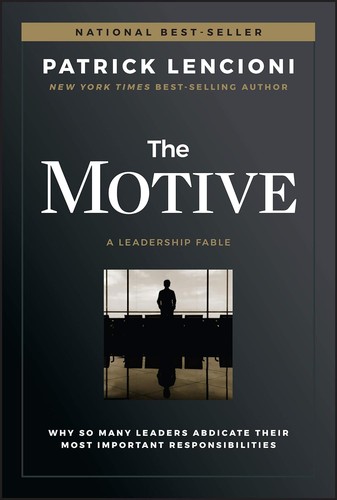
The Motive
Why So Many Leaders Abdicate Their Most Important Responsibilities
Leaders lead for one of two reasons. Because leadership is a reward, or because it is a responsibility. The first motive produces the avoidance behaviors most executive teams complain about. The second is the precondition for organizational health.
A book summary and review by Bruce Eckfeldt
Overview
The Motive is Patrick Lencioni’s shortest and most pointed book, and the one he says he should have written first. The argument is that most leadership problems attributed to skill, culture, or strategy are actually motive problems. Leaders lead for one of two reasons. Because leadership is a reward for hard work and should be enjoyable, or because leadership is a responsibility to serve the people and the organization and should be difficult. The first motive produces avoidable dysfunction. The second produces organizational health. Lencioni argues that the reason so many talented leaders fail to build healthy organizations is that they arrived at the top with the wrong motive and never examined it.
The book is structured as a fable followed by a short model. The fable is a single day-long conversation between two CEOs of competing home-security companies. Shay Davis, recently promoted CEO of Golden Gate Alarm, is struggling and reaches out reluctantly to his rival Liam Alcott, CEO of the more successful Del Mar Alarm. Over the course of the day, Liam surfaces five specific responsibilities Shay has been avoiding, not because he lacks the skill but because he does not believe they are what a CEO should have to do. The model that follows names the two motives, defines the five omissions of reward-centered leaders, and closes with two short chapters on vigilance and on what separates responsibility-centered leadership from servant leadership as a movement.
Leaders lead for one of two reasons. Because leadership is a reward, or because it is a responsibility. The first motive produces the avoidance behaviors most executive teams complain about. The second is the precondition for organizational health.
Chapter Summaries
Chapter 1: Introduction
The book opens with Lencioni’s account of the question that had been bothering him for years. He had spent two decades working with executives and could not explain why so many leaders who knew what to do failed to do it. The answer he arrived at, and the reason for writing this book, is that the underlying motive for taking the leadership role determines what a leader is willing to do, and no amount of skill training will change behavior that runs against the leader’s motive.
- Lencioni distinguishes his argument from most leadership literature. Most books assume the leader wants to do the work of leadership and only needs to learn how. The Motive assumes the opposite. Many leaders do not actually want to do the work of leadership and are looking for a version of the role that lets them avoid it.
- The book is deliberately short. Lencioni’s stated intent is that a busy CEO could read it on a single flight. The form is a concession to the reader who would not finish a longer treatment and a signal that the underlying claim does not need a long book to be made.
- The introduction previews the structure. A fable in which two CEOs work through the diagnosis in a single day, followed by a compact model that names the two motives and the five specific responsibilities reward-centered leaders abdicate.
Chapter 2: The Fable
The bulk of the book is a single day-long conversation between Shay Davis, recently promoted CEO of Golden Gate Alarm, and Liam Alcott, CEO of the more successful Del Mar Alarm. Shay’s numbers are not failing but his company’s growth trails competitors, and the private-equity firm backing him is beginning to ask questions. He reaches out reluctantly to Liam, his most successful rival and, for reasons Shay does not initially understand, someone willing to spend a day with him. Over coffee, lunch, and a walk, Liam works through what Shay actually does with his time and what he avoids.
- Liam surfaces that Shay does not run great leadership meetings, does not manage his direct reports closely, does not have hard conversations with underperformers, does not develop his executive team as a team, and does not repeat key messages to his organization. Shay’s response to each is the same. Those are not really the CEO’s job, or the CEO does not have time, or the CEO has trusted people to handle them.
- Liam’s counter is that the CEO is the only person in the company for whom those five responsibilities are the job, and that avoiding them is not delegation. It is abdication. The distinction between delegation and abdication is one of the sharpest lines in the book.
- The turn in the conversation comes when Liam asks Shay to describe why he wanted to be CEO. Shay’s answer, that he had earned it through years of hard work and wanted the role for the challenge and the recognition, is exactly the answer Lencioni later names as reward-centered.
- Liam’s answer to the same question, that he took the CEO role because someone had to serve the people at Del Mar and he was the person best positioned to do it, is the responsibility-centered stance the book argues is the only one that produces durable organizational health.
Chapter 3: The Lesson: Introduction
The book pivots from fable to model. The introduction to The Lesson names the question the fable was designed to expose. Why do so many leaders who know what to do fail to do it. Lencioni’s answer, developed over the next four chapters, is that the answer lies in the leader’s underlying motive, and that the motive determines which parts of the CEO role the leader considers legitimate work and which the leader considers beneath them or someone else’s problem.
- The model is deliberately binary. There are two motives, not a spectrum. Lencioni acknowledges this is a simplification and argues that the simplification is diagnostically useful because it forces the leader to name which motive is currently dominant.
- Organizational health, defined in Lencioni’s earlier work as an organization with minimal politics and confusion and high alignment, productivity, and engagement, is named as the outcome the right motive produces. The wrong motive produces the opposite regardless of the leader’s technical skill.
- The chapter’s implicit challenge to the founder-CEO is that they cannot outsource the motive question. A CEO with the wrong motive can hire executives with the right one, and the organization will still be unhealthy because the top of the company determines what actually gets done.
Chapter 4: Exploring The Two Leadership Motives
The book’s central distinction. Reward-centered leadership is the belief that being a leader is the reward for hard work, and therefore the experience of being a leader should be pleasant and enjoyable, free to choose what to work on and to avoid what is mundane, unpleasant, or uncomfortable. Responsibility-centered leadership is the belief that being a leader is a responsibility, and therefore the experience of leading should be difficult and challenging, though not without personal gratification.
- The two motives look identical from the outside. Both leaders may have the same resume, the same public statements, the same values on the wall. The difference shows up in what each is willing to do when the work is genuinely unpleasant, and it is visible over time in what the organization becomes.
- Reward-centered leaders are not necessarily lazy or unethical. Many are hard working, well intentioned, and technically capable. The motive is not about effort. It is about which activities the leader considers legitimate parts of the job and which they consider beneath them or someone else’s problem.
- Lencioni argues that reward-centered leadership is more common among people who reached the CEO role by climbing a corporate ladder in which each promotion was framed as a reward. The framing installs the motive before the leader has considered whether it fits the job.
- The stance is testable. Lencioni’s diagnostic is to ask a leader which parts of their week they enjoy and which they avoid. Reward-centered leaders can name what they enjoy and quietly avoid what they do not. Responsibility-centered leaders may not enjoy the hard parts but they do not avoid them.
Chapter 5: The Five Omissions Of Reward-Centered Leaders
The longest chapter in The Lesson. Lencioni names the five specific responsibilities reward-centered CEOs consistently avoid. Developing the leadership team as a team. Managing subordinates directly. Having difficult and uncomfortable conversations. Running great team meetings. Communicating constantly and repetitively. Each omission is presented in the same structure. The rationalization a reward-centered leader uses to explain the omission, the counter-argument for why the omission is abdication rather than delegation, and the observable cost to the organization.
- Omission one is the failure to build the executive team as a team. Reward-centered leaders hire talented individuals and then leave them to figure out how to work together. Lencioni argues this is the single highest leverage activity a CEO can undertake and that no one else in the company can do it. Trust between senior leaders, productive conflict in the room, and commitment to decisions made collectively are all functions the CEO either holds or drops.
- Omission two is failure to actively manage direct reports. The rationalization is trust and the desire not to micromanage. Lencioni’s counter is that trust is not the absence of engagement. Management is coaching, honest performance conversations, and insistence that the subordinate manage their own subordinates the same way. The pattern cascades. A CEO who does not manage their direct reports produces direct reports who do not manage theirs, and the pattern reaches the front line within a year or two.
- Omission three is avoidance of hard conversations. The rationalization is concern for team morale. Lencioni’s counter is that the team, working around the unaddressed issue, is more demoralized than a direct conversation would have made them, and the leader who avoided the conversation is the one whose comfort was protected. The leading indicator is the corridor conversation. Team members who cannot get the leader to address an issue in the room end up discussing it in the hallway.
- Omission four is treatment of meetings as bureaucratic overhead rather than as the primary venue in which the CEO does the work of leadership. The critique connects to Lencioni’s earlier book Death by Meeting. Meetings are where decisions get made, conflict gets resolved, and alignment gets built. The test for a leadership meeting is whether at least one significant decision was made in the room that had not been made outside it. Meetings that ratify decisions made in one-on-ones are reporting sessions.
- Omission five is failure to repeat key messages until the organization absorbs them. Lencioni argues employees need to hear a message roughly seven times before they trust that the leader means it. The reward-centered leader stops repeating when they get bored, usually around the second or third time. The organization concludes the message was a passing enthusiasm and returns to whatever it was doing before. The CEO is the chief reminding officer, and repetition is not a communication problem. It is the job.
Chapter 6: Imperfection And Vigilance
The closing argument of The Lesson. No leader is purely responsibility-centered, and even the strongest responsibility-centered leaders slip. The condition for sustained responsibility-centered leadership is not perfection. It is vigilance. The leader has to keep asking whether the current pattern of behavior looks like someone who took the job to serve or someone who took it as a reward, and be willing to correct when the answer drifts.
- The failure mode Lencioni warns against is a leader who identifies as responsibility-centered and stops examining themselves. The motive question is not answered once. It is answered continuously, and the answer can change without the leader noticing.
- The specific drift pattern is that as the leader becomes more successful, the rewards of the role increase and become easier to enjoy. The leader begins to spend more time on the parts of the job they enjoy and less on the parts they find hard, without ever making a conscious decision to do so.
- The vigilance practice Lencioni recommends is a periodic self-audit against the five omissions. Which have I been quietly dropping. What has that cost the organization. What would I have to change in the coming quarter to reverse the drift.
Chapter 7: The Surprising Danger Of Fun
A short chapter that anticipates the most common defense of the reward-centered stance. That leaders should enjoy their work and that insisting the CEO role should be hard is joyless. Lencioni’s counter is that there is nothing wrong with a CEO enjoying the role. The problem is when the enjoyment becomes the criterion for what the CEO chooses to do and not do. Fun as an outcome is fine. Fun as a filter is dangerous.
- The chapter separates enjoyment from motive. A responsibility-centered leader can and often does find gratification in the work. The distinction is whether the leader is willing to do the parts of the job that are not enjoyable when the job requires them.
- The specific danger is that fun-as-filter is invisible to the leader. The leader does not think of themselves as skipping the hard parts. They think of themselves as focusing on where they add the most value, which happens to be the parts they enjoy most.
- The corrective Lencioni names is to notice which parts of the job the leader protects on their calendar and which they allow to slip when other things come up. The pattern is the diagnostic. The leader’s stated priorities are not.
Chapter 8: The End Of Servant Leadership
The book closes with a short argument that the term servant leadership, as it is now used in most leadership literature, has been softened to the point of meaninglessness. Lencioni argues that the phrase was originally Robert Greenleaf’s, that Greenleaf intended it as a hard stance about who the leader exists to serve, and that its current usage as a synonym for nice, humble, or empathetic leadership empties it of the demand that made it useful. Responsibility-centered leadership, as Lencioni defines it, is what Greenleaf actually meant.
- The critique is directed at the leadership-industrial complex more than at Greenleaf. The term has been adopted by consultants, training programs, and corporate leadership frameworks in ways that let leaders keep the label without doing the work.
- Lencioni’s proposal is not new terminology. It is to reserve the term for leaders who actually meet the responsibility test the book has just spent one hundred and eighty pages defining, and to stop using it as a general compliment for anyone who is approachable or kind.
- The closing sentence of the book is a challenge to the reader. The CEO who has read this far and identifies with the responsibility-centered stance is invited to test the identification against the five omissions, and to notice which of the five they have been quietly dropping. The motive question, Lencioni argues, is answered by behavior alone.
About the Author
Patrick Lencioni is the founder and president of The Table Group, a consulting firm focused on organizational health, and the author of a dozen books that have sold over seven million copies in more than thirty languages. His previous books include The Five Dysfunctions of a Team, The Advantage, Death by Meeting, and Silos, Politics, and Turf Wars. Before founding The Table Group in 1997, he worked at Bain and Company, Oracle, and Sybase, where his experience running teams and observing executive dysfunction provided the raw material for his subsequent books.
Lencioni is known for writing leadership fables, short narratives followed by a compact model. The format is a deliberate choice. He argues that most executives will finish a story who will not finish a management textbook, and that the fable structure allows him to make an argument through characters and situations that would feel preachy in direct prose. The Motive, published in 2020, is the shortest of his books and, by his own account, the one he wishes he had written first because everything else assumes the reader wants to do the work of leadership, which is the exact assumption he now believes cannot be made.
Key Takeaways
1) There are two motives, and only two.
Lencioni’s central claim is that leaders lead for one of two reasons. Because leadership is a reward for hard work and should be enjoyable, or because leadership is a responsibility to serve the people and organization and should be difficult. The two motives look identical from the outside. The difference shows up in what the leader is willing to do when the work is genuinely unpleasant, and it becomes visible over time in what the organization becomes.
- The binary framing is deliberate. Lencioni acknowledges that most leaders have some of both motives, and argues that the diagnostic value comes from forcing the leader to name which one is currently dominant rather than describing a spectrum.
- The motive is often installed unconsciously by a career of promotions framed as rewards for effort. The leader arrives at the CEO role assuming the role is the prize without ever considering whether the assumption fits the job.
- The motive is not visible in what the leader says. It is visible in what the leader does when the work is hard. A leader can hold responsibility-centered language and reward-centered behavior for years without the gap being named.
2) Delegation and abdication look identical on the org chart.
One of the sharpest lines in the book is Lencioni’s distinction between delegation and abdication. A delegated responsibility is still held by the leader, who checks in, supports the person doing the work, and remains accountable for the outcome. An abdicated responsibility is one the leader has handed off and stopped thinking about, usually with the justification that the person receiving it is capable and should not be micromanaged. From the org chart, the two look the same. From inside the company, they do not.
- The reward-centered leader’s default is abdication framed as trust. The framing is convincing because trust is a virtue and the person receiving the responsibility often is capable. The dysfunction is not in the choice to hand the work off. It is in the leader’s disengagement afterward.
- The signal is what happens when things go wrong. A delegating leader treats the problem as a shared one and engages. An abdicating leader treats it as the delegate’s failure and expresses disappointment from a distance.
- The five omissions in the book are all responsibilities that get abdicated by reward-centered leaders under the language of trust or delegation. Naming each one as abdication rather than delegation is the first move.
3) Developing the leadership team is not delegable.
The first omission Lencioni names is the failure to build the executive team as a team. Reward-centered leaders hire talented individuals and then leave them to figure out how to work together. Lencioni argues that this is the single highest-leverage activity a CEO can undertake and that no one else in the company can do it. Trust between senior leaders, productive conflict in the room, and commitment to decisions made collectively are all functions the CEO either holds or drops.
- The work is emotional and cannot be outsourced to HR or an offsite facilitator. The facilitator can help. The CEO has to do the work of holding the team through the discomfort that trust and productive conflict require.
- The cost of the omission is invisible in the current quarter and enormous over two years. Politics between functions, decisions that do not stick, and a leadership team that behaves like a group of individuals reporting to a CEO rather than a team.
- For a growth-stage founder, the team built in the twenty-to-fifty-million range either scales the company or becomes the ceiling. The founder’s time on team development is the highest-leverage time on their calendar.
4) Not micromanaging is not the same as not managing.
The second omission is failure to actively manage direct reports. Lencioni argues that many CEOs, wanting to avoid the label of micromanager, have swung to the opposite failure mode of not managing at all. Management, in Lencioni’s sense, is regular coaching, honest performance conversations, and the insistence that the subordinate manage their subordinates in the same way. It is not dictating how the work gets done.
- The rationalization is trust. The leader trusts the direct report and does not want to hover. Lencioni’s counter is that trust is not the absence of engagement. It is the willingness to engage honestly and to expect the direct report to do the same in return.
- The omission cascades. A CEO who does not manage their direct reports produces direct reports who do not manage theirs, and within eighteen months the pattern has reached the front line of the company.
- The practical test is whether the CEO’s one-on-ones with each direct report involve real coaching and accountability, or whether they have become status reporting. Most CEOs failing this omission still hold the meetings.
5) Avoiding hard conversations protects the leader, not the team.
The third omission is the avoidance of difficult conversations. Reward-centered leaders duck conflict, delay feedback, and let performance and behavioral issues persist rather than confront them. The rationalization is usually that the leader does not want to demoralize the team. Lencioni’s counter is that the team, working around the unaddressed issue, is more demoralized than a direct conversation would have made them, and the leader who avoided the conversation is the one whose comfort was protected.
- Every avoided conversation makes the next one harder. A performance issue named in the moment is a coaching conversation. The same issue named six months later is a much harder conversation about why the leader waited.
- The corridor conversation is the leading indicator. When team members who cannot get the leader to address an issue in the room end up discussing it in the hallway, the leader has taught the team that the room is not where hard things get named.
- The discomfort inventory is the practical tool. A short list of the conversations the leader knows they should be having and are not, with a date for each. The list, once written, becomes harder to ignore than the issues.
6) The CEO’s meeting calendar is the CEO’s operating model.
The fourth omission is the treatment of meetings as bureaucratic overhead rather than as the primary venue in which the CEO does the work of leadership. Lencioni’s argument is that meetings are where decisions get made, conflict gets resolved, and alignment gets built, and that a CEO who cannot run meetings has abdicated the primary lever for shaping the company. The critique connects to his earlier book Death by Meeting. The fix is not fewer meetings. It is different meetings, structured around decisions rather than reporting.
- The reward-centered leader’s dismissal of meetings is often a defense against the difficulty of running them well. Great meetings surface conflict, force prioritization, and require the leader to make calls they would rather defer.
- The test for a leadership meeting is whether at least one significant decision was made in the room that had not been made outside it. Meetings that ratify decisions made in one-on-ones are not leadership meetings. They are reporting sessions.
- The CEO’s meeting cadence is visible to the leadership team and to the organization below them. Canceled, delegated, or perpetually rescheduled leadership meetings signal that the CEO does not consider the room where the work happens.
7) The CEO is the chief reminding officer.
The fifth omission is the failure to repeat key messages until the organization actually absorbs them. Reward-centered leaders say things once and expect the organization to have heard them. Lencioni’s argument is that employees need to hear a message roughly seven times before they trust that the leader means it, and that the CEO who stops repeating when they get bored has stopped doing the job. The role is chief reminding officer, and repetition is not a communication problem. It is the work.
- The pattern shows up in strategy execution. A new strategic priority is announced with fanfare, mentioned twice more, and quietly abandoned when the CEO moves on. The organization learns to discount CEO announcements as passing enthusiasms.
- The tool is a small number of messages, repeated so often the CEO is embarrassed by the repetition, through every available channel. If the CEO is not tired of saying it, the message has not been repeated enough.
- Repetition is not about employees’ capacity to hear once. It is about the volume of competing messages they filter, and the CEO’s willingness to compete for attention against everything else on the employee’s plate.
8) Responsibility-centered leadership requires vigilance, not perfection.
The book’s closing argument is a warning against complacency. No leader is purely responsibility-centered, and even the strongest responsibility-centered leaders slip. The condition for sustained responsibility-centered leadership is vigilance. The leader has to keep asking whether the current pattern of behavior looks like someone who took the job to serve or someone who took it as a reward, and be willing to correct when the answer drifts.
- The specific drift pattern is that as the leader becomes more successful, the rewards of the role increase and become easier to enjoy. The leader spends more time on the parts they enjoy and less on the parts they find hard, without ever making a conscious decision to do so.
- The vigilance practice is a quarterly self-audit against the five omissions. Which have I been quietly dropping. What has that cost the organization. What would I change next quarter to reverse the drift.
- The most important gift a responsibility-centered CEO gives the organization is not any specific decision. It is the demonstration that the CEO role can be occupied by someone who treats it as a responsibility, which changes what the next generation of leaders in the company assumes the role is for.
Strengths and Limits
The book’s strength is that it names a diagnostic most leadership literature misses. Most books assume the leader wants to do the work of leadership and only needs to learn how. The Motive assumes the opposite and asks what happens if the leader does not actually want to do the work. That reframing produces a set of concrete observations the reader can test against their own calendar within an hour. The five omissions are specific, observable, and hard to argue with when named honestly. The book is also unusually short for what it delivers. The fable is under a hundred and thirty pages and the model is under fifty. Lencioni’s decision to write a book that could be finished on a single flight is a deliberate concession to the reader who would not finish a longer treatment.
The limits are real. The binary framing between reward-centered and responsibility-centered leadership is diagnostically useful and analytically thin. Real leaders have mixed motives, and the book’s insistence on a binary can leave a reader labeling themselves as one or the other rather than examining the specific behaviors that matter. The fable format has its usual limitations. The characters are types rather than people, the dialogue is efficient rather than realistic, and readers who dislike the fable format will find the book easy to dismiss on stylistic grounds while missing the underlying argument. The evidence base is Lencioni’s consulting experience, which is extensive but not systematic, and the book does not engage seriously with alternative explanations for leadership dysfunction such as structural incentives, unclear strategy, or genuine skill gaps. The predictable failure mode is a leader who reads the book, identifies as responsibility-centered, and never applies the diagnostic to their own behavior on the grounds that they already have the right motive, at which point the book has produced a new form of the exact self-deception it was written to prevent.
My Take
This is the shortest book I recommend to founder-CEOs and the one I recommend most often when the diagnosis is not skill and not strategy. The pattern I see in growth companies is exactly the one Lencioni names. A capable founder-CEO who has learned to sell, to hire, and to raise money finds themselves in a role that requires a different kind of work, and quietly avoids the parts of that work they do not enjoy. The five omissions read like a checklist of the specific complaints I hear from leadership teams about their CEOs, in almost the exact language the teams use. That is a rare level of diagnostic accuracy for a leadership book.
The book plays differently across contexts. In a founder-led SaaS company between five and twenty million in revenue, the CEO is often still the top salesperson and the top product person, and the omissions Lencioni names are the ones the CEO has simply not had time to notice. In an industrial or professional-services company at twenty to fifty million, the CEO usually has the time but has chosen not to spend it on team development, direct-report management, or repetition, and the pattern is harder to correct because it has been reinforced for longer. The book is more useful to the first CEO as a warning and more useful to the second CEO as a mirror.
The most credible outside objection comes from Jim Collins, whose Level 5 leadership framework in Good to Great makes a similar humility-plus-will argument but grounds it in comparative research across eleven companies rather than in a fable and a model. Collins would say that Lencioni is describing something real but that the evidence for it is Lencioni’s consulting practice, which is extensive but not systematic, and that the binary between reward-centered and responsibility-centered misses the leaders who move between the two stances depending on the situation. My read is that Collins is right about the evidence base and Lencioni is right about the diagnostic. The binary is not analytically precise. It is operationally useful, which is a different standard.
Where the book stops short is on the how. Lencioni names the five omissions clearly and gives one or two pages of advice on each, which is enough to see the problem and not enough to fix it. The book that finishes the job on the operating detail is Lencioni’s own The Advantage, which develops each omission into a full operating chapter and shows how they fit together as organizational health. Read The Motive first for the diagnosis. Read The Advantage second for the operating manual. Reading The Advantage without first accepting the diagnosis The Motive names produces the predictable failure Lencioni warns against, a CEO who adopts the practices without the motive and wonders why they do not work.
Discussion Questions
For CEOs
- If I am honest, why did I want to be the CEO. Was it because I had earned it and the role was the reward, or because there was work here that needed to be done and I was willing to be the one to do it. Which answer holds up under pressure.
- In the last thirty days, which parts of the CEO role have I protected on my calendar and which have I allowed to slip. Does the pattern match a reward-centered or a responsibility-centered leader.
- For each of the five omissions, which have I been quietly dropping. Developing the leadership team. Managing my direct reports. Having difficult conversations. Running great meetings. Communicating constantly. Which one is the largest gap.
- What responsibilities have I abdicated under the language of delegation and trust. If I asked my direct reports which of my responsibilities I have actually handed off and which I have simply stopped thinking about, what would they say.
- What are the three most uncomfortable conversations I know I should be having and am not. What is the cost to the team of each one continuing to be unaddressed. What is my actual reason for avoiding them, and would I defend it out loud.
- In my last three leadership team meetings, what significant decision was made in the room that had not been made outside it. If I cannot name one for at least two of the three, what has the meeting become.
- What three messages does this company need to hear repeatedly for the next ninety days. How many times have I said each one in the past thirty days. If I am not embarrassed by the repetition, I have not repeated it enough.
- As I have become more successful in this role, where have the rewards of the job become easier to enjoy and where has the drift toward reward-centered behavior begun to show. Am I willing to correct it, or am I telling myself the correction is not necessary because I identify as responsibility-centered.
For Teams
- If we were being honest, would we say the CEO of this company treats the role as a reward for hard work or as a responsibility to serve the people and the organization. How would each of us know the difference from our vantage point.
- For each of the five omissions, how is our CEO doing. Developing us as a team. Managing each of us directly. Having hard conversations. Running great meetings. Communicating constantly. Which is the largest gap for us as a team.
- As a leadership team, are we actually functioning as a team or as a set of individuals reporting to the CEO. What would be different if we operated as a team, and what would each of us have to change to make it real.
- What are the two or three hardest conversations that need to happen in this room and have not happened. What is the cost to the company of each one continuing to be unsaid.
- In our leadership team meetings, are we making decisions that had not already been made in one-on-ones. If not, what are the meetings for, and what would we need to change to make them the room where decisions actually get made.
- What three messages does the company need to hear repeatedly for the next quarter, and how consistently is each of us on this team repeating them in our own functions. Are we amplifying the CEO’s messages or diluting them.
- For each of us as leaders, which parts of our own leadership role are we protecting on our calendars and which are we allowing to slip. Does the pattern match what a responsibility-centered leader would do.
- If a new leader joined this team next month, what would they observe about our motives within the first ninety days. Would they see a team led by responsibility-centered leaders or a team where the motive question has never been asked.
Practical Tools
1. Motive Self-Audit
The motive question cannot be answered once and then set aside. Lencioni’s whole argument is that the answer drifts, especially as the leader becomes more successful and the rewards of the role become easier to enjoy. A quarterly self-audit against the five omissions is the practical mechanism for keeping the motive question live. Install it at the start of any quarter, and especially in the quarter after a significant success, when the drift toward reward-centered behavior is easiest to justify.
How it works:
- Score yourself on each of the five omissions on a scale of one to five. Developing the leadership team. Managing subordinates. Having difficult conversations. Running great team meetings. Communicating constantly. Do not grade generously.
- For each score below four, name one specific situation from the past ninety days in which the omission cost the organization something concrete.
- Choose the two lowest scores. For each, design one specific correction for the coming quarter. Not a program. A specific change in your calendar or behavior.
- Share the two corrections with one person you trust who will hold you accountable. Not your CEO peer group. Someone who will notice if you drift and will say so.
- At the end of the quarter, rescore against the same five omissions. Compare. Note which corrections held and which did not. Ask what the pattern says about your motive.
Within a year, the leader can name three specific corrections they made because of the audit and one they attempted and could not sustain. The one they could not sustain is usually the most diagnostically valuable, because it names the place where the reward-centered stance is strongest.
2. Discomfort Inventory
The third omission, avoidance of hard conversations, is the most immediately correctable of the five. The conversations are usually known. What is missing is an external commitment that makes them harder to keep postponing than to have. Use it any time three or more hard conversations have been sitting on the leader’s list for more than a month, or as a standing monthly practice for a leader whose team has developed a corridor-conversation pattern.
How it works:
- Write down the three most uncomfortable conversations you know you should be having and are not. Be specific. Name the person, the issue, and what you actually need to say.
- For each, name your actual reason for avoiding the conversation. Not the reason you tell yourself. The real reason. Fear of the person’s reaction. Uncertainty about your own position. Concern about your reputation. Write it down.
- For each, set a specific date within the next thirty days for having the conversation. Put the date on the calendar with the person’s name on it.
- Tell one person on your leadership team the list, the reasons, and the dates. The external commitment is what will get the conversations to actually happen.
- After each conversation, note what happened and what you learned. Update the list with the next three that have surfaced. The inventory is not a one-time exercise. It is a rolling practice.
Within a quarter, the leader has had all three conversations and has begun to notice that the next set of hard conversations is easier to identify and to schedule than the first set was. The corridor-conversation pattern in the team begins to weaken.
3. Delegation Versus Abdication Review
As the company scales, the CEO delegates more responsibilities. Some of what gets called delegation is actually abdication, and the two look identical on the org chart. The review surfaces the difference by asking the direct reports themselves, which is the only reliable way to distinguish. Use it once a year, ideally in the first quarter, and after any significant reorganization that has shifted responsibilities among the leadership team.
How it works:
- In your next one-on-one with each direct report, ask them to name one responsibility they believe you have delegated to them and one they believe you have abdicated. Give them the distinction before you ask.
- Listen. Do not defend. Write down the responsibilities they name. Notice which of your own reactions want to reframe an abdication as delegation.
- After you have heard from all direct reports, compile the abdicated responsibilities into one list. Look for patterns. Are the abdications clustered in a specific area of the business, or in a specific type of activity.
- For each abdicated responsibility, decide whether to re-engage or to formally hand it off with the accountability made explicit. Do not leave anything on the list ambiguous.
- Share the decisions with the direct reports involved. The transparency is part of the correction. It signals that the CEO is willing to name the pattern and act on it.
The leadership team gains a shared vocabulary for the difference between delegation and abdication, and the CEO’s engagement with previously abdicated responsibilities becomes visible within a quarter. The pattern in the abdications, once named, usually points to the CEO’s strongest reward-centered tendency.
4. Leadership Meeting Decision Test
The fourth omission is the treatment of meetings as bureaucratic overhead rather than as the primary decision venue. The decision test is the sharpest single diagnostic in the book for whether a leadership team meeting is actually functioning as a leadership team meeting or has drifted into reporting. Apply it after each leadership team meeting for a full quarter, then quarterly thereafter as a standing check.
How it works:
- At the end of each leadership team meeting, name in writing one significant decision that was made in the room that had not been made before. Be specific. What was decided, by whom, and what changes as a result.
- If you cannot name a decision, note that fact. Do not rationalize. If the meeting was valuable for other reasons, note those separately, but do not conflate them with the decision test.
- Over a quarter, count how many of your leadership team meetings passed the test. The target is at least eighty percent. If it is lower, the meetings have drifted into reporting and the format needs to be redesigned.
- Redesign options include reducing meeting frequency but making each one decision-focused, adding a standing meeting specifically for decisions that need the full team, and separating operational reviews from leadership team meetings.
- Communicate the redesign to the leadership team. The clarity of purpose is what will make the meetings work, not the specific format.
Within a quarter, the leadership team meets less often but makes more decisions in the room, and the direct reports notice that meeting time is worth their preparation because the meetings actually determine what happens next in the company.
5. Chief Reminding Officer Cadence
The fifth omission is the failure to repeat key messages until the organization absorbs them. The reward-centered leader stops when they get bored, which is usually the second or third time. Lencioni argues that seven repetitions is the minimum before an employee trusts the leader means it. This cadence installs the repetition as a structural habit rather than an act of willpower. Install it at the beginning of any quarter in which a specific strategy, priority, or cultural shift needs to be absorbed by the organization.
How it works:
- Choose the three most important messages the company needs to hear over the next ninety days. Not eight. Not five. Three. Write them down in the exact language you will use each time.
- Identify every channel through which you communicate. Leadership team meetings. All-hands. Direct-report one-on-ones. Team emails. Written updates. Skip-level meetings. Video messages.
- For each channel, commit to including at least one of the three messages in every instance of that channel for the full ninety days. The messages should rotate but each should appear multiple times per channel over the quarter.
- Ask three trusted people at different levels of the company to tell you, at day thirty and day sixty, what they have heard the CEO saying. If they cannot name at least two of your three messages, you have not repeated them enough.
- At day ninety, evaluate whether the messages have landed. The signal is not whether people can recite them. It is whether people are making decisions consistent with them without being reminded.
By the end of the quarter, the leader is embarrassed by the repetition, and the organization has begun to make decisions consistent with the three messages without being prompted. The signal that the cadence is working is that the messages have moved from CEO announcement to shared operating assumption.
6. Ninety-Day Vigilance Review
Lencioni’s closing chapter argues that even responsibility-centered leaders slip, and that the condition for sustained responsibility-centered leadership is not perfection but vigilance. The ninety-day review is the practice that makes vigilance a habit rather than an intention. Install permanently as a quarterly practice for as long as the leader is in the CEO role, and especially in the quarter after a major success, when reward-centered drift is easiest to justify.
How it works:
- At the end of each quarter, take ninety minutes alone. Reread your own notes from the previous vigilance review. Note where the corrections held and where they did not.
- Rescore yourself on the five omissions. Compare to the previous quarter’s scores. Note any pattern of decline, especially in the omissions you had previously corrected.
- Ask the motive question directly. Over the past ninety days, has my behavior looked more like someone who took the job to serve or someone who took it as a reward. Which specific decisions or non-decisions are the evidence.
- Choose one correction for the coming quarter. Not a program. One specific change in behavior or calendar. Write it down.
- Share the correction with the same accountability person you have been working with. If you have not been working with one, this quarter is when to start.
Over a year, the leader can name four specific corrections they made because of the review, and can point to changes in the organization that resulted. More importantly, the leader has developed the habit of asking the motive question before an outside event forces them to.
Further Reading
- The Table Group, Lencioni’s consulting firm, for the underlying organizational-health model and diagnostic tools.
- The Five Dysfunctions of a Team, for the earlier framework that develops the first omission on leadership team building in detail.
- Death by Meeting, for the earlier framework that develops the fourth omission on running effective meetings in detail.
- The Advantage, Lencioni’s synthesis of organizational health, for the operating case in which The Motive functions as the missing prerequisite.
- Working Genius, Lencioni’s later framework on the six types of work each person is naturally suited to, for the individual-level counterpart to The Motive.
Share This Review

Bruce Eckfeldt is a business coach and strategic advisor to founder-CEOs of growth-stage companies, a former Inc. 500 CEO, and the author of Springboard. More book reviews →
These summaries present Bruce Eckfeldt’s analysis of business and leadership books for founder-CEOs and leadership-team members of growth companies. Each one identifies the ideas most relevant to decision quality, strategy, and leadership capacity, notes where the evidence is weak, and suggests practical ways to test what is worth testing. All ideas, stories, and quotations belong to the original author and to the people they cite. The assessments and recommendations are Bruce’s. It is a companion to the book, not a substitute for reading it.
To learn more about Bruce’s programs, request other book summaries, or get in touch, contact booksummaries@eckfeldt.com.
Get the Next Review.
A new book review lands in Better, Faster, my weekly newsletter for founder-CEOs, along with one practical essay and questions for your team.