Emotions Revealed
Recognizing Faces and Feelings to Improve Communication and Emotional Life
Emotions arrive faster than thought and cannot be switched off, but a person who learns their triggers, the feel of each emotion, and the signals on other faces gains a few seconds of choice over what happens next.
A book summary and review by Bruce Eckfeldt
Overview
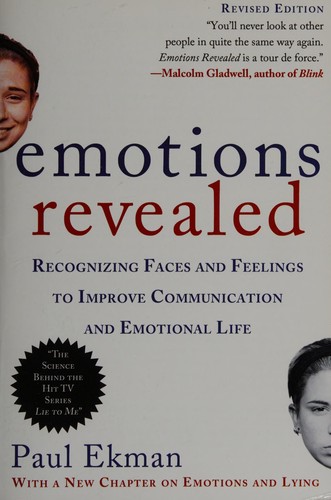
Emotions Revealed is Paul Ekman’s synthesis of four decades of research on emotion and the face, written for a general reader. The first four chapters explain how emotion works. Ekman presents his cross-cultural evidence that a small set of facial expressions is universal, then describes the automatic appraisal mechanisms that trigger emotion before conscious thought, why learned triggers are so hard to unlearn, and what happens in the first seconds of an emotional episode.
Chapters 5 through 9 take the major emotions one at a time. Each covers the triggers, the function, the dangers, and the exact facial signals, with photographs and exercises for recognizing subtle and partial expressions in others and the bodily sensations in oneself. The second edition adds Chapter 10 on lies and emotions, covering micro expressions, the emotions that betray deceivers, and applications in security work. A conclusion on emotional style, an afterword, and an appendix test of expression recognition close the book.
The book has four practical aims, stated by Ekman. Become aware of an emotion before acting on it. Choose how to behave once emotional. Read how others feel. Use that information with care.
Emotions arrive faster than thought and cannot be switched off, but a person who learns their triggers, the feel of each emotion, and the signals on other faces gains a few seconds of choice over what happens next.
Chapter Summaries
Chapter 1: Emotions Across Cultures
Chapter 1 argues that facial expressions of emotion are universal products of evolution, not local customs learned like a language. Ekman tells how he set out in the 1960s expecting to confirm the view of Margaret Mead and Ray Birdwhistell that expressions are culturally learned, and how his own evidence pushed him to Charles Darwin’s position instead.
- Ekman showed photographs of facial expressions to people in literate cultures in the United States, Japan, Brazil, Chile, and Argentina, who largely agreed on the emotion shown. Because that agreement could have come from shared exposure to film and television, he then took the test to the Fore people of Papua New Guinea, who had little contact with outside media.
- The Fore matched faces to stories of emotional situations and produced the same expressions when asked to show how they would look. That evidence, plus the encouragement of his mentor Silvan Tomkins, persuaded Ekman that a set of expressions, including anger, fear, sadness, disgust, surprise, happiness, and contempt, is shared across humanity.
- Ekman reconciles universality with visible cultural difference through display rules. In a study of Japanese and American students watching stressful films, both groups showed the same expressions when alone. When an authority figure was present, the Japanese students masked negative expressions with smiles. The face moves the same way everywhere. Culture governs who may show what to whom.
- The practical implication is that the face carries real information across cultural lines, but what a person allows others to see depends on the social setting and their learned rules for managing expression.
Chapter 2: When Do We Become Emotional?
Chapter 2 explains what triggers emotion. Ekman’s answer is that most emotions begin with automatic appraisal, a fast and unconscious scan of the environment for anything that matters to one’s welfare. Because this happens in milliseconds, people are usually already emotional by the time they notice it.
- Ekman calls the automatic scanning mechanisms autoappraisers. They compare what is happening against an emotion alert database containing both evolved themes and learned variations, and they fire before deliberate thought can intervene. This is why people often cannot say in the moment why they reacted.
- Each emotion has a universal theme and many learned variations. Loss is the theme for sadness. Interference with a goal is a theme for anger. Individual experience adds variations, so two people with the same theme can be set off by very different events.
- Autoappraisal is the most common path but not the only one. Ekman describes nine routes into emotion, among them extended reflective appraisal, remembering a past episode, imagining a scene, talking about an emotional experience, empathy with another person, being instructed by others what to fear or resent, violation of social norms, and voluntarily adopting the facial expression of an emotion.
- The last route is the most surprising. In Ekman’s laboratory work with Robert Levenson and Wallace Friesen, people who moved their facial muscles into the configuration of an emotion, without being told which emotion, showed changes in physiology associated with that emotion. The face is an input to feeling as well as an output.
Chapter 3: Changing What We Become Emotional About
Chapter 3 asks whether people can change what triggers them. Ekman’s answer is a qualified yes. Evolved themes cannot be erased, and learned triggers can be weakened but rarely removed, because the brain appears built to preserve emotional learning that once mattered for survival.
- Ekman cites research by Joseph LeDoux and others suggesting that learned emotional associations are retained even after they stop producing a response. The goal is therefore to cool a hot trigger, so that it fires less strongly and can be noticed, not to delete it.
- Six factors predict how hard a trigger will be to weaken. How close it is to the evolved theme. How closely the current event resembles the original learning situation. How early in life it was learned. How strong the original emotional charge was. How dense the original episodes were, meaning many intense repetitions in a short period. And the person’s affective style, their characteristic speed and strength of response.
- Ekman’s department chair illustrates the first factor. He became furious when drivers cut into a merge lane, a trivial cost, yet rarely became angry when faculty criticized plans he cared about. Physical obstruction sits close to the evolved anger theme of being thwarted. A written critique sits far from it.
- His illustration of the full process is Tim, a man teased cruelly by a dominant father, who still flares at any teasing twenty years later. The first step is recognizing the anger in his body and its effect on others. Next comes identifying the specific trigger, teasing by someone with power over him. Then he rehearses a different interpretation in calm moments, so that the reappraisal is available when the trigger fires.
- The work is easier for distant, late-learned, low-charge triggers and much harder for triggers learned early, intensely, and repeatedly. Ekman suggests keeping a log of episodes to identify the trigger, and notes that psychotherapy often helps a person see a trigger more than it helps weaken it.
Chapter 4: Behaving Emotionally
Chapter 4 moves from what triggers emotion to what people do once it starts. Ekman argues that the expressions, physiological changes, and impulses of an emotion cannot be prevented, but what a person says and does can be shaped, and the key capacity is a form of self-observation he calls attentiveness.
- The onset of emotion brings involuntary changes in three systems. Signals in the face and voice. Autonomic changes such as heart rate and sweating. And shifts in thinking that bias what a person notices and remembers. These are what make emotional behavior feel unchosen.
- The refractory period is the window, often seconds but sometimes much longer, during which a person can only take in information that confirms the emotion they are already feeling. Disconfirming facts are ignored or discounted. This is why people say things in the heat of the moment that they would not endorse a minute later.
- Ekman illustrates it with Jim and Helen. Jim tells Helen he cannot pick up their daughter, and she reacts with anger before he explains that his boss just called an emergency meeting. Helen now knows the frustration was unavoidable, but if she is still in the refractory period her annoyance wants to justify itself. Jim, reading her anger, gets angry in return, because anger tends to provoke anger.
- Ekman describes the target capacity as attentively considering one’s emotional feelings. It means noticing that one is emotional within a few seconds, asking whether the response fits the situation, reappraising, and if reappraisal fails, directing what one says and does. The aim is more choice about how emotion is enacted, not less emotion.
- Moods differ from emotions. They last hours rather than seconds, often have no clear trigger, and lower the threshold for the related emotion. An irritable mood makes anger more likely and harder to notice.
- Attentiveness can be built through knowledge of one’s triggers, familiarity with the bodily sensations of each emotion, and noticing others’ emotions as a cue to check one’s own. Ekman reports, however, that most people are poor at reading subtle expressions in others unless the expressions are strong.
Chapter 5: Sadness and Agony
Chapter 5 treats sadness and agony as two faces of loss. Agony is protest against a loss and sadness is resignation to it. Ekman argues that both serve a social function, signaling a need for help and drawing comfort from others.
- Loss is the universal theme. The loss may be of a person, a role, a goal, health, or self-esteem. Agony is active and agitated, while sadness is passive and withdrawn, and the two often alternate in grief.
- Sadness recruits support. Its signal invites others to help and increases the bond with those who respond. Ekman notes that sadness can also be a danger when it persists and becomes depression, which he distinguishes from the normal emotion.
- The most reliable facial sign of sadness is the raising of the inner corners of the eyebrows, a movement few people can make deliberately. That is why it is a useful marker of genuine sadness when it appears.
- Ekman asks the reader to notice subtle sadness in colleagues and family, then to consider whether to acknowledge it, ask about it, or leave it alone. The choice depends on the relationship and on whether the person intended to show it.
Chapter 6: Anger
Chapter 6 calls anger the most dangerous emotion, because it motivates harm to others. Ekman argues that anger also serves useful functions, such as signaling that something must change and mobilizing the energy to remove an obstacle, and that the problem is usually what people do with it.
- Anger has several triggers. Being physically or psychologically interfered with in the pursuit of a goal. Being threatened or hurt. Disappointment in someone. Someone else’s anger directed at oneself. Frustration of a goal is the most common in daily life.
- The family of anger runs from annoyance through indignation, sullenness, exasperation, and fury to resentment and vengeance. Resentment can last for years and prolong anger without any new trigger.
- Anger is contagious. Because anger commonly provokes anger, an angry response from one person often escalates an exchange. Ekman counsels pausing long enough to consider the cause before replying in kind.
- Early facial signs include lowered and drawn-together brows, a hard stare, and narrowed or pressed lips. Ekman stresses that a subtle sign may show only annoyance, or a person trying to control anger, and the observer should not assume the worst.
- Ekman reports a study of midlevel executives in which Type A individuals showed a partial anger expression, a glare, more often than Type B individuals during a mildly frustrating interview. In a follow-up with Erika Rosenberg and James Blumenthal’s group at Duke, heart patients who showed anger while recalling past frustrations were more likely to have episodes of reduced blood flow to the heart.
Chapter 7: Surprise and Fear
Chapter 7 pairs surprise and fear because they often occur together and are easy to confuse. Ekman argues that surprise is the briefest emotion and fear is the emotion most tied to survival.
- Surprise is triggered by the sudden and unexpected and lasts only a second or two until a person figures out what happened. It then gives way to whatever emotion follows, which may be fear, enjoyment, or anger.
- Fear is triggered by the threat of harm, physical or psychological. Its typical action is to freeze or to flee. Ekman distinguishes fear of an immediate threat from worry or anxiety about a threat that may come.
- The eyes carry the most information. In fear, the upper lids rise and the lower lids tense. In surprise, the upper lids rise without the lower lid tension. That small difference separates a startled face from a frightened one.
- Fear signals can be read in professional settings as discomfort with a question or a situation, but Ekman notes that fear of disbelief can look like fear of being caught. The signal shows the emotion, not its cause.
Chapter 8: Disgust and Contempt
Chapter 8 treats disgust and contempt as related but distinct emotions of rejection. Disgust is aversion to something offensive. Contempt is a feeling of moral superiority over another person.
- Disgust’s evolved theme is getting rid of something offensive to taste or smell. It extends to people and actions that are morally repellent. The face wrinkles the nose and raises the upper lip.
- Contempt is felt only toward people or their actions, never toward tastes or smells. It carries an element of enjoyment in feeling superior, which makes it corrosive in close relationships.
- The contempt expression is one-sided, a tightening and slight raise of one lip corner. Ekman distinguishes it from a one-sided raise of the upper lip, which can signal either disgust or contempt.
- Ekman cites John Gottman’s research on married couples. Wives whose husbands showed contempt felt flooded, saw their problems as severe and unworkable, and became ill more often over the following four years. The husbands’ anger or disgust did not predict these outcomes. Ekman expects the finding to carry over to work, where a subordinate’s contempt toward a superior signals a relationship that is unlikely to last.
Chapter 9: Enjoyable Emotions
Chapter 9 argues that happiness is too broad a word. Ekman separates more than a dozen distinct enjoyable emotions and argues that people differ widely in which ones they seek, and that this shapes how they live and work.
- The enjoyable emotions include the sensory pleasures, amusement, contentment, excitement, relief, wonder, ecstasy, and elevation. Ekman also adopts words from other languages, such as fiero, the pride in meeting a difficult challenge, and naches, the pride a parent feels in a child’s accomplishment. He discusses gratitude and schadenfreude, pleasure in a rival’s misfortune, as possible additions.
- Each enjoyable emotion has its own trigger and its own pull on behavior. A person driven by fiero chases difficult goals. A person who seeks contentment avoids them. Knowing which enjoyments matter most to oneself and to others explains differences in motivation.
- The genuine enjoyment smile, which Ekman names the Duchenne smile after the nineteenth-century neurologist Guillaume Duchenne, involves the muscle around the eye as well as the lip corners. The eye-cover fold drops and the cheeks lift. Polite and social smiles usually lack this, although strong social smiles can mimic it.
- Smiles are also used to mask other emotions. A smile that appears on top of a brief sign of sadness, fear, or anger is one of the most common forms of concealment.
Chapter 10: Lies and Emotions
Chapter 10, new to the second edition, applies the book’s research to deception. Ekman argues that lies are often betrayed by emotion, not by any special sign of lying, and that the observer’s job is to detect concealed emotion and then find out why it is there.
- Ekman traces micro expressions to his early frame-by-frame analysis of a filmed psychiatric interview, in which a patient who later admitted she had concealed plans to take her life showed a fleeting expression of anguish covered by a smile. Micro expressions last a fraction of a second and most people miss them.
- Micro expressions can come from deliberate suppression of an emotion or from repression of a feeling the person does not consciously recognize. Either way they show what is felt, not what is true.
- Three emotions commonly accompany lying. Fear of being caught, guilt about the deception, and duping delight, the pleasure some liars take in getting away with it. The more of these a liar feels, the more likely leakage becomes.
- Signs of concealed emotion are hot spots, not proof. A truthful person who fears being disbelieved can show the same fear as a liar. Ekman calls the mistake of reading that fear as guilt the Othello error, after Othello’s misreading of Desdemona’s distress.
- Ekman describes applying the research to training for police, intelligence, and airport security screeners, and to everyday gut decisions about whom to trust. His guidance is to treat a hot spot as a reason to ask further questions.
About the Author
Paul Ekman (1934 to 2025) was a psychologist and for 32 years a professor in the Department of Psychiatry at the University of California, San Francisco, according to his faculty profile. With Wallace Friesen he developed the Facial Action Coding System, the standard tool for measuring facial movement, and he later built the Micro Expression Training Tools. The Review of General Psychology ranked him among the 100 most eminent psychologists of the twentieth century. He advised law enforcement, security agencies, and animation studios, and his work inspired the television series Lie to Me. He died in San Francisco in November 2025, and the Paul Ekman Group continues under his daughter, Eve Ekman.
His credibility for this book rests on the cross-cultural fieldwork and laboratory measurement that the first chapters report directly. It is weaker on the practical chapters on behavior change and on the security applications in Chapter 10, which draw more on Ekman’s experience and judgment than on controlled outcome studies, and the universality claim at the center of the book has been disputed since publication by researchers who see emotion as more context-dependent.
Key Takeaways
1) Emotion Starts Before Choice
Autoappraisers trigger emotion in milliseconds, before conscious thought. The first real decision point comes after the emotion has begun, which shifts the question from whether to feel something to what to do while feeling it.
- People are usually emotional before they know why.
- The useful skill is fast noticing, not suppression.
2) Triggers Cool But Rarely Disappear
Learned triggers persist because emotional learning is preserved. Triggers close to an evolved theme, learned early, or learned intensely and repeatedly are the hardest to weaken. That is why the same situation keeps producing the same reaction in an otherwise thoughtful person.
- Six factors predict how hot a trigger stays.
- A trivial event can provoke more emotion than an important one if it sits closer to the theme.
3) The Refractory Period Distorts Judgment
For a stretch after emotion begins, people take in only information that confirms what they feel. Facts that would end the emotion are discounted. A decision made inside that window is made with partial information.
- Annoyance looks for reasons to justify itself.
- Anger tends to provoke anger in the other person, which extends both refractory periods.
4) Moods Lower The Threshold
Moods last for hours and make the related emotion easier to trigger and harder to notice. An irritable mood primes anger, and an apprehensive mood primes fear. Much apparently disproportionate reaction is a normal emotion arriving on top of a mood.
- Moods often have no obvious cause.
- Knowing one’s mood is a precondition for reading one’s own reactions accurately.
5) Faces Show Emotion Not Cause
Facial expressions reliably signal that an emotion is present, especially at full strength, but they do not reveal what triggered it. Fear of being disbelieved and fear of being caught look the same. Reading a face well means asking what is behind it.
- Subtle and partial expressions are where most of the useful information sits.
- The Othello error is the confident misreading of a true emotion’s cause.
6) Contempt Corrodes Relationships
Contempt is the emotion of superiority over another person, and the research Ekman cites from John Gottman links it to distress and illness in the partner on the receiving end. It has a distinctive one-sided expression, which makes it detectable early.
- Contempt is felt only toward people or their actions, never toward tastes or smells.
- Its element of enjoyment makes it easy to indulge and hard to see in oneself.
7) Enjoyment Comes In Kinds
Treating happiness as one emotion hides real differences in what motivates people. Fiero, contentment, excitement, relief, and naches pull behavior in different directions, and people organize their lives around the ones they value most.
- A preference for fiero drives people toward difficult challenges.
- The genuine enjoyment smile involves the muscles around the eyes.
Strengths and Limits
The book’s main strength is its integration of mechanism and observation. Ekman links what triggers an emotion, what it feels like, what it does to thinking, and how it appears on the face, so the reader gets a working model rather than a list of tips. The refractory period and the six factors governing trigger strength are the ideas that carry the most practical weight, because they explain why intelligent people repeatedly react in ways they regret. The emotion-by-emotion chapters, with photographs of subtle and partial expressions, are a contribution few popular books match. Chapter 10 extends the material to deception with an important caution built in, that signs of emotion are prompts for inquiry, not verdicts.
Ekman acknowledges that triggers learned early and intensely may not yield to the methods described, and that most people read subtle expressions poorly without training. Beyond those stated limits, the universality of facial expressions is presented as settled, although it has been contested. A large 2019 review led by Lisa Feldman Barrett argued that facial movements are neither reliable nor specific indicators of particular emotions across contexts. The behavior-change guidance rests largely on illustrative cases, such as Tim and Helen, rather than tested interventions. The security applications in Chapter 10 also predate a 2013 Government Accountability Office review that found published research did not support the use of behavioral indicators to reliably detect deception. The predictable failure mode is a reader who treats a glimpsed expression as proof of what another person feels or intends.
My Take
The diagnosis holds, and the part that matters most for a CEO is not the face reading. It is the refractory period. Leadership team meetings are full of decisions made by people who are a few seconds into anger or fear and can only hear the evidence that supports it. Founders are especially exposed, because their companies are full of triggers that sit close to Ekman’s themes. A missed commitment reads as interference with a goal. A challenge in front of the team reads as a threat to status. Learning to notice that state and delay the decision is worth more than any skill at reading others.
The book plays differently by setting. In a co-located team that meets in person, the observation guidance applies almost directly. On video, faces are small, compressed, and often off camera, so the micro expression material loses most of its value and the self-awareness chapters carry the load. In negotiation, including an exit process, the Chapter 10 caution matters more than the detection techniques. A seller or buyer who reads fear as deception will misjudge the other side. In companies that span cultures, display rules matter as much as the expressions themselves.
The most credible outside objection comes from Lisa Feldman Barrett, whose 2019 review with Ralph Adolphs, Stacy Marsella, Aleix Martinez, and Seth Pollak argued that people do not reliably make the same face for the same emotion, and that context does most of the work in reading one another. The GAO’s 2013 review of the TSA behavior detection program, which Ekman advised, adds a practical warning about what happens when observation is turned into a screening rule. I take the objection seriously on detection and lie spotting. It does much less damage to the book’s account of triggers, moods, and the refractory period, which is where the leadership value sits.
The adjacent book is Barrett’s How Emotions Are Made. Ekman gives a usable model of emotion as a fast, built-in response to be managed. Barrett supplies the counterweight, that emotions are constructed from context, prediction, and the concepts a person has learned. Read together, they push a leader toward a sound habit. Notice the signal, and then ask about it before concluding anything.
Discussion Questions
For CEOs
- Which recurring situation in the business produces a reaction in me that I later regret, and which of Ekman’s evolved themes does it sit closest to?
- In the last month, which decision did I make while still in the refractory period of an emotion, and what information did I discount at the time?
- What mood do I most often bring into leadership meetings, and which emotion does it make more likely?
- Which enjoyable emotion, such as fiero, contentment, excitement, or relief, actually drives my choices about growth and risk?
- When I sense discomfort in someone on my team, do I ask about it or do I decide what it means?
- Where am I relying on gut reads of trust in hiring, sales, or deal conversations, and how often have I checked those reads against outcomes?
For Teams
- Which topics reliably raise the temperature in our meetings, and what is the trigger underneath each one?
- What agreement could we make about pausing a decision when one of us is visibly angry or anxious?
- When has one of us read another’s reaction as resistance when it was really something else, such as fear of being blamed?
- Where does contempt show up in how we talk about other teams, customers, or competitors?
- How do display rules differ across the people on this team, and who is likely masking more than we realize?
- What would change if we asked about a reaction instead of interpreting it?
Practical Tools
1. Hot Trigger Inventory
Ekman’s Chapters 2 and 3 show that learned triggers persist and that six factors predict how hot each one stays. A trigger that has not been named cannot be cooled, because it fires before conscious thought. Build this inventory when the same kind of event keeps producing a reaction that seems out of proportion, or before a period of high pressure such as a capital raise, a reorganization, or a sale process.
How it works:
- List the last five occasions at work when a reaction surprised you by its strength or that you later regretted.
- For each, name the emotion and the specific event that set it off, as precisely as possible, including who was involved.
- Match each event to the closest evolved theme, such as interference with a goal for anger, loss for sadness, or threat of harm for fear.
- Rate each trigger against Ekman’s factors, especially closeness to the theme, resemblance to an early experience, and how often it has fired.
- Pick the one trigger that costs the most and write the alternative interpretation you want available the next time it fires.
- Rehearse that interpretation in calm moments, when the trigger is not active.
The signal is earlier recognition. The reaction still arrives, but it gets named in the moment rather than in hindsight, and the alternative interpretation is available within seconds. Over time, the people around you notice fewer flare-ups in the specific situations on the list.
2. Refractory Period Pause
Chapter 4 describes the refractory period, during which a person can take in only information that confirms the emotion they are already feeling. Decisions made inside it use partial information, and anger provokes anger in return. Use this pause in any leadership meeting, negotiation, or difficult conversation in which you notice your own face, voice, or body shifting, or in which the room has heated up.
How it works:
- Learn your own early physical cues for anger and fear from Chapters 6 and 7, such as jaw tension, heat in the face, or a tightening in the chest.
- When you notice a cue, name the emotion silently and treat any judgment you are forming as provisional.
- Ask one question that invites disconfirming information, such as what the other person knows that you do not.
- If the emotion is strong, defer the decision to a set time later the same day or the next morning rather than deciding in the room.
- Agree the deferral norm with the leadership team in advance, so it reads as process rather than avoidance.
Fewer decisions get reversed the next day, and meetings recover faster after a heated exchange. Team members begin to call the pause themselves, which is the clearest sign it has become a norm rather than a personal habit.
3. Emotional Episode Debrief
Ekman’s goal of attentiveness, noticing an emotion within seconds and considering whether it fits, is built by reflection after the fact before it can work in real time. Ekman suggests a log for this purpose in Chapter 3, recording what happened in the moments before an emotion began. Reviewing an episode while it is fresh connects the trigger, the sensations, the refractory period, and the behavior into one picture. Run it within a day of any interaction that went worse than you intended.
How it works:
- Write down what happened in sequence, from the triggering event to your first reaction to what you said and did.
- Identify when you first became aware you were emotional, and how much time had passed by then.
- Note what mood you were in beforehand and whether it lowered the threshold.
- Identify what you discounted or did not hear while the emotion was strongest.
- Decide whether anything needs to be repaired with the other person and do it.
The gap between the start of an emotion and awareness of it shortens. Debriefs that once identified the emotion only after the conversation start to identify it during the conversation, which is the point at which behavior can still change.
4. Ask Before Concluding
Chapters 5 through 9 teach the subtle and partial expressions of each emotion, and Chapter 10 warns that an expression shows that an emotion is present, not why. The Othello error is the confident misreading of cause. Use this practice in one-on-ones, performance conversations, sales and partner meetings, and any conversation where you notice a flicker of an emotion that does not fit what is being said.
How it works:
- Notice the signal and the moment it appeared, such as a brief raise of the inner brows during a discussion of a deadline.
- Name the emotion to yourself without attaching a cause.
- List at least two plausible reasons for that emotion, including one that reflects well on the other person.
- Ask an open question about the topic that coincided with the signal, such as how the person feels about the timeline.
- Listen for the answer and update your read, rather than steering toward the explanation you expected.
Conversations surface concerns earlier, before they show up as missed deadlines or resignations. People report feeling heard rather than read, and your interpretations are checked against what people say rather than against your assumptions.
5. Team Affective Style Map
Ekman’s conclusion describes affective style, the differences among people in how fast emotion arrives, how strong it gets, and how long it takes to recover. Chapter 9 adds that people differ in which enjoyable emotions they seek. A leadership team that understands these differences misreads one another less often. Use the map at a team offsite, when adding a new executive, or when friction between two leaders keeps recurring.
How it works:
- Ask each leader to describe, privately and in writing, how quickly they tend to react, how intense their reactions get, and how long recovery takes.
- Ask each leader to name the enjoyable emotion that most motivates them at work, such as fiero, excitement, contentment, or relief.
- Share the answers in a facilitated discussion, with each person choosing what to disclose.
- Identify pairs on the team whose styles are likely to collide, such as a fast, intense responder working with a slow, quiet one.
- Agree how each pair will handle a heated moment, including who calls a pause and how they reconnect.
Recurring friction between specific leaders drops because each knows what the other’s reaction does and does not mean. Disagreements shift from being about tone to being about substance.
Further Reading
- Barrett, Adolphs, Marsella, Martinez, and Pollak, Emotional Expressions Reconsidered (2019), the main scientific challenge to facial universality
- GAO, Aviation Security: TSA Should Limit Future Funding for Behavior Detection Activities (2013), on the limits of behavioral deception detection
- Robert W. Levenson, In Memoriam: Paul Ekman, an account of Ekman’s scientific contributions by a longtime collaborator
- Paul Ekman Group, training on micro expressions and emotional skills, now directed by Eve Ekman
- Macmillan, publisher page for the second edition
Share This Review

Bruce Eckfeldt is a business coach and strategic advisor to founder-CEOs of growth-stage companies, a former Inc. 500 CEO, and the author of Springboard. More book reviews →
These summaries present Bruce Eckfeldt’s analysis of business and leadership books for founder-CEOs and leadership-team members of growth companies. Each one identifies the ideas most relevant to decision quality, strategy, and leadership capacity, notes where the evidence is weak, and suggests practical ways to test what is worth testing. All ideas, stories, and quotations belong to the original author and to the people they cite. The assessments and recommendations are Bruce’s. It is a companion to the book, not a substitute for reading it.
To learn more about Bruce’s programs, request other book summaries, or get in touch, contact booksummaries@eckfeldt.com.
Get the Next Review.
A new book review lands in Better, Faster, my weekly newsletter for founder-CEOs, along with one practical essay and questions for your team.