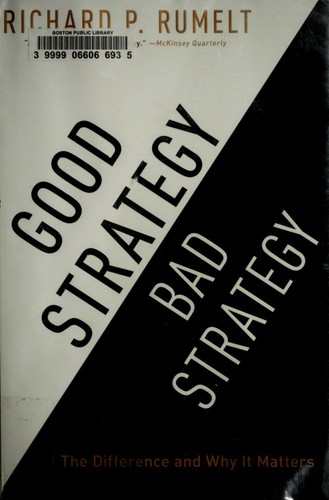
Good Strategy Bad Strategy
The Difference and Why It Matters
Good strategy is a coherent argument connecting a diagnosis of the situation, a guiding policy for dealing with it, and a set of actions that carry the policy out. Bad strategy is a mixture of fluff, goals mistaken for plans, failure to face the challenge, and objectives that contradict each other.
A book summary and review by Bruce Eckfeldt
Overview
Good Strategy Bad Strategy is Richard Rumelt’s argument that most documents called strategy are not strategy at all. Rumelt, the Harry and Elsa Kunin Chair at UCLA Anderson and one of the most cited scholars in the strategy field, spent four decades studying what companies, militaries, and governments actually do when they claim to be doing strategy. His conclusion is direct. Good strategy is unexpected because it is so rare. Bad strategy is common, produced by leaders who confuse ambition with analysis, goals with action, and vision statements with plans. The book was published by Crown Business in 2011 and became the reference work for a generation of leaders trying to distinguish the two. It is organized in three parts. Good and Bad Strategy defines the terms. Sources of Power catalogs the mechanisms good strategy uses to create advantage. Thinking Like a Strategist covers the mental habits needed to produce strategy that actually works.
Rumelt’s central operating tool is the kernel of good strategy. A diagnosis of the situation, a guiding policy for dealing with it, and a coherent set of actions that implement the policy. Any document that lacks one of the three is not a strategy. Rumelt uses cases as diverse as Admiral Nelson at Trafalgar, Norman Schwarzkopf in Desert Storm, Steve Jobs’s 1997 return to Apple, Wal-Mart’s rise, and IKEA’s design system to show what the kernel looks like in practice, and cases like Chad Logan’s 20/20 plan, Digital Equipment Corporation’s collapse, and Global Crossing’s bankruptcy to show what bad strategy looks like. The book is written for executives and public-sector leaders who need to make choices under uncertainty and who are surrounded by documents that dress up avoidance as ambition.
Good strategy is a coherent argument connecting a diagnosis of the situation, a guiding policy for dealing with it, and a set of actions that carry the policy out. Bad strategy is a mixture of fluff, goals mistaken for plans, failure to face the challenge, and objectives that contradict each other.
Chapter Summaries
Chapter 1: Good Strategy Is Unexpected
Chapter One opens with a case Rumelt returns to throughout the book. Steve Jobs’s return to Apple in 1997. Apple was ninety days from bankruptcy. Jobs cut the product line from fifteen desktops to one, cut inventory eighty percent, killed printers, killed the Newton, and accepted a one hundred fifty million dollar investment from Microsoft that traded Apple’s patent dispute for cash. The moves were not obvious and they were not incremental. That is the point. Good strategy is unexpected because most companies produce fluff instead.
- Good strategy is unexpected because it is rare. If good strategy were common, consultants and executives would not spend so much time producing bad strategy in its place.
- The Apple case is not a story of vision. Jobs did not announce a bold new future. He cut ruthlessly and focused resources on a small set of products that could actually be delivered. Good strategy is often subtractive.
- Rumelt’s second opening case is Wal-Mart’s rise. The strategic insight was that a network of stores connected to a regional distribution center could serve towns of ten thousand people that had been considered too small for a discount store. Every competitor knew town size was the constraint. Wal-Mart changed the unit of analysis from a store to a system of stores.
- The Battle of Trafalgar is the third case. Admiral Horatio Nelson faced thirty-three French and Spanish ships with twenty-seven British ships. Standard doctrine was to form a parallel line and exchange fire. Nelson split his fleet into two columns that broke the enemy line perpendicular to it, forcing the fight into close combat where British gunnery superiority mattered most. Nelson died in the battle. Britain lost no ships and captured or destroyed nineteen enemy ships. Nelson’s strategy was unexpected because it violated the accepted doctrine, and it worked for exactly that reason.
Chapter 2: Discovering Power
Chapter Two argues that good strategy discovers a source of power the situation makes available, and applies that power at the point of maximum leverage. The discovery is not a matter of copying best practice. It is a matter of seeing what others have missed.
- Rumelt uses the David and Goliath story as the reference case. David’s advantage was not courage. It was that a sling used at range against an armored infantryman converted the fight from one Goliath was designed to win into one he was designed to lose. Good strategy identifies the fight the situation allows you to change.
- The Desert Storm case follows. Iraq invaded Kuwait on August 2, 1990, and by January 1991 Saddam Hussein had five hundred thousand troops dug in behind fortifications built to fight the Iranians. General Norman Schwarzkopf’s staff faked a Marine amphibious assault, then executed a left-hook armored envelopment through the Iraqi desert flank the Iraqi command had assumed was too rough to cross. The ground war ended in one hundred hours.
- Discovering power requires seeing the situation as it is, not as convention describes it. Convention had said the Iraqi flank was impassable. The reality was that modern armor and logistics could cross it. Convention had said no discount store could work in a town of ten thousand people. The reality was that a network of stores could.
- The chapter closes on the observation that discovering power is often threatening to insiders. The convention protects incumbents. The discovery undermines them. Good strategy therefore requires the willingness to be unpopular with the people who benefit from the convention.
Chapter 3: Bad Strategy
Chapter Three names the phenomenon Rumelt spends the rest of Part One dissecting. Bad strategy is not the absence of strategy. It is the active presence of documents that call themselves strategy but are not. Rumelt identifies four hallmarks.
- Fluff. Language that dresses up commonplace ideas in inflated vocabulary to conceal that no real thinking has occurred. Rumelt cites a bank strategy document that used the phrase customer-centric intermediation of proprietary financial solutions to describe what the bank had always done, which was accept deposits and make loans.
- Failure to face the challenge. A strategy that does not diagnose what the actual obstacle is cannot address it. Rumelt cites the case of a mid-sized company whose strategy document was a list of financial goals and no analysis of the competitive situation. The document assumed the challenge away.
- Mistaking goals for strategy. Chad Logan is the central case. Logan, chief executive of a mid-sized graphics company, told Rumelt his strategy was to grow revenue twenty percent and profit twenty percent annually. Rumelt asked how. Logan answered with more restatement of the goal. Goals are what you want. Strategy is how you will get there.
- Bad strategic objectives. Objectives that are impossible, contradictory, or so numerous that they cannot guide action. Rumelt describes what he calls a dog’s dinner of objectives, a list of dozens of imperatives none of which anyone will act on because acting on any of them precludes acting on the others.
Chapter 4: Why So Much Bad Strategy?
Chapter Four asks why bad strategy is so common if the alternative is available. Rumelt’s answer is that good strategy requires saying no, and organizations reward leaders who say yes. Bad strategy is what emerges when a leader tries to please every constituency at once.
- Good strategy requires choice. The choice includes what the organization will not do. Bad strategy avoids the choice by covering every option with a plausible-sounding action item.
- The template of vision, mission, values, and strategy popularized in the nineteen nineties has become an operational obstacle. Rumelt cites the pattern of leadership offsites that produce three-word vision statements, five-value cards, and no actual strategy. The template rewards word-craft over analysis.
- New Thought, the popular self-help philosophy dating to the nineteenth century, has fused with business writing to produce the belief that positive thinking is a form of strategy. Rumelt is direct that it is not. Wishing for a result is not a method for producing it.
- Democratic decision-making inside organizations tends to produce bad strategy because it aggregates every stakeholder’s preferences into a document no one opposes. Good strategy usually produces opposition from at least one internal constituency. The absence of opposition is often a signal that the document has not made the actual choice.
Chapter 5: The Kernel Of Good Strategy
Chapter Five is the operational core of the book. The kernel of good strategy has three parts. A diagnosis that defines the nature of the challenge. A guiding policy for dealing with the challenge. A set of coherent actions that carry the policy out. Any document that lacks one of the three is not a strategy.
- The diagnosis is the causal analysis of the situation. It names what is happening and why. Rumelt argues most bad strategy fails at this step because leaders skip diagnosis and jump to action. Getting the diagnosis wrong makes everything downstream wrong.
- The guiding policy is the overall approach chosen to deal with the diagnosis. It is not the specific action. It is the class of actions the organization will take and the class of actions it will not. The guiding policy channels action toward some ends and away from others.
- The coherent actions are the specific coordinated moves that carry out the guiding policy. They must be coherent with each other, not just consistent with the policy. A set of actions that individually make sense but collectively pull in different directions is not coherent, and is not a strategy.
- Rumelt uses the 1997 Apple turnaround to illustrate all three. Diagnosis. Apple was overextended and losing money on a fragmented product line. Guiding policy. Focus resources on a small set of high-quality products that would command premium prices. Coherent actions. Cut fifteen desktops to one, cut inventory eighty percent, kill printers and the Newton, take the Microsoft investment. The three parts reinforced each other.
Chapter 6: Using Leverage
Chapter Six opens Part Two. Rumelt catalogs the sources of power good strategy uses to create advantage. Leverage is the first. Concentrating resources at a point where a small effort produces a large effect.
- Leverage requires three elements. Anticipation of what competitors will do. Insight into the pivot point where a small change produces a large effect. Concentration of resources on that pivot point rather than spreading them across many bets.
- Rumelt uses the Pierre Wack case at Royal Dutch Shell in the nineteen seventies as the anticipation reference. Wack’s scenario-planning team foresaw the oil shock of 1973 and prepared Shell to respond faster than any competitor. The anticipation produced the leverage.
- Toyota is used as the second case. Toyota’s insight was that reducing setup time on stamping presses from hours to minutes would unlock small-batch production and eliminate the inventory cost that was structural for every other automaker. The pivot point was setup time, not vehicle design.
- The failure mode is spreading resources broadly enough that no single move has leverage. Rumelt cites the pattern of companies with dozens of strategic priorities, none of which is resourced enough to matter. That is not strategy. It is portfolio management with the word strategy on the cover.
Chapter 7: Proximate Objectives
Chapter Seven introduces the concept of proximate objectives. A goal is proximate when it is close enough to feasible that the organization can plausibly reach it. Rumelt argues good strategy sets proximate objectives, while bad strategy sets blue-sky objectives so distant that no one knows how to work on them.
- The Kennedy moon program is the reference case. When President Kennedy announced the goal of putting a man on the moon by the end of the decade, the goal was hard but feasible. Phyllis Buwalda at NASA’s Manned Spacecraft Center had already documented that lunar landing was technically achievable within the decade. The objective was proximate.
- By contrast, blue-sky objectives like eliminate poverty or transform education cannot guide action because no one knows what to do on Monday morning. Rumelt argues that leaders who set blue-sky objectives are usually avoiding the harder work of defining what is actually achievable.
- The proximate objective is a solvable problem chosen from the larger set of problems the organization faces. Choosing it well requires diagnosis and judgment about which problems can be solved with the resources available.
- Rumelt’s operational advice is to pick a proximate objective that, if achieved, unlocks the next set of possibilities. Not the final goal. The next step from which the goal becomes reachable.
Chapter 8: Chain-Link Systems
Chapter Eight covers chain-link systems, in which the strength of the whole is limited by the weakest link. Rumelt argues these systems require concentrated attention on the binding constraint rather than balanced improvement across all links, and that competitive advantage often comes from having multiple links that are hard to imitate simultaneously.
- IKEA is Rumelt’s central case. IKEA’s competitive advantage is not any single capability. It is the coherent integration of design, self-service showrooms, flat-pack packaging, customer transport, self-assembly, and low prices. Each link reinforces the others. A competitor cannot copy any single link and match IKEA.
- In chain-link systems, improving a non-binding link produces no gain. Rumelt argues that most organizational improvement effort is wasted because it targets the wrong link. Diagnosing the binding constraint is the first move.
- General Motors is used as a chain-link failure case. GM’s decades-long attempt to match Toyota by improving individual factories missed that the binding constraint was the interaction between design, supplier relationships, and labor relations. Improving one link while the others remained broken produced no advantage.
- The chain-link concept is a partial answer to the question of why some companies sustain advantage over decades. The advantage rests on multiple mutually reinforcing links that competitors cannot copy one at a time, and cannot copy all at once without abandoning their existing configuration.
Chapter 9: Using Design
Chapter Nine argues that good strategy is closer to engineering design than to financial optimization. It requires anticipation, coordination, and the integration of components into a coherent whole. Design-type strategies are those that create advantage through the integration itself rather than through any single component.
- Hannibal’s victory at Cannae in 216 BC is the historical reference. Hannibal arranged his troops so that the weaker center gave way while the stronger flanks held, drawing the Roman legions into a pocket where they could be enveloped and destroyed. The design of the formation was the strategy, not any single unit’s quality.
- Rumelt contrasts design-type strategy with what he calls chunk-type strategy. Chunk-type strategy consists of applying resources in a straightforward way to a clear opportunity. Design-type strategy requires integrating many moves so their combined effect exceeds the sum of the individual moves.
- The Jet Propulsion Laboratory Voyager mission is Rumelt’s modern reference. The trajectory required using the gravitational pull of each planet to reach the next, and the entire mission was designed as a single integrated sequence. No component worked independently. The whole was the point.
- Design-type strategy is harder to produce because it requires holding many interdependencies in mind simultaneously. Rumelt argues that most organizations default to chunk-type strategy because it fits their decision-making machinery, even when the situation calls for design.
Chapter 10: Focus
Chapter Ten covers focus. Concentrating resources on a specific target where the organization can create outsized advantage, rather than spreading them across every opportunity. Focus is the discipline that converts leverage from a concept into a commitment.
- Crown Cork and Seal under John Connelly is the reference case. Crown chose to focus on hard-to-manufacture cans, short production runs, and rapid delivery for customers with unusual needs. The focus meant declining other business Crown could have done. The decline was the strategy.
- Focus creates advantage because concentrated resources against a specific target outperform dispersed resources against a general target. Rumelt argues this is mathematically obvious and organizationally rare.
- The Paccar case reinforces the point. Paccar focuses on premium heavy trucks for owner-operators, deliberately declining the fleet market where volume is higher and margins are lower. The focus produces sustained profitability in an industry where generalists struggle.
- Focus is the discipline organizations most often violate. Rumelt cites the pattern of leadership teams that agree on focus in the offsite and then add exceptions the following month, each defensible in isolation, until the focus is gone.
Chapter 11: Growth
Chapter Eleven is Rumelt’s argument on growth. Growth as a goal is not strategy. Healthy growth is a consequence of a business that customers want, produced by an organization that can deliver it profitably. Growth pursued for its own sake typically destroys value.
- Rumelt names the pattern of growth by acquisition without strategic logic as one of the most reliable value destroyers in modern business. Global Crossing built one point five billion dollars of fiber and sold to a competitor for eight billion before the entire industry collapsed. The growth was real. The value was not.
- Crown Cork and Seal is used to show the same pattern inside an otherwise well-run company. The all-out pursuit of size in the nineteen nineties, driven by the conviction that scale would matter, almost sank the company that had built its position on focus. Growth undid the strategy that had produced the growth.
- Telecom Italia is Rumelt’s other case. Growth targets set by executives, boards, or Wall Street analysts drive acquisitions that would not otherwise be made. The acquisitions meet the growth target and destroy value.
- Healthy growth is a result of strengths in specific businesses that make them worth expanding. Unhealthy growth is a symptom of a strategy that has substituted the desire for scale for the analysis of where advantage exists. Rumelt is direct that the pattern is widespread, value-destroying, and rarely challenged inside the companies that produce it.
Chapter 12: Using Advantage
Chapter Twelve is on competitive advantage. Rumelt argues that most talk of advantage misses what actually creates it. An advantage exists when a company can produce more value from an activity than its competitors can. Sustaining the advantage requires isolating mechanisms that prevent competitors from copying it.
- The Stewart Resnick pomegranate juice case is Rumelt’s illustration. Resnick’s POM Wonderful brand created a market for pomegranate juice from what had been an obscure fruit. The advantage was not the juice. It was the market Resnick built before competitors realized a market existed.
- Isolating mechanisms include patents, brand, scale economics, network effects, and hard-to-imitate coordinated activities. Rumelt argues that most advantages are not one of these individually. They are combinations that resist imitation because any single copy is insufficient.
- Advantage can be extended by deepening it, broadening it, creating higher demand for advantaged products, or strengthening the isolating mechanisms. Each is a different strategic move and requires a different set of investments.
- The failure mode is treating an advantage as durable when the isolating mechanisms have eroded. Rumelt cites the pattern of once-dominant companies whose competitive position depended on protections that no longer hold and whose leadership teams continue to operate as if they did.
Chapter 13: Using Dynamics
Chapter Thirteen argues that industry dynamics create windows of opportunity for strategic action that do not exist in stable conditions. Recognizing and acting within these windows is a distinguishing skill of good strategists.
- Cisco Systems during the internet build-out is Rumelt’s central case. The rise of packet-switched networking created a window in which router capabilities determined network capacity. Cisco recognized the window, focused resources on router capability, and built a decade of advantage before the industry stabilized.
- The music industry’s shift from physical to digital distribution is a second reference. The window opened as compression, storage, and bandwidth converged. Apple moved into the window with iTunes and the iPod. The incumbent labels did not, and lost the aggregation position they had held for fifty years.
- Windows close as competitors adapt. The strategic question is not only whether a window exists but how long it will remain open, and what the organization can accomplish within it. Windows that appear permanent almost never are.
- Missing a window is often worse than never having had access to one. Silicon Graphics missed the transition to commodity graphics chips and never recovered. Digital Equipment Corporation missed the transition from minicomputers to personal computers and did not survive.
Chapter 14: Inertia And Entropy
Chapter Fourteen covers the two forces that undermine competitive advantage over time. Inertia is the tendency of organizations to continue doing what they have been doing. Entropy is the tendency of well-run organizations to become less coordinated over time. Both are enemies of sustained good strategy.
- Rumelt uses General Motors as the inertia case. GM’s decades of dominance produced operating patterns that could not be changed even after Japanese competition made the patterns obviously obsolete. The inertia was structural, not cognitive.
- AT and T Bell Labs is the entropy case. The world-class laboratory produced the transistor, information theory, and the Unix operating system, and gradually became less coordinated as it grew, until the coherence that produced its early breakthroughs was gone.
- Continental Airlines under Gordon Bethune is the counterexample. Bethune took over a company at the bottom of every operational and financial ranking and rebuilt coordination by simplifying the fleet, aligning incentives, and restoring service reliability. The turnaround worked because Bethune fought both inertia and entropy simultaneously.
- Inertia and entropy are predictable forces, not accidents. Rumelt argues that sustained strategic performance requires explicit organizational maintenance to counter them. Leaders who assume yesterday’s coordination will persist tomorrow are almost always wrong.
Chapter 15: Putting It Together
Chapter Fifteen is the case study that integrates the tools in Part Two. Rumelt walks through the rise of Nvidia, the graphics-chip designer that moved from obscurity to dominance in the late nineteen nineties by riding the wave of three-dimensional gaming with a design-type strategy. The chapter reads as an operating guide to the whole book applied to a single company.
- Nvidia’s diagnosis was that specialized graphics hardware would displace general-purpose CPUs for graphics-intensive workloads as three-dimensional gaming took hold. The diagnosis was correct and few competitors saw it in time.
- The guiding policy was to release a new graphics processor generation every six months rather than the industry-standard eighteen. The cadence itself was the strategy. Competitors who could not match the cadence fell behind on every generation.
- The coherent actions included a three-team engineering rotation that kept a product on the market while the next two were being designed, close partnerships with game developers, and disciplined focus on the gaming segment before expanding.
- Rumelt closes the chapter by noting that the sequence, diagnosis, guiding policy, coherent actions, is the entire book compressed into a working template. A leader who works through the three steps carefully has done the strategic work. A leader who has skipped any of the three has not.
Chapter 16: The Science Of Strategy
Chapter Sixteen opens Part Three. Rumelt argues that strategic thinking is closer to scientific inquiry than to formulaic planning. Strategy is a hypothesis about how to win, and like any hypothesis it should be developed, tested, and revised as evidence accumulates.
- The scientific stance means treating a strategic decision as a testable claim rather than a commitment. What must be true for this strategy to work. What evidence would prove it wrong. What experiments would produce that evidence.
- Howard Schultz’s early Starbucks strategy is the extended case. Schultz’s hypothesis was that Americans would pay a premium for espresso drinks in a European-style cafe environment. The hypothesis was tested in a small number of stores before capital was committed to scale.
- Andrew Carnegie’s steel operations are the historical reference. Carnegie applied measurement and experimentation to production in a way his competitors did not, and built the largest company of his time as a result. The scientific stance was the source of the cost advantage.
- The scientific stance is contrasted with what Rumelt calls the vision-and-values stance, in which strategy is treated as a matter of belief rather than analysis. Beliefs are not testable and therefore not correctable. Bad strategy is often the result of unfalsifiable beliefs.
Chapter 17: Using Your Head
Chapter Seventeen is on the mental habits that produce good strategy. Rumelt argues these habits are learnable and rare. The most-cited is what he calls kernel-based thinking. Insisting on the diagnosis, guiding policy, and coherent actions structure before accepting any document as a strategy.
- Create-destroy analysis. For every strategic claim, generate the alternatives that could also be correct and the arguments against the primary claim. Rumelt argues that leaders who only defend their preferred option are not thinking strategically.
- Panel of experts. Simulate a group of trusted external advisors and ask what each would say about the current strategic problem. Rumelt argues the technique surfaces considerations the internal team has become blind to.
- The judgment technique. When a decision must be made under uncertainty, name the specific uncertainties, name what would need to be true for each option to work, and choose the option whose success conditions are most plausible given the evidence.
- Kernel-based thinking is the discipline that runs through all the techniques. If the diagnosis is unclear, force it into words. If the guiding policy is not stated, state it. If the coherent actions do not reinforce each other, revise them. Every technique in the book depends on this basic structural discipline.
Chapter 18: Keeping Your Head
Chapter Eighteen closes the book with a discussion of the discipline required to avoid the errors of judgment that produce bad strategy. Rumelt uses the 2008 financial crisis as the extended case, arguing that the crisis was produced by the same errors of thinking he catalogs throughout the book, applied at scale by leaders who assumed the errors could not happen to them.
- Independent judgment is the central discipline. Rumelt argues that strategic leaders must be willing to disagree with the consensus of their peers, their boards, and their industry, when the evidence supports disagreement. The 2008 crisis was produced in part by chief executives who followed the pattern of their peers rather than analyzing their own positions.
- Herding, the tendency to conform to what other decision-makers are doing, is the single most common failure of strategic judgment. Rumelt cites the mortgage-backed securities market as a case in which every major participant followed the pattern and none of them stopped to ask whether the pattern made sense.
- The inside view and the outside view are useful checks on each other. The inside view is the specific analysis of the situation. The outside view is the base rate of how similar situations have played out historically. Rumelt argues that leaders who use only the inside view are usually overconfident, and that adding the outside view is one of the most reliable corrections available.
- The book closes on the observation that good strategy is difficult, unpopular, and necessary. Difficult because it requires diagnosis and choice. Unpopular because it requires saying no. Necessary because the alternative, bad strategy, is common and produces the failures that fill business history.
About the Author
Richard P. Rumelt is the Harry and Elsa Kunin Chair in Business and Society at the UCLA Anderson School of Management, where he has taught since 1976. He holds a B.S. and M.S. in electrical engineering from the University of California, Berkeley, and a doctorate from the Harvard Business School. Before joining UCLA he worked at the Jet Propulsion Laboratory on the design of unmanned spacecraft. He is among the most-cited scholars in the strategy field, with more than seventy thousand citations to his published work, and is best known for his early doctoral research showing that firm-level differences produce a larger share of profitability variation than industry-level differences. He served as the founding president of the Strategic Management Society and has consulted for governments, corporations, and non-profits for four decades.
Rumelt’s credibility on strategy rests on the combination of four decades of empirical research and four decades of consulting engagements with organizations trying to make strategic decisions. Good Strategy Bad Strategy is his synthesis of that combined experience, and it is unusual for an academic strategy book in that it is written for practitioners rather than for other academics. Rumelt published a follow-up in 2022, The Crux, that extends the diagnosis framework of the kernel with additional operating tools. Good Strategy Bad Strategy has been translated into more than thirty languages and remains the reference the strategy field returns to for the distinction between the two.
Key Takeaways
1) The kernel of good strategy has three parts.
Rumelt’s operating framework is the kernel. A diagnosis of the situation. A guiding policy for dealing with it. A set of coherent actions that implement the policy. Any document that lacks one of the three is not a strategy. The kernel is the book’s most-referenced tool because it is a testable structure. If a strategy document does not have the three parts, it fails the test regardless of how polished the language is.
- The diagnosis is the causal analysis of what is happening and why. Most bad strategy fails at this step. Leaders skip diagnosis and jump to action, and every downstream choice inherits the error.
- The guiding policy is the class of actions the organization will and will not take. It channels effort toward some ends and away from others. It is not the specific action.
- The coherent actions are the specific coordinated moves. Coherent means they reinforce each other, not just that each is consistent with the policy in isolation. Actions that individually make sense but collectively pull in different directions are not coherent.
2) Bad strategy has four hallmarks.
Rumelt’s most-quoted contribution is the taxonomy of bad strategy. Fluff. Failure to face the challenge. Mistaking goals for strategy. Bad strategic objectives. The list is diagnostic. Once the pattern can be named, it can be identified in a leader’s own documents and in the documents produced around them. The identification is often uncomfortable because most executives have produced at least one of the four.
- Fluff is inflated language that conceals the absence of thought. The customer-centric intermediation of proprietary financial solutions example is real. Rumelt encountered it in a bank strategy document and used it as the reference case for the whole category.
- Mistaking goals for strategy is the Chad Logan case. Twenty percent revenue growth and twenty percent profit growth are goals, not strategies. When Rumelt asked how, Logan restated the goals. This is the modal failure mode in company strategy documents.
- Bad strategic objectives include what Rumelt calls dog’s dinner of objectives. A list of dozens of imperatives none of which can guide action because acting on any of them precludes acting on the others. Rumelt saw this pattern repeatedly in public-sector strategy documents.
3) Good strategy discovers a source of power.
Rumelt argues that good strategy is the discovery and application of a source of power the situation makes available. The discovery is not a matter of copying best practice. It is a matter of seeing what others have missed. Nelson’s break-the-line at Trafalgar. Schwarzkopf’s left hook in Desert Storm. Wal-Mart’s regional distribution centers serving small towns. Each strategy discovered a source of power the convention had said did not exist.
- Discovery requires seeing the situation as it is, not as convention describes it. The convention protects incumbents. The discovery undermines them. Good strategy is therefore often unpopular with the people who benefit from the convention.
- Wal-Mart’s insight was that a network of stores connected to a regional distribution center could serve towns of ten thousand people. Competitors had assumed town size was the constraint. Wal-Mart changed the unit of analysis from a store to a system of stores.
- Nelson at Trafalgar faced twenty-seven British ships against thirty-three French and Spanish ships. He split his fleet into two columns that broke the enemy line perpendicular to it, converting the battle into close combat where British gunnery superiority mattered most. Britain lost no ships and captured or destroyed nineteen enemy ships.
4) Leverage requires anticipation, insight, and concentration.
Rumelt’s leverage concept combines three elements. Anticipation of what competitors will do. Insight into the pivot point where a small change produces a large effect. Concentration of resources on that pivot point rather than spreading them across many bets. The Pierre Wack scenario-planning work at Royal Dutch Shell and Toyota’s setup-time reduction are the reference cases.
- Pierre Wack’s team at Shell foresaw the 1973 oil shock and prepared Shell to respond faster than any competitor. The anticipation produced the leverage. Shell moved from a mid-tier oil company to the top rank as a direct result.
- Toyota’s insight was that reducing stamping-press setup time from hours to minutes would unlock small-batch production and eliminate the inventory cost that was structural for every other automaker. The pivot point was setup time, not vehicle design.
- The failure mode is spreading resources broadly enough that no single move has leverage. Rumelt cites the pattern of companies with dozens of strategic priorities, none of which is resourced enough to matter. That is not strategy. It is portfolio management with the word strategy on the cover.
5) Proximate objectives beat blue-sky objectives.
A goal is proximate when it is close enough to feasible that the organization can plausibly reach it. Blue-sky objectives, eliminate poverty, transform education, become the best in the world, cannot guide action because no one knows what to do on Monday morning. Rumelt argues that leaders who set blue-sky objectives are usually avoiding the harder work of defining what is actually achievable.
- The Kennedy moon program is the reference case. When Kennedy announced the goal of putting a man on the moon by the end of the decade, the goal was hard but feasible. NASA’s Phyllis Buwalda had documented that lunar landing was technically achievable within the decade. The objective was proximate.
- The proximate objective is a solvable problem chosen from the larger set of problems the organization faces. Choosing it well requires diagnosis and judgment about which problems can be solved with the resources available.
- The next-step principle. Rumelt’s operational advice is to pick a proximate objective that, if achieved, unlocks the next set of possibilities. Not the final goal. The next step from which the goal becomes reachable.
6) Growth is not strategy.
Rumelt’s most-quoted contrarian argument is that growth as a goal is not strategy. Healthy growth is a consequence of a business that customers want, produced by an organization that can deliver it profitably. Growth pursued for its own sake typically destroys value. The pattern of growth by acquisition without strategic logic is one of the most reliable value destroyers in modern business, and Rumelt is direct that it runs against the growth-at-all-costs pattern of venture-backed technology and Wall-Street-driven public companies.
- Global Crossing built one point five billion dollars of fiber and sold to a competitor for eight billion before the entire industry collapsed. The growth was real. The value was not. The pattern repeated in Telecom Italia and dozens of other cases.
- Growth targets set by executives, boards, or Wall Street analysts drive acquisitions that would not otherwise be made. The acquisitions meet the growth target and destroy value. Rumelt argues this is a predictable consequence of confusing growth with strategy.
- Crown Cork and Seal, the company Rumelt uses in the focus chapter as a positive example, is used in the growth chapter as the negative one. The all-out pursuit of size in the nineteen nineties almost sank the company that focus had built.
7) Chain-link systems concentrate advantage.
In chain-link systems the strength of the whole is limited by the weakest link. IKEA is Rumelt’s central case. IKEA’s advantage is not any single capability. It is the coherent integration of design, self-service showrooms, flat-pack packaging, customer transport, self-assembly, and low prices. Each link reinforces the others. A competitor cannot copy any single link and match IKEA.
- In chain-link systems, improving a non-binding link produces no gain. Most organizational improvement effort is wasted because it targets the wrong link. Diagnosing the binding constraint is the first move.
- General Motors’ decades-long attempt to match Toyota by improving individual factories missed that the binding constraint was the interaction between design, supplier relationships, and labor relations. Improving one link while others remained broken produced no advantage.
- The chain-link concept explains why some companies sustain advantage over decades. The advantage rests on multiple mutually reinforcing links that competitors cannot copy one at a time and cannot copy all at once without abandoning their existing configuration.
8) Inertia and entropy erode strategy over time.
Chapter Fourteen names the two forces that undermine competitive advantage over time. Inertia is the tendency of organizations to continue doing what they have been doing. Entropy is the tendency of well-run organizations to become less coordinated over time. Both are predictable, not accidental, and both require explicit organizational maintenance to counter.
- General Motors is the inertia case. Decades of dominance produced operating patterns that could not be changed even after Japanese competition made the patterns obviously obsolete. The inertia was structural, not cognitive.
- AT and T Bell Labs is the entropy case. The world-class laboratory produced the transistor, information theory, and the Unix operating system, and gradually became less coordinated as it grew, until the coherence that produced its early breakthroughs was gone.
- Continental Airlines under Gordon Bethune is the counterexample. Bethune rebuilt coordination by simplifying the fleet, aligning incentives, and restoring service reliability. The turnaround worked because Bethune fought both inertia and entropy simultaneously.
Strengths and Limits
The book’s strength is that it is one of the most operationally useful books ever written on strategy. Rumelt’s kernel, the diagnosis, guiding policy, coherent actions structure, is a testable framework that a leadership team can apply to any document that claims to be a strategy, and it correctly identifies the modal failure modes in that document. His taxonomy of bad strategy, fluff, failure to face the challenge, mistaking goals for strategy, and bad strategic objectives, has become the reference vocabulary the strategy field uses to describe what is wrong with the documents most companies produce. The case material is unusually strong for a strategy book. Nelson at Trafalgar, Schwarzkopf in Desert Storm, Jobs’s 1997 return to Apple, Wal-Mart’s rise, IKEA’s design, and Hannibal at Cannae are all used to illustrate specific mechanisms rather than as vague inspiration. Rumelt’s willingness to name growth-for-its-own-sake as value-destroying is unusual in the strategy literature and one of the most-quoted arguments in the book.
The limits are worth naming. The book is stronger on diagnosing bad strategy than on producing good strategy in a specific business context. Rumelt gives excellent examples of what good strategy has looked like in retrospect, and he is more cautious about prescribing how to produce it prospectively. That caution is honest, and it also means readers looking for a template will not find one. The book is also weighted toward large-company and public-sector cases, with Apple, Wal-Mart, GM, IKEA, Nvidia, and military examples doing most of the work. Case selection is also retrospective and focused on winners. Rumelt is careful with attribution, but the reader who wants a sample of companies that used the kernel and failed will not find one. The prose is direct and occasionally combative, which some readers find refreshing and others find distancing.
My Take
The diagnosis in this book has held up better than almost any other strategy book I recommend. Fifteen years after publication, the pattern Rumelt names still describes what most of my clients hand me when I ask to see their strategy. It is usually a list of goals, a set of financial targets, and some fluff about being customer-obsessed. It is not a diagnosis, it is not a guiding policy, and the actions do not reinforce each other. The kernel is the single most useful diagnostic I use in my practice. I ask a founder-CEO to walk me through the diagnosis behind their strategy in one paragraph. When they cannot, which is most of the time, we now know where the work is.
The book plays differently depending on stage and capital structure. For a bootstrapped company or a founder-owned business preparing for exit, Rumelt’s argument against growth for its own sake is exactly the right frame. For a venture-backed SaaS company at Series B or C, the growth argument runs directly into the incentive structure and the board will not let it land. That does not mean Rumelt is wrong. It means the growth chapter is a harder conversation in that room. The chain-link and focus chapters apply cleanly to professional services and industrial companies. The design and dynamics chapters apply cleanly to product companies. The kernel applies everywhere.
The most credible outside critique of Rumelt is Rita McGrath’s argument in The End of Competitive Advantage. McGrath’s position is that Rumelt’s treatment of advantage assumes a level of durability that no longer exists in most industries. Advantages now come and go on cycles measured in years, not decades, and the strategic skill has shifted from protecting an advantage to sequencing through a series of transient ones. My read is that McGrath sharpens the dynamics chapter more than she undermines the book. The kernel still holds. The diagnosis, guiding policy, and coherent actions still have to line up. The difference is that leaders have to rerun the kernel more often, because the diagnosis changes faster than it used to.
The book that completes Good Strategy Bad Strategy for the operating question is Roger Martin and A. G. Lafley’s Playing to Win. Rumelt is stronger on what bad strategy looks like and why it is so common. Martin and Lafley are stronger on how to actually produce a strategy inside a leadership team, with a specific set of five choices the team has to make together. Read Rumelt first for the argument and the diagnostic. Read Playing to Win second for the operating manual. Rumelt’s 2022 follow-up, The Crux, is worth reading if the diagnosis question, which challenge is the one that actually matters, is where the leadership team is stuck.
Discussion Questions
For CEOs
- For our current strategy document, can I underline the diagnosis, the guiding policy, and the coherent actions, and do they connect to each other, or do we have a plan or a wish list dressed up as a strategy?
- Which of Rumelt’s four hallmarks of bad strategy, fluff, failure to face the challenge, mistaking goals for strategy, and bad strategic objectives, is most present in our own planning documents?
- What is the convention everyone in our industry follows? What would become possible for us if the convention were not true?
- For our top strategic priority, what is the pivot point where a small change produces the largest effect? Are we concentrating resources there, or spreading them?
- Do we have a proximate objective, feasible in twelve to eighteen months, that would unlock the next set of possibilities, or are our objectives blue-sky ambitions that cannot guide action on Monday morning?
- What in our current growth target is justified by underlying advantage, and what is justified only by the expectation that we should grow? Would we set the target this high if no one outside the company were watching?
- In our business, what are the five to seven links that produce our competitive advantage, and which is the binding constraint we should be improving first?
- Where in our organization has inertia turned once-strategic patterns into obsolete ones, and where has entropy degraded the coordination that used to exist?
For Teams
- For our top strategic priority, what is our diagnosis of the situation, stated in one or two sentences, that any team member could repeat from memory?
- What is our guiding policy, the class of actions we will take and the class we will not, and can we name three things we have deliberately chosen not to do?
- Which of our current actions reinforce each other, and which pull in different directions? Where do we have incoherence that we have not been willing to name?
- For our most recent leadership document, is there fluff we can rewrite in plain English? Are there goals we have described as strategy? Are our objectives so numerous they cannot guide action?
- For our business, what is the pivot point where concentration would produce leverage, and how are our current priorities and resources distributed relative to that pivot point?
- What are the five to seven links that produce our competitive advantage? Which is weakest? Are we investing in the weakest link, or in improvements that will not move the whole?
- What operating patterns in our team were once strategic and have become inertial? What coordination we used to have has degraded, and what would it take to restore it?
- Where are we following the pattern of our peers because they are following it, without having done our own analysis of whether the pattern makes sense for us?
Practical Tools
1. Kernel Audit
The kernel is Rumelt’s most-operational tool. Diagnosis, guiding policy, coherent actions. The audit is a structural test any strategy document must pass. If the document cannot be structured into the three parts, or if the parts do not connect, it is not a strategy. The audit is uncomfortable and clarifying. Use it on the current annual strategy document, on a board deck that claims to present a strategy, on the strategy sections of a business plan, or on the strategy documents produced by direct reports. Also useful before an acquisition or major investment decision to test the strategic rationale.
How it works:
- Print the strategy document. Read it once through without marking anything.
- Read it again and underline the diagnosis. The causal analysis of what is happening and why. If the diagnosis is not stated, note the absence.
- Underline the guiding policy. The class of actions the organization will take and will not take. If the policy is not stated, note the absence.
- Underline the coherent actions. The specific coordinated moves. Check that the actions reinforce each other, not just that each is individually consistent with the policy.
- If any of the three is missing, or if the parts do not connect, revise the document until they do. Do not accept a strategy document that fails the audit.
The document reads as a coherent argument connecting diagnosis, policy, and actions. A member of the leadership team can restate all three from memory. The actions are visibly reinforcing each other. Actions that pull in different directions have been removed.
2. Bad Strategy Screen
Rumelt’s four hallmarks of bad strategy, fluff, failure to face the challenge, mistaking goals for strategy, and bad strategic objectives, are diagnostic. The screen tests any document against the four and identifies which hallmarks are present. Documents that fail two or more hallmarks are almost always bad strategy regardless of how polished the language is. Use it before adopting a new strategy document, before presenting a strategy to the board, before approving a strategic recommendation from a direct report, or when reviewing a competitor’s strategy to understand where they are vulnerable.
How it works:
- Test for fluff. Read every sentence and ask whether it says anything a competitor could not say about themselves. Rewrite in plain English. If the plain-English version is commonplace, the sentence was fluff.
- Test for failure to face the challenge. What is the actual obstacle the strategy is designed to overcome. If the document does not name it, or names something generic like the competitive environment, the hallmark is present.
- Test for mistaking goals for strategy. For each goal in the document, ask how. If the how is a restatement of the goal, or is missing, the hallmark is present.
- Test for bad strategic objectives. Count the objectives. If there are more than three or four, or if any of them contradict each other, or if any of them are impossible with current resources, the hallmark is present.
- For each hallmark present, name the specific problem and rewrite the affected section. Documents with two or more hallmarks should be sent back for rework rather than adopted.
The document passes all four tests. Plain-English rewrites do not reveal fluff. The specific challenge is named. Goals are accompanied by concrete methods. Objectives are few, feasible, and non-contradictory. The document is now worth circulating to the board.
3. Convention Reversal
Good strategy discovers a source of power the situation makes available, and the discovery is often blocked by the conventions everyone in the industry follows. The convention reversal exercise names the convention explicitly and asks what becomes possible if it is not true. Nelson, Wal-Mart, and Toyota each ran a version of this exercise, whether formally or not. Use it before entering a new market, before a major product decision, or in annual strategic planning when the leadership team suspects the industry pattern no longer serves them. Also useful when a competitor’s move has revealed a convention the team had not seen.
How it works:
- Name three conventions everyone in your industry follows. Not company-specific practices. Beliefs everyone in the industry treats as given.
- For each convention, name why it exists. What historical circumstance made it true. Is the circumstance still true today.
- For each convention, ask what would be possible if the convention were not true. What products, markets, or operating models would become available.
- For the most promising possibility, name what would need to be true for your company specifically to act on it. Capabilities you have. Capabilities you would need to build.
- Test the resulting hypothesis against the kernel. Is there a diagnosis, guiding policy, and set of coherent actions that support acting on the convention reversal. If so, you have a candidate strategy.
The exercise produces at least one candidate strategy that violates industry convention, that is grounded in real advantages the company holds, and that passes the kernel audit. Even if the strategy is ultimately rejected, the team has expanded its view of what is possible.
4. Chain-Link Constraint Diagnosis
In chain-link systems, the strength of the whole is limited by the weakest link, and improvement effort spent on non-binding links produces no gain. IKEA’s advantage rests on the integration of six or seven links, and General Motors’s failure to match Toyota came from improving one link while the others remained broken. The diagnosis identifies the binding constraint and directs improvement effort to it. Use it annually as part of operational planning, before major investment decisions in specific capabilities, or when the company has been investing heavily in improvement without seeing corresponding results in competitive position.
How it works:
- Name the five to seven links that produce your competitive advantage. Product design. Supply chain. Manufacturing. Distribution. Brand. Customer experience. Whatever the specific set is for your business.
- For each link, rate it against the best in your industry on a one-to-five scale.
- Identify the weakest link. That is the binding constraint. Improvement effort spent elsewhere will not move the competitive position.
- Ask why the weakest link is weakest. Historical accident. Under-investment. Wrong leadership. Cultural resistance. The cause of the weakness informs the improvement approach.
- Direct improvement resources to the binding constraint until it is no longer the weakest link, then repeat the exercise on the new binding constraint.
The leadership team agrees on the binding constraint. Improvement resources are concentrated on the weakest link rather than spread across all links. Within twelve to eighteen months, the binding constraint has moved, and the team is working on the new one.
5. Proximate Objective Setting
A goal is proximate when it is close enough to feasible that the organization can plausibly reach it. Blue-sky objectives, become the best in the world, transform the industry, cannot guide action because no one knows what to do on Monday morning. Proximate objectives replace them with feasible targets that, if reached, unlock the next set of possibilities. Use it during annual planning when the goals under consideration are too abstract to guide action, or when the leadership team has set the same aspirational goal for several years without visible progress toward it.
How it works:
- State the aspirational goal. The blue-sky version. What the leadership team eventually wants.
- Ask what would need to be true, one step closer, for the aspirational goal to become reachable. That is the next-level proximate objective.
- Ask whether the proximate objective is feasible in the next twelve to eighteen months with the resources actually available. If not, move one step closer again.
- Repeat until the objective is both feasible and, if achieved, unlocks the next set of possibilities. That is the proximate objective the organization should actually pursue.
- Once the proximate objective is set, work on it exclusively. Do not add the aspirational goal back into weekly conversations. The proximate objective is the operating target.
The organization has a specific target it can pursue on Monday morning. Weekly progress can be measured against the target. Reaching the target is realistic given the resources, and reaching it opens the next set of possibilities. The aspirational goal is preserved as context but does not appear in operational discussion.
6. Herding Check
Herding, the tendency to conform to what other decision-makers are doing, is Rumelt’s diagnosis of the single most common failure of strategic judgment. The check is a structured test of whether a strategic decision is being made on the basis of independent analysis or on the basis of pattern-following. The 2008 financial crisis is Rumelt’s extended case for what happens when the check is absent. Use it before any major strategic decision, particularly acquisitions, market entries, or capital investments, where the leadership team has been influenced by the pattern of what peers or competitors are doing. Also useful when a board or investor group is pushing a particular decision.
How it works:
- Name the peer set. Who else is making similar decisions. Competitors, industry peers, portfolio companies, whoever the reference set is.
- Name the pattern. What is the common direction the peer set is moving in.
- Ask whether your decision matches the pattern. If yes, ask what specific analysis of your situation justifies matching the pattern. If the answer is a version of everyone else is doing it, the herding risk is high.
- Ask what would need to be true for your specific situation to warrant the decision, independent of what peers are doing. If you cannot answer, do not make the decision.
- Apply the inside view and outside view together. What does the specific analysis of your situation suggest. What is the base rate of how similar decisions have played out historically. If the two disagree, the base rate is usually more reliable.
The decision is defensible on the specific analysis of your situation, independent of what peers are doing. Base rates on similar historical decisions have been checked. The leadership team can articulate what evidence would have led to the opposite decision, and that evidence is absent.
Further Reading
- Richard Rumelt’s 2022 follow-up, The Crux. Extends the diagnosis framework with additional operating tools and is the most direct next-book for readers who found Good Strategy Bad Strategy useful.
- Rumelt’s 1974 doctoral dissertation and the follow-up research showing that firm-level differences produce more of profitability variation than industry-level differences. Foundational empirical support for the strategy field’s shift toward resource-based thinking.
- Pierre Wack’s Harvard Business Review articles on scenario planning at Royal Dutch Shell. The primary references for the anticipation case in Chapter Six.
- The Wal-Mart case as told by Sam Walton in Made in America. First-person account of the regional distribution center insight and small-town strategy Rumelt cites in Chapter One.
- The Nelson case in Andrew Lambert’s Nelson: Britannia’s God of War. Detailed primary-source-based account of the Trafalgar tactic Rumelt uses as his opening reference on unexpected strategy.
Share This Review

Bruce Eckfeldt is a business coach and strategic advisor to founder-CEOs of growth-stage companies, a former Inc. 500 CEO, and the author of Springboard. More book reviews →
These summaries present Bruce Eckfeldt’s analysis of business and leadership books for founder-CEOs and leadership-team members of growth companies. Each one identifies the ideas most relevant to decision quality, strategy, and leadership capacity, notes where the evidence is weak, and suggests practical ways to test what is worth testing. All ideas, stories, and quotations belong to the original author and to the people they cite. The assessments and recommendations are Bruce’s. It is a companion to the book, not a substitute for reading it.
To learn more about Bruce’s programs, request other book summaries, or get in touch, contact booksummaries@eckfeldt.com.
Get the Next Review.
A new book review lands in Better, Faster, my weekly newsletter for founder-CEOs, along with one practical essay and questions for your team.