The Laws of Human Nature
Human behavior is driven by a limited set of primal forces that operate below awareness, and the person who learns to observe those forces in others and in themselves gains calm, judgment, and influence that everyone else lacks.
A book summary and review by Bruce Eckfeldt
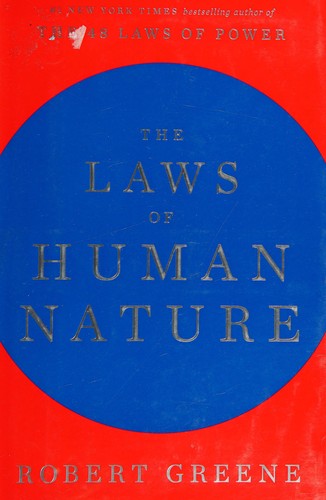
Overview
The Laws of Human Nature is Robert Greene’s attempt to assemble a working guide to the forces that drive human behavior below the level of awareness. Greene argues that people live on the surface, reacting emotionally to what others say and do and settling for simple explanations of both other people’s bad behavior and their own. He draws on a century of psychology, including Melanie Klein, John Bowlby, Heinz Kohut, Carl Jung, Paul Ekman, and Daniel Kahneman, along with philosophers such as Arthur Schopenhauer and José Ortega y Gasset, and calls the result a codebook for deciphering behavior.
The book is organized as eighteen laws, each a chapter. Every chapter follows the same structure. It opens with an extended historical story that illustrates the law, positively or negatively, then explains the psychology behind it, then offers strategies for managing it in others and in oneself, and closes with a section on transforming the force into something productive. The figures range from Pericles and Elizabeth I to Howard Hughes, Lyndon Johnson, Michael Eisner, and John D. Rockefeller. Greene frames the reader as an apprentice in human nature, and argues that social media and modern technology have intensified these forces rather than tamed them.
Human behavior is driven by a limited set of primal forces that operate below awareness, and the person who learns to observe those forces in others and in themselves gains calm, judgment, and influence that everyone else lacks.
Chapter Summaries
Chapter 1: Master Your Emotional Self
The Law of Irrationality. Greene argues that emotions shape thinking far more than people realize, steering them toward ideas that soothe the ego and evidence that confirms what they already believe. Rationality is not a natural state but a power that must be cultivated. The chapter’s model is Pericles, who led Athens for decades through restraint and argument, and whose death in the plague early in the Peloponnesian War left the city to factions that took it to ruin in Sicily.
- Greene presents Pericles as the leader who governed by his inner Athena, the goddess of practical wisdom. He withdrew when emotion rose and returned to decide only after it subsided, which is why his policies outlasted the cycles of heroic, risk-seeking leaders before him.
- The Athenian story shows the mechanism of collective irrationality. After Pericles died, the Assembly answered Nicias’s warning about Syracuse by doubling the expedition, because fear of defeat had turned into an appetite for a decisive win.
- Greene names six biases that distort judgment: confirmation bias, conviction bias, appearance bias, group bias, blame bias, and superiority bias. Each feels like reasoning from the inside, which is why each goes unnoticed.
- Inflaming factors push people toward their most irrational state. Greene lists sudden gains and losses, rising pressure, charismatic or inflaming individuals, and the contagion of the group. He cites the South Sea Bubble and the crashes of 1929 and 2008 as examples.
- The strategies for the rational self include knowing oneself thoroughly, examining emotions down to their roots, increasing reaction time before acting, and accepting people as facts rather than as one wishes them to be.
Chapter 2: Transform Self-love into Empathy
The Law of Narcissism. Greene argues that everyone sits somewhere on a narcissistic spectrum that begins with the infant’s need for attention, and that the healthy end of the spectrum is defined by the ability to turn self-absorption outward into empathy. The deep narcissist has no coherent self and builds one from other people’s attention. The chapter illustrates the spectrum with four types: Joseph Stalin as the controlling narcissist, the seventeenth-century nun Jeanne des Anges as the theatrical narcissist, Leo and Sonya Tolstoy as the narcissistic couple, and Ernest Shackleton as the healthy narcissist.
- Greene traces narcissism to early development. A child who receives too little attention, or attention that is too smothering, fails to build a stable self-image and spends adulthood seeking validation from others to hold it together.
- Deep narcissists are recognizable by hypersensitivity to criticism, a need to control the people around them, and a habit of treating others as extensions of themselves. Greene warns that the narcissistic leader is the most dangerous version because charisma and grandiose confidence attract followers.
- Stalin is presented as a narcissist who alternated charm and intimidation to keep everyone around him off balance and dependent.
- Shackleton is the positive case. Trapped on the Antarctic ice with his crew, he read each man’s moods, anticipated the ones who would break morale, and adjusted his own demeanor to hold the group together through months of danger.
- Greene breaks empathy into components: an empathic attitude of curiosity, visceral empathy that tunes into others’ moods, analytic empathy that works out their values and history, and the cumulative skill that develops with practice.
Chapter 3: See Through People's Masks
The Law of Role-playing. Greene argues that people learn early to wear social masks that hide what is frowned upon, but that the masks always leak through nonverbal signals. The chapter’s central figure is the psychiatrist Milton Erickson, who was paralyzed by polio at seventeen and spent his recovery watching his family, noticing how their faces, tones, and gestures contradicted their words. He built a career on that skill.
- Greene calls nonverbal communication a second language that most people never learn to read because they are absorbed in their own words and thoughts. Erickson’s forced stillness made him an observer.
- Observational skill requires lowering one’s own self-absorption and attending to the face, voice, posture, and pace of the other person, especially when they shift.
- Greene gives decoding keys for three categories of signal: like and dislike, dominance and submission, and deception. The common thread is attention to mismatch between what is said and what is shown.
- Overdone displays are often the signal. Exaggerated warmth, excessive certainty, or unusual animation can mean the person is working hard to cover the opposite.
- The chapter closes with impression management. Greene argues that since everyone plays roles, the goal is to play them consciously, managing nonverbal cues, adapting to the audience, and creating the right first impression rather than pretending to be unmasked.
Chapter 4: Determine the Strength of People's Character
The Law of Compulsive Behavior. Greene argues that character is formed in layers, from genetics, from early attachment, and from habits laid down over a lifetime, and that it compels people to repeat the same patterns. People rarely do something consequential just once. The chapter follows Howard Hughes Jr., whose public image as a rugged maverick concealed a compulsive need for control that wrecked his film projects, his aircraft ventures, and his defense contracts.
- Greene reads Hughes’s pattern back to an anxious, smothering mother and a pressuring, distant father. After both died, Hughes took full control of the family company and the need to control everything became the defining pattern of his career.
- The Hughes Aircraft story shows the pattern at its most expensive. Hughes promised engineers and managers real authority, then undermined them compulsively, and project after project ran late or failed.
- Greene’s core instruction is to ignore the front and the myth and look at the pattern. The best predictor of what someone will do is what they have done repeatedly, especially under stress.
- Strength of character shows in how people handle adversity, how they handle power, how they work with others, and in small details of behavior they do not think are being watched.
- Greene describes toxic character types to watch for, including the hyperperfectionist who must control everything, the drama magnet, the big talker who impresses with ideas and does not deliver, the pampered prince or princess, and the rescuer who builds dependence.
Chapter 5: Become an Elusive Object of Desire
The Law of Covetousness. Greene argues that people desire what they do not have and cannot easily get, and that desire is driven more by imagination than by the object itself. The chapter tells the story of Gabrielle Chanel, an orphan raised in a convent who built a fashion empire by understanding what women wanted before they could articulate it, and by surrounding her work with secrecy and an air of the forbidden.
- Greene attributes Chanel’s power partly to deprivation. A childhood without beauty or luxury gave her an acute sense of what others longed for.
- Absence and mystery stimulate desire. Chanel kept her methods and the formula of No. 5 secret, which made both more coveted.
- Greene argues that people want what others want. Visible demand, rivalry, and the hint of exclusivity raise the perceived value of a person, product, or idea.
- The transgressive and the forbidden attract because they promise something outside ordinary limits. Chanel’s androgynous designs drew on that appeal.
- The supreme desire, in Greene’s closing section, is to turn covetousness on reality itself, valuing what is present and attainable rather than chasing fantasies of what is out of reach.
Chapter 6: Elevate Your Perspective
The Law of Shortsightedness. Greene argues that the human animal is wired to respond to what is immediate and vivid, and that this pull toward the short term drives people into manias and bad decisions they later cannot explain. The chapter recounts the South Sea Bubble of 1720, in which John Blunt’s scheme drew all of England, including Isaac Newton, into a speculative frenzy that ended in widespread ruin.
- The South Sea story shows how a short-term gain becomes evidence that the gains will continue. Early winners made later caution feel foolish, and the crowd overrode individual judgment.
- Greene identifies four signs of shortsightedness. Unintended consequences come from actions taken without thinking through second-order effects. Tactical hell is endless battle over immediate issues. Ticker tape fever is overreaction to each new piece of news. Lost in trivia is fixation on detail at the expense of the larger picture.
- Philip II of Spain is the example of lost in trivia. Greene describes him studying every detail of the planned invasion of England while neglecting the larger factors, such as the weather, that decided the Armada’s fate.
- Elevating perspective means stepping back from the present moment, imagining how a decision will look months and years out, and asking whether it serves long-term goals.
- The farsighted human, in Greene’s account, cultivates patience, weighs consequences before acting, and keeps distance from impulsive people whose urgency is contagious.
Chapter 7: Soften People's Resistance by Confirming Their Self-opinion
The Law of Defensiveness. Greene argues that everyone holds a self-opinion that they are autonomous, intelligent, and good, and that any attempt at influence that threatens this self-opinion triggers resistance. Direct argument makes people dig in. The chapter tells how Lyndon Johnson, as a young senator, won the trust of the conservative Georgia senator Richard Russell and the liberal Minnesota senator Hubert Humphrey by validating how each man saw himself.
- Johnson’s method with Russell was to become the protégé of a powerful, lonely man, sharing his interests and seeking his advice. With Humphrey he affirmed his idealism while steering him toward pragmatism.
- Greene’s point is that Johnson rarely argued. He shaped the conditions in which others reached his conclusions themselves, which made them defend the conclusion as their own.
- Greene offers strategies for becoming a master persuader. They include listening deeply, infecting people with the right mood through one’s own calm and warmth, confirming their self-opinion, and using their resistance and stubbornness rather than fighting it.
- Validation must be specific to the person’s actual self-image. An independent thinker wants his independence confirmed, and a generous person wants her generosity recognized.
- The chapter closes by turning the law inward. Greene argues that people become more rigid and defensive with age and must work deliberately to keep a flexible mind.
Chapter 8: Change Your Circumstances by Changing Your Attitude
The Law of Self-sabotage. Greene argues that each person has an attitude, a characteristic way of seeing the world, that shapes what happens to them by shaping what they notice and how they respond. A constricted attitude narrows possibilities and invites the outcomes it fears. The chapter follows Anton Chekhov, who grew up with a violent father and in poverty, and who transformed his own outlook by working to understand and forgive his father and taking responsibility for his family.
- Left alone in Taganrog as a teenager, Chekhov worked, studied, and began to see his father as the product of a hard life as a former serf beaten by his own father. Greene treats that shift as the source of Chekhov’s later generosity and creative range.
- Greene describes five constricted attitudes: hostile, anxious, avoidant, depressive, and resentful. Each produces the reactions in others that confirm it.
- Attitude is self-fulfilling because it filters perception. A hostile person sees hostility, provokes it, and takes the result as proof.
- The expansive attitude treats setbacks as information, approaches people with openness, and directs anxiety and frustration into work.
- Chekhov’s journey to the penal colony on Sakhalin Island is presented as an act of deliberately widening his perspective, which produced a work that drew attention to the prisoners’ conditions.
Chapter 9: Confront Your Dark Side
The Law of Repression. Drawing on Carl Jung’s concept of the shadow, Greene argues that everyone represses traits and desires that do not fit their acceptable self-image, and that what is repressed does not disappear. It grows and leaks out, often at the worst moment. The chapter’s case is Richard Nixon, whose image of control and strength concealed insecurities that surfaced as the surveillance and dirty tricks culminating in Watergate.
- Greene argues that the shadow forms in childhood and that the more rigidly a person maintains a virtuous front, the stronger the hidden opposite becomes.
- Nixon is presented as a man who projected toughness while carrying deep resentment and insecurity, which drove the secret recording and attacks on opponents that brought him down.
- Greene lists signs of the shadow: contradictory behavior, emotional outbursts, vehement denial, accidental behavior, overidealization of causes, and projection of one’s own traits onto others.
- Contradictory types follow a pattern. The tough guy hides softness, the saint hides appetite for power, and the rigid rationalist hides irrational impulses.
- The integrated human, in Greene’s closing section, acknowledges the shadow and channels its energy into work, creativity, and candor rather than denying it.
Chapter 10: Beware the Fragile Ego
The Law of Envy. Greene argues that comparison is a constant of human nature, and that envy, the painful sense of inferiority when someone has what we lack, is almost always disguised because admitting it means admitting inferiority. The chapter tells the story of Mary Shelley’s friendship with Jane Williams in Italy, in which Jane’s warm friendship concealed an envy of Mary’s intelligence and reputation that surfaced after the drowning of Percy Shelley and Edward Williams.
- Envy hides behind friendship because closeness is where comparison is most acute. Greene’s lesson from the Shelley story is that envious friends are often the most attentive.
- Greene lists signs of envy: fleeting microexpressions, poisonous praise that undercuts an accomplishment, gossip, and a push and pull of warmth and coldness.
- He describes five envier types: the leveler who cloaks envy as a concern for fairness, the entitled slacker, the status fiend, the attacher who clings to successful people, and the insecure master who envies talented subordinates.
- Envy triggers include sudden success, shifts in status among peers, and visible ease. Greene notes that successful people often reduce envy by downplaying fortune and attributing success to luck or hard work.
- Moving beyond envy means turning comparison into admiration and emulation, getting closer to people one envies to see the full picture of their lives, and taking pleasure in others’ good fortune.
Chapter 11: Know Your Limits
The Law of Grandiosity. Greene argues that people have a need to feel great and important, and that success, especially early success, inflates this need until it disconnects them from reality. The chapter follows Michael Eisner at Disney, whose early run of hits with Frank Wells’s support gave way to decisions made against advice, the troubled opening of Euro Disney, the departure of Jeffrey Katzenberg, the failed hiring of Michael Ovitz, and eventual resignation.
- Greene’s diagnosis of Eisner is the success delusion. Early wins came from a combination of talent, timing, and other people’s contributions, but Eisner came to attribute them entirely to his own genius.
- Grandiosity grows quietly because its early decisions often work. The cost appears later, when decisions are made on self-belief rather than evidence and no one in the room will challenge them.
- Greene argues that grandiosity is increasing, fed by indulgent parenting, social media, and a culture of disdain for expertise.
- The grandiose leader uses predictable myths: destiny, a special connection to ordinary people, promises of salvation, an illusion of success, and exemption from the rules.
- Practical grandiosity, in Greene’s closing section, channels the need for greatness into work. It requires accepting limits, testing self-belief against results, and setting challenges that are ambitious but attainable.
Chapter 12: Reconnect to the Masculine or Feminine Within You
The Law of Gender Rigidity. Greene draws on Jung’s concepts of the anima and animus to argue that everyone is born with both masculine and feminine traits, that social conditioning leads people to repress one side, and that the repressed side returns as projection onto others. The chapter’s figure is Caterina Sforza, the Renaissance noblewoman raised by her father to ride, fight, and appreciate the arts, who defended her territories with both charm and martial courage.
- Greene presents Caterina Sforza as a person who integrated the traits her culture assigned to both sexes, which let her outmaneuver opponents who expected only one register.
- Repressed traits become projections. Greene describes the idealized images men and women tend to project onto each other and traces many of them to the relationship with the opposite-sex parent.
- The cost of rigidity is a narrower range of responses. A leader who has suppressed empathy or patience, or assertiveness or decisiveness, has fewer tools for any given situation.
- Greene argues that thinking styles also vary along this axis, contrasting quick, assertive action with patient, holistic, relational attention, and argues that the most effective people blend them.
Chapter 13: Advance with a Sense of Purpose
The Law of Aimlessness. Greene argues that people need a sense of direction, and that without a genuine purpose they drift toward pleasure, distraction, or false purposes supplied by others. A high sense of purpose organizes energy and makes setbacks bearable. The chapter’s figure is Martin Luther King Jr., whose sense of calling crystallized during the Montgomery bus boycott and sustained him through years of threats until his assassination in 1968.
- Greene describes King’s moment of doubt after threatening calls during the boycott, and his resolution of it, as the point at which purpose became an inner voice rather than an external role.
- A real purpose comes from within. Greene argues that it grows from one’s particular inclinations and skills rather than from what others expect or reward.
- Strategies for developing purpose include discovering one’s calling, using resistance and negative experiences as spurs, absorbing energy from purpose-driven people, building a ladder of descending goals, and losing oneself in the work.
- Greene warns about false purposes, including the pursuit of pleasure for its own sake, causes joined mainly for belonging, the pursuit of money and attention, and cynicism.
- Purpose helps a person withstand group pressure because the internal direction outweighs the need for approval.
Chapter 14: Resist the Downward Pull of the Group
The Law of Conformity. Greene argues that people become different when they join a group, more emotional, more suggestible, and more eager to fit in, and that groups reliably produce factions, scapegoats, and courts around their leaders. The chapter’s experiment in human nature is the Cultural Revolution as experienced by Gao Yuan, a student whose school descended into rival factions, public humiliations, and violence in the name of Mao’s revolution.
- Greene’s reading of the Cultural Revolution is that Mao tried to remake human nature through ideological fervor, and the experiment instead revealed it. Status competition, tribalism, and scapegoating appeared within groups that claimed to oppose them.
- Groups exert pressure through the need to belong, the security of shared identity, and the visible cost of being marginalized. People perform loyalty to the group even when they privately doubt it.
- Every group with a leader develops a court. Greene describes the courtier types to watch, including the intriguer, the stirrer, the gatekeeper, the favorite, the jester, the punching bag, and the mirrorer.
- Greene advises mirroring the leader skillfully and being kind to the group’s punching bag, because how a person treats the scapegoat shapes how the group sees them.
- The reality group is the healthy alternative. It is built around a shared purpose, competent lieutenants of good character, free flow of information, and an emphasis on results over politics.
Chapter 15: Make Them Want to Follow You
The Law of Fickleness. Greene argues that people are ambivalent toward leaders, wanting strong leadership and resenting it at the same time, an ambivalence rooted in childhood feelings toward parents. Authority must be earned and continually renewed. The chapter’s figure is Elizabeth I, who inherited a fragile throne, was underestimated as a young woman, and held authority for decades by never assuming her subjects’ loyalty was permanent.
- Greene describes the entitlement curse, the belief that a title confers lasting authority. He presents Elizabeth as a leader who refused to feel entitled and worked continually to prove herself to her council, her subjects, and foreign powers.
- Elizabeth’s handling of Mary, Queen of Scots and of the Earl of Essex shows the mix Greene recommends: patience and restraint until action is unavoidable, then decisive action in the service of the realm rather than personal feeling.
- Authority depends on followers believing the leader works for something larger than themselves. Greene argues that a leader’s own effort, sacrifice, and long view set the tone that followers adopt.
- Strategies for establishing authority include finding a style that suits one’s natural character, focusing outward on the group’s needs, leading from the front, and balancing firmness with empathy.
- The inner authority, in Greene’s closing section, is self-command. A leader who has mastered his own moods and impulses projects the steadiness followers need.
Chapter 16: See the Hostility Behind the Friendly Façade
The Law of Aggression. Greene argues that aggression is a part of human nature that cannot be wished away, and that it often operates behind polished, friendly, or moral surfaces. The chapter’s sophisticated aggressor is John D. Rockefeller, whose calm, pious, soft-spoken manner coexisted with the relentless consolidation of the oil-refining industry into Standard Oil.
- Greene reads Rockefeller’s drive as a response to childhood insecurity, including an unreliable father, which made him determined to impose order on the chaotic oil business.
- Sophisticated aggressors rationalize their aggression as a moral or practical necessity. Rockefeller framed his consolidation as bringing order to an industry ruined by competition.
- Aggressors exploit their targets’ emotions, especially greed, fear, and anger. Greene advises not reacting impulsively, studying the aggressor’s patterns, and finding the weaknesses behind the show of strength.
- Passive aggression is the more common form. Greene describes strategies such as subtle superiority, the sympathetic victim, dependency, and blame-shifting, and recounts how Milton Erickson’s class handled a student’s chronic lateness by turning her own behavior back on her.
- Controlled aggression, in the closing section, channels the same energy into ambition, persistence, anger directed at real problems, and fearlessness.
Chapter 17: Seize the Historical Moment
The Law of Generational Myopia. Greene argues that every person is shaped by their generation more than they realize, and that generations follow recurring patterns in which the young react against their elders and the old lose touch with the spirit of the times. The chapter follows Georges-Jacques Danton through the French Revolution, a man who read the rising tide of popular anger and rode it to prominence, then opposed the Terror and was executed by Robespierre’s tribunal.
- Greene contrasts Danton’s sensitivity to the mood of his generation with Louis XVI’s attachment to a world that was ending. Danton understood the spirit of the times. Louis did not.
- Danton’s fate is part of the lesson. He moved against the excesses of the Revolution too early and too openly, and the tide that lifted him then destroyed him.
- Generational identity is formed in youth through shared events and styles. Greene argues that people remain attached to the values of their generation long after the world has moved on.
- Generational patterns repeat. Each generation tends to see itself as more advanced and the one before it as rigid, and each eventually becomes the older generation it resisted.
- Greene advises understanding one’s own generation, staying alert to the spirit of the rising one, and adapting to it without abandoning one’s own core.
Chapter 18: Meditate on Our Common Mortality
The Law of Death Denial. Greene argues that people avoid thinking about death, and that this denial makes them waste time, cling to trivial concerns, and lose a sense of connection to others. Facing mortality directly sharpens purpose and deepens empathy. The chapter tells the story of Flannery O’Connor, who learned she had lupus, returned to her mother’s farm in Georgia, and devoted her shortened life to her writing.
- Greene notes that O’Connor was first told she had rheumatoid arthritis and learned the truth of her lupus diagnosis later. He presents her response, devotion to her work rather than despair, as the model.
- Awareness of death, in Greene’s account, made O’Connor more attentive to people and more urgent about her art, not more fearful.
- Death denial shows up as wasted time, as an inflated sense of the importance of small grievances, and as an inability to accept suffering as part of life.
- Greene’s philosophy of life through death involves keeping mortality in view, treating time as the scarcest resource, and recognizing the shared fate that connects all people.
- The chapter ends the book on the idea that the higher self Greene describes throughout is most available to someone who has accepted the limits of a single life.
About the Author
Robert Greene is the author of The 48 Laws of Power, The Art of Seduction, The 33 Strategies of War, The 50th Law with 50 Cent, Mastery, The Laws of Human Nature, and The Daily Laws, all New York Times bestsellers according to his official site. He attended the University of California at Berkeley and the University of Wisconsin at Madison, where he received a degree in classical studies. His books have a large following in business, politics, and the music industry.
Greene’s credibility for this book comes from synthesis and storytelling. He is a wide reader of history, biography, philosophy, and psychology, and the book’s strength is its ability to illustrate an idea through a vivid historical case. He is not a psychologist or researcher, and the book does not present original research. The psychological framework draws heavily on psychoanalytic and depth-psychology traditions, including Klein, Kohut, and Jung, alongside more empirical work by Ekman and Kahneman, and Greene does not distinguish sharply between the two kinds of evidence.
Key Takeaways
1) Most behavior is driven by forces people do not see in themselves.
The book’s foundational claim is that human beings experience the results of their emotions, moods, and drives without conscious access to their causes. People explain their own lapses as circumstance and others’ bad behavior as character, and in both cases settle for a story that is convenient rather than accurate. Greene’s argument is that the same limited set of forces, irrationality, narcissism, envy, grandiosity, conformity, aggression, and others, recurs across eras and individuals, and that recognizing them is the precondition for managing them.
- Greene describes this as a stranger within, a part of the self that operates independently of willpower and pushes people into patterns they regret.
- The forces trace to how humans evolved as social animals, including sensitivity to others’ emotions, constant status ranking, and tribal division into insiders and outsiders.
- Greene argues that social media and digital communication have intensified these forces by making emotional contagion, envy, and tribalism faster and wider.
2) Pattern predicts behavior far better than presentation.
Greene’s most practical argument concerns judging others. Character is formed in layers over a lifetime and compels people to repeat what they have done before, especially under stress. A person’s charm, ideas, and public myth are poor guides to how they will act when the stakes rise. The Howard Hughes chapter is the extended case. His image as a maverick hid a compulsion to control that produced the same failure in film, aviation, and defense contracting.
- Greene’s working rule is that people rarely do something consequential just once.
- Character shows most clearly in how a person handles adversity, power, and collaboration, and in small details they do not think are observed.
- The toxic types Greene describes are dangerous because they often impress at first, through ideas, energy, or the promise to solve problems.
3) Influence works by lowering resistance, not by winning arguments.
The defensiveness chapter argues that every person holds a self-opinion that they are autonomous, intelligent, and good, and that direct persuasion feels like an attack on it. People defend the position because they are defending themselves. Lyndon Johnson’s success in the Senate came from validating how Richard Russell and Hubert Humphrey saw themselves, which let him steer them toward conclusions they then defended as their own.
- Greene’s persuasion strategies start with deep listening and the right mood, because people respond to demeanor before words.
- Validation has to match the person’s actual self-image to work. Generic flattery triggers suspicion.
- The same law applies inward. Greene argues that people become more rigid with age and need to work deliberately to stay open to influence.
4) Success is the most reliable trigger of grandiosity.
Greene argues that early wins reshape a leader’s self-image faster than they reshape the leader’s actual capability. Michael Eisner’s run at Disney came from talent, timing, and the contributions of Frank Wells, Jeffrey Katzenberg, and others, but Eisner came to credit himself and began making decisions against advice. Grandiosity is hard to catch because its first decisions often work, and the cost arrives when no one remains who will push back.
- Greene treats grandiosity as a normal need for importance that success amplifies, not as a rare pathology.
- The grandiose leader relies on recognizable myths, including destiny, exemption from rules, and a special bond with ordinary people.
- Practical grandiosity redirects the need for greatness into ambitious work tested against results.
5) Every group with a leader forms a court, and the court distorts information.
The conformity chapter argues that people change when they enter groups, becoming more suggestible and more concerned with belonging and status. Groups reliably develop factions and courtiers around whoever holds power. Gao Yuan’s account of the Cultural Revolution is Greene’s extreme case, a movement that claimed to abolish hierarchy and instead produced rival factions, scapegoats, and violence.
- Greene’s courtier types, including the gatekeeper, the favorite, the mirrorer, and the punching bag, each filter what the leader hears.
- The reality group counters the court through shared purpose, competent lieutenants of good character, open information, and a focus on results.
- The book treats conformity as a force that operates on the leader too, not only on subordinates.
6) Authority is borrowed from followers and has to be renewed.
Greene argues that people are ambivalent toward leaders, wanting strength and resenting it, and that this ambivalence makes authority fragile. A title confers the position but not the loyalty. Elizabeth I held her throne by refusing to feel entitled, demonstrating through effort and judgment that she served the realm, and showing restraint until decisive action was unavoidable.
- Greene calls the belief that a position guarantees loyalty the entitlement curse.
- Followers watch whether the leader works for something larger than personal interest, and set their own effort accordingly.
- Inner authority, the leader’s command of their own moods, is the foundation for outer authority.
7) The forces that damage people can be turned into strengths.
Each chapter ends with a section on transformation, and the book’s arc is toward what Greene calls the higher self. Self-love becomes empathy. Comparison becomes admiration and emulation. Grandiosity becomes ambition channeled into work. Aggression becomes persistence and fearlessness. Awareness of death becomes urgency and connection. The argument is that the forces cannot be eliminated, only redirected, and that redirection begins with seeing them in oneself before seeing them in others.
- Greene insists that readers resist excluding themselves. It is always tempting to see narcissism, envy, and aggression only in other people.
- Accepting one’s own shadow, in Greene’s account, makes a person less hypocritical and easier to trust.
- The book closes on mortality because Greene treats the acceptance of limits as the condition for living by the higher self.
Strengths and Limits
The book’s strength is its breadth and its method. Greene organizes a large body of psychological and philosophical thought into eighteen recognizable patterns and anchors each in a long historical narrative that makes the pattern memorable. The stories of Pericles, Howard Hughes, Lyndon Johnson, Michael Eisner, and Elizabeth I are vivid enough that the underlying idea stays with the reader. The chapters on character, defensiveness, grandiosity, and conformity contribute the most to management thinking because they address judgment of people, persuasion, the effect of success on a leader, and the dynamics of a leadership group around its head. The consistent turn from diagnosis to self-examination keeps the book from being only a manual for reading others.
The limits are evidence, length, and framing. The psychological framework leans heavily on psychoanalytic traditions such as Klein, Kohut, and Jung, whose claims are less testable than the experimental findings Greene also cites, and the book does not separate the two. The historical stories are selected to illustrate each law, which makes them persuasive and also makes them poor tests of it. The book provides a selected bibliography but no notes, so specific claims are hard to trace. At roughly six hundred pages, with eighteen laws and many sub-typologies, the material is repetitive in places and the typologies multiply faster than they can be applied. The predictable failure mode for a reader is to adopt Greene’s vocabulary as a tool for diagnosing colleagues while skipping the self-examination each chapter asks for.
My Take
The diagnosis holds, and it holds most for the founder-CEO. In a five-to-fifty-million-dollar company, the CEO’s moods, biases, and blind spots propagate through the leadership team faster than any process can correct them. Four chapters do most of the work for my readers. Compulsive behavior is a hiring and promotion chapter in disguise. Grandiosity describes exactly what an early run of success does to a founder’s judgment. Conformity explains why the leadership team stops bringing bad news. Fickleness explains why authority built on being the founder starts to erode once the company outgrows the founder’s direct reach.
The book plays differently by context. In a founder-led company, the courtier dynamics in chapter 14 are sharper because there is no board or professional management layer between the founder and the team, and the founder’s shadow tends to become the company’s culture. In a company with institutional investors or an independent board, the grandiosity and fickleness chapters read more as warnings about how the CEO is being watched. The gender rigidity and generational myopia chapters are the least operational for a growth company, though the generational chapter has real value for a CEO leading a workforce two or three decades younger.
The most credible outside objection comes from Kirkus Reviews, which called the book a formula of truisms dressed in long historical yarns and a neo-Machiavellian program of self-validation, and suggested the Stoics covered the same ground better in the much shorter Enchiridion. I take the formula critique seriously. The evidence base is uneven, and a story about Michael Eisner proves only that Eisner happened. Where I part with Kirkus is on usefulness. The book is best read as a vocabulary for pattern recognition, not as science, and a leader who can name grandiosity or the court around them has a better chance of catching it. The real risk is the one Greene himself warns about: using the laws to diagnose other people and never turning them inward.
The book that completes this one is Manfred Kets de Vries’s The Leader on the Couch. Kets de Vries works from the same psychodynamic tradition, but he is a clinician and a professor of leadership who applies it directly to executives and organizations, which gives the material the practical setting Greene’s history lacks. For the irrationality chapter specifically, Daniel Kahneman’s Thinking, Fast and Slow supplies the experimental evidence Greene’s argument depends on. Read Greene for the patterns, Kets de Vries for how they play out in a leadership team, and Kahneman for what the research actually supports.
Discussion Questions
For CEOs
- Which of my last five major decisions was made while I was under the influence of a strong emotion, and how did it turn out?
- Which of Greene’s six biases, confirmation, conviction, appearance, group, blame, or superiority, most often shapes my judgment, and who on my team would name it first?
- When I hired or promoted my last three senior leaders, how much weight did I give to their track record under stress compared with how they presented?
- Which of our early successes do I credit mostly to my own judgment, and what part did timing, luck, or other people actually play?
- Who on my leadership team plays the gatekeeper, the favorite, or the mirrorer, and what information am I not hearing as a result?
- What do I do that would look, to an observer, like the contradictory behavior Greene describes as a sign of the shadow?
- When I want my team to accept a decision, do I argue for it, or do I shape the conditions in which they reach it themselves?
- What would change in how I spend the next year if I treated my time as the scarcest resource I have?
For Teams
- When pressure rises in this team, which inflaming factor usually sets it off: sudden gains or losses, deadlines, one person’s mood, or group contagion?
- What repeated pattern in how we work together keeps producing the same problem, and what does that pattern protect?
- Where does envy show up between functions or peers here, and how is it disguised?
- What bad news did this team hold back from the CEO in the last quarter, and why?
- Who in this group plays the punching bag, and how does the way we treat that role shape how safe others feel speaking up?
- Which of our current commitments are tactical hell, endless battles over immediate issues, rather than progress on what matters long term?
- When we try to persuade another department, do we confirm how they see themselves or do we challenge it?
- If an outside observer watched our last leadership meeting, what would they say we were really competing for?
Practical Tools
1. Emotional Reaction Delay
Greene’s first law argues that emotions distort judgment most when the stakes are high and the pressure is rising, and his model is Pericles, who withdrew until emotion subsided before deciding. The biases he lists feel like reasoning from the inside, so they cannot be caught in the moment without a deliberate pause. Use this before any decision that is large, hard to reverse, and made under time pressure or strong feeling, such as a termination, a major hire, an acquisition offer, or a public response to a setback.
How it works:
- Name the decision and the emotion you are feeling about it in a sentence each. Be specific: anger at a person, excitement about a deal, fear of losing a customer.
- Ask which of Greene’s six biases could be operating. Write the one that fits best and what it would make you overlook.
- Identify the inflaming factor at work: a sudden gain or loss, rising pressure, a persuasive person, or the mood of the group.
- Set a minimum delay proportional to the stakes, a night for a large decision and longer for one that cannot be reversed. Do not commit before it expires.
- After the delay, restate the decision and the reasoning. If the reasoning is unchanged and holds without the emotion, proceed.
Fewer decisions get reversed within weeks of being made. The leadership team notices that the CEO’s first reaction is no longer the final answer, and starts bringing information before the decision rather than after it.
2. Character Pattern Review
The compulsive behavior chapter argues that character repeats, that people rarely do something consequential just once, and that charm, ideas, and reputation are poor guides to how someone will act under stress. Howard Hughes’s image as a maverick concealed the same control pattern across every venture. Use this review before any senior hire, promotion into a leadership role, or partnership where the other party’s judgment will affect the business.
How it works:
- List the three or four most demanding situations in the candidate’s history: a failure, a crisis, a sudden increase in authority, a conflict with a peer.
- For each, find out what they actually did, from references and direct questions, not what they say they learned.
- Look for repetition. Note any behavior that appears in more than one situation, positive or negative.
- Check the pattern against Greene’s toxic types, especially the perfectionist who must control everything, the big talker, and the rescuer who builds dependence.
- Observe small details during the process: how the candidate treats junior staff, how they respond to an unexpected question, whether they keep minor commitments.
Hiring discussions shift from impressions to evidence of repeated behavior. The team can name the pattern it expects to see from a new leader and recognize it early if it appears, rather than discovering it a year later.
3. Success Reality Check
The grandiosity chapter argues that early success inflates a leader’s self-image faster than it improves their capability, and that grandiosity is hard to catch because its first decisions often work. Michael Eisner’s decline at Disney began after his strongest years. Use this after a record quarter, a major win, a funding round, or any stretch in which the business has outperformed expectations.
How it works:
- Write down the success and the three factors that produced it.
- For each factor, assign honest shares to your own judgment, to other people’s contributions, to timing and market conditions, and to luck.
- Ask two leaders you trust to do the same exercise independently, then compare. Pay attention to where your share is larger than theirs.
- List the decisions you are now considering that you would not have considered before the success, and test each against the evidence rather than the momentum.
- Name who in the business is currently allowed to tell you that you are wrong, and when they last did.
The CEO credits the team with specifics rather than in general terms, and new initiatives launched after a win get the same scrutiny as those launched in a hard year. Someone on the team pushes back in a meeting and the CEO visibly changes course.
4. Self-Opinion Mapping
The defensiveness chapter argues that people resist influence that threatens how they see themselves, and that Lyndon Johnson persuaded powerful senators by validating the self-image each held. Direct argument hardens positions because people defend themselves along with their view. Use this before any important persuasion: a leader resisting a reorganization, a co-founder opposed to a strategic shift, a board member skeptical of an investment.
How it works:
- Write how the person sees themselves in three or four words, for example independent, prudent, loyal to the original vision.
- Identify how your proposal could appear to threaten that self-image.
- Reframe the proposal so that accepting it confirms the self-image rather than challenging it.
- Plan to listen first. Ask questions that let the person articulate their concerns and their values before presenting anything.
- Look for a way to let their resistance or stubbornness work for the proposal, such as inviting them to stress-test it.
The other person begins describing the proposal in their own words and defending it to others. Meetings that would have been arguments become working sessions on how to proceed.
5. Leadership Court Map
The conformity chapter argues that every group with a leader forms a court, and that courtiers filter what the leader hears. Greene’s courtier types, including the gatekeeper, the favorite, the mirrorer, and the punching bag, each distort information in a predictable way. Use this when the CEO senses that bad news is arriving late, when meetings produce consensus too easily, or after a decision failed because something known inside the company never reached the top.
How it works:
- List the people closest to you in the business and how information from the rest of the company reaches you.
- For each person, ask honestly which role they play most often: gatekeeper, favorite, mirrorer, stirrer, intriguer, or punching bag.
- Identify what kind of information each role is likely to filter out. A mirrorer filters disagreement. A gatekeeper filters access.
- Create one direct channel that bypasses the court, such as regular skip-level conversations or anonymous input on specific decisions.
- Change how you respond to the punching bag and to dissent in meetings, because the group watches how the leader treats both.
Bad news arrives sooner and from more sources. Meetings include visible disagreement, and the people who disagree are not penalized for it. The CEO hears about problems before customers do.
6. Shadow Inventory
The repression chapter argues that the more rigidly a person maintains a virtuous front, the stronger the hidden opposite becomes, and that the shadow leaks out through contradictory behavior, outbursts, denial, and projection. Nixon’s image of control concealed the insecurity that destroyed his presidency. Use this periodically as a self-examination, and especially after an outburst or a reaction that seemed out of proportion to the trigger.
How it works:
- Write the three qualities you most want others to see in you as a leader.
- For each, write its opposite. These are the most likely contents of your shadow.
- List any recent behavior that contradicted the front: an outburst, an unusually harsh judgment of someone, an unexplained avoidance.
- Note what you criticize most sharply in others. Greene argues that projection often points to a repressed trait in oneself.
- Choose one productive outlet for the energy behind the shadow trait, such as directing a need for control into a specific operating discipline rather than into micromanagement.
Outbursts become less frequent and are followed by acknowledgment rather than justification. Leaders on the team report that the CEO is more consistent, and that what the CEO says and does in pressured moments match more closely.
7. Long-View Decision Test
The shortsightedness chapter argues that people are wired to respond to what is immediate and vivid, and identifies four signs that the short term is winning: unintended consequences, tactical hell, ticker tape fever, and getting lost in trivia. The South Sea Bubble shows how quickly a crowd overrides individual judgment. Use this during annual and quarterly planning, and whenever the leadership team is consumed by a single urgent issue.
How it works:
- List the issues that consumed most of the leadership team’s time in the last month.
- Classify each as long-term progress or one of the four signs of shortsightedness.
- For each major pending decision, write what its effect will look like in six months, a year, and three years. Note second-order consequences explicitly.
- Identify any decision driven mainly by a recent number, a competitor’s move, or a single customer’s demand, and ask whether it would still make sense without that trigger.
- Reserve a recurring block of leadership time for long-term questions that cannot be displaced by urgent ones.
A smaller share of leadership time goes to recurring fires, and fewer initiatives are launched and abandoned within the same quarter. The team can explain how current priorities connect to the three-year direction.
Further Reading
- Kirkus Reviews’ review of The Laws of Human Nature, the sharpest published critique of the book’s formula and its neo-Machiavellian framing.
- Robert Caro’s Master of the Senate, the full-length account of Lyndon Johnson’s Senate years and his relationships with Richard Russell and Hubert Humphrey, the subject of chapter 7.
- James B. Stewart’s DisneyWar, the detailed account of Michael Eisner’s tenure at Disney, for readers who want the grandiosity case of chapter 11 in full.
- Ron Chernow’s Titan, the standard biography of John D. Rockefeller, for a fuller picture of the sophisticated aggressor in chapter 16.
- Gao Yuan’s Born Red, the memoir of the Cultural Revolution that underlies the conformity case in chapter 14.
- Robert Greene’s official site, for his other books and recorded interviews on the laws.
Share This Review

Bruce Eckfeldt is a business coach and strategic advisor to founder-CEOs of growth-stage companies, a former Inc. 500 CEO, and the author of Springboard. More book reviews →
These summaries present Bruce Eckfeldt’s analysis of business and leadership books for founder-CEOs and leadership-team members of growth companies. Each one identifies the ideas most relevant to decision quality, strategy, and leadership capacity, notes where the evidence is weak, and suggests practical ways to test what is worth testing. All ideas, stories, and quotations belong to the original author and to the people they cite. The assessments and recommendations are Bruce’s. It is a companion to the book, not a substitute for reading it.
To learn more about Bruce’s programs, request other book summaries, or get in touch, contact booksummaries@eckfeldt.com.
Get the Next Review.
A new book review lands in Better, Faster, my weekly newsletter for founder-CEOs, along with one practical essay and questions for your team.