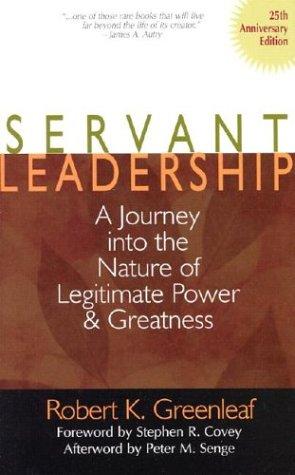
Servant Leadership
A Journey Into the Nature of Legitimate Power and Greatness
The servant-leader is servant first. The test is whether the people served grow as persons, become healthier, wiser, freer, more autonomous, more likely themselves to become servants. Every practice in the book follows from that test.
A book summary and review by Bruce Eckfeldt
Overview
Servant Leadership is the collected essays of Robert Greenleaf, a career executive at AT and T who spent 38 years inside the largest corporation in the world observing how leaders actually behave and who then, after retiring in 1964 as Director of Management Research, wrote for another 25 years about what he had seen. The 25th Anniversary Edition gathers his three foundational essays, The Servant as Leader (1970), The Institution as Servant, and Trustees as Servants, along with later essays applying the framework to business, education, foundations, churches, and the individual’s inward journey. The book is not a theory of leadership. It is a description of a stance the leader takes toward the people the institution exists to serve, and an argument that this stance is the only one that produces institutions worth working for over the long run.
The organizing idea is that the servant-leader is servant first. The natural feeling of wanting to serve comes before the choice to lead, and that order matters. A person who is leader first, and who then decides to serve because it produces results, is a different person acting on different motives, and Greenleaf argues the difference eventually shows up in what the institution becomes. The book’s practical value for a founder-CEO is that it names a test the leader can apply to any decision. Do the people served grow as persons, become healthier, wiser, freer, more autonomous, more likely themselves to become servants. And, what is the effect on the least privileged. Everything else in the book, from persuasion to foresight to the trustee’s role, follows from that test.
The servant-leader is servant first. The test is whether the people served grow as persons, become healthier, wiser, freer, more autonomous, more likely themselves to become servants. Every practice in the book follows from that test.
Chapter Summaries
Chapter 1: The Servant As Leader
The 1970 essay that names the idea. Greenleaf writes it in his mid-sixties, after 38 years at AT and T, and traces the seed of the concept to Hermann Hesse’s novella Journey to the East, in which a band of pilgrims travels with a servant named Leo who sustains them by his caring spirit and who is later revealed to be the head of the religious order sponsoring the journey. Greenleaf’s argument is that the great leader is experienced first as a servant, and that the reverse ordering, leader first, produces something different that cannot be corrected by adding service back later.
- The best test of the servant-leader is stated in one sentence and repeated throughout the book. Do those served grow as persons, become healthier, wiser, freer, more autonomous, more likely themselves to become servants. Greenleaf adds a second clause. What is the effect on the least privileged in society, will they benefit or at least not be further deprived.
- The servant-leader is servant first. Servant-leadership begins with the natural feeling that one wants to serve. A conscious choice then leads the person to aspire to lead. The central question is not what service can you render as a leader, it is what leadership can you exercise as a servant. Greenleaf treats leadership as a special case of service, not the other way around.
- Greenleaf distinguishes leadership from management and administration. Management comes from manus, hand, and suggests control. Administration comes from administrare, to serve, and suggests maintenance. Leadership means going out ahead to show the way, and its only test is that someone follows voluntarily. Compliance produced by sanctions does not qualify as leadership.
- The essay identifies foresight as the central ethic of leadership. A leader who waits until everyone else can see the coming event has waited too long and is now merely reacting. Failure to foresee, when earlier action was possible, is an ethical failure, not merely a strategic one.
Chapter 2: The Institution As Servant
The second essay turns the idea from the individual leader to the institution. Greenleaf argues that the most important servant-leaders in a modern society are institutions themselves, because most people spend most of their working lives inside them. The chapter also introduces the trustee argument that runs through the rest of the book. An institution exists to serve, and the trustees are the ones who hold it to that purpose over time.
- The critique is that most large institutions perform poorly against the best test not because their employees are incompetent but because their governance is designed around control rather than service. The remedy is not more oversight. It is trustees who understand their role as holding the institution in trust for the people it exists to serve.
- Greenleaf rejects the single strong CEO as the standard model. He proposes that leadership at the top of a large institution be held by a team of equals with a primus inter pares, a first among equals. The single-CEO model concentrates power in one person and produces the arrogance and isolation Greenleaf considers the primary failure mode of institutional leadership.
- The chapter uses Greenleaf’s own study of AT and T’s regeneration under Theodore Vail, appointed by J. P. Morgan in 1907. Vail inherited a company with an employee morale problem, a bad public reputation, questions about financial soundness, and inadequate technology. By 1920 all four were corrected. Greenleaf identifies three strategies. A clear and powerful mission. Identification of the obstacles and assignment of capable people to overcome them. Creation of a widely accepted sense of urgency.
- The institution-as-servant view reframes strategy. The strategic question is not how do we compete, it is what does this institution exist to serve, and are the people at the top holding it to that purpose against the pressures that would pull it toward something else.
Chapter 3: Trustees As Servants
The third foundational essay develops the argument that the trustee role, board member for a business or governor for a nonprofit, is the highest expression of servant-leadership because trustees hold the institution in trust for the people it exists to serve without themselves running it. Greenleaf argues that the current state of trusteeship in most institutions is inadequate, and that reforming it is the single change that would do most to strengthen institutional performance.
- Trustees serve at a level of abstraction operational management cannot afford. They hold the mission, name the obstacles to greatness, and ask the questions no one inside the operation is positioned to ask. Greenleaf’s view is that trustees who operate at that level are rare, and that most boards have drifted into either rubber-stamping management or interfering with it.
- The chairperson of the board carries a specific responsibility Greenleaf calls the double servant-leadership role. The chair serves the board by leading it well, and serves the institution by holding the board to its trusteeship function. The role requires someone with the stature to challenge the CEO and the temperament to lead trustees through questions and persuasion rather than domination.
- Greenleaf rejects the argument that trustees are only responsible to shareholders. He argues that trustees are responsible to all the people the institution affects, including employees, customers, and the community, and that a board that acts only for shareholders will produce an institution that loses trust with everyone else, which eventually costs the shareholders too.
- The practical implication for a founder-CEO is that building a real board, one populated by trustees who understand the role, is a growth-stage decision that shapes what the company becomes over the following decade. The founder who selects board members for their willingness to be quiet has selected against the function Greenleaf considers essential.
Chapter 4: Servant Leadership In Business
Greenleaf applies the framework to business, drawing on his 38 years at AT and T and his consulting after retirement with the Ford Foundation, the Lilly Endowment, and other institutions. The chapter’s argument is that business, precisely because it employs so many people, has a servant-leadership responsibility that most business leaders do not recognize and that most business schools do not teach.
- The distinction between operator and conceptualizer runs through the chapter. Operators run the business day to day. Conceptualizers see the whole and see what the business could become. Greenleaf argues that most senior leaders are strong operators promoted past their conceptual capacity, and that the failure to develop conceptualizers is the single biggest weakness in most large companies.
- Greenleaf describes what he calls the umbrella effect at AT and T. A strong subordinate manager could create positive attitudes among their people even when higher-level management produced negative attitudes elsewhere in the company. The observation matters for a growth-company CEO because it means that pockets of servant-leadership can be built inside a company whose top has not yet come around.
- The chapter names people-first as the practical test in business. A company that puts people first, meaning employees, customers, and community, does not treat people as means to financial ends. Greenleaf argues that the companies he studied with this orientation consistently outperformed peers on the financial measures over long periods, though he cautions that people-first cannot be adopted as a technique because employees see through it within a quarter.
- The chapter also introduces one of Greenleaf’s sharpest cautions. Servant-leadership cannot be installed as a program. Attempts to do so produce what he calls the aspirin effect. A short-lived improvement followed by disillusionment worse than the original condition. The only durable path is for the top person to actually become a servant-leader, at which point what the leader is and does begins to spread.
Chapter 5: Servant Leadership In Education
The education chapter argues that universities are the institution most in need of servant-leadership and least equipped to produce it. Greenleaf cites John Gardner’s charge that universities administer an anti-leadership vaccine to their students, training them in analysis and criticism at the expense of the capacity to lead. The essay proposes that one in one thousand of the roughly 500,000 U.S. college faculty, about 500 people, could act as mentors to students who might become servant-leaders in the next generation.
- Greenleaf uses Thomas Jefferson’s apprenticeship under the Williamsburg lawyer George Wythe as his model of mentorship. Without Wythe’s influence, Greenleaf argues, Jefferson might not have written the Declaration of Independence or drafted the Virginia statutes that shaped the Constitution, and might instead have settled for being an eccentric Virginia scholar. Wisdom develops through real-life experience, testing judgment, risking decisions, making mistakes, and being guided by a mentor who cultivates awareness.
- The chapter’s model for institutional education is Nikolai Grundtvig and the Danish Folk High Schools, which Grundtvig envisioned during the first three quarters of the nineteenth century as short, intensive, residential programs for young adults focused on Danish history, mythology, and poetry. Grundtvig did not found or run a single school. He provided a vision, a dream, love for the peasants, and passionate advocacy for more than fifty years, and the Danish people built the schools with their own resources and transformed Danish agriculture and national spirit.
- The critique of leadership development in the chapter is that it happens too late in the life of the future leader. Greenleaf recommends beginning preparation no later than secondary school and earlier if possible, because young people need preparation to stand against cultural assumptions about power and competition before those assumptions have become automatic.
- The chapter’s argument for a founder-CEO is indirect but pointed. If universities produce operators rather than conceptualizers, and if conceptualizers are what growth-stage companies need most, then the founder cannot outsource leadership development to the education system and must build it inside the company.
Chapter 6: Servant Leadership In Foundations
The foundations chapter reflects Greenleaf’s post-retirement consulting with the Ford Foundation and the Lilly Endowment, and his study of the Danforth Foundation and others. His argument is that foundations sit in a position of unusual leverage and unusual insulation from feedback, and that the combination makes them one of the most difficult institutions to lead well.
- Foundations do not have customers who can leave. They do not have investors who can sell. They do not have voters who can throw them out. The absence of external feedback means that a poorly led foundation can persist for decades without anyone outside noticing. Greenleaf argues that trusteeship, done well, is the only corrective, and that foundation trustees are especially prone to becoming ceremonial rather than functional.
- The chapter uses the example of James Shannon at the General Mills Foundation. After Shannon’s staff was reduced from six and a half people to four, he recruited roughly a dozen employees who did not report to him to volunteer their free time on grant-making site visits. The foundation’s grants budget increased from $4.5 million to $9 million. Greenleaf uses the example as evidence that servant-led leadership can find capacity in an institution that formal reporting lines would not have surfaced.
- Greenleaf proposes that foundations are third-level institutions whose principal purpose is to strengthen second-level institutions like universities and churches. The framing challenges the standard foundation view that its purpose is to fund projects. Greenleaf’s argument is that funding projects without strengthening the institutions that carry them produces short-term outputs and long-term weakness.
- The practical implication is that a founder-CEO who serves on foundation boards, or who considers establishing a family foundation, should ask the same trustee questions Greenleaf raises about businesses. What does the foundation exist to serve, and are the trustees holding it to that purpose against the drift toward reputation and self-preservation.
Chapter 7: Servant Leadership In Churches
The chapter on churches is important less for its ecclesiastical content than for Greenleaf’s argument that religious institutions have the same servant-leadership responsibility as businesses and universities, and that their failure to exercise it has weakened them relative to the culture. The chapter uses the eighteenth-century Quaker John Woolman as the archetype of the individual servant-leader operating inside an institution.
- John Woolman devoted approximately thirty years of his adult life to eliminating slavery among the Religious Society of Friends. He lived to age fifty-two. By 1770, nearly a hundred years before the American Civil War, no Quakers held slaves. Woolman’s method was gentle, clear, persistent, nonjudgmental, and based on persuasion applied one person at a time. He traveled the East Coast by foot or horseback, visited slaveholders repeatedly over many years, and asked questions such as what does owning slaves do to you as a moral person and what kind of institution are you binding over to your children.
- Greenleaf uses Woolman as evidence that persuasion, understood as sustained and dynamic engagement over years, can accomplish what coercion cannot. The Religious Society of Friends became the first religious group in America formally to denounce and forbid slavery. Greenleaf argues that the change was durable precisely because it was reached by persuasion rather than by rule.
- The chapter’s more pointed argument is that seminaries, the training institutions for religious leaders, produce operators rather than servant-leaders because they focus on curriculum rather than on the formation of the person. Greenleaf’s critique of seminaries applies point for point to business schools and law schools.
- For a founder-CEO whose company has a strong values or mission element, the chapter’s implication is that leaders formed inside institutions optimized for compliance and credentialing will not by default carry the mission when the founder steps back. The formation of servant-leaders is a separate task and requires deliberate investment.
Chapter 8: Servant-Leaders
This chapter turns from institutions back to the individual leader. Greenleaf gathers the personal qualities that recur across every servant-leader he studied and argues that they cannot be added on top of an unchanged interior. The chapter makes awareness, persuasion, foresight, and conceptualization the interior operating equipment of the leader, and treats each as a capacity to be developed over years rather than a skill to be acquired in a course.
- Awareness is Greenleaf’s word for the capacity the leader has to see what is happening inside themselves and in the situation. It is not a source of comfort. Greenleaf calls awareness a disturber and awakener, a condition of being sharply awake and reasonably disturbed. Able leaders are not seekers after solace. They carry their own inner serenity that allows them to sit with what awareness reveals.
- Persuasion is central. Servant-leaders rely on persuasion rather than positional authority. Persuasion allows the person being persuaded to reach a feeling of rightness through their own intuitive sense, and the person being persuaded must take that step alone. Greenleaf contrasts persuasion with coercion, the use or threat of sanctions, and with manipulation, guiding people into beliefs or actions they do not fully understand. Persuasion is dynamic, sustained, and challenging, not passive.
- Conceptualization is the capacity to hold a large idea over time and to let it shape action without collapsing into either abstraction or immediate task. Greenleaf argues that most senior leaders are strong on the immediate and weak on the conceptual, and that the institution suffers when the top leader cannot hold the whole in mind long enough to guide the parts.
- Healing, listening, empathy, stewardship, commitment to the growth of people, and community-building are the qualities Larry Spears later distilled into the widely cited ten characteristics. Greenleaf treats each not as a checklist item but as an expression of the underlying servant-first stance. Without the stance, the qualities become performance.
Chapter 9: Servant Responsibility In A Bureaucratic Society
This chapter examines the individual servant-leader’s stance inside a large bureaucratic system. Greenleaf argues that the modern corporation, university, hospital, and government agency are the settings in which most servant-leadership either happens or fails to happen, and that the person of conscience inside a large institution has responsibilities that cannot be discharged by leaving.
- The bureaucratic setting is treated as the given, not as the problem to be solved. The interesting question for Greenleaf is not how to escape the bureaucracy but how a servant-leader operates inside it without either colluding with its worst tendencies or becoming ineffective through pure opposition.
- Greenleaf argues that responsible dissent inside an institution is a servant-leadership act, not an act of disloyalty. The person who names what is wrong in a way the institution can hear, and who stays inside long enough to help change it, does more for the institution than the person who leaves in protest.
- The chapter names the trap of premature exit. Talented people who leave when the institution disappoints them relieve themselves of the pain but deprive the institution of the corrective. Greenleaf’s view is that staying to change is often the harder and more useful form of service.
- For a founder-CEO, the practical implication is that senior people who name hard truths inside the leadership team are exercising a form of servant-leadership. Punishing that behavior, subtly or directly, teaches the rest of the team that dissent is not safe, and the company loses the corrective mechanism Greenleaf considers essential.
Chapter 11: An Inward Journey
The closing essay of the framework argues that the capacity to lead as a servant depends on personal work the leader has to do on themselves. Greenleaf draws on Robert Frost’s poem Directive to describe the inward journey as a passage that has to be taken by the leader alone. No institution can do it for them and no course can substitute for it.
- The inward journey is not a self-improvement project. It is the deliberate development of the interior capacities that servant-leadership rests on. Solitude, reflection, listening, and the practiced habit of sitting with what awareness reveals are the substance of the journey.
- Greenleaf treats these practices as operating infrastructure. The leader who has not done the inward work will not sustain the outward stance under pressure. The moments when servant-leadership matters most are the moments the unprepared leader cannot meet.
- Frost’s line, and the way is at the head of the waters, is used to name the leader’s obligation to trace difficult questions back to their source rather than to accept the version of the question that first arrives. The leader’s job is to reach the head of the waters before deciding.
- The essay closes on the argument that servant-leadership is not a technique that can be adopted. It is a way of being that the leader either develops through the inward journey or does not. What the leader is and does then spreads through the institution by imitation rather than by rollout.
About the Author
Robert K. Greenleaf spent 38 years at AT and T, joining Ohio Bell in 1926 immediately after graduating from Carleton College and rising to become Director of Management Research, a position from which he studied and advised on leadership across a company with more than one million employees. He described his own executive role as light, which he considered a benefit because it kept him at reflective distance from the top structure he was observing. He watched AT and T through the expansion of the 1920s, the Depression, World War II, and the growth years of the 1950s and 1960s.
Greenleaf retired from AT and T in 1964 at age 60 and founded the Center for Applied Ethics, later renamed the Robert K. Greenleaf Center for Servant-Leadership. His second career lasted approximately 25 years and included consulting with the Ford Foundation and the Lilly Endowment, teaching at MIT, Harvard, and Duke, and writing the essays collected in this book. He wrote The Servant as Leader in 1970 at age 66. He died in 1990. Larry C. Spears, editor of the 25th Anniversary Edition and long-time head of the Greenleaf Center, distilled ten characteristics from Greenleaf’s writings that have become the most widely used practical framing of the concept.
Key Takeaways
1) The best test names one question that can be applied to any decision.
Greenleaf’s best test is stated in one sentence and repeated across the essays. Do those served grow as persons, become healthier, wiser, freer, more autonomous, more likely themselves to become servants. The test is applied to every decision, not to an annual review. What makes it useful for a founder-CEO is that it converts leadership from a set of behaviors to be scored to a single question that can be asked in real time about a specific choice.
- The test has a second clause. What is the effect on the least privileged in society. The two clauses together prevent the test from being narrowed to a comfortable in-group.
- The test is behavioral, not aspirational. A leader cannot pass it by intending to serve. It is passed by whether the people served, over time, grow.
- The test is asymmetric with respect to time. Actions that produce compliance now and dependency later fail the test even if the current-quarter numbers improve.
2) Servant first is a stance, not a behavior set.
Greenleaf is precise that the servant-leader is servant first. The natural feeling of wanting to serve comes before the choice to lead. A leader-first who then chooses to serve because it produces better results is a different person on different motives, and Greenleaf argues the difference eventually shows in the institution. The stance is not a behavior that can be adopted. It is the orientation from which behavior emerges.
- The distinction matters for hiring at senior levels. A leader-first can pass a behavioral interview by describing servant-leader behaviors. The stance shows up under pressure, when the leader chooses between what serves and what advances them personally.
- The stance is not softness. Servant-leaders exhibit toughness, conviction, tenacity, and courage. Greenleaf argues they are often stronger than coercive leaders because their strength comes from something other than positional power.
- The stance is testable over time by whether the leader is willing to hold positions that cost them personally when those positions serve the people they lead.
3) Foresight is the central ethic of leadership.
Greenleaf identifies foresight as the ethical center of leadership. A leader who waits until everyone else can see the coming event has waited too long and is now merely reacting. Failure to foresee, when earlier action was possible, is an ethical failure. Foresight requires the leader to hold past, present, and future as one organic unity and to act on what that view reveals before it becomes obvious to others.
- Foresight is not prediction. It is the capacity to see the shape of what is coming clearly enough to act, accepting that the specific form will differ.
- Foresight is partly intuitive and cannot be reduced to analysis. Greenleaf argues that leaders without native foresight should stay close to those who have it.
- The ethical weight of foresight comes from the asymmetry between early action, which is cheap, and late action, which is expensive to everyone the leader serves.
4) Persuasion is dynamic, sustained, and slower than most leaders will accept.
Persuasion is the servant-leader’s primary tool. It is not the soft alternative to authority. It is a sustained engagement with another person’s judgment that allows them to reach a conclusion through their own reasoning. Greenleaf contrasts persuasion with coercion, the use or threat of sanctions, and with manipulation, guiding people into beliefs they do not fully understand. Persuasion takes time, and it requires the leader to hold their position with conviction while remaining open to the other person’s response.
- John Woolman spent thirty years persuading Quaker slaveholders one at a time. By 1770 no Quakers held slaves. Greenleaf uses the example as evidence that persuasion accomplishes what coercion cannot.
- Persuasion is undermined by any use of positional power to shorten the conversation. Once the leader signals that the outcome is not really open, the engagement stops being persuasion and becomes managed compliance.
- The person being persuaded must take the last step alone. Leaders who require the visible submission of the other person have moved from persuasion to something else.
5) Institutions are the primary servant-leaders in a modern society.
Greenleaf’s second essay shifts the argument from the individual to the institution. Most people spend most of their working lives inside institutions, and the character of those institutions shapes what those people become. A servant-led institution produces employees who grow. A poorly led institution produces employees who diminish. For a growth-stage founder, the argument is that the company itself is a servant-leader in formation, and the founder’s job is to build it so that it can hold the stance after they are gone.
- Greenleaf rejects the single strong CEO as the standard model for large institutions. He proposes a team of equals with a primus inter pares, first among equals, on the ground that concentrating power in one person produces the arrogance and isolation he considers the primary failure mode.
- The institution’s stance is set at the top and diffuses down. A CEO cannot install servant-leadership as a program while continuing to run the top of the company on different principles.
- The AT and T umbrella effect Greenleaf describes means that pockets of servant-leadership can exist inside a company whose top has not adopted the stance. For a growth-stage CEO, the observation means that individual leaders in the company can be developed as servant-leaders even before the overall culture shifts.
6) Trustees hold the mission when management cannot.
The third foundational essay makes the argument that trustees, board members for a business or governors for a nonprofit, are the highest expression of servant-leadership because they hold the institution in trust for the people it exists to serve without themselves running it. Greenleaf’s view is that most boards have drifted into either rubber-stamping management or interfering with it, and that reforming trusteeship is the single change that would do most to strengthen institutional performance.
- The chairperson of the board carries what Greenleaf calls the double servant-leadership role. The chair serves the board by leading it well and serves the institution by holding the board to its trusteeship function. The role requires someone with the stature to challenge the CEO.
- Greenleaf rejects the view that trustees are responsible only to shareholders. He argues that trustees are responsible to all the people the institution affects, and that a board acting only for shareholders will eventually lose the trust that the shareholder value itself depends on.
- For a founder-CEO, the practical implication is that building a real board, populated by trustees who understand the role, is a growth-stage decision that shapes what the company becomes over the following decade.
7) Awareness is a disturber and awakener, not a source of comfort.
Greenleaf’s treatment of awareness cuts against the wellness reading of servant-leadership. Awareness is not the leader’s calm. It is the leader’s capacity to see what is actually happening in themselves and in the situation, and what is actually happening is often uncomfortable. Greenleaf writes that awareness is not a giver of solace, that it is a disturber and awakener, and that able leaders are not seekers after solace but carry their own inner serenity.
- The inner work of the leader is not an add-on. Greenleaf treats it as operating infrastructure. Without solitude, reflection, and deliberate development of listening, servant-leadership is not sustainable.
- Awareness includes what the leader would rather not see about themselves. The capacity to sit with that material is a precondition for leading others to sit with theirs.
- The distinction between inner serenity and seeking solace matters. A leader who seeks solace will unconsciously arrange the company to protect their comfort. A leader with inner serenity can hold the discomfort without needing others to resolve it.
8) Servant-leadership cannot be installed as a program.
Greenleaf’s sharpest caution about his own idea is that servant-leadership cannot be adopted as a management technique. Attempts to install it as a program produce what he calls the aspirin effect. A short-lived improvement followed by disillusionment worse than the original condition. The only durable path is for the top person to actually become a servant-leader, at which point what the leader is and does begins to spread through the organization.
- The failure mode is predictable. A CEO reads the book, launches a values program, trains managers on the ten characteristics, and continues to run the top of the company on different principles. Within a quarter the workforce reads the program as manipulation, and trust falls.
- Greenleaf’s alternative is slower. The top person does the personal work, applies the best test to their own decisions, and lets the change diffuse through the organization by imitation over years rather than by rollout in weeks.
- The alternative is also more demanding. It requires the CEO to accept that they are the primary instrument through which servant-leadership either enters the company or does not, and that no delegation of the effort will work.
Strengths and Limits
The book’s strength is that it names a stance most leaders have never seen clearly articulated and offers a single test the leader can apply to any decision. The test, whether the people served grow as persons, becomes a way of holding leadership accountable in real time rather than at annual review. The essays are drawn from Greenleaf’s 38 years of direct observation inside the largest company in the world and 25 more years of consulting with foundations, universities, and churches. That range of institutional experience is unusual and gives the book its authority. The framing of persuasion as dynamic and sustained rather than as soft or slow is the book’s most durable operating contribution. The example of John Woolman spending thirty years persuading Quakers out of slavery one person at a time is the clearest illustration of what Greenleaf actually means by persuasion, and it is far tougher than the word usually suggests.
The limits are real. The essays are written in the voice of a mid-twentieth-century corporate elder, and the prose is discursive and often circles a point rather than arriving at it. Readers looking for a management framework will find the material harder to extract than a modern book of similar influence. The examples are drawn heavily from AT and T, seminaries, foundations, and universities, and the transposition to a modern founder-led company is left to the reader. The book also gives less attention than a modern reader will want to how servant-leadership operates under the shareholder, venture, and private-equity pressures that shape most growth-stage companies today. Greenleaf assumes an institutional patience the current capital environment does not always allow, and the book’s argument has to be adapted rather than transplanted for that reason.
My Take
Greenleaf’s central diagnosis holds up better than most leadership writing from the 1970s. The best test, whether the people served grow as persons, remains the single most useful sentence I know for a founder-CEO to apply to a specific decision in real time. What has aged is the assumed setting. Greenleaf wrote for executives inside large, patient, mid-century institutions. The founder-CEO of a growth-stage company runs a smaller, faster, more capital-constrained operation, and the essays require translation before they land. The stance travels. The mechanics do not.
The book plays very differently across the contexts I work in. For a bootstrapped services firm with long employee tenure and slow customer churn, Greenleaf reads almost directly. For a venture-backed SaaS company under quarterly board pressure, the trustee argument and the primus-inter-pares model are useful provocations but not operating instructions. For a founder approaching exit, the most important chapter is the trustee essay, because the board the founder builds in the two years before transaction is the board the successor inherits, and Greenleaf’s framing of what a trustee actually does is sharper than anything in the exit-planning literature.
The credible outside objection is Jim Collins’s Level 5 finding, which points in the same direction as Greenleaf but with evidence rather than exhortation. Collins found that the leaders who took companies from good to great were personally humble and professionally determined, which is close to what Greenleaf calls servant-first. The sharper critique comes from readers who argue that servant-leadership is a religious ethic in secular clothing and that the language of service is easily performed while the underlying stance is missing. That critique lands. In practice, most companies that adopt the vocabulary do not do the work Greenleaf describes, which is why the term now carries reputational risk when used casually in front of a leadership team.
Where the book underdelivers is on implementation. Greenleaf describes the stance well and the mechanics badly, and the essays predate every operating framework a growth-stage CEO would use to install one. Read Greenleaf first for the argument. Read Liz Wiseman’s Multipliers second for the evidence on how a servant-first leader actually affects team output. Read Patrick Lencioni’s The Advantage third for the operating cadence that lets the stance show up in how the company runs week to week. The three books together do what none does alone.
Discussion Questions
For CEOs
- If I applied Greenleaf’s best test to the decision I am closest to making right now, would the people served grow as persons, become healthier, wiser, freer, more autonomous, more likely themselves to serve. If the answer is no, what would I have to change.
- Am I servant first or leader first. What in my own history and motives suggests one answer and what suggests the other. When have I had to choose between serving the people I lead and advancing my own position, and what did I choose.
- Where in the company can I already see the shape of what is coming that others cannot yet see, and where am I holding back from acting because the earlier action would be costly to be wrong about in front of the team.
- In which recurring conversation with a senior leader have I been getting surface agreement and slow execution. Have I actually persuaded them or have I signaled that the outcome is not really open.
- What am I actively arranging inside the company to protect my own comfort. What am I not hearing because I have made it costly for people to say it.
- If my board today were the trustees Greenleaf describes, what would they be asking me that they are not asking. What am I quietly relieved they are not asking.
- What personal work have I been postponing that Greenleaf would say is operating infrastructure for the way I lead. Solitude, reflection, or the development of listening. What has kept me from doing it.
- If I decided today to become the primary instrument through which servant-leadership enters this company, what would change in my calendar in the next thirty days.
For Teams
- If we applied Greenleaf’s best test to the way this leadership team makes decisions, would the people affected grow as persons over time. In which functions is the answer clearly yes and in which is it clearly no.
- Where in the company are we treating people as means to financial ends rather than as the people the institution exists to serve. Would we defend the current practice if it were named plainly.
- Which of us on this team is servant first and which is leader first. What evidence does each of us have about ourselves, and how honest are we willing to be about it in this room.
- Where has this leadership team been relying on positional authority when persuasion was the more effective tool. Where has that reliance produced compliance without commitment.
- What can each of us already see the shape of that this team is not yet acting on. What stops us from surfacing it here, and what would change if we did.
- If our board were fully exercising the trustee role Greenleaf describes, what would they be asking us that they are not currently asking. What would change if we asked those questions of ourselves.
- Which of our current practices, if described plainly to a new employee on their first day, would fail to sound like the company we describe in public. What would we change if we could not tolerate the gap.
- If we decided as a leadership team to adopt the servant-first stance, what would we have to stop doing. The stopping is usually harder than the starting.
Practical Tools
1. Best Test Application
The best test is Greenleaf’s single most portable practice. Applying it to real decisions in real time is the only way to know whether the stance has taken hold in the leader, and it produces immediate feedback about which decisions have been quietly failing the test all along. Use it on any significant decision, and especially on decisions about compensation, promotion, layoffs, and reorganization, where the people affected are most directly served or unserved by what the leader chooses.
How it works:
- Before making the decision, write down the decision in one plain sentence and name the people it affects most directly.
- Ask, of each group of people affected, whether the decision as currently framed will help them grow as persons, become healthier, wiser, freer, more autonomous, more likely themselves to serve.
- Ask the second clause. What is the effect on the least privileged among those affected. Will they benefit, or at least not be further deprived.
- If the answer to either question is no, do not change the framing to make the answer come out yes. Instead, ask what a different decision would look like that would pass both clauses.
- Record the decision, the test result, and the reasoning in a private log. Review the log every ninety days for patterns.
Within a quarter, the leader can name three decisions they made differently because of the test and one they made the same but with a clearer understanding of what they were choosing. The log begins to reveal patterns in the kinds of decisions that fail the test by default.
2. Servant First Diagnostic
The servant-first stance is the operating difference between servant-leaders and leader-first executives who have learned the vocabulary. The distinction is invisible in most interview processes because it lives in motive, not behavior, and Greenleaf argues the stance shows up under pressure rather than in performance. Use this diagnostic in the final round of any senior hiring process, in promotion decisions to the leadership team, and periodically with existing senior leaders as part of a talent review.
How it works:
- Ask the candidate to describe two decisions from the past three years. One where serving their people produced a personal cost to them, and one where serving themselves produced a cost to their people.
- Listen for whether the personal cost was actually paid, meaning a specific professional consequence the candidate can name, or whether it was acknowledged without being paid.
- Ask what the candidate would have done differently in the second decision if they were making it today. Listen for whether the answer is analytic or evaluative. Analytic answers show reflection. Evaluative answers show discomfort.
- Ask what the candidate believes their people would say about them if asked to describe a time they felt served and a time they felt used. Follow up by asking how the candidate knows.
- After the interview, sit with the response before deciding. The servant-first stance is often quiet and does not perform well in the room. The leader-first stance is often articulate and performs well.
The leadership team gains a shared vocabulary for the difference between servant-first and leader-first candidates, and the company begins to hire differently for the top layer within a year.
3. Foresight Naming
Foresight, in Greenleaf’s terms, is the ability to see the shape of what is coming clearly enough to act, and he identifies it as the ethical center of leadership. The obstacle is not usually the seeing. It is the cost to the leader of naming what they see out loud before others can. This practice makes the naming a shared exercise rather than an act of individual exposure. Use it as part of quarterly planning or at the beginning of an offsite, and especially in the quarter before a strategic decision the team knows is coming but has not yet framed.
How it works:
- Ask each senior leader to name one situation in their function where they can already see the shape of what is coming and where the team is not yet acting. Do it in writing first, without discussion.
- Have each leader read their statement aloud. Do not evaluate. Capture them on a board.
- As a team, ask what stops the earlier action for each item on the board. The answers usually cluster around the cost of being wrong out loud, the cost of starting a hard conversation, or the cost of admitting a prior decision was premature.
- Choose the two items where the earlier action is most valuable and design one operating change for each in the next thirty days.
- Return to the board in ninety days. Ask what has become obvious that the team had already named but not acted on. The pattern of what the team can see but cannot act on is the leadership development agenda.
Within two quarters the team begins to raise emerging issues earlier and with less individual exposure, and the CEO has visibility into which leaders can see what is coming and which are running behind the visible evidence.
4. Persuasion Sequence
Persuasion in Greenleaf’s sense is sustained engagement over time, not a single conversation, and the John Woolman example anchors the point. Most CEO attempts to persuade a senior leader collapse in the first meeting because the CEO reverts to positional pressure when the leader does not immediately agree. This sequence gives the CEO a structure that removes the positional pressure and lets the persuasion actually happen. Use it on a specific recurring issue where you have been getting surface agreement and slow execution from one senior leader, and where the underlying disagreement has not been named.
How it works:
- In the first conversation, name the issue and your position on it. Ask the leader to state their own position in return, including what they see that you may not. Do not push toward resolution. End the conversation with the positions on the table.
- In the second conversation, one to two weeks later, ask the leader what has shifted for them since the first conversation. Share what has shifted for you. If your position has moved, say how. If it has not, say why.
- In the third conversation, one to two weeks later, ask the leader to name a position they could hold that would satisfy their concerns and yours. If they produce one, work from it. If they cannot, ask what would have to be true for them to hold your position.
- Do not use positional pressure at any point in the sequence. If you cannot hold off the pressure, the issue is not one that can be persuaded, and you have learned something worth knowing about the underlying disagreement.
- At the end of the sequence, either the position holds up on its own or the two of you have arrived at a different position together. Either outcome is durable in a way managed compliance is not.
The issue is resolved by shared understanding rather than by CEO fiat, and the leader begins to raise similar issues earlier and more openly because the earlier conversation showed that the outcome was actually open.
5. Trustee Question Review
Trustees, in Greenleaf’s sense, hold the institution’s mission against the pressures that would pull it away, and the trustee essay treats reforming this role as the single change that would do most to strengthen an institution. Most boards do not exercise the function because no one has asked them to. This review asks each board member to name what they believe they are holding in trust and what pressures they see, and it surfaces the actual state of trusteeship in the company. Use it annually in the first board meeting of the calendar year, or in the first meeting after a significant change in the business or in board composition.
How it works:
- Send each board member a written prompt two weeks in advance. Ask them to name, in one paragraph, the mission they believe they are holding in trust for the people the company exists to serve.
- Ask them to name, in a second paragraph, the three most significant pressures they see pulling the company away from that mission. Include internal and external pressures.
- In the board meeting, have each member read their two paragraphs aloud. Do not debate the wording. Capture the mission statements and the pressures on a board.
- As a group, converge on the two or three pressures the board considers most important to name. Ask what the board should do differently in the coming year to hold the company against those pressures.
- Return to the same two paragraphs at the end of the year. Ask whether the mission the board holds has stayed the same and whether the pressures have shifted. Repeat annually.
The board begins to act as trustees rather than as advisors, and the CEO gains clarity about which board members hold the mission and which are ceremonial. Board composition decisions follow.
6. Inner Journey Cadence
Greenleaf treats solitude, reflection, and the development of listening as operating infrastructure for the servant-leader, and the closing essay makes the case that no institution can do this work for the leader. The infrastructure is invisible to the organization until it fails, at which point everything the leader has built begins to erode. This cadence installs the personal practice as a non-negotiable operating rhythm. Install it as a weekly practice for a full year, and treat it as most important during high-stress periods when the practice is most easily dropped and most needed.
How it works:
- Block two hours per week for solitude with no meetings, no phone, no reading, no output. The block is not for planning or reflection with a purpose. It is for the leader to sit with what is actually happening in themselves and in the company.
- Keep a private log after each block. Write one paragraph on what the awareness revealed, whether comfortable or not. Do not edit for later reading.
- Once a month, review the past four weeks of log entries. Look for patterns. Ask what has been repeatedly showing up that you have not acted on. Ask what has been showing up that you have quietly arranged the company to avoid.
- Once a quarter, share one insight from the log with one person you trust who is not on the leadership team. The sharing is not for advice. It is to test whether the insight holds up in the presence of another person.
- Once a year, return to the log from the previous year. Ask what you saw that you did not yet have the capacity to act on and whether you have that capacity now.
The leader begins to bring more awareness into the leadership team’s operating rhythm, sits with hard truths without collapsing them prematurely, and makes fewer decisions that fail the best test in retrospect.
Further Reading
- The Robert K. Greenleaf Center for Servant-Leadership, for original Greenleaf essays and the ongoing research community.
- Larry C. Spears’s ten characteristics of servant-leadership, for the most widely used operational framing of Greenleaf’s ideas.
- Peter Senge’s afterword to the 25th Anniversary Edition, for the systems-thinking connection between servant-leadership and the learning organization.
- Ken Blanchard and colleagues’ Servant Leadership in Action, for a practitioner collection applying the framework to modern organizations.
- James Autry’s The Servant Leader, for the plainest application of Greenleaf’s stance to day-to-day management practice.
Share This Review

Bruce Eckfeldt is a business coach and strategic advisor to founder-CEOs of growth-stage companies, a former Inc. 500 CEO, and the author of Springboard. More book reviews →
These summaries present Bruce Eckfeldt’s analysis of business and leadership books for founder-CEOs and leadership-team members of growth companies. Each one identifies the ideas most relevant to decision quality, strategy, and leadership capacity, notes where the evidence is weak, and suggests practical ways to test what is worth testing. All ideas, stories, and quotations belong to the original author and to the people they cite. The assessments and recommendations are Bruce’s. It is a companion to the book, not a substitute for reading it.
To learn more about Bruce’s programs, request other book summaries, or get in touch, contact booksummaries@eckfeldt.com.
Get the Next Review.
A new book review lands in Better, Faster, my weekly newsletter for founder-CEOs, along with one practical essay and questions for your team.