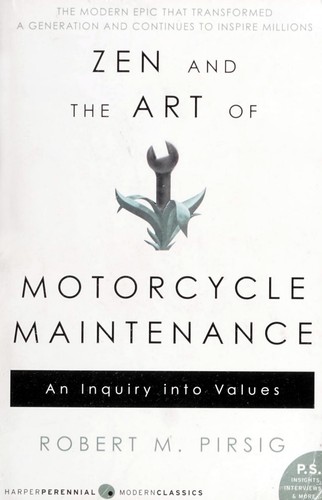
Zen and the Art of Motorcycle Maintenance
An Inquiry into Values
Good work, in mechanics or anywhere else, comes from caring about the quality of what is in front of you, and a form of reason that leaves out that sense of quality produces both ugly technology and the people who flee from it.
A book summary and review by Bruce Eckfeldt
Overview
Zen and the Art of Motorcycle Maintenance is a first-person account of a summer motorcycle trip from Minnesota to the Pacific coast of California. The narrator rides with his eleven-year-old son, Chris, and for the first half of the trip with friends John and Sylvia Sutherland. Along the road he delivers a series of reflections he calls a Chautauqua, after the traveling lecture circuits of nineteenth-century America. A second story runs underneath. The narrator is slowly reconstructing the thinking of Phaedrus, his own former self, a teacher of rhetoric whose pursuit of a single question ended in a breakdown and court-ordered electroshock treatment that destroyed his personality. In the Author’s Note Pirsig says the account is based on actual events and is not a guide to orthodox Zen practice or to motorcycles.
The argument starts with a practical split. Some people see the world in classical terms, as underlying form, parts and function. Others see it in romantic terms, as immediate appearance and feeling. The Sutherlands’ refusal to touch their own machine is the romantic side. The shop mechanics who wreck the narrator’s engine are the classical side gone empty. Pirsig traces both failures to the same cause, a version of reason that separates the knower from the thing known and has no place for value. Phaedrus’ answer was Quality, the direct sense of what is good that comes before the split into subject and object. The book applies that answer to stuck problems, to the gumption traps that drain a person’s enthusiasm, and to the history of Greek thought.
Good work, in mechanics or anywhere else, comes from caring about the quality of what is in front of you, and a form of reason that leaves out that sense of quality produces both ugly technology and the people who flee from it.
Chapter Summaries
Chapter 1: Two Attitudes Toward Technology
The opening chapter sets out the problem the whole book works on. The narrator and Chris ride northwest from Minneapolis with John and Sylvia Sutherland, and the narrator notices that his friends will not maintain their own new BMW and grow irritated when the subject comes up. He links this to Sylvia’s distress over a dripping faucet that John will not fix. Their stance is not ignorance. It is a deliberate flight from technology, which they experience as dehumanizing. The narrator announces that the Chautauqua will argue the flight defeats itself.
- Pirsig treats avoidance of technical work as a value choice rather than a skill gap. The Sutherlands could learn maintenance. They refuse because engagement with the machine feels like surrender to the system they dislike.
- The cost of the flight is dependence. People who will not understand a system they rely on are left trusting others to understand it for them, and are frustrated when it fails.
- The chapter’s central line is that the Buddha resides as comfortably in the gears of a cycle transmission as on a mountaintop. The book’s claim is that meaning is available inside technical work, not only in escape from it.
Chapter 2: The Spectator Mechanics
The second chapter shows the opposite failure. The narrator recalls taking his machine to a shop where young mechanics, radio blaring, botched a simple repair, damaged the engine, and never found the real problem. He later traced repeated seizures to a sheared pin in the oil system that had been there all along. He reads their carelessness as the same detachment he finds in the repair manuals, a spectator attitude toward the work.
- Competence without care produces bad work. The mechanics had the tools and the training. What they lacked was involvement with the machine in front of them.
- Pirsig argues the manuals encode the same detachment. They describe the machine as a set of procedures performed by a generic person, which removes the worker from the picture entirely.
- The sheared pin was found by slow, careful attention, not by more expertise. The narrator warns that hurrying is itself a sign of not caring about the thing being hurried.
Chapter 3: Ghosts And Natural Law
A thunderstorm drives the group into a motel, and Chris asks whether his father believes in ghosts. The narrator argues that scientific laws are also a kind of ghost. The law of gravity, he says, exists nowhere except in human minds, yet everyone believes in it completely. The chapter ends with the narrator confessing that his ideas are not his own. They belong to someone he calls a ghost who has been following the trip.
- The argument separates the world from the concepts people use to describe it. Gravity existed before Newton, but the law of gravity is a human construction, and it is treated with the same unexamined faith as any belief in spirits.
- This prepares the book’s later claim that rationality is itself a set of inherited assumptions. Questioning the assumptions is not the same as rejecting reason.
- The confession at the end introduces the second story. The narrator is carrying ideas from a former self he has not yet named.
Chapter 4: The Packing List
The narrator reviews the checklist he keeps for long motorcycle trips, divided into clothing, personal items, camping gear, and motorcycle tools and parts. The list is practical, and the commentary on each item shows how much of a long ride depends on preparation done in advance. He closes by describing the personality a machine develops over time, which he calls the real object of motorcycle maintenance.
- Preparation is presented as care made concrete. The list exists because the narrator kept forgetting things, and he built a system so the lesson would not have to be relearned on every trip.
- A machine’s personality, in Pirsig’s description, is the intuitive sum of everything the owner knows and feels about it. That accumulated knowledge is what lets an attentive owner notice a fault before it becomes a failure.
- How a machine is treated decides whether it becomes a reliable friend or a cripple. The narrator’s own bike recovered from the shop’s damage because of steady attention.
Chapter 5: The Beer Can Shim
Riding across the Dakotas, the narrator recalls offering John a shim cut from an aluminum beer can to fix his slipping handlebars. John declined, and the narrator realized the shim was perfect in function and unacceptable in image. The chapter ends with the narrator glimpsing a figure at the edge of his vision and naming him for the first time. It is Phaedrus.
- The shim episode shows two people seeing the same object differently. For the narrator it was the right material for the job. For John it was a piece of junk, and no argument about function could change that.
- Pirsig uses the moment to show that the disagreement is not about facts. It is about which mode of understanding a person uses, and neither side can see the other’s point from inside its own mode.
- The naming of Phaedrus marks the shift from a lecture about ideas to a story about the man who first had them.
Chapter 6: Classical And Romantic Understanding
This chapter introduces the book’s main distinction. Classical understanding sees the world as underlying form, parts and the relationships among them. Romantic understanding sees it as immediate appearance, inspiration and feeling. Each mode finds the other shallow or cold. Pirsig argues the split now divides the culture into a classical establishment and a romantic counterculture, with no one able to reconcile them. He describes Phaedrus as a man who cut ideas apart with an analytic knife and became its victim.
- The two modes are not personality types. They are ways of understanding that the same person can use, and most people default to one and dismiss the other.
- The analytic knife is Pirsig’s name for the act of dividing the world into parts. Every division is a choice, and the choice shapes what the person can then see.
- The book frames its project as finding a point where the two modes meet. The rest of the Chautauqua is the search for that point.
Chapter 7: Who Phaedrus Was
In the heat of eastern Montana the narrator gives the first direct account of Phaedrus. He was a master of logic with a measured IQ of 170, isolated and unconcerned with how others saw him. The narrator explains that Phaedrus was declared insane and that his personality was destroyed by a court-ordered treatment. What survives is fragments of memory, and the narrator is the one assembling them.
- The book is candid that its ideas come from someone judged mad. Pirsig does not hide this. He asks the reader to judge the ideas on their merits while knowing their history.
- Phaedrus’ gift was analytic speed, and the narrator presents that gift as part of what destroyed him. Pure analysis, followed far enough, cut away everything that held his life together.
- The trip west is also a return to the places where Phaedrus lived, and the memories come back as the landscape does.
Chapter 8: The System As Structure
On a curb in Miles City the narrator adjusts his tappets and uses the motorcycle to show classical analysis at work. A machine can be described as a hierarchy of components and functions, each divided into smaller parts. He argues that what people call the system, in factories and governments, is the same structure of concepts. Attacking the factory or the government attacks effects. The real system is the pattern of rational thought that produced them.
- The hierarchy of the motorcycle is a mental structure, not a physical one. The parts are real, but the way they are grouped exists in the mind of the person doing the grouping.
- Organizations persist on structure even after they lose purpose. Pirsig notes that people perform meaningless work because the structure demands it, with no villain involved.
- Changing a system means changing the thinking that built it. Tearing down an institution leaves the pattern that will rebuild it.
Chapter 9: Logic And Scientific Method
Riding up the Yellowstone Valley, the narrator explains the two kinds of logic the mechanic uses. Induction reasons from observations to general principles. Deduction reasons from principles to predictions. Formal scientific method combines them in six steps, from the statement of the problem through hypotheses, predictions, experiments, results and conclusions. He uses a motorcycle that will not start to show why each step matters.
- The purpose of method, in Pirsig’s account, is to keep nature from fooling the investigator into thinking something is known when it is not.
- Writing the problem down precisely is part of the method, not paperwork. The discipline of stating what is known and what is not is what keeps reasoning honest.
- A test must be run at the right point to mean anything. To know whether the electrical system has failed, the mechanic tests for spark at the plug, the output of that system, rather than somewhere upstream.
Chapter 10: The Problem Of Hypotheses
This chapter tells how Phaedrus broke from science. Working in a laboratory as a young man, he noticed that forming hypotheses, the step scientific method cannot explain, was the easiest part of the work. Every test produced more hypotheses than it eliminated. He concluded that the number of rational hypotheses that can explain any phenomenon is infinite. Pirsig cites a 1918 speech by Albert Einstein on the unexplained source of scientific insight.
- If hypotheses multiply faster than experiments can test them, science cannot promise to move toward a single truth. Phaedrus saw this as a crack in the method itself.
- Pirsig argues this explains the instability of modern knowledge. Science, meant to replace uncertainty with fact, keeps producing new uncertainty.
- The personal cost was immediate. Phaedrus, who had finished a year of university science at fifteen, was expelled at seventeen for failing grades.
Chapter 11: Hume, Kant And Korea
After his expulsion Phaedrus drifted into the Army and served in Korea, then returned to study philosophy. The narrator explains the problem Phaedrus took up through David Hume and Immanuel Kant. Hume showed that if all knowledge comes from the senses, neither substance nor causation can be known. Kant answered that the mind supplies a priori structures, such as space and time, that shape experience. Phaedrus studied Kant closely but found the whole tradition ugly in a way he could not name.
- Pirsig presents philosophy as the level above science where its foundations can be examined. Science cannot study its own method without a bootstrap problem.
- Kant’s answer to Hume preserved knowledge by locating part of it in the mind. Phaedrus took from this that what people experience is always partly constructed.
- The ugliness Phaedrus sensed was not in any one argument. It was in reason as taught, and that unnamed reaction became the starting point of his later work.
Chapter 12: India And The DeWeeses
In Cooke City the narrator remembers DeWeese, an artist who taught with Phaedrus in Bozeman and whom the group will visit. He also recounts Phaedrus’ time studying at Benares Hindu University in India. Phaedrus arrived an empirical scientist and left one, collecting contradictions rather than answers. The chapter ends with a quiet evening in which the group feels the weight of years and place.
- The India episode is presented as exposure, not conversion. Phaedrus found no secret teaching, only ideas that stayed with him and returned years later.
- Pirsig describes DeWeese as someone who took Phaedrus seriously, which matters because almost no one else did.
- The narrator declines to develop his companions as characters. He calls them friends rather than devices, which keeps the book an inquiry rather than a novel.
Chapter 13: The Church Of Reason
Approaching Bozeman, the narrator explains what Phaedrus meant by the Church of Reason. He gave the lecture during a political fight at Montana State College, where the governor was trying to fire the college president and the legislature was pressing the school to pass every student. A university, he argued, is not its buildings or its budget. It is a commitment to the pursuit of truth through reason, and that commitment can conflict with the people who fund the buildings.
- Pirsig distinguishes the institution from the place that houses it. The real institution is a body of practice, and it can be betrayed by people who control the place.
- The lecture made Phaedrus a public figure at a school he describes as a teaching college with no time for research or reflection.
- The chapter shows the cost of holding an institution to its stated purpose. Phaedrus’ stand isolated him further.
Chapter 14: Art And Technology Rejoined
At the DeWeeses’ house the narrator is asked to make sense of assembly instructions for a barbecue rotisserie. He recalls instructions for a Japanese bicycle that began by saying assembly requires great peace of mind. He argues that skilled assembly is a form of art. The worker’s thoughts and the material change together until both are right. The separation of art from technology, he says, is unnatural.
- Instructions fail because they describe the steps and leave out the person doing them. The state of mind of the worker shapes the result as much as the procedure.
- Pirsig’s description of the skilled worker is a feedback loop. The material shapes the next move, and the next move changes the material.
- The claim that art and technology are one prepares the later argument. Both come from the same source, which the book will call Quality.
Chapter 15: The Question Of Quality
The Sutherlands head home, and the narrator visits the building where Phaedrus taught. He recalls the moment the inquiry began. A colleague named Sarah, passing his desk, said she hoped he was teaching Quality to his students. The remark acted like a seed crystal. Phaedrus realized that everyone recognizes quality, that grades and prices depend on it, and that no one can define it.
- The chapter isolates the paradox at the center of the book. People act on quality constantly but cannot say what it is.
- If quality cannot be defined, it seems not to exist. But if it does not exist, there is no basis for preferring one thing to another, which is plainly false.
- Phaedrus’ teaching had been about rules of good writing. The question pushed him to ask what the rules were trying to capture.
Chapter 16: Seeing Without Grades
Chris and the narrator begin a hike into the mountains above Bozeman, and the narrator recalls Phaedrus’ teaching experiments. A student who could not write about her town was told to narrow her subject to one brick on the front of the Bozeman opera house. She produced five thousand words. Phaedrus had students write about the back of a thumb, or a coin. He then withheld grades altogether to see what students would do without them.
- The brick assignment worked because it forced direct observation. The student could not repeat what she had heard and had to look for herself.
- Grades, in Pirsig’s argument, train students to imitate the instructor rather than to see. Removing them exposed how much motivation depended on the grade.
- Phaedrus imagined a student motivated by knowledge rather than credentials and described that motivation as a ferocious force, once it catches hold.
Chapter 17: Ego Climbing
On the trail the narrator contrasts two ways of climbing. The ego climber is always looking ahead to the summit and is unhappy where he is. The selfless climber attends to each step and enjoys the climb itself. He sees the first pattern in Chris. In the classroom story, Phaedrus asks students to rank essays by quality without defining it, and the class average almost always matches his own ranking.
- Pirsig argues that a goal held only as an external destination makes every step an effort, because the present always falls short of where the climber wants to be.
- The classroom ranking showed that students could recognize quality reliably without a definition. Recognition came before any rule.
- Phaedrus reversed the rule that a subject must be defined before it is taught. The undefined goal of quality filled the gap left by grades and students engaged.
Chapter 18: A World Without Quality
To test whether Quality exists, Phaedrus imagined subtracting it from the world. Art would vanish, along with sports, humor and most of what people choose among. Supermarkets would carry only basic grains and ungraded staples. Since the world clearly does not work this way, Quality exists whether or not it can be defined. His colleagues then pressed him on whether Quality was in the object or in the observer.
- The subtraction test is a practical argument. A concept that cannot be defined can still be shown to exist by what disappears without it.
- Phaedrus compared a world without quality to Sparta, to Orwell’s 1984 and to Huxley’s Brave New World. Systems that reduce life to function leave out what people actually value.
- The question his colleagues raised, whether quality is objective or subjective, becomes the dilemma of the next chapter.
Chapter 19: Quality As An Event
Phaedrus faced a dilemma. If Quality lives in objects, science should be able to measure it. If it lives in the observer, it is just personal preference. He refused both. Quality, he concluded, is not a thing. It is an event, the moment at which a subject becomes aware of an object. Quality is neither mind nor matter but a third entity that comes before both.
- The dilemma assumes reality is divided into subjects and objects. Phaedrus’ move was to reject that division rather than choose a side.
- Treating Quality as an event explains why people disagree about it. They meet the same event with different backgrounds, so they divide it differently.
- Pirsig presents this as a reversal of the usual order. Quality is not something subjects and objects have. Subjects and objects are what people derive from it.
Chapter 20: Before Subject And Object
Near the summit the narrator turns back, deciding the mountaintop is not worth the risk. He continues Phaedrus’ argument. Quality is the cutting edge of experience, the moment before the intellect sorts it into things. Any definition of Quality is both true and false because definition is analysis, and Quality is what analysis starts from. Phaedrus then found close parallels in the Tao Te Ching, and his thinking accelerated beyond control.
- The argument is that awareness of value comes before awareness of objects. A person senses that something is good or bad before naming what it is.
- This is why Quality resists definition. It is not mysterious, Phaedrus wrote, but so simple and immediate that breaking it into parts misses it.
- The narrator’s choice to turn back is deliberate. He describes Phaedrus as someone who climbed to the top and came down with a stone tablet of rules.
Chapter 21: Quality And The Tao
On the descent the narrator distances himself from Phaedrus’ claim that Quality and the Tao are the same. He says he has no way to test it and that Phaedrus was no sage. He keeps the practical part. If Quality is the common basis of art, science and religion, those areas can be brought back into relation. Art, in this view, is simply high-quality endeavor.
- The narrator separates the useful idea from its most ambitious form. He will use Quality to understand work without claiming to have found the source of everything.
- The task, he says, is to return to everyday life with a wider understanding, not to stay on the mountain.
- Pirsig restates the earlier argument about art and technology in its plainest form. Art is high-quality work, wherever it occurs.
Chapter 22: Poincaré And Selected Facts
Leaving Bozeman, the narrator introduces Henri Poincaré, the French mathematician and physicist whom Bertrand Russell called the most eminent scientific man of his generation. Poincaré concluded that the axioms of geometry are conventions chosen for convenience. He argued that scientists choose which facts to attend to by a sense of harmony and beauty. Pirsig reads this as a scientist describing the role of Quality in discovery.
- Poincaré’s work gives Phaedrus’ idea an independent source. A leading scientist reached the same conclusion about the limits of method without having heard of Phaedrus.
- The selection of facts is the step method cannot perform. Pirsig argues that a preintellectual sense of what fits does the selecting.
- The chapter closes with growing friction between the narrator and Chris, which the book treats as part of the same problem.
Chapter 23: The Glass Door
This brief chapter is a recurring dream. The narrator stands behind a glass door and sees Chris, Chris’s younger brother and their mother on the other side. He realizes the door is the lid of his own sarcophagus. A dark figure forbids him to speak. He shouts to Chris that he will see him at the bottom of the ocean, and wakes alone in a ruined city.
- The dream makes the family story explicit. Chris is trying to reach a father who is not fully present, and the narrator cannot open the door.
- The figure in the shadows foreshadows the book’s climax. The narrator does not yet know who it is.
- The ocean, the trip’s destination, becomes the place where the two selves will have to meet.
Chapter 24: Stuckness
Riding into Idaho, the narrator applies Quality to a mechanical problem. A screw with a stripped slot will not come out of a side cover. Scientific method cannot help, because it tests hypotheses but does not supply them. This is stuckness. Rather than fight it, the narrator argues for staying with it. Stuckness is the state in which a person is most open to seeing the screw freshly.
- The traditional approach treats the screw as a fixed object with a fixed function. Stuckness forces a person to drop that view and look at what is actually there.
- Pirsig describes the fear and anger that follow, and the urge to hammer on the problem or hand it to an expert. Those reactions close off the openness that produces the answer.
- The practical claim is that structured reason is necessary but not enough. To build a factory or fix a machine without getting stuck, a person also needs a sense of what is good, and that sense can be developed.
Chapter 25: Peace Of Mind
In the heat of the Salmon River canyon the narrator turns to the romantic side, the ugliness of technology the Sutherlands were fleeing. He argues the ugliness is not in technology itself. It comes from the separation of the maker from the thing made. The good mechanic is involved with the work and has a peace of mind that comes from harmony with it. The place to improve the world, he says, is first in one’s own heart and head and hands.
- Ugly technology is the product of people who do not care about what they are making. Pirsig locates the problem in the relationship between worker and work, not in machines.
- Care, in this account, is the absence of separation between the person and the job. The everyday language of being involved or being a natural describes the same state.
- Peace of mind is presented as a precondition for good work rather than a reward for it. The worker’s inner state shows up in the result.
Chapter 26: Gumption Traps
This long chapter is the book’s practical manual. Gumption is the psychic energy that fills a person who is on the Quality track. Gumption traps drain it. Pirsig divides them into setbacks, caused by outside conditions, and hang-ups, caused by the person. Setbacks include out-of-sequence reassembly, intermittent failures and the parts problem. Hang-ups include value traps, truth traps and muscle traps. He ends by saying the real cycle being worked on is a cycle called yourself.
- The value traps are value rigidity, ego, anxiety, boredom and impatience. Value rigidity, the inability to revalue what one sees, is the most widespread. Pirsig illustrates it with the South Indian monkey trap, in which the monkey stays caught because it will not let go of the rice.
- The truth trap is yes-no logic. Some questions have the answer mu, the Japanese term for no thing, which says the question was framed wrong. Pirsig notes that laboratory results often give exactly this kind of answer.
- Muscle traps are physical. Bad tools, poor surroundings and discomfort drain gumption as surely as frustration does, and fixing them is part of the work.
Chapter 27: The Face In The Shadows
The glass door dream returns. This time the narrator confronts the figure in the shadows, seizes it and drags it into the light. He wakes to Chris shaking him and crying. In the dream he saw that the face was his own. He realizes the dreamer is Phaedrus, who is waking up, and that he, the narrator, is the figure keeping the door shut.
- The reversal is the turning point of the personal story. The narrator has treated Phaedrus as the threat. The dream shows that the narrator has been the one blocking Chris.
- Pirsig describes a mind divided against itself. The two selves cannot both remain as they are.
- Chris hears his father for the first time in the dream, which signals that the door can be opened.
Chapter 28: Chicago And The Committee
The narrator reconstructs Phaedrus’ last academic chapter. Phaedrus enrolled in the University of Chicago’s Committee on the Analysis of Ideas and Study of Methods, an interdisciplinary doctoral program led by a Chairman trained in classical Greek thought. He also taught rhetoric at the University of Illinois at Navy Pier. Reading Aristotle, he grew convinced that Aristotle had subordinated rhetoric to dialectic and stripped Quality out of Western thought.
- Pirsig sets out the mythos over logos argument. Rational thought grew out of an older body of myth and still carries its assumptions.
- Phaedrus saw Aristotle’s classification of rhetoric as the moment the Western tradition separated method from value.
- His conflict with the Chairman was personal as well as intellectual. The narrator describes Phaedrus as fanatic and alone, sure he was right and unwilling to soften his position.
Chapter 29: The Sophists And Arete
Reaching the Pacific at Crescent City, the narrator follows Phaedrus into early Greek philosophy. Reading the classicist H. D. F. Kitto’s The Greeks, Phaedrus found that the Greek word arete, usually translated as virtue, meant excellence. The Sophists taught arete. Phaedrus concluded that Plato had condemned the Sophists to establish dialectic as the only route to truth, and that the Quality the Sophists taught had been buried for two thousand years.
- Arete, in Kitto’s reading as Pirsig presents it, is excellence in every part of life. It is not a moral rule but a standard of doing things well.
- The argument recasts the Sophists as teachers of quality rather than salesmen of clever argument, and recasts Plato as the one who changed the terms.
- Pirsig ties the history back to the motorcycle. A person who fixes things with quality, he notes, is unlikely to run short of friends.
Chapter 30: The Breakdown
The narrator recounts the confrontation that ended Phaedrus’ academic life. In the Chairman’s class on Plato’s Phaedrus dialogue, Phaedrus challenged the reading, and the Chairman’s composure gave way. Phaedrus then stopped sleeping, walked the Chicago streets and finally sat staring at a bedroom wall for three days. The chapter ends with the narrator realizing that Chris misses Phaedrus, the father who was there before.
- Phaedrus won the argument in the classroom and lost everything else. Pirsig presents the victory and the collapse as the same event.
- The city in his last days becomes, in the narrator’s description, a citadel of form and substance, the opposite of what Phaedrus believed in.
- The realization about Chris reframes the trip. The son is not afraid of Phaedrus. He is grieving him.
Chapter 31: Telling Chris
On the fog-bound California coast the narrator decides to send Chris home by bus, afraid of what he might do if he stays responsible for him. He tells Chris that he was insane for a long time and is close to it again. Chris breaks down. When it is over Chris asks whether his father was really insane. The narrator, astonished, hears himself say no. Chris says he knew it.
- The narrator sees that Chris has inherited Phaedrus’ drive, asking question after question and never satisfied. The father’s unresolved split has been passed to the son.
- Honesty is what breaks the deadlock. Saying what had been hidden lets both of them stop pretending.
- Chris’s answer, I knew it, is the book’s emotional resolution. He had held on to the father who was lost.
Chapter 32: Over The Shoulder
The last chapter is a short ride south toward San Francisco. The narrator and Chris take off their helmets in the warm air. Chris stands on the footpegs and says that for the first time he can see over his father’s shoulder. He asks whether he can have a motorcycle when he is older and whether his father will teach him to care for it. The narrator closes on the sense that they have won.
- The split self is resolved, not by choosing one side but by integrating the two. The narrator no longer needs to keep Phaedrus out.
- Chris’s new view over the shoulder mirrors the book’s argument. The relationship changes when the father is fully present.
- Pirsig ends on maintenance. Chris asks whether it is hard, and the answer is that it is not if a person has the right attitudes. Having the right attitudes is the hard part.
About the Author
Robert Maynard Pirsig was born in Minneapolis in 1928. According to the Los Angeles Times obituary, he entered the University of Minnesota at fifteen, left at seventeen, served in the Army in Korea, completed his bachelor’s degree in 1950, and studied Eastern religions in India. He taught English composition at Montana State College from 1960 and then taught at the University of Illinois in Chicago, where he was hospitalized in 1962 after a mental collapse. He supported his family as a technical writer while writing the book. One hundred and twenty-one publishers rejected it before William Morrow accepted it, and it has since sold more than five million copies. His second book, Lila: An Inquiry into Morals, appeared in 1991. His son Chris was killed in a 1979 robbery in San Francisco, which Pirsig describes in the Afterword. Pirsig died in 2017.
His credibility for this book comes from lived experience on both sides of its central split. He was a trained technical writer who maintained his own machine, and a teacher who ran the classroom experiments the book describes. His credibility as a historian of philosophy is weaker. He was self-taught in much of the material, and his readings of Aristotle, Plato and the Sophists are argumentative rather than scholarly. Pirsig himself says in the Author’s Note that the book is not a reliable guide to Zen practice or to motorcycles.
Key Takeaways
1) Avoiding technical work is a values choice, and it creates dependence.
Pirsig’s starting observation is that intelligent people often refuse to understand the systems they rely on. John Sutherland could learn to maintain his motorcycle. He refuses because engaging with it feels like giving in to a world he dislikes. The book argues that this refusal leaves the person dependent on others who may not care, and frustrated when things break.
- The Sutherlands’ flight from technology is described as deliberate, not ignorant.
- The spectator mechanics in Chapter 2 show the other side, technical skill without involvement.
- Both failures come from the same separation of the person from the work.
2) Classical and romantic understanding each see only half the picture.
Classical understanding sees structure, parts and function. Romantic understanding sees surface, feeling and immediate meaning. Each mode finds the other shallow or cold. Pirsig argues that most conflict between technical and nontechnical people comes from this split, and that neither side can win the argument from inside its own mode.
- The beer can shim was perfect in function and unacceptable in image.
- The same person can use both modes but usually defaults to one.
- Every analytic division is a choice that shapes what can be seen next.
3) Quality is recognized before it can be defined.
Phaedrus’ classroom experiments showed that students who could not define quality could still rank essays by it and agree with one another. The book’s argument is that the sense of what is good comes before analysis. Definitions follow recognition, not the other way around. A concept that resists definition can still be shown to exist by what disappears when it is removed.
- Removing grades exposed how much motivation depended on external judgment.
- The subtraction test showed that a world without quality would lose art, humor and real choice.
- Phaedrus concluded that Quality is an event, the moment a subject becomes aware of an object.
4) Scientific method tests ideas but cannot supply them.
Phaedrus noticed that every experiment produced more hypotheses than it eliminated. The method that is supposed to narrow uncertainty cannot say where good ideas come from or which facts deserve attention. Henri Poincaré, as Pirsig presents him, reached the same conclusion and argued that scientists choose facts by a sense of harmony. That sense is what the book calls Quality.
- The number of rational hypotheses that can explain a phenomenon is infinite, in Phaedrus’ formulation.
- Method keeps an investigator honest about what is known. It does not generate insight.
- Selecting the right facts is a preintellectual judgment.
5) Stuckness is the start of understanding, not a failure.
When a screw will not come out and no method helps, the normal response is fear and anger. Pirsig argues that being stuck is the moment when fixed ideas about the problem loosen and a person can see what is actually there. The urge to hammer on the problem or hand it to an expert closes off the openness that produces the answer.
- Structured reason is necessary but not enough to get unstuck.
- A sense of what is good carries a person forward, and that sense can be developed.
- Staying with the problem is a discipline, not a delay.
6) Gumption is the fuel of good work, and most of it is lost to traps.
Gumption is the energy a person has when engaged with the work. Pirsig catalogs the ways it drains away. Some are external setbacks, like reassembling parts out of order. Most are internal, like ego, anxiety, boredom and impatience. The most widespread is value rigidity, the inability to revalue a situation as new facts appear.
- The South Indian monkey trap illustrates value rigidity. The monkey stays caught because it will not let go of the rice.
- Yes-no logic is a trap when the honest answer is mu, which says the question was framed wrong.
- Bad tools and poor surroundings drain gumption as surely as frustration does.
7) Care is the absence of separation between the worker and the work.
The book’s resolution is practical. Ugly technology and careless work come from people who are detached from what they make. The good mechanic is involved, and that involvement produces a peace of mind that shows up in the result. Pirsig says the place to improve the world is first in one’s own heart and head and hands, and then outward.
- Peace of mind is a precondition for good work, not a reward for it.
- The real cycle being worked on, Pirsig writes, is a cycle called yourself.
- The family story ends the same way. The relationship changes when the father is fully present.
Strengths and Limits
The book’s strength is that it makes an abstract philosophical argument concrete through ordinary work. The beer can shim, the stripped screw, the rotisserie instructions and the brick on the opera house each carry an idea that would be hard to grasp in the abstract. The classical and romantic distinction gives readers a usable way to understand why technical and nontechnical people talk past each other. The chapters on stuckness and gumption traps are among the most precise descriptions in popular literature of what happens inside a person working on a hard problem, and they apply well beyond mechanics. The personal story gives the argument stakes. The ideas cost Phaedrus his sanity, and the book shows what it takes to hold them without being destroyed by them.
The book’s limits begin with its own disclaimers. Pirsig says in the Author’s Note that it is not a reliable guide to Zen or to motorcycles. Its history of philosophy is selective and argumentative. The readings of Aristotle, Plato and the Sophists support Phaedrus’ thesis and do not engage the scholarship that would complicate it. The claim that Quality precedes subject and object is presented as a conclusion but is never tested against competing accounts, and the narrator himself declines to defend Phaedrus’ link between Quality and the Tao. The book is also long and uneven. The philosophical chapters in Part IV are dense, and readers looking for practical guidance will find most of it concentrated in Chapters 24 through 26. The predictable failure mode is reading Quality as a mystical absolute rather than as a working description of attention and care.
My Take
This is not a business book, and I include it because the diagnosis lands squarely on growth companies. The founder who will not look at the finance model and the operator who runs a process without caring whether it produces anything good are the Sutherlands and the spectator mechanics. Most leadership teams I work with have both, and they talk past each other in exactly the way Pirsig describes. The chapters on stuckness and gumption traps are the best practical writing I know on why capable people stall on hard problems. Value rigidity alone explains a large share of the strategy conversations that go nowhere.
The book reads differently by context. In a software or product company, the classical and romantic split often runs between engineering and sales or design, and Pirsig’s framing gives both sides a vocabulary that is not an insult. In an industrial or field-service business, the book is closer to the work itself, and the argument about care and craftsmanship is a direct challenge to procedure-driven quality programs that check the steps without asking whether anyone cares about the result. In a founder-led company the personal story matters too. The founder whose identity is split between the builder and the operator will recognize something in the narrator and Phaedrus.
The most credible outside objection came early. George Steiner, reviewing the book for The New Yorker in 1974, praised it but flagged pedestrian stretches and potted summaries of Kant that betray the aggressive certitudes of the self-taught man. R. C. Zaehner made a related point in the Times Literary Supplement, arguing that Pirsig’s escape from Aristotle ends in a very Aristotelian love of parts and functions. I think both are right about the philosophy and neither touches the practical core. You do not need to accept the history of the Sophists to use the gumption traps.
The book that completes this one is Matthew Crawford’s Shop Class as Soulcraft. Pirsig describes care from the inside of one man’s mind. Crawford, a philosopher who ran a motorcycle repair shop, explains why modern work separates thinking from doing and what that costs organizations. Read together, they make the case that quality is a management problem and not only a personal virtue.
Discussion Questions
For CEOs
- Where in the business have I chosen not to understand a system I depend on, and what has that dependence cost when something broke?
- Am I more naturally a classical or a romantic thinker, and which members of my leadership team see the other half that I miss?
- Which part of our operation runs on procedure without anyone caring whether the result is good, the way Pirsig’s spectator mechanics worked?
- What problem have I been stuck on for more than a quarter, and have I been hammering on it or actually looking at it freshly?
- Which of my own values about the business have hardened into value rigidity, the way the monkey holds the rice?
- Which of the gumption traps, ego, anxiety, boredom or impatience, shows up most in how I lead, and when does it show up?
- Where am I climbing toward a goal so hard that I am unhappy with every step along the way?
- If I removed our main performance measure for a quarter, as Phaedrus removed grades, what would my team do?
For Teams
- Where do the classical and romantic thinkers on this team talk past each other, and what would each side need to hear to understand the other?
- Which of our standard operating procedures reads like Pirsig’s repair manuals, steps with no person in them?
- What recurring problem do we keep handing to an expert or a vendor instead of understanding it ourselves?
- Which of our yes-or-no debates is actually a mu question, one that was framed wrong?
- What are our muscle traps, the bad tools and poor surroundings that drain energy every week?
- Where do we reassemble work out of sequence and then have to take it apart again?
- Can we rank recent work by quality and agree, even without a written definition of good? What does that tell us?
- Where in our work do we see the peace of mind Pirsig describes, and what conditions produced it?
Practical Tools
1. Gumption Trap Audit
Pirsig’s catalog in Chapter 26 names the ways people lose the energy to do good work. Setbacks come from outside, and hang-ups come from inside, through value rigidity, ego, anxiety, boredom, impatience, yes-no logic and poor tools or surroundings. Naming the trap is most of the cure, because each one feels like a fact about the problem until it is identified as a fact about the person. Use this exercise when a project or an initiative has stalled and the team cannot say why.
How it works:
- List the stalled initiatives from the last two quarters.
- For each, ask what drained the energy, and sort the answers into setbacks and hang-ups.
- For each hang-up, name the specific trap from Pirsig’s list. Be precise. Boredom and impatience look alike but have different causes.
- For value rigidity, ask what the team has refused to revalue as new facts came in.
- Pick one trap per initiative to address first, and name what would change if it were removed.
The signal is a shift in language. Instead of saying the project is hard, the team says which trap is in the way. Stalled work gets restarted with a specific correction rather than more pressure, and the same traps become easier to spot early the next time.
2. Classical Romantic Translation
Chapter 6 argues that people who see the world in classical terms, as structure and function, and people who see it in romantic terms, as appearance and meaning, find each other’s view shallow or cold. In a leadership team this often shows up as operations against sales, or finance against product. Use this exercise when a debate keeps repeating without resolution and the two sides seem to be describing different problems.
How it works:
- Name the recurring disagreement in one sentence.
- Ask each side to describe the issue only in the other mode. The classical thinker describes how it looks and feels. The romantic thinker describes its parts and how they connect.
- Note what each side sees in the translation that it missed before.
- Restate the problem in a form that both modes can accept.
The signal is that the argument changes shape. Sides stop defending positions and start describing the same problem. Decisions that had been stuck for months move because the team is finally discussing one issue instead of two.
3. Stuckness Protocol
Chapter 24 treats being stuck as the moment when fixed ideas about a problem loosen. The normal reactions, forcing a solution or handing the problem to an expert, close off the fresh look that produces an answer. Use this protocol when a strategic or operational problem has resisted the usual approaches for longer than it should.
How it works:
- State the problem precisely in writing, as Chapter 9 recommends, including what is known and what is not.
- List the assumptions about how the problem must be solved, the equivalent of treating the screw only as a screw.
- Set aside one assumption at a time and ask what the situation looks like without it.
- Hold off on a decision until at least one new option appears that was not on the original list.
The signal is that the team stops repeating the same three options. A new framing of the problem appears, often simpler than the earlier ones, and the decision that follows has more conviction because the team understands why the earlier attempts failed.
4. Quality Ranking Exercise
Phaedrus’ classroom experiment in Chapter 17 showed that people who cannot define quality can still recognize it and agree with one another. That agreement is a better starting point for standards than a written definition imposed from above. Use this exercise when a team needs shared standards for work that is hard to measure, such as proposals, customer communication, hiring or design.
How it works:
- Collect five to eight recent examples of the same kind of work.
- Have each leader rank them by quality independently, without discussing criteria.
- Compare the rankings and note where they agree and where they differ.
- Discuss what the top-ranked examples share, and write down only what the group actually saw.
The signal is that the team discovers it already agrees more than it expected. Standards emerge from the work itself, which makes them easier to apply. Disagreements become specific and useful rather than general and frustrating.
Further Reading
- George Steiner’s 1974 New Yorker review, Uneasy Rider.
- R. C. Zaehner’s 1974 Times Literary Supplement review, On the Road with Aristotle.
- The Los Angeles Times obituary of Robert Pirsig.
- Plato’s Phaedrus, the dialogue at the center of Chapter 30, in Benjamin Jowett’s translation.
- Henri Poincaré’s Science and Hypothesis, the source Pirsig draws on for Poincaré.
Share This Review

Bruce Eckfeldt is a business coach and strategic advisor to founder-CEOs of growth-stage companies, a former Inc. 500 CEO, and the author of Springboard. More book reviews →
These summaries present Bruce Eckfeldt’s analysis of business and leadership books for founder-CEOs and leadership-team members of growth companies. Each one identifies the ideas most relevant to decision quality, strategy, and leadership capacity, notes where the evidence is weak, and suggests practical ways to test what is worth testing. All ideas, stories, and quotations belong to the original author and to the people they cite. The assessments and recommendations are Bruce’s. It is a companion to the book, not a substitute for reading it.
To learn more about Bruce’s programs, request other book summaries, or get in touch, contact booksummaries@eckfeldt.com.
Get the Next Review.
A new book review lands in Better, Faster, my weekly newsletter for founder-CEOs, along with one practical essay and questions for your team.