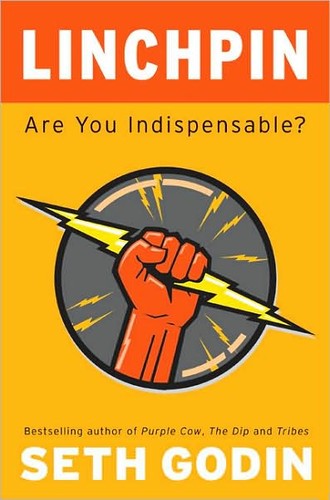
Linchpin
Are You Indispensable?
In an economy that commoditizes predictable work, the people who become indispensable are those who choose to bring judgment, generosity, and art to their jobs and who overcome their own resistance to ship it.
A book summary and review by Bruce Eckfeldt
Overview
Linchpin argues that the industrial bargain is over. For a century, Seth Godin writes, organizations offered security, pay, and benefits in exchange for following instructions, showing up on time, and working hard. Competition and technology broke that bargain. Any work that can be broken into small, predictable steps can be done cheaply by someone else or by a machine. The people who remain valuable are linchpins, those who bring judgment, generosity, and art to their work and would be hard, risky, and costly to replace.
Godin uses the word art broadly. Art is any original act of courage that changes another person, delivered as a gift, and it can happen in a cubicle as easily as a studio. Two forces keep people from making it. The first is a school and work system built to produce compliant factory workers. The second is the resistance, a fearful inner voice Godin calls the lizard brain, which pushes people to hide, delay, and avoid shipping. The book is addressed to individuals, but much of it concerns what organizations gain or lose by how they treat such people. Godin closes by arguing that the world does not have a talent shortage. It has a shipping shortage.
In an economy that commoditizes predictable work, the people who become indispensable are those who choose to bring judgment, generosity, and art to their jobs and who overcome their own resistance to ship it.
Chapter Summaries
Chapter 1: The New World of Work
The first chapter argues that the factory model of work is collapsing. Godin traces it from Adam Smith’s account of pin-making through interchangeable parts and Henry Ford’s assembly line. Factories prized compliant, replaceable workers, and many white-collar jobs still follow the same model. In a period of change, organizations instead need people who bring humanity, connection, and judgment.
- Godin introduces PERL, the Percentage of Easily Replaced Laborers. Factory-era businesses aimed for a high PERL to keep wages down.
- The Law of the Mechanical Turk holds that any project broken into small, predictable parts can be done for close to free. Godin’s examples include Wikipedia and online transcription services.
- Godin argues there are only two ways to compete: be cheaper and more standard, or be faster, more remarkable, and more human.
- He criticizes Michael Gerber’s The E-Myth Revisited for recommending businesses run by people with the lowest possible level of skill, arguing that such businesses can be copied and end up competing on price.
Chapter 2: Thinking About Your Choice
Godin argues that becoming indispensable is a choice, not an inborn trait. Linchpins decided that a new kind of work mattered and trained themselves for it. He contrasts the old American Dream, keep your head down, follow instructions, show up on time, work hard, with a new one: be remarkable, be generous, create art, make judgment calls, and connect people and ideas.
- The phrase not my job is presented as a factory reflex. Godin argues that in a factory, doing someone else’s job is dangerous, while for a linchpin, doing the job that is not getting done is essential.
- Rules substitute for judgment. Godin’s example is a fast-food refund policy that tells staff to refund when in doubt, because the organization has not hired people it trusts to decide.
- Godin argues that bosses claim to want cheap, obedient workers but actually want someone who changes things, which he calls the boss’s lie.
- He contrasts a zero-sum view of jobs with a view in which exceptional people expand markets and create new work.
Chapter 3: Indoctrination: How We Got Here
Godin argues that public schooling was designed to produce factory workers and consumers, and that it succeeds at teaching compliance and fitting in. He quotes Woodrow Wilson and Andrew Carnegie on education as preparation for manual work and as a response to labor unrest. The problem, he argues, is not that schools fail but that they teach the wrong things.
- Godin argues that schools should teach only two things: solve interesting problems and lead.
- Being good at school is distinguished from being good at work. School measures how well someone does school.
- He cites the conductor Roger Nierenberg, who showed that musicians asked to play at their individual edges sounded almost the same as when playing in strict unison, as an example of how narrowly people learn to perform.
Chapter 4: Becoming the Linchpin
This chapter defines the linchpin as a person whose absence would cause important work to falter. No one is literally irreplaceable, Godin concedes, but some people are hard, risky, and costly enough to replace that they might as well be. Linchpins create forward motion by seeing what is true, understanding possible outcomes, and making something happen.
- The law of linchpin leverage holds that the more value a person creates, the fewer minutes of labor it takes. Godin cites Richard Branson, whose distinctive contribution may take only minutes a day.
- In idea work, the gap between average and great is enormous. Godin argues a great designer such as Jonathan Ive can be worth many times a good one.
- Knowledge alone rarely makes someone indispensable. Knowledge combined with judgment, insight, and credibility does.
- Godin argues that projects are the new résumés, and cites the designer Jason Zimdars, hired by 37signals on the strength of his work rather than his credentials.
Chapter 5: Is It Possible to Do Hard Work in a Cubicle?
Godin argues that the hard work of the new economy is emotional labor, the effort of doing something important when it is not easy. He defines art as a personal gift that changes the recipient, and distinguishes the job, following instructions and meeting specifications, from the work, taking responsibility, challenging the status quo, and shipping.
- Emotional labor can be volunteered without extra pay. Godin argues that in many customer-facing jobs it is the real thing being paid for.
- He cites JetBlue, where Amy Curtis-McIntyre hired friendly people and encouraged them to perform rather than read scripts, as an example of emotional labor building a brand.
- Godin’s example of Ed Sutt, who spent years developing a nail to keep houses together in hurricanes after noticing that nails rather than wood had failed, shows art in an engineering setting.
- Art for everyone tends to be bland. Artists need to know whom they serve and whom to ignore.
Chapter 6: The Resistance
This chapter argues that the real barrier to indispensability is internal. Shipping, bringing work into contact with the world, is a rare skill. What prevents it is the resistance, a term Godin takes from Steven Pressfield, driven by the lizard brain, the fearful, status-seeking part of the mind that prefers hiding to risk. He quotes Steve Jobs: real artists ship.
- Thrashing, brainstorming and changing a project, is essential but must happen early. Godin argues that late thrashing creates delays and defects, so changes should shrink as the ship date approaches.
- Coordination costs rise quickly as more people join a project, so Godin recommends limiting who can thrash and putting one person, not a committee, in charge.
- The resistance shows up as perfectionism, excess data gathering, committees, endless email, and distraction. Godin argues that when resistance intensifies around a project, the project probably matters.
- He sets out a project method: post a real due date, gather all ideas early, have one person write the plan, get sign-off from everyone with authority, and then build without further thrashing.
Chapter 7: The Powerful Culture of Gifts
Godin argues that gifts are central to art and to the linchpin’s value. Drawing on the anthropology of Marcel Mauss and Lewis Hyde, he contrasts a gift, which binds giver and recipient, with a transaction, which leaves the parties separate. Digital work makes generosity inexpensive to scale, and gifts build the community that later creates commerce.
- Godin describes three circles: true gifts shared with friends and colleagues, commerce where people pay, and a wider tribe of followers who encounter and share the work. Expanding the first and third circles grows the second.
- A gift given in expectation of return becomes a covert transaction and loses its power.
- Once emotional labor is mapped, measured, and monetized by an organization, Godin argues, it stops being genuine.
- Receiving a gift well, with gratitude and respect, is presented as part of the culture of gifts.
Chapter 8: There Is No Map
Godin argues that linchpins navigate without instructions, and that art is the act of navigating without a map. This requires seeing a situation clearly, without the distortion of attachment to a preferred outcome. He uses the Buddhist idea of prajna, clear discernment, and argues that anger at events that cannot be changed is wasted effort.
- Godin sets out a model with two axes, passion and attachment. A Fundamentalist Zealot is passionate and attached, a Bureaucrat neither, a Whiner attached but not passionate, and a Linchpin passionate without attachment to a fixed worldview.
- Outsiders often see more clearly because they lack an industry’s assumptions. Godin cites the music and newspaper industries, which could not separate their product from the medium that carried it.
- He contrasts travelers who blame an airline for a cancelled flight with Richard Branson, who as a young man chartered a plane and sold seats to stranded passengers.
Chapter 9: Making the Choice
This chapter argues that the decision to stand out rather than fit in is available to anyone, without a new job or title. Godin writes that linchpins are made, not born, and that access to capital and connections matters less than it did. The missing element in most work, he argues, is the gift: the insight, initiative, and generosity beyond the assigned task.
- Godin argues that people can either fit in or stand out, but not both.
- He cites Binny Thomas, who stopped attending meetings for cover and sought projects where she could make a difference, and was promoted weeks later without asking permission.
- Formal authority is presented as a factory concept. Godin recounts asking a government enforcement officer who said he lacked authority to lead how much bigger his badge needed to be.
- He argues that a person can choose a job and bring passion to it, rather than waiting for a job that matches an existing passion.
Chapter 10: The Culture of Connection
Godin argues that linchpins cannot succeed alone. Their ideas must connect with people, and relationships are increasingly what organizations sell. He cites research by Sandy Pentland at MIT on honest signals, the cues people send beyond words, to argue that people detect insincerity, which is why scripts and manufactured interactions fail.
- The person who builds and maintains relationships is often more valuable than the one with superior technical knowledge. Godin contrasts a banker with an MBA and one who holds relationships with the firm’s key accounts.
- He cites Frank Eliason at Comcast, who began responding personally to angry customers on Twitter, as an example of connection that no manual required.
- Honest signals mean that genuine intent shows. Godin argues that this is why manufactured warmth does not work.
Chapter 11: The Seven Abilities of the Linchpin
This chapter sets out seven ways a person becomes indispensable: providing a unique interface between members of the organization, delivering unique creativity, managing great complexity, leading customers, inspiring staff, providing deep domain knowledge, and possessing a unique talent. Godin argues that each requires judgment that cannot be reduced to a manual.
- Godin cites a summer camp travel day, with hundreds of children traveling to many cities at once, where only about a dozen of ninety staff could be trusted to manage independently. The skill was judgment, not training.
- He cites Lester Wunderman, a pioneer of direct marketing, as someone whose value to Godin’s company lay in judgment and strategy rather than tactics.
- A unique talent must be hard to replace. Godin argues that pleasant and compliant is not a superpower.
- Humility is distinguished from compliance. Humility helps a person respond well to setbacks. Compliance avoids responsibility.
Chapter 12: When It Doesn't Work
The final chapter addresses failure. When art does not land, Godin’s answer is to make more art and learn from the result. He argues that most bosses who seem to forbid initiative do not actually do so, and that the minority who do are a reason to find another job. He also concedes that passion does not guarantee success, and that some work cannot be monetized.
- Godin distinguishes the right answer from the answer that can be sold. An idea may be rejected because the proposer lacks the track record to carry it, not because it is wrong.
- When support from above is missing, he argues, change can start downward through customers and colleagues, with results earning more freedom later.
- Weak craft is acknowledged as a possible reason for failure. Godin suggests that a person may be doing the wrong work rather than doing the right work badly.
- When art cannot pay, Godin recommends separating it from the work that pays the bills rather than damaging it.
About the Author
Seth Godin is a marketer, entrepreneur, and author. He founded the early internet marketing company Yoyodyne, which Yahoo acquired in 1998, and served as Yahoo’s vice president of direct marketing. His earlier books include Permission Marketing, Purple Cow, The Dip, and Tribes, and he has written a daily blog for many years. Linchpin followed Tribes and extends its argument from marketing to individual careers.
Godin’s credibility on this subject comes from his experience building and marketing businesses and from his long record of observing how ideas spread. It does not come from labor economics, organizational research, or managing large workforces. The book’s evidence is a large collection of individual stories, many drawn from readers and acquaintances, rather than systematic data.
Key Takeaways
1) Predictable work is being commoditized, and humanity is what remains valuable.
Godin’s central economic claim is that any work broken into small, predictable steps can be done for close to free, which he calls the Law of the Mechanical Turk. Organizations that compete on cost will keep finding cheaper ways to do such work. The work that remains valuable requires judgment, connection, and originality, which cannot be specified in advance.
- PERL, the Percentage of Easily Replaced Laborers, measures how much of an organization runs on replaceable work.
- There are two ways to compete: cheaper and more standard, or faster, more remarkable, and more human.
- Many white-collar jobs remain factory work in all but setting.
2) The job is not the work.
Godin distinguishes the job, following instructions and meeting specifications, from the work, which means taking responsibility, challenging assumptions, and changing people. A linchpin does the job and then adds the gift, the insight and effort no one required. This distinction runs through the book and is what allows a person to become indispensable without changing roles.
- Emotional labor is often what customer-facing roles are actually paid for.
- Doing the job that is not getting done is essential for a linchpin.
3) Art is a gift that changes the recipient.
Godin defines art as any original act of courage, delivered as a gift, that changes another person. It can be a hurricane-resistant nail, a hotel clerk’s late-night errand, or an interface design. Because a gift creates a bond, it builds a community around the giver, and that community later creates commercial value.
- Gifts given in expectation of return become transactions.
- Generosity in the first and third circles grows commerce in the second.
- Emotional labor that is mapped and monetized stops being genuine.
4) The barrier to shipping is internal resistance.
Godin argues that the shortage in most organizations is not ideas or talent but the willingness to finish and deliver. The resistance, driven by the lizard brain, shows up as perfectionism, committees, excessive research, and distraction. The remedy is structural as well as personal: thrash early, put one person in charge, set a public ship date, and stop changing the plan as delivery nears.
- Real artists ship, a phrase Godin attributes to Steve Jobs.
- When resistance intensifies, the work probably matters.
- We do not have a talent shortage, we have a shipping shortage.
5) Linchpins are made by choice, not born.
Godin argues that indispensability is a decision to stand out rather than fit in, available within an existing job. The obstacles, a school system built for compliance and a fearful inner voice, are real but can be overcome. Authority is not required. People follow linchpins because they want to.
- You can either fit in or stand out, not both.
- Formal authority is a factory concept.
6) Indispensability comes from seven specific abilities.
The seven abilities give the concept concrete form: a unique interface between people, unique creativity, managing complexity, leading customers, inspiring staff, deep domain knowledge, and a unique talent. Each involves judgment that cannot be reduced to a manual, which is what makes it hard to replace.
- Knowledge alone rarely makes someone indispensable.
- Pleasant and compliant is not a superpower.
Strengths and Limits
The book’s strength is its diagnosis. The Law of the Mechanical Turk and the idea of PERL describe the commoditization of predictable work clearly and early, and the distinction between the job and the work gives individuals and organizations a useful way to think about where value is created. The chapter on the resistance offers concrete project discipline, including thrashing early, a single owner, and a fixed ship date, that applies well beyond creative work. The seven abilities give an abstract argument a usable structure.
The book is built on anecdote rather than data, and its many examples are chosen to illustrate the argument rather than test it. It is written almost entirely from the individual’s point of view, so it says little about how organizations should design roles, pay, or structure to support linchpins, or about the risks an organization faces when it depends on a few indispensable people. Its account of schooling is selective. The argument underweights craft and skill relative to choice and attitude, a gap Godin acknowledges only in the final chapter, where he concedes that weak craft may be why art fails.
My Take
The diagnosis has aged better than most business books from 2010. The Law of the Mechanical Turk now reads as a description of what AI is doing to a widening range of white-collar work. Anything that can be specified step by step is getting cheaper, fast. For a founder-CEO, the useful question the book raises is not whether to become a linchpin. It is which work in the company should be systematized and which should be left to judgment, and whether the company actually rewards the people who supply the judgment.
Read from the owner’s chair, the book contains a tension Godin does not address. Linchpins create value, and they are also key-person risk. A company whose value sits in a few indispensable people, the founder most of all, is worth less to a buyer and harder to scale. Godin dismisses Michael Gerber’s E-Myth argument for building a business run by systems. A CEO needs both: systems for the predictable work so the company does not depend on any one person, and room for linchpins in the places where judgment creates the margin. Service businesses feel this most, because their linchpins tend to own the key relationships.
The most credible outside objection is Cal Newport’s in So Good They Can’t Ignore You. Newport argues that the path to meaningful work runs through rare and valuable skills built over time, and that attitude and passion follow mastery rather than precede it. Linchpin treats indispensability largely as a choice. Newport’s evidence suggests it is mostly earned through craft. Godin concedes the point only in his final chapter.
The adjacent book that completes this one is John Warrillow’s Built to Sell. Godin explains why individuals should make themselves indispensable. Warrillow explains why an owner must make sure the business is not dependent on any single indispensable person, starting with the owner. Read Linchpin to decide where the company needs judgment. Read Warrillow to make sure that judgment does not become a single point of failure.
Discussion Questions
For CEOs
- Which roles in the company are factory work that could be specified, automated, or outsourced, and which depend on judgment?
- Who are the linchpins in the company today, and what would happen to revenue or customers if each left?
- Do your pay, promotion, and recognition systems reward people who do the work beyond the job, or people who follow the process?
- How much of the company’s value depends on you personally, and what are you doing to reduce it?
- Where in your own work are you thrashing late, changing a project when it should be shipping?
- Which important initiative has stalled because no single person owns it?
- What rule in the company exists because you have not hired or trusted people to use judgment?
- Which of the seven abilities do you personally supply to the company, and which should you be developing in others?
For Teams
- What is the gift each of us brings beyond our job description, and does the rest of the team know about it?
- Which of our projects is suffering from late thrashing, and who should have the final call?
- Where does the resistance show up in how we work, such as perfectionism, more research, or another meeting?
- Which customer relationships depend on one person, and what happens if that person leaves?
- Where do we follow a script with customers when judgment would serve them better?
- Which ideas have we failed to sell internally because we lacked the track record, rather than because they were wrong?
- Who on this team supplies a unique interface between groups, and is that recognized?
- What did we ship in the last month, and what have we been close to shipping for longer than a month?
Practical Tools
1. Judgment Work Map
Godin’s PERL and Law of the Mechanical Turk argue that predictable work will keep getting cheaper, while work requiring judgment, connection, and creativity holds its value. A CEO needs to know which is which inside the company in order to decide where to systematize and where to invest in people. Use this map during annual planning, before a reorganization, or when evaluating automation and AI tools.
How it works:
- List the main roles or activities in each function.
- For each, estimate how much of the work could be written as step-by-step instructions.
- Mark activities that are largely specifiable as candidates for systems, automation, or outsourcing.
- Mark activities that depend on judgment, relationships, or originality, and name who supplies them today.
- Decide where to invest in systems and where to invest in the people supplying judgment.
Automation and hiring decisions become explicit choices rather than reactions. The leadership team can say where the company’s margin comes from and who creates it.
2. Key Person Dependency Review
Linchpins create value, and the book’s own definition makes clear they are hard, risky, and costly to replace. For an owner, that same quality is concentrated risk. This review identifies where the company depends on a few indispensable people, including the founder, so the dependency can be managed. Use it annually, before any capital event, or when a key person signals they may leave.
How it works:
- List the people whose departure would most affect revenue, customers, operations, or culture.
- For each, note what they hold that others do not, such as relationships, knowledge, or judgment.
- Rate the impact of losing each person over the next six months.
- For the highest-risk dependencies, agree on actions such as documenting knowledge, sharing relationships, developing a successor, or adjusting retention terms.
- Repeat the review in six months.
The list of single points of failure gets shorter. Customer relationships spread across more than one person, and the founder’s personal involvement in daily operations visibly declines.
3. Ship Date Discipline
Godin argues that late thrashing, changing a project as delivery nears, is a primary cause of delays and defects, and that committees prevent shipping. His remedy is to thrash early, put one person in charge, and fix the ship date. Use this method at the start of any project that has a history of slipping or that involves several functions.
How it works:
- Set a real ship date and publish it.
- Gather every idea and objection early, from everyone with a stake.
- Have one named owner write the full plan.
- Get explicit sign-off from everyone with authority to change the plan, including their commitment to ship it if it is delivered on time.
- After sign-off, refuse new changes unless they are critical, and log the rest for the next version.
Projects ship close to their stated dates. Late changes drop and are visible when they happen, and the team spends less time revisiting decisions already made.
4. Resistance Log
Godin argues that the resistance, the fearful inner voice he calls the lizard brain, shows up as perfectionism, extra research, committees, email, and distraction, and that its intensity is a signal that the work matters. Naming the pattern is the first step to working past it. Use this log when a leader has an important piece of work that keeps not getting done.
How it works:
- Name the important piece of work that keeps slipping.
- For one week, note each time you turn away from it and what you do instead.
- Look for the patterns, such as more data, another review, or reaching for email.
- Set a short daily block for the work and a ship date for a first version.
- Share the first version with one person before it feels ready.
The work ships in a rough form sooner than it would have, and the leader learns which of his or her habits are resistance rather than diligence.
5. Seven Abilities Review
Godin’s seven abilities of the linchpin give the idea of indispensability a concrete structure: unique interface, unique creativity, managing complexity, leading customers, inspiring staff, deep domain knowledge, and unique talent. Mapping a leadership team against them shows where the company’s judgment comes from and where it is thin. Use this during succession planning or leadership development reviews.
How it works:
- List the seven abilities.
- For each leader, mark the one or two abilities he or she most clearly supplies.
- Identify abilities supplied by only one person or by no one.
- Assign development or hiring actions for the gaps.
- Share the map with the team and agree on who will build which ability.
Development conversations become specific. The team can see which abilities it lacks and which depend on one person, and hiring decisions start to fill named gaps.
Further Reading
- Seth Godin’s blog, where he continues to develop the ideas in Linchpin and related books.
- Steven Pressfield’s The War of Art, the source of Godin’s concept of the resistance.
- Cal Newport’s So Good They Can’t Ignore You, the strongest counterargument that valuable work rests on skill built over time.
- John Warrillow’s Built to Sell, on reducing an owner-led company’s dependence on any one indispensable person.
- Michael Gerber’s The E-Myth Revisited, the systems-first view of small business that Godin criticizes.
Share This Review

Bruce Eckfeldt is a business coach and strategic advisor to founder-CEOs of growth-stage companies, a former Inc. 500 CEO, and the author of Springboard. More book reviews →
These summaries present Bruce Eckfeldt’s analysis of business and leadership books for founder-CEOs and leadership-team members of growth companies. Each one identifies the ideas most relevant to decision quality, strategy, and leadership capacity, notes where the evidence is weak, and suggests practical ways to test what is worth testing. All ideas, stories, and quotations belong to the original author and to the people they cite. The assessments and recommendations are Bruce’s. It is a companion to the book, not a substitute for reading it.
To learn more about Bruce’s programs, request other book summaries, or get in touch, contact booksummaries@eckfeldt.com.
Get the Next Review.
A new book review lands in Better, Faster, my weekly newsletter for founder-CEOs, along with one practical essay and questions for your team.