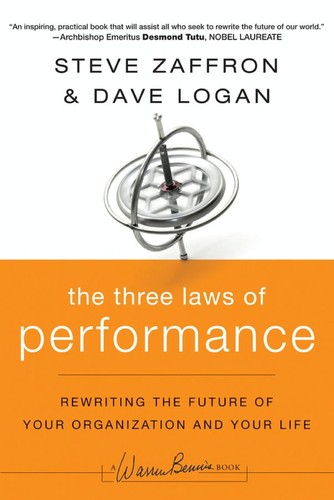
The Three Laws of Performance
Rewriting the Future of Your Organization and Your Life
People and organizations do not act on the facts of a situation. They act on how the situation occurs to them. Change the occurrence, in language, and you change what people do.
A book summary and review by Bruce Eckfeldt
Overview
The Three Laws of Performance argues that most attempts to improve performance fail because they treat performance as a function of skills, incentives, or plans, when it is actually a function of how a situation appears to the people inside it. Zaffron and Logan draw on more than three hundred large-scale change engagements led by Vanto Group across twenty countries, including Reebok, Northrop Grumman, BHP Billiton, Petrobras, Telemar Brazil, Polus Group Japan, Lonmin, and Apple, to make the case that performance transforms only when the perceived situation transforms. The book is written into the Warren Bennis Signature Series at Jossey-Bass, and Bennis provides the editor’s note.
The book is structured around three laws and three corresponding leadership corollaries. Part One presents the laws through case studies. Part Two applies them to leadership and organizations. Part Three applies them to the individual leader. The central operating idea is that every person and every organization has a default future, meaning the future they experience as already written by the past, and that this default future silently governs present action. Rewriting the default future in language, with the people who will live inside it, is what changes performance. The argument is contrarian to most management practice. Performance does not follow plans. It follows perception, and perception is built in language.
People and organizations do not act on the facts of a situation. They act on how the situation occurs to them. Change the occurrence, in language, and you change what people do.
Chapter Summaries
Chapter 1: Transforming an Impossible Situation
The opening chapter states the First Law of Performance and illustrates it with the BHP New Zealand Steel turnaround. In 1997 Malcolm Burns was appointed managing director of a mill widely expected to close. His employees expected further cuts, and that expectation, not the underlying operations, was governing what they did. Burns did not argue with the facts. He held a public meeting, told the workforce he was not the visionary they needed, and asked them to author the future of the company with him.
- The First Law of Performance. How people perform correlates to how situations occur to them. The word occur is used precisely. It means the reality that arises for a person from that person’s view of the past and the future, not the facts themselves.
- At BHP New Zealand Steel, the situation occurred as dire and destined to fail. That occurrence, not the mill’s actual economics, was producing the behavior Burns needed to change. Once the workforce co-authored a new future, costs fell between 15 and 20 percent, safety and productivity improved, and the business became profitable while the workforce was reduced by roughly a quarter.
- Actions and occurrence match perfectly. The authors argue that when a leader finds a person’s actions inexplicable, the correct response is not to challenge the actions. It is to inquire into how the situation is occurring for that person, because the actions will always fit that occurrence.
- Most change programs fail because they attempt to change the actions while leaving the occurrence untouched. Training, restructuring, and new incentives land inside the old occurrence and produce the same behavior. The precondition for change is that the situation must first occur differently to the people inside it.
Chapter 2: Where Is the Key to Performance?
Chapter Two states the Second Law of Performance and moves the argument from occurrence to its source. Occurrence, the authors argue, is not a private mental event. It arises in language, both what is said and what is unsaid. The chapter uses Helen Keller’s acquisition of language as its central illustration and introduces the concept of the racket, a persistent pattern of complaint and behavior that carries a hidden payoff and a hidden cost.
- The Second Law of Performance. How a situation occurs arises in language. Language includes body language, tone, facial expression, and symbolic action, and the unsaid communicates as powerfully as the spoken.
- The unsaid is where performance lives or dies. Assumptions, expectations, disappointments, resentments, and interpretations shape how situations occur, and until the unsaid is surfaced in discussion, the future is written and cannot be altered.
- A racket has four elements. A persistent complaint, a pattern of behavior that accompanies it, a payoff for keeping the complaint alive such as being right or being justified, and a cost the person is usually unwilling to name. The cost typically lands in love, health, happiness, or self-expression.
- The mining company Lonmin in South Africa is used as an example of the unsaid at work. White executives had treated black workers with contempt for decades. That history was unspoken but fully present, and it shaped every operational interaction until it was surfaced and addressed directly.
- Complaints are interpretations of facts, not facts. Bringing the interpretation into the open loosens the certainty that makes workplace conflict feel permanent, and returns the person to a position from which they can act.
Chapter 3: Rewriting a Future That's Already Written
Chapter Three states the Third Law and introduces the two constructs on which the rest of the book depends. The default future is what people expect will happen, at gut level, based on the past. It functions as an unspoken self-fulfilling prophecy. The rewritten future is a possibility, invented in language with the people who will live inside it, that displaces the default future and changes what people do in the present.
- The Third Law of Performance. Future-based language transforms how situations occur to people. Descriptive language reports what has been. Future-based language creates a possibility that did not previously exist and, when spoken with commitment, alters occurrence in the present.
- Every person and every organization has a default future. It is what people believe deep in their bones will happen unless something completely unexpected occurs. The default future is a projection of the past forward, and until it is articulated, it governs action invisibly.
- Rewriting the future is not painting a positive picture on top of the old one. The authors are explicit that a new future requires creating space, which means naming the default future first and getting the people involved to see that they are living into it. The canvas has to be cleared before a new one can be painted.
- A rewritten future is a possibility to which people commit their entire being, not a forecast or a stretch goal. The commitment is the transformative element. Without it, future-based language reads as marketing and produces no change.
- Northrop Grumman’s aerospace division around 2001 illustrates the mechanism. The division had built its identity around bombers and fighters, and its default future was more of the same. Leadership used future-based language to invent a possibility of the division as a primary contractor for reusable launch vehicles and human spaceflight, and eventually NASA came to view it that way.
Chapter 4: With So Many Books on Leadership, Why Are There So Few Leaders?
Chapter Four opens Part Two by asking why leadership books multiply and effective leaders do not. The authors argue that most leadership development trains people in descriptive language, in analysis of what is, and in techniques for managing people inside the default future. What leadership actually requires is the capacity to author a future in language and to hold the space in which others can co-author it.
- Leadership Corollary One. Leaders have a say, and give others a say, in how situations occur. Leaders are not the sole authors of the future. They create the conditions in which the future can be co-authored by the people who will implement it.
- The leader’s first practical work is to articulate the default future the organization is living into. Naming the default future is what makes it visible enough to displace, and it is a step most leaders skip because the default future is uncomfortable to name.
- Effective leaders master the movement between descriptive and future-based language. They use descriptive language for analysis and future-based language when the situation requires that people take new action they would not otherwise take.
- The chapter argues that leadership as usually taught, in the analytic and behavioral traditions, produces good managers of the existing occurrence and few leaders capable of altering it. This is why leadership books multiply without producing more leaders.
Chapter 5: The Self-Led Organization
Chapter Five applies the corollaries at organizational scale. Zaffron and Logan argue that an organization is best understood as a network of conversations, and that the leader’s job is to shape that network so that people at every level are authors rather than recipients of the future. The Telemar Brazil case, in which most of fifteen thousand employees participated in the process and the company entered a new market a year later, is used as the reference implementation.
- Leadership Corollary Two. Leaders master the conversational environment. Innovation, coordination, product development, and customer relationships all happen through conversations, and the quality of the conversational environment determines what can be created inside it.
- Leadership Corollary Three. Leaders listen for the future of their organization. The leader creates space, invites the workforce into it, and listens for the future the organization can commit to, rather than announcing a vision and asking for alignment.
- At Telemar Brazil, most of fifteen thousand employees participated in the future-authoring process. One year later the company entered a growing and profitable new market. Former Telemar Rio CEO Marcio Roza is on record that the pace of that entry would not have been achievable through conventional planning.
- The self-led organization does not mean an organization without leaders. It means an organization in which authority is exercised through the conversational environment rather than through top-down direction, and in which people at every level take action consistent with a future they helped invent.
- The chapter also addresses the new frontier the authors were interested in at publication. Working effectively in the developing world, sustainability in communities, and expanding wealth in both material and human terms. The corollaries generalize to those settings.
Chapter 6: Who or What Is Leading Your Life?
Chapter Six opens Part Three by applying the laws to the individual leader. The claim is that most executives are led by their own default future rather than leading from a created future. That default future is usually assembled around a decision made unconsciously years earlier about who the person is and what is possible for them, and that decision continues to govern current behavior until it is surfaced.
- There is almost always someone or something driving a leader’s life other than the leader. This is not a character weakness. It is the default operation of the laws. Until the individual sees this, they are not authoring their life. They are ratifying a decision made long ago.
- To be authentic in the authors’ sense is to be one’s own author. That requires finding one’s native energies and desires and finding a way of acting on them. It is not a matter of self-improvement. It is a matter of taking authorship.
- The chapter’s questions, who are you really and how did you become who you are, are presented not as therapeutic prompts but as operating diagnostics. The answers reveal the default future the leader is living into and the past decision that generated it.
Chapter 7: The Path to Mastery
Chapter Seven addresses how a leader develops fluency in the laws. The authors resist the idea of a stepwise program. Mastery, they argue, is more like learning a language through immersion than following a checklist. They identify a small number of milestones that indicate progress rather than steps that produce it.
- Mastery is developed through immersion in the laws, not through study of them. Reading the book does not produce mastery. Living inside the distinctions in real operating situations does.
- The first milestone is seeing your terministic screen in action. The names a person gives to situations act as lenses that filter out possibility. Seeing the lenses is the first step in changing them.
- The second milestone is building a new terministic screen. The authors use Galileo as the reference example. The language of the sun rising and setting kept the Earth still. New language allowed the Earth to move.
- The third milestone is seeing new opportunities for elevated performance everywhere. After the first two milestones, a leader begins to ask, spontaneously and without effort, how a situation must be occurring to the people involved such that they are doing what they are doing.
Chapter 8: Breaking the Performance Barrier
Chapter Eight closes the book with seven commitments for a leader who intends to operate from the laws in ordinary work. The commitments are not techniques. They are stances that make future-based language possible for someone who is themselves inside an organization’s conversational environment.
- Get out of the stands. Observers comment. Players act. Breaking the performance barrier requires being in the game, which means taking risks the observer does not have to take.
- Create a new game. A game begins when an influential person uses future-based language to declare that something is more important than something else and holds themselves accountable to it. Without the declaration and the accountability, the old game continues.
- Make the obstacles conditions of the game. Whatever a person treats as an obstacle will govern how they play. Reframing the obstacle as a condition allows the game to proceed inside the constraint rather than against it.
- Share insights. The commitment is to circulate what is being learned rather than hoard it. Performance elevates faster when insights move through the organization rather than staying with the person who developed them.
- Find the right coaching. The role of the coach is to alter how the game occurs for the player, especially at critical moments. Coaches say and do whatever is required to win the game, and the leader has to choose one who can do that work.
- Start filing the past in the past. Most people carry the past forward as material for the present. The commitment is to leave the past where it belongs so that the future is available to be authored.
- Play the game as if life depended on it, and begin by coaching yourself. The final commitment turns the reader inward. Everything in the book generalizes only if the reader operates it on themselves first.
About the Authors
Steve Zaffron is the CEO of Vanto Group, a San Francisco consulting firm that designs and implements large-scale performance initiatives, and an executive and board member of Landmark Worldwide. Vanto and its predecessor firms have led initiatives at more than three hundred organizations in twenty countries, including Apple, GlaxoSmithKline, Johnson and Johnson, Heinz Northern Europe, Reebok, Northrop Grumman, BHP Billiton, Petrobras, Telemar Brazil, and Polus Group Japan. The case material in the book is drawn from that consulting record. Dave Logan is on the faculty of the USC Marshall School of Business, cofounder and senior partner emeritus at CultureSync, and author or coauthor of five books, most notably Tribal Leadership. He holds a doctorate in organizational communication from the Annenberg School at USC.
The credibility of the book rests on the authors’ first-hand access to the engagements it describes. That access produces detailed case material that most management books do not have. It also creates the book’s principal risk. The intellectual lineage of the occurrence framework runs through Werner Erhard’s est and Landmark Education, and the authors do not disguise the connection. Readers who bristle at that lineage should be aware of it. The material stands on its own case evidence, but the vocabulary and the way distinctions are made will be familiar to anyone who has been through a Landmark program and unfamiliar to anyone who has not.
Key Takeaways
1) Performance follows perception, not plans.
The First Law is the book’s core operating claim, and it is contrarian to most management practice. Managers change targets, incentives, structures, and processes on the assumption that people will respond to the new arrangement. Zaffron and Logan argue that people respond to how the arrangement occurs to them, not to the arrangement itself. This is why so many restructurings, incentive redesigns, and strategy refreshes produce the same behavior under new labels. The intervention landed inside the old occurrence and was absorbed into it.
- The First Law is stated precisely. How people perform correlates to how situations occur to them. The word occur is a technical term. It means the reality that arises for a person from their view of the past and the future.
- How a situation occurs is not the person’s opinion of the situation. It is more primary than opinion. It is the ground from which the person’s actions arise without the person deliberating about them.
- The BHP New Zealand Steel turnaround was not driven by better plans. It was driven by the workforce coming to see the situation differently, after which cost, safety, and productivity all moved.
2) The default future runs the company until someone names it.
Every organization is already living into a future its people believe, at gut level, will happen. Zaffron and Logan call this the default future. It is not written down. It is not officially endorsed. It is a projection of the past forward, and it silently governs how people behave in the present. Strategy documents, mission statements, and off-site outputs do not displace the default future. They land on top of it and produce no change. The default future is displaced only when it is named and the people living into it see that they are doing so.
- The default future often takes the form of we are going to get acquired, we are going to lose this customer, this founder will never actually let go, the good people are leaving, or we have already peaked. Naming it is uncomfortable. That is why it usually stays unnamed.
- A rewritten future is not a stretch target. It is a possibility to which the people involved commit their entire being. Without the commitment, the language is marketing.
- The canvas has to be cleared before a new picture can be painted. The authors are explicit that leaders who skip the naming of the default future and jump to the vision produce a hybrid that changes nothing.
3) Occurrence lives in language, and most of the language is unsaid.
The Second Law locates occurrence in language, and Zaffron and Logan are precise that the language that matters is not only what is spoken. Assumptions, resentments, expectations, and interpretations that no one has said aloud govern how a situation occurs and therefore how people act. Until the unsaid is surfaced, the same conversation will produce the same behavior, and no amount of skill development or process redesign will alter it. This is why so many well-run team meetings produce no change. The material that would produce change is in the room but not on the table.
- The Lonmin mining example makes the point at scale. The unsaid history between white executives and black workers was fully present in every operational interaction and produced the behavior that operational fixes could not touch.
- A racket has four elements. A persistent complaint, a pattern of behavior that accompanies it, a hidden payoff often in being right or being justified, and a hidden cost usually in love, health, happiness, or self-expression.
- Bringing the unsaid into the open loosens the certainty that makes conflict feel permanent. It does not resolve the disagreement. It restores the participants’ capacity to act on it.
4) Future-based language is not vision. It is commitment.
The Third Law introduces the mechanism by which occurrence is altered. Descriptive language reports on what is or has been. Future-based language declares a possibility that did not previously exist. The difference is not style. It is that future-based language, spoken with commitment by someone with authority, changes what people take to be possible and therefore changes what they do. Most corporate vision statements are descriptive language in the future tense. They report an expectation. They do not commit to a possibility, and the workforce reads them as reports rather than as declarations.
- Northrop Grumman’s aerospace division illustrates the mechanism. The declaration that the division would be a primary contractor for reusable launch vehicles and human spaceflight preceded and produced the operational reality it named.
- The declaration works only when the person making it is willing to be held accountable to it. Without that willingness, the language reads as aspiration and produces no change in what people do.
- The authors anticipate the objection that future-based language is a rebranding of vision statements and pep talks. Their response is that vision statements are usually descriptive rather than future-based, and the pep talk is a symptom of leadership trying to change behavior without changing occurrence.
5) The organization is a network of conversations.
The Second Leadership Corollary treats the organization not as a hierarchy or a structure but as a network of conversations through which every consequential thing happens. Products get built through conversations. Customers get served through conversations. Priorities get set through conversations. The leader’s job is to master that conversational environment, which means shaping which conversations are held, who is in them, and what language is used inside them. This reframes the CEO’s time. Time spent altering the conversational environment is high-leverage. Time spent outside it is not.
- Innovation is a conversation before it is a product. If the conversation is not being held, the product does not exist. If the conversation is being held in descriptive language only, the product is a variation on what already exists.
- Coordination failures are conversation failures. Two teams that cannot deliver together are usually two teams whose leaders are not in the right conversation with each other.
- The leader’s calendar is the leader’s first operating decision about the conversational environment. The conversations that happen are the ones the leader has made time and space for.
6) Leadership development, as usually practiced, produces managers of the default future.
The authors’ most pointed critique of the leadership industry is that it trains people in analysis, self-awareness, and behavior, all inside the existing occurrence. That training produces competent managers of what is. It does not produce people who can author a new future. The distinction matters for a founder-CEO because the company’s next stage will require exactly the capacity most leadership development does not build. Naming the default future, holding a commitment against it, and shaping the conversational environment so the team can co-author what replaces it.
- Leadership Corollary One is that leaders have a say, and give others a say, in how situations occur. The corollary rules out both top-down declaration and pure bottom-up consensus. The leader authors and hosts.
- The leader’s discomfort at naming the default future is usually the reason it goes unnamed. If the CEO cannot say it aloud, no one else will.
- The book’s implicit standard for a leadership team is not that it agrees. It is that it can hold a commitment together against a default future that continues to pull on each of them individually.
7) The individual leader is usually being led by their own default future.
Part Three turns the laws on the individual. Zaffron and Logan argue that most senior leaders are living inside a default future assembled around a decision made unconsciously years earlier about who they are, what is possible for them, and how much they are allowed to want. That decision continues to govern day-to-day behavior at the top of the company. The book’s uncomfortable claim is that a leader cannot author a future for the organization that is larger than the future they have authored for themselves. Personal work is not optional. It is operating infrastructure.
- The chapter’s diagnostic questions, who are you really and how did you become who you are, are not therapeutic prompts. They are the mechanism by which the leader identifies the past decision that is currently running their present.
- Being one’s own author means finding one’s native energies and desires and finding a way to act on them. It is not self-improvement. It is authorship.
- The Path to Mastery is not stepwise. It is immersion. Mastery arises from operating inside the laws in real situations, not from studying them.
Strengths and Limits
The book’s strength is that it names a mechanism most leaders sense but cannot articulate. People act on how situations occur to them, occurrence lives in language, and future-based language changes occurrence. Once the distinctions are on the table, the reader recognizes them immediately in situations they have been managing without a vocabulary for. The case material is unusually strong for a book of this kind. The BHP New Zealand Steel turnaround under Malcolm Burns, the Northrop Grumman aerospace pivot, the Telemar Brazil rollout across roughly fifteen thousand employees, and the Polus Group succession in Japan are all drawn from Vanto Group engagements the authors ran or observed directly. The concept of the default future is the book’s most portable contribution. It gives a leadership team plain language for the thing that quietly governs behavior in an organization and that most planning documents leave untouched.
The limits are real. The intellectual lineage runs through Werner Erhard’s est and Landmark Education, and the vocabulary of occurrence, rackets, and terministic screens will read as either revelatory or off-putting depending on the reader’s history with that tradition. The book does not disguise the connection, but it also does not translate the distinctions into language a reader unfamiliar with them can pick up quickly. Chapter Two in particular is dense for anyone new to the framework. The case evidence is also drawn almost entirely from very large multinational engagements Vanto ran. The mechanics of a fifteen-thousand-person future-authoring process do not map cleanly onto a fifty-person leadership team, and the authors do not scale the practices down. There is a second risk of a different kind. Future-based language, spoken by a leader who is not prepared to be held accountable to it, degrades rapidly into corporate marketing and destroys trust faster than descriptive language would have. The predictable failure mode is a leadership team that adopts the vocabulary, holds an inspiring session, and produces no operating change, at which point the workforce reads the language as manipulation and returns to the default future with more certainty than before.
My Take
The core diagnosis holds up better than the vocabulary does. When I sit with a founder-CEO who has run the same three plays for six quarters and gotten the same result, the book’s claim is right on target. The problem is almost never the plan. It is that the situation occurs to the team the same way it did last time, and any new plan gets absorbed into that occurrence. What Zaffron and Logan call the default future, I usually hear a leadership team describe as the way things go around here. It is the strategy document nobody wrote and everybody follows.
The vocabulary is where the book runs into trouble for the market I work in. The intellectual lineage runs through Werner Erhard’s est and Landmark Education, and the language of occurrence, rackets, and terministic screens either lands as revelatory or as off-putting depending on the reader’s history with that tradition. I have watched a smart CEO close the book at Chapter Two because the register felt like a workshop they never wanted to attend. That is a loss, because the argument underneath the vocabulary is sound and portable. In a SaaS or product company where the team is already fluent in narrative and framing, the concepts translate cleanly. In a traditional industrial or professional-services company, the translation is heavier lift and probably needs a coach who can hold the room through it.
The most credible outside objection is Chris Argyris’s, which predates the book by decades. Argyris argued that defensive routines and undiscussable topics are what actually govern organizational behavior, and that the mechanism is behavioral, not linguistic. My read is that Zaffron and Logan and Argyris are describing the same phenomenon with different vocabularies. Argyris gives you the research and the diagnostics. The Three Laws gives you a way of talking about the future that a leadership team can actually rally around. The two are complementary rather than competing. A separate reservation, which is mine rather than Argyris’s, is that the case evidence is drawn from very large multinational engagements. The mechanics of a Telemar-scale rollout do not map cleanly onto a fifty-person leadership team, and the authors do not scale the practices down.
Read the Three Laws first for the argument that a leader’s real work is to alter how the situation occurs, not to install a better plan. Read Robert Kegan and Lisa Lahey’s Immunity to Change second for the operating manual, because Kegan and Lahey give you the diagnostic protocol the Three Laws mostly withholds. If your team is going to use only one of the two vocabularies, use theirs. It is drier, more research-grounded, and easier to hand to a skeptical CFO without losing the room.
Discussion Questions
For CEOs
- What is the default future my company is currently living into that I have not yet named aloud, and what stops me from naming it?
- Where am I trying to change behavior by changing incentives or structure without first changing how the situation is occurring to the people whose behavior I want to change?
- In the last leadership meeting where a hard issue came up, what was the material that was in the room but not on the table?
- What future have I been describing to the company in the future tense that I am not actually prepared to be held accountable to?
- Which of my recurring complaints about my leadership team is a racket. What is the payoff I am getting for keeping the complaint alive, and what is the cost?
- Where in my calendar am I shaping the conversational environment, and where am I only operating inside it?
- What decision did I make about who I am and what is possible for me that is still running my current behavior as CEO?
- If I stopped speaking first in every meeting for a month, what future would this team author that they are not currently authoring?
For Teams
- If we had to describe the default future of this company in one plain sentence, what would it say, and would all of us give the same answer?
- What is each of us thinking about the strategy right now that we have not said out loud in this room?
- For our two hardest cross-functional issues, how is the situation occurring to the people whose behavior needs to change, and does our current plan address that occurrence?
- Which of our team’s persistent complaints about each other are actually rackets, and what would change if we surfaced the payoff and the cost?
- Are we using descriptive language when the situation requires future-based language, or the other way around?
- What future are we currently declaring to the organization that we are not, as a team, prepared to be held accountable to?
- Where has the conversational environment of this company degraded, and what conversation is no longer being held that used to be?
- If we cleared the canvas and started over, what future would this leadership team commit to with our entire being?
Practical Tools
1. Default Future Naming
The default future is the book’s operating construct. It runs the company until it is named aloud, and most leadership teams cannot start a real strategy conversation until they have named it. This exercise puts the default future on the table in a way the team cannot walk back from and creates the space required for a rewritten future to have room to land. Use it at the beginning of any offsite, strategy refresh, or scaling transition when the team feels stuck on a plan that keeps producing the same behavior it produced last cycle.
How it works:
- Ask each leader to write down, in one sentence, what they believe will actually happen in this company over the next two years if nothing unexpected changes. Do it silently and independently first.
- Have each leader read their sentence aloud without discussion. Capture them on a board.
- As a team, converge on the two or three sentences that describe the default future most accurately. Argue about wording until the room agrees.
- Ask each leader whether they are personally living inside that future or against it. The answers matter more than the wording.
- Only after the default future is named and owned, open the conversation about what future the team would commit to instead.
The team leaves with a single sentence describing the default future, agreed to by everyone in the room, and a decision about whether to commit to a different future or not. Either decision is progress.
2. Racket Inventory
The concept of the racket is the most implementable idea in the Second Law chapter. It gives a leadership team plain language for the pattern of complaint and behavior that everyone recognizes and no one has been able to name. Making the racket visible does not resolve the underlying issue. It returns the team to a position from which the issue can be worked. Use it when the same complaint has recurred in the leadership team for two or more quarters without change, or when a leader is describing another team member the same way at every one-on-one.
How it works:
- For a specific persistent complaint the team has been carrying, write out its four elements. The complaint itself. The pattern of behavior that accompanies it. The payoff, usually being right, being justified, or avoiding responsibility. The cost, usually to love, health, happiness, or self-expression.
- Notice which elements are easy to name and which are not. The unspoken one is the material.
- Share the four elements with the person the complaint is about. Do not ask them to change. Ask what they would need to hear from you to make the pattern unnecessary.
- Take one action within the next week that makes the payoff unavailable to you.
The complaint stops recurring in team meetings within the following month, not because the underlying issue is resolved but because the leader has stopped drawing the payoff from it.
3. Future Based Language Conversion
Most corporate vision statements are descriptive language in the future tense. They report an expectation. They do not commit to a possibility. Converting them changes what the workforce hears, because a commitment can be tested and an expectation cannot. Use it before any all-hands announcement, investor presentation, or board update in which the CEO intends to declare what the company will do next.
How it works:
- Take the current draft of the message. Mark every sentence that describes what will happen or what the company will become in the future.
- For each marked sentence, ask whether it is a report of an expectation or a commitment to a possibility. If it is a report, mark it for conversion.
- Rewrite each report as a commitment. Change we expect to reach to we commit to. Change we anticipate to we will.
- For each commitment, name one operating decision in the following week that makes it costly to walk back. The commitment is the language plus the operating decision, not the language alone.
- Test the rewritten message on two or three senior people who were not in the drafting room. Ask whether they read commitments or aspirations.
The message contains fewer future-tense sentences than the original, and each remaining one is paired with a concrete operating decision the CEO has already made or is prepared to make.
4. Unsaid Surfacing in a One on One
The Second Law locates most of the material that governs a working relationship in what is not being said. A structured surfacing question in the one-on-one gives both parties access to that material without requiring a difficult set-piece conversation. The point is not to resolve. It is to make the material available. Install as a standing question in the one-on-one with every direct report. It is especially useful with any leader whose one-on-ones have become quiet or purely operational.
How it works:
- At the end of every one-on-one, ask, what have you been thinking about the work, or about us working together, that you have not said aloud.
- Do not defend, correct, or interpret. Write it down. Repeat the material back to confirm you heard it accurately.
- Ask whether the leader wants a response now or would prefer that you sit with it. Either answer is acceptable.
- Return to the material in the next one-on-one, before the operational agenda. Ask what has shifted for the leader since they named it.
- After a month, ask the leader what they now hear differently about the way you lead them.
The leader begins to raise the material without being asked, and the one-on-one shifts from status reporting to a real working conversation about what is between you.
5. Conversational Environment Audit
The Second Leadership Corollary is that the leader masters the conversational environment. The audit makes the environment visible by asking which conversations are being held, which are not, and which are being held in the wrong language. It converts an abstract corollary into an observable operating fact. Use it once a year at a leadership offsite, in the first quarter after a significant hire or reorganization, or when the CEO senses that the company has stopped talking about the things that matter.
How it works:
- List the ten most consequential conversations the company depends on. Include strategy, product roadmap, top-account review, senior talent, customer escalations, and cross-functional coordination.
- For each, name who is in the conversation, how often it happens, and what language predominates. Descriptive language for analytic work. Future-based language for committing to what will happen next.
- Identify the conversations that are missing. What decisions are being made without the conversation that should precede them.
- Identify the conversations being held in the wrong language. Descriptive language used where a commitment is needed. Future-based language used where analysis is needed.
- Choose one conversation to add or redesign in the next quarter. Assign the leader who owns it and the cadence.
Within a quarter, the added or redesigned conversation is being held on cadence, and the leader responsible can name the decisions that have been made inside it that would not otherwise have been made.
6. Self Authored Future Statement
Part Three’s argument is that a CEO cannot author a future for the company that is larger than the future they have authored for themselves. This exercise puts the leader’s personal default future on the same table as the company’s, which is the only place from which the two can be worked together. Use it during exit-readiness planning, at a leadership transition, or when the CEO is considering a significant change in role that they have not yet named to the team.
How it works:
- Write down, in one sentence, the future you are currently living into. Not the future you would describe to the board. The one you actually expect at gut level.
- Write down, in one sentence, the future you would author if no past decision were in the way.
- Identify the gap. What is the past decision that is holding the first sentence in place. When did you make it. What was the payoff.
- Choose one operating change in the next quarter that costs the payoff. The change is the point at which the authored future starts to become real.
- Return to the two sentences in ninety days. Rewrite the first one and observe how much of the gap has closed.
The gap between the two sentences narrows in three months, and the leader can name one operating decision they took that they would not have taken from inside the default future.
7. Seven Commitments Review
Chapter Eight’s seven commitments are the stances required to operate from the laws inside a real organization. Reviewing them quarterly makes visible where the leader has drifted back into the stands, back into descriptive language, or back into the default future without noticing. Use it quarterly as a personal review, or after any period in which the leader has spent significant time firefighting or reacting rather than authoring.
How it works:
- Score yourself against each of the seven commitments on a five-point scale. Get out of the stands. Create a new game. Make obstacles conditions. Share insights. Find the right coaching. File the past in the past. Play as if life depended on it.
- For each low score, name one specific situation from the past quarter in which the commitment was not held.
- Choose the two lowest and design one operating change for the coming quarter for each.
- Share the two commitments with one other person who has permission to ask you about them.
- Rescore at the end of the quarter and compare.
The two chosen commitments show measurable improvement in the following quarter, and the leader can name one specific situation in which the improved commitment produced a different outcome than would otherwise have occurred.
Further Reading
- The Barbados Group and Werner Erhard’s foundational papers on ontological leadership, for the intellectual source of the occurrence framework the book operates from.
- Dave Logan, John King, and Halee Fischer-Wright’s Tribal Leadership, for the parallel framework on how organizational language shapes what teams can accomplish.
- The Vanto Group case library, for additional case material on the large-scale engagements the book draws from, including work with Reebok, Northrop Grumman, and BHP Billiton.
- Amy Edmondson’s research on psychological safety, for a research-grounded account of how unsaid material in a team affects performance.
- Chris Argyris on defensive routines and undiscussable topics, for the classic management-research treatment of what Zaffron and Logan call the unsaid.
Share This Review

Bruce Eckfeldt is a business coach and strategic advisor to founder-CEOs of growth-stage companies, a former Inc. 500 CEO, and the author of Springboard. More book reviews →
These summaries present Bruce Eckfeldt’s analysis of business and leadership books for founder-CEOs and leadership-team members of growth companies. Each one identifies the ideas most relevant to decision quality, strategy, and leadership capacity, notes where the evidence is weak, and suggests practical ways to test what is worth testing. All ideas, stories, and quotations belong to the original author and to the people they cite. The assessments and recommendations are Bruce’s. It is a companion to the book, not a substitute for reading it.
To learn more about Bruce’s programs, request other book summaries, or get in touch, contact booksummaries@eckfeldt.com.
Get the Next Review.
A new book review lands in Better, Faster, my weekly newsletter for founder-CEOs, along with one practical essay and questions for your team.