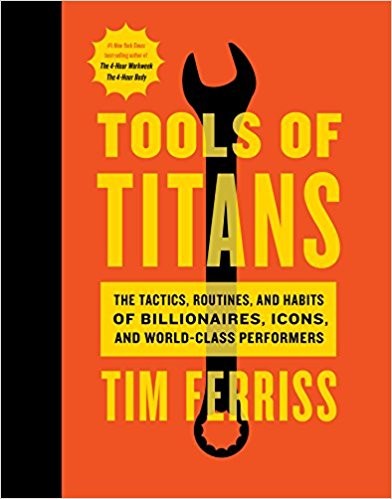
Tools of Titans
The Tactics, Routines, and Habits of Billionaires, Icons, and World-Class Performers
World-class performance across every field is less a matter of innate talent than a portable, testable stack of tools, routines, and questions that any practitioner can borrow and validate on themselves.
A book summary and review by Bruce Eckfeldt
Overview
Tools of Titans, published in 2016 by author and investor Tim Ferriss, is a curated distillation of more than two hundred long-form interviews from The Tim Ferriss Show podcast. Rather than a single narrative argument, the book functions as a tactical reference volume, presenting the routines, mental models, favorite books, exercises, supplements, and heuristics that Ferriss found repeatedly across billionaires, elite athletes, artists, military leaders, philosophers, and scientists.
Ferriss organizes the material into three parts modeled on Benjamin Franklin’s maxim, Healthy, Wealthy, and Wise, and layers over them three meta-skills drawn from Hermann Hesse’s Siddhartha, clear thinking, patient waiting, and enduring discomfort. The Healthy part covers physical durability, sleep, mobility, diet protocols, cold exposure, and morning routines. The Wealthy part addresses prioritization, filters, negotiation, saying no, skill stacking, and entrepreneurial decision-making. The Wise part addresses fear, meaning, discipline, uncomfortable conversations, and mortality. The book is deliberately designed to be read non-linearly, treated as a buffet from which the reader runs personal experiments rather than a single system to be adopted whole.
World-class performance across every field is less a matter of innate talent than a portable, testable stack of tools, routines, and questions that any practitioner can borrow and validate on themselves.
Chapter Summaries
Chapter 1: Healthy
The Healthy part argues that physical capacity is trainable, measurable, and upstream of judgment, and that most people treat it as a fixed trait instead. Ferriss assembles it from athletes, physicians, and coaches, including Amelia Boone, Rhonda Patrick, Wim Hof, Peter Attia, Dominic D’Agostino, Kelly Starrett, and Christopher Sommer, and it closes with Sommer’s chapter on ‘The Single Decision.’ Most of the content is protocol-level physiology. The part worth a business reader’s attention is not the protocols but the shared logic underneath them, which is that deliberate stress followed by deliberate recovery builds capacity, and that unstructured days produce neither.
- The morning-routine material is spread across short chapters such as ‘5 Morning Rituals That Help Me Win the Day,’ and the routines themselves contradict each other. Some guests meditate, some train, some journal, some take cold showers. What is constant is that the first hour is committed in advance. Ferriss’s own claim is that more than eighty percent of the people he interviewed have a daily mindfulness or meditation practice, which he reads as evidence for the category rather than any specific practice.
- The reason the first hour matters is not that mornings are magical. It is that the first hour is the only part of the day that is not yet contested. Once you open email, the day’s agenda is set by whoever wrote to you overnight, and every subsequent decision is made from a queue you did not build. Committing the hour in advance is the cheapest way to arrive at the first real decision of the day with a position rather than a backlog. The practice fails when it is judged on how the morning felt instead of on whether the decisions got better.
- Christopher Sommer’s ‘Single Decision’ principle holds that once a commitment is made and is worth making, reopening it consumes energy that belongs in execution. His reasoning comes from coaching gymnasts. An athlete who renegotiates the commitment every morning never accumulates the compounding that the training depends on, because the deliberation itself is the drain. The same mechanism applies to a leadership team that returns to a settled strategic question every quarter.
- The physiology material, from Hof’s cold exposure through Attia and D’Agostino on metabolic health and Starrett on mobility, is the most contested and most dated part of the book. Read it as a list of experiments with defined endpoints rather than as findings. The transferable idea is the one Ferriss applies to everything else in the part, which is that a practice is worth keeping only if you decided in advance what result would justify keeping it.
Chapter 2: Wealthy
The Wealthy part is the most directly transferable material in the book, and its recurring argument is that returns concentrate in a small number of decisions, so the scarce resource is conviction and attention rather than opportunity. Chris Sacca and Marc Andreessen supply the investment logic, Derek Sivers the commitment filter, Scott Adams the argument for combining skills, and Peter Thiel and Seth Godin the case for defining a category instead of competing inside one. Ferriss adds ‘The Canvas Strategy’ and chapters from Tony Robbins, Ramit Sethi, Reid Hoffman, and James Altucher. The through line is subtraction.
- Sacca and Andreessen are cited for filters strict enough that they decline nearly everything without regret. The reasoning is that in a portfolio where a small number of positions produce most of the return, the cost of a mediocre yes is not the money. It is the attention that a great opportunity would have needed later. A CEO with a full customer roster and a full calendar faces the same arithmetic even without a portfolio.
- Andreessen’s paired-metrics idea is that every metric worth tracking should be tracked alongside the metric that would reveal it being improved the wrong way. The mechanism is simple. A single number becomes a target, a target gets optimized, and the optimization has a cost that shows up somewhere the number does not measure. Pairing makes the cost visible in the same review rather than two quarters later.
- Derek Sivers’s rule is that anything short of ‘Hell, yes’ is a no, and his related line is that busy is a form of being out of control. The argument is that a lukewarm yes consumes the same calendar as an enthusiastic one and returns far less, and that a full calendar usually means priorities were set by whoever asked first. Scott Adams argues alongside this that reaching the top twenty-five percent in two or three complementary skills is both more achievable and more valuable than reaching the top one percent in a single one, because the combination is rarer than either part.
- ‘The Canvas Strategy,’ built from a story about Steve Jobs’s early Apple engineering team, argues that trust and information access come before mandate, and the way to buy both is to do the unglamorous supporting work that makes other people more effective. It is the part’s clearest answer to how a second-layer leader earns a larger role. Robbins and Sethi on pricing make the complementary point that buyers respond to perceived value rather than to cost-plus reasoning, which is the most immediately usable material in the part for pricing and deal conversations.
- Reid Hoffman’s habit of writing down a problem before sleeping is presented as a low-cost decision-quality practice rather than a productivity trick. The claim is that the problem continues to be processed without conscious attention, so the morning starts with a partial answer instead of a blank page. ‘How to Say No When It Matters Most’ and ‘How to Earn Your Freedom’ function as standalone calendar and commitment audits.
Chapter 3: Wise
The Wise part holds the book’s most useful material on how leaders behave under pressure, and its organizing claim is that most stalled decisions are emotional rather than informational. Ferriss’s own chapter, ‘My Favorite Thought Exercise: Fear-Setting,’ contains the book’s most durable framework, and Kevin Kelly contributes the retrospective version of it. Jocko Willink on discipline, Brené Brown on uncomfortable conversations, Josh Waitzkin on recovery, and Peter Diamandis on scale of ambition each address a different failure mode. The closing chapters, from BJ Miller, Sebastian Junger, and Cal Fussman, deal with mortality and meaning.
- Fear-setting works because anxiety is unspecified by nature and specification shrinks it. Ferriss, drawing on Seneca, argues that the reason a decision sits unmade is rarely missing information. It is that the downside has never been written in concrete language, so it stays vague and therefore unbounded. Listing the worst cases, what would prevent each one, and what would repair each one usually reveals a set of finite and mostly recoverable outcomes. The column that actually forces action is the last one, the cost of not deciding, projected out over years.
- Kevin Kelly’s ‘Is This What I So Feared?’ is the retrospective half of the same exercise. Looking back at a feared outcome and comparing it to what actually happened recalibrates how much weight to give the next fear. Most people never run this check, which is why the same fear stays the same size for a decade.
- Jocko Willink’s argument that discipline equals freedom inverts the usual framing. Constraints decided in advance eliminate the daily negotiation, and the energy saved by not deliberating is the freedom. Brené Brown’s contribution runs parallel. Her claim, as presented in the book, is that willingness to have uncomfortable conversations tracks with success, and the practical consequence is that avoidance is both measurable and manageable. Avoidance is always the cheapest option this week and the most expensive one this year.
- ‘The Dickens Process,’ built on a Tony Robbins technique, asks what a limiting belief has already cost across the past, what it is costing now, and what it will cost if it is carried forward. The mechanism is that beliefs persist because their cost is never totaled in one place. Forcing the total is what makes them negotiable. It complements fear-setting, which handles the decision, by handling the belief underneath it.
- Josh Waitzkin makes the case for deliberate deloading after intense pushes, on the grounds that capacity is built during recovery rather than during the effort, and that continuous intensity produces plateaus rather than gains. This maps onto the sprint-and-collapse cycles common in founder-led companies. Peter Diamandis’s moonshot questions work on a different axis. A ten-times target invalidates the incremental plan and forces a different approach, where a ten-percent target can be met by working harder at the current one.
- The chapters from BJ Miller, Sebastian Junger, and Cal Fussman on mortality, belonging, and asking better questions are the least operational material in the book. They matter most to a founder approaching a transition, where the practical question of selling the company sits on top of a harder one about identity after it is sold.
About the Author
Timothy Ferriss is an American author, angel investor, and podcaster best known for the 4-Hour series, beginning with The 4-Hour Workweek in 2007, followed by The 4-Hour Body and The 4-Hour Chef. His work centers on lifestyle design, self-experimentation, and the deconstruction of expert performance into learnable components. He has been an early-stage investor or adviser in companies including Uber, Facebook, Shopify, Duolingo, and Alibaba, and hosts The Tim Ferriss Show, one of the most-downloaded business and interview podcasts of the past decade.
Ferriss’s credibility for this particular book rests less on academic authority than on sustained access. Over hundreds of multi-hour interviews he has been able to press elite performers on the specifics of their routines, and Tools of Titans is his synthesis of those conversations. He positions himself explicitly as a human guinea pig who tests protocols on himself before recommending them, which reinforces the book’s underlying epistemology. What matters is not authority but replicable results.
Key Takeaways
1) Success is a portable stack of tools, not a personality.
Ferriss’s foundational claim is that world-class performance converges on a small set of transferable practices, and that titans differ from everyone else less by talent than by which tools they have installed. The book reads as an inventory of those tools rather than a theory of character. What separates top performers, on this account, is not who they are but what they run.
- An experimentalist philosophy of inventory management, not character transformation, runs through the book. Titans are assembled, not born.
- Over eighty percent of guests reported a daily mindfulness or meditation practice, and many men over forty-five skipped or lightened breakfast.
- Many used the ChiliPad sleep-cooling device and cited Sapiens, Poor Charlie’s Almanack, Influence, and Man’s Search for Meaning as formative reads.
- A belief shared across guests. Failure is not durable.
2) The quality of your life is determined by the quality of your questions.
Ferriss argues that highly effective people distinguish themselves less by their answers than by the questions they habitually ask, since the frame of a question determines the range of accessible answers. Several of the book’s most-quoted lines are questions, not conclusions.
- Peter Diamandis asks two mission-clarifying prompts. What did you want to do as a child before anyone told you what you were supposed to do, and what would you do with one billion dollars if required to spend it improving the world. He uses the paired answers to help entrepreneurs name a Massive Transformative Purpose.
- Bryan Johnson asks whether a venture is an ‘itch,’ a passing curiosity that fades once scratched, or a ‘burn,’ a problem that keeps returning and worsening if left unaddressed. The distinction is a pre-commitment filter for deciding which pursuits justify a sustained multi-year push.
- Derek Sivers applies a ‘Hell, yes’ commitment rule. If an opportunity does not provoke immediate enthusiasm, the answer is no, not maybe.
- Ferriss quotes investor Peter Thiel’s challenge to any ten-year plan, ‘why can’t you do this in six months,’ and rewords it as his own operating question. The point is not to shorten the plan. It is to expose which parts of the plan are genuine constraints and which are assumptions the team has stopped questioning.
3) Fear-setting is higher leverage than goal-setting.
Ferriss’s most durable original contribution asks the practitioner to define the worst-case scenario of an avoided decision in specific detail, list steps to repair the damage, and inventory the cost of inaction, converting vague dread into named, usually reversible outcomes. Goal-setting focuses attention on the upside. Fear-setting removes the emotional friction that keeps the decision from being made at all.
- Ferriss illustrates it with his own decision to leave his first company, which he credits with unlocking his writing career.
- Kevin Kelly’s related ‘Is this what I so feared?’ exercise involves living cheaply with a sleeping bag and oatmeal to defang worst-case scenarios experientially.
- The exercise projects the cost of inaction at six months, one year, and three years out.
- The structure matters more than the sentiment. Naming a specific repair step is what makes a feared outcome tractable.
4) Ruthless filters, not more effort, produce leverage.
The Wealthy part argues that elite performers succeed by removing more. They apply a Pareto-style 80/20 filter to time, customers, and information, combined with the ‘lead domino’ heuristic of finding the single task that makes many others easier or unnecessary. The filters are subtractive. None of them add capacity. They reduce the number of things competing for it.
- Chris Sacca and Marc Andreessen are cited for high-conviction investment filters that let them decline most opportunities without regret.
- Derek Sivers argues that ‘busy equals out of control.’
- Andreessen’s ‘paired metrics’ idea pairs every tracked metric with one that catches its adverse consequences.
- The filters converge on the same insight. Capacity is not created. It is recovered from things that should not have been on the list.
5) Rare skill combinations beat narrow mastery.
Scott Adams argues, as quoted in the book, that becoming world-class at one skill is extraordinarily hard, while becoming top-quartile at two or three complementary skills, ideally including communication, is achievable and produces a scarcer, more defensible position than mastery alone. The claim is about scarcity, not about breadth for its own sake.
- Ferriss applies this retrospectively across guests. Engineers who became storytellers, athletes who became executives, comedians who became long-form interviewers.
- He links it to an accelerated-learning method of deconstructing a target skill into its highest-leverage sub-components, developed further in his own The 4-Hour Chef.
- A common combination is worth no more than a single common skill. Scarcity is what the combination has to buy.
6) Morning routines work by protecting the first hour.
Ferriss found that nearly all his high-performing guests had a deliberate morning routine and rarely checked email in the first hour, synthesizing a roughly twenty-minute default of making the bed, ten to twenty minutes of meditation, light movement, tea, and journaling. The specific ritual matters less than the fact that the hour was committed before the day began.
- Josh Waitzkin pairs interval training with meditation.
- Jocko Willink treats a pre-dawn lift as an expression of ‘discipline equals freedom.’
- Transcendental Meditation or Vipassana practice was near-universal across guests.
- Frequent use of the ChiliPad and strict sleep windows to protect the state upstream of the morning.
7) Enduring discomfort is trainable, not innate.
The Wise part’s third meta-skill treats cold showers, sauna, fasting, and hard mobility work as psychological interventions as much as physiological ones, habituating the practitioner to voluntarily choose short-term discomfort for a longer-term outcome. The practical corollary is that avoidance of hard conversations, hard decisions, and hard training is a habit that gets stronger with repetition, and so is the opposite.
- Kevin Kelly’s sleeping-bag-and-oatmeal exercise defangs worst-case scenarios experientially.
- Jocko Willink treats discipline as a full operating philosophy rather than a tactic.
- Coach Sommer’s ‘Single Decision’ framework rejects re-litigation of settled commitments.
- Brené Brown argues that success correlates with willingness to initiate uncomfortable conversations.
Strengths and Limits
The book’s strength is its format. It is a reference rather than an argument, so it can be opened at any page and read in five minutes, and its density means the ratio of usable ideas to pages is high even though most chapters will not apply to any given reader. Four ideas do most of the work. Fear-setting, the lead-domino question, subtractive filters, and paired metrics. All four operate on the same constraint, which is decision quality under limited attention. Ferriss also earns trust by presenting himself as a human guinea pig who tests the protocols on himself, and by preserving the source interviews at chapter length rather than reducing them to lists. That preservation is what makes it a reference rather than a self-help book.
The limits are real and worth naming. The evidence is anecdotal by design, drawn from a self-selected group of unusually successful people interviewed by a sympathetic host, so survivorship bias runs through nearly every chapter and the advice is often contradictory from one guest to the next. The book offers no method for deciding which advice applies to whom. The health protocols are the most dated portion, and several have been revised or contradicted by later work, including Peter Attia’s own in Outlive. Much of the guest population comes from venture-backed technology and elite athletics, contexts with different capital structures, risk tolerances, and time horizons than most operating businesses. Ferriss is aware of the buffet problem and frames the book as a menu of experiments with defined endpoints rather than a system to be copied, but the book does not provide the diagnostic that would tell a reader which items on the menu belong on their plate.
My Take
I recommend this book to founder-CEOs with the same caveat every time. Read it as a reference, not a program. Four ideas in it are worth the price of the whole book for someone running a growth-stage company. Fear-setting, the lead-domino question, the hell-yes filter, and paired metrics. All four operate on the constraint that actually binds most CEOs I work with, which is not access to capital or opportunity but decision bandwidth and the leadership team’s ability to decide without them. If you leave the book with those four installed and drop everything else, you got more from it than most readers do.
The book plays very differently by context. For a founder in software or professional services, the Wealthy part carries the weight and the Healthy part is more or less optional. For an owner-operator in a physical business, the ratio inverts, because physical durability really is the constraint when the CEO is still on the shop floor. In both cases the Wise part is the sleeper. It contains the most durable material, and it is the part most readers skim because it looks softer. Fear-setting is not soft. It is the highest-leverage decision practice in the book, and I have used it with founder-CEOs approaching an exit more than any other tool in it.
The most credible outside critique of the book, articulated by writers such as Cal Newport and by the academic literature on expertise, is that Ferriss confuses correlation with mechanism. Titans do these things, therefore doing these things makes you a titan. The critique lands. The book has no method for distinguishing the ritual that made someone successful from the ritual they picked up after they were already successful, and it does not try. That is the survivorship-bias problem that runs through any book built from interviews with winners. My read is that it is a real limit and it does not disqualify the book. Read it as a menu of experiments to run on yourself, decide the endpoint before you start, and keep only what changed the decision or the outcome.
For a founder-CEO with limited reading time, the adjacent book that finishes what Tools of Titans starts is Cal Newport’s Deep Work. Newport supplies the mechanism the morning-routine and filter material in Ferriss depends on but never fully explains, which is that cognitive capacity is protected time. On the health side, Peter Attia’s Outlive is now the operating manual that supersedes most of Ferriss’s Healthy part. Read Tools of Titans first for the surface area of ideas. Read Newport and Attia second for the parts of the argument Ferriss assumes rather than makes.
Discussion Questions
For CEOs
- Which decision have I carried longest without resolving, and what specifically am I afraid will happen if I decide?
- What is the cost of not making that decision, at six months, one year, and three years?
- Which of my current commitments would I accept again if my calendar were empty tomorrow?
- What am I doing that feels productive but will not change the outcome of this quarter?
- Where am I confusing being busy with being in control of the business?
- For each number I watch closely, what is the number that would tell me we are winning it the wrong way?
- What conversation am I avoiding, and what is that avoidance costing the business?
- If my judgment were unavailable for thirty days, which decisions would stall, and what does that tell me?
For Teams
- What is the single objective this quarter that, if we achieved it, would make the most other objectives easier or unnecessary?
- Which items on our current priority list does that objective not touch, and are we willing to drop them?
- Which customer segments, products, or opportunities are we pursuing at maybe rather than at yes, and what would we gain by declining them outright?
- Which metric on our scorecard could someone improve in a way that damages the business, and what paired metric would catch it?
- Which decision do we keep reopening, and is the real disagreement about the decision or about who owns it?
- Is each of us being developed toward a rare combination of capabilities, or only deeper into one function?
- What was the hardest conversation any of us initiated in the last month, and what did it produce?
- Which recurring problem have we been treating as an execution failure when it may be an unresolved decision?
Practical Tools
1. Fear-Setting Exercise
Important decisions get deferred not because the information is missing but because the downside is unnamed, and unnamed downside stays large. Ferriss’s fear-setting exercise, drawn from Seneca and presented in his chapter ‘My Favorite Thought Exercise,’ converts vague dread into a specific list of outcomes, prevention steps, and repair steps. Written downside is almost always smaller and more repairable than it felt. Use it on any decision you have carried for more than thirty days. Common candidates include a co-founder conflict, a leadership-team termination, exiting a customer segment, a pricing change, a restructure, or the decision to begin a sale process.
How it works:
- Define. List every specific worst-case outcome of taking the action, in concrete language rather than generalized dread.
- Prevent. For each outcome, list what would reduce its probability.
- Repair. For each outcome, list what would restore the situation if it happened.
- Benefits. List the likely partial-success outcomes of acting, not only the best case.
- Cost of inaction. Name the specific financial, strategic, and relational costs of not acting, projected at six months, one year, and three years.
You end with a decision and a date, not a longer list of considerations. If working through it does not change what you do this month, the worst case was probably not the real obstacle. Revisiting the exercise a quarter later, to compare feared outcome to what actually happened, is what recalibrates the weight given to the next fear.
2. Lead-Domino Selection
The most common failure in quarterly planning is not choosing the wrong priorities. It is choosing too many, which guarantees that the hardest one gets the least attention. Ferriss’s lead-domino heuristic, drawn from The ONE Thing by Gary Keller and referenced throughout the Wealthy part, forces the team to name the single objective that makes the largest number of other objectives easier or unnecessary. Use it at the start of quarterly and annual planning, before any list of objectives is drafted.
How it works:
- Ask the team to name the single objective that, if achieved this quarter, would make the largest number of other objectives easier or unnecessary.
- Test it. If achieving it would not change the difficulty of anything else, it is a priority but not the domino.
- Assign one accountable owner and the resources that owner actually needs.
- List what the domino does not touch, and decide explicitly what is being deferred.
One objective the whole team can name without looking it up, and a short list of things the team has agreed not to do this quarter. The conversation the exercise forces about what to drop is usually more valuable than the objective it produces.
3. Hell-Yes Filter
Derek Sivers’s argument, quoted throughout the Wealthy part, is that a calendar full of lukewarm commitments is worse than an open one, because the lukewarm commitments consume the capacity that a clear yes would need. Anything short of ‘Hell, yes’ is a no. The rule is easy to state and hard to apply, because the calendar is populated by past yeses no one has revisited. Run it quarterly on your standing calendar, and use the same test on new customer segments, partnerships, board seats, and speaking commitments.
How it works:
- List every recurring commitment on your calendar and every open opportunity in front of the company.
- Score each one as a clear yes or a no. Remove maybe as an option.
- For anything that is not a clear yes, decide whether to decline it or renegotiate its terms.
- Repeat the exercise on the company’s opportunity pipeline with the leadership team.
A calendar with visible open time and a pipeline the team can describe in one sentence. If everything survives the filter, the filter was not applied honestly. Most growth companies are carrying two or three segments that no one would choose again if they were starting today, and the company version of the filter is where the value is.
4. Paired-Metric Review
Marc Andreessen’s paired-metrics idea, referenced across the Wealthy part, addresses a structural weakness in scorecards. Any single metric can be improved in a way that damages the business, and the damage usually surfaces later than the improvement. Pairing each headline number with the metric that would catch its adverse consequences puts the tradeoff in the same review. Build it into the existing monthly or quarterly scorecard review. It does not require a separate meeting.
How it works:
- For each metric on the scorecard, name the metric that would reveal if it were being improved the wrong way.
- Add the pair to the same report, side by side, not in an appendix.
- Review both together. Treat a pair that is moving in opposite directions as the agenda item.
- Retire any metric for which no meaningful pair exists. It is probably not a decision-grade number.
Every headline number on the scorecard has a companion, and at least one review per quarter surfaces a tradeoff the team had not seen. The tool has particular value for a company preparing for a sale or an outside investment, because the tradeoffs it catches are exactly the ones diligence is designed to find.
5. Uncomfortable-Conversation Count
Brené Brown’s claim in the Wise part, as Ferriss presents it, is that success correlates with willingness to have uncomfortable conversations. The practical consequence is that avoidance is measurable and therefore manageable. Counting the conversations initiated, not the ones that felt good, makes avoidance visible to the team. Use it as a standing leadership-team practice, and open offsites with it. It is most useful when the team appears unusually aligned.
How it works:
- Each member counts the genuinely uncomfortable conversations they initiated in the last month, with each other, with employees, with customers, and with investors.
- Debrief the single hardest one. What made it hard, what was said, and what changed as a result.
- Name the conversation each person is currently avoiding, and who it is with.
- Set a date for one of them.
The count is roughly stable or rising, and the team can name specific avoided conversations rather than reporting that there are none. A falling count is not evidence of a healthy team. It is usually evidence that disagreement has moved out of the room.
6. Protected First Hour
The first hour is the only part of the day that is not yet contested. Once you open email, the agenda has been set by whoever wrote to you overnight, and every decision after that is made from a queue you did not build. Ferriss’s guests do wildly different things with the hour. What they share is that the hour was committed before the day started. Install it permanently if you can, and treat it as non-negotiable during diligence, a financing process, an integration, or a leadership transition.
How it works:
- No email or messages for the first sixty minutes.
- One deliberate practice. Movement, meditation, breathwork, or reading. The choice matters less than the consistency.
- Write down the single most important decision you will make that day.
- Review after two weeks and keep it only if the decisions got better, not if the mornings felt better.
You arrive at the first meeting of the day with a position rather than a queue. Judged as a lifestyle practice it gets dismissed. Judged as protection of the scarcest resource in the company during the periods when it is most contested, it holds up.
7. Single-Decision Rule
Coach Christopher Sommer’s principle, quoted in the Healthy part, is that once a commitment is made and worth making, reopening it consumes energy that belongs in execution. Teams that relitigate settled decisions rarely improve them, and the deliberation itself is the drain. Use it when the same strategic question returns to the agenda for the third time without new information.
How it works:
- Name the decision and the date it was made.
- Ask what new information has emerged since. If there is none, the discussion is closed.
- If there is new information, decide once more and record the reasoning.
- Record who owns the decision, so the next reopening has an address.
Agenda time shifts from revisiting decisions to reviewing whether the chosen path is working. Apply the rule carefully. A team that keeps reopening a decision is sometimes undisciplined and is sometimes signalling that the decision was made without their input. Check which one you have before enforcing the rule.
Further Reading
- Naval Ravikant’s later development of the leverage triad, capital, code, and media, which extends the book’s material on wealth and maps onto equity, ownership, and eventual exit.
- Jocko Willink’s Extreme Ownership as a full articulation of the discipline-equals-freedom material.
- Brené Brown’s Dare to Lead as the leadership-team application of the vulnerability and uncomfortable-conversation material.
- Cal Newport’s Deep Work as the operating-system implementation of the morning-hour and filter material.
- Peter Attia’s Outlive as a scientifically updated version of the book’s Healthy part. Several protocols in Tools of Titans have since been superseded.
Share This Review

Bruce Eckfeldt is a business coach and strategic advisor to founder-CEOs of growth-stage companies, a former Inc. 500 CEO, and the author of Springboard. More book reviews →
These summaries present Bruce Eckfeldt’s analysis of business and leadership books for founder-CEOs and leadership-team members of growth companies. Each one identifies the ideas most relevant to decision quality, strategy, and leadership capacity, notes where the evidence is weak, and suggests practical ways to test what is worth testing. All ideas, stories, and quotations belong to the original author and to the people they cite. The assessments and recommendations are Bruce’s. It is a companion to the book, not a substitute for reading it.
To learn more about Bruce’s programs, request other book summaries, or get in touch, contact booksummaries@eckfeldt.com.
Get the Next Review.
A new book review lands in Better, Faster, my weekly newsletter for founder-CEOs, along with one practical essay and questions for your team.