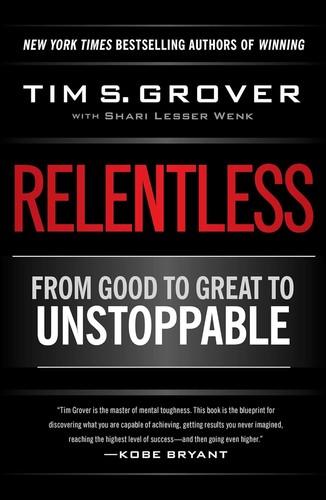
Relentless
From Good to Great to Unstoppable
The difference between good, great, and unstoppable is a mindset of total ownership, instinct built through relentless preparation, and a craving for results that makes the work itself irrelevant.
A book summary and review by Bruce Eckfeldt
Overview
Relentless is Tim Grover’s account of the mindset he observed in the elite athletes he trained, most prominently Michael Jordan, Kobe Bryant, and Dwyane Wade. Grover argues that what separates the best from the merely talented is not physical ability but a mental state: an unending drive to win, a refusal to be satisfied, and the ability to act on instinct under pressure. He says plainly that the book is not science. It is a practitioner’s description of what he saw from inside the training room.
The two opening chapters set up the book’s framework. Grover sorts competitors into three types. A Cooler is good, follows instructions, and passes the problem to someone else when pressure rises. A Closer is great, performs under pressure when the situation is defined in advance, and wants credit. A Cleaner is unstoppable, takes responsibility for everything, creates the opportunity rather than waiting for it, and is never satisfied. The remainder of the book is organized as thirteen traits of the Cleaner, the Relentless 13, each a chapter. Grover’s central instruction is to stop overthinking and trust instincts built through preparation.
The difference between good, great, and unstoppable is a mindset of total ownership, instinct built through relentless preparation, and a craving for results that makes the work itself irrelevant.
Chapter Summaries
Chapter 1: You Keep Pushing Yourself Harder When Everyone Else Has Had Enough
The first trait is work beyond the point where others stop. Grover argues that the real power source is mental, from the neck up, and that the body follows a strong mind. He describes his training regime as a dictatorship with three rules: show up, work hard, and listen. He removes options from athletes because, given a choice, most people take the easier one.
- Removing options removes the chance to choose the easy path. Grover does the thinking about the program so the athlete’s only job is to do the work.
- Every day the athlete must do something he does not want to do. Grover argues that avoided tasks compound, so one skipped task becomes two, then several, until the backlog becomes a mental barrier.
- Cleaners do the hardest things first, which shows there is no task too big and clears the path for everything else.
- Grover cites Kobe Bryant insisting on playing the game after he suffered a broken nose and a concussion in the All-Star Game, because he wanted to know how his body would respond.
Chapter 2: You Get into the Zone, Shut Out Everything Else, and Control the Uncontrollable
The second trait is control of emotion under pressure. Grover describes the Zone as a quiet state in which there is no thinking, only instinct and focus. He contrasts the three types: a Cooler gets everyone emotional before a game, a Closer gets himself emotional, and a Cleaner stays calm and saves everything for game time. The Cleaner’s only emotion in the Zone is a controlled, cold anger that never becomes rage.
- Emotion is presented as weakness because it can be used against the competitor. As soon as someone pushes your buttons, Grover argues, they have won.
- Controlled anger is treated as fuel. The distinction is between anger the competitor directs and rage that directs the competitor.
- The Zone cannot be entered by thinking about it. Grover argues that thinking is the distraction the Zone removes.
- Grover notes that a leader who shows frustration in meetings signals that he is not in control, and that the people around him pick up on it and panic.
Chapter 3: You Know Exactly Who You Are
The third trait is trust in one’s own instincts. Grover argues that the competitor already has everything he needs inside, and that real learning means absorbing so much that it can be used instantly without thinking. He contrasts the three types: a Cooler thinks about what he is supposed to think about, a Closer thinks, analyzes, and eventually acts, and a Cleaner does not think, he knows.
- Instinct is presented as the product of preparation rather than a substitute for it. Grover describes it as instinctive, not impulsive, and quick, not hurried.
- In business terms, Grover argues that a decision does not need a meeting. The prepared leader makes it.
- Grover cites Larry Bird at the 1988 All-Star three-point contest as an example of total self-trust, and quotes Oprah Winfrey on every right decision coming from her gut.
- A Closer tells himself what he wants. A Cleaner feels it. The distinction is between deliberate intention and settled conviction.
Chapter 4: You Have a Dark Side That Refuses to Be Taught to Be Good
The fourth trait is the willingness to drop inhibitions and pursue success without concern for approval. Grover argues that every high achiever has a dark side, a part that refuses to behave, and that staying safe means being limited. He separates this from recklessness. The dark side is controlled, and the Cleaner chooses when to act on his urges.
- Grover presents the dark side as the source of the extra gear, the part that ignores the usual rules of right and wrong to discover what the competitor is capable of.
- Self-control is what separates the dark side from self-destruction. A Cleaner controls his urges rather than being controlled by them.
- Grover argues that following every rule produces ordinary results, because the competitor becomes like everyone else, afraid of failing and worried about being liked.
- Grover observes that the dark side tends to lose its power under public scrutiny unless the competitor is willing to own it openly.
Chapter 5: You're Not Intimidated by Pressure, You Thrive on It
The fifth trait is treating pressure as an opportunity. Grover distinguishes clutch, which is about the last minute, from relentless, which is about every minute. A Cleaner ignores external pressure and focuses on the internal pressure he puts on himself, which is always greater. He also admits mistakes immediately, because owning an error removes the pressure it creates.
- Self-imposed pressure is a defense against external pressure. If the competitor already demands more of himself than anyone else could, there is nothing others can add.
- Grover separates pointless stress, created by showing up unprepared or ignoring obligations, from the earned pressure of a real challenge, which he describes as a privilege.
- On mistakes, Grover’s types are explicit: a Cooler gives excuses, a Closer blames someone else, and a Cleaner says he messed up and fixes it. Blame, he argues, is an admission of having had no control.
- Confidence shows up as the ability to laugh at setbacks while still taking them seriously.
Chapter 6: When Everyone Is Hitting the "In Case of Emergency" Button, They're All Looking for You
The sixth trait is being the person others turn to in a crisis. Grover argues that a Cooler waits to be told the plan, a Closer studies the plan, and a Cleaner wants every option available at all times. Because the Cleaner has prepared for many outcomes, nothing feels risky. He adjusts the situation to himself rather than adjusting himself to the situation.
- Preparation is broad rather than narrow. The Cleaner rehearses many possible scenarios instead of one plan, which is what lets him improvise.
- Risk tolerance comes from confidence in adapting, not from certainty about outcomes. Grover frames it as going for it and making a change if wrong.
- Grover argues that the fastest responders do not go back to the drawing board or schedule a meeting. They act on prepared instinct.
- The Cleaner shoulders blame easily, which is part of why others trust him in emergencies.
Chapter 7: You Don't Compete with Anyone, You Find Your Opponent's Weakness and You Attack
The seventh trait is setting one’s own standard rather than measuring against others. Grover argues that the Cleaner makes others compete with him. The chapter also addresses leadership. Grover describes how Michael Jordan stayed positive with teammates during games, then held them sharply accountable afterward, and argues that a leader at the top must pull others up or what he has built collapses.
- A Cooler waits for a pat on the back, a Closer pats himself on the back, and a Cleaner just does his job. Recognition is not the goal.
- Grover argues that the best way to raise someone’s performance is to put him where he can truly excel, not where the leader wants him to excel.
- Successful people compensate for what they lack. Grover argues that a true leader sees past deficiencies to the abilities he can use.
- Grover cautions that a negative attack does not energize people. A leader must watch how criticism lands and adjust.
Chapter 8: You Make Decisions, Not Suggestions, You Know the Answer While Everyone Else Is Still Asking Questions
The eighth trait is decisiveness. Grover argues that every minute spent deliberating is a minute someone else spends acting. Instincts do not register a situation as positive or negative, only as a situation requiring a response. Preparation and instinct are the safety net, not the approval of others.
- Thinking does not achieve outcomes, only action does. Grover’s instruction is to prepare thoroughly and then act.
- The best get better by attending to details, which is what makes fast decisions reliable.
- Grover rejects the idea that good things come to those who wait and replaces it with good things coming to those who work.
Chapter 9: You Don't Have to Love the Work, but You're Addicted to the Results
The ninth trait is the book’s most distinctive idea. Grover argues against the familiar advice to love what you do. The athletes he trained did not love the work. They craved the result so intensely that the work became irrelevant. He rejects luck as an explanation for success and argues that sacrifice is the price of being elite.
- Craving the result is a more durable motivation than loving the work, because it holds through the days when the work is plainly unpleasant.
- Grover offers a test: list what you would have to sacrifice to get what you want, then list what you are willing to sacrifice. If the lists do not match, you do not want it badly enough.
- Grover does not accept luck as an explanation for success. There are facts, opportunities, and realities, and the response to them determines the outcome.
- Grover argues that privilege is a poison unless it is managed, and that talent gets people to the top faster but does not keep them there.
Chapter 10: You'd Rather Be Feared Than Liked
The tenth trait is a preference for respect over approval. Grover sets out the types: a Cooler keeps his opinions to himself, a Closer says what he thinks behind your back, and a Cleaner says it to your face. He argues that the loudest person in the room has the most to prove, and that real competitors do not need to talk about what they will do.
- Grover argues that Kobe Bryant, Michael Jordan, and Larry Bird preferred respect from teammates to friendship, and relied on small circles of trusted friends outside the team.
- Self-control, intelligence, and the way a competitor conducts himself are presented as what earns respect, not volume or display.
- When others resort to insults, Grover argues, it shows they are intimidated and have no other way to compete.
- Grover is explicit that being difficult only works if backed by being the best. Without results, he argues, the behavior is simply unpleasant.
Chapter 11: You Trust Very Few People, and Those You Trust Better Never Let You Down
The eleventh trait concerns the inner circle. Grover argues that success requires surrounding oneself with people who can operate at a demanding level of excellence, and that this is often the hardest thing for a Cleaner to do. He describes a Cleaner viewing people as tools, each suited to a specific job, and warns against changing people simply to shake things up.
- Grover argues that leaders who constantly replace the people around them usually have the problem themselves, because they have not worked out what they need.
- Advice is often sought for confirmation rather than truth. Grover urges openness to advice that runs against what the competitor wants to hear.
- People who do not pursue their own goals, Grover argues, will rarely encourage others to pursue theirs.
- A Cleaner would rather act on his own instincts and fix the result than follow someone else’s advice and regret it.
Chapter 12: You Don't Recognize Failure, You Know There's More Than One Way to Get What You Want
The twelfth trait is the refusal to accept failure as final. Grover argues that failure is what happens when the competitor decides he has failed, and until then he is still finding a way. A Cooler accepts what he cannot do and quits, a Closer keeps working at it, and a Cleaner stays with it until he decides to do something else.
- Setbacks are treated as the route to success rather than its opposite. The competitor learns, adapts, and returns to work.
- Grover argues that safe play produces good results, and that only taking chances produces great ones.
- No one starts unstoppable. The progression from good to great to unstoppable runs through mistakes and adjustment.
Chapter 13: You Don't Celebrate Your Achievements Because You Always Want More
The final trait is permanent dissatisfaction. A Cooler is first to the celebration and last to leave, a Closer makes an appearance and leaves with his own group, and a Cleaner wants to get back to work. Grover closes by arguing that the greatest battles are with oneself, and that the competitor must always demand more of himself than others demand of him.
- Achievement is treated as the beginning of the next goal rather than an end point.
- The internal standard is always higher than the external one, which is what keeps the competitor moving.
- Grover’s closing argument is that honesty with oneself is what makes a competitor ready for every challenge.
About the Author
Tim S. Grover is a strength and performance trainer who worked with Michael Jordan for more than a decade and later with Kobe Bryant, Dwyane Wade, and other elite NBA players. He founded Attack Athletics in Chicago. The book was written with Shari Lesser Wenk, a sports writer and agent. Grover’s earlier book, Jump Attack, covers his physical training method.
His credibility for this book comes from sustained, close access to a small number of athletes at the very top of a highly selective profession. It does not come from research on motivation, performance psychology, or leadership. Grover states this himself and describes the book as instinct rather than science. His observations on business are drawn from analogy rather than direct experience leading an organization.
Key Takeaways
1) Cooler, Closer, and Cleaner describe three responses to pressure.
The book’s organizing framework sorts competitors by how they respond when the stakes rise. A Cooler is competent but waits for instruction and hands off the problem. A Closer performs under pressure when the situation is defined in advance but seeks credit and avoids the unexpected. A Cleaner creates the opportunity, takes responsibility for everything, and is never satisfied. Grover presents these as good, great, and unstoppable.
- The Closer can win the game if given the opportunity. The Cleaner creates the opportunity.
- Cleaners never need a push. Everyone else does.
- The framework is applied to mistakes, pressure, preparation, and relationships throughout the book.
2) Craving the result is more durable than loving the work.
Grover’s most distinctive argument contradicts the standard advice to follow one’s passion. The athletes he trained did not love the daily work. They wanted the result so intensely that the work stopped being a reason to stop. This motivation holds through the unpleasant days that passion-based motivation cannot explain.
- The test is whether what you would have to sacrifice matches what you are willing to sacrifice.
- Grover rejects luck as an explanation for others’ success.
3) Instinct is the product of preparation, not a substitute for it.
The instruction not to think is easily misread. Grover’s argument is that the competitor should prepare so thoroughly that, in the moment, there is nothing left to deliberate. He describes the ideal as instinctive, not impulsive, and quick, not hurried. The Cleaner prepares for many scenarios rather than rehearsing one plan, which is what makes improvisation possible.
- Preparation is broad, covering many options rather than a single plan.
- Deliberation in the moment is presented as a sign of insufficient preparation.
4) Internal pressure is a defense against external pressure.
Grover argues that the Cleaner sets a standard for himself higher than anyone else could set, which leaves others with nothing to add. He separates the pointless stress of being unprepared from the earned pressure of a real challenge, and treats the latter as a privilege. External pressure becomes manageable when it is smaller than the pressure the competitor already carries.
- Clutch is about the last minute. Relentless is about every minute.
- Emotion is treated as a vulnerability others can exploit.
5) Owning a mistake in one sentence removes its pressure.
The book’s treatment of mistakes runs through the three types. A Cooler gives excuses, a Closer blames someone else, and a Cleaner admits it and fixes it. Grover argues that blame is an admission of having had no control, and that without control there can be no solution. A plain admission ends the discussion and moves attention to the fix.
- Explaining a mistake reopens the argument. Admitting it closes it.
- Admitting error is presented as a source of respect.
6) Failure is a decision rather than an event.
Grover argues that failure happens only when the competitor decides he has failed. Until then, a setback is information and the competitor is still finding another route. Safe play produces good results, and only taking chances produces great ones. The progression from good to unstoppable runs through mistakes and adjustment.
- A Cleaner is done when he says he is done, not when others say so.
- No one starts unstoppable.
Strengths and Limits
The book’s strength is its vivid, memorable framework. Cooler, Closer, and Cleaner give a quick shared language for how people respond to pressure, and the Relentless 13 are easy to recall. Several of Grover’s practical observations hold up independent of the book’s tone: do the hardest thing first, do one unwanted task every day before avoided work compounds, admit mistakes plainly, and prepare for many scenarios rather than one plan. The argument that craving the result sustains effort better than loving the work is a useful counterweight to passion-based career advice.
The book offers no evidence beyond the author’s recollection of a small number of exceptional athletes, and Grover states that it is not science. The sample contains only people who reached the top of their sport, so it cannot show whether the mindset caused their success or simply accompanied it. The copyright page notes that certain identifying characteristics have been changed, without saying which. Several claims are framed so that no outcome could contradict them, such as treating criticism as proof of being a Cleaner. Some traits, including preferring fear to affection, trusting very few people, and acting without deliberation, are presented as virtues without examining their costs in settings that depend on collaboration.
My Take
Grover is describing something real. The founders I work with who build exceptional companies usually do have an internal standard higher than anyone else could impose, and they do crave the result more than they love the work. As a mirror for a founder’s own discipline, the book is useful. The risk is reading it as a leadership manual. Trust very few people, rather be feared than liked, decide without asking, and never celebrate are close to a description of why a founder-led company stalls at the founder’s personal capacity.
The book translates best to roles where individual performance is the product: a founder in the early years, a top salesperson, a solo specialist. It translates worst to a leadership team in a fifty-person company, where the CEO’s job is to build other people’s capacity rather than to be the best player on the floor. Grover’s own Jordan story makes the point without intending to. The behavior that drove the Bulls also needed Phil Jackson and a system around it. Few growth companies have that counterweight built in.
The most credible objection goes at the instruction not to think. Daniel Kahneman and Gary Klein, in their 2009 paper on the conditions for intuitive expertise, concluded that intuition can be trusted only in environments regular enough to learn from and with fast, clear feedback. Professional basketball qualifies. Most of the decisions a CEO makes, such as senior hires, acquisitions, pricing changes, and market entry, do not. In those settings, gut confidence and accuracy diverge, and the book gives no way to tell the difference.
The adjacent book that completes this one is Liz Wiseman’s Multipliers. Grover’s Cleaner, applied as a management style, often becomes what Wiseman calls a Diminisher, the intense, capable leader whose presence shrinks the thinking of everyone around them. Wiseman shows how to keep the standard and the drive while multiplying the capacity of the team. Read Grover for the personal standard. Read Wiseman for how to lead with it.
Discussion Questions
For CEOs
- In which situations do you behave like a Cooler, a Closer, or a Cleaner, and where does that change under pressure?
- What would you have to sacrifice to reach your current company goal, and does that list match what you are actually willing to sacrifice?
- What is the task you have been avoiding longest, and what has the delay cost?
- Which of your recent decisions were made on instinct, and in which of those areas do you get fast and clear feedback on whether you were right?
- When you make a mistake in front of your team, do you explain it or own it?
- Which of Grover’s traits serve you as a founder but cost you as the leader of a growing team?
- How do your direct reports experience your intensity, and how do you know?
- What is the internal standard you hold yourself to, and have you made it visible to anyone else?
For Teams
- When pressure rises on this team, who steps forward and who waits to be told what to do?
- Which of our current plans depend on a single scenario, and what other scenarios should we prepare for?
- Where are we creating pointless stress through lack of preparation, as opposed to the earned pressure of real challenges?
- How do we handle mistakes in this team, with explanations, blame, or plain admission?
- Which hard task does each of us do first each day, and which do we keep putting off?
- Do we celebrate results, move straight to the next goal, or something in between, and what does that do to the team?
- Who on this team is currently in a role that suits where they can excel rather than where we want them to?
- Where would the team benefit from more deliberation, and where are we deliberating when we should decide?
Practical Tools
1. Pressure Response Map
Grover’s Cooler, Closer, and Cleaner framework distinguishes people by how they respond when the stakes rise, rather than by talent or role. Mapping a leadership team against it shows who creates opportunities, who performs when the situation is defined, and who hands off problems. Use it when planning a high-stakes initiative or when the same few people keep being pulled into every crisis.
How it works:
- List the three or four recent situations where the company was under the most pressure.
- For each, note how each leader responded: waited for direction, executed a defined plan, or took ownership of the whole outcome.
- Look for patterns by person and by type of situation.
- Identify the situations where the team needs more ownership and the people who could grow into it.
- Agree on one assignment for each such person in the next quarter that requires ownership beyond a defined plan.
Crises stop routing to the same two people. More leaders arrive at problems with a proposed solution, and the CEO is pulled in less often.
2. Sacrifice Match Test
Grover’s test for whether someone really wants a goal is to compare what reaching it would require giving up with what the person is actually willing to give up. If the two lists do not match, the commitment is not real. Use this before committing to a major company goal, a stretch target, or a personal objective such as a new role.
How it works:
- State the goal precisely, with a date.
- List everything reaching it would realistically require you to give up or reduce, such as time, other projects, comfort, money, or relationships.
- Mark each item as willing, unwilling, or unsure.
- If any required item is marked unwilling, either change the goal or change your answer.
- Share the final list with one person who will hold you to it.
Goals become fewer and more credible. Missed targets are traced to a known trade-off rather than to surprise, and leadership teams stop committing to goals they were never prepared to pay for.
3. Hardest Thing First
Grover argues that every day the competitor must do something he does not want to do, because avoided tasks compound until they become a barrier. Cleaners do the hardest thing first. Use this practice when a leader’s list of deferred difficult tasks, such as hard conversations, overdue decisions, or unpleasant analysis, is growing.
How it works:
- At the end of each day, identify the one task for tomorrow that you most want to avoid.
- Do it first the next morning, before email or meetings.
- Note at the end of the week how many deferred items were cleared.
- Each week, add one item from the longest-deferred list.
The deferred list shrinks rather than grows. Hard conversations happen earlier and are smaller when they do, and the leader’s week stops being shaped by avoidance.
4. One Sentence Ownership
Grover argues that a Cooler gives excuses, a Closer blames others, and a Cleaner admits the mistake and fixes it. Blame signals lack of control, and explaining a mistake reopens the argument. Use this when a leadership team’s reviews of missed results consistently turn into explanations.
How it works:
- When reporting a miss, the owner states it in one sentence, without explanation, such as we missed the target and it was my call.
- The owner then states the fix and the date.
- Questions from the team are limited to what is needed to understand the fix.
- Contributing causes are discussed afterward, as process issues rather than as defense.
Reviews get shorter and move to the fix faster. People stop rehearsing explanations before meetings, and admitting a mistake stops carrying a penalty.
5. Pressure Inventory
Grover distinguishes pointless stress, created by being unprepared, missing commitments, or letting problems grow, from the earned pressure of a real challenge, which he calls a privilege. Separating the two shows how much of a team’s stress is self-inflicted. Use this when a leadership team reports being stretched thin or when stress is affecting performance.
How it works:
- Each leader lists the main sources of pressure over the past month.
- Each source is labeled as self-created, such as poor preparation or avoided decisions, or as earned, such as a real competitive or growth challenge.
- The team identifies the self-created items that recur most often.
- For each recurring item, agree on the preparation or decision that would remove it.
The share of self-created pressure drops visibly over two or three months. Leaders spend more of their energy on the challenges that matter and less on firefighting problems they created.
Further Reading
- Daniel Kahneman and Gary Klein, Conditions for Intuitive Expertise: A Failure to Disagree, the 2009 American Psychologist paper on when expert intuition can be trusted.
- Angela Duckworth’s Grit, the research-based account of sustained effort and long-term goals that tests many of Grover’s claims.
- Carol Dweck’s Mindset, on the difference between treating ability as fixed or developable, which informs how setbacks are interpreted.
- Liz Wiseman’s Multipliers, on how intense, capable leaders either grow or diminish the capacity of the people around them.
- W. Timothy Gallwey’s The Inner Game of Tennis, an earlier account of performance through quieting conscious overthinking.
Share This Review

Bruce Eckfeldt is a business coach and strategic advisor to founder-CEOs of growth-stage companies, a former Inc. 500 CEO, and the author of Springboard. More book reviews →
These summaries present Bruce Eckfeldt’s analysis of business and leadership books for founder-CEOs and leadership-team members of growth companies. Each one identifies the ideas most relevant to decision quality, strategy, and leadership capacity, notes where the evidence is weak, and suggests practical ways to test what is worth testing. All ideas, stories, and quotations belong to the original author and to the people they cite. The assessments and recommendations are Bruce’s. It is a companion to the book, not a substitute for reading it.
To learn more about Bruce’s programs, request other book summaries, or get in touch, contact booksummaries@eckfeldt.com.
Get the Next Review.
A new book review lands in Better, Faster, my weekly newsletter for founder-CEOs, along with one practical essay and questions for your team.