The Alter Ego Effect
The Power of Secret Identities to Transform Your Life
Performance is context-dependent, so the leverage is not in becoming a better person in general but in deliberately choosing who shows up on the one arena where the outcome is decided.
A book summary and review by Bruce Eckfeldt
Overview
Todd Herman argues that high performers do not perform consistently because they have resolved their self-doubt. They perform consistently because they have learned to bring a deliberately chosen version of themselves to the specific arenas that matter most, and to leave the rest of themselves at the door. He calls that chosen version an Alter Ego, and he calls the arena a Field of Play.
The book’s central reframe is the Superman riddle. Herman notes that most audiences assume Superman is the alter ego. He argues the opposite. Clark Kent is the constructed persona, built to serve a purpose in a specific setting. On that reading, an alter ego is not a disguise laid over a real self. It is a purpose-built instrument for one context, switched on when it is needed and switched off when it is not.
The method is a build sequence rather than an exhortation. Name the field. Find the handful of moments on that field that actually decide the outcome. Identify the internal force that has been stopping you, which Herman calls the Enemy. Choose the traits you need and borrow them from a person, character, animal, or idea you admire. Give the result a name and an origin story. Pair it with a physical object and a physical trigger. Then take it onto the field and use it only there.
Performance is context-dependent, so the leverage is not in becoming a better person in general but in deliberately choosing who shows up on the one arena where the outcome is decided.
Chapter Summaries
Chapter 1: What's Your Phone Booth Moment?
The opening chapter establishes that identity shifting is not a novelty being introduced but a capacity the reader already has and uses unconsciously. Herman’s claim is that the shift happens either way, driven by circumstance or driven by choice, and the book’s entire contribution is moving it from the first category to the second.
- Herman opens with Bo Jackson, who tells him in a greenroom that “Bo Jackson never played a down of football in his entire life.” Jackson describes himself as a kid who could not contain his emotions, and describes bringing a cold and methodical character onto the field instead. Herman names the transition the phone booth moment.
- The Superman riddle carries the chapter. Herman reports that roughly ninety percent of audiences answer that Superman is the alter ego, and argues the reverse: Superman is the real person and Clark Kent is the persona built to accomplish something specific. The mechanism matters because it removes the charge of inauthenticity from the method.
- The chapter defines the book’s two poles. The Trapped Self is the part of a person shaped by outside expectations, rules and judgments, which Herman says does not show up the way the person wants. The Heroic Self is the state of acting for one’s own reasons and being absorbed in the activity.
- The reason the method routes around reasoning rather than through it is stated directly. Herman writes that you cannot logic your way out of an unconscious problem, comparing willpower against resistance to a mouse trying to direct a herd of rampaging elephants, and proposes using imagination instead to change whose instincts you are checking.
- The chapter’s second story is Anthony, a prep-school basketball player who deferred in the closing minutes of games. After his coach compared him unfavorably to a teammate, Anthony took a 4:35 a.m. train from Washington, D.C. to New York on his own. He chose a black panther for its speed and fluidity, and the resulting name was the Black Ghost.
- Herman sets the book’s scope in the same chapter. He states plainly that he is not a therapist and is unqualified to do that work, that a therapist can help where the problem is clinical, and that this is not a motivational book with an easy button buried inside it.
Chapter 2: The Origin of Alter Egos
The second chapter grounds the idea historically so that it reads as an old practice rather than a new technique. The argument is that deliberate persona use has a long lineage among performers and public figures, and that every reader already practiced it fluently as a child before learning to stop.
- The etymology does the framing work. Herman traces the term to Cicero in 44 BC and glosses its root meaning as the other I, or a trusted friend. That reading converts the alter ego from a mask worn against other people into an ally recruited inside one’s own head.
- Herman’s own companion resources assign an interview with Shep Gordon to this chapter. Gordon is the talent manager and producer behind Alice Cooper and others, and Herman describes being pointed out in an audience when Gordon was asked how his performers find another gear.
- The childhood argument is the chapter’s persuasive core. Herman contends that everyone has already used the mechanism, in the form of pretending to be a superhero or a firefighter or a favorite athlete, and that his job is not to hand over a new idea but to cause the reader to remember an existing one.
- The book borrows two intellectual frames it names openly. Carl Jung’s shadow becomes what Herman calls the Enemy, and Joseph Campbell’s hero’s journey becomes the sequence the rest of the book follows: an ordinary world, a force that blocks you, a chosen extraordinary world, an origin story, then tests and quests.
Chapter 3: The Power of the Alter Ego Effect
This is the diagnostic chapter, and Chapter 1 points forward to it twice. It argues that performance on any given arena is the product of layered influences rather than of raw effort, and it supplies the model Herman uses to locate where a person is actually stuck.
- The Field of Play model places four layers around what Herman calls the Core Self. Core Drivers are what motivates a person at a scale larger than themselves. The Belief Layer is how they define themselves and the world. The Action Layer is how they show up. The Field of Play is the context itself, including the physical environment, the constraints, and the people present and their expectations.
- The model’s diagnostic value is that it separates causes that look identical from the outside. Two people underperforming in the same meeting can be blocked at different layers, and the intervention differs accordingly. Herman’s illustration is a tennis player whose driving value of fairness kept her from closing out matches against opponents she outmatched.
- Herman redefines inauthenticity to defuse the obvious objection. His formulation is that true inauthenticity is when you could be doing something and you are not doing it, and that the failure to act on known capability is what erodes self-efficacy. He is equally direct that faking it until you make it is a terrible idea and has nothing to do with the method.
- Underneath the model sits a contested premise. Herman argues that the older assumption that psychological health means experiencing oneself as a single unified self is now broken, and points to work on multiple-self theory, naming Gregg Henriques and David Lester among his sources.
- The book’s load-bearing scientific citation appears here: enclothed cognition, which Herman attributes to Hajo Adam and Adam Galinsky and to the Kellogg School of Management. His retelling is that participants wearing a doctor’s coat made under half the errors and finished in under half the time.
- The mechanism claim is a contrast between two systems. Herman locates willpower in the frontal lobe and resistance in the unconscious, concludes that willpower is a terrible tool for sustained change, and proposes creative imagination as the only force that reliably beats resistance. This is presented as his working model rather than as an established finding.
Chapter 4: Your Ordinary World
The Ordinary World is defined as a mode rather than a place. It is the state of performing from the outside in, governed by other people’s expectations and by an accumulated personal story about what is and is not possible. The chapter’s job is to get the reader to name one arena where they are living in it.
- Herman’s diagnostic is the direction of motivation. You know you are in the Ordinary World when most of your motivations come from an outside-in perspective, which he says makes a person outcome-focused and concerned with pleasing others rather than with performing.
- The chapter’s operative instruction is a selection rule, not a mindset shift. Herman asks which area of life is currently most frustrating, or where the biggest available win sits, and directs the reader to build for that arena specifically.
- The scope constraint is stated early and repeated throughout the book. Herman’s guidance is to start with one arena and not to build out nine alter egos, because the method depends on the distinctness of the context rather than on the number of personas.
- The chapter frames the gap in behavioral terms rather than emotional ones. Herman’s own language for the Ordinary World is the set of actions, thoughts and behaviors a person is currently not taking, which is what prevents the results they want. That framing makes the diagnosis observable rather than introspective.
Chapter 5: Finding Your Moments of Impact
Having chosen an arena, the reader narrows further. Moments of Impact are defined in Chapter 1 as the critical moments that define a large part of a person’s success, and this chapter is the search procedure for locating them. The premise is that performance on a field is decided by a small number of specific moments rather than by continuous effort across the whole field.
- The narrowing is what makes the method economical. If the alter ego only has to hold for a handful of identified moments, it does not need to be sustained across a working week, which is what distinguishes this from an instruction to become a different person.
- Herman supplies a taxonomy rather than a formula. His categories include high-stakes events, physical and emotional distractions such as grief or equipment failure or spectators, adverse conditions, financial pressure, and illness or exhaustion.
- One category is aimed squarely at people who are already succeeding. Herman names comparisonitis, and observes that impostor feelings arrive regardless of achievement level, triggered by high-performing peers and by curated public displays of other people’s results.
- The identification method works backward from the result. The reader examines the field, works back from the outcome they want, and asks which moments actually determine it. Herman’s instruction is to read through the categories and note the moments that jump out rather than to derive them analytically.
Chapter 6: The Hidden Forces of the Enemy
The Enemy is Herman’s name for the internal force that stops a person from showing up as they intend. The chapter’s argument is that this force is not a defect and not laziness. It is a protective mechanism doing its job badly, which is why confronting it with discipline tends to fail.
- The lineage is named. Herman states that what he calls the Enemy is what Carl Jung called the shadow, and describes its purpose as keeping a person safe. Treating the blocking force as misguided protection rather than as weakness changes what a sensible response looks like.
- The forces Herman names across the chapter and elsewhere include doubt, worry, the judgment of others, social pressure, conformity, impostor feelings, personal trauma, and inherited family or group narratives. Chapter 1 adds the social version explicitly: expectations, rules and judgments from religion, family, teammates, coworkers and friends.
- The most useful observation in the chapter is that a Core Driver and the Enemy can be the same value. Herman’s tennis player was driven by fairness, a value that served her everywhere except on the court, where it stopped her closing out matches. The Enemy is therefore often a strength operating in the wrong context.
- Herman marks a hard boundary here that most performance books omit. He states that some people are dealing with genuine biochemical conditions that no amount of goal setting, visualization or workshop attendance will touch, and he discloses his own experience of depression. He also proposes that self-doubt may not be something to overcome at all, but a permanent feature of the human experience.
Chapter 7: Pulling the Enemy from the Shadows
A short hinge chapter, seven pages in the book, covering the move from recognizing the Enemy to handling it. The mechanism is externalization: catch the internal commentary, name its source, and set it apart from yourself so that it becomes a voice you can answer rather than a conclusion you have already accepted.
- The chapter’s premise is that negative self-talk is corrosive specifically because it is indistinguishable from one’s own judgment. Many people run a circular self-critical dialogue that feeds itself, and the intervention is to recognize that the commentary originates from the Enemy, mark it as such, and set it aside.
- Naming creates a third party in the internal conversation. Once the Enemy has a name and a form, the dialogue stops being a person arguing with themselves and becomes an exchange between the Heroic Self and something identifiable that is trying to pull them off the field.
- The reframe Herman uses in his own language is that your negative self-talk is not you. That is a claim about ownership rather than about volume. The commentary does not need to stop for the method to work. It needs to stop being treated as authoritative.
Chapter 8: The Power of Your Story
A short chapter arguing that humans are natural story-making machines and are already living inside a powerful narrative at every level of life, whether or not they know it. The consequence is that the question is never whether a person is running on a story but whether they chose the one they are running on.
- Herman treats story as low-cost simulation. Reading or watching a narrative puts a person inside another character’s decisions for a few hours at no risk, which is why borrowed identities are learnable at all.
- The practical consequence is that most people are stuck in a narrative about what they can and cannot do, and allow it to govern behavior without ever examining it. Herman’s position is that language matters here, because the narration is what sets the boundary.
- Story is also what distinguishes a ritual from a habit. Herman’s argument is that a ritual is stronger than a routine precisely because it carries meaning and a narrative about why the action is being taken, which is the same reason a uniform with two hundred years of accumulated stories behind it changes the behavior of the person wearing it.
Chapter 9: Choosing Your Extraordinary World
The Extraordinary World is the counterpart to Chapter 4, and the distinction is not about circumstances. It is about the locus of decision. The Ordinary World is outside-in. The Extraordinary World is what results from deciding in advance how you intend to show up on one chosen arena and then owning the outcome.
- Herman’s definition is that the Extraordinary World happens because of a person acting with more intention about how they want to show up, and that the reward is owning all of the results because they decided them. That is a claim about agency rather than about conditions, and it is the cleanest single idea in the book for a reader running an organization.
- The chapter carries two exercises. They map onto two of the four layers introduced in Chapter 3, one for beliefs and one for actions. The belief-layer exercise asks what the reader wants to start believing, expecting, feeling and valuing, then works backward to what they would need to believe for the required actions to feel effortless.
- The action-layer exercise is deliberately concrete. It asks how the reader is showing up, acting, behaving and choosing, then passes each answer through three filters: start, continue, and do more of. Herman’s examples are specific behaviors such as asking for the sale more often, making more eye contact, or booking more meetings.
- The two exercises are sequenced belief first, then action, and the output is scoped to the Moments of Impact identified back in Chapter 5, which is the linkage that keeps the exercise from becoming a general aspiration statement.
Chapter 10: The Power of a Mission
The chapter argues that a hedonic goal is a weak engine. Pursuing personal pleasure produces a hollow result, and a mission larger than one’s own enjoyment produces measurably better performance. The mission is what makes the discomfort of operating as someone new worth absorbing.
- The mission functions as the alter ego’s single job on the field, which is what keeps it from sprawling. Herman quotes Bo Jackson’s version of it, that he had one mission alone and it was to destroy anything in his path, and notes that in the context of a football field that mission serves the person holding it.
- Herman’s strongest illustration of mission overriding self-consciousness is his account of Martin Luther King Jr. In Herman’s telling, King was leading a movement important enough that he did not want his accumulated insecurities to interfere, and he put on a pair of glasses to step into what Herman says King called his distinguished self. This attribution is Herman’s.
- The chapter reframes a common performance complaint. Herman’s position is that when people say they need more focus, what they actually need is more meaning attached to the activity and to where it is taking them. Focus on that reading is a symptom, not a lever.
- The prerequisite Herman names is uncomfortable and rarely stated. He describes the hardest part of the work as being honest with yourself about what you actually want, and cites athletes he helped retire and an owner he helped exit a business after thirteen years as among his favorite outcomes.
Chapter 11: Defining Your Superpowers and Crafting the Name
One of the two longest chapters in the book, and the one where the reader builds. The premise is that traits can be borrowed wholesale from something that already embodies them, which is faster and more reliable than trying to generate them from scratch.
- The chapter offers three entry points rather than a sequence. Start with the superpowers, meaning the traits the field actually requires. Choose someone or something you admire. Or recognize that the answer is already in front of you.
- The traits do not have to come from a person. Herman’s own catalog includes fictional characters with one-line trait descriptions, athletes, animals, ideas such as beauty or mystery, places, the four elements, and archetypes. His instruction is that none of the descriptions is fixed and that the reader’s own interpretation is what matters.
- The naming process is shown rather than described. Anthony’s candidates were the Black Panther, Panther X and Anthony Stealth, all of which were rejected before the Black Ghost landed. The signal that a name is right is the reader’s own reaction to saying it, not its cleverness.
- Herman uses his own two composites as the worked examples. Geronimo, for football, blended Walter Payton, Ronnie Lott and a group of Native American warriors, drawn from the history of the Alberta land he grew up on. Super Richard, for business, blended Joseph Campbell, Benjamin Franklin and Superman, and took its name from Herman’s own legal first name.
Chapter 12: Breathing Life into Your Alter Ego
An exercise chapter that addresses the most common failure of the method. Herman’s argument is that a chosen identity that stays in the imagination as a pleasant image does nothing at all, and that the distinguishing move is acting through it rather than daydreaming about it.
- The sticking point Herman names is precise. People build the alter ego up as a dream in their mind and then live inside the dream, which feels like progress and produces none. Taking it one step further and acting through the idea is what activates the qualities and moves a person past resistance.
- The chapter’s second distinction is between knowledge and belief. Herman’s position is that an alter ego is not only about changed behavior but about changed emotion, which is why understanding the model is insufficient and rehearsal is required.
- The capacity being exercised is suspension of disbelief, which Herman treats as a skill everyone already had and then trained out of themselves. He calls a playful mindset the key that unlocks flow, and argues that without an attitude of playfulness the rest of the method is very difficult to run.
Chapter 13: The Heroic Origin Story
Every hero has an origin story, and this chapter argues that a constructed identity needs one too. The function is emotional rather than narrative. The origin story is what supplies the emotional context that lets the switch actually throw, and Herman’s claim is that the simplest origin stories are often the most powerful.
- The requirement is depth of feeling, not elaborateness. What the story has to do is make the reason for the choice deeply embedded, which is what allows the Heroic Self to be turned on reliably rather than only on good days.
- Herman’s own origin story is the book’s model case. He describes difficult events in childhood, mental-health struggles, and being six feet tall at a hundred and fifty-nine pounds while aiming at professional football. His response was Geronimo, a composite of Walter Payton and Ronnie Lott, and he says he does not view the resulting performance as his own.
- The chapter’s capstone is Cary Grant’s late-life line, which Herman quotes as “I pretended to be somebody I wanted to be, and I finally became that person, or he became me, or we met at some point.” Herman then edits it, arguing that the accurate verb is not pretended but activated, which is the distinction the whole book rests on.
Chapter 14: Activating Your Alter Ego with a Totem or Artifact
The longest chapter in the book at twenty-five pages, and the one that supplies the switch. Herman’s argument is that humans live in a world of symbols and that the mind will render almost anything meaningful, which makes a physical object a workable trigger for a chosen state.
- The Totem is defined broadly: any object that helps a person connect to their alter ego, including a lab coat, a uniform, a hat, a pair of glasses, or the field itself. The stronger version of a Totem is an object that carries personal historical significance for its owner.
- The Activation Event is where the chapter is unusually strict. It can be anything that feels natural, but Herman requires that it be a physical action paired with the object. Intention alone does not qualify, which is what separates this from positive self-talk.
- The chapter resolves what Chapter 1 withheld. Anthony’s Totem was a towel, and his activation was deliberately wiping his face with it as though pulling on a panther mask, performed just before the game started. Herman flagged in Chapter 1 that he had left something crucial out of that story, and this is it.
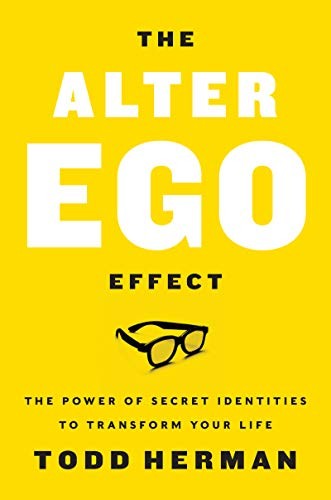
- Herman’s own Totem is the pair of glasses on the book’s cover. He bought non-prescription glasses despite twenty-fifteen vision, and describes the arms of the frames sliding across his temples as a switch being flicked. He also states plainly that the glasses do not get worn at home, which is the boundary rule expressed as a practice.
- The chapter’s exemplar of a historically significant object is Martin Luther King Jr.’s glasses, which Herman says inspired the cover and which he attributes to King’s distinguished self. Herman also names other Totems he has used, including a Darth Vader helmet for writing, his football helmet for Geronimo, and a bracelet made by his daughters that hangs by the front door and activates a Mr. Rogers approach to parenting.
- The chapter carries a dilution rule. Using the object indiscriminately weakens it, and the more meaning attached to the object the more deeply it resonates. That makes restraint part of the mechanism rather than a matter of taste.
Chapter 15: Tests, Trials, and Delivering the Ground Punch
The chapter covers what happens on the first outings, when doubt returns and the temptation is to withdraw. The Ground Punch is the deliberate declaration that starts the performance, and Herman’s point is that its audience is the person making it and nobody else.
- The Ground Punch scales to the person. Herman describes it as either a large physical move or a deliberately subtle gesture that nobody else would notice, and says its purpose is to send a message primarily to yourself that the performance has started. The superhero image is explicit in the book: the moment the hero plants a fist and the ground reverberates.
- The chapter’s answer to returning doubt is evidentiary rather than motivational. Herman’s instruction is to recall the beginning of your own record and recite your successes and achievements back, so that the response to an attack of insecurity is constructed from the alter ego’s perspective rather than the Enemy’s.
- The framing treats early failure as expected rather than as disconfirming. Tests and trials are a stage in the sequence, which sets the reader’s expectation that the first uses of a new identity will be uneven without that unevenness invalidating the build.
Chapter 16: Mindsets, Missions, Quests, and Adventures
The closing chapter converts a one-time build into an ongoing practice. It supplies a set of postures for staying in the practice and then extends the sequence outward from mindsets to missions to quests to adventures.
- The chapter’s centerpiece is the Six Mindsets to Win, stated as first-person declarations. Bring it on embraces the challenge. I am ready for anything is adaptability. I am a creative force is imagination. I love to play is the playful attitude. I wonder what will happen treats life as a laboratory. I believe I can change asserts that personality is malleable.
- Two of the six are load-bearing for the rest of the book. Herman elsewhere calls a playful mindset the key that unlocks flow, and defines mental toughness as adaptability and flexibility regardless of what circumstances are presenting.
- The last mindset closes the argument. If personality is malleable, then the persona is not a lie about a fixed self, and the whole method is internally consistent. If it is not, the method reduces to performance.
- Herman’s closing posture is deliberately unpackaged. He says the book is a choose-your-own-adventure book, that there is no pixie dust, and that he cannot sell alter egos off the shelf. The method is a build sequence the reader has to run rather than a product they can adopt.
About the Author
Todd Herman is a performance advisor who grew up on a farm and ranch in southern Alberta and now lives in New York City. He was a nationally ranked badminton player and played college football on scholarship. He began working with athletes in 1997, at twenty-one, founding a company called The Peak Athlete after volunteering as a high-school football coach and finding he was effective on the mental side of the game. He identified the pattern behind this book in 2003, interviewed the people he was working with about it, and built it into a method. He is the creator of the 90 Day Year leadership and skills development program, which has twice won a Stevie Award, and his company has been recognized on the Inc. 500 list. He waited roughly fifteen years to write the book, which was a Wall Street Journal bestseller.
The credibility for this specific book is practitioner credibility, and it is worth being precise about where it comes from and where it does not. Herman reports more than two decades of one-to-one work across eighty-plus sports, self-reported at over sixteen thousand hours, and he names Kobe Bryant, Cristiano Ronaldo and Rafael Nadal among the athletes he has advised. No academic degree, clinical license or sports-science credential appears in his own materials, and he is explicit in Chapter 1 that he is not a therapist and is unqualified to do that work. The specific claim that he was hired in 2003 to help create the Black Mamba persona is his own account, and the attribution of a distinguished self to Martin Luther King Jr. is likewise Herman’s. The book’s authority rests on pattern recognition across a large number of individual cases rather than on controlled research, and it is stronger read that way.
Key Takeaways
1) Performance is contextual, so the unit of improvement is an arena and not a person.
The book’s foundational move is to stop asking how to become more confident or more decisive in general and to ask instead who needs to show up on one specific field. Herman’s Field of Play model treats the environment, the constraints and the expectations present as part of the performance system rather than as background. That relocates the problem from character to context, which is why the same person can be commanding in one room and diminished in another without either being the real version.
- The four layers around the Core Self are Core Drivers, the Belief Layer, the Action Layer, and the Field of Play. Two people failing identically in the same meeting can be blocked at different layers.
- Herman’s instruction is to choose the arena where frustration is highest or the available win is largest, and to build for that arena alone.
- Bo Jackson’s alter ego lived on the football field and did not travel into business or the classroom, which Herman treats as the correct use rather than as a limitation.
2) The block is almost never a lack of desire, so effort is the wrong instrument.
Herman’s account of why people fail to act on what they already know is that reasoning and unconscious resistance are not evenly matched. His image is a mouse trying to direct a herd of rampaging elephants. He locates willpower in the frontal lobe and resistance in the unconscious, concludes that willpower can steer for days or weeks but loses over any longer horizon, and proposes imagination as the only force that reliably wins. The neuroscience here is loose, and it is his model rather than an established finding, but the practical conclusion is defensible on its own terms: if trying harder has not worked repeatedly, more trying is unlikely to be the missing ingredient.
- The Enemy is protective rather than hostile. Its job is to keep a person safe, which is why it responds to reassurance and circumvention rather than to discipline.
- Herman draws the lineage to Carl Jung’s shadow explicitly, which situates the concept in a tradition rather than presenting it as invention.
- He refuses the standard performance-industry prescription that the reader simply lacks desire, and names biochemical conditions as a real limit that no amount of goal setting will move.
3) The trap is the direction of motivation, not the circumstances.
The Ordinary World and the Extraordinary World are not different situations. They are the same situation approached from opposite directions. Outside-in means motivation sourced from other people’s expectations and judgments, which Herman says makes a person outcome-focused and concerned with pleasing rather than performing. Inside-out means deciding in advance how you intend to show up on a chosen field, which produces both the performance and the ownership of the result. Nothing about the external conditions has to change for the shift to occur.
- Herman’s diagnostic question is where the motivation is coming from, which is answerable in a way that questions about authenticity are not.
- His redefinition of inauthenticity is that it consists of not doing what you could be doing, which inverts the usual objection to persona work.
- The reward he names for the inside-out approach is owning all of the results, because the choice about how to show up was yours.
4) Naming a block converts it from a conclusion into a conversation.
The functional reason to name the Enemy is that unnamed self-criticism is indistinguishable from one’s own judgment. When the critical voice has no separate identity, its content arrives as an assessment already accepted. Giving it a name and a form creates a third party in the internal dialogue, and the same sentence that was previously a verdict becomes a position that can be answered. Herman’s formulation is that your negative self-talk is not you, which is a claim about ownership rather than about volume. The commentary does not have to stop.
- The pattern the chapter targets is circular self-criticism that feeds itself, each pass deepening the next.
- The same logic runs in the other direction. Naming the chosen identity is what allows a person to attribute the performance to it, which is exactly what Herman does with Geronimo.
- Herman’s tennis-player case shows that the Enemy is frequently a genuine strength operating on the wrong field. Fairness served her everywhere except in a match she was winning.
5) Borrowed traits are faster and more reliable than self-generated ones.
The chapter on superpowers rests on a claim about efficiency. Asking a person to become more decisive gives them nothing to work from. Asking them which person, character, animal or idea already embodies the decisiveness the field requires gives them a complete behavioral reference to imitate. Herman’s own catalog deliberately includes non-human sources: animals, ideas such as mystery or peace, places, elements and archetypes. The source does not need to be admirable in general. It needs to embody the specific traits the arena demands.
- The three entry points are alternatives rather than steps: start from the traits, start from someone you admire, or notice that the answer is already present in your environment.
- Herman’s own composites blended multiple sources. Super Richard combined Joseph Campbell, Benjamin Franklin and Superman.
- Herman cautions that no trait description is fixed and that the reader’s own reading of a character is what carries the meaning.
6) The trigger has to be physical, and it has to be rationed.
The Activation Event is the most operationally distinctive requirement in the book. Herman defines a Totem as any object that connects a person to their chosen identity, and then insists that the activation paired with it be a physical action. Intention on its own does not qualify. He also imposes a dilution rule: using the object indiscriminately weakens it, and the more meaning attached to it, the more strongly it works. Restraint is therefore part of the mechanism, not a stylistic preference.
- Herman’s own example is the arms of his glasses sliding across his temples, which he describes as a switch being flicked.
- Anthony’s activation was wiping his face with a towel as though pulling on a panther mask, performed once, just before the game started.
- The boundary rule appears as a practice rather than a caveat. Herman states that the glasses do not get worn at home.
7) A mission, not intensity, is what makes a new identity hold.
The chapter on mission argues that a hedonic goal is a weak engine and that a purpose larger than personal enjoyment produces better outcomes. The mechanism is that acting as someone new is uncomfortable, and the mission is what makes the discomfort worth absorbing. This also constrains the persona to a single job on the field, which is what stops it from sprawling into a general personality upgrade. Herman extends the point to a common complaint, arguing that people who say they need more focus actually need more meaning attached to the activity and to where it leads.
- Bo Jackson’s mission was a single sentence about destroying anything in his path, which served him in that context and nowhere else.
- Herman’s account of Martin Luther King Jr. is his strongest illustration: a mission important enough that accumulated insecurities could not be allowed to interfere.
- The prerequisite Herman names is honesty about what you actually want, and he counts helping athletes retire and an owner exit after thirteen years among his best outcomes.
8) The boundaries are the method, not the fine print.
The book is repeatedly and unusually clear about what it is not proposing. Herman rejects faking it until you make it, on the grounds that deception is an outside-in move by definition and that the method is about activating a chosen self rather than misleading anyone. He rejects living as the alter ego full time, saying it produces a fractured person. He rejects building many personas at once. He rejects the idea that the book substitutes for clinical care. Read together, these constraints are what make the method coherent, because they confine it to short, bounded, high-stakes use on a single arena.
- The distinction Herman draws is between pretending and activating, and he applies it to Cary Grant’s own account of his career.
- His scope instruction is to start with one arena and not to build out nine alter egos.
- In Chapter 1 he routes clinical need to clinicians directly inside a case story rather than confining the disclaimer to front matter.
Strengths and Limits
The book’s principal strength is that it is a build sequence rather than an exhortation, and the sequence is unusually specific. Choose one arena. Identify the handful of moments on it that decide the outcome. Name the internal force that has been blocking you. Borrow the traits you need from a source that already embodies them. Give the result a name and an origin story. Pair it with an object and a physical trigger. Use it only there. Each step has a stated purpose and a mechanism, and the Field of Play model gives the reader a way to locate which layer they are actually stuck at instead of applying undifferentiated effort. The book is also candid in ways the performance genre rarely is. Herman rejects faking it until you make it, states that he is not a therapist and is unqualified to do that work, names biochemical conditions as a real limit that no workshop will move, warns that living as the alter ego full time produces a fractured person, and says outright that he cannot sell alter egos off the shelf. Its most durable contribution to the management literature is the reframe underneath all of it: that performance is a property of a person in a context rather than a fixed attribute of the person, which makes it improvable by design rather than only by growth.
The limits are largely evidentiary. The book’s load-bearing scientific citation is enclothed cognition, and the specific lab-coat finding Herman relies on failed a pre-registered, high-powered direct replication that its original authors accepted as competently conducted. Herman’s retelling also overstates the original: he says the doctor’s coat group finished in under half the time, while the published paper states twice that completion times did not differ between conditions. The research most often invoked for the underlying idea, the Batman effect studies of children impersonating a competent character, measured minutes of persistence on a deliberately boring task among four- to six-year-olds, has no published adult replication, and contained a design confound in which only the character condition also got to choose its character. The adult self-distancing literature that does replicate reports small effects, and its pronoun-only variant is the weakest form. The multiple-self psychology Herman describes as settled is asserted rather than demonstrated, and the strongest version of his claim rests on a study he does not name. Beyond the evidence, the book contains no cost model. It specifies how to switch the persona on and, apart from the instruction not to live there, says almost nothing about what sustained operation out of character costs or how to recover from it. The predictable failure mode follows from that gap: a reader builds a second self for the hardest arena, finds that the hardest arena is most of the working week, and ends up performing continuously without the bounded use the method depends on.
My Take
The diagnosis holds, and it holds harder for founder-CEOs than for the athletes Herman built the method on. Most founders I work with are operating in at least three arenas they never trained for, and they are measurably different people in each one. The same founder who is genuinely fearless in a product argument goes quiet in a board meeting, or dominates a sales call and cannot run a performance conversation with a direct report. The reflex is to read that inconsistency as a character problem, which produces years of general self-improvement and very little change. Herman’s contribution is to relocate the problem to the arena. That is the right relocation, and it makes the problem tractable in a way that working on confidence never does.
It plays very differently depending on the arena, and the difference tracks how bounded that arena is. For discrete high-stakes performances with a clear start and end, an investor pitch, a stage keynote, a negotiation, a difficult termination, the method is well matched. There is an entrance, a defined performance, and an exit. It matches much worse for the arena founders actually struggle with, which is being the CEO. There is no offstage. Leading a company is not a performance with a start whistle, and a persona that has to hold from Monday morning to Friday night stops being a bounded instrument. The other split is founder-led versus institutionally led. In a fifteen-person company the founder’s personality is the operating system, and a visible persona shift is felt by everyone and read as inauthenticity. At two hundred people with real management layers, the same shift is unremarkable, because everyone already understands that the CEO in a board meeting and the CEO in a team retrospective are running different scripts.
The most credible objection comes from someone who accepts the mechanism and then prices it. Brian Little at Cambridge coined the term free traits for strategic displays that run counter to a person’s fixed traits in service of something they care about. His finding is that short bursts need not be costly, but that prolonged acting out of character drives fight-or-flight activation and contributes to burnout, and that the remedy is structural rather than motivational: restorative niches where a person can operate as their first nature, and shared agreements with colleagues that protect the recovery. Herman’s book has no such model. Igor Grossmann, whose research on third-person self-reflection is the closest legitimate science to Herman’s mechanism, adds a sharper caution in his own paper, noting that strategic public use of third-person language for self-presentation may not produce the benefits his diary studies found. And the emotional-labor literature makes a distinction the book never does. Across ninety-five studies, Ute Hülsheger and Anna Schewe found that surface acting, a display layered over an unchanged internal state, correlates with impaired well-being at around point four, while deep acting, in which the person actually generates the state, does not. A costume and a name most easily produce the first. Herman offers no diagnostic to tell a CEO which one they are doing, and that is the gap I would want closed before handing the book to someone already close to their limit.
The book that completes it is Herminia Ibarra’s Act Like a Leader, Think Like a Leader. Ibarra agrees with Herman on the thing most people find objectionable, that you act your way into a new self rather than reflecting your way there. She disagrees about what is inside. Herman’s framing is that the alter ego releases a Heroic Self already present. Ibarra’s research says there is no such fixed article waiting, and that leadership identity is built iteratively out of experiments in real roles and the feedback they generate, which she calls outsight. Read together the two are complementary and the sequencing is obvious. Use Herman to get through the specific moments you have been avoiding, because a bounded persona and a physical trigger will genuinely get a founder onto a stage or into a hard conversation. Then use Ibarra to convert those outings into permanent range, so that in eighteen months the capability is yours and the object on the hook by the door is a souvenir rather than a requirement.
Discussion Questions
For CEOs
- Which single arena in your role produces the most avoidance, and what would you be doing differently there if the avoidance were gone?
- Name the three to five moments on that arena that actually decide the outcome. How much of your total performance sits inside them?
- In which of your recurring rooms are you a materially different and worse operator than you are in the room you are best in? What is different about the room, not about you?
- What internal commentary shows up in the moments you avoid, and whose voice does it sound like when you write it down verbatim?
- Which of your genuine strengths is working against you on that specific arena, in the way that fairness stopped Herman’s tennis player closing out matches?
- Which specific traits does that arena require that you do not reliably bring, and who or what already embodies all of them at once?
- What is the mission on this arena, stated in one sentence, that would make operating out of character worth the cost?
- If you did build a bounded second self for this arena, what is your recovery structure, and what would tell you it had stopped being bounded?
For Teams
- Where does this team perform materially below its capability, and is the gap in the arena or in the individuals?
- Which recurring meeting produces the most careful language and the least real disagreement, and what about the setting causes that?
- What are this team’s Moments of Impact, meaning the specific recurring moments where the outcome is actually determined?
- Which behaviors does the team currently not exhibit that would change results, stated as observable actions rather than as attitudes?
- Where is the team operating from the outside in, optimizing for how a decision will be perceived rather than for whether it is right?
- What shared narrative does this team hold about what it can and cannot do, and when was it last tested against evidence?
- Which team norms function as protective mechanisms that once served a purpose and now block performance?
- If a leader here started operating noticeably differently in one specific setting, would this team read it as intentional or as inauthentic, and what does the answer tell you about the team’s psychological safety?
Practical Tools
1. Field Of Play Selection
Every step that follows depends on getting this one right, and the most common error is choosing too many arenas or choosing the wrong one. Herman’s model treats the environment, its constraints, and the expectations of the people in it as part of the performance system, which means an intervention that is not scoped to a specific arena has nothing to act on. His selection rule is deliberately blunt: go to the area of your life you are most frustrated with, or where the biggest available win sits. Use this when the honest answer to why performance is inconsistent is that it varies by room rather than by day.
How it works:
- List the four to six distinct arenas in your role. Board meetings, investor conversations, leadership team meetings, sales calls, difficult individual conversations, public speaking. Treat each as separate even where the people overlap.
- Score each on two dimensions. How much does the outcome of this arena matter to the business, and how far below your capability do you operate in it.
- Choose the single arena scoring highest on both. Resist the instinct to pick two. Herman’s instruction is not to build out nine alter egos.
- Write down what specifically is different about that arena. The physical setting, who is present, what they expect, what is being judged. This is the layer the block usually lives in.
- Write one sentence describing how you currently show up there and one describing how you intend to. Keep both behavioral.
You will know this has worked when the conversation about your own performance stops being about character and starts being about a specific room. The useful signal is that you can now describe the problem without using any adjective about yourself, only a description of a setting and a gap between two named behaviors.
2. Moments Of Impact Inventory
Herman defines Moments of Impact as the critical moments that define a large part of a person’s success, and Chapter 5 is the search procedure for finding them. The reason this narrowing matters is economic. If the whole arena has to be transformed, the effort required is unsustainable. If four identified moments have to be handled differently, the effort is small and the leverage is most of the outcome. Use this immediately after selecting an arena, and before deciding anything about traits or names.
How it works:
- Work backward from the outcome you want on the chosen arena. Ask what specifically has to happen for that outcome, and keep asking until you reach moments rather than phases.
- Read through Herman’s categories and note the ones that apply: high-stakes events, physical and emotional distraction, adverse conditions, financial pressure, exhaustion, and comparison against high-performing peers.
- Write each candidate moment as an observable event with a trigger. Not preparing better for board meetings, but the moment a board member challenges a number you are not certain about.
- Cut the list to three to five. For each, write what you currently do and what the moment actually requires.
- Check the list against your calendar for the last quarter. If a moment did not actually occur, replace it with one that did.
The signal is that you can name, in advance and without hesitation, the four moments in the next month where your performance will be decided. Preparation stops being general readiness and becomes rehearsal for named events, and the amount of anxiety attached to the whole arena drops because it is now attached to a finite list.
3. The Enemy Naming Pass
Chapter 7 argues that self-criticism is corrosive specifically because it arrives indistinguishable from your own judgment, so its content is accepted before it is examined. Naming its source creates a third party in the internal dialogue, which converts a verdict into a position that can be answered. Herman’s formulation is that your negative self-talk is not you. Note that the same chapter’s parent argument in Chapter 6 is that the blocking force is protective, so the objective is not to defeat it. Use this for the specific moments identified in the previous exercise, not as a general practice.
How it works:
- For each Moment of Impact, capture the internal commentary verbatim, in the moment or immediately after. Write the actual sentences, not a summary of them.
- Look for the pattern across moments. Most people are running three or four sentences on repeat, not an infinite variety.
- Ask what each sentence is protecting you from. Herman’s position is that the Enemy’s job is to keep you safe, and the answer is usually a specific historical exposure.
- Test whether the block is actually a strength in the wrong context, as fairness was for Herman’s tennis player. If it is, note where that value does serve you, because you are not removing it.
- Give the pattern a name and use it out loud when it appears, so that the commentary is addressed rather than absorbed.
What changes is the latency between the thought and the action. Before, the commentary produced hesitation that looked like deliberation. After, the sentence still arrives, is recognized as familiar, and does not change the decision. If your standing objection to a course of action turns out to be one of four sentences you have been running for a decade, that is the exercise working.
4. Superpower Selection And Naming
Chapter 11 rests on a claim about efficiency. Being told to be more decisive supplies nothing to imitate. Identifying something that already embodies the exact decisiveness the arena requires supplies a complete behavioral reference. Herman offers three entry points rather than a sequence, and his catalog deliberately extends beyond people to animals, ideas, places and archetypes, because the source only has to carry the traits. Use this once the arena and the moments are fixed, since the traits are selected against the moments and not against a general ideal.
How it works:
- For each Moment of Impact, list the two or three traits the moment actually requires. Keep the list short and specific. Composed under direct challenge is usable. Confident is not.
- Consolidate into a single trait set for the arena. If the consolidated set exceeds five traits, the arena is probably two arenas.
- Find one or more sources that already embody the whole set. Ask who or what already has this, and allow non-human answers.
- Blend if no single source covers the set. Herman’s own examples are composites of two to five sources.
- Name it, then say the name out loud. Herman’s worked example ran through three rejected candidates before landing, and the test is your own reaction rather than the name’s cleverness.
- Write the origin story in a short paragraph. Why this set of traits, why this source, why this arena. Chapter 13’s claim is that the simplest origin stories are the most powerful, and that emotional truth is what matters rather than elaborateness.
The observable result is that preparation changes character. Instead of trying to feel ready, you are asking how this specific set of traits would handle the moment, which is a question with an answer. If the name makes you slightly uncomfortable to say and simultaneously clarifies what to do, it is the right one.
5. Totem And Activation Pairing
This is the switch, and Chapter 14 is the longest chapter in the book. Herman defines a Totem as any object that connects a person to their chosen identity, and then imposes a requirement that separates the method from positive self-talk: the activation paired with the object has to be a physical action. His own version is the arms of a pair of glasses sliding across his temples, which he describes as a switch being flicked. The chapter also carries a dilution rule, so restraint is part of the mechanism. Use this only after the trait set and name exist, because the object has to point at something.
How it works:
- Choose an object already present in the arena or plausibly carried into it. Herman’s examples include glasses, a towel, a helmet, a jacket and a bracelet.
- Prefer an object with personal history over a purchased one. The chapter’s stronger category is an object that already means something to you, and Herman’s own bracelet was made by his daughters.
- Define the physical action that pairs with it. It must be physical, small, repeatable, and invisible to observers if you want it to be.
- Set the boundary explicitly. Decide where the object is not used. Herman’s rule is that the glasses do not get worn at home, which is what keeps the trigger from diluting.
- Define the deactivation as deliberately as the activation. Removing the object, and a specific action attached to removing it, is the recovery half of the practice and the part most readers skip.
- Run it on a low-stakes instance of the moment before using it on a high-stakes one. Chapter 15 treats early unevenness as a stage rather than as disconfirmation.
The signal is a reduction in the ramp-up time you need before a hard moment. Something that previously required an hour of working yourself up becomes available in seconds. The stronger signal is on the other side: you notice yourself putting the object down and the intensity coming off, which is the boundary working and the part that protects you from operating out of character all week.
6. Extraordinary World Action List
Chapter 9 carries two exercises that map onto two of the four layers from Chapter 3, and they are the most concrete work in the book. The premise is that the Extraordinary World is not a change in circumstances but a change in the locus of decision, which means it has to be expressed as specific behaviors rather than as a resolution. Herman sequences belief first, then action, and scopes the output to the identified moments. Use this to convert everything above into a checkable list, and revisit it quarterly rather than once.
How it works:
- Belief layer first. Write what you would need to believe about yourself and about this arena for the required behaviors to feel effortless rather than forced.
- Then what you would need to expect, about yourself and about the people on that arena, for those behaviors to be reasonable rather than risky.
- Then what you would need to value about your own skills and knowledge to act decisively there.
- Action layer second. For each Moment of Impact, name the specific behavior you will start, the one you will continue, and the one you will do more of. Herman’s examples are at the level of asking for the sale more often or making more eye contact.
- Attach each behavior to a named moment on the calendar. A behavior with no scheduled occasion is an intention.
- Review at the end of the quarter against what actually happened in those moments, not against how you felt about them.
The result is that a change of identity becomes auditable. At quarter end you can say which of eight named behaviors occurred in which of four named moments, which is a very different conversation from asking whether you feel more confident. The reliable early signal is that other people on that arena describe you differently before you feel any different yourself.
Further Reading
- Herminia Ibarra, “The Authenticity Paradox,” Harvard Business Review, January 2015. The argument that a rigid attachment to a true self is a growth trap, and that leaders develop by acting first and reflecting second.
- Brian R. Little, “Acting Out of Character in the Immortal Profession: Toward a Free Trait Agreement.” The cost model the book lacks, including restorative niches and the risk of prolonged out-of-character behavior.
- Ethan Kross and colleagues, “Self-Talk as a Regulatory Mechanism: How You Do It Matters,” Journal of Personality and Social Psychology, 2014. Seven studies on shifting from first person to third person during reflection.
- Igor Grossmann and colleagues, “Training for Wisdom: The Distanced-Self-Reflection Diary Method,” Psychological Science, 2021. Two pre-registered experiments, and the authors’ own caution about strategic public use of third-person language.
- Rachel White and colleagues, “The Batman Effect: Improving Perseverance in Young Children,” Child Development, 2017. The study most often cited for the book’s premise, run on four- and six-year-olds.
- Hajo Adam and Adam Galinsky, “Enclothed Cognition,” Journal of Experimental Social Psychology, 2012. The book’s load-bearing citation, worth reading alongside the replication record below.
- Devin Burns and colleagues, “An Old Task in New Clothes: A Preregistered Direct Replication Attempt of Enclothed Cognition Effects on Stroop Performance,” 2019. The high-powered replication that found no lab-coat effect.
- Ute Hülsheger and Anna Schewe, “On the Costs and Benefits of Emotional Labor,” Journal of Occupational Health Psychology, 2011. Ninety-five studies separating surface acting from deep acting, and the well-being costs of the former.
- Daphna Oyserman, “Identity-Based Motivation: Implications for Intervention.” The peer-reviewed theory closest to Herman’s premise, holding that identities are context-dependent and dynamically constructed.
- Herminia Ibarra, “Provisional Selves: Experimenting with Image and Identity in Professional Adaptation,” Administrative Science Quarterly, 1999. The academic ancestor of trying on a professional identity before owning it.
- Todd Herman’s own Chapter 1, released free by the publisher. The Bo Jackson greenroom scene, the Superman riddle, and Anthony’s story in full.
Share This Review

Bruce Eckfeldt is a business coach and strategic advisor to founder-CEOs of growth-stage companies, a former Inc. 500 CEO, and the author of Springboard. More book reviews →
These summaries present Bruce Eckfeldt’s analysis of business and leadership books for founder-CEOs and leadership-team members of growth companies. Each one identifies the ideas most relevant to decision quality, strategy, and leadership capacity, notes where the evidence is weak, and suggests practical ways to test what is worth testing. All ideas, stories, and quotations belong to the original author and to the people they cite. The assessments and recommendations are Bruce’s. It is a companion to the book, not a substitute for reading it.
To learn more about Bruce’s programs, request other book summaries, or get in touch, contact booksummaries@eckfeldt.com.
Get the Next Review.
A new book review lands in Better, Faster, my weekly newsletter for founder-CEOs, along with one practical essay and questions for your team.