12 Habits of Valuable Employees
Your Roadmap to an Amazing Career
Doing your job well is the baseline, and real value comes from habits that improve the system around the job so the whole company grows.
A book summary and review by Bruce Eckfeldt
Overview
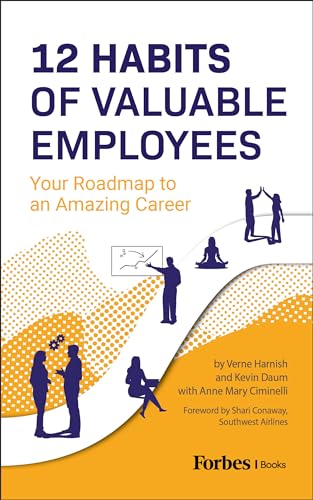
12 Habits of Valuable Employees is a short field guide written for the people inside a growing company rather than the people running it. Verne Harnish, Kevin Daum, and Anne Mary Ciminelli start from a gap they say leaders see and employees rarely do. Most team members believe they are reasonably valuable. Their employers often see adequacy, meaning people who show up, meet the minimum requirements, avoid problems, and create value roughly equal to what they are paid. The book sets out to close that gap by describing what valuable looks like in practice.
The structure borrows the four hiring criteria Harnish set out in Scaling Up: Will, Values, Results, and Skills, presented in order of importance. Each criterion becomes a part of the book with three habits, for twelve in total. Every habit chapter opens with a workplace story that shows a capable person doing a good job, then shows what that person missed and how a valuable employee would turn the same situation into something larger. Each chapter closes with three practical actions. The book ends with guidance for employers and a suggested rhythm of one habit per month and one behavior per week.
Doing your job well is the baseline, and real value comes from habits that improve the system around the job so the whole company grows.
Chapter Summaries
Chapter 1: Developing as a Leader
The first habit argues that leadership is a practice an employee can start before the title arrives, and that the company benefits most when the practice spreads. The story follows Jessica, promoted to team leader at the semiconductor firm SumCo at 26 with little support and a distant manager. She learns by trial, by listening to experienced colleagues, and by reading late at night, and her impact grows once she treats the role as something to expand rather than simply manage.
- Leading by example creates value because it lifts the people around the leader. The authors argue that consistent, visible growth practices give the rest of the company a pattern to copy and help build an internal pipeline of future leaders.
- Learning is the first action. The authors point to Mark Zuckerberg’s goal of reading a book every two weeks and to Peter Drucker’s reading of fiction to sharpen his people skills. The mechanism is that leaders who keep learning keep widening the range of problems they can solve.
- A peer coach supplies objectivity a manager often cannot. Someone on the same journey can see blind spots without the evaluation pressure that colors feedback from a boss.
- The authors ask readers to become multipliers, people who amplify the results of those around them by spotting and unlocking colleagues’ talents. Value moves from individual output to team output.
Chapter 2: Aligning Vision
The second habit argues that ambition is only valuable when it fits the company’s larger plan. Alex, newly appointed to lead the Pleasantville branch of the tax firm PrepaTax, beats a 15 percent growth target with 27 percent growth. His success overloads shared resources, pulls his marketing away from company standards, and his self-taught code changes create technical problems. Once he studies the strategic plan and works with other branch leaders, every branch hits the target.
- Local wins can create system losses. The chapter’s point is that a high performer who optimizes their own unit without regard for shared resources is borrowing from colleagues, and the bill arrives somewhere else in the company.
- The authors place part of the fault with senior leaders who relied on written announcements instead of conversations that build shared understanding. Vision that is only published is rarely absorbed.
- The first action is to absorb the vision, including the company’s BHAG and quarterly priorities, and to ask senior leaders when they are unclear. The authors note that leaders tend to be impressed by the question.
- The test of alignment is whether an activity can be tied back to the company’s ultimate goal. If it cannot, the activity should be reconsidered. The third action extends the test to colleagues, helping them reprioritize when their work drifts.
Chapter 3: Enabling Growth
The third habit argues that valuable employees treat company growth as their own objective and look past their own patch of territory. Isaac, an assistant leader at the Boulder location of the plant-based chain VeggieHut, prepares his team for a health inspection by arranging preventive maintenance and assigning inspection duties, and the location earns its best score. He then calculates the long-term case for new equipment, and the chain replaces it at every location.
- Fixing the local problem is adequate. Turning it into a scalable improvement is valuable. Isaac’s value in the story comes from the second step, where he takes his data to regional leadership and the fix spreads.
- The authors frame growth through two questions. What is being done consistently poorly by current standards, and which processes, procedures, and behaviors will inhibit future scale.
- Many employees believe growth is someone else’s job. The authors argue senior leaders actively look for people who can see beyond the here and now, which makes growth thinking a visible differentiator.
- The three actions are to learn the whole business, study scalability, including Harnish’s Mastering the Rockefeller Habits, and form growth committees with other ambitious colleagues so growth thinking becomes a group habit.
Chapter 4: Integrating Core Values and Purpose
The fourth habit opens the Values part and argues that core values only work when people act on them, enforce them, and build them into company systems. Megan, creative director at the agency Commnivore, coaches a skilled but disengaged designer named Alan through one-on-ones and meeting preparation. She then realizes the team talks about its five values without living them, and launches a program that builds the values into hiring, onboarding, reviews, and rewards.
- The authors compare core values to the rules of a sport. Rules only hold when someone acts as the referee, and in a healthy company everyone shares that role.
- Core values are described as No Matter What values. That framing produces only two kinds of employees, those who actively live the values and those who detract from them through behavior and decisions.
- Speaking up is part of the habit. If a colleague violates a value, the authors advise a private conversation where possible and escalation to their leader otherwise. People who model the values should be called out publicly so others learn.
- The practical actions are to learn the company’s values and compare them with one’s own, map each responsibility to a value with measurable goals, and enlist colleagues in value-driven behavior.
Chapter 5: Managing Conflict
The fifth habit argues that real value emerges when the issues behind conflict are surfaced and resolved at the root rather than smoothed over. Brin works at Longville Healthcare Agency amid passive-aggressive email threads and shouting in meetings. After learning active listening and pausing before reacting from a book on conflict, he invites his manager, Andy, to coffee and offers to help. Within three months the office culture has shifted.
- Reactive firefighting consumes time without removing causes. The authors argue employees create value when they find the root cause, resolve differences productively, and change the system so the problem stops recurring.
- Conflict is described as either a culture killer or a culture maker. The difference is whether people practice respectful honesty and civil disagreement that ends in a decision.
- Banishing quiet politeness is the first action. The authors ask readers to state ideas and concerns clearly, without apologies or caveats, because hedged input is easy to ignore.
- The idea circle lets team members raise problems informally, even anonymously on cards, before the group turns to solutions. It surfaces issues that would otherwise stay hidden.
Chapter 6: Driving Excellence
The sixth habit argues that reactive effort burns out and that excellence comes from systems built with the future in mind. Angela at Evergreen Commercial Construction takes over external communications after a merger triggers customer complaints. Her first burst of content, a response team, blog, social posts, and an internal podcast, fades as the team tires. She rebuilds a simpler model tied to company goals, with every department owning annual content.
- Effort that is not aligned with a corporate vision is hard to sustain. Quality falls and the program becomes a burden, which is why Angela’s first approach collapsed.
- Adequate employees improve their own efforts. Valuable employees spread new knowledge systematically through the company, which turns one person’s improvement into a company capability.
- Templates are the most concrete action in the chapter. When an employee finds a better way to do a task, the authors ask them to institutionalize it as a template, checklist, workflow, or how-to guide.
- Acting with the future in mind means weighing both short-term and long-term consequences before acting, which is the discipline Angela lacked in her first attempt.
Chapter 7: Surfacing Issues
The seventh habit opens the Results part and argues that last-minute heroics often hide the behavior that made heroics necessary. Jonathan, a veteran loan officer at Midstate Capital Finance, overlooks small discrepancies in a couple’s mortgage application and misses a new regulation. The loan nearly fails, he rescues it, and he is praised. The authors call the rescue a well-managed patch over a preventable problem, and Jonathan responds by building checklists and a weekly regulatory update.
- Heroics are a symptom. The organization rewards the rescue and never sees the cost in time, customer trust, and team strain that the preventable problem created.
- Taking things apart is the first action. Understanding why formulas and processes are built the way they are makes it far easier to see where they will break.
- A diligence process, with standard preparation and a completion checklist, replaces personal workarounds that depend on one experienced person’s memory.
- Reducing handoffs lowers the number of places a process can fail. The authors argue fewer touches mean less need for anyone to save the race at the end.
Chapter 8: Improving Process
The eighth habit argues that scalable processes that can be taught, measured, and improved sit at the heart of value creation. Mary leads a visual communications team at Excelsior Marketing that is drowning in urgent requests with no shared process. She works with the team to identify the recurring steps, builds a checklist, and sets aside half an hour a day to refine the process. Within weeks the team is faster and the quality of its work improves.
- When everything depends on the situation, nothing scales. The team’s overload in the story comes from the absence of a shared process, not from too little effort.
- Process is measured three ways. The authors name quality, time, and cost, and ask employees to know those measures for every process they touch.
- Weekly cross-functional lunches are the first action. Meeting someone from another department to explore a shared process exposes the handoffs where most failures happen.
- Documentation turns individual learning into company learning. The authors ask employees to record each process so others learn from both successes and mistakes.
Chapter 9: Getting Things Done
The ninth habit argues that productivity depends on training, structure, and consequences, and that a valuable employee fixes all three rather than just working harder. Dylan at the home-services firm BreezeAir faces a demand surge from a successful promotion. He organizes training, pairs experienced technicians as shadow mentors, and adds buffer time between appointments. He then pushes for systemic fixes, including onboarding, procedure handbooks, and an updated performance evaluation system.
- Productivity requires accountability. The authors list training for required activities, the structure and tools to do the work, and meaningful consequences for those who cannot make the grade.
- Evaluation starts with oneself. Readers are asked to find where they are unproductive because they are unmotivated, lack structure, or face no consequences.
- Curiosity is treated as a productivity habit, because critically examining processes is how inefficiencies and opportunities come to light.
- Daily and weekly goals tied to team priorities make progress visible and allow adjustment along the way.
Chapter 10: Fostering Communication
The tenth habit opens the Skills part and argues that communication creates value when it is built around a memorable message and delivered as a campaign rather than a single event. Brittany’s customer service team prepares a polished but forgettable presentation for the CEO. A teammate, Aliyah, draws on her performing arts background to turn it into a story, with posters beforehand and follow-up emails afterward, and the message lands.
- Communication is judged by what is remembered, not by what is said. A clean, accurate presentation can still fail if nothing sticks.
- Every communication should start from the key message. The authors ask readers to begin with the end goal and design everything around it.
- A wider repertoire, including writing, public speaking, and online communities, lets a communicator reach audiences that one format would miss.
- Campaigns beat events. Planned messaging across several formats and moments reinforces the message long after the meeting ends.
Chapter 11: Inspiring Creativity
The eleventh habit argues that creativity is most valuable when it is tied to goals and spread across a team rather than concentrated in one person. Connie, the first full-time marketing lead at the nonprofit BrightStart-4-All, builds the organization’s visibility on her own until colleagues start saying she has it covered. She slows down and launches Creative Lunches, and content production becomes a team effort.
- A single creative star creates a dependency. When creativity sits with one person, others use phrases like I am not that creative to opt out.
- Creativity needs clear, data-driven goals. The authors argue ideation without a defined objective wastes effort and erodes credibility.
- A creative process requires exposure to new inputs. The authors suggest forums, conferences, and museums, and learning beyond business.
- Surfacing creativity in others means giving colleagues clear points to check in and give feedback, which raises both the quality and the adoption of the work.
Chapter 12: Effecting Change
The final habit argues that change happens when someone builds a well-supported case and persuades the people affected, rather than imposing it. Auggie takes over engineering at GoGas, a stable company falling behind on software, production technology, and the shift to electric vehicles. He studies the resistance, finds that it comes from fear of uncertainty, and presents change as collective growth. The team moves from not needed for now to asking for the next step.
- Resistance to change is usually fear, not laziness. Auggie’s approach works because he treats the fear as legitimate and addresses it directly.
- The valuable employee combines diagnosis, a mission others find exciting, and the ability to execute the plan. Missing any one of the three stalls the change.
- The authors borrow a three-step process from Ari Weinzweig of Zingerman’s. Write an envisioned future describing how things will be better, list everyone affected, and meet each person to win their support.
- The conclusion asks readers to work one habit per month and one behavior per week, then repeat the cycle, the way athletes return to fundamentals.
About the Authors
Verne Harnish founded the Entrepreneurs’ Organization in 1987 and chaired its Birthing of Giants CEO program at MIT for fifteen years. He is founder and CEO of Scaling Up, a global executive education and coaching company, and the author of Mastering the Rockefeller Habits and Scaling Up. Kevin Daum is an Inc. 500 CEO, a media strategist, an Inc.com columnist, and the author of books including ROAR! Get Heard in the Sales and Marketing Jungle. He was a major contributor to Scaling Up. Anne Mary Ciminelli worked as an associate editor at Daum’s firm, TAE International, and co-wrote 12 Lessons in Business Leadership with him.
The authors’ credibility here comes from decades of sitting on the employer side of the table. Harnish and Daum have spent their careers with founders and CEOs, and the book’s central claim, that leaders see adequacy where employees see value, reflects what those leaders say in private. The same vantage point is the limit. The evidence comes from surveys of employers and the authors’ own experience rather than structured research with employees or data on outcomes.
Key Takeaways
1) Adequacy is the hidden default, and most people do not see it in themselves.
The authors build the book on what employers say about their people in closed-door conversations. Leaders keep and value people who show up, meet the requirements, deliver reliably, and avoid problems, and the best organizations treat that profile as mere adequacy. The gap matters because the people inside it rarely see it. Most employees believe they are valuable, so the shortfall tends to register only when a promotion or opportunity goes to someone else.
- The bar keeps moving in a growing company, so performance that was valuable at one stage can become adequate at the next.
- Adequate employees keep a company treading water. They do not help it pull ahead of competitors.
2) Will, Values, Results, and Skills are ranked, and the order matters.
The book is organized around the four hiring criteria from Harnish’s Scaling Up, presented in order of importance. Will comes first because without desire nothing else develops. Values come next because a high performer who violates the culture does damage that results cannot offset. Results follow, and Skills come last because technical skills date quickly and a motivated person can acquire them.
- Each criterion holds three habits, which gives a talent conversation a shared vocabulary that goes beyond job performance.
- The ranking pushes against the common practice of hiring for skills and firing for attitude.
3) The valuable move is the second step, from fixing a problem to fixing the system.
Across the twelve stories, the protagonist first does a good job and then sees a larger opportunity. Isaac fixes his location’s equipment and then makes the case for the whole chain. Jonathan rescues a loan and then builds the checklist that prevents the next rescue. Megan coaches one designer and then builds values into hiring and reviews. The repeated pattern is the book’s real argument. Value comes from improving the system that produced the problem.
- The first step earns praise. The second step changes the company.
- Leaders spot the second step because it reaches beyond the employee’s own role.
4) Heroics are often a sign that something upstream is broken.
The Surfacing Issues chapter makes the book’s sharpest operational point. Companies admire people who save the day at the last minute, and that admiration hides the fact that the rescuer’s own behavior often caused the crisis. Jonathan’s loan rescue earns recognition, and the authors call it a well-managed patch over a preventable problem. Rewarding heroics teaches the organization to tolerate the conditions that require them.
- Checklists, diligence processes, and fewer handoffs reduce the need for heroes.
- Recognition systems that celebrate rescues need a counterweight that celebrates prevention.
5) Alignment beats ambition when the two conflict.
Alex’s 27 percent growth against a 15 percent target is the book’s warning about unaligned high performance. His results came partly at the expense of shared resources, brand standards, and technical systems. When he aligned with the strategic plan, every branch reached the target. The authors also hold leadership accountable, arguing that vision delivered through written announcements rather than dialogue leaves ambitious people to define their own direction.
- A BHAG and quarterly priorities only align people who have absorbed them.
- An activity that cannot be tied to the company’s goal is a candidate for removal.
6) Values and conflict are everyone’s job, not only management’s.
The Values part asks employees to act as referees. Core values are framed as No Matter What values, which leaves two kinds of employee, those who live them and those who detract from them. Conflict is handled the same way. The authors argue that quiet politeness is a cultural cost, and that employees who name issues clearly and help resolve them at the root create more value than those who stay neutral.
- Speaking up about a value violation starts privately and escalates only when needed.
- Hedged, apologetic input is easy for a team to ignore.
7) Mastery is iterative, one habit at a time.
The book closes with a cadence rather than a checklist. Readers are asked to work one habit per month and one behavior per week, then repeat the full year, the way tennis, golf, or pickleball players return to fundamentals with every stroke. The habit frame matters because it treats value creation as repeated behavior rather than a single decision to try harder.
- A twelve-month cycle maps neatly onto a company’s annual and quarterly planning rhythm.
- The authors’ closing advice is to do the job you want next.
Strengths and Limits
The book’s main strength is its format. Each habit is taught through a contrast between a capable person doing good work and the same person seeing the larger opportunity, which makes the difference between adequate and valuable concrete for readers early in their careers. The four-part structure ties individual behavior to the Will, Values, Results, and Skills criteria many growth companies already use for hiring, so the book gives employees and leaders a shared vocabulary. The Surfacing Issues and Improving Process chapters carry the most operational weight, because they connect individual habits to scalable systems. The book is short enough to be read and discussed across a whole team, and the one-habit-a-month cadence makes it usable as a year-long development program.
The limits come from its vantage point and evidence. The argument is written from the employer’s side and rests on surveys of employers and the authors’ experience, not on structured research with employees or outcome data. The stories are illustrative scenarios rather than documented cases, and each one resolves neatly within weeks or months. Several habits assume the company already has the infrastructure the habit depends on, including a published BHAG, clear quarterly priorities, and stated core values. In companies without them, an employee practicing Aligning Vision or Integrating Core Values has little to align with. The book also gives limited attention to how much of an individual’s performance is shaped by the systems and managers around them, and the employer guidance is brief compared with the employee material.
My Take
The diagnosis holds, and I hear it constantly from founder-CEOs. They have teams full of people who are good, loyal, and reliable, and they still feel like they carry the company. Harnish and Daum name that gap precisely. Adequate means creating value roughly equal to compensation, and a growing company cannot scale on that. What I like most is that the book is written to be handed to employees, which is rare. Most of what I read on this topic talks to leaders about their people. This one talks to the people.
How it lands depends heavily on the company. In a business already running Scaling Up, with a BHAG, quarterly priorities, and core values that are actually used, the twelve habits plug straight in and give employees a clear picture of what the operating system expects of them. In a company without that foundation, the book can read as the CEO asking people to try harder. It also plays differently by role. The Results habits translate cleanly to operations, finance, and delivery teams. The Skills habits fit marketing, sales, and customer-facing roles better than they fit a plant floor.
The most credible objection comes from W. Edwards Deming, who argued in Out of the Crisis that most variation in performance comes from the system, not the worker, and that management owns the system. Read through Deming’s lens, a book asking employees to stop blaming leadership and own their own value puts the load on the wrong people. I think the objection is half right. The best habits in this book, Surfacing Issues and Improving Process in particular, are really system habits, and they only stick when leaders reward prevention over heroics. If a CEO distributes this book without changing what gets recognized, the habits will fade.
The book that completes it is Liz Wiseman’s Impact Players. Wiseman covers the same territory with a research base the Harnish and Daum book lacks, built from interviews with 170 managers about their highest-impact contributors. Read 12 Habits for the behaviors and the shared language. Read Wiseman for the mindset under them and for the evidence. On the leadership side, Geoff Smart’s Who handles the hiring half of the same equation.
Discussion Questions
For CEOs
- How many people on my leadership team would I privately describe as adequate rather than valuable, and do they know it?
- Have I told my team clearly what valuable looks like in each role, or am I expecting them to infer it?
- Which of our BHAG, quarterly priorities, and core values could a frontline employee state accurately today?
- Where are we rewarding heroics that hide a preventable problem?
- Which high performer on our team is winning locally while creating costs somewhere else in the company?
- When an employee fixes a local problem, do we have a path for them to take the fix company wide?
- How much of the underperformance I see is the person, and how much is the system I built around them?
- If I handed this book to every employee, what would I need to change first so the habits had something to stick to?
For Teams
- What would leaders in this company describe as adequate in our function, and what would make them say we created real value?
- Can each of us tie our top three activities this week to a company priority?
- Where do we rely on one person’s memory or heroics to get something right?
- Which process do we touch most often, and do we know its quality, time, and cost measures?
- What conflict on this team is being managed by quiet politeness rather than resolved?
- Which of our core values do we talk about most and practice least?
- Who on this team holds creative or technical knowledge that the rest of us depend on, and how would we spread it?
- What change does this team need that keeps getting deferred as not needed for now?
Practical Tools
1. Adequate Versus Valuable Calibration
The book’s starting point is that leaders and employees disagree about what valuable means, and that most people rate themselves above average. The gap closes only when the standard is spoken out loud. This exercise makes the line between adequate and valuable explicit for each key role. Use it before annual reviews, when promoting from within, or when a CEO finds themselves frustrated with people who are doing their jobs.
How it works:
- Pick three to five key roles and write down what adequate looks like in each, meaning reliable, on time, and within the job description.
- For each role, write two or three specific examples of what valuable would look like, framed as improvements to the system rather than more effort.
- Map each example to Will, Values, Results, or Skills to check the balance.
- Review the draft with the people in those roles and ask what they would add or change.
- Use the agreed descriptions in one-on-ones and reviews for the next two quarters.
Performance conversations shift from whether someone did their job to what they improved beyond it. Employees start bringing examples of system-level contributions to their reviews without being asked, and promotion decisions become easier to explain to the people who were not promoted.
2. One Habit a Month
The authors close by recommending one habit per month and one behavior per week, then repeating the cycle. The rhythm works because habits form through repetition in context, not through a single reading. Running it company wide gives everyone the same vocabulary at the same time. Use it as a year-long development program, launched at annual planning so it runs alongside the quarterly rhythm.
How it works:
- Assign the twelve habits to the twelve months, starting with the Will part.
- At the first team meeting of each month, read the chapter story and discuss where the team sees the adequate version in its own work.
- Each week, pick one of the chapter’s three actions for every team member to practice.
- At the last meeting of the month, have each person share one example of the habit in action.
- Recognize the best example publicly, with priority given to system improvements over individual effort.
By the third month, team members begin naming the habits in ordinary meetings, for example calling out a heroics pattern or asking how a task ties to the BHAG. The monthly examples become a running record of improvements that leadership can use in reviews and in culture stories.
3. Line of Sight Check
Alex’s story in Aligning Vision shows that unaligned ambition creates hidden costs, and that leaders who communicate vision only in writing share the blame. The test the book offers is whether each activity can be tied back to the company’s ultimate goal. This check applies that test to a team’s actual work. Use it at the start of each quarter, or when a high-performing unit is straining shared resources.
How it works:
- Ask each team member to list their five largest activities for the coming month.
- For each one, ask them to name the quarterly priority or BHAG it supports.
- Flag any activity that cannot be tied to a priority and decide whether to stop, shrink, or justify it.
- Identify where one team’s plan depends on another team’s resources and confirm the other team agrees.
- Have the leader explain the priorities in conversation, not only in writing, and answer questions.
The number of activities with no clear link to a priority drops each quarter. Shared functions such as IT, marketing, and finance report fewer surprise requests, and high performers begin asking about the strategic plan before launching new initiatives.
4. Heroics Audit
The Surfacing Issues chapter argues that last-minute rescues often hide the behavior that made them necessary, and that recognizing heroics trains the company to tolerate preventable problems. The authors’ remedy is diligence processes, checklists, and fewer handoffs. This audit applies the remedy to recent rescues. Use it after any quarter with several fire drills, or when the same person keeps saving the same kind of situation.
How it works:
- List the last five occasions when someone saved a deal, a delivery, or a customer at the last minute.
- For each one, trace the problem back to its first visible signal and note who could have seen it.
- Count the handoffs in the process and identify which ones could be removed.
- Write a short diligence checklist for the step where the problem started.
- Change the recognition practice so prevention is celebrated as visibly as rescue.
The same type of rescue stops recurring, and the people who used to be heroes spend their time on higher-value work. Leadership meetings spend less time on escalations, and the recognition program begins to highlight people who caught problems early.
5. Process Measures Review
Improving Process argues that scalable processes are at the heart of value creation, and that each process should be measured by quality, time, and cost. Mary’s team in the story moves from chaos to cohesion once it agrees on recurring steps and refines them daily. This review gives a team the same discipline. Use it when a team is overloaded, when quality is inconsistent, or before adding headcount.
How it works:
- Choose the one process the team runs most often.
- With the team, list the recurring steps and agree on a checklist.
- Define one measure each for quality, time, and cost.
- Set aside a short daily block for two weeks to refine the steps and remove waste.
- Document the result and cross-train at least two people on the full process.
The team can state its quality, time, and cost numbers and show how they changed. Requests are handled in a consistent order, after-hours work drops, and new team members get up to speed from the documentation rather than from the busiest person on the team.
6. Envisioned Future Briefing
Effecting Change borrows a three-step process from Ari Weinzweig of Zingerman’s. Write an envisioned future, list everyone affected, and meet each person to win their support. It works because resistance is usually fear of uncertainty, and a detailed picture of the future plus individual conversations reduces that fear. Use it for any change that crosses departments, such as a new system, a reorganization, or a pricing change.
How it works:
- Write a short description of how things will be better once the change is complete, in concrete terms.
- List every person or group the change affects.
- Meet each person individually, share the envisioned future, and ask what concerns them.
- Revise the plan to address the concerns that are legitimate.
- Announce the change only after the key people have been heard.
The announcement meeting raises fewer surprises because most objections were handled in individual conversations. Adoption is faster, and the language in the room shifts from not needed for now to questions about the next step.
Further Reading
- Liz Wiseman’s Impact Players research, built from interviews with 170 managers about their highest-impact contributors, for the evidence base behind the same territory.
- W. Edwards Deming’s argument that most performance variation belongs to the system and to management, the strongest counterweight to an employee-focused view of value.
- Wendy Wood’s research on habit formation, including her finding that about 43 percent of daily actions are habitual, for the science under a habit-based approach.
- Geoff Smart and Randy Street’s A Method for Hiring, the employer-side discipline for finding people who already show these habits.
- Super Players, the 2026 successor edition by the same authors, which keeps the twelve habits and adds a chapter on leading with AI, field notes from practitioners, and an expanded employer’s guide.
Share This Review

Bruce Eckfeldt is a business coach and strategic advisor to founder-CEOs of growth-stage companies, a former Inc. 500 CEO, and the author of Springboard. More book reviews →
These summaries present Bruce Eckfeldt’s analysis of business and leadership books for founder-CEOs and leadership-team members of growth companies. Each one identifies the ideas most relevant to decision quality, strategy, and leadership capacity, notes where the evidence is weak, and suggests practical ways to test what is worth testing. All ideas, stories, and quotations belong to the original author and to the people they cite. The assessments and recommendations are Bruce’s. It is a companion to the book, not a substitute for reading it.
To learn more about Bruce’s programs, request other book summaries, or get in touch, contact booksummaries@eckfeldt.com.
Get the Next Review.
A new book review lands in Better, Faster, my weekly newsletter for founder-CEOs, along with one practical essay and questions for your team.