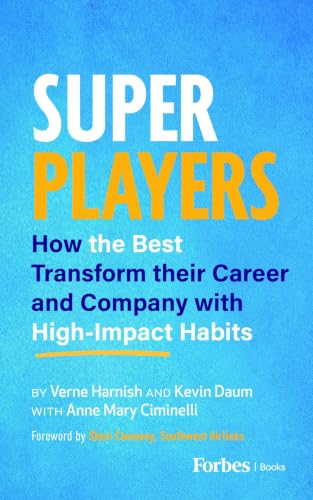
Super Players
How the Best Transform Their Career and Company with High-Impact Habits
Super Players create value well beyond their pay by building habits that improve the system around their job, and in the AI era that includes leading the tools rather than being led by them.
A book summary and review by Bruce Eckfeldt
Overview
Super Players is the expanded successor to the authors’ 2024 book 12 Habits of Valuable Employees. Verne Harnish, Kevin Daum, and Anne Mary Ciminelli argue that most employees are doing what they believe is expected and still get overlooked, because leaders treat reliable, on-time, problem-free work as adequacy. A Super Player is the person who makes leaders say wow, someone who creates value well beyond their compensation. The book is written mainly for employees at every career stage, with a closing guide for employers.
The book keeps its predecessor’s structure. Twelve habits sit inside the four hiring criteria from Harnish’s Scaling Up, Will, Values, Results, and Skills, ranked in that order of importance. Each habit opens with a workplace story, replays it to show what a Super Player would do differently, and ends with three actions and a Create Immediate Value Today box of reading, viewing, and conversation starters. New material includes a section on leading with intelligence, human or machine, a set of field notes from practitioners at companies including Etsy and Oracle, and an expanded employer’s guide.
Super Players create value well beyond their pay by building habits that improve the system around their job, and in the AI era that includes leading the tools rather than being led by them.
Chapter Summaries
Chapter 1: Developing as a Leader
The Will part opens with the habits of desire, and the first habit treats leadership as a practice an employee can begin before the title arrives. The chapter follows Jessica, who wanted a promotion, got it at 26, and found herself managing five former peers. She works hard and earns respect, and the chapter asks why that was still not good enough. The Super Player version expands the role rather than simply managing it, and invests in developing others.
- Doing the new job well is adequate. The valuable move is leading by example in a way that lifts the people around the leader and builds the company’s internal pipeline.
- Learning is the foundation of the habit. Leaders who keep reading and seeking input widen the range of problems they can solve as the company grows.
- Peers make better development partners than bosses in one respect. They can point out blind spots without the weight of a performance evaluation.
- The habit’s end state is multiplying others. Value shifts from individual output to the output of the team the leader develops.
Chapter 2: Aligning Vision
The second habit argues that ambition creates value only when it fits the company’s larger plan. The chapter’s story features a branch leader who overperforms against his growth target and, in the process, strains shared resources and drifts from company standards. The Super Player version studies the strategic plan, works with peers in other units, and lets the company as a whole hit its targets rather than one branch.
- Local overperformance can be a system cost. A unit that wins by borrowing from shared functions moves the bill to someone else.
- Super Players absorb the company’s long-term goal and quarterly priorities and ask leaders directly when either is unclear.
- Every significant activity should be traceable to the company’s ultimate goal. Activities that cannot be traced are candidates to stop.
- Alignment is also a leadership obligation. Vision that is announced in writing but never discussed leaves ambitious people to set their own direction.
Chapter 3: Enabling Growth
The third habit argues that Super Players treat company growth as part of their own job. Fixing a local problem is adequate. Turning the fix into something the whole company can adopt is valuable. The chapter asks employees to look past their own territory, identify what is being done poorly by current standards, and spot the processes and behaviors that will block the company’s next stage of scale.
- Many employees assume growth belongs to senior leadership. The authors argue that leaders actively look for people who think beyond the here and now.
- Two questions frame the habit. What is consistently done poorly today, and what will inhibit growth tomorrow.
- Learning the whole business, not only one function, is what lets an employee see where a local improvement could scale.
- Growth thinking spreads faster when ambitious colleagues pursue it together rather than one at a time.
Chapter 4: Integrating Core Values and Purpose
The Values part covers the habits of character. The fourth habit argues that core values only work when people live them, enforce them, and build them into company systems. Read This First describes values as the cultural rules by which people act and decide, and warns that faking fit does not work for long because others see it. The chapter asks Super Players to treat values as rules of play that everyone helps referee.
- Every company has cultural rules, set either by design or by default. Super Players make their own decisions align with them on purpose.
- Values only hold if someone acts on violations. The habit asks employees to speak up, privately first and through leadership when needed.
- Mapping each responsibility to a value turns a poster on the wall into a standard for daily work.
- Fit runs both ways. The authors say only the employee can judge whether a company truly fits their own values.
Chapter 5: Managing Conflict
The fifth habit argues that value comes from resolving conflict at its root rather than smoothing it over. Unaddressed conflict drains time and energy and erodes culture. The chapter asks Super Players to surface the issues behind the friction, state their own views clearly, and help the group move from disagreement to decision. The approach rests on active listening and on pausing before reacting.
- Conflict can make or break a culture. The difference is whether disagreement is honest, respectful, and ends in a decision.
- Quiet politeness has a cost. Ideas and concerns hedged with apologies are easy for a team to ignore.
- Structured ways to surface problems informally, before the group jumps to solutions, bring hidden issues into the open.
- The Super Player changes the system so the same conflict does not keep returning.
Chapter 6: Driving Excellence
The sixth habit argues that bursts of reactive effort fade and that excellence comes from sustainable systems built with the future in mind. The chapter follows Angela at Evergreen Commercial Construction, whose response to a reputation problem grows into a communications program involving other departments. Her first approach is energetic and unsustainable. The lasting version ties the work to company goals and spreads ownership across the organization.
- Effort that is not aligned with a larger vision loses quality and becomes a burden.
- Adequate employees improve their own work. Super Players spread what they learn so the improvement becomes a company capability.
- Templates, checklists, and how-to guides are how one person’s better method becomes everyone’s standard.
- Weighing long-term consequences before acting is what separates a sustainable program from a spike of activity.
Chapter 7: Surfacing Issues
The Results part covers the habits of performance, and Read This First warns that many employers tolerate tardiness, disloyalty, and personality problems from people who deliver, regardless of the cultural damage. The seventh habit argues that last-minute heroics often hide the behavior that made heroics necessary. Super Players find problems early, trace them to their source, and remove the conditions that create the need for rescue.
- A rescue is often a well-managed patch over a preventable problem. Recognizing the rescue without examining the cause invites a repeat.
- Understanding how a process is built makes it easier to see where it will break.
- Diligence processes and checklists replace workarounds that live in one experienced person’s memory.
- Every handoff is a place for something to fail, so reducing handoffs reduces the need for heroes.
Chapter 8: Improving Process
The eighth habit argues that scalable processes, ones that can be taught, measured, and improved, sit at the heart of value creation. When every task depends on the situation, nothing scales and teams drown in urgent requests. The chapter asks Super Players to identify the recurring steps in their work, agree on them with colleagues, measure them, and refine them in small, regular increments.
- Overload is often a process problem rather than an effort problem.
- Quality, time, and cost are the three measures every process owner should know.
- Cross-functional conversations expose the handoffs where most process failures happen.
- Documenting a process turns individual learning into company learning and makes the work teachable.
Chapter 9: Getting Things Done
The ninth habit argues that productivity depends on training, structure, and consequences, and that Super Players fix all three rather than working longer hours. Read This First frames the Results criterion around measurable consistency and the ability to tell working hard from working smart. The chapter asks employees to examine their own unproductive patterns and to push for the systems that make a whole team more productive.
- Accountability rests on three supports. People need training, the structure and tools to do the work, and meaningful consequences.
- Self-evaluation comes first. The habit asks whether low output stems from motivation, structure, or the absence of consequences.
- Curiosity about how work gets done is what surfaces inefficiency.
- Daily and weekly goals tied to team priorities make progress visible and allow course correction.
Chapter 10: Fostering Communication
The Skills part covers the habits of influence. Read This First names observation, communication, and adaptation as the skills that matter most regardless of industry, and ranks Skills last among the four criteria because technical skillsets need updating every three to five years. The tenth habit argues that communication creates value when it is built around a memorable message and delivered as a campaign rather than a single event.
- Communication is measured by what the audience remembers and acts on.
- Every message should start from the end goal, with everything else designed around it.
- A wider range of formats, written, spoken, and online, reaches people a single format would miss.
- Repeated messaging across moments and channels outlasts a single polished presentation.
Chapter 11: Inspiring Creativity
The eleventh habit argues that creativity is most valuable when it is tied to clear goals and spread across a team. The chapter’s story features a marketer with real creative spark whose individual success leads colleagues to leave the creative work to her. The Super Player version slows down, sets data-driven objectives, and builds a process that draws ideas out of the whole team.
- A single creative star becomes a dependency and gives others permission to opt out.
- Creative effort without a defined objective wastes time and erodes credibility.
- Exposure to new inputs from outside the business keeps the creative process supplied.
- Structured check-ins and feedback points raise both the quality and the adoption of creative work.
Chapter 12: Effecting Change
The final habit argues that change succeeds when someone builds a well-supported case and persuades the people affected rather than imposing it. Resistance usually comes from fear of uncertainty. The chapter asks Super Players to combine diagnosis, a mission others find compelling, and the ability to execute, and to win support one conversation at a time before announcing the change.
- Treating resistance as legitimate fear, rather than laziness, is what makes it addressable.
- A concrete description of how things will be better reduces uncertainty for the people affected.
- Individual conversations with each affected person build support that an announcement cannot.
- Change agents need all three capacities. Diagnosis, mission, and execution together move a reluctant team.
About the Authors
Verne Harnish founded the Entrepreneurs’ Organization in 1987 and chaired its Birthing of Giants CEO program at MIT for fifteen years. He is founder and CEO of Scaling Up, a global executive education and coaching company, and the author of Mastering the Rockefeller Habits, Scaling Up, and Start to Scale. Kevin Daum is an Inc. 500 CEO, a media strategist, an Inc.com columnist, and the author of books including ROAR! Get Heard in the Sales and Marketing Jungle. Anne Mary Ciminelli worked as an associate editor at Daum’s firm, TAE International, and co-wrote 12 Lessons in Business Leadership with him. The foreword is by Shari Conaway, former managing director of the People Department at Southwest Airlines.
The authors write from long experience on the employer side, and the book’s definition of adequacy comes from what leaders say about their people. Read This First describes the core evidence as an informal survey of leaders about the traits of team members they liked and would rehire, supplemented by the authors’ work with thousands of leaders and team members. The field notes add practitioner voices but not structured research. The book is best read as an experienced practitioners’ synthesis rather than a study.
Key Takeaways
1) The traits leaders say they would rehire for describe adequacy, not value.
In the authors’ informal survey, leaders described team members they liked and would rehire. They show up, deliver the minimum requirements, think through basic issues, deliver on time and on budget, do what they are told, get along, cause no problems, and create value roughly equal to their compensation. Among the best organizations, the authors argue, those are standards of mere adequacy that keep a company treading water. Most people rate themselves in the top half of their peers, which is why the gap stays invisible.
- The best companies prefer fewer, better paid, smarter people to many lower paid, less valuable ones.
- Adequacy may not be enough to survive a fast-changing market, let alone win one.
2) A Super Player is defined by the reaction they produce in leaders.
The authors define a Super Player as someone who makes leaders say wow. That’s better than I could have done. I’m impressed they took the initiative. They exceeded our expectations by a mile. The definition is deliberately practical and observable. It is not a statement about personal worth, and the authors note that A-players are not the only employees who add value. It names the level of contribution leaders notice and reward.
- The wow test is relative to the leader’s own standard, which makes it a moving target as the company grows.
- The authors’ epigraph from Dawn Exline captures the career logic. Promotions go to people already doing the next job.
3) Will, Values, Results, and Skills are ranked, and Skills come last.
The four capacities come from the hiring criteria in Harnish’s Scaling Up and are presented in order of importance. Will is the desire to excel, act with courage, persevere, learn, and innovate, and without it nothing else matters. Values are the cultural rules a person must be comfortable playing by. Results reflect measurable, consistent delivery. Skills rank last because most technical skillsets need updating every three to five years, so self-driven learning matters more than any current skill.
- The skills the authors call most durable are observation, communication, and adaptation.
- Employees who wait to be trained burden the system and slow growth.
4) Employment is a pact, and the employee holds more power than they think.
The authors describe employment as neither a right nor a privilege but an agreement with deliverables and compensation. They note that the early excitement of a new job typically fades after 90 to 120 days, and that it is easy to blame culture or leadership when it does. Their position is that the ultimate power belongs to the employee, who can disengage, leave, or take responsibility for their own experience. Blaming leadership, in their view, mainly stalls the employee’s own career.
- Entrepreneurs want people who buy in to the vision. Corporations want loyalty and performance. Achievers want advancement and recognition.
- None of those expectations is met without effort and communication from both sides.
5) In the AI era, the habit that matters is how you engage with intelligence.
The new Leading with Intelligence section argues that Super Players of the future will be hybrids who partner with AI without losing themselves. It describes three modes of engagement, adapted from a framework by Van M. Van. Do for me is command mode. Think for me offloads sensemaking without giving context. Think with me is the leadership shift, where the person engages, invites insight, and co-creates alignment. The story of Kara, whose voice dissolved into auto-generated drafts until she asked what she would actually say, illustrates the cost of the first two modes.
- The authors frame intelligence as a relationship rather than as speed or correctness.
- The same three modes apply to how leaders direct people as well as tools.
6) The valuable move is the second step, from fixing a problem to fixing the system.
Across the twelve habit chapters, the protagonist first does a good job and then sees the larger opportunity. Jessica manages her team well and then develops it. Angela responds to a reputation problem and then builds a program other departments own. The Results habits make the same move operationally, replacing heroics with checklists and ad hoc work with measured processes. The repeated pattern is the book’s real argument. Value comes from improving the system that produced the problem.
- The first step earns praise. The second step changes the company.
- Leaders notice the second step because it reaches beyond the employee’s own role.
7) Leaders are responsible for the conditions that let Super Players emerge.
The book closes by turning to employers. The authors tell leaders they set the example every day, inspiring or discouraging the people on their team, and that they win hearts and minds more through ethos and pathos than logic or authority. The foreword by Shari Conaway credits Southwest Airlines’ results to mutual commitment between company and employees. The goal, in the authors’ framing, is every employee reaching a personal best each week and each year, not a handful of employees of the month.
- The Employer’s Guide to Stimulating Value applies the same framework to the company side.
- The suggested rhythm is one habit per month, repeated annually.
Strengths and Limits
The book’s strengths are its clarity and its usability. The adequacy list in Read This First is one of the most precise descriptions available of what leaders quietly tolerate, and the wow definition gives employees an observable target. The four-part structure links individual habits to the Will, Values, Results, and Skills criteria many growth companies already use for hiring, so leaders and employees share a vocabulary. Each habit is built for action, with three steps and a Create Immediate Value Today box, which makes the book workable as a year-long team program. The Leading with Intelligence section addresses AI without becoming a tool tutorial, and the three modes of engagement apply equally to managing people. The field notes add practitioner voices from companies including Etsy and Oracle, and the employer’s guide gives leaders a role in the program.
The limits sit mostly in evidence and scope. The definition of adequacy rests on an informal survey of leaders, and the stories are illustrative scenarios rather than documented cases. Some supporting claims are loosely sourced. The book attributes to the US Bureau of Labor Statistics the figure that people change careers seven times on average, and the BLS states that it has never attempted to estimate career changes. The habit chapters carry forward the 2024 book largely intact, so readers of 12 Habits of Valuable Employees will find the core familiar and the new material concentrated in the AI section, the field notes, and the employer’s guide. The AI section is short, and its three modes are a lens rather than a method. The argument also places most of the responsibility on the employee, with comparatively little on how management systems shape individual performance.
My Take
The diagnosis holds, and AI makes it sharper. The adequacy list in Read This First is essentially the profile of the employee whose routine work AI now does faster. If a person’s value is roughly equal to their pay and consists of doing what they are told on time, that role is exposed. The authors are right that the defensible ground is judgment, initiative, and improving the system, and the Think with me frame is a useful shorthand for founder-CEOs who are watching teams either freeze or outsource their thinking to tools.
If you already own 12 Habits of Valuable Employees, know what you are buying. The twelve habits and most of the stories are the same. The new value is the AI section, the field notes, and the employer’s guide, and for a CEO rolling this out to a team, that last piece is the reason to choose this edition. The book also lands differently by company. In a business running Scaling Up with real core values and quarterly priorities, it slots straight in. In a company without that infrastructure, employees will read Aligning Vision and Integrating Core Values and find nothing to align with.
The most credible objection comes from Jeffrey Pfeffer at Stanford, whose work in Dying for a Paycheck documents how management practices damage employee health and engagement. Read through Pfeffer’s lens, framing employment as a pact in which the employee holds the ultimate power understates how asymmetric that pact usually is. I take the objection seriously. The book is strongest when a CEO uses it to set expectations and then changes what gets measured and recognized. It is weakest when it is handed out as a message that the problem is the people.
The book that completes it is Ethan Mollick’s Co-Intelligence. Harnish and Daum give the posture for working with AI. Mollick gives the practice, grounded in his research at Wharton, of how people and AI actually divide and combine work. For the people side, Liz Wiseman’s Impact Players covers the same ground as the twelve habits with a stronger research base.
Discussion Questions
For CEOs
- Which people on my team would I privately describe using the book’s adequacy list, and have I ever told them what wow would look like?
- When did someone on my leadership team last make me say wow, and what exactly did they do?
- Do I hire and promote in the Will, Values, Results, Skills order, or do I default to skills?
- Where am I tolerating cultural damage from someone because they deliver results?
- How is my team engaging with AI right now, do for me, think for me, or think with me?
- How do I engage with my own leadership team in those same three modes?
- What would I need to change in recognition and measurement for these habits to stick?
- If an employee read this book and came to me with a system-level idea, would our company know what to do with it?
For Teams
- What would make our leaders say wow about this team’s work in the next quarter?
- Which of the four capacities, Will, Values, Results, or Skills, is our team’s weakest?
- Where are we using AI to do our thinking instead of to think with us?
- What heroic rescue have we celebrated recently that was really a preventable problem?
- Which of our processes could a new team member learn from documentation alone?
- Which of the company’s core values do we struggle with most in practice?
- What skill will each of us need in three years that we are not building now?
- If each of us practiced one habit this month, which one would make the biggest difference?
Practical Tools
1. Wow Inventory
The authors define a Super Player by the reaction they produce in leaders. That’s better than I could have done. They took the initiative. They exceeded expectations by a mile. Most companies never say out loud what produces that reaction, so employees guess. This exercise captures it from real examples. Use it with a leadership team before review season or when setting expectations for a newly promoted group.
How it works:
- Ask each leader to recall three moments in the past year when someone on their team made them say wow.
- Write each example down in concrete terms, covering what the person did, what problem it solved, and what it changed.
- Sort the examples by Will, Values, Results, and Skills.
- Identify the patterns that appear across several leaders.
- Share the anonymized examples with the wider team as illustrations of what valuable looks like here.
Employees can see specific, local examples of the contribution leaders value, rather than abstract guidance. Leaders discover where their expectations differ from one another and can align them before reviews.
2. Four Capacities Talent Review
The book ranks Will, Values, Results, and Skills in order of importance, following the hiring criteria in Scaling Up. Many companies hire for skills and tolerate values problems from people who deliver, which the authors warn against. This review applies the ranking to the current team. Use it in quarterly talent conversations or before a reorganization.
How it works:
- List each direct report and rate them on the four capacities using a simple three-level scale.
- Rate in the book’s order, Will first and Skills last.
- Flag anyone rated strong on Results but weak on Values and discuss the cultural cost.
- Flag anyone strong on Will but weak on Skills as a development priority.
- Agree on one development action for each person and revisit it next quarter.
Talent conversations move beyond performance alone. Leaders confront the cases where results have been excusing values problems, and development investment goes first to people with strong will.
3. Three Modes AI Review
The Leading with Intelligence section describes three ways people engage with intelligence, human or machine. Do for me is command mode. Think for me offloads sensemaking without context. Think with me engages, invites insight, and co-creates. The first two modes produce derivative output and disengaged people. This review shows a team which mode it defaults to. Use it a few months after rolling out AI tools, or when output starts to feel generic.
How it works:
- Ask each team member to list five recent tasks where they used AI.
- For each task, have them label the mode they used, do for me, think for me, or think with me.
- Discuss two examples of think for me and what context was missing.
- Rework one recurring task so it runs in think with me mode, with the person’s own judgment stated first.
- Apply the same lens to how the team leader delegates to people.
Team members can name the mode they are in and catch themselves when they are outsourcing judgment. Output becomes more specific to the business, and leaders gain a shared language for how they delegate to people as well as to tools.
4. Internal Field Notes
Part V of the book collects field notes from practitioners at companies including Etsy, Oracle, and the Entrepreneurs’ Organization. Reviewers highlight Doron Bar-Caspi’s note on asking managers what they need and building specialist teams around those priorities. Outside examples help, and examples from inside the company carry more weight. This exercise builds a company’s own collection. Use it alongside a team reading of the book or as part of onboarding.
How it works:
- Invite five to eight people known for creating outsized value to write a short field note.
- Ask each to describe one situation, what an adequate response would have been, and what they did instead.
- Ask them to name the habit from the book that the story illustrates.
- Collect the notes and share one at each monthly team meeting.
- Add new notes each year so the collection stays current.
New and existing employees see how the habits look in this company’s actual work. The people who write the notes are recognized for system-level contribution, and the collection becomes a durable part of onboarding.
5. Employer Readiness Check
The book closes with The Employer’s Guide to Stimulating Value and tells leaders they set the example every day. Several habits, including Aligning Vision and Integrating Core Values and Purpose, assume the company has a clear long-term goal, quarterly priorities, and lived values. Without them, the habits have nothing to attach to. This check confirms the company side is ready before employees are asked to change. Use it before distributing the book to a team.
How it works:
- Confirm the company has a stated long-term goal and current quarterly priorities that employees can access.
- Confirm the core values are used in hiring, reviews, and recognition, not only displayed.
- Review the recognition program and note whether it rewards prevention or only rescue.
- Identify a path for employees to bring system-level ideas to the leadership team.
- Close the largest gap before launching the book program.
When employees start practicing the habits, they find priorities to align with, values that are enforced, and a route for their ideas. The program reads as a shared commitment rather than a request to try harder.
6. Habit of the Month
The book’s suggested rhythm is one habit per month, and each habit includes three actions and a Create Immediate Value Today box of reading, viewing, and conversation starters. Running the rhythm across a team gives everyone a shared vocabulary at the same time. Use it as a year-long development program launched at annual planning.
How it works:
- Assign the twelve habits to the twelve months, starting with Will.
- Open each month by discussing the chapter story and where the team sees the adequate version in its own work.
- Use the chapter’s conversation starters in one-on-ones during the month.
- Have each person practice one of the three actions each week.
- Close each month with examples and recognize the one that improved a system.
The habits start appearing in ordinary meeting language within a quarter. Leaders gain a record of system improvements to draw on in reviews, and the cycle can be repeated annually with new examples.
Further Reading
- Ethan Mollick’s research on how people and AI combine work, the practical complement to the book’s Think with me posture.
- Liz Wiseman’s Impact Players research, built from interviews with 170 managers, for an evidence base covering the same territory as the twelve habits.
- The Bureau of Labor Statistics FAQ on lifetime job changes, which explains why no official estimate of career changes exists.
- Wendy Wood’s research on habit formation, the likely source of the book’s claim that about 40 percent of daily behavior is habitual. Her studies put the figure at 43 percent.
- Verne Harnish’s Inc. column introducing the four traits of Super Players, a short version of the argument suitable for sharing with a team.
Share This Review

Bruce Eckfeldt is a business coach and strategic advisor to founder-CEOs of growth-stage companies, a former Inc. 500 CEO, and the author of Springboard. More book reviews →
These summaries present Bruce Eckfeldt’s analysis of business and leadership books for founder-CEOs and leadership-team members of growth companies. Each one identifies the ideas most relevant to decision quality, strategy, and leadership capacity, notes where the evidence is weak, and suggests practical ways to test what is worth testing. All ideas, stories, and quotations belong to the original author and to the people they cite. The assessments and recommendations are Bruce’s. It is a companion to the book, not a substitute for reading it.
To learn more about Bruce’s programs, request other book summaries, or get in touch, contact booksummaries@eckfeldt.com.
Get the Next Review.
A new book review lands in Better, Faster, my weekly newsletter for founder-CEOs, along with one practical essay and questions for your team.