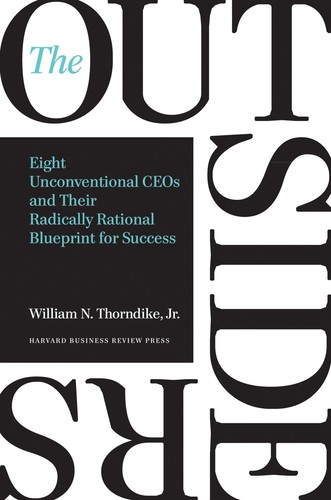
The Outsiders
Eight Unconventional CEOs and Their Radically Rational Blueprint for Success
Long-term shareholder value depends less on operating brilliance than on how a CEO allocates capital, and the best allocators were rational, patient, independent, and focused on per-share value and cash flow rather than size, earnings, or Wall Street approval.
A book summary and review by Bruce Eckfeldt
Overview
The Outsiders profiles eight CEOs who, by Thorndike’s measure, outperformed both the market and their peers by wide margins over long tenures. They are Tom Murphy of Capital Cities, Henry Singleton of Teledyne, Bill Anders of General Dynamics, John Malone of TCI, Katharine Graham of the Washington Post Company, Bill Stiritz of Ralston Purina, Dick Smith of General Cinema, and Warren Buffett of Berkshire Hathaway. Thorndike writes that on average they outperformed the S and P 500 by over twenty times and their peers by over seven times.
Thorndike’s measure of a CEO is the compound annual return to shareholders during the CEO’s tenure, compared with peers and the market. By that standard, he argues, the celebrated Jack Welch was great, but these less famous CEOs were greater. What set them apart was capital allocation. A CEO has two jobs: running operations efficiently and deploying the cash those operations produce. Thorndike frames the second job as five uses of capital (investing in operations, acquisitions, dividends, paying down debt, and repurchasing stock) and three sources (internal cash flow, debt, and equity).
A preface on Singleton and an introduction set up the argument. Eight chapters each profile one CEO. Chapter 9 distills the shared mindset. An epilogue offers an example and a ten-point capital allocation checklist, and an appendix applies what Thorndike calls the Buffett test.
Long-term shareholder value depends less on operating brilliance than on how a CEO allocates capital, and the best allocators were rational, patient, independent, and focused on per-share value and cash flow rather than size, earnings, or Wall Street approval.
Chapter Summaries
Chapter 1: A Perpetual Motion Machine for Returns
Tom Murphy and his partner Dan Burke built Capital Cities from a single struggling television station into a media company that bought ABC.
- Thorndike reports that a dollar invested with Murphy grew to $204, a 19.9 percent compound annual return over twenty-nine years. Over the same period the S and P 500 returned 10.1 percent and leading media companies 13.2 percent.
- The formula was to buy properties in attractive industries, using leverage selectively, then improve operations, pay down debt, and repeat. The 1985 purchase of ABC for $3.5 billion was the largest bet.
- Murphy ran a radically decentralized company. Burke said that Murphy delegated to the point of anarchy. Murphy hired for intelligence and drive and then left people alone.
- Acquisitions had to meet a strict test: a double-digit after-tax return over ten years without leverage.
Chapter 2: An Unconventional Conglomerateur
Henry Singleton founded Teledyne in 1960 and used it to demonstrate almost every tactic the other CEOs in the book would later follow.
- Thorndike writes that from 1963 to 1990, Singleton delivered a 20.4 percent compound annual return, against 8 percent for the S and P 500 and 11.6 percent for other major conglomerates. A dollar invested in 1963 was worth $180.94 by 1990.
- While Teledyne’s stock traded at high multiples in the 1960s, Singleton used it to buy about 130 companies, never paying more than twelve times earnings. When multiples fell, he stopped acquiring.
- From 1972 to 1984 he bought back about 90 percent of Teledyne’s shares, a repurchase program without precedent at the time.
- Singleton ran operations on a decentralized basis, measured units on cash flow rather than reported earnings, avoided dividends and stock splits, and rarely spoke to analysts or the press.
Chapter 3: The Turnaround
Bill Anders, a former astronaut, became CEO of General Dynamics in 1991 as the end of the Cold War shrank the defense industry.
- Anders concluded that the industry had too much capacity. General Dynamics would stay only in businesses where it was first or second in its market and would exit the rest.
- He sold most of the company’s businesses, including the F-16 fighter business, because buyers offered attractive prices. The company kept submarines and tanks.
- The cash went back to shareholders through special dividends and large repurchases. Thorndike credits Anders and his successors with a 23.3 percent annual return over seventeen years.
- Thorndike quotes Anders saying that most CEOs grade themselves on size and growth and that very few really focus on shareholder returns.
Chapter 4: Value Creation in a Fast-Moving Stream
John Malone built TCI into the largest cable company in the United States by focusing on cash flow, tax efficiency, and scale.
- Malone saw that cable systems produced predictable cash flow and could use debt and depreciation to keep reported earnings and taxes low. He focused investors on cash flow, and Thorndike credits him with popularizing EBITDA.
- Scale lowered programming costs, so TCI made a long run of acquisitions. Malone also used joint ventures, spin-offs, and tracking stocks to fund growth and make the businesses easier to value.
- Thorndike reports a 30.3 percent compound annual return under Malone. A dollar invested grew to more than $900.
Chapter 5: The Widow Takes the Helm
Katharine Graham took charge of the Washington Post Company after her husband’s death in 1963, with almost no management experience.
- Thorndike reports a 22.3 percent annual return over her twenty-two years as CEO, well ahead of the S and P 500 and her peers.
- She brought Warren Buffett onto the board when he was little known, and with his influence the company repurchased a large share of its stock.
- Acquisitions had to meet a strict hurdle of an 11 percent cash return without leverage over ten years. The result was fewer deals, and Thorndike quotes the view that the deals not done were very important.
Chapter 6: A Public LBO
Bill Stiritz ran Ralston Purina for nineteen years, using debt, divestitures, and repurchases in the manner of a leveraged buyout inside a public company.
- Stiritz sold businesses that did not meet his return standards and built around strong consumer brands such as pet food and Energizer batteries.
- He repurchased about 60 percent of the company’s shares. Acquisitions had to beat the return available from buying back stock.
- Thorndike reports a 20 percent annual return over Stiritz’s tenure. Stiritz relied on a few key assumptions rather than elaborate models and described leadership as analysis.
Chapter 7: Optimizing the Family Firm
Dick Smith took over his father’s drive-in theater business and turned General Cinema into a diversified company over four decades.
- Smith moved theaters into shopping malls and added screens, then diversified into soft drink bottling, retailing, and publishing at well-timed moments.
- He sold the Pepsi bottling business for more than $1 billion in cash and used the proceeds to buy publisher Harcourt Brace Jovanovich.
- Thorndike reports a 16.1 percent annual return over Smith’s forty-three years, well ahead of the S and P 500 and his peers.
Chapter 8: The Investor as CEO
Warren Buffett turned Berkshire Hathaway, a failing textile company, into a holding company built on insurance float and wholly owned businesses.
- Thorndike reports a 20.7 percent compound annual return over forty-five years, against 9.3 percent for the S and P 500.
- Berkshire is extremely decentralized in operations and extremely centralized in capital allocation. Buffett hires well, manages little, and keeps his calendar open for reading and thinking.
- Insurance float provides low-cost capital. Buffett concentrates investments, holds for long periods, avoids auctions, and pays no dividend.
Chapter 9: Radical Rationality
The final chapter distills what Thorndike calls the outsider’s mindset, the traits and tactics the eight CEOs shared.
- They always did the math, using simple calculations and conservative assumptions, and went ahead only when a project cleared their hurdle rate.
- They paid attention to the denominator, buying back stock when it was cheap so that remaining owners held more of the business.
- They were independent, unpromotional, and patient, with what Thorndike calls a crocodile-like temperament that waited for the right opportunity and then acted boldly.
- They ran decentralized organizations, disdained dividends, used leverage selectively, minimized taxes, and focused on cash flow over reported earnings. Thorndike writes that their advantage was temperament more than intellect.
About the Author
William N. Thorndike Jr. is the founder of Housatonic Partners, a private equity firm that invests in small and mid-sized companies. He came to the subject as an investor studying what distinguished long-term results, and the book grew out of research on CEOs whose performance stood out against both the market and their peers.
His authority is that of a practitioner and investor rather than an academic researcher. The book is a set of profiles chosen for exceptional outcomes, built from interviews, company histories, and return calculations, not a controlled study of what causes performance.
Key Takeaways
1) A CEO is judged by per-share returns relative to peers and the market.
Thorndike measures a CEO by the compound annual return to shareholders during the CEO’s tenure, compared with peers and the S and P 500. Size, revenue growth, and reported earnings are not the test. By this measure the eight outsiders surpassed even Jack Welch, the conventional benchmark.
- Context matters, because a bull market flatters absolute returns.
- Growth often does not correlate with value per share.
- Relative performance over long tenures is what counts.
2) Capital allocation is the CEO’s most important job.
Thorndike divides the CEO’s work into running operations and deploying the cash they generate. The second job uses five tools and three sources of capital, and he argues that two companies with identical operations can produce very different returns depending on how they allocate.
- The five uses are reinvestment, acquisitions, dividends, debt paydown, and repurchases.
- The three sources are internal cash flow, debt, and equity.
- The CEO leads allocation rather than delegating it to finance or business development.
3) Cash flow, not reported earnings, determines value.
The outsiders measured units and acquisitions on cash generation. Singleton paid managers on cash returns. Malone steered investors toward cash flow. Several kept reported earnings and taxes low on purpose because cash was what compounded.
- Tax efficiency was treated as a source of returns.
- Acquisition hurdles were set on unlevered cash returns.
- Wall Street guidance was ignored.
4) The denominator matters.
Almost every outsider repurchased large amounts of stock when it was cheap, from Graham’s large buybacks to Singleton’s 90 percent. Thorndike notes in his HBR interview that all but one repurchased at least 30 percent of their shares. Their buybacks were opportunistic and concentrated, not scheduled.
- Repurchases served as the benchmark acquisitions had to beat.
- Buying when cheap gave remaining owners more of the business.
- Thorndike cautions that routine quarterly buybacks are unlikely to produce compelling returns.
5) Decentralize operations, centralize capital.
The outsiders ran lean headquarters and gave operating managers wide autonomy. Murphy delegated to the point of anarchy and Buffett hires well and manages little. Capital allocation stayed with the CEO.
- Small corporate staff kept costs and politics low.
- Autonomy attracted and kept strong operators.
- The CEO’s time went to allocation, not operations.
6) Patience punctuated by boldness.
The outsiders waited long periods without acting and then made very large moves when prices were right, such as Murphy’s purchase of ABC or Smith’s purchase of HBJ. Thorndike calls this a crocodile-like temperament and argues that avoiding bad decisions mattered as much as making good ones.
- Strict hurdle rates kept them out of overpriced deals.
- They sold businesses or stock when prices were high.
- Flexibility mattered more than any fixed strategy.
7) Temperament beats intellect.
Thorndike concludes that what set the outsiders apart was temperament more than intelligence. They were first-time CEOs, mostly without MBAs, frugal and unpromotional, who thought independently and kept outside advisers at a distance. What mattered was how they played the hand they were dealt.
- Iconoclasm was rational, not contrarian for its own sake.
- Charisma was overrated.
- A long-term perspective made patience possible.
Strengths and Limits
The book’s strength is that it changes how a CEO’s job is defined. Its measure of CEO success, relative per-share return over a tenure, is clear and hard to argue with. The five uses and three sources of capital give executives a complete map of their capital choices. The profiles are short, vivid, and drawn from very different industries and starting points, from a widow with no business experience to an astronaut turned turnaround CEO. That supports Thorndike’s claim in his HBR interview that the model is robust across contexts. The epilogue checklist turns the lessons into questions a CEO can apply directly.
The limits come from method and setting. The eight were selected for outstanding results, so the book cannot show how many CEOs followed similar tactics and failed. Phil Rosenzweig warns about this kind of outcome-based selection in The Halo Effect. A 2023 Claremont McKenna senior thesis by William Turner tested Thorndike’s traits on a broader, more recent set of CEOs. It found only partial support, and share repurchases showed an effect opposite to the one Thorndike describes. Several of the strategies relied on conditions that may not repeat: cheap stock in the 1970s and early 1980s, high conglomerate multiples in the 1960s, and tax rules that favored leverage in cable. Most tactics assume a public company with a traded stock. The predictable failure is copying the tactics, especially leverage and buybacks, without the hurdle-rate discipline and patience that made them work.
My Take
The diagnosis holds, and it may matter more for private growth companies than for public ones. Most founder-CEOs I see spend nearly all their time on operations and treat capital allocation as whatever is left after payroll and the next hire. Thorndike’s two-job framing, run the operation and deploy the cash, is the most useful reframe I know for a CEO crossing twenty or thirty million in revenue, when the cash decisions start to matter more than any single operating fix.
It translates differently in a private company. There is no traded stock to buy back, but the same logic applies to buying out a partner or minority holder, choosing between distributions and reinvestment, or deciding whether an acquisition beats putting the cash into the core business. The hurdle-rate discipline and the bias toward cash flow over reported earnings carry over directly. Decentralization works only once the company has operators strong enough to run their units without the founder, so for many companies it is a goal for later.
The most credible outside objection comes from Phil Rosenzweig in The Halo Effect. He argues that studies which select companies by outcome and then look back for shared traits cannot tell whether those traits caused the success. Thorndike chose eight winners. We do not see the leveraged conglomerates and buyback-heavy companies that failed using similar tactics. I accept that criticism. I still find the book valuable because its core principles, hurdle rates, cash flow, and per-share thinking, rest on finance logic rather than on the eight stories.
What the book leaves incomplete is the framework behind the hurdle rate. Thorndike tells a CEO to set one and do the math, but not how to think about return on capital, cost of capital, and growth together. Value: The Four Cornerstones of Corporate Finance by Koller, Dobbs, and Huyett fills that gap and makes the checklist usable.
Discussion Questions
For CEOs
- What compound annual return has the business delivered to its owners during my tenure, and how does it compare with peers and the market?
- How much of my time goes to operations, and how much to capital allocation?
- What is our hurdle rate, and do we actually apply it to every major use of cash?
- Over the last three years, how did we split our cash among reinvestment, acquisitions, distributions, debt paydown, and buying out owners?
- Which of our planned investments would clear our hurdle rate on conservative assumptions?
- Are we measuring units and leaders on cash flow, or on revenue and reported profit?
- What would I sell today if a buyer offered an exceptional price?
- Where am I following industry convention without checking the math?
For Teams
- Which of our investments over the last two years earned their expected return, and which did not?
- How much cash does our area generate or consume each year?
- What decisions could we make without headquarters approval if we had clear return standards?
- Where are we spending money on growth that will not add value per owner?
- What would we cut if we ran the business with a much smaller central staff?
- Which tax or financing choices affect our cash flow, and do we understand them?
- What opportunity are we waiting for, and what price or conditions would make us act?
- Which of our standard practices would an outsider question first?
Practical Tools
1. Capital Allocation Checklist
Thorndike’s epilogue closes with a ten-point checklist for capital decisions. It starts with the CEO leading allocation and setting a hurdle rate, then ranks every alternative by return and risk. Working through it before major decisions puts outsider discipline into practice. Use it for the annual capital plan and before any acquisition, large investment, or distribution.
How it works:
- Confirm that the CEO, not finance or business development, leads the decision.
- Set or restate the hurdle rate, generally above the blended cost of debt and equity.
- Calculate conservative after-tax returns for every internal and external alternative, including buying out owners, and rank them by return and risk.
- Set acceptable cash and debt levels and check every option against them.
- Retain cash only for options above the hurdle. Otherwise return it, and consider selling businesses when prices are unusually high.
Every major use of cash is compared against the alternatives and a known hurdle rate. Capital stops flowing to projects by default.
2. CEO Scorecard
Thorndike measures a CEO by compound annual return relative to peers and the market. Applying the same measure to one’s own tenure is uncomfortable but clarifying. Do it once to establish a baseline and then update it annually.
How it works:
- Estimate the company’s value at the start of the CEO’s tenure and today, using a consistent method.
- Add distributions to owners and adjust for capital they put in.
- Calculate the compound annual return per unit of ownership.
- Compare it with a relevant peer group and a broad market index over the same period.
- Identify which capital decisions contributed most to the result, positive or negative.
The CEO knows whether the business has compounded owner value faster than alternatives. Discussions about growth shift toward value per owner.
3. Hurdle Rate Setting
Thorndike calls choosing the hurdle rate one of the most important decisions a CEO makes. Murphy and Graham each used a strict unlevered ten-year return test for acquisitions. A clear hurdle rate keeps the company out of overpriced deals and low-return projects. Set it before the next capital plan and revisit it when the cost of capital changes.
How it works:
- Estimate the company’s blended cost of debt and equity, erring high for a private company.
- Review the returns on the company’s best existing opportunities.
- Set a hurdle rate that reflects both, expressed as an after-tax, unlevered return over a defined horizon.
- Write down the rule and the horizon so they apply to every proposal.
- Track the actual returns of approved projects against the hurdle.
Proposals arrive already tested against a known standard. The team can say no to attractive-sounding deals that do not clear it.
4. Owner Buyout Analysis
Buybacks were the outsiders’ benchmark investment. In a private company, the equivalent is often buying out a partner, an early investor, or a minority holder. Analyzing it as a capital allocation decision shows when it beats the alternatives. Run it whenever an owner wants liquidity or when ownership is fragmented.
How it works:
- Estimate the value of the stake being offered on conservative assumptions.
- Calculate the return to remaining owners from buying it at the offered price.
- Compare that return with the hurdle rate and other uses of the same cash.
- Check the effect on cash and debt levels and on key relationships.
- Decide whether to buy now, negotiate a structured purchase, or decline.
Ownership changes are judged on return per remaining owner, not only on fairness or emotion. Remaining owners know what they gained.
5. Decentralization Readiness Review
Every outsider ran a lean headquarters with autonomous operators while keeping capital decisions central. Moving toward that model requires capable unit leaders and clear return measures. Run the review annually as the company adds business units or locations.
How it works:
- List the decisions currently made by the CEO or central staff.
- Identify which could be delegated to unit leaders with clear cash flow and return measures.
- Assess whether each unit leader is ready for that authority.
- Delegate operating decisions in stages while keeping capital allocation central.
- Track the ratio of central staff to total employees over time.
Operating decisions move closer to the units, and the CEO’s time shifts toward allocation. Central costs fall as a share of revenue.
6. Opportunity Watchlist
The outsiders were patient for long stretches and then acted boldly when prices were right. Keeping a defined watchlist with target prices turns that temperament into a practice. Maintain it continuously and review it quarterly.
How it works:
- List potential acquisitions, asset purchases, and owner buyouts the company would want at the right price.
- For each, set the price or terms at which it would clear the hurdle rate.
- Identify the signals that would show the price is moving toward that level.
- Arrange financing capacity in advance so the company can act quickly.
- Review the list quarterly and act only when the terms are met.
The company can move quickly when an opportunity appears, and it no longer overpays in hot markets.
Further Reading
- Thorndike on HBR IdeaCast discussing the eight CEOs, the sources and uses of capital, and the limits of routine buybacks.
- The book’s contents and front matter on O’Reilly.
- Google Books listing with the publisher’s description.
- William Turner’s Claremont McKenna thesis, a statistical test of Thorndike’s findings on a broader set of CEOs.
- McKinsey’s The CEO’s Guide to Corporate Finance, the authors of Value on acquisitions, divestitures, and risk.
Share This Review

Bruce Eckfeldt is a business coach and strategic advisor to founder-CEOs of growth-stage companies, a former Inc. 500 CEO, and the author of Springboard. More book reviews →
These summaries present Bruce Eckfeldt’s analysis of business and leadership books for founder-CEOs and leadership-team members of growth companies. Each one identifies the ideas most relevant to decision quality, strategy, and leadership capacity, notes where the evidence is weak, and suggests practical ways to test what is worth testing. All ideas, stories, and quotations belong to the original author and to the people they cite. The assessments and recommendations are Bruce’s. It is a companion to the book, not a substitute for reading it.
To learn more about Bruce’s programs, request other book summaries, or get in touch, contact booksummaries@eckfeldt.com.
Get the Next Review.
A new book review lands in Better, Faster, my weekly newsletter for founder-CEOs, along with one practical essay and questions for your team.