How a Card Game Reveals the Way Your Team Actually Thinks About Strategy
Why the strategic instincts your team operates by in a fifteen-minute exercise are the same instincts shaping how you compete in the market.
By Bruce Eckfeldt

The Tool
Most leadership teams believe they think strategically. They have strategy documents, quarterly planning sessions, and frameworks taped to conference room walls. Then you put them in a room with half a deck of cards and a fifteen-minute timer, and within about eight minutes, you see exactly how they approach value, competition, and risk. The card game doesn’t create their strategic instincts. It just reveals them. That’s what makes it useful.
I built Full House after watching too many leadership teams default to chasing the obvious opportunities everyone else in their industry was also chasing. I wanted a way to surface that pattern without triggering the defensive reactions that come up in direct strategy conversations. A game format works because you can’t BS your way through a card game. The mechanics are simple. What the exercise exposes is not.
The Gap Between Strategy Talk and Strategy Behavior
Strategy is one of those words leaders use confidently without agreeing on what it means. Ask five executives to define their company’s strategy, and you’ll get five different answers. Ask them how they approach a new market opportunity, and you’ll hear the same abstract language about positioning, differentiation, and value. But watch them make real decisions under time pressure, and you’ll see their actual operating logic, which is often very different from what the strategy deck says.
The cost of this gap is high. Teams pursue opportunities that look attractive but don’t fit. They overpay for obvious assets while ignoring undervalued ones. They compete hard for the same high-visibility wins everyone else is chasing and miss the quieter opportunities where real margin lives. And because the pattern shows up in how they instinctively process information rather than in any single decision, it’s hard to see and harder to change.
You can’t fix a pattern you can’t see. That’s the problem Full House is built to solve.
A Strategy Exercise Disguised as a Card Game
Full House is a strategy exercise disguised as a card game. Each team gets a random stack of half cards and fifteen minutes to assemble complete cards and build scoring combinations. Playing the hand you’re dealt is part of the exercise.
Here’s what makes it more than a game. The instructions don’t mention trading. Teams have to figure out on their own that they can trade with other teams, form alliances, give cards away, or do whatever else they can negotiate. Some teams figure this out in the first two minutes. Some don’t figure it out until minute ten. Some never do. The difference in outcomes is enormous.
The deeper reason this exercise works is that strategy is always contextual. What makes a good move good depends on what everyone else on the field is doing and not doing. The same card that’s worthless in one hand is a cornerstone in another. The same trade that looks brilliant at minute three might be a disaster at minute ten because the landscape shifted. Good strategy is less about finding the right answer and more about reading the field and responding faster than the people you’re playing against.
A live fifteen-minute game forces you to enact strategy while the ground is moving under you. You might start with the best strategy in the room and find by minute eight that it’s the wrong strategy, because what worked when everyone was hoarding no longer works when everyone is trading. Good teams adjust. Great teams anticipate. Struggling teams stick with their original plan and wonder why it stopped working. The scoreboard is an honest mirror. Either you read the field, or you didn’t.
What I See in Almost Every Room
Every group plays this game a little differently, but certain patterns show up across almost every room I’ve run it in. Here are three of them.
The hoarders. Some teams lock onto high-value singles early and build their whole game around accumulating Jokers, Aces, and face cards. They negotiate hard for these and refuse to trade them away. They finish with a respectable score but rarely win. In the debrief, they’ll describe their approach as disciplined and focused. The honest read is that they confused what looked valuable with what actually scored points. The team that hoards in the game is usually the same team that hoards in your market, chasing the obvious opportunities everyone else is chasing while the bigger combinations sit in someone else’s pile.
The team that competes internally. Some teams spend more energy jockeying within themselves than engaging with the rest of the room. They’ll argue over strategy, debate every trade, and burn the clock on internal disagreement. Their score suffers. In the debrief, they’re often surprised to hear observers describe them as gridlocked, because from the inside it felt like rigorous deliberation. This is the pattern most worth bringing back to your real work. The same dynamic that wasted ten minutes in a card game is probably costing you weeks of velocity in your real planning cycles.
The late awakening. One of the most useful debrief moments is when a team realizes out loud that they had the game wrong and only saw it clearly in the last minute or two. This is the real learning. In the market, the cost of a late awakening is much higher than in fifteen minutes with cards. Sit with the question this raises about your actual business. Where might you be having a late awakening right now and not know it yet?
What makes the debrief work isn’t identifying which team fits which pattern. It’s letting your team see that their behavior in the game wasn’t random. It was a smaller version of how they operate. The patterns that showed up in fifteen minutes with cards are the same patterns shaping how they make decisions in their market. Once they see that, the real conversation can start.
Running Full House With Your Team
The setup is simple. The value is in the debrief, where the patterns that showed up in the room get connected to how your team competes in the market. That conversation is easy to rush, and hard to steer from inside the team.
I run Full House with leadership teams as part of strategy sessions and offsites, usually as the opening exercise before the real strategy work starts. If you want to run it with your team, reach out and we can talk about where it fits.
Downloads
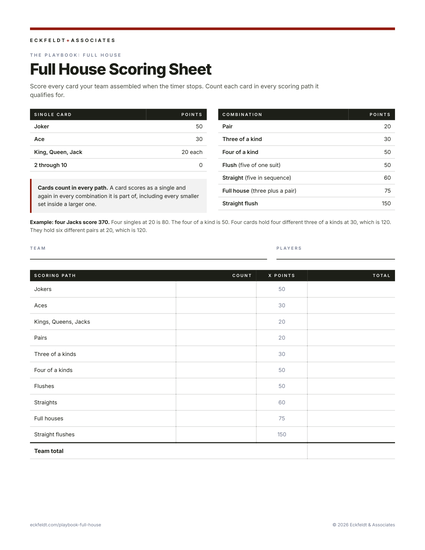
- Scoring Sheet, PDF, 1 page Full House Scoring Sheet
The one-page scoring sheet for each team. Card and combination values, the rule that every card counts in every path, a worked example, and a tally grid.
Download
Get the Next One.
Every new post and playbook lands in Better, Faster, my weekly newsletter for founder-CEOs, along with questions for your team and a book worth reading.