From Angel to Exit Episode 33
Inside a Founder's Exit Journey: Structuring for Scale, Earning Trust, and Choosing the Right Buyer
Wesley PortegiesFounder, MedComms Experts
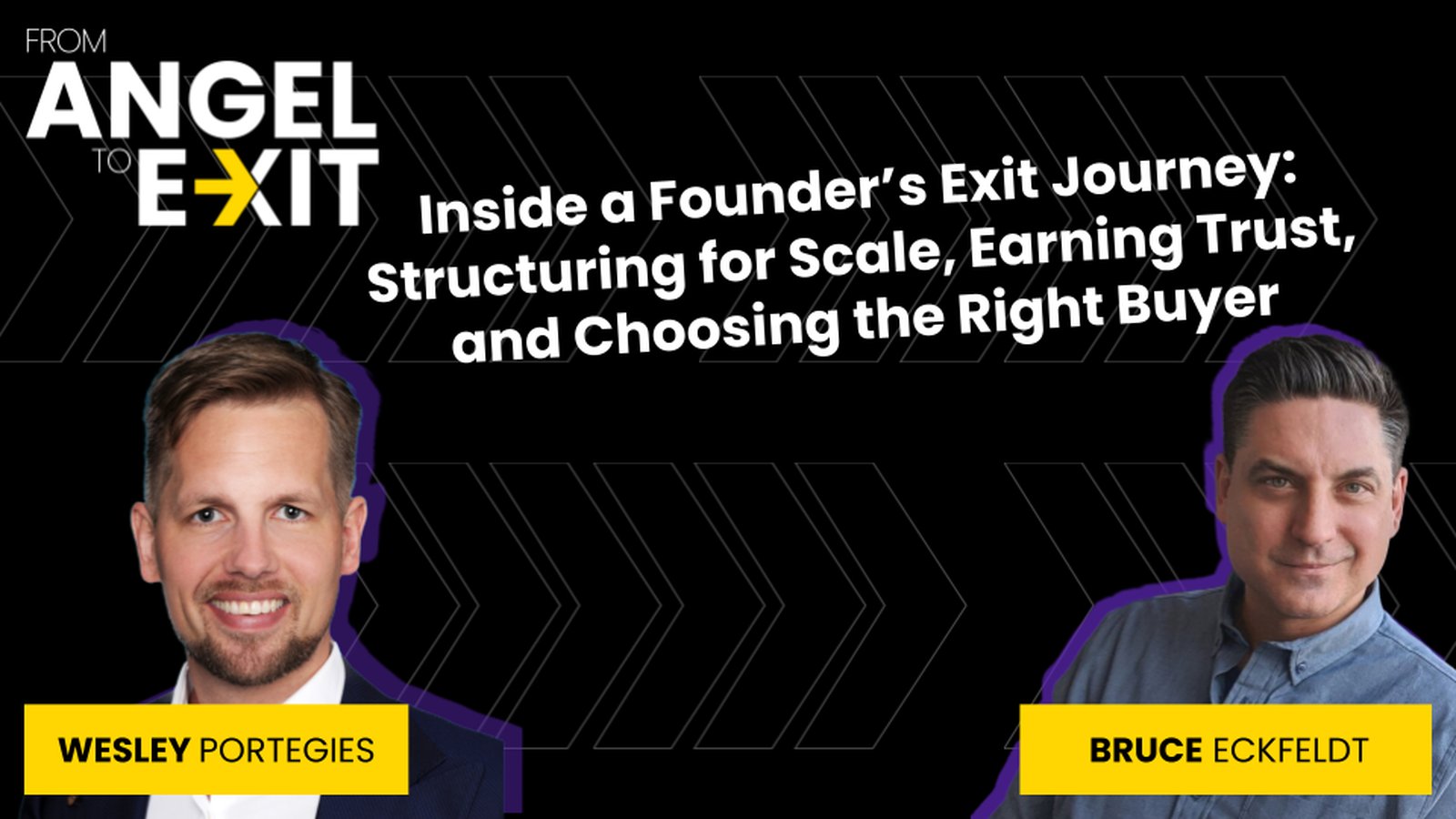
Listen to the Episode.
Play the full conversation right here, or pick a chapter to jump straight to that moment. Prefer your own app? Every episode is on Spotify, Apple Podcasts, and the rest.
About This Episode.
Start with the key takeaways, the ideas worth bringing back to your leadership team. Then read the full story of the conversation, or use the chapters above to jump straight to the moment that matters most to you.
- Founders should start investor conversations early, even without plans to sell.
- Run your business like it’s for sale, regardless of your current exit timeline.
- Early systems and contracts (employment, client, GDPR) are critical for smooth exits.
- Fit with investors is more important than valuation, trust and aligned vision matter.
- Strategic frameworks (like TreeHack) support scale by aligning teams and communication.
- A failed exit can still provide huge value, Wesley used it as a learning & prep tool.
- Transparency builds trust: share “the good, the bad, and the ugly” during diligence.
- Inorganic growth requires partners with experience, not just capital.
Frustrated by outdated agency models, Wesley Portegies founded MedComms Experts and scaled it to a 90-person firm across the US and Europe. In this episode, Wesley reveals how he prepped for exit without ever planning one, building solid systems, exploring investor conversations early, and ultimately finding a strategic partner aligned with his vision. A masterclass in founder succession, agency growth, and exit readiness, this episode is a must-listen for founders serious about scaling and strategic exits.
Watch the Video.
Prefer to see the conversation? The full episode plays right here on the page, so you can watch while you follow the takeaways or read along with the transcript. Every episode of From Angel to Exit is also on my YouTube channel, along with short clips from each conversation.
About the Guest.
The background behind the conversation, and where to find this guest online.
Wesley Portegies
Founder, MedComms Experts
Wesley Portegies founded MedComms Experts and scaled it to a 90-person firm across the US and Europe. He found a strategic partner aligned with his vision and shares how solid systems made the company ready to sell.
- linkedin.com/in/wesleyportegies
Full Transcript.
The complete conversation, lightly edited for readability. Open it to read along, or search the page for a topic or a name.
Read the full transcript
Bruce EckfeldtWelcome, everyone. This is From Angel to Exit. I'm Bruce Eckfeldt, I'm your host. Our guest today is Wesley Portegies. He is an exited founder. We're going to hear about his story, his business, the exit he went through, and what he's doing now. I always love these conversations with folks who have been through the process, and in this case it's not too distant past. It's still reasonably fresh. I'm excited to really get into the process, the logistics around it, and some of the insights, so hopefully folks who are earlier in the process get some good takeaways and things to think about. With all that, Wesley, welcome to the program.
Wesley PortegiesThank you. My pleasure to be here.
Bruce EckfeldtI'm excited for this. Before we dive into the business and the exit, I'd love to get a little personal background, before you got into your business. Give us a sense of your upbringing. Did you want to be an entrepreneur from day one? In kindergarten, was this how you answered the question? Give me a little background.
Wesley PortegiesIt's a great question, actually, because I don't come from a family of entrepreneurs. My dad was a mechanic. My mom worked in a supermarket. I come from a very modest, normal upbringing. But it happened that my sister, my only sibling, and I both became entrepreneurs, unexpectedly. I don't think I ever thought as a kid, "I want to become an entrepreneur or a business owner." It just happened.
I'm pretty much full of ideas all the time, things I could do. And it's hard to navigate the corporate environment as an employee when you're overflowing with ideas and things you want to do. I think that showed in my education. I had some challenges going through high school and college as a result. Then I started working in a large corporate environment, and of course I locked horns with one or two managers over time. I started realizing that was mainly because I had all these ideas and visions beyond what was possible in that particular situation.
So I ended up starting my first company when I was 19. This was all very small potatoes compared with what I ultimately built. I had a few endeavors all over the place, from selling wine to car cleaning products to other things. But I ultimately ended up working in the medical industry, where I was the client of the company I ultimately built, MedComms Experts. Well, I wasn't the client, because the company didn't exist yet, but I was representing what would now be one of our clients. I was actually pretty frustrated with how these agencies, medical communications agencies, would support me, and hence I decided to found one myself.
Bruce EckfeldtIt's like, well, no one's there to do it for me, so I'll go and do it for other people. When did it actually click for you that you should build a business around this? Was there a moment, a shift of perspective? Because it sounds like in the beginning you were just looking for services: "Hey, I'm trying to get my job done, I need this service, and I can't find anyone. This is really frustrating." When did it click that maybe other people have this need and there's an opportunity in the market?
Wesley PortegiesI had this frustration with working with agencies, and at the same time, the company I was working for was reorganizing. I'd worked in a typical large corporate organization, so not much was happening. I think my brain was kind of underutilized. I remember doing my MBA and thinking about this new venture all at the same time. I just needed something new.
I had a colleague I was working with at the time, and we were going out for drinks, actually. He said, "You know what would be cool? We can do this better. Why don't we start an agency?" And he became my co-founder at the time. So it was literally over drinks.
Bruce EckfeldtI think a lot of businesses have been started over alcohol. When you started, did you have a particular vision of where this was going? Were you thinking, "Hey, this could be a billion-dollar company, we could change the world"? How ambitious was the vision in the beginning?
Wesley PortegiesThat's a great question. There was definitely a vision, but it turned out to be completely different, which I think happens very often. And the vision wasn't that focused on monetary reward. It was more frustration with how things were done, and a little bit of an almost arrogant way of thinking: why does no one understand how this needs to be done? We'll just go in there and show how it's done.
It was very much about driving innovation. In our particular space, a lot has changed over the almost 13 years I've had the company. At the time, I remember, it was a pretty dull industry. There were still a lot of privately held agencies out there at the time. There aren't many left. Most of them were led by medical doctors or other scientific people. Of course, there's nothing wrong with being scientific, but I felt more creativity was needed.
I come from a marketing background. I'm not a scientist, and neither am I a medical doctor. Some people told me I was crazy to start a medical communications company without that background. But I felt the creativity was the part I was actually bringing in. The scientific rigor and knowledge, I can find people who are way better at that than I am.
Bruce EckfeldtGive us a sense of the growth journey. You mentioned things shifted at times. Any good inflection points or learnings as the company started to scale and get some traction?
Wesley PortegiesThere were many different insights. First of all, I think it's important when you start something to realize that you're probably going to end up doing something else. It's almost like your degree. You're studying for something, and at that point you think you're going to be in that profession, but you might not be. And I think it's more often that that happens than the other way around.
In our case, when we started the company, we thought we were going to be more like a freelance marketplace, like Upwork or something like that, but very specific to our industry. That lasted about four weeks. Then I remember someone from Baxter called us and said, "Hey, we need to launch a new product and we need help." Before we knew it, we were helping Baxter launch a product, and we realized, okay, we're going to be an agency. That was after developing all the plans, all the one-page business plans and so on.
Bruce EckfeldtScrap all that.
Wesley PortegiesBut I also think that's important. You need to set out with some kind of vision, but you also need to be very flexible in your mind and understand how you're going to apply your knowledge properly in whichever way possible. So flexibility in your thinking, not being too rigid in trying to keep executing what you set out to do, and understanding that sometimes the market wants something different from you, and that's where you then go.
Bruce EckfeldtI always find it's a bit of a strategic challenge. The market's saying we should go left. Is this really what we want to do? There's a choice there. Sometimes it's, "Hey, we're being told to go there, and we should respond." Other times it's, "Maybe that's a short-term thing, but we need to keep an eye on a longer-term plan." Did you have any particular process? I'm always curious how companies set or develop strategy. Any systems or frameworks or rhythms you leaned on as you got into that growth?
Wesley PortegiesOver time. In the beginning, we didn't even have an office. In the post-pandemic world that might be more normal, but at the time it wasn't. We were basically two guys with a laptop trying to start. Over the first few years there wasn't much structure. In some years we didn't even set a goal. We were just busy doing the work that got thrown at us. In that sense, we were quite privileged to get a lot of work. Even though I would discourage anyone from using this mantra for too long, if you deliver good work, you tend to get more work in our business. It's very much a trust business.
But over time, especially when we really started growing and hiring more people, it became more and more important to have these structures. At our largest, we were about 90 people, and that's really where I started feeling, as the CEO, that we needed more structure. It becomes harder to get everyone pointed in the same direction.
So, for instance, we used a model that's a little bit similar to EOS in certain elements, and that was really helpful, especially when it came to communication rhythms. Things like daily huddles, and thinking about how you cascade information down through the organization, but also how you create a bottom-up feedback stream from your teams that you can use for your decision-making. That was extremely important. Working quarter by quarter with quarterly goals and rocks and all these things has also been pretty important to us.
Bruce EckfeldtAt what point did you feel you had a real company with the potential to scale? You went from "We've got a couple of projects and a small team and we're making money" to "We've got something that could actually have a future, something bigger than you individually." Was there a moment where that started to happen?
Wesley PortegiesI would say it was four or five years in, which is also around the time we expanded into the US. I started my company in Switzerland. I'm European myself, originally. We actually got some clients from the US, which surprised me, because the market here in the US is extremely competitive. Why are these pharmaceutical companies working with a few guys in Switzerland? That's where I started understanding that we actually had something unique, because I did ask them that question. "Thank you for your business, but why are you working with us?"
Bruce EckfeldtNow that we've signed the contract, why did you sign the contract?
Wesley PortegiesAnd they said, "There's something unique about working with you. We like your way of thinking. You're quite innovative," and so on. Very detailed things they liked about us. So I thought, okay, let's actually try that in the United States. I moved over and started building up our business here. That's when the light really started switching on in my mind. If we're getting business from the other side of the world in a very competitive landscape, we must be doing something right, and we can probably get further than we thought in the beginning.
That was a pivotal moment, realizing we can actually do this and it's something that can scale. But knowing that you can scale and knowing how to scale are two completely different things. That has been a pretty hard challenge, I would say.
Bruce EckfeldtAlways. At what point did you feel you had something that might be sellable, or start to think about where this was ultimately going, other than being a cash-flowing business with you riding off into the sunset as CEO? When did the idea of needing a long-term plan start to come up for you?
Wesley PortegiesI've always had the mindset that I identified with my company, and I still do, but it is its own entity. I want the company to grow, and that's something that could be separate from me. So I always wanted to make decisions that were good for the company and not just good for Wesley. In an ideal world, they're both, but sometimes they're not.
Then I joined EO, the Entrepreneurs' Organization here in New York City, which was an amazing experience in terms of working with a forum and meeting other entrepreneurs. I happened to go to one of their events, and there was a guy called Brett Dearing who gave a talk about exits and so on. I was only there because I wanted to network with a few people. I thought, well, I'm not interested in that. I wasn't planning on selling the company or anything like that.
But he made one remark that always stuck with me. Regardless of whether you're interested in selling your company, you should always run it as if you're selling it. Because when you're selling your company, the potential buyer is going to scrutinize every single thing, and those things are probably very important things. So even if you're never going to sell your company, you should still run it as if you were. That really struck a chord with me.
I'm a perfectionist by nature. My wife is too, and we always joke with each other that we're recovering perfectionists. So I thought, here's another opportunity to do an even better job. What are the things we need in place for that? So I started talking a bit more with investors. I got quite a few emails and outreach from potential investors, as probably a lot of people do, and typically I would just ignore them. But because of that remark, I started thinking, okay, let's have a talk. Not really with the intent to sell, but with the intent to become acquainted and see what they're looking at.
So I presented to a few of those investors a few times, listened to their feedback, and thought, that's great. It was very inspiring. Someone telling you your EBITDA could be twice as high, or someone telling you, "Hey, you're in a service business, but I think you're overstaffed." It might not always be true, but it can lead you in the right direction and motivate you to look at things anew. Honestly, when you've done something for over a decade, sometimes you stop seeing it all. You get used to it. So it was a very encouraging and motivating experience.
At that point, I was really not planning to take on any investors. But then at a certain point, I felt we could accelerate more. There was a time when I was looking to acquire other companies, and while I was in the process of trying that, I realized we needed more capital. There were different routes to go about it, and I could have found more capital in different ways. But I realized that what was best for the company, which for me is number one, would be to find a group that wanted to invest in our company, and then we'd grow together, because they also bring in a lot of expertise. It's not just about funds. It's also about expertise and understanding how you grow a company inorganically. Sales and organic growth, we're used to that. That's what we've done for 12-plus years. The inorganic part we had never done before, so it's nice to partner with someone who has that experience.
Bruce EckfeldtSo what was that process like? What did you need to do internally to get ready? How did you approach investors? What were you looking for, how did you evaluate them, and what was your strategy at that point?
Wesley PortegiesIt goes back to the different conversations I had, the presentations I gave, and mainly the feedback I got. That feedback can be very random. Some of the things I'll give as examples were maybe not necessarily things we needed to work on, but an example I've heard a lot is: make sure all your team members have a proper employment contract and, if needed, a non-compete. These can be very little things you don't think about much day to day, but they become a bigger topic when you exit.
I think there's a lot of information out there that people can find on what you really need to make sure you get properly set up. And surprisingly, they're typically the little nuisances that you tend to push away in the day to day because they're not important today, but they become really important then.
Bruce EckfeldtThey're not important now, but they become important later. And the other problem is that they're often easy to do early and very difficult to do later.
Wesley PortegiesExactly. The example I gave about non-competes or contracts is a good one. Imagine going to your 80, 90, 100 people and giving them all new contracts. That's not an easy project. But if you make sure you get it right from the start... That's a good point, Bruce. For anyone who's early in their venture and listening to this, invest in that foundational work, because even though today you think it doesn't matter, there's likely, and hopefully, going to be a time when it really matters to you, and your future self will be grateful you did it now.
Bruce EckfeldtExactly. We run into this especially with services companies. Even your client contracts: are they assignable? You don't think about it, but you can have a contract that's been in place for four, five, six years with a long-term client, you go to sell, and then you realize the contract is not assignable. Now you have to go to the client, and now the client is holding you hostage on the deal, because they've got to sign this thing.
I had a case where I had to pony up about 20 grand to an employee we didn't have a non-compete with. Actually, I knew we had one, and I knew it was signed, but I couldn't find the document. I went through emails, I went through folders, and finally we just had to present something, and it ended up being a 20-grand check I had to sign to get that thing. Obviously we did it because we had to. We were doing a deal. People don't think about that. It's not on your checklist early, but if you can get these things on your checklist early, it makes it so much easier later.
Wesley PortegiesExactly. Especially policies and these kinds of things. Another one that comes to mind is GDPR and data privacy. You can stick to all the rules and do perfectly what's expected of you, but maybe not have it documented. Well, that's going to be a problem.
Bruce EckfeldtIt doesn't exist if it's not documented. And you're still going to have to warrant it in your purchase and sale agreement. You don't want to have to, but in those cases you end up doing it. So you had this vision, you saw the need to bring in other capital, really strategic capital, people who could help you grow and maybe do some roll-up. How did you start to talk to potential investors? What path did you see? Was it, "Okay, I really need to go to private equity now, because I need strategic capital and a platform to do a roll-up"? Was that clear to you, or did you have to sort it out over time?
Wesley PortegiesI made a very conscious effort to start learning about this, and learning, to me, meant starting conversations. Those emails with all the requests to connect and "look at partnership," as they typically phrase it, I would typically ignore at first. But when I realized I wanted to explore this idea, I started responding to some of them and having some conversations. I must say I was also a little bit lucky, because my wife happens to work for an investment bank, so she helped me get connected.
Bruce EckfeldtSo you had an inside angle on the whole thing. The takeaway for all entrepreneurs is to marry an investment banker.
Wesley PortegiesYes. But this one is taken, just to be clear. She was able to connect me, and her company actually organized a conference, so I went there. Of course, other people will have that opportunity too. I was just lucky that I was right in the middle of it.
I would really recommend to anyone considering this: just start talking. Have conversations and keep them low stakes. Don't feel like you need to get up on the podium and present and make the best impression right away. Just have conversations and observe what they're asking from you. The kinds of questions they ask are very telling about what they're looking for, and you're going to see patterns over time as you talk with more and more of these people.
For me personally, there were a lot of initial conversations, then only a few more in-depth conversations, and then only two or three situations where I actually went into a real process. The first time I went through that process was extremely helpful. You go through due diligence and these kinds of things, which is not easy. It's very time consuming. It's a challenge to keep running your business and go through due diligence at the same time, so make sure you have some support.
The first time I did that was quite a few years ago. I think it was 2021. And it went pretty well, actually. It was a good pressure test for us. But we ended up not proceeding, simply because I didn't see the fit. It was more on a personal level, especially since for me it wasn't really driven just by money. I wanted the company to grow beyond me. So I was looking more for partnership and a growth opportunity.
Bruce EckfeldtAnd it sounds like you were planning on staying on. It wasn't, "I want to exit, I'm done with this, and I want to go do something else." It was, "I'm looking for capital investment and a partner. I want to continue to run it. I just want to be able to make some bigger moves and have some bigger players at the table." So this was not just about maximizing the transaction. It was about where it puts you, and whether it's the situation you want to be in post-transaction to really continue to grow and scale.
Wesley PortegiesAbsolutely. And I think that's very important in any case, even when you're maybe not planning to stay on for that long. Situations where you just step out and hand over the keys, I'm not sure those even exist, to be honest. I don't think a lot of investors would be interested in that.
Bruce EckfeldtThey're rare. They happen every now and again.
Wesley PortegiesBut it's very important to realize you're likely going to work with these people for at least a few years, and it needs to be a good match. In that particular case, I just couldn't feel that. If money is the only contribution they can make, I don't think it's worth it. There needs to be more. There needs to be a true partnership. You need to be able to trust each other. They should bring in some expertise that you actually need as well. At the time, that wasn't true, so I decided not to continue.
Bruce EckfeldtI'm curious how you discovered that. What part of the process gave you the insight that led you to conclude this really wasn't the right deal, because of the people and the nature of things and where it was going to put you? And on reflection, is there anything you would have done differently or earlier to suss that out? It sounds like you got pretty far down the process. If you're doing due diligence, that's a fairly involved step in a transaction. What would you do differently?
Wesley PortegiesI'm not sure I could have anticipated it, to be honest, because of the things that made me think that. Well, maybe there's actually one thing I could have done. I'll circle back to that. We went through the whole due diligence process, and the feedback I was getting was that everything was fine. We passed due diligence. Then they came back and started renegotiating.
Bruce EckfeldtOf course. A retrade.
Wesley PortegiesFor some kind of made-up reason. I think it was something like, "We thought your US team was bigger." I don't know what was unclear about the list of employees I sent on day one. That hurt my trust, to be honest. I know this is done once in a while, but that doesn't mean I have to like it. I thought, I'm going to need to work with you. I need to trust you to build the company together. And already you're showing you're kind of unreliable. I'm okay with negotiating, even negotiating intensely. I'm used to that. But I'm also a man of my word, and I just didn't feel it was appropriate. So that was the first indicator.
Then, only after that, they started introducing the team that would actually be working with me. They were suggesting a particular person on the team, and I saw that this person, a very nice and experienced person, didn't have the expertise I was looking for and needed. Those two things together made me bow out of the opportunity.
To circle back to what I could have done differently: I could have made it clear, "Listen, once you have a valuation on the table, that's what we're sticking to," and spelled out what the rules would be for changing that valuation. Of course, I was completely inexperienced in doing any of this, so I didn't know that at the time, but that's something I'd recommend others do.
Bruce EckfeldtIt happens all the time, pretty much. One thing I try to do in these deals is make sure that the letter of intent clarifies the representations we've made about the performance of the company, financial and otherwise, and that due diligence is really just validating those things. Assuming they're validated, we won't be changing the terms. The only reason to change the terms is if something we've represented turns out not to be true in due diligence.
Because of that exact issue. It's a classic. You go into due diligence, and then they want a haircut, a retrade. "Now that we look at this, we don't like the client concentration." Well, you had the client concentration information earlier. There's nothing new here. And it's hard. If you're doing a clean transaction where you're walking away with cash on the table and nothing ongoing, then fine, negotiate the deal, get the money, and walk away. But if you're going to be staying on, or there's an earnout, or you've got money still on the table, or you're keeping equity, it's tough.
One thing I generally like is to get all the issues up front. Put all the hair on the table up front, because then it's a positive experience from there. You never have to drop other shoes later in due diligence. That's what kills the other side, when the buyers say, "Oh wait, what is this other thing you didn't tell me about?" and you're halfway through diligence. So put it all out there.
Wesley PortegiesI really like that. That's great advice, Bruce, because ultimately everything is going to be exposed. There's the illusion that you can approach it more like a sales conversation, where you could potentially, I wouldn't say hide, but not highlight some of the things that are maybe not so great. Well, they're going to come up 100%.
In the situation I ultimately ended up with, that's exactly how it went as well. I was very transparent from the start about everything: the good, the great...
Bruce EckfeldtThe good, the bad, and the ugly.
Wesley PortegiesThe good, the bad, and the ugly, thank you. It's all part of it. And I think that's also part of trust. If someone walked away as a result, then that's what it is. They were not the right partner.
Bruce EckfeldtSo you went all the way through diligence once and didn't do the deal. At the end of that, were you disheartened? Were you emboldened: "Now I know what I'm doing, I'm going to go back out to market"? What was your mindset after going through that whole process and not completing a transaction?
Wesley PortegiesIt was an interesting time, because I actually wasn't disheartened at all. I just thought, listen, I'm going to keep building the business. We're doing well, and there will be an even better opportunity sometime in the future when the time is right. Not knowing that I would actually go through quite a downturn. There was an industry-wide downturn in our particular sector. So of course I've scratched my head a few times: should I have just done it? From an economic perspective, maybe that would have made sense. But from a happiness perspective, it would not have. So I'm still extremely happy with how everything turned out.
Of course, due diligence is very tiring and you invest a lot of time. But at the same time, I came out of those conversations with a lot of learnings. They also tend to do a lot of research on your behalf. They'll interview your clients, for instance, and feed that back to you, and they'll analyze your numbers. So in the worst-case scenario, you can see it as a free consultancy session.
Bruce EckfeldtIt's like a big diagnostic on the health and sellability of your company. So where did you end up? That deal didn't work out, and you went through a downturn and recovery. How did you end up doing the deal you ultimately transacted on?
Wesley PortegiesIt was very organic, actually. I wasn't looking around or approaching anyone. It was one of those situations where I got connected, actually through that particular conference I went to. I got to speak with someone who was in a search fund, and I just really liked the conversation. I could feel it was a good match. In this particular case, he would also come into our organization, which is exactly what happened. He became our CEO, and I became the chief strategy officer as a result.
I could see the benefit, because when we were talking about how we could potentially do this, he was outlining his strengths, which are quite different from mine, but exactly in an area where I would love some support. It also allows me to focus on things I like more. So from that perspective, it felt like a really good match. Of course, the financial part of the deal and how things would be structured all needed to line up with that.
Other considerations, especially in our space: it's quite different if a large competitor comes around the corner and wants to tuck you into their organization, as they call it, versus being the first organization they're investing in within your sector, which is more our situation here. I'm not saying I would never do the other thing, but I sometimes feel that, especially if you're an innovator in your space, that can be a little hard.
So I'm really happy I found someone who's really aligned. And I think having someone come into your company to help you build it up is really high value. It's not just an investment where a return is expected. Of course a return is expected, but it's backed up with people who actually support you. That was extremely important.
And the investment group behind it, the Brydon Group in this case, I just felt good about how they communicated with me. I noticed in the past, talking with some of these groups, that they can be quite dispassionate and don't really understand that they're talking with the founder. I'm basically selling my brainchild. Some people just don't understand that. They talk about it like it's a car or whatever. In this particular case, I could really feel that they respected that element of it, that I've spent 12, 13 years building this company up, and that it's a big deal to invite someone into your space. Those were very important things to me.
Bruce EckfeldtTell me a little about how you negotiated the role. I'm always fascinated by founders who stay on, particularly when you're bringing in another CEO and you'll have another executive role. How did that work out in terms of seeing that opportunity, and how important or complicated was negotiating it as part of the overall deal? Were there a lot of trade-offs for you: "I could sell the whole thing and get cash," versus leaving money on the table, retaining equity, getting executive compensation and performance bonuses as part of the role? How did you work through the total deal, given that you had an ongoing role?
Wesley PortegiesThey were actually really open with me. They asked a lot of questions versus just telling me what was going to happen, which was really convenient, because I think that's how you find win-win situations in life. If you prescribe, it's going to be hard to find a way that works for everyone. Maybe we were just very lucky, but it happened that we were very much aligned on how we saw things.
For instance, I really like the sales role in my company, because I'm very passionate about the services we provide and the value we create for clients. I like to consult with our clients. I like to come up with new ideas on how we can tackle things. For me, that's the most important part of what I do in the organization. I'm less on the finance front, or HR, or other things like that. And that's where the strengths of John Ribble, the person who became our CEO, actually are. So it quickly became apparent how we could split this up in a way that made sense for both of us.
Bruce EckfeldtWhat's your plan? Do you have a particular time frame? Are you planning on staying on for a couple of years, or are you here until you decide you're not? How structured is it, and how much runway and vision do you have for the new role?
Wesley PortegiesThere's no defined time frame. I'll stay as long as I'm having a good time. I think it's important to feel purpose in your professional life, so that's important to me. And this whole deal now offers new opportunities. Now we can grow inorganically, and we're looking at where else we could make investments that make sense for our group to grow. After 12 years, it's really welcome to have a new perspective and a change of scenery. I have the opportunity to learn one or two things about that, which is sparking my imagination again.
So there's no predetermined plan. But like I said, the company is an entity of its own. In whatever economic scenario I'm in, I want the company to become something bigger, to become a legacy that keeps existing. I think this next phase of growth solidifies that thought, and I'm really excited to be part of that process.
Bruce EckfeldtThat's great. Any reflections, takeaways, or learnings you'd share with the audience? Things you wish you'd done differently, or things you realize were really good moves that you'd encourage people to put on their checklist earlier in the process? It's a lot easier to do this earlier than later. What comes up on that list?
Wesley PortegiesA few things we've covered already. Especially contractually, whether it's with clients or employees or anything else, and policies like GDPR and data security. Even though it's hard to see in the moment, and it's an investment, especially for a small company, I think you can take a few steps to scale it up over time. But don't wait too long. It's easy to forget. If you skip it a bit in the beginning, you might just become too busy to think about it, and it will come back to you with a vengeance at a point when you don't want it. So that's definitely something I think is extremely important.
Personally, I also believe you should run your company because of your passion. I think an exit is great if you want it. But if you make that your goal, you might never get there, because it should be the result of building a successful company. That's what investors want to buy: successful companies. And I think those are built on a desire to change something in this world and do something other people appreciate and are happy to pay money for.
And, like I mentioned in the beginning, run your company as if you're selling it. If you were an investor, what are the hard facts you would be critical about? It could be many different things. One I haven't mentioned so far in our conversation is revenue concentration. I run an agency, comparable to a marketing agency, and that's a famous thing investors look at. If 40% of your revenue comes from one client, that's risky for them. These are things you need to keep under control. Not just because at a certain point you want to exit, but because it's healthy business to do so.
Bruce EckfeldtIt's good business. My philosophy is: assume you're going to keep the business forever, and be ready to sell at any time. That's where the best scenarios come from. If something comes across your desk and it's a great offer and you're ready to sell, then do it. And if an offer comes across that you don't like, you don't have to take it. Being in a position where you're desperate to sell is not good for anyone.
Wesley PortegiesAnd this is maybe one other thing that surprised me a little. You don't have to wait for the perfect moment to start having conversations. It might not be the perfect moment to actually make a move, but that doesn't mean you can't have conversations. Even when things are not going that well, it can still be good to have conversations and build up your network. Most of these investors have seen it all, and they understand that businesses go up and down.
So even when things are a little down, you can still have conversations, and then you can actually show them: "Listen, this is what we did to change it. This is how we recovered. And now we're healthy." That almost makes it more interesting, because now they understand you're not just lucky. You actually know how to run a business, and the business is solid. So that's maybe one other tip: build your network and keep in touch with it, regular touch points once in a while, without overdoing it, so you don't lose too much time and can focus on running your business. I think it's healthy to have a network of investors you can talk with.
Bruce EckfeldtExcellent advice. Wesley, it's been a pleasure. If people want to contact you or get more information, what's the best way to do that?
Wesley PortegiesI would say LinkedIn. I'm easy to find on LinkedIn, and I can send you the link if you want to post it in the show notes. I'm happy to help others who are going through a similar experience by sharing some of my experiences in this endeavor.
Bruce EckfeldtI'll put it in the show notes. I appreciate it. That's a great offer. Thank you so much for taking the time today, Wesley. It's been a pleasure.
Wesley PortegiesAbsolutely. Thank you, Bruce.
Never Miss an Episode.
Know the moment a new episode goes live. Subscribers also get a say in future guests and the topics we cover.
Other Related Episodes.
More conversations that connect to this one. Or browse the full archive by topic or by guest.
Mital Makadia
The legal and strategic mistakes founders most often regret at exit, and how to avoid them.
Listen and Read
Chad Williams
Why every founder needs an M&A lawyer, and how to handle LOIs, earnouts, and non-competes.
Listen and Read
Karl Sigerist
Why so many lower middle market deals fail, and how to prepare for a high-value exit.
Listen and Read