From Angel to Exit Episode 34
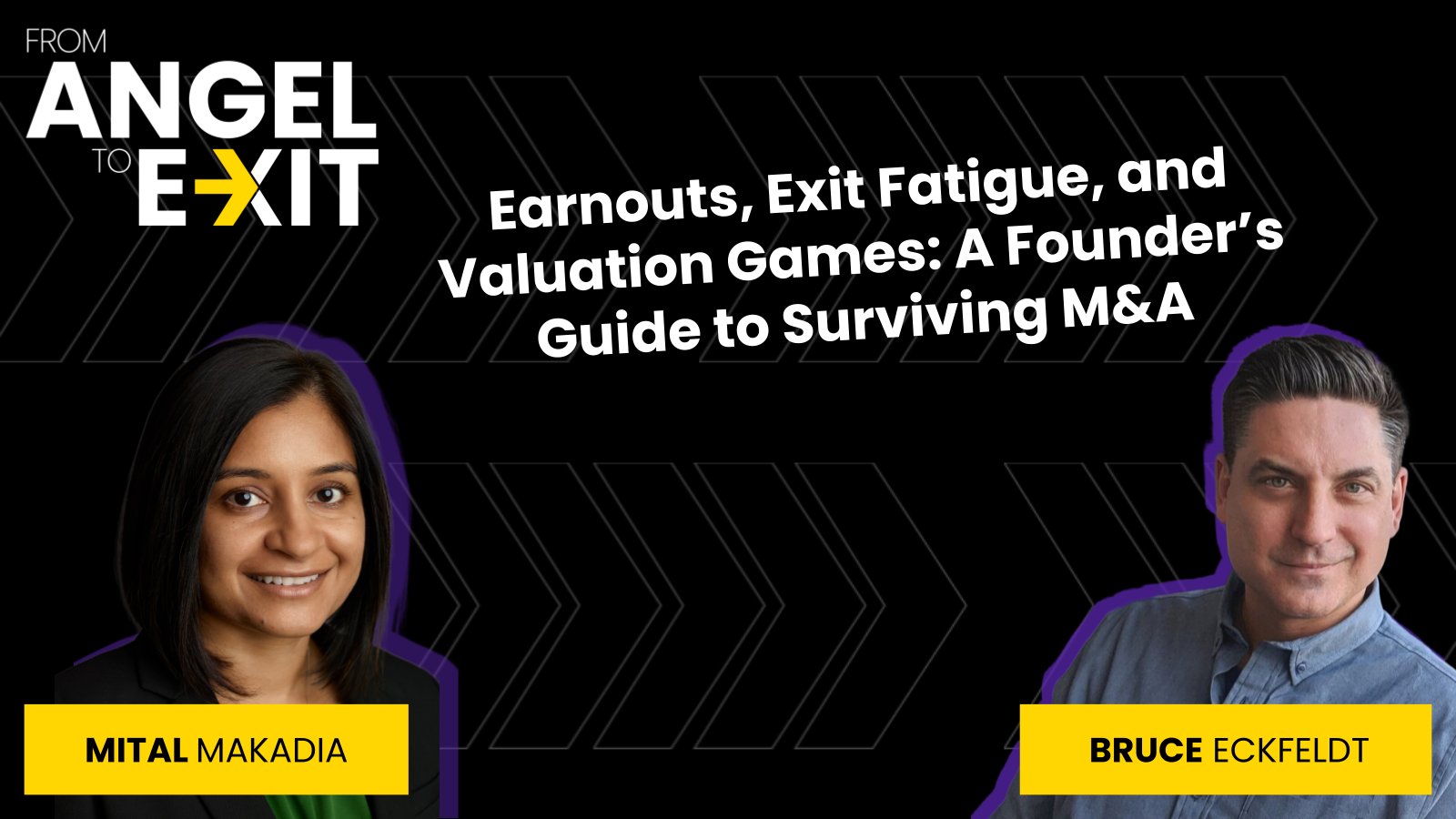
Earnouts, Exit Fatigue, and Valuation Games: A Founder's Guide to Surviving M&A
Mital MakadiaPartner, Grellas Shah
Listen to the Episode.
Play the full conversation right here, or pick a chapter to jump straight to that moment. Prefer your own app? Every episode is on Spotify, Apple Podcasts, and the rest.
About This Episode.
Start with the key takeaways, the ideas worth bringing back to your leadership team. Then read the full story of the conversation, or use the chapters above to jump straight to the moment that matters most to you.
- Early term sheet negotiations are where founders have the most leverage, maximize it.
- Avoid taking high valuations early unless you're certain you can grow into them.
- Strategic investors can block future funding rounds, vet motivations carefully.
- Earnouts should be considered “gravy,” not guaranteed, negotiate control and budget.
- Build in single-trigger acceleration and “good reason” resignation clauses.
- Keep buyer relationships warm long before you plan to sell.
- Founders often walk away quickly post-exit, plan earnout terms accordingly.
- Don’t show desperation, buyers will use it to their advantage.
What do startup founders often regret most at exit? Overvaluing too early, choosing the wrong investor, and skipping key legal protections. In this episode, Mital Makadia, Partner at Grellas Shah, shares legal and strategic insights from two decades of advising startups through funding and M&A. She breaks down common founder mistakes, why strategic investors can be dangerous, and how to protect yourself with better term sheets and earnout clauses. Founders looking to scale, raise capital wisely, or plan a successful exit will find actionable legal and financial guidance grounded in real-world experience.
Watch the Video.
Prefer to see the conversation? The full episode plays right here on the page, so you can watch while you follow the takeaways or read along with the transcript. Every episode of From Angel to Exit is also on my YouTube channel, along with short clips from each conversation.
About the Guest.
The background behind the conversation, and where to find this guest online.
Mital Makadia
Partner, Grellas Shah
Mital Makadia is a Partner at Grellas Shah with two decades of experience advising startups through funding and M&A. She helps founders avoid the legal and deal-structure mistakes they most often regret.
- Website
- grellas.com
Full Transcript.
The complete conversation, lightly edited for readability. Open it to read along, or search the page for a topic or a name.
Read the full transcript
Bruce EckfeldtWelcome, everyone, to From Angel to Exit. I'm Bruce Eckfeldt, I'm your host. Our guest today is Mital Makadia, and she is a partner at Grellas Shah. We're going to talk a little bit about the M&A environment. We're going to talk about exits. We're going to talk about earnouts. I'm excited for this. I'm always excited to talk with people who have been through this or have seen many transactions. It's a chance to talk about patterns, trends, things like that.
So I'm excited about the conversation and some of the insights. Hopefully some of the folks listening who are earlier in this process, looking to scale and ultimately exit their companies, will get a couple of nuggets, a couple of takeaways, to help them think more strategically about what this journey looks like, what this process looks like, and what they do after. So with all that, Mital, welcome to the program.
Mital MakadiaThank you for having me. It's nice to meet you.
Bruce EckfeldtLikewise. Before we dig into the world of exits and earnouts and transactions, I would love to get a little background. Professionally, what was your background? How did you get into this space? Give us a little of the story.
Mital MakadiaSure. I was a young lawyer on the East Coast, and I went straight into corporate law at the big firms in New York. I did that for about five years, in New York and in DC. I did mostly public company securities work and IPO work. Then I transitioned out here to the West Coast, and for the last 15 years I've been doing general corporate work, but for the startup space. So not as much public company work, but definitely early-stage startups. I've been practicing law for over 20 years now, and the last 15 have been squarely focused on the startup space, which is very exciting, especially here in the Bay Area.
Bruce EckfeldtGive us a little contrast. What has been interesting about getting into the startup space from the public side? What have been some of the challenges? I'd love to get your take.
Mital MakadiaThe best part is working with founders and entrepreneurs directly. When I was doing public company securities work at the larger firms on the East Coast, my clients were the vice president of so-and-so, at that level. We'd deal with the CEO and the founders, but very rarely. They're pretty much gone by then. Even the early investors are gone by then. It's a completely different makeup of owners. Here, you're dealing with passionate entrepreneurs and the struggles they're dealing with, and when they win and when they make it, that's much more rewarding and exciting for us.
In terms of the struggles with early-stage startups, it's really the money: trying to get the funding, trying to survive. We see a lot of startups that don't make it, and that's always sad, because we've been on that journey with them from the beginning. There's always the next venture, but it is sad when that first passion project dies. Hopefully that's not what we're talking about here. We're talking about clients who make it. For most of my clients, if they make it, it's between the A and the C round. When they make it between the A and the C round, that's when they get a significant chunk of money. They haven't been diluted as much. They get life-changing money, and that's always exciting.
Bruce EckfeldtDo you have any rules of thumb about the number of companies that don't make it versus the number that are successful?
Mital MakadiaGod, that would keep me up at night if I kept the metrics. I try not to think about that. It's hard to put a number on it. I'd say it's an easier metric to determine which companies make it once they've got outside funding, because a lot of companies don't make it to the Series A, and that's tough to track. But once they get that Series A, it's easier to track.
Bruce EckfeldtAnd do you typically start working with them at that Series A point?
Mital MakadiaClients come to us pretty much at incorporation or right after their Series A. That's pretty much the window when we get them, and we take them through the various funding rounds: A, B, C, D. Beyond D, I would say they outgrow us. They're on their way to IPO, and we're not scaled for that. We're pretty mid-market in terms of valuations. Anything less than a billion dollars in valuation is our sweet spot. And then we do the M&A work as well.
Bruce EckfeldtEveryone has their own definitions of what these rounds represent in terms of size. How do you define A, B, C, D in terms of stages of growth, or pivot points or transition points for companies?
Mital MakadiaThere are a lot of VCs doing early-stage, almost angel-type investing. They call it a seed series, but it's not really. I would say once a company hits about $5 million ARR and gets that round, that's pretty much a proper Series A, if not more.
Bruce EckfeldtAnd what are they using it for? What's the inflection point in terms of a change of strategy or focus? Now that they've got a Series A, what does it allow them to do?
Mital MakadiaScale, mostly. It gets them over that hump so they can really scale. But I was going to answer your earlier question about how many of them make it. Once they get that Series A, I think the majority of them make it. It depends on how you define making it. You see a lot of LinkedIn posts about so-and-so being acquired by so-and-so, but what were the terms? Generally speaking, they'll land somewhere. It might not be where they wanted to land. It might not be where the early option holders or common stockholders really get much of anything. But somebody will buy them. They'll find a home somewhere, or at least a place where they can do their next venture from. They've gained some insight and experience, and they're better at it in the next venture.
Bruce EckfeldtWhen you look at B, C, and D, is it just ongoing growth, or are there pivot points that come into play in terms of what they're focused on, changes of leadership, or changes of strategy?
Mital MakadiaC is the real growth round. A helps them scale. B, I don't know how we'd define a B, but they're doing well. C is really when they're going global.
Bruce EckfeldtSo there's a major expansion. They've proven their model. They've got leadership in place. Systems are more or less working. They've proven the financials.
Mital MakadiaAnd those investors aren't really involved with the company in the same way the Series A and Series B investors are. The Series A and Series B investors are rolling up their sleeves. They're very helpful. C is the money.
Bruce EckfeldtInteresting. So the earlier investors are intimately involved with leadership, strategy, recruiting, building teams. Whereas the C investors basically have a really big checkbook: let's fuel this thing, get it to the next stage, and then cash out.
In terms of types of transactions, you mentioned a couple of scenarios: getting bought by another company, doing another round of funding, getting tucked into something. What are some of the typical paths you see founders find themselves on, or scenarios they start to think about once they get a first round of funding?
Mital MakadiaTypically it's a strategic buyer. You never know where those buyers come from. It could be somebody you didn't even think of as a buyer, maybe a large customer of yours. But typically it's a strategic buyer who comes in.
Bruce EckfeldtFor audience clarification, strategic means it's not just, "Hey, I see a financial return in putting money into this company." There's some underlying asset or capability that I can leverage in a unique way and combine with my existing business to create something synergistically more valuable than the entities on their own.
Mital MakadiaCorrect.
Bruce EckfeldtWhen you're working with founders, when do you start talking about those paths and which one they might most likely end up on, just in terms of planning for the future? When does this discussion come up, and what does it look like?
Mital MakadiaUsually when they're tired. It depends on what's going on in their life and how much energy they have to get over the next hump. The pandemic changed things a lot for people. A lot of companies raised money that maybe should not have been funded. There's been a lot of M&A among my clients in the last two years. A lot of that is because clients raised easy money right after the pandemic, in 2021 and 2022, but the environment wasn't there for raising additional funds in 2024. They were reaching the end of their runway, and they had to figure out how to sell.
Bruce EckfeldtI'd love to talk about that a little. When you say post-pandemic easy money, companies funded that shouldn't have been funded, is that just supply and demand? The money was looking for a home, and investors were willing to fund things that maybe weren't the most viable?
Mital MakadiaNot necessarily. Not for everyone, obviously. Or maybe at higher valuations than were warranted.
Bruce EckfeldtI always find this one interesting, because there's definitely a mindset among founders of, "I should get the highest valuation I possibly can every single time." And I've certainly seen lots of situations where people do an early stage at a very high valuation, and then they're boxed in.
Mital MakadiaThey are boxed in.
Bruce EckfeldtTell me why this is a problem. How does it affect future rounds? What are the dynamics?
Mital MakadiaBecause it sends a signal about what your company should have been to earn that valuation. What the size of your team should have been, the revenue numbers you should be pulling in, the customer metrics. If that's not all there, it makes the next round infinitely harder.
Bruce EckfeldtSo they're ahead of themselves. From a funding point of view, they haven't caught up operationally and strategically to the funding they've had. So when the next round comes, what ends up happening?
Mital MakadiaIt ends up being a flat round, and that sends a negative signal to the market. It's not good for employee morale either. That first valuation shouldn't have been that high.
Bruce EckfeldtCan we throw out some numbers? Say you do a $2 million round at a $4 million valuation, and when you go to do your next round, you take on another $2 million, but you're still at a $4 million valuation. What would the numbers be in these cases?
Mital MakadiaNo, it would likely be more like a $40 million or $60 million valuation. Let's say you raised your Series A at a $40 million to $60 million valuation.
Bruce EckfeldtAnd what's an average raise for a Series A?
Mital Makadia$5 million to $10 million, maybe. Then let's say you're raising your B round, and it's coming in at another $60 million valuation. That makes it harder.
Bruce EckfeldtBecause now the existing investors are basically hamstrung. The A investors overpaid, and the fact that they overpaid becomes very transparent in the next round.
Mital MakadiaBecause the A valuation shouldn't have been that high. And it's bad for morale. Like I said, it sends a negative signal to your employees, and to the new investors when they come in and see that you raised the prior round at the same valuation. "Why are you offering me the same valuation? What's wrong with you? What's wrong with the company? What troubles has it had the last two years?"
Bruce EckfeldtSo you just haven't really executed on the plan.
Mital MakadiaRight. But to your point, a lot of times at that first stage of negotiation, you've got maybe two or three term sheets you're playing off each other. The instinct is always to go for the one with the highest valuation. Really, go for the best partner you can find, the one who's actually going to help you.
Bruce EckfeldtI was just going to ask that. Is there a situation where you would say don't take the best valuation? It sounds like it's because you really need to look at who you're getting in bed with.
Mital MakadiaDefinitely don't take it from a strategic investor. That's always the scariest. I've had clients who took money from a strategic investor, and then that investor really starved them and prevented anyone else from coming into the next round, just so they could scoop them up.
Bruce EckfeldtInteresting. So they take a round and then box out future investors to keep the valuation down.
Mital MakadiaThis wouldn't happen with a traditional VC in the US. But I've had lots of clients who have taken funding from the venture capital arm of some Asian corporation, and not to malign Asian corporations, but it's usually a strategic investment. There's something about your IP they like. This large foreign public company has a venture capital arm, and they're offering you $5 million. Let's take it.
But that $5 million usually comes with certain veto rights, or maybe even a ROFR, a right of first refusal, to buy you. They'll ask for the first right to buy you in an M&A transaction. In the beginning, you're not thinking about it. You think, maybe it'll be a bidding war, someone will want me, great. You're not thinking about what could happen two years from now. You've spent that money, you're looking for the next investor, and all of a sudden this corporation has no interest in you getting additional funding from anyone else, because they want your technology. This has very much happened.
Bruce EckfeldtFor founders approaching this, how do you advise them, or what do you suggest they think about? Because it's complicated. I'm a founder, I'm trying to run a company, I'm trying to build a business and deal with employees, and now I've got to figure out the motives and intentions of the people who are going to fund me. How do you sort through this as a founder?
Mital MakadiaThere's so much money out there right now that your money shouldn't just be money. It should provide something else: connections to customers, like you said, help in scaling and growing the business, being a real partner in all of this with you. Because you can get money anywhere. I know it's easier said than done.
Bruce EckfeldtPeople in the money business know that. People in the founding business don't necessarily realize it. How do you practically balance that? Yes, there's lots of money available if you know where to look, put in the effort, and have the time and patience. But I think most founders would say that, unfortunately, when they're looking for money, they're typically looking under pressure. "I've got six months of runway," or "I've got this major opportunity, and if I can't get a funding round, I'm going to miss this joint venture or partnership or big client."
Mital MakadiaThat's where the accelerators come in. Find a nice, reputable group of people who can help you. There are a lot of people out there who will promise you the sun and the moon and take a percentage of whatever amounts they help you raise. Stay away from all that. But find reputable groups that can assist. They're out there.
Bruce EckfeldtWe've talked to a few of them on the program, so they're out there. This is the challenge for founders. There are a lot of balls to keep in the air, but carving out time, having good strategies, understanding the landscape, having good advisors and trusted networks can be super powerful and helpful in sorting through those things.
Let's talk a little about the M&A side of things. When you talk with founders about where this is going and what the paths are, what are you advising them to do to develop those paths, or to get ready, or at least to avoid doing things that will make some of those paths harder? Are there things you're helping them with at those stages?
Mital MakadiaThere's diligence: making sure your legal house is in order and your financial house is in order. Make sure you have a good accountant and a good lawyer. Those are things you can address once you get into the M&A. The main thing is: are you going to use a banker? Are you going to use a broker? Or are you going to go out there, pound the pavement, and find a potential buyer yourself?
Bruce EckfeldtWhat do you recommend? Do you have any general guidelines?
Mital MakadiaUnder a certain size, don't use a banker. Some of them can add real value, but generally speaking, you're going to give up a fair chunk of the sale proceeds for them to eventually find a buyer who was already in your orbit.
Bruce EckfeldtI don't know where your numbers are. I typically find that under $50 million, you probably won't find a banker who will work for you, and in terms of value, you're not going to be their biggest client. It ends up being kind of a no-thank-you deal. And particularly when you're looking at strategic buyers, I think a lot of founders don't appreciate that they could probably map out a pretty good list of potential acquirers themselves.
Mital MakadiaThere are some who will, but that's harder. And yes, founders often weren't even thinking about it, but those buyers are literally in their orbit.
Bruce EckfeldtThey're competitors, partners, suppliers, customers. I've done this exercise with companies, and all of a sudden we come up with a list of a dozen people we should be talking to at some level. Now, we may not be sending them emails saying, "Hey, do you want to buy us?" But there might be ways of starting to develop relationships and explore some of this earlier rather than later.
Mital MakadiaAs a founder, it's always good to keep those relationships warm, even from the very beginning. Just check in with them, make sure they know who you are. You might not even want to sell for the next five years, but from the beginning, keep those lines of communication open, because you never know.
Bruce EckfeldtIs there anything founders should look for in some of those relationships? Is it strategic fit? Market opportunity? Complementary services?
Mital MakadiaIt's going to be the terms. Because once you sell the company... I don't know about your experience, Bruce, but in my experience, once you're an entrepreneur, you're an entrepreneur. As much as you think this product you've built is so amazing and is going to do wonderful things inside this large corporation, your heart's not going to be in it. It's not yours once you sell it, and you're going to want to get out, no matter how much incentive there is for you to stay. They can put in a four-year vesting term. They can do that.
I used to keep an internal list of how long my founders lasted post-closing, and my record was about three months, I think. Somebody lasted three months. But then I beat my record, and I don't think it will ever be beaten. I did an M&A deal, I think in February two years ago, and the deal closed on a Thursday. I remember the exact moment. I was hiking in San Francisco, in Twin Peaks, on the Saturday or Sunday, and I got a call: "I can't do it. I'm leaving."
And I'll tell you, it was because his team couldn't get cell phones. Their cell phone plans wouldn't be paid by the buyer anymore, and he just couldn't take that. He made enough money, he could have paid for it himself, but it was the insult of having to answer to somebody. All of a sudden you're working for somebody, and their HR rep is telling you what you can and can't do with your team.
Bruce EckfeldtIt's a policy issue. I get it, but it's a matter of principle. I generally say most entrepreneurs are unemployable. What made you a great entrepreneur makes you a horrible employee.
Mital MakadiaBut I don't think anyone's going to beat my three-day record. That record stands. And there was incentive for him to stay, because there was additional money. It wasn't as if he was walking away from nothing.
Bruce EckfeldtIt's not about the money. Let's talk about this, because I find it fascinating. It's where psychology versus logic versus future vision come into play. Oftentimes these deals come with some kind of earnout or ongoing role. I break it out this way. You've got your cash-out transaction, what you get on the transaction date. Then you've got deferred payments, which could be fixed notes, ongoing payments that aren't tied to performance. They're typically at some risk because they're backed by the company. Then you've got earnouts, which are often performance based, either milestones or revenue or company or individual performance. And then you've got executive packages. Sometimes founders stay on in an executive role that has a significant salary and maybe its own performance bonus and compensation. How do you help founders sort through these things as they get offers and compare term sheets?
Mital MakadiaLet's take them separately. Salary is what it is. Are you happy with it? As long as you stay, you'll earn it. If you're not happy, you'll walk away and you won't have it. Are you okay with that?
The one that's more difficult is when a portion of the actual sale proceeds is held back subject to vesting. It's not quite an earnout, but they're basically earning out their sale proceeds, and it's only time-based. As long as they stay employed, they get their full sale proceeds. That one's always an easy one: make sure you get acceleration. Full single-trigger acceleration if you're terminated without cause.
Bruce EckfeldtSo being terminated without cause would automatically accelerate and make all those payments due immediately.
Mital MakadiaYes. If you're terminated without cause, it automatically accelerates. Including resignation for good reason. Those two go hand in hand.
Bruce EckfeldtSo what is resignation for good reason? How would you actually define that?
Mital MakadiaIt's usually a reduction in salary or role. Let's say I get acquired by Google or Apple, and I have an acceleration clause so that if they terminate me without cause, I get my full sale proceeds. But if I don't have a corresponding good reason clause, they could make me the janitor at their facility in Alaska. They haven't technically terminated me, but it's essentially constructive termination. In that situation, I would have cause to resign for good reason, and then I would get full acceleration. So you definitely want any reduction in salary, any reduction in your role, or a requirement that you move more than 20 miles from your primary work office to trigger full acceleration.
Taking out that and the salary, the third bucket you talked about was earnouts. With earnouts, I always tell clients to assume they're never going to actually get it. As long as you're okay with that, go for it. But that's not reality. The reality is that earnouts are used to bridge the gap between what the sellers need and what the buyers are willing to pay at the time. So unfortunately, earnouts do factor into too many deals. Even though I advise clients not to count on them, it is what it is. With earnouts, you really want to focus on two main things. One, do you have full control over your ability to earn that earnout after the M&A?
Bruce EckfeldtMeaning, if the earnout's tied to gross margin or revenue growth...
Mital MakadiaAre you going to be able to keep your team employed? You're going to end up being a subsidiary of a larger corporation. Are you going to continue to be able to operate and run your business, and sign on the customers you need, et cetera?
The second is, are they going to give you the right budget? Remember, even if your company is operating on its own inside a larger company, you're no longer the CEO or on the board of that company. Yes, you're running that division, but really the buyer and their VP of whatever control the resources. So there are two things you've got to negotiate in the actual sale agreement if you have an earnout: control over your ability to actually earn it, and an actual budget number, so they're required to give you the resources you need to earn it.
And if they don't, like I said, build in that acceleration provision. Buyers don't want to agree to any language in the purchase agreement that restricts them in any way. They're going to say, "We need flexibility to run the business. We need to be able to hire and fire people. We need to set our budget and do whatever we need to do. Maybe even create a competing product, or no longer focus on this product we've bought." That's okay. You can have that flexibility, because you need to run your business how you need to run it. But in that case, you need to accelerate me. You have to pay me out. That has to factor into whatever business decisions you need to make.
Bruce EckfeldtHave you seen earnouts where the founder doesn't have an operational role in the company, and it's basically, "If the company continues to perform, you get the money"?
Mital MakadiaI've seen that, but I tell clients, just don't count on it. Think of it as gravy. If it happens, it happens. You get the check in the mail.
Bruce EckfeldtIf you get a check in the mail, you'll be surprised and happy.
Mital MakadiaBut speaking of that, at whatever earnout points you've negotiated, make sure you've also negotiated for information rights. At the 12-month mark or the 18-month mark, ask to see the financials, or whatever the numbers are, so you can verify for yourself whether the milestone has been achieved. And make sure there's a dispute mechanism in there.
Bruce EckfeldtWhat would that look like? Arbitration, or a third party?
Mital MakadiaNot even arbitration. An actual mechanism built into the purchase agreement, so they're required to give you periodic information. I wouldn't even wait until the 18th month. Every quarter, they're required to give you the metrics for the product sales or whatever you need to verify. That way you get into the habit of reviewing them and can track progress. Then at the end of the year, or the earnout period, you can verify. You have maybe 60 days to compare the numbers, with audit rights to audit their books, et cetera. And if you don't agree with their numbers, you both have a mechanism for appointing an independent third party. That kind of mechanism can be built into the purchase agreement.
Bruce EckfeldtThis may be a more conceptual question, but I always find it interesting, and often challenging, when you're in transaction mode. I wouldn't say it's adversarial, but you both have somewhat competing interests, and you're negotiating against each other. I hate to say it, but you're thinking about all the ways things could go wrong and all the ways you could get screwed. And then you sign the deal and say, "Okay, great, let's work together." How do you navigate that?
Mital MakadiaIt's like signing a prenup before your wedding. It's always going to leave a bad taste in someone's mouth. I'm sorry, it is. It's just the reality. People eventually land somewhere, but not without battle scars. It takes a lot of maturity on both sides to avoid those sorts of negative feelings.
But generally speaking, I tell clients the most leverage you're ever going to have is before you sign the term sheet, when they're essentially wooing you. Once you've signed that term sheet, it's death by a thousand cuts. It really is. They keep chipping away: "Well, our HR rep wants this," and "Corporate dev wants this," and the CEO is different, and the CFO, and the general counsel. In a large company, there's always, "I'm your biggest advocate here at this company, but I need to get it approved by the board." They're professionals. They know what they're doing. For the founders, it's the first time they're doing this.
So they are going to wear you down. Like I said, once you sign that term sheet, you're picturing the money. You're picturing the end. You've already spent it in some cases. You're picturing the end of your 12- or 14-hour workdays, whatever it is. It's really hard to get back into growth mode if the deal falls apart. So you'll take whatever they give you, even if, and this is the sad part, they renegotiate the price halfway through. I'm seeing that more and more now. It's really sad, because in my 20 years of doing this, I've seen more purchase price renegotiations in the last three or four years than in my entire career.
Bruce EckfeldtRetrades. Two things. One, my advice to most founders is that the key to happiness is low expectations. Post-signing, it's a different world. Just accept all these things. The more you can accept that things might happen, could happen, probably will happen in some respects, the better off you're going to be. The more realistic you're going to be. Two...
Mital MakadiaDon't show weakness. That's the other one. Sorry, I didn't mean to interrupt you. I was going to say don't show weakness, because they'll smell it. They can tell when a founder is desperate and scared that the buyer is going to walk away.
Bruce EckfeldtThat was the next one I was going to bring up, so that's great. This is hard for venture-backed companies that have to repay money and have a certain runway, particularly if they're not profitable or can't otherwise cover their costs. But there's this idea that you are always the other buyer. If you're at the table, you can choose to buy your company back. You're the other buyer in those situations. Even if it's an unsolicited offer, or you really only have one party at the table and it feels like you're in a bind, the more you can set it up as "Well, no, I can continue to operate the company," the stronger the position you're going to be in.
Obviously, in some of these startup cases they're running out of cash and need cash to survive. But what have you seen founders do that helps them not feel so desperate, not feel like they have no option in these situations?
Mital MakadiaPlan ahead. Like you said, have that... what's it called? BATNA?
Bruce EckfeldtYep. Best alternative to a negotiated agreement.
Mital MakadiaHave that BATNA. Don't wait until you've got three months of runway left. That's the worst time to do this. As soon as you raise your Series B or Series C, start those conversations, keep them open, so that you're not beholden to this group of investors or a buyer who comes in at the last minute. Plan ahead.
Bruce EckfeldtI'm curious about the retrade trend you've seen. What do you think is driving it? Are buyers just bullish, and they realize they can push sellers around? Has this just become a strategy for them?
Mital MakadiaI hope not. I don't want to live in a world where they're doing this with premeditation. I think they're just being extra bullish at the beginning. I am an optimist. I don't want to think the world is that conniving. But there are things we can do at the term sheet stage to protect you in those sorts of situations.
It's unusual to have a termination fee in private company transactions, and those termination fees usually only kick in once the agreement is signed and then terminates between signing and closing. But in most private company transactions, it's the act of actually getting to signing that's difficult. Between signing and closing, there's very little risk that the deal doesn't close. But there are things we can do at the term sheet stage to at least cover transaction expenses.
Bruce EckfeldtAre you seeing kill fees associated with term sheets?
Mital MakadiaThat's what I mean. We can get a little creative with that. I like to call them prepayment fees or something like that. They'll put in $250,000 right now as a prepayment, and that gets credited at closing. If they walk away, they don't get it back. At least that covers your transaction expenses and your efforts for the last six weeks, when you've been ignoring your business and your customers.
Bruce EckfeldtExactly. That's one of the biggest risks I've seen: founders take their eye off the ball, and now they're dealing with a down quarter and trying to put lipstick on a pig to close the deal. If you're not continuing to focus on performance, it can be a problem.
Another thing I typically do with founders is create a list of all the reasons why you shouldn't want to buy my company, all the skeletons in my closet, and get that out up front. That way you don't run into the situation where you're in diligence, something comes up, and now you're at risk: "Okay, we've got to knock 10% off the price because we didn't know about X, Y, and Z." Get all that stuff on the table up front and take away all the arguments they could make for reducing the price early, so you don't get into that situation during diligence.
Mital MakadiaIn my experience, founders don't know those things. If they did, they would have taken care of them themselves. They don't know unless they've gone through one failed M&A. Then with the next buyer, certainly. I've done that a couple of times, where we'll approach a buyer and tell them right away that the last deal fell apart because of export control issues or whatever it was.
Bruce EckfeldtClient concentration, or an issue with some IP, or something. Do you run mock due diligence with companies? It seems like you could put them through the gym once, get all those things on the table, and fix them before doing it for real. We need to figure out a due diligence weekend where we take leadership teams away, run them through the wringer, and see what comes up.
Mital MakadiaI wish. But who has the budget for that, unless there's a buyer coming in? And it's the documents. Yes, there's that grueling due diligence call where 50 lawyers from the buyer get on the call, and you've got one little CEO and me. But that's fine. Those calls are what they are. They aren't a big deal. It's the unknown. It's what they're going to find in your documents that you don't know about. That can't be addressed over a weekend.
Bruce EckfeldtAre there a couple of things that typically come up that you'd tell founders to think about or prepare for before they get too far?
Mital MakadiaNot really, because usually it's nothing that can't be fixed. Usually it's something to do with IP assignments not being done properly, or some equity issuances not being done properly. Those can be fixed in diligence. Larger regulatory issues are hard to control for.
Bruce EckfeldtEnvironmental kinds of issues. Interesting. What other advice would you have for founders who are earlier stage? Things they could think about, or general philosophies, that will help them when they approach transaction mode?
Mital MakadiaI think: learn to be a better negotiator. That's one I overlooked when I was a younger lawyer, how important that is. As I get older, I see founders who are just calmer, whether it's with their investors or a potential M&A buyer. There are a lot of those softer skills that can get you far.
Bruce EckfeldtAnd it's always hard, because as a founder you may do two, three, four of these if you're really lucky, but the other side is doing them three times a week.
Mital MakadiaThat's the difficult part. That's why I tell founders that at the term sheet stage, when you have the most leverage, get what you can get.
Bruce EckfeldtThank you so much. This has been great, Mital. If people want to find out more about you and the work you do, what's the best way to get that information?
Mital MakadiaOur law firm website, www.grellas.com. That's G-R-E-L-L-A-S. And you can find me online anywhere as Mital Makadia. I'd be happy to chat.
Bruce EckfeldtI'll make sure all the information is in the show notes. Thank you so much for taking the time today.
Mital MakadiaThank you.
Never Miss an Episode.
Know the moment a new episode goes live. Subscribers also get a say in future guests and the topics we cover.
Other Related Episodes.
More conversations that connect to this one. Or browse the full archive by topic or by guest.
Wesley Portegies
How building solid systems prepared his firm for an exit before he ever planned one.
Listen and Read
Karl Sigerist
Why so many lower middle market deals fail, and how to prepare for a high-value exit.
Listen and Read
Chad Williams
Why every founder needs an M&A lawyer, and how to handle LOIs, earnouts, and non-competes.
Listen and Read