From Angel to Exit Episode 47
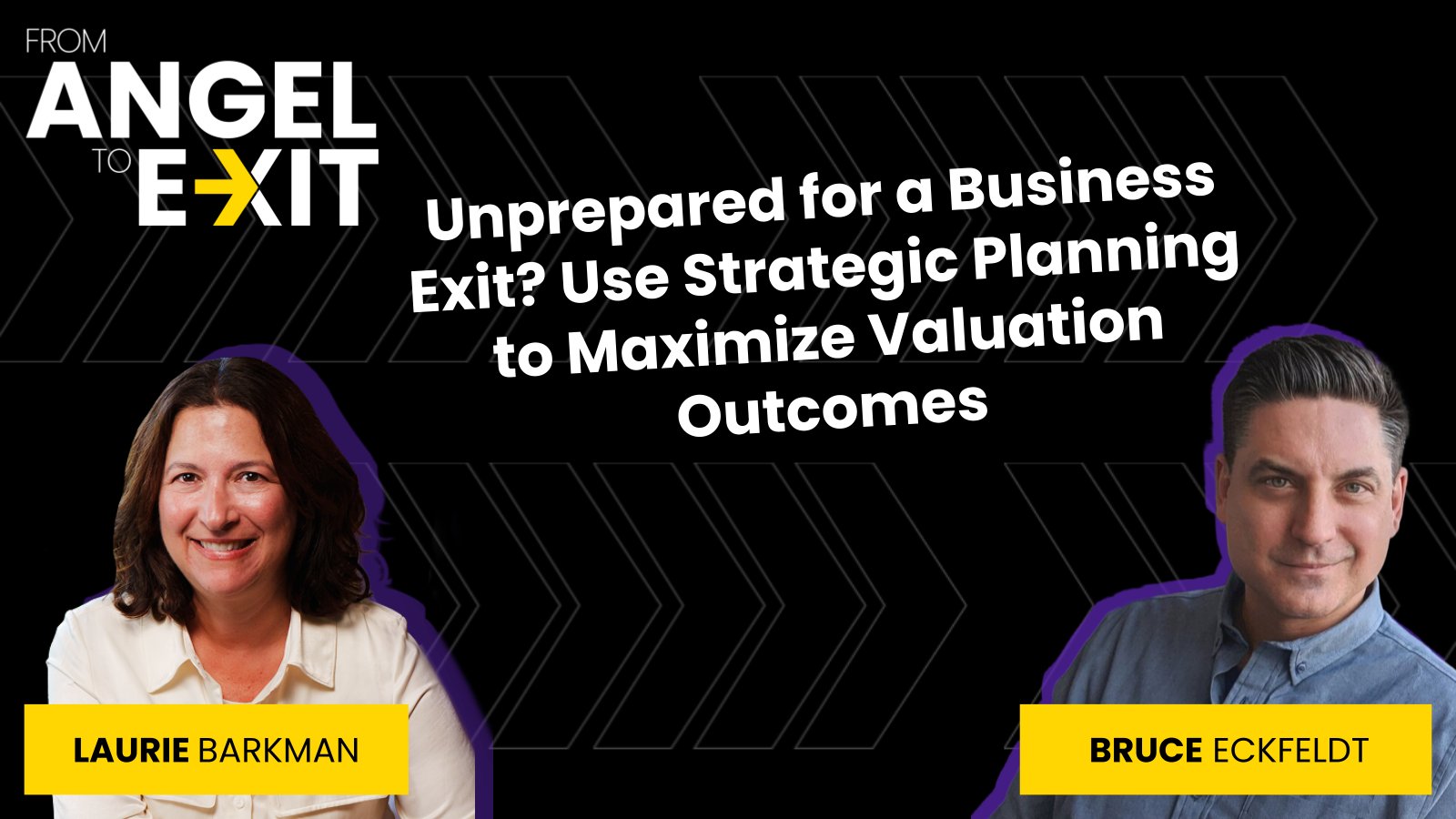
Unprepared for a Business Exit? Use Strategic Planning to Maximize Valuation Outcomes
Laurie BarkmanFounder and CEO, Business Transition Sherpa
Listen to the Episode.
Play the full conversation right here, or pick a chapter to jump straight to that moment. Prefer your own app? Every episode is on Spotify, Apple Podcasts, and the rest.
About This Episode.
Start with the key takeaways, the ideas worth bringing back to your leadership team. Then read the full story of the conversation, or use the chapters above to jump straight to the moment that matters most to you.
- The importance of building a leadership bench and reducing founder dependency
- Why transferability drives valuation in M&A
- Common pitfalls that reduce exit outcomes
- The role of clarity in overcoming fear-based decision-making
- How founders can reverse-engineer their exit strategy for maximum value
- Laurie’s “Built Method” framework reinforces a structured approach to scaling and exiting, helping founders move from reactive decision-making to intentional, value-driven outcomes. This episode is a must-listen for founder-CEOs aiming to scale strategically, increase enterprise value, and exit on their terms.
- Most founders delay exit planning, reducing valuation and limiting strategic options
- Transferability, not revenue, is the key driver of M&A attractiveness
- Build leadership teams early to reduce dependency and increase buyer confidence
- Strategic planning aligns teams and minimizes internal resistance during growth
What happens when a “bluebird” acquisition offer arrives, and you’re not ready? Laurie Barkman, Founder and CEO of Business Transition Sherpa, joins the show to unpack her journey from corporate marketing leader to CEO of a $100M division, and ultimately through a billion-dollar company sale that reshaped her career.
Laurie shares how she stepped into a CEO role within a third-generation family business, navigating internal resistance, leadership alignment challenges, and operational complexity. Just 18 months into her tenure, an unexpected acquisition offer triggered a high-stakes M&A process. While maintaining business performance, Laurie and her executive team simultaneously supported due diligence and positioned the company for a successful sale.
The conversation dives deep into what founders often overlook: exit readiness. Laurie explains how most entrepreneurs fail to plan proactively, relying instead on chance opportunities, what she calls the “bluebird effect.” The problem? Buyers act on their timeline, not yours.
Drawing from her experience and insights from over 120 podcast interviews, Laurie introduces the concept of strategic transition planning, focusing on building transferable value, aligning leadership teams, and creating optionality. She emphasizes that exit planning isn’t about selling, it’s about preparing a business to be sellable at any time.
Key themes include:
Watch the Video.
Prefer to see the conversation? The full episode plays right here on the page, so you can watch while you follow the takeaways or read along with the transcript. Every episode of From Angel to Exit is also on my YouTube channel, along with short clips from each conversation.
About the Guest.
The background behind the conversation, and where to find this guest online.
Laurie Barkman
Founder and CEO, Business Transition Sherpa
Laurie Barkman is the founder and CEO of Business Transition Sherpa. She rose from corporate marketing leader to CEO of a $100M division and went through a billion-dollar company sale before helping owners plan their own transitions.
- laurie@btsherpa.com
Full Transcript.
The complete conversation, lightly edited for readability. Open it to read along, or search the page for a topic or a name.
Read the full transcript
Bruce EckfeldtWelcome, everyone. This is From Angel to Exit. I'm Bruce Eckfeldt, I'm your host. Our guest today is Laurie Barkman. She is founder and CEO of The Business Transition Sherpa. We're going to hear about her story, having gone through quite a major exit as a CEO, and then the work she's doing today with folks who are in that transition period, figuring out their strategy with their business and what they're going to do next.
I'm excited for this, because Laurie not only has exit experience, but has worked with lots of folks through the exit process, so we get a chance to compare some notes and see what she's learning in the space and what she's found. I think there could be a lot of great nuggets for folks who are earlier in this process, thinking about an exit at some point in their careers, and hopefully some good takeaways on things they should think about and consider as they go through that journey. So with all that, Laurie, welcome to the program.
Laurie BarkmanHey, Bruce. Thank you so much. I'm so glad to be with you.
Bruce EckfeldtIt's great to have you here. Before we dive into the work you're doing today and dig into this topic of founders and owners working through sales, I would love to get your personal background. How did you get into the professional space? I know you had a pretty interesting experience as a CEO. We'd love to hear the story leading up to that, and then hear about that experience.
Laurie BarkmanI'll begin by saying, look, I believe there's an entrepreneurial gene, and I believe I had it, have it, but denied it and hid it for a long time. I suppressed it. That's really the nature of the story. In a nutshell, I began my career in big co, big, big co: global companies, management training programs, leadership programs. I grew in my career to the point where I was really known for marketing. I was a leader in marketing.
Here's a fun fact: the biggest marketing budget I ran in my career was $100 million. That's big for all the marketers out there going, "Oh my."
Bruce EckfeldtIt's a lot of spend.
Laurie BarkmanThat's a lot of spend. And here's the other fun fact. When I worked in startups throughout my career, I had a dollar to spend.
Bruce EckfeldtExactly.
Laurie BarkmanWhich is a joke, but not a joke. So I've literally had the $100 million to $1 marketing budget and everything in between. That's the nature of my career. Why did I go from big co to startups and back again? I think it's because I knew I was a maverick. I knew I liked the entrepreneurial side, even if I didn't have the big idea or the guts to go do something on my own.
When I graduated from business school, Bruce, in the late nineties, it was all about the tech startup and getting venture capital and exploring all these things. I wasn't a tech founder. I didn't have a big idea, and frankly, I didn't really have the risk profile. We had just bought a house. We were settling down. I had this debt from business school, and I'm like, "I've got to get working here and begin my career."
Bruce EckfeldtI need some cash.
Laurie BarkmanWe need to keep the lights on and put food on the table. That's where I really suppressed it. But I think the draw to the startup was that I've always had a big heart for entrepreneurs and founders, because of their risk profile. I respect that a lot. They're taking a lot of risk. They're going after something they believe in.
So fast forward through the career journey, and a recruiter reached out and said, "There's a third generation family-owned business in your backyard," literally, that I had never heard of. They were recruiting for a CEO position to run a division. It was a separate entity, which is why I had the CEO title, and it was part of a long-term succession. Everybody knew this was happening. It wasn't a secret. They weren't looking for somebody for the next two years. They were looking for somebody for the next 20. And I was like, "Holy crap." Self-doubt, all these things come in. Am I qualified? Yada, yada.
But I went for it, and it was a very lengthy six-month interview process. I was up against some big guns, and I got it. I was in my young forties at the time. Of course, it was my first time being a CEO. And I thought, "You know what? Even the president of the United States is a first-timer in their job. So I'll be okay. Somebody's got to jump in and do it." That's what got me into the next act of my career.
The first act was being the marketing leader and doing cool things on growth. The next act was, "I've got P&L responsibility for a $100 million company." We had some e-commerce properties. Direct sales were pretty big. We also had over a million square feet of warehouse space in the US and Canada. So it was a very sizable operation. And the larger entity was the third generation business. My direct manager was the chairman at the time. He was probably in his 60s. I reported to the board, and it was a lot of amazing work. It was a lot of amazing pressure.
And I think, Bruce, that's the next part of this story. Okay, what happened next, and what happened to the 20-year story? It wasn't 20 years. It was three years. The reason why was because a company came knocking and told our chairman, "We've been watching your company for years." The company was 67 years old, and the chairman had no idea. None of us did. I call this the bluebird effect. The bluebird came and said, "We're interested in acquiring your business, the whole company."
I remember the day my boss told me. I almost fell off my chair. It was my birthday, and he said, "We're going to start a sale process here." And we did. It was a successful sale process. Myself and the other executives had to keep our heads down, keep the pedal on the gas, and make sure we did everything we could to keep the business running. At the same time, in addition to the day job, we had to help with due diligence and help package up this over $1 billion revenue business for sale.
It was quite the journey, let me tell you. That's why it was a shorter time horizon for me, because I found myself on the other side of the integration, as part of the senior leadership team integration and all that kind of stuff. But that was part of the story. It can happen. And that's really what kicked off what I do today. That's what got me thinking about business transition and succession through the generations, and the challenges and pitfalls of having a business that's not ready, and an owner that's not ready. I know the story is a little bit long, but that's the genesis of it.
Bruce EckfeldtI'm curious, when you took the CEO position, what did you know was going to be a challenge for you? You anticipated a certain amount of challenge in taking that leadership position. What did you not anticipate that was a challenge? I'm curious what you were prepared for and what you weren't prepared for, and how that played out for you in the beginning.
Laurie BarkmanOne of the biggest things is that I knew an internal candidate wanted my job and interviewed for it. He didn't get it, and then he was my direct report. He had a very senior role and a very important role on the team. That was very, very challenging. I stepped into that knowing full well that was going to be the situation. It was something I had to deal with for a long time, most of the time I was there.
Bruce EckfeldtThat's hard.
Laurie BarkmanIt was really hard. I had a target on my back from the beginning. He had loyalty from some employees. He had loyalty from some customers. I never really built trust with him, and unfortunately that wasn't able to change until we made some changes in the organization. That whole journey was just really tough.
Bruce EckfeldtI hear that a lot, whether it's jockeying for the position and not getting it, and then reporting into that position. It can be hard. What were your takeaways on that? In the end, is there anything you would have done differently, if it came up again?
Laurie BarkmanI was between a rock and a hard place, because he was a very senior leader. He had more than half of the organization reporting to him, and he was the tip of the spear for revenue, things like that. I remember talking to another CEO friend who ran his family business. It was probably about a month before I started, and I was telling him about the situation, and his advice was very clear. He said, "You need to get rid of him right away."
I didn't do that. Did I make the right decision? I don't know. I don't know to this day. I still kind of wonder. It's a tough spot. What's the saying? When everything's changing, you can't change everything. There were some areas of the business where we were eventually going to make changes, but it's tough when you're a new leader coming in, things are running in an existing way, and there are different existing power centers. I was starting from scratch, and they had 20-plus years. It was just a tough spot for me to be in. I had support from above. I had support from peers. It took a while to get the full support of the management team, until we made some changes.
Bruce EckfeldtI'm curious what helped with the rest of the team in terms of building trust. Coming into these situations is difficult. They've been together for a long time. There's a lot of history, a lot of existing dynamics, and you've got new leadership coming in. What are some of the things you learned that were really effective in helping gel that new team?
Laurie BarkmanOne of the things I did was create a sense of a leadership team. We called it OpCom, because it sounds cool, but it means operating committee. Who's on the operating committee? I had added some talented folks, and I had promoted some folks, so we had more of a bench than just the original structure of CEO, call it chief revenue officer, and CFO. It was sort of those three at the head, versus more like seven of us, where responsibilities, accountabilities, and scope were clarified and people were given the opportunity to step up.
The other thing I did was introduce a strategic planning process. I had a lot of strategic planning experience from some of the big cos I'd been at over the years, and I brought it here, both as a framework and also literally the facilitator I had used at one of my corporate jobs many years before. We had kept in touch, and I knew he had a great touch. He had a great style, and he could help us, and I didn't have to lead it. I could be a participant. That was really important.
And the outcome, Bruce, that was really cool was alignment. That's really the main thing with strategic planning: can you get your team aligned on something they feel excited about? So we did that. In addition, I had a philosophy about the step-level approach: how do we bring people up, and how do we get more people involved than who are literally in the room right now? So we did that as a sequence. Our first set of meetings was probably a little larger than you might have expected, because it was more than just OpCom. We invited their first-level direct reports, plus people, if they didn't overlap, who were considered HiPos, high potentials, because I wanted them to see the process. I wanted them to be involved. I wanted them to weigh in and have a point of view. I wanted them to learn, and also feel that inclusivity.
That was part of my larger strategy of how to get more people on board and not isolate the islands of negativity. I want to get the islands of negativity in the room. That's fine. We'll hear them. And if they choose not to say anything, or they choose to bad-mouth after the meeting, the classic meeting after the meeting, that's bull crap. That's what some people would do. They would have the meeting after the meeting, they would caucus, and they would just generate negativity spirals. I was trying to head all of that off at the pass, because if everybody's in the room saying, "Yep, we're all in on this," that negativity spiral elsewhere gets minimized.
Bruce EckfeldtJust get it on the table. Speak now or forever hold your peace. I like it. You went into this thinking you were going to be doing it for the next 20 years. When did it first come up, or when were there indications that there might be a sale, that it might not be 20 years?
Laurie BarkmanIt was about a year and a half into my tenure. It was my birthday, and my boss called me into his office. We were having some business challenges at that time, and I was all prepared with my calculator and my talking points and my binders. It was funny: when you had a meeting with my boss, you either sat at a long rectangular table or you sat in front of his desk.
Bruce EckfeldtOoh. Okay.
Laurie BarkmanWhere you sat influenced the kind of meeting you were going to have. I thought we were going to sit at the long rectangular table, and he said, "Have a seat," and we sat in front of his desk. I started to panic and I started to sweat, and I was like, "Oh my God, what is happening right now?" Because I wasn't prepared for it, whatever it was. And I really wasn't prepared. That's when he said, "We got a call from this global corporation, transportation logistics. They've been watching us from afar, and they're interested in acquiring us." And I literally almost fell off my chair.
I was like, "Okay." Not only were we not having the conversation I thought we were going to have, we were having a completely different conversation than anybody expected. He said, "This is the cone of secrecy. Only a few people know about it, and we're going to explore it." And I was like, "Okay, let's go."
That was about a year and a half in. So if you do the math, it was a year and a half pre, and a year and a half post. That was the three years.
Bruce EckfeldtAnd what was the rationale? Was it just that the money was too good? Were there other factors, like, "I think this is a better move for us," or, "We're divesting from these companies"? What was the underlying motivation?
Laurie BarkmanIt was a full sale. It was an entity sale of everything. And it was a pretty big company. It was doing over $1 billion in revenue just on its own. The strategic acquirer said, "We need some of your capabilities and services. We want to stitch you in. We'll do hybrid branding to begin." Eventually it became fully integrated branding. Now we're talking 10 years ago, so obviously by today things are well integrated.
At the time, the vision was pretty clear. It was a competitive move. It was a strategic move. There were lots of reasons. They also wanted to create some new services for key clients in an industry segment, the e-commerce segment. They wanted to create more services in that segment, and they felt our capabilities would enable them to do it faster. All of those reasons were why this big acquirer was interested in our company.
From our point of view, I'm not family, and I wasn't part of all the board meeting conversations, but the gist of it is that this was a third generation company that didn't have any family members in the entity past the third gen leader, who I mentioned was the chairman. They had done a really good job of developing a senior leadership team, both by growing people from within and hiring from the outside, folks like myself, of course, and also through acquisitions. I think maybe seven or eight years before I got there, they had bought a pretty sizable company in Texas.
One of the benefits of that acquisition was the management team. The senior leaders of the company were pretty much from that acquisition. You've heard of the term acqui-hire. Typically it's our tech company friends, who have these really interesting dev experiences and skills. Well, in this case, the acqui-hire was for the bench of the leadership team. Our chairman had the forethought to look ahead and go, "Wait, we have a gap. Who can take this company to the next generation?" And the next gen was management from the outside, so to speak, not family.
If I had to guess why the family voted, "Yes, we should sell," it was probably partly because of that. And also, it was a way for them to begin a new chapter. There were a lot of things I observed along the way, and I have a lot of respect for how they did things. On the day of the close, Elvis left the building. Literally, we had a cake, we clapped. It was sad. It was really sad, to imagine him leaving, and he had the portraits of his grandfather, his father, and himself on the wall. I'll remember that day for a long time.
So Elvis left the building on the day of the close and began their next chapter immediately, which I think was really cool. I describe it as investing in things for the family. They set up a family office, and the person who was the CFO for our company joined the family office and was the CFO for them. They also started a foundation, investing in causes they care about.
His spouse was not in the business, but she was, and is, very involved in the foundation. They have two sons, and then grandkids, and they found a way to get them involved. Some were more involved in the business than others, at various times, of course. So I don't mean to imply they weren't involved. They just weren't involved day to day. I don't know if they had an official family board, but they definitely communicated, the children with their parents.
And I always like to describe the foundation as not just writing a check. They help set goals for the organizations they invest in, and they're trying to help them in a variety of ways. I just had a real respect for that and how they went through their transition with grace.
And by the way, because there was a change of control provision, when the deal closed, myself and many others had a significant amount of money in our jeans. That was incredible. Imagine: some people started working there after high school or college and then worked there 20, 30, 40 years. Their hard work was definitely appreciated and recognized. That was really amazing.
Bruce EckfeldtIt sounds like a great success. I'm curious, as you got into working through the deal itself and negotiating things, what were the big factors? What were you focused on in terms of driving the success of the transaction, both valuation and getting the deal done? What were the sticking points? I'm curious what came up in the process and what you had to navigate.
Laurie BarkmanI want to compliment the team. There were about 12 of us who were the executives at the original company. So I always describe this as a team effort. We were each running our own P&L. I had my P&L. Our responsibilities individually were: run your business as best you can, keep it confidential, keep everybody focused, and don't take your foot off the gas. In addition to that: help us be the management team the acquirer wants.
One of the things I remember was an all-day offsite event, where we prepared presentations about our business units and each of us took our turn. What we were basically told was, "This isn't an interview, but it's kind of an interview."
Bruce EckfeldtYeah, exactly.
Laurie BarkmanAs you can imagine, this was the pressure. I wanted to do a really good job at that. I wanted to convey the excitement I had to join the big entity. And by the way, Bruce, they liked all of us. They wanted all of us. And then that became a condition of closing.
Which was really interesting, because now, future forward, I became an M&A advisor, and I'm talking to my clients about this stuff. It was a condition of close. We had to accept the job offer with the acquirer and sign an agreement prior to the deal closing, which was a weird dynamic. But that was part of it. They wanted all 12 signatures, so they knew we were coming over.
Would every company do that? No. Clearly this was a very large transaction, and they wanted to make sure they had the leadership team in place. But it is a factor when you think about transferability and who's the team. That was a really big takeaway for me, and I think it's in the form of a framework that applies in lower middle market deals. Middle market deals will manifest my experience in some way, shape, or form.
Bruce EckfeldtAnd how long did you stay on post-transaction?
Laurie BarkmanA year and a half.
Bruce EckfeldtWas that the plan? How did you make that decision? I'm curious what that period was like for you.
Laurie BarkmanI found myself on the other side of integration. That's just plain and simple. We consolidated areas of the business: back office, IT, HR, finance. Those were first, and that's pretty typical in a strategic enterprise integration. It's not a shocker for anybody. The other side of it was how the business units were structured and what overhead or headcount was needed. My group and other groups got combined and consolidated, and therefore, yeah, I got a package.
Bruce EckfeldtI'm curious, for you personally, how was this whole experience? What did you learn? What was it like to go through these stages? Any big takeaways for you?
Laurie BarkmanThe whole thing was big. Just the whole thing. Getting a CEO position at age 42, the first female really at that level in the company. It was a role I was really proud of. And at the same time, it was almost like A Tale of Two Cities. It was the best of times, it was the worst of times. I was so stressed all the time. I'd come home and just want to sit on my couch and pet my dog and watch television. I have kids and I'm a mom and I was active. It wasn't like I was depressed or anything. But at times I was like, "Oh my God, this is a crazy thing." As much as I liked it and enjoyed it and learned so much, it was stressful, Bruce. And then it got really stressful.
There were pockets. I shared the big thing about trust and my team, and that was part of it. The other part was that when business is great, everything's great. When business is tough, oh my goodness. One of the first things I did when I got there, and I won't drop the name of the company, was this: we had a contract with probably the largest retailer in the country, and almost the world. So you can try to figure out who that is. I had to renegotiate that contract.
I actually negotiated a credit from them. Nobody does that. I got a credit in the millions of dollars from them. And we negotiated payment terms, which, if you think about cash flow, was also worth a lot to us. That was one of the first things I did. So it was like, "Welcome to the team. Oh my God, here's a shit show you've got to fix."
So there were those highs and lows. I tried to be very thoughtful, try to be a mentor, try to grow the team, try to grow everyone's capabilities. It was an uphill battle in a lot of ways, and on that side of it, I learned a lot. Certainly with the deal. I enjoyed my experience as a member of the leadership team and the executive team, reporting to the board. It was all new for me, and I got good at it. I would get compliments after board meetings. We had a board member from Dell, and he specifically wrote me a note. It said, "Thank you for explaining something so complex in a way I can understand." And I'm like, "You know what? That's actually one of my superpowers," I've come to realize.
Bruce EckfeldtThat's a good one.
Laurie BarkmanHow do you get people to support your vision when they might not inherently understand the business? We've got to start there. I could go on and on about the things I learned. And then there was managing the stress and managing my return on time. This was three years, and I had money in my jeans. It was a huge return on time. But what did it cost me? So as I thought about what I wanted to do after the sale, what I wanted to do next, I had the benefit of time. I was still relatively young in my career, if I can call the forties young. I think so. It gave me the ability to choose my path, and boom, I chose the path of being an entrepreneur.
Bruce EckfeldtSo how did you get from that whole experience to what you're doing today? Fill in the gaps, and let's talk about what you're focused on now.
Laurie BarkmanI was in the shower, where all of our great ideas come from. About a year before that, I think this was maybe 2019-ish, I had lunch with a friend who's an entrepreneur. She created a wonderful, call it fast food, concept of Indian food. A really, really good concept. We were having lunch at her restaurant, and she goes, "You should be a podcaster. You should have a podcast."
And I said, "What are you even talking about? You're crazy." My immediate reaction was no. Why would I do that? That negative first talk we get in our heads. As my grandmother would say, "Feh." And then my husband was like, "Oh yeah, you should do video." I'm like, "What are you even saying?" Mind you, the year was 2019.
So I'm taking a shower, and I'm like, "If I were going to do a show, what would I call it?" And I just kept thinking about my experience at this third generation company, and how each time, the next picture on the wall got the baton. They were given the keys, and they did something different. The history of the company was a horse and buggy, a blind horse and buggy, by the way, delivering produce from the river up a big hill here in Pittsburgh, in Oakland. That was the original transport business.
Then the next gen comes in, and what did they introduce? They introduced trucking and warehousing. And then the third generation, again, the leader I was fortunate to work with, his impact was creating what's called reverse logistics. How do we get materials from stores and warehouses that are not going to actively be sold anymore? That's called reverse logistics. Damages, overstocks, whatever, or recalls in the case of medicines, where you have to destroy them and have handling and all that.
So I was thinking about that, and I was thinking about innovation, growth, and transition. I'm like, "Yeah, that's pretty consistent throughout my entire career," whether I was at a big co or a small co startup. Innovation, growth, and transition. Those have been the threads. At the time, there was a great show on HBO called Succession. It was a new show, and I started to watch it, and I just kept thinking of that word, and boom, that's it. So my podcast is called Succession Stories, and we're now celebrating our sixth year.
Bruce EckfeldtCongratulations.
Laurie BarkmanThank you. We launched in 2020, literally at the start of the pandemic, when we were not able to be in person. It ended up being a fantastic way to learn and have conversations and meet people, business owners and advisors, and to learn about this space we call the space of next: the exit planning space, growth advisory, things like that. Because here I was, and I'm like, "I want to do something that makes an impact in the world of entrepreneurs. How can I use my superpowers to do that?" There was a bit of exploration, as with many entrepreneurs. We want to find the pain points. We want to find all the things. And I started with a show, I guess because it was the universe talking to me, telling me that was the way to start.
Bruce EckfeldtWhat did you learn, having all these conversations with folks? Was anything surprising, working with some of these other folks around this process?
Laurie BarkmanOh my God, I learned so much. My original way of packaging what I do and who I serve was strategic planning, because I figured out that was a superpower. Then I started to get educated through different certifications: the Exit Planning Institute and some other programs. I got certified. Then I figured out a way to put it together that made sense for me, and I call it strategic transition planning.
I ended up writing a book about it. I call it The Business Transition Handbook. At the time I wrote the book, I think I had 120 episodes in, and I had all the transcripts. With ChatGPT, it would have been a lot easier, but I manually went through all of my transcripts, and I thought about what the business owner cares about. What are we trying to do here? There's the carrot and the stick. You want to create value, you want to create exit options. That's the carrot. The stick is: don't step in it, friend.
You want to avoid the minefields and the pitfalls. That's the other part of the subtitle of the book. The subtitle is How to Create Valuable Exit Options and Avoid Succession Pitfalls. That's the nature of it. We want the plus, and we want to avoid the minus.
In its essence, what I learned in my conversations from the show, my own experience, and consulting now with more than 50 clients began to be a wrapper, and the book was a first way for me to really package all those key learnings around personal transition, financial readiness, business value growth, and all the concepts. It's like a mini MBA meets practical stories that we can all relate to. The feedback over the years has been that people feel like I'm talking with them when they're reading the book, which was really my intention, because in a way I was carrying forward the voice from my show. When people listen to the show, it's like, "I'm talking with you."
So anyway, I'm really proud of the work, and I absolutely loved, and still love, having great people on the show, which includes you, by the way. You've been a guest on the show, and it's a great episode. It just was fortuitous. Nobody knew the world was going to shut down, and it became a fantastic medium to try to put some ideas and concepts together.
Bruce EckfeldtWhat are a couple of the pitfalls and quagmires that folks fall into when they're starting to think through this transition process?
Laurie BarkmanYou've probably seen this too in your practice. Many business owners just don't think about their future exit. They don't build towards it. They don't contemplate it until maybe that little bluebird comes calling. And that's fair. But the thing to know about bluebirds is that they buy on their time, not yours.
So if we're going to be intentional about a transition, we're going to be intentional about the number one thing we should be understanding about our business, which is: how transferable is it? How attractive is it? What is the value today? What do we think it's worth in the future to us? How does that all tie in with our bigger picture? I guarantee you, many, many people, unless they're working with an excellent advisor like yourself, or maybe me, don't put these pieces of the puzzle together until it's too late. And then they wonder.
I think you write about regrets in your new book. I talk about regrets as well, and I'd love to chat with you about your opinion on this. I think of regrets in two buckets. One is we regret what we did, and we wish we'd done it differently. The other is we regret what we didn't do, and we wish we'd done those things. What I say to everybody is, look, we've got to try to avoid both buckets. If we're intentional, we set goals, we set a plan, and we're not just hoping. Hope is not a strategy. We're going to be intentional about it. We're going to create a transition vision and an exit vision that we're going to work towards and reverse engineer. That's ultimately the work I've been doing now with clients for six-plus years.
Bruce EckfeldtThat's an interesting one. For me, a lot of it is framed around the energy behind the decision. If the energy is one of fear, I find that's where the regret tends to come up, whether I regretted doing something or regretted not doing something. When it comes from that place of fear. Whereas there's all this VUCA. There's uncertainty. You don't know what's going to happen. I get that. But if you put a stake in the sand and say, "Okay, look, I'm going to take action towards some kind of intentional future that I want to create," even if things go totally sideways, a shit show, that's fine. Maybe I have reflections. Maybe I look back on it and say, "Ooh, I probably should have thought about this, and I could have done it a little differently." But I find it doesn't fall into the regret category so much. It's a learning process. The regret tends to come when I did something and I had hesitation or fear. That's where I think you run into, "Oh geez, I wish I would have done this differently."
Laurie BarkmanThat's a good point. It's almost like the blocker. Why didn't we? Well, I was afraid of something. And I think that's the common bond we have in trying to help business owners on their journey: try to unpack these fears while we have time. I have a brand new client. He's delightful. He's 70, and he's grateful that we're going to work together, but he's regretful too, because he says, "I wish I'd found you 10 years ago."
So I guess that's the overall message for folks who are thinking about their path. I think a lot of people have a misconception: "Oh, exit planning, I have to decide." No, you don't. You can create options. Notice the word options. I say exit options a lot. Maybe we prioritize A and we explore A, and it's not going to work out. Okay, now we have B. I think the other part of regret is when we had one thing, we tried that one thing, it didn't work out, or it worked out, and now we regret it. We should have done the other thing. Okay, cool. Let's explore the options while we have time to do so.
And to piggyback on your notion of fear, I think the counterbalance to fear can be clarity. Through exploration, finding clarity. Are we always going to be 100% right? No, and that's okay. But surround yourself with really good advisors, like you, Bruce, and maybe me, and some other people: the specialists in tax and law and all these things. This is complicated stuff, and it's hard to go it alone. I always like to say this to my entrepreneur friends: you didn't build your business on your own, so you're not going to go through a transition and exit plan on your own either.
Bruce EckfeldtI like your title of Sherpa. I think it's very apropos in terms of what the role is and where the opportunity is for founders to explore this stuff. And like you said, now is the time. I always say the best time to plan your exit was when you started the business. The second best time is now. It is never too soon. Because, like you said, you're creating options. You're getting yourself into a position of clarity. You understand what your drivers are, what your motivation is, what the future is. Then when opportunities come up, you're in a much better position to evaluate them and decide: is this opportunity helping me get to where I want to be, or not?
Exit planning is not, "We're going to exit in 12 months, so here are all the things we're going to do, and then we're going to pull the trigger." It's: how do I put myself in a position to be ready to exit at any time, but also be happy to keep the company? Because I know I've got a valuable asset, and I've got a future I want to see that doesn't require an exit. But if something comes up that gets me where I want to go faster, then great, do it. You have to have that clarity. So I very much agree that exit planning is really about clarity. It's not about the transaction or the transition itself. What are you excited about right now? What programs do you have coming up? What work are you doing? I'm curious what's on your plate.
Laurie BarkmanOh my gosh, we're launching some really cool things for a couple of different audiences. The first thing is to introduce a concept, our platform, that I'm calling the BUILT Method. The BUILT Method is really the platform I'm speaking from about all the aspects you and I discussed, packaged in an acronym we can remember. B-U-I-L-T. Each letter stands for something. You can guess what the T stands for. It's my favorite word, transition. Conceptually, it's having the vision, having the pathway, unlocking the blockers, integrating our systems and platforms, leading with clarity, not chaos, and then transitioning with confidence and control.
The BUILT Method led me to create different solutions for two different audiences. One is the business owner audience. I've been working with private clients for years, and one of the things I'm doing is launching intensives, where people can spend a very short, intense amount of time with me one-on-one to get clarity on lots of things. There's absolutely a way to work together over Zoom, no doubt about that. But I'm really leaning in, Bruce, on experiences. My clients enjoy working with me, and there's a motivation to do the work. A lot of times it's a cold start problem: "Oh my God, there's so much to figure out." So I'm launching these intensives as a way to help people feel like, "Okay, we're just going to tackle a lot of things right away."
The other thing I wanted to mention is for a different audience, our financial advisor friends out there. If we have people listening who are financial services advisors or wealth advisors, and they're looking for ways to have conversations with clients, I'm launching a new platform. It's a conversational framework called BUILT by Design, and it's licensable by financial advisors to use with their clients. I'm super excited about it. It's a great way to introduce a new element to your practice. There's total upside with the revenue opportunity, but there's immeasurable value in being sticky in the relationships and having impactful conversations with your business owner clients. So if anybody wants to learn about either of those things, of course, I'd love to talk with them.
Bruce EckfeldtWhat's the best way to get that information and learn more about what you're doing and your programs? Give us the details.
Laurie BarkmanMy website is btsherpa.com, and that's where people can find all kinds of things we talked about today, including BUILT by Design and our one-on-one advisory work. If people want to email me, feel free. It's laurie@btsherpa.com. They can also connect with me on my website and set up a time to chat. I look forward to it.
Bruce EckfeldtI highly encourage everyone to check it out, and we'll make sure all the info is in the show notes so people can get it. Laurie, it's been a pleasure. Thank you so much for taking the time today.
Laurie BarkmanBruce, it was my pleasure to be with you. Thanks so much.
Never Miss an Episode.
Know the moment a new episode goes live. Subscribers also get a say in future guests and the topics we cover.
Other Related Episodes.
More conversations that connect to this one. Or browse the full archive by topic or by guest.
Elizabeth Shea
How positioning a company early shapes which buyers show up and what they will pay.
Listen and Read
Christine McDannell
Why buyers pay more for a business that runs without its founder, and how systems and AI get you there.
Listen and Read
Yarin Gaon
Why more products, customers, and revenue streams can lower value, and what to build instead.
Listen and Read