From Angel to Exit Episode 48
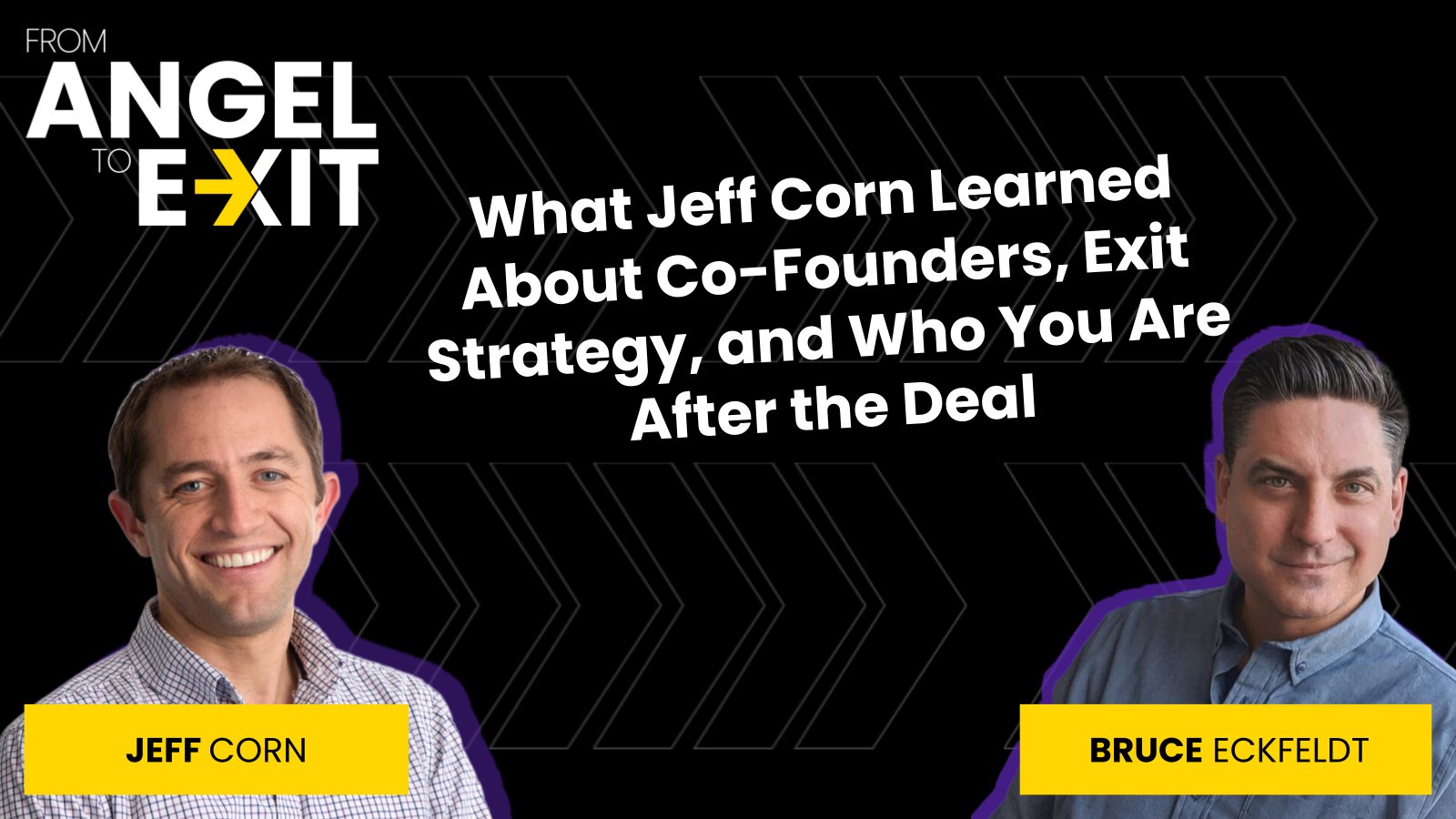
What Jeff Corn Learned About Co-Founders, Exit Strategy, and Who You Are After the Deal
Jeff CornFounder, Virtuance
Listen to the Episode.
Play the full conversation right here, or pick a chapter to jump straight to that moment. Prefer your own app? Every episode is on Spotify, Apple Podcasts, and the rest.
About This Episode.
Start with the key takeaways, the ideas worth bringing back to your leadership team. Then read the full story of the conversation, or use the chapters above to jump straight to the moment that matters most to you.
- Founder misalignment can significantly delay growth and complicate exit strategy decisions
- Bootstrapping builds control but limits access to strategic guidance and capital
- Scaling requires shifting from execution to strategic leadership and team development
- Peer groups and coaching accelerate founder growth and decision-making clarity
- Exit processes are unpredictable, maintaining optionality improves negotiation leverage
- Avoiding earn-outs can protect founders from post-acquisition performance risk
- Personal readiness is as important as business readiness in successful exits
- True fulfillment post-exit requires redefining purpose beyond financial success
Building a scalable business is rarely a straight line, and exiting one is even more complex. In this episode, Jeff Corn, founder of Virtuance, shares a candid look into his entrepreneurial journey, from early hustle to eventual acquisition.
Jeff began with a simple insight: real estate photography was inefficient, expensive, and outdated. By combining creative expertise with operational efficiency, he built a company designed to streamline the process. However, like many founders, Jeff underestimated the complexity of scaling. What started as a scrappy operation quickly evolved into a multi-market business requiring technology, systems, and leadership growth.
A major turning point came when founder misalignment surfaced. Differences in vision, risk tolerance, and personal motivations led to a multi-year process of restructuring ownership. This highlights a critical lesson for founders: alignment early on is essential to long-term success and exit readiness.
As Virtuance scaled, Jeff transitioned from working in the business to working on it, seeking peer networks, coaching, and strategic clarity. These shifts were key to preparing the company for acquisition.
The exit process itself proved far more challenging than expected. Jeff shares the emotional rollercoaster of M&A, emphasizing the importance of maintaining optionality and not becoming overly attached to a single outcome. Strategic decisions, like avoiding earn-outs, played a crucial role in protecting value.
Ultimately, the exit was successful, but Jeff emphasizes that the biggest lessons were personal. Post-exit, he navigated identity shifts, rediscovered purpose, and redefined success beyond financial outcomes.
This episode is a must-listen for founder-CEOs considering scaling or exiting, offering real-world insights into business growth, M&A strategy, and life after exit.
Watch the Video.
Prefer to see the conversation? The full episode plays right here on the page, so you can watch while you follow the takeaways or read along with the transcript. Every episode of From Angel to Exit is also on my YouTube channel, along with short clips from each conversation.
About the Guest.
The background behind the conversation, and where to find this guest online.
Jeff Corn
Founder, Virtuance
Jeff Corn is the founder of Virtuance. He built the company from early hustle through to an acquisition and speaks candidly about co-founders, exit strategy, and life after the deal.
- Website
- virtuance.com
Full Transcript.
The complete conversation, lightly edited for readability. Open it to read along, or search the page for a topic or a name.
Read the full transcript
Bruce EckfeldtWelcome, everyone. This is From Angel to Exit. I'm Bruce Eckfeldt, I'm your host. Our guest today is Jeff Corn. Jeff is an exited entrepreneur. We're going to hear about his company, Virtuance, the experience he had building the company and then actually getting acquired: the good, the bad, and the ugly. Jeff's got a lot of interesting stories and background here, and I think we're going to get a lot of good takeaways for our listeners in terms of what to think about and what to prepare for before you actually think about an exit, before you get into an exit process. So with all that, Jeff, welcome to the program.
Jeff CornThanks for having me, Bruce. Excited to get into it.
Bruce EckfeldtIt's a pleasure. Before we talk about the company and obviously the exit, I'd love to get a little background. How did you get into business? In kindergarten, did you know you were going to be an entrepreneur and start a company? What was your backstory?
Jeff CornI wouldn't say I knew I was going to be an entrepreneur in kindergarten, although looking backwards, maybe there were some signs.
Bruce EckfeldtThere are some tells.
Jeff CornI joke that I had multiple careers before I was 25. My dream was always to be a television reporter, of all things. Starting at the age of 14 or 15, I did everything you need to do to start building a resume around that: internships, volunteering, lots of free work in TV studios and everything else. In college, I focused on that a little bit, although the school I went to didn't have a program for it. But I got a job with ABC News in New York, during school and shortly thereafter, and thought, "Oh, I've got it made. This is my life. It's amazing and great."
I decided I wanted to be on air, and they said, "Well, we've got a possible opening in St. Joseph, Missouri, or Bangor, Maine." So I'm living in New York City, and I'm thinking, "Okay, I'm going to go to either Bangor, Maine, or St. Joseph, Missouri." I chose St. Joseph, Missouri. Long story short, I did it for about a year. It was an amazing, incredible experience, but I realized really quickly that this wasn't how I wanted to spend my life. I can tell you all the reasons for that, but it's another conversation.
What I realized is that I was spending a lot of my time on economic development, and in a tiny little town, that meant real estate development. So I started spending a lot of time with real estate developers and real estate folks, and I loved the business. I just loved everything about it. I ended up leaving the station and moving back to Denver, where I'm from. I went to business school with a focus on finance and real estate development, and worked for a couple of different real estate firms for a few years, doing medical office development and office investment.
It was then that I had the sort of epiphany a lot of entrepreneurs tend to have, which is that there was a better mousetrap that could be built around how real estate was marketed. That's what led me, after five or six years in the real estate development game, to say I was actually going to take the leap and start a company around this.
I skipped over some of the other entrepreneurial adventures I had along the way. There are always little things. In college, I had a number of different ventures, nothing that was world changing in any regard. And I did start a consumer products company. I was moonlighting on that when I was doing real estate development, and I got out of it after just a couple of years. I just didn't have the energy to do both. My partner in it went on to have some great success with it.
Bruce EckfeldtGood.
Jeff CornSo I founded Virtuance in 2010, and teamed up with a guy I went to grad school with. He was the artistic genius, the creative genius behind it, and I was approaching it much more from the real estate component. I brought the real estate expertise, or at least experience, and he brought the artistic and creative element. That was how we got started.
Bruce EckfeldtDid you feel like you were knowledgeable, successful, capable as an entrepreneur before starting Virtuance? In terms of your entrepreneurial experience, how was it landing for you so far?
Jeff CornLet's just say I had no idea what I was getting myself into. I think that's probably a somewhat typical story if you're not a third or fourth time founder. To give you a little about the business, and I'm sure we'll get into it in a minute, in the early days we would measure our success by how many photo shoots we were doing in a week.
I remember having a very simple spreadsheet where I mapped out our first few months: if we could do 50 photo shoots in a week, we have it made. I did the math, and this is amazing. It was just me and my co-founder, and that was the goal. If we just do 50 photo shoots a week, this can be a real thing. It's just funny looking back on that, because you asked what I knew. Well, I had no idea. I didn't know anything. We weren't even factoring in what it takes to actually scale a company. Technology development was nowhere on our radar.
It was literally two young, passionate, capable, hardworking guys who thought we had an idea and could do something. I went to business school, and it's not a knock on business school, but it was a 15-year journey that was, call it a PhD in business, call it whatever you want. I learned so much more just by doing than by sitting in a classroom. So, long story short, no. I had no clue what I was getting into.
Bruce EckfeldtBut yet you did it anyway.
Jeff CornYeah. There were times along the journey where I thought, "Oh my gosh, if I had known what I know now, I never would have done this," frankly. That's not to say you shouldn't do it, but there are times in that journey where you look at yourself in the mirror and say, "What the heck? How did I get myself into this?"
Bruce EckfeldtWhat was the original thesis? What was the problem you saw in the market that you were trying to solve? Where did you see the opportunity?
Jeff CornIt started when I was working for a small real estate development firm. We were sourcing and raising money for deals, and then going out and building them or acquiring them. Part of my role was that after we acquired them, I was responsible for marketing the property. We obviously needed to get the property tenanted or sold. I went through that process a handful of times before I realized how broken it was.
The process looked like this: I would call a photographer and say, "We just acquired this building, we're trying to tenant it, and we need photos of it." They'd say, "Okay, no problem." They'd be maybe three or four weeks out. Then they'd show up at the property, bring an assistant or two along, and be at the property for one to two days. At the end of one to two days, they'd say, "Okay, we'll be back in touch with you when the photos are ready." It would be 10 to 14 days before I'd get the photos back, and then I'd get 10 or 15 photos of the property. The photos looked amazing, but we paid anywhere from $10,000 to $20,000 for them. And I was just scratching my head: what the heck is happening in those 10 to 14 days?
Bruce EckfeldtExactly.
Jeff CornYou send someone out, you take photos, and then it takes two weeks to get them back to me, and I only get 10 photos. What is happening? I often think of curiosity as a superpower of a founder, and that's what it was for me. I just became really curious about what was actually happening in this process. I started asking questions and learning a lot more about it, and I realized that the magic happens in the editing of the photos. Very little happens on site that is essential, although there was a lot we could fix about the one to two days sitting on site.
That was the beginning of it. I teamed up with my partner, who had just had young kids, so for the first time he bought a nice camera and started getting into photography to take photos of his kids. We were talking over a drink one night, we put our heads together, and said, "Oh my gosh, there's an opportunity here." Like I said, he approached it from the creative side of saying there's got to be a better way, and I approached it from recognizing the business need in the space. That was how we got started.
We had a conviction that we could build technology that would greatly reduce the friction in this process. It was a very classic, not necessarily that sexy, case of building a better mousetrap. We pushed really hard, and we got told no a million times by everybody and their mother, and we kept pushing because we had such conviction in this.
Bruce EckfeldtWhat were some of the objections you were getting? Where did you find friction or resistance in the market?
Jeff CornThe friction and resistance in the market came from the fact that the technology wasn't quite where it needed to be, for one. There was this idea that the market's saturated, this is the way it's been going on for so long, and there's nothing better about what you're doing. The idea that if we present a product at a much lower price point, there's no way there could be value there. People were so accustomed to paying what they were paying, because they expected a good product. If we rush through the process and do it too quickly, the quality's not going to be there. On and on and on. And it just didn't make any sense to us. A lot of it was just the idea that people had been doing things a certain way, and that's the way they would always be done. We saw opportunity in that.
Bruce EckfeldtFamiliarity. When you founded the company and started this whole journey, did you have visions of, "I'm going to sell this thing someday for a whole bunch of money"? What were your expectations early on?
Jeff CornNo chance. At a certain point you start to have the realization that, wow, we're actually building something of value. But that was seven, eight, nine years in. When we started, I'm picturing myself, as we speak, being at my desk at 7:00 AM. I was single. I was 26. I was living by myself, and that was my goal. I said, "I just need to be up at my desk at 7:00 AM making phone calls. That's my job right now." Most of the time I'd be sitting in my underwear. This was before the days of video calls.
I would make sales calls from seven until noon every day. Then I'd go out on a couple of photo shoots if we had any business that afternoon. We'd come back, and I would edit photos from literally 5:00 PM until 2:00 AM. The whole time, we were faking it till we made it. We were telling people that we had this amazing technology and there was automation happening. And the automation was my co-founder and me, up all night, just grinding, trying to get these things delivered the next day.
We did that for about three to five months, give or take. Up at our desks at seven, go to bed at 2:00 AM, and do it all over again, before we made our first hire and started actually thinking a little more strategically. But to answer your question, no. It was purely about trying to make a little bit of money, deliver a service, and prove that this could work. There were no visions of some big exit someday at all.
Bruce EckfeldtYou mentioned that at some point you realized, "I've got something here." When did that shift for you? When did it dawn on you that you had an asset that was going to have some kind of future, you had growth, and you needed to start thinking about where you ultimately go with this? When did that first cross your mind?
Jeff CornIt's a good question. I think the first time I really thought about that was when we expanded into a second city. The way the business worked, we were based in Denver, and we had contracted photographers. Those photographers, in theory, could be anywhere. Once we built the technology behind it, so we didn't have to do a bunch of manual automation, we were able, in theory, to hire folks anywhere. So about two years after we founded it, we decided to open a second location. Our first city outside of Denver was Las Vegas.
I remember being on a plane, flying to Las Vegas to interview salespeople we were going to hire there. It's crazy to even think that's how we used to hire people: let's get on a plane and go do an interview for an entry-level sales role. But that's what we did. It was our first out-of-state hire, and I remember being on that plane thinking, "Wow. Once we do this, we can do it again, and again, and again." That's when we saw the trajectory from a revenue standpoint. But really, in my mind, it was more about the people. It was, "Wow, we're building an organization, and organizations have value." This isn't just me and my co-founder sitting in our basement in our underwear making sales calls anymore. That'll give you a visual of me in my underwear.
Bruce EckfeldtAnd how did that shift things for you? Once you went from, "I'm just trying to hustle and get something going," to, "I've got something," what shifted in terms of how you approached things and the questions you asked yourself? What did that look like?
Jeff CornWhat shifted for me, I remember, is that there were certain points where I started to ask myself, "What is my job?" We're fast forwarding a little bit here, to where we have an organization and things are humming. But I started to realize that my job was just to be better every day than I was the day before, personally and professionally. And I realized that as soon as I was the bottleneck to this business, we weren't going anywhere.
So the shift for me was thinking beyond the doing. The classic we've all heard: working in the business versus on the business. That was really the shift for me. I need to take a step back. I need to actually think strategically. It sounds so easy when I say it now, but obviously it's balancing how I run a growing business, and I was very much in the business for the first, let's say, five, six, seven years, with how I make sure this organization is positioned well to take advantage of the opportunities in front of it, whether that's an acquisition or anything else.
Frankly, I sought out peer groups. Peer groups were a big part of my journey, and I'm still incredibly bullish on peer groups for supporting founders. I got a coach. I joined organizations like EO, for example, and some other organizations that allowed me to have real conversations with people who were in similar positions. I just became really hungry for interaction, for surrounding myself with communities of people who had any clue what was going on, because it was hard to find them otherwise.
I'm sure it comes up all the time in conversations you have, but being a founder is the loneliest I've ever felt. Even though I'm the guy at the top running this organization and everybody's looking at me, I've never felt so lonely in my life, and with so few answers, frankly, at those middle stages when we were starting to scale. So the short answer to your question is that I really sought out communities. For all the mistakes I made along the way, that is one thing I did get right.
I look back and say, if I hadn't had those communities, if I hadn't been able to interact with the kinds of people I needed and wanted to during that time, I would have remained lost and alone. Not to say it eliminated all my challenges, but I felt like I had a community of people who understood me and were a resource I could go to when needed. We never raised funding. We were bootstrapped.
Bruce EckfeldtI was just going to ask, what was your cap table at that point? Were you 50/50 partners? What was your structure?
Jeff CornMy co-founder and I were 50/50, essentially, on day one. Then, once things got a little more real and we realized we needed to build some technology here and make this real, we brought in a CTO, who became a partner in the business. So for all intents and purposes, we were a third, a third, a third. He had some shares that vested over four years, I think. That was the cap table. We each owned 33% of the company, essentially, after vesting.
The reason I mention that we were bootstrapped is that I can tell you all the benefits, in my mind, of being bootstrapped. There are obviously pros and cons to every approach, but one of the detriments of being bootstrapped is that we didn't have any formal board. We didn't have any formal advisors. I think a lot of founders lean on that board, especially if they're first-time founders, whether it's a board of advisors or an actual governance board. We didn't have that, so I felt like I needed to seek that out.
Bruce EckfeldtFor the three of you, how did you envision the future? How did you figure out between the three of you where you were taking the company, what you wanted to achieve, what success looked like? Was there a process you used to align on that? I'm always curious with partnerships how you go through that process.
Jeff CornIt's messy. One of the things I didn't know, that I think I know now, is just how important it is to align interests up front. I was great friends with my co-founder. We had a lot of similar thinking, and about two years after we founded the company, there started to be some rifts. The rifts were private, but they quickly became public. It's hard to hide those from the company. Without getting into the details, what ended up happening is that we began a process to separate from one another about three years in. It took us about four years from the time we realized that to really cleanly separate. What it ultimately looked like is that my CTO and I bought him out, about five or six years into the company.
I mention that because the reality was we weren't aligned. We weren't aligned on what we wanted to do with the company. We weren't aligned on where we wanted to go. We weren't aligned on how hard we wanted to work to get there, and what that looked like along the way. So about five or six years in, it became my CTO and myself, and we were equal partners at that point.
There were still differences in our own motivations. I was, call it, early thirties at that point, recently married. I had my first kid right around then. I was just starting out in my career, for all intents and purposes. I had zero net worth, probably negative net worth, at that point. My CTO had come out of another exit a few years earlier, and he was certainly not financially motivated at that point at all. I was. So we had a lot of discussions about what the future looks like. What kind of distributions are we going to take? I needed cash flow. He didn't.
Bruce EckfeldtClassic.
Jeff CornAll of these things. We were an LLC, so we had some flexibility in the way we compensated ourselves and whatnot. It's messy. I could go into so many stories about the details of it. He worked really hard, I think, to get me away from a scarcity mindset that I often had, because I just needed some cash to run my life. So we had a real yin and yang. We're incredibly different people, but we were able to work really well together. It took a lot of time to learn how we each operated.
But I will say that communication is everything. The second the communication breaks down, I think it's over, or at least there's a lot of trouble in paradise. It wasn't clean. It wasn't a straight line. It wasn't easy. But over many, many years, we ultimately were able to align on the idea that if we don't capitalize on what we're building, we're introducing more risk into the equation without necessarily getting any benefit from that risk.
Bruce EckfeldtHow did the two of you decide, "We do actually want to entertain some kind of exit"? How did that conversation come up? What were the differences in timeframe and vision for what that looked like? I'm curious when that happened.
Jeff CornThere were several stages to it. There was a point in time when we would ask ourselves, "Should we raise money?" The question we asked in order to answer that first question was: are we growing too quickly, or are we growing too slowly? If the answer to either of those was yes, we'd ask, would money solve that problem? If we're growing too quickly, then we need some additional operational funds, technology, whatever it is. If we're growing too slowly, could money fuel our growth?
The reason I mention that is because those conversations ultimately led to the conversation of whether we should exit the business. There was a point in time when I needed capital. I had paper equity.
Bruce EckfeldtYeah, exactly. I'm worth a lot of money on paper.
Jeff CornAnd nothing in the bank account. Going back to this idea that I was just a young, broke kid running a company, and he was an engineer who got off on what he called, and I still laugh when I say it, braingasms. He said, "I get paid in braingasms. As long as I have a braingasm every now and then, I'm good. I don't care what the money is."
I respect that, and it was great. The business benefited when he had a braingasm, because that meant we had some technical breakthrough that was magical. But it didn't put money in my bank account. So there was a certain point where I decided I wanted to go out for a secondary. I wanted to raise money purely to take some chips off the table. I began that process, and going through it, I came to understand how valuations are determined. We were talking mostly to family offices at that point.
What ended up happening is that my partner stepped in and said, "Let me just solve this problem for you." He was the buyer of my shares. So we maintained the same control, but the cap table shifted. I got a little bit of cash, and he got the shares. That process gave me some insight, but it also put my head in a place where I said, "Wow, we could actually exit." I had some sense of what the value would be at that point, and that put the idea in our heads.
And interestingly enough, Bruce, it wasn't anything about the business itself that really got me over the hump. It was more personal, more about what was going on in my personal life. I'm not afraid to say it: the fact that my marriage outlasted the business is nothing short of a miracle. I say that with so much respect for my wife. I can't even believe she put up with what she did, to be honest. The business was front and center all the time. It was in the room every single moment. That was really hard. We had young kids, and it was challenging.
In hindsight, I think I was lying to myself, but I kept saying to myself and to her, "It's going to be different when..." We're so close. Everything's going to be amazing when this happens. And it was years of that. So that was going on in the background, and we were seeing pretty phenomenal growth, but also looking around a corner and seeing that growth start to slow a little bit.
Bruce EckfeldtTaper just slightly.
Jeff CornCombine that with where valuations were at the time we decided to move forward, and it all just added up. It felt like the right thing. I also felt like there was a disconnect between what the business needed and what I could bring it at that time. The business needed to take on significant additional risk to get to the next level. There are these levels you get to, and with every level, you've got to take a leap to get there. Psychologically and financially, I was not in a place to be the one to take us through that next leap.
So the idea of bringing in capital through an exit, which would actually allow the business and our team to go to the next level, was really attractive to me. Combine that with all of the backstory I just shared, and the decision was pretty clear for me. Convincing my partner at that time that it was the right idea was a whole other story. It took a lot of conversations and a lot of years, frankly, for us to align. There was about a three or four year process after I was convinced that we should start moving in that direction. So certainly not decisions made on a whim.
Bruce EckfeldtThat's great, and thank you for the insights. So you made that decision. What did that process look like? Did you have a pretty clear understanding of, "We're going to run a process, we're going to hire these people, this is what it's going to look like, these are the potential buyers"? How mapped out was that versus the reality of what you actually went through?
Jeff CornHow do I even begin? There's really nothing that could have prepared me for what was to come when we actually went to market. But I will say that at the time we made the decision, we had moved the business upstream. We started out working with individual realtors. Then we moved on to working with brokerages, regional brokerages, then national brokerages, and then we had opportunities to work with big capital, like hedge funds, and real estate portals, household names, people you would know.
It was when we moved from these mom and pops up to having real enterprise-level customers that it was easier to see who an acquirer could be. For example, we had partnerships we had worked with for a long time with well-funded public companies, and it felt like, "Okay, there's a path here." That said, that's not exactly how it went. I'm happy to get into more detail, to the extent we want to go there.
Bruce EckfeldtWhat's always interesting for me is: what did you anticipate? How did you think it was going to go, and what did you feel you needed to do to prepare for that? And then what actually happened? Where did you get caught off guard, or realize, "It wasn't going to be like that. It was going to be like this, and I wish I had done this, or thought about this a little more"? I always find that prepping for the exit is where some of the challenges are, because people haven't been through it. How do I prepare for this thing I've never done before, when I don't really know what's going to happen? I'm curious about that psychology for you.
Jeff CornI think there are two pieces. One is very practical: what do you need to do to prepare for an exit from a business standpoint? The other, which I think is more to your question and more important, is the psychology around it. And gosh, I didn't anticipate the rollercoaster. I thought, "We're at the end. We've made it. Now we're going to sell, and it's going to be great."
I don't know that anything could have prepared me for the rollercoaster. But if I were advising anybody going through this process, and I've had the opportunity to be in that position now with a couple of companies, I would say, and it's way easier said than done, that whatever I could have done to maintain optionality and not get wrapped around the axle with a specific outcome would have benefited me.
We closed the transaction by the skin of our teeth in many regards, and I think a lot of transactions are like that. I thought it would be a straight line: here's the process, go here, then here, then here, then here. On paper, it looks great. In reality, it was a bumpy ride. Very bumpy. To the point where many, many times in that process, we thought, "There's no chance. There's no way this is happening. It's all over. We've got to go back to the drawing board." And the thought of that was so devastating to me. So devastating.
So the advice I would provide, or what I think I know based on going through it, is that obviously nothing's done until it's done, but as soon as you are so committed to a specific outcome, you've lost the game. It's so hard to implement in practice. But if our transaction had not ended up closing and having a positive outcome, I really wonder where I would have been psychologically and mentally. And I wonder what I could have done differently to make sure I was fine either way. We'd been running this business for 12 years. It was profitable, and we were making money. Everything was great, other than the personal side I told you about.
So again, not a straight line. A very bumpy, rocky road. Nothing's done till it's done, and I didn't appreciate that. I really didn't.
Bruce EckfeldtHaving done lots of these interviews, and my own exit, and having worked with a lot of founders, that's generally the case. Very rarely do you have a clean, methodical exit. There are always bumps. There's always drama. There's always the last minute, "Are we actually going to close this thing?" Going into it with the expectation that that's going to happen can be helpful.
You mentioned something I would love to dig into a little bit, which is the whole idea of optionality. When you say you wish you'd had optionality, give me more. What would optionality have looked like in that situation for you?
Jeff CornIt's a great question. I have the opportunity now to be in communities where I talk to and work with a lot of founders, and it's amazing to me how many, I would say the vast majority of early-stage founders, are already thinking about an exit. And I tell them, an exit is just one option. That's the beauty of being an entrepreneur. You have so many options in front of you, and you can decide. I'm a huge fan of maintaining optionality anywhere I can. However, I didn't do it in this case.
What do I mean? Look, selling is one choice. In the situation I was in, we had plenty of options, even though I wasn't able to see them, because I had these blinders on, looking at the exit. The options could have been bringing in a CEO. You've got to put your ego aside for that, and you've got to decide whether you're psychologically going to be able to let go. But I could have exited the business and still owned it.
What else? We could have brought in minority investors. We could have done an employee sale over many years if we wanted to. We could have continued to operate the business and just not done it at the same growth trajectory. Obviously that would take a hit to our value, but it would improve cash flow. There are a lot of options, and none of them are so bad. I just had it in my head that we're selling, it's going to close, and that's it. And if not, it's all over. That was so far from the truth at that moment. So that's what I mean when I talk about optionality.
Bruce EckfeldtThe irony in this is that I find founders who go into this process with real options, and some are definitely better than others, it's not like they have three amazing options, but they've got options, end up getting better deals. Because they can negotiate from a much stronger place, or at least not from a place of panic. As you mentioned, "I've got to sign this deal, because if I don't sign this deal, I don't know what's going to happen." That's not a great place to negotiate from.
Jeff CornAbsolutely. And I think we did have options. I just psychologically wasn't able to really see them. All's well that ends well, so it's easy to say now. But I think optionality is something I think a lot about in business. I always advise founders on optionality: not to think about things in a binary way, like it's yes or no. There's always some middle ground. There are always ways to work things out, and it's easier to see the forest for the trees when you're not going through it.
Bruce EckfeldtI know the exit was financially successful, but what about the non-financial aspects of the exit, the terms, how things played out? What do you wish you would have done differently? Is there anything you wish would have turned out differently in terms of how the exit actually unfolded and how things played out post-exit?
Jeff CornI think, for all intents and purposes, it was a great outcome for us, and I feel very fortunate and lucky that we achieved it. I would say there are a couple of things I benefited from by virtue of my partner having gone through a large exit before. The first was when we engaged a banker. Literally on the first phone call we had with the banker, the first thing he said was, "We're not going to take an earnout." Just like, "So let's talk about how we want to position it." He said, "Whatever we do, no earnout." And I think that takes a banker off guard, because the banker wants optionality too.
Bruce EckfeldtYeah, exactly.
Jeff CornBut he stuck to his guns, and I trusted him on that.
Bruce EckfeldtWhy was that? Was it a personal decision or a strategic decision? Why did he not want an earnout?
Jeff CornWell, we all make decisions based on our past experience. He had a bad past experience. His point of view is not unique to him. I've heard it time and time again. It doesn't mean earnouts are bad, but here's what can happen. I'm running my business. I'm in control of everything. I feel like I know what levers I can pull to make things happen. So when someone says, "Can you hit this revenue number next year?" I say, "Of course. I know I can do that." But what we don't necessarily factor in as founders is that when we're trying to do that, we're living in a different environment. Somebody else is controlling those levers, not us. What happens when your sales budget gets cut, but you still need to hit a number?
It was those things he was afraid of. I was uneducated. I would have said, "Let's do a deal that makes sense, whether it's an earnout or not." But in hindsight, it was the best thing that could have happened, frankly, because our timing was great. I'm not going to lie: we got really lucky on the timing. Shortly after our sale, interest rates went up considerably, and obviously that has a huge impact on the real estate market. Real estate sales slowed dramatically, and our revenue took a hit. So I was very thankful that we actually got a deal done that didn't include an earnout. That was a success.
The other thing, and like I said, all's well that ends well: we ended up selling to a strategic that was international. They were based in Sweden. The challenge was that there were things I took for granted going into the transaction. Like, where's the funding coming from? I just assumed that if they're showing up at the table, the money is kind of there.
Bruce EckfeldtAre you getting your money?
Jeff CornIt's common, and it's certainly not discrediting to our buyer. It's just a common thing that you figure it out as you go along. And they figured it out as they went along. What ultimately needed to happen was that they needed to do a majority recap in order to fund the acquisition. So it ended up being a pretty classic leveraged buyout for us, with a PE firm. All's well and good. It was a great firm, and we had a good relationship. But the reason I mention it is that it was different than what we thought going in. It created a lot more conversations for us internally about, "Is this what we want to do? Is this what we set out to do?" Because some of the rules of the game changed midway.
Bruce EckfeldtI'm curious, what are you focused on today? How has this played out for you? What's the next chapter, and how are you focusing your time and energy?
Jeff CornIt's been a very interesting journey. It's been not quite two years since I left the company. I sold the company in '22, stayed on for a couple of years as part of the deal and beyond, and then left not quite two years ago. I think about it in different stages, Bruce. There was this absolute pure elation, of, "I don't even need to think about what I want to do." I told people it felt like the first day of summer vacation as a kid. And that lasted maybe a month or two months.
Bruce EckfeldtThat's good. Most people say it's like a week.
Jeff CornAnd I felt like I knew myself. I read all the books. I listened to all the podcasts about what it's going to feel like. And I kept coming back to this prominent sentiment that you get back in the game, you're going to go do it again. And I was like, "No, I'm not. I don't get it. That's not me." I think there's some truth to that, and I need to give myself a little credit for knowing myself and trusting that. But it wasn't entirely true. So I did that for a few months. It was just, "This is fun. I don't have to do anything. I won freedom," blah, blah, blah.
Then I went into a mode that a good friend of mine rightfully calls engineering smallness. I love that term, because I was describing to him what I was doing. I said, "I'm doing all these things with my hands. I'm tinkering. I built a maker space in my basement. I'm doing 3D printing and laser cutting and CNC, and I'm learning CAD and all this stuff." He's like, "Oh yeah, you're engineering small." I said, "What does that mean?" He said, "For so long, you had this big thing that wasn't really so much in your control. There were so many things other people could do to screw it up. So now it's like swinging the pendulum back the other way: what can I do that only I can control?" When I'm working on a CNC machine, carving some wood, no one's going to screw that up for me except me. So there was a lot of tinkering that lasted maybe four to six months.
Then I went through a phase where I said, "I really want to just give back with my time." So I joined a number of boards, and I started mentoring some high school students, and I did a lot of free mentoring work where none of it was about money. It was just about the love of the game. And I think behind it was a lot of, "How do I remain relevant?" So I spent my time, I think, forcing myself to try to remain relevant.
Then I got to the place where I think I am now. I'm incredibly busy. A lot of what I do is spend time on things I truly value that I wasn't able to spend time on before. Number one is my health. That is something that for me is now non-negotiable. I recognize it's a luxury, because I wasn't able to make it non-negotiable before. Some people can do that. I wasn't able to do it while I was grinding 80 hours a week.
The second, and at least as important, if not much more important, is my family. I've got young kids, 10 and eight years old, and I've been very conscious of the fact that these years are fleeting. That looks like being able to take them to school in the morning, pick them up from school, take them to their activities, and spend much more quality time than I was able to before.
That said, I also recognize that those things in and of themselves are not enough for me from a fulfillment standpoint. There's a little bit of guilt in saying that, because it's like, "You have health, you have family, and you have money. What else do you want?" But there is this desire for more. The way I think about it now, Bruce, is like a spectrum. On one side, I have absolute freedom and optionality, but very little impact. On the other side, I lose some of that freedom and optionality, but I have a lot more impact. What I'm trying to do now is focus on things that are somewhere in the middle. Freedom is really invaluable, and when I say freedom, I just mean the ability to choose how you spend your time.
But I am certainly a recovering workaholic, and I don't know how successfully I'm recovering. I'm involved in a lot of different things now. I'm advising a handful of companies. I'm doing a little bit of coaching here and there. I sit on a couple of boards of organizations. It's impossible in this day and age not to be obsessed with AI and everything we can do. I'm building products, when I could never do that before, and I'm testing out a bunch of things. From a truly work standpoint, I'm still figuring that out. The entrepreneurial itch does not go away. I am the same person I always was. And I'm trying hard to figure out how to find joy without productivity.
Bruce EckfeldtInteresting.
Jeff CornThat has proven to be one of the biggest challenges, frankly. My wife and I have what's turned into a joke: if I go into my office and sit in front of my computer, we always used to call that work. "Oh, you're going to work again." But now that I don't have a job, it's like, "What are you doing in there?"
Bruce EckfeldtDo we need that computer?
Jeff CornBut it becomes the default if we don't do something different. For a long time, I tried to fight that, Bruce. I said, "Why do I feel the need to do anything that's productive?" But the reality is, I've come to terms just in the last few months with the idea that it's fun for me. It's actually fun. So now I don't say I'm going to work. I say I'm going to go have a little bit of fun. That could be going out on a bike ride, or it could be sitting in front of a computer tinkering with some product I'm building.
I think the North Star for me right now is that when I'm working, I want to make sure I'm working on things I really enjoy. Easier said than done, because anything we do, there's going to be some minutiae, things that are challenging and frustrating. But I'm a lifelong learner. I'm incredibly curious. That doesn't change.
So all of that is a long way of saying I don't know what I want to do when I grow up, Bruce. But I know it's not going to be just sitting on a beach, because that's not really fulfilling to me. And as much as some things change, most things don't. I still have a young family, and I have the same responsibilities I've had, exit or no exit. I still have the same psychological makeup, exit or no exit. So, long way of saying, I'm really busy. I have not been bored for one second. But I'm trying to make sure I can find joy in some kind of balance, which I didn't have before.
Bruce EckfeldtI find a lot of exited entrepreneurs go through that. No one's going to retire. The entrepreneurs I know who exit, no one wants to sit on the beach. They'll play golf for a couple of weeks, and then they'll be like, "Oh yeah, this is boring." I think the bigger picture for me has always been that it's a huge power you have as an entrepreneur: to create value, to create opportunity for people, to improve society, improve culture. I think there's almost an obligation we have as exited entrepreneurs to give back, not just in terms of money, but in terms of time and energy. Let's create the next thing. Let's create improvement in the world.
I think it's powerful, and I think there's a real opportunity for exited entrepreneurs, because you don't have the financial needs anymore, but you have an opportunity to do great things. So I highly encourage people to do that, and I'm excited that you're still in there figuring out what the next thing is and where you want to go with it.
Jeff CornFor sure. I think it's in our DNA. It's funny, because I talk to some of my friends who are not entrepreneurs, and they look at me and shake their heads. They're like, "What are you doing? Why are you working? What's happening?" All I can say is, either you get it or you don't, and there's no judgment if you don't get it. But there's a certain DNA. I can't sit still for very long. I'm working on that, but I've been working on that my whole life, and I know I'm not alone in that. So it's a journey.
What I love about it is that the exit allowed me to see something I wasn't able to see before, and that is that I'm very clear now that there's no destination. It's all the journey. There is no destination. And I recognize that somebody listening to me say that could say, "Well, sure, it's easy for you to say that now." And they would be totally right, because I wouldn't have been able to say that before the exit. But I know now that if that level of, quote unquote, success can't make me feel like I've arrived, then nothing will.
Bruce EckfeldtExactly.
Jeff CornThat's been the biggest unlock for me, honestly, as ironic as it is. I've unlocked this idea that I will now have for the rest of my life: there's no destination. And it's a pretty beautiful thing when I think about it, because it allows me, in theory, to find more joy in the doing and the things happening in the present, as opposed to what's going to go on tomorrow or the next day. It's easy to say. I'm still learning to embrace it. But I think that's honestly been the biggest unlock of the whole thing: we're never going to arrive. It's all a journey.
Bruce EckfeldtJeff, this has been a pleasure. Some great conversation. I love where we landed this. I think it's a really great takeaway, and hopefully a great insight for folks listening. If people want to find out more about you, what's the best way to get that information?
Jeff CornLinkedIn is probably the best. I'm not super active on social, so I would say LinkedIn is the best way to find me.
Bruce EckfeldtCool. We'll make sure that link is in the show notes so people can get it. Jeff, thank you so much for taking the time today. Really great conversation. I really appreciate it.
Jeff CornThank you, Bruce, for having me. It's always fun to get into it, so thank you.
Never Miss an Episode.
Know the moment a new episode goes live. Subscribers also get a say in future guests and the topics we cover.
Other Related Episodes.
More conversations that connect to this one. Or browse the full archive by topic or by guest.
Ana Chaud
The story behind Garden Bar, and what she learned scaling, selling, and moving beyond founder life.
Listen and Read
Denise Logan
Why the emotional transition is the riskiest part of a sale, and how to prepare for it.
Listen and Read
Scott Snider
Why he faced an identity crisis after selling at 24, and how founders can avoid regret after the sale.
Listen and Read