From Angel to Exit Episode 50
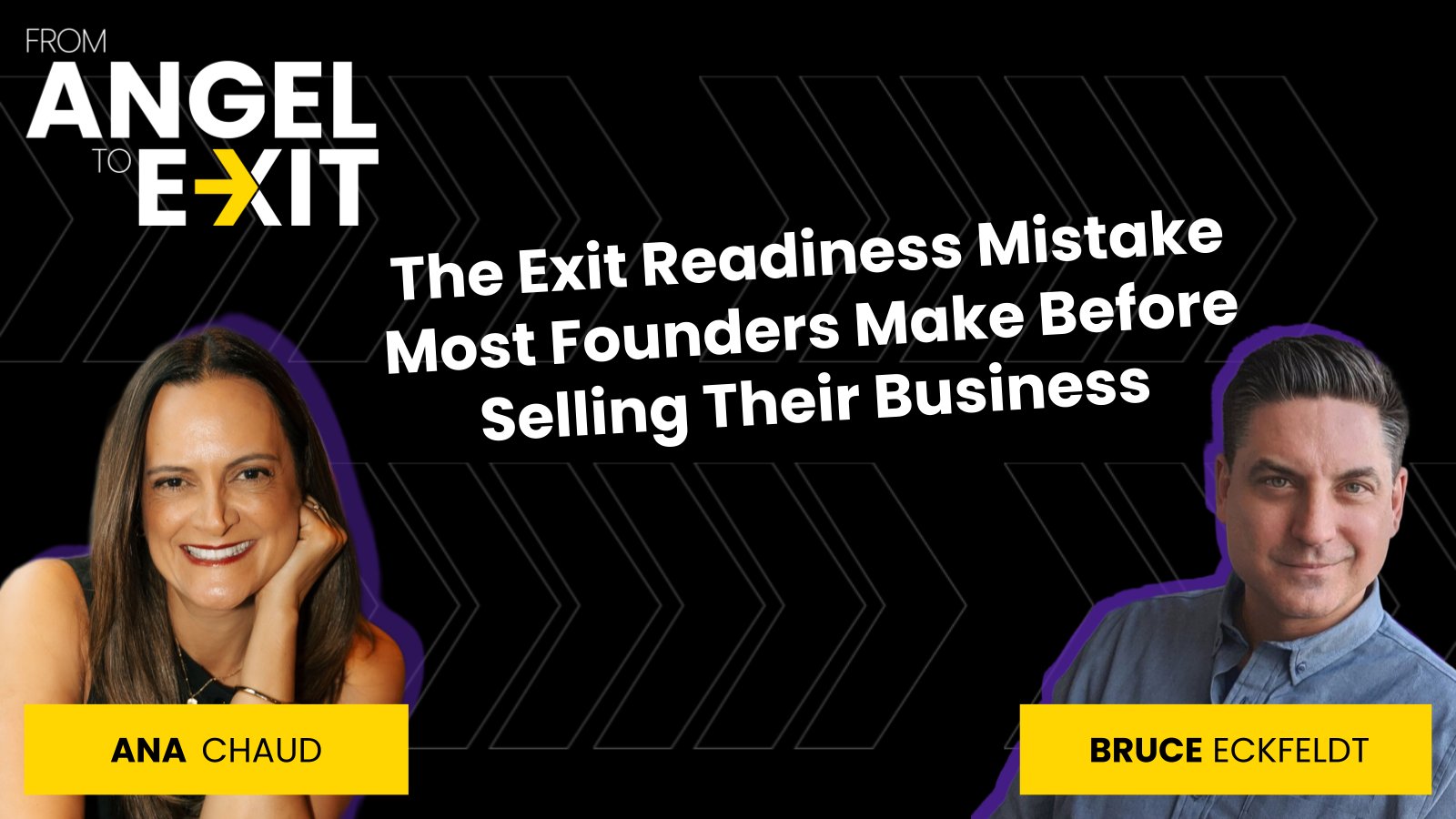
The Exit Readiness Mistake Most Founders Make Before Selling Their Business
Ana ChaudFounder, Garden Bar
Listen to the Episode.
Play the full conversation right here, or pick a chapter to jump straight to that moment. Prefer your own app? Every episode is on Spotify, Apple Podcasts, and the rest.
About This Episode.
Start with the key takeaways, the ideas worth bringing back to your leadership team. Then read the full story of the conversation, or use the chapters above to jump straight to the moment that matters most to you.
- Financial discipline creates leverage during growth and acquisition discussions.
- Founder communication and team buy-in directly impact execution success.
- Clean financial records simplify due diligence and increase buyer confidence.
- Understanding unit economics is critical for multi-location scaling.
- Funding strategy should align with long-term exit objectives.
- Investor transparency builds trust and strengthens acquisition outcomes.
- Founders should prepare emotionally for life after an exit.
- Financial literacy is a leadership skill every founder must develop.
Building a company is hard. Exiting successfully is even harder. In this episode of From Angel to Exit, Ana Chaud shares the remarkable story behind Garden Bar and the lessons she learned scaling, selling, and transitioning beyond founder life.
Born and raised in Brazil, Ana spent over a decade as a business consultant working closely with entrepreneurs before launching her own company. Following a major life transition and frustration with the lack of healthy lunch options in Portland, Oregon, she founded Garden Bar, a fast-casual salad concept inspired by brands like Sweetgreen and Chopt. What started as a personal need quickly evolved into a rapidly growing business.
Ana discusses how Garden Bar expanded from one location to nine locations in just three and a half years by focusing relentlessly on operational efficiency, customer experience, and financial performance. She explains how understanding throughput, labor costs, food costs, and unit economics allowed the business to scale sustainably while creating strong brand recognition.
The conversation explores the acquisition process in detail, including how a Seattle-based competitor approached Garden Bar, the negotiation process, and the importance of having experienced advisors during M&A transactions. Ana shares how investor alignment, valuation expectations, and clean financial reporting played a critical role in achieving a successful outcome.
One of the most valuable parts of the discussion focuses on exit readiness. Ana emphasizes that founders should prioritize financial hygiene long before considering a sale. Accurate reporting, strong investor communications, clear cap table management, and a thoughtful funding strategy can dramatically improve both valuation and deal execution.
The episode also explores founder identity after an exit. Ana reflects on navigating life beyond her role as CEO, the emotional aspects of letting go, and how her experience ultimately led her back to helping founders as a fractional CFO and strategic advisor.
For founder-CEOs preparing to scale, raise capital, or pursue an eventual acquisition, this conversation offers practical guidance on growth strategy, financial leadership, and building a company that is truly exit-ready.
Watch the Video.
Prefer to see the conversation? The full episode plays right here on the page, so you can watch while you follow the takeaways or read along with the transcript. Every episode of From Angel to Exit is also on my YouTube channel, along with short clips from each conversation.
About the Guest.
The background behind the conversation, and where to find this guest online.
Ana Chaud
Founder, Garden Bar
Ana Chaud is the founder of Garden Bar. She scaled and sold the company and now works with leaders on the transition beyond founder life.
- Website
- sankalpaleadership.com
- linkedin.com/in/anachaud
Full Transcript.
The complete conversation, lightly edited for readability. Open it to read along, or search the page for a topic or a name.
Read the full transcript
Bruce EckfeldtWelcome, everyone. This is From Angel to Exit. I'm Bruce Eckfeldt, I'm your host. Our guest today is Ana Chaud. She is an entrepreneur and an exited founder. We're going to hear some of her stories and what she's doing today. I'm excited for this. There are a lot of learnings in any exit, but I know Ana's had some fun ones, and we're going to hear a little about the lessons she's learned. So with all that, Ana, welcome to the program.
Ana ChaudThank you, Bruce. It's really nice to be here.
Bruce EckfeldtIt's a pleasure to have you. Before we get into business, I would love to get a little personal background. What's your backstory? Give us a little of the history. Did you always want to be an entrepreneur when you were young?
Ana ChaudOh my God, there's no such thing as a quick background for me, because I did not have a linear path. Most people think this journey is linear, and it was nothing like that for me. I was born and raised in Brazil and moved to the United States when I was 21 to get a graduate degree. I never thought I was going to be an entrepreneur. I started working right away as a business consultant, for 12 years in San Francisco, always working with founders, always working with entrepreneurs, but I never thought I was eventually going to step into those shoes.
Nonetheless, working with them, I created a little black book of dos and don'ts from founders, thinking, "If one day I become that, this is something I'll try, or this is something I won't try." But I always tell everybody I was the best founder until I became one.
For those 12 years, I was pretty involved in the business from a financial standpoint. I've always had a financial background. Not that I knew more than them, but I had my thoughts on how they should run a business and why they were doing things this way or that way. When I left San Francisco and went to the Pacific Northwest, the industry I was working in was not prominent in Portland, Oregon. So I switched a little bit. I went into the creative industry at the time, but then that's when I decided to start my own business in Portland and become a founder. That was when everything changed. I stepped into a founder's shoes and had to experience what that journey felt like.
Bruce EckfeldtI'm curious, what was in your little black book? You mentioned this little black book of dos and don'ts as a founder. What were some of the things you put into it?
Ana ChaudA lot of it, honestly, was about articulating. That was a big one in my black book: how did the leader get buy-in from the team? The reason for that was that I was always working with the founder, the CEO, on creating a vision, on creating a structure and a process, and then implementing the strategy we had put together. When it was time to announce it, I was next to them, seeing them roll it out and thinking, "We've got to get buy-in here. How do we do that?" Listening to the team, making sure the team felt included. That was a big difference I noticed.
For all those years, I probably worked with over 100 founders. I would see the ones that were a little better at articulating vision, at implementing, at getting people excited, versus the ones that were just there to put it out, and people had to figure it out. So those were the dos and don'ts: how they worked with a team, what kind of motivation. I kept thinking about what would make one team more successful than another, and how people would feel a little more part of that company and want to be in that company. Culture was a big thing for me in the dos and don'ts, and that's what I brought with me when I started the business.
Bruce EckfeldtI'm always curious what prompts someone to found a company. Sometimes they've had a plan and have been working on it for years. Other times they just can't stand their job, so they leave and start a company. Where was the motivation? What was the driving force for you?
Ana ChaudIt's so unglamorous, but I'll tell you. It's not a great story, honestly. Now I look back and I laugh, but at the time it was pretty dramatic. When I moved to Portland, I got a divorce, and I found myself in a situation where I had to go back to work. I was consulting, and consulting is very erratic, as you know. I was in a completely new market. This was one year after getting to Portland. I didn't have a client base, and I felt I had to find a job to feed my kids, and the whole thing that goes with divorce. It's that story where you're on the bathroom floor crying.
So I ended up getting a job as a controller at a company I was consulting for. No offense to any controller, but if you know anything about that job, and you know me and my energy, it was really hard for me to do that job. Having said that, the business itself was hard, and I only had a half hour for lunch.
So now, Bruce, imagine this story. I'm back in the dating scene. I have a half hour for lunch. I have to eat lunch fast, and I can't find anything in the healthy space. And I'm thinking, "This is pathetic. I need a place where I can get a salad." I kid you not, this is a true story. There was a Chipotle next to the office, and I found myself going to Chipotle pretty much five days a week and getting the salad there, except it got to a point where I needed more than six ingredients. There are only so many combinations I could do.
Bruce EckfeldtYou've done every combination.
Ana ChaudAnd I thought, "Why can't I find a salad?" Everywhere I would go for a salad, I would have to sit down. It would be a sit-down restaurant. I had gone to New York City, and I noticed New York was booming with Sweetgreen at the time, and Chopt, which were two pretty big concepts, and people were flaunting their salads in the park. And I'm thinking, "This doesn't exist in Portland. I need to start one."
Coincidentally, at that time my ex-husband bought me out of the house. He gave me a bunch of cash, and he goes, "Do you want to go buy another house?" I said, "You know what? Actually, I'm going to start a business." He thought I was out of my mind. And I thought, "I just need to start a salad restaurant."
I had no idea what it was to start a restaurant. I had not been in food service. I knew how to run a business. I just didn't know how to run a business in food service. But at the time, I met my co-founder, Christopher. He was a restaurateur in Portland. He had two full service restaurants. And he said, "I can help you get it off the ground." And I said, "You know what? Let's do this. Let's go."
We picked the busiest neighborhood of Portland, called the Pearl, right across the street from this very famous bookstore called Powell's, and we started our first location in 2014. The city just loved it. The city embraced it. They went crazy. We had a really, really great store. Everything was made from scratch. Everything was how I wanted it to be.
A year later, we scaled to two locations, and we noticed this was really taking off. Three and a half years in, we were at about nine locations. Then, when we were building the 10th, I found out my competitors from Seattle were coming to Portland, and we started to date, and I convinced them to marry me and buy me out.
Bruce EckfeldtI love it.
Ana ChaudAnd then they did. It was five years from first store to exit, almost to the dot.
Bruce EckfeldtWhen you opened the first location, did you have ambitions for exiting? Did you have a vision for what that would be like? Tell me a little about what the intention was when you first started.
Ana ChaudAbsolutely. When I started, the first location was a prototype. At the time, yes, I had an idea of what it would look like as a multi-unit, because remember, I had Sweetgreen in mind, I had Chopt in mind. What I didn't know at the time was whether we were going to go the franchise model or the corporate model. I was trying to figure it out. It wasn't until the second location that I understood who we were. We were not a destination brand. We were a convenience model, a model where people want to be within two blocks and walk to it.
Once I started to understand who our audience was, what kind of business we were, and what we were offering, I was able to say, "Okay, this is actually a perfect model for me to have what's called first mover's advantage." So we saturated downtown at the time, with five locations within about 1.5 miles of each other. We created a brand, and then we started to expand from there.
Originally, obviously, after the 10th location, it goes: what's 20? What's 30? What's 40? But for that to happen, I had to design a funding strategy, and that's the part you have to think about when you're talking about business and exits. What does that look like? When do I go from this venture funding to institutional? Do I eventually go to PE? So I started to really understand that. I have to say, I loved the business side, and that was a really big challenge for me as a finance person. But I would say food service is not the most interesting place for me to be in, and that's a very polite way to say it, when people say restaurants fail.
Had I not had the experience I had with numbers, it would have been really, really hard to make it happen.
Bruce EckfeldtI'm curious, what were the insights you had on the numbers and finance side that allowed you to navigate some of those challenges? Were there any particular insights you had around what it really takes to found and scale a restaurant-based business?
Ana Chaud100%, yes. First of all, I needed to understand what the numbers were. I had to know what the industry average was for net margins and understand where the money goes in between. And then I saw the sad reality of that world. You have to understand, we're fast casual. We're not full service. We didn't have alcohol, so we had to really work with that. Plus, our food cost was really expensive because of quality. Once I started understanding that, I realized the only way for me to make this a profitable business was to scale it and take advantage of economies of scale.
So it was volume. For each store, I knew what I had to do in terms of throughput to make sure that store would produce what it needed to produce as a contribution, so we could actually scale in volume. And as you start to multiply a business, and now I work with multi-units, it's understanding how your vendors are going to start giving you price breaks. Remember, the two big things in food service are food cost and labor. Everything else is rounding error. But food cost and labor are huge, so that's what you have to manage. Labor is hard, but with food cost, you have to figure out ways to do it with your vendors.
So I started to learn how to get economies of scale and increase volume. I had to have more throughput, so we would time how long it would take to get a salad, how many people I had to have in line, how many people I had to have on staff. I had to make all these calculations, which was actually pretty fun.
Bruce EckfeldtIt's a well-oiled equation. I change this variable and get this outcome.
Ana ChaudAnd remember the whole part I said before, that you have to articulate to your team. For my team, Bruce, I couldn't come and say, "Hey guys, we need to increase our sales by 10%." It means nothing to them. Nothing. But I would say something like this: "Hey guys, if we get one extra ingredient per salad, we will hit our goals." That was all I said. I would go to the people on the line and say, "All I need you to do is get one extra ingredient. 'Hey, would you like to add bacon to this?'" That's it. One extra ingredient. So I was able to break it down in ways they understood. Plus, they loved it. I had a really fun relationship with my team.
Bruce EckfeldtIt's interesting, because there's such a direct connection between the frontline workers' behavior and how they interact with the customer. They literally make or break the financial success of the business. How do you gamify those things so the workers know exactly what to do? "My job today is how much bacon can I sell," and how they weave that into the conversations. That's where the business either works or doesn't.
Ana ChaudIt is, and they are the first person your customer sees. If they don't believe in what they're doing, I don't care who is behind the scenes. The person saying hello to your customer is the one who's going to close that and make sure of the impression that customer has. So they were always my priority. I onboarded every single employee personally, and I went through a lot of them. There was a point in time when we would have orientations with 20 people every week. But I made a point that they knew who I was, what my story was, why I did what I did. They were able to speak from hearing from me about why a salad dressing was named after my dad, who was my inspiration on salads. And they knew my birthday. All my birthday twins on the team.
And this is a true story. I'm Brazilian. I hug everybody. They would come in, and I would hug my employees, until my HR director said, "You've got to stop. You've got to stop. You cannot hug your team. Do you understand?" I'm like, "But..." So she said, "They can hug you." So I had to send a memo that said, "Look, I love hugging everybody, but apparently I'm not able to do that. So if you guys want to hug me, you can come say hi, and we'll do it together."
To this day, I still hear back from my employees. I just had that kind of relationship with them. It was a lot of fun. They loved it.
Bruce EckfeldtI imagine. During the pandemic, I did a couple of events where they gave you a sticker to put on, depending on whether you want distance or you don't. You need to give all your employees a sticker for who's willing to be hugged and who's not.
Ana ChaudTotally. The green and the red sticker. Yes, I remember those.
Bruce EckfeldtSo you mentioned that this competitor was coming down, and that was an opportunity for you, and you navigated an exit that way. But before you learned you were going to get attacked from the north, what was your exit plan? In which direction were you thinking? Give me a little of the vision you saw for the company.
Ana ChaudGood question. When you're doing these multi-units, you start becoming really good friends with the other owners and founders of multi-units. There was one in town, Kim Malek. She has an ice cream shop, called Salt & Straw, and she's still very, very successful. They actually have five or six here in Miami. They're doing great. At the time, Kim and I were walking in parallel, and she had private equity money come in. I was looking at what was happening with her and thinking, "Hmm, is this something that could possibly happen to Garden Bar?"
So I was looking at other multi-unit owners and seeing what they were doing, but at the same time, I was talking about different possible exit strategies. There was a group in town that owned a lot of different chains. They owned, I don't know, 200 Taco Bells. They owned Buffalo Wild Wings. They were very well known, and I was talking to them about the possibility of, "Hey, would you like to work together and help me scale?" I knew I was going to get into a bigger group, if that makes any sense, or I would eventually have to bring an executive over to help me scale to the level I wanted to scale.
The exit would be for my angels. I knew my angels had about a five to seven year expiration date for me to get them out and happy. I knew that was going to happen. I just didn't know exactly how it was going to happen: if it was going to be getting private equity to come in, or going with a different group, or an exit altogether. The exit altogether sounded pretty nice, so I did that.
Bruce EckfeldtI get that. How did you actually find out that this group was going to be coming down to the Portland area? What was that realization like? What was the mental process you went through, the six stages of processing all of that? Give me some insight there.
Ana ChaudWhat happened was, I had a financial advisor at the time, who was also an investor, and we had gone up to Seattle with a real estate agent to start looking at locations there. We knew we had two options for a second market, Seattle or Denver at the time, so we flew to both places to look at expanding. Somehow, the founders of Evergreens heard about it, and they reached out to me on LinkedIn.
It was really weird. They said, "Hey, we found out you guys are here. Maybe we should talk." And I said, "Yeah, let's talk." So I went to Seattle to meet with them, and that was our first meeting. At the time, there was no conversation of acquisition. They were trying to feel me out. I was trying to feel them out, to see who was going where.
Bruce EckfeldtThe little dance.
Ana ChaudBut then, eventually, I was really honest with them. I said, "Look, Portland is not Seattle. We don't have the density for two big brands. And if a national brand ever comes in, such as Sweetgreen, it would eat both of us alive. So the only way to survive in Portland would be to have only one brand." And because their board came from MOD Pizza, they had a lot of power in the F&B space. It made more sense for them to take me over.
Bruce EckfeldtOnce you realized that was going to be the path, how did you prioritize? What was important to you in terms of structuring it? What did you want to get out of that transaction? What was your list of priorities going into those conversations?
Ana ChaudI was very lucky that one of my investors was a really, really amazing help. They had done so many M&As, so they helped me through the process from there. I wouldn't have been able to do it alone. I didn't have a whole C-suite at the time. It was just me, right here. So it was great to have that.
The first thing I wanted was a fair price for the acquisition, and I knew what the range was. I wanted my investors to get paid. That was a big deal for me. As I go through the story, you're going to see. This story is actually out there on YouTube, so it's not like people don't know what I went through, because COVID, of course, messed everything up. But for me to sleep at night, I needed to make sure my investors got paid. So I wanted to make sure it was a fair price and that the terms were good for my investors to get paid.
You're probably going, "What about you? What about you?" It's not that I didn't care about me. It's that we were still in a growth phase. You've got to understand, each unit has what we call a maturity stage. A store doesn't get to full peak until maybe 12 months after it opens. So every time you open a new store, you're funding that other store.
Bruce EckfeldtYou're rolling everything forward.
Ana ChaudLooking back, I scaled a little too fast. With nine stores in three and a half years, I didn't even know what was going on. But my point is that we were still in that ramping phase. What my acquirers were seeing was the brand we created, what we were doing, the potential. We were growing in revenue like nothing else, but we still had to deliver the profit. If you think about Sweetgreen, I don't even think they've turned a profit yet.
Bruce EckfeldtThey're still in growth.
Ana ChaudThey're still growing.
Bruce EckfeldtThat's always the challenge for these growth companies, particularly capital-intensive growth companies. You've got to plow your profits back into capitalizing the next store. Were you able to tell the story to the acquirers of, "We're generating good profits, and we're just taking those to open the next store"? In terms of valuation, if we're going to do a multiple of EBITDA, it may be zero right now. But practically, we can abstract that a little and show some kind of profitability, and then get some kind of valuation based on that. Is that the nature of the conversation?
Ana ChaudHonestly, EBITDA doesn't even play a role. It goes as a multiple of revenue, honestly.
EBITDA is almost nonexistent. Even a very successful restaurant has very low EBITDA, because that's just the way it is. So it's based on revenue. But yes, the story was there. There was nothing we needed to do. Garden Bar had the press, the people, the lines. It was just right there. The amount of what we call goodwill when you sell was incredible. The brand was there. It was strong. People still remember it, because they changed the name, of course.
So the story was not hard to tell. It was just coming up with that number, without the EBITDA multiplier. That's what we were trying to do. But I really had someone help me with that negotiation. It was amazing, because it's hard for me to be the friendly face and negotiate that. So having Sam there to help me out was fantastic.
Bruce EckfeldtI think it's always the challenge. There's always this conundrum when it comes to these exits, particularly if you're going to stay on at some level. You treat this as a zero-sum game, very adversarial in the negotiations, but on the flip side, you sell, and now you're part of the company and you've got to work with these people. It can be really awkward.
Ana ChaudWhich didn't really last very long.
Bruce EckfeldtGive me some sense of some of the other terms: staying on, earn-outs, deferred payouts, things like that. Was there anything interesting or unique about how you structured things?
Ana ChaudThe structure was pretty straightforward. We got an initial amount, which was all I needed to get my investors back with a return, a really good return. And then I was going to have the earn-out, which would have been my share. I say would have been because it was based on a target for revenue. Now, the target for revenue was a slam dunk. There was no way we wouldn't meet that revenue.
Bruce EckfeldtOkay. So it was a confident number.
Ana ChaudOh yeah. Except there was COVID. There were no stores open, so there was no revenue. It was 100% zero revenue. So that never materialized.
But that being said, think about it: I had 10 leases and a personal guarantee, Bruce, because this is restaurants we're talking about. So all of that was gone. In the end, with all that happened with COVID and everything else, I wasn't having to manage all that chaos, so I feel really blessed. It was hard for them. They did a fantastic job doing what they had to do, and I have ultimate respect for what they did. But the structure would have been really simple: this deposit that I gave my investors, and then one year, and then the earn-out.
As far as me working with them, there was also COVID, so things ended up leaving. I don't know how it is for other founders, but my sense when I started working with them after I left was that I'm living in my house, but someone's coming in and rearranging the furniture in front of me. And I'm thinking, "But that table works much better there." And they're like, "Nope, it's not your house anymore. The table's going over here." So it was not very easy for me, because I was so intimate with my team and what they were good at, and all of a sudden you're seeing all these changes and there's nothing you can say. So it's very hard.
Bruce EckfeldtI got moved from the master suite down to the office with a twin bed.
Ana ChaudOr the nanny's quarters, or whatever.
Bruce EckfeldtExactly. I'm curious, emotionally for you, how was that whole process? I'm sure it was a bit of a mixed bag. What were the emotional phases you went through in selling this? I'm sure there were elements of excitement and of fear. What came up during the process for you personally?
Ana ChaudSeveral things. I wasn't as emotional as most founders would have been. It's funny, I was talking to my son yesterday. I think it's genetic. He was a D1 player, and he decided now he's going to go into business. He said, "I'm quitting soccer. I'm going into business. My last game is this Saturday." And I said, "Are you sad?" He goes, "No. I've made the decision, and I'm living on the other side of the decision."
So there was a little bit of that. Once I made a decision, my brain was already on executing it, and I didn't stay in, "Oh my gosh, it's my baby, my baby this, my baby that." I didn't do that. That being said, there is always a piece of a founder that's going to wake up the next day and say, "Who am I?" You have a title. People ask what you do, and you say it. That is the piece where I think a lot of people get stuck, and they can predict that pain before I could.
For me, I did everything, and then, yes, I woke up the next day going, "Whoa. I didn't see this coming." But a lot of people see that coming ahead of time, and so they suffer in anticipation. I did not. I was in execution mode. This is the best for the company. I'm going to go.
You don't know me, but if you knew me, you'd know that I've had a lot of different lives. I've talked on YouTube about that. So for me, changing from one thing to another is not a foreign feeling. I actually love change. So I was just like, "This phase is over. Let's go." That's Ana. This is not what other founders go through. Like you, I work with a lot of founders who are in exit mode, and there's such a fear of, and an attachment to, the identity. What am I going to do? This is my baby. So I can totally understand and empathize with that, but it wasn't like that for me. Once I made that decision, I was pretty good.
Bruce EckfeldtI think there are two things I'm hearing there that are really important. When I'm working with founders, one of the things I dig into in their background is how well they've navigated change previously. If you've had change in your life, you know what's going to happen. It doesn't necessarily make it easier, but you're much more able to navigate it, feel the emotions and not get overwhelmed by them, or just know, "Okay, this is going to be really disorienting for a while, but I will ground myself. There will be another thing. I will figure it out. I trust myself." If you have that, it makes it a lot easier and helps you get through it.
So after you sold, what was the journey for you? You were in some kind of executive position for how long? Tell me a little about the post-transaction period.
Ana ChaudA few months, and then I left. And then COVID hit. It was really right there. I think I went through what everybody went through with COVID, except that I went right back into what I was doing before Garden Bar. I was always a business consultant, doing financial work. Now I do fractional CFO work. So that was a very smooth and easy transition for me. I just went back and started working with clients again.
The only change was that, having had that experience as a founder, plus the whole COVID mess, I started to work with my founders a little more on what they want for themselves before we come up with a business strategy. That was the shift for me: helping them with the strategy, but with more of an intentional strategy. Helping them figure out, "Okay, what's the purpose of trying to grow to this amount? Why are we doing this? How much time do you want to spend with your family?"
That's when I noticed that a lot of people just don't really know what they want. And that started to lead to what I do right now with my partner. We do 50 Pages, which is helping leaders figure out what they want, a little bit like that. But I never left the space where I help founders with financial strategy and figuring out what they want to do with their business. So I'm still there. I like doing it.
Bruce EckfeldtI definitely see it as a thread for you. You were doing it before. It was the superpower in the business. That's how you really created value and accelerated the business. So I totally get that you're back into it.
I'm always curious, with founders who have exited and are now on their next chapter: is there anything you wish you had done while you were still in the other company to build a platform, or prepare yourself, or give yourself a bit of a running start on this business? Anything you wish you had added or changed or prepared for in terms of the next chapter?
Ana ChaudBefore I exited?
Bruce EckfeldtYeah, before you exited.
Ana ChaudIn hindsight, everything is 20/20, of course. I wish I had thought about what it was going to be. I didn't have the time or the luxury to think about it. In my mind, I had to execute. I was managing the business. I was trying to navigate the exit. My attorney kept saying, "I've never seen an exit where there's only one person in the room. It's just me and you." And I'm like, "No kidding. This is what we're doing. We're going to get this done."
So it was just a convoluted time. And remember, I was raising my boys. My boys really took on a lot of the stress of a mom. I think what I would have done differently is not be as stressed as I was, because looking back, it's never worth it. But I didn't know better. So I probably should have thought about what would be next. But because of what you said earlier, I've been so used to navigating change. It's been the common thread in my entire life. I knew I was going to figure it out at some point, and that's why I didn't do it. I probably should have thought about it, but I didn't. I just waited until that chapter was over, and I was like, "Oh, now I'll start it over again."
Bruce EckfeldtBased on what you're doing today, is there anything you look back on and see, "Okay, I could have built these relationships, or put this thing together, or started this thing sooner"? Anything you could have done then that would have helped you hit the ground faster on what you're doing today, or made it easier?
Ana ChaudYes. I probably would have connected with more people who had exited and understood what they went through. I didn't do that. Honestly, as we're talking now, I see there is a community that goes with that. I didn't even know it existed then. I probably would have done that, and I probably would have talked to more people who were part of my sphere at the time, in particular my investors, and figured out where they saw that I could be of more value.
One thing I've always wanted to do, and didn't do, was be more involved with venture capital funds, because that was a part of me that I really enjoyed. I enjoyed what they were doing, and I always thought, "How fun would it be to be on that side of the table?" But I didn't pursue it at the time, and I could have, because I had all these connections. I didn't think about it. I thought, "Things are going to come, and I'm going to figure it out when they do." But I probably could have done my homework a little more and talked to people who had exits.
Bruce EckfeldtWhat advice would you give to pre-exit founders, people who are a couple of years away from a potential exit? It sounds like you had a pretty good situation: you had some good investors, the business was generally going well, and you had a pretty good sense of where things were going. But what would you advise other founders who are nearing an exit or thinking about one, in terms of things they should focus on, relationships they should develop, or things you see people missing? What would you suggest they do to make the whole process easier and more successful?
Ana ChaudThis is going to sound super biased, but I'll say it anyway. It's knowing their numbers. Most people don't. The reason I was able to navigate this exit, and it seems like it was super smooth, though it wasn't as smooth as it seems, is because my books were flawless. I knew my numbers. I knew my reports. My investors knew exactly where we were. In the investor reports I wrote personally, every single metric was there. So people knew 100% of the time where we were financially and the issues we had, because we had cash flow crunches like everybody does. Cash flow crunch is part of the world. I knew my runway.
Why do I say that? Because when you go through what we call forensic due diligence, ours was basically next to nothing. I said, "You can grill me on any single number in my general ledger. I will tell you every single thing." But that's because that's what I do.
When I work with clients, in particular the ones who are trying to get out, I always start by looking at the balance sheet, and I say, "Okay, if we were going to sell this tomorrow, this is how your investor, your bank, or whoever you're going to sell it to is going to read your numbers. Is this the story of your company?" Little things. For example, I have a client who had $16 million in gift cards that they never cleared from the balance sheet. I'm thinking, "What do you think is going to happen here?" It's little habits that we don't execute that are going to compound later when you try to exit.
So if I had to give advice to founders who think they're going to exit down the line, it's to make sure your finance hygiene is in place from an early start. You don't want to try to clean everything up later and then find out your numbers are so bad. That's what we have to create a valuation for your company. That's what we have to sell. So that is one big thing.
The second is that I had a little snafu. When I was raising money, I did not know the details of, for example, a convertible note: what happens if you sell before it converts. Those little things came to bite me later, because I didn't know enough about them. Now I do. Now I can sit with somebody and say, "Look, let's do this." But at the time, I didn't, and it was very investor friendly.
And that's another thing, Bruce. If a founder is going to think about an exit down the line, have a funding strategy that makes sense. What happens, as you know, is that when somebody has an idea, they're so excited to get it going that they'll do anything. "Give me the money, I'll do it. I'll give you half of the company. I don't care." I see this all the time. But we don't think about what's going to happen down the line. If I get money from my family, all of a sudden I have 13 cousins on my cap table. How am I going to exit and get out from under my 13 cousins?
So that financial clarity, I personally think, is key. But again, this is my biased view, because that is one very important thing to me. I think that had I not had that, it would have been a much harder exit. That part was easier.
Bruce EckfeldtGood advice. The best time to get all those things in order is when you start the company. The second best time is now. Is there a timeframe? Do you say, "Look, we really need X number of years before a transaction to go through all these things"? How much time do you like to have with a company to do that work and make sure everything is in the right order and well organized before a transaction starts to happen?
Ana ChaudIf they know what they're doing, and it's just that the numbers don't say it, it's really not that long. I can look at something and say, in maybe two or three months, all we need to do is look at the numbers and make sure they're showing the way they need to show. Are the accounts written right? Do we clean this up or that? It's usually work I do with the CPA, to make sure everything is in place. So it's not that long, unless there is a glitch we don't know about or can't figure out, and we have to figure it out. But normally it's not that long.
At the same time, the benefit of having that is that as you're running the business, you have knowledge of what's happening in your own business. That's the benefit of having very good financial processes and understanding how to read them, how to know your metrics. I think that's where a lot of people think the accountants are going to do that work. I hear this all the time. "What's your finance team?" "I have an accountant." Well, okay, that's great. They file your taxes, and they're making sure your taxes are awesome. I want to know how you read your financials internally.
So that's where I think it helps. But also, if you're going to sell this business, you're going to tell a story. You asked me about the story. The more you know how the numbers come and translate, the better the story is. If I'm able to show, "Look, this is what's happening. Look at my food cost. I actually decreased food cost over the years. I'm keeping my labor steady, even with all the hikes in minimum wage. Look at what I'm able to do." If I'm able to tell a story by understanding these numbers, that makes a huge difference. The level of confidence is so much different.
Bruce EckfeldtI recommend that. So what are you up to now? Tell me a little about your current endeavor. Are you starting more companies? What does the future hold for Ana?
Ana ChaudIt's so funny you said that. First of all, I work as a fractional CFO. I help founders. My work is very one-on-one with a founder, because I help with strategy, but from a financial lens. If we're going from point A to point B, how do we create the funding strategy for that? But also, how is your company operating?
And funny enough, I started a program called Finance for Founders. I kid you not, true story. It's literally a basic understanding of what a founder needs to know. I don't need a founder to calculate depreciation, but I need the founder to understand what depreciation is. So I distilled it to the basics of what a founder needs to know to be able to talk to an investor, and also how to pitch. I see that as the missing link in most pitches: people can't tell the investor where that dollar is going to go. If I'm giving you a dollar, where is it going to go? They can't do that.
So I'm very excited about that, because I want to demystify it. I was talking to a founder last week, and it's a real trigger. It's almost like a fear. Every time we talk finance, she's like, "I don't want to know numbers. I don't want to know numbers." And I'm thinking, "Well, hold on. I'm going to calm you down. Let's breathe. Everybody just breathe. Let's take an exhale, and then we're going to talk about it. I'm going to take you through this fear."
So that's what I'm up to now. Except that now I'm back in the post-exit founders community, and everybody's building new things, and I've started getting the urge, thinking, "Oh my gosh, something might come up. I'm so excited." So the future will tell if I'm going to start something new. But right now I'm definitely giving back in terms of value, this piece of the numbers, which I think is so essential.
Bruce EckfeldtMost founders can't help but start other companies. It's a conviction. It's a disease, maybe. I don't know exactly what it is.
Ana ChaudRight. I thought I was going to meet all these post-exit founders and everybody was going to be like, "Oh, I want to chill." And no one's doing that. One of them has three new businesses. I'm thinking, "What's going on?" But I can see why. There is this excitement of starting over and knowing what to do now. It's like having another kid, when now you know that if the kid cries a little bit, it's okay. You know they're not going to die, and they're not going to be hungry. If you know how to do it, it's a little better.
Bruce EckfeldtI love it. If people want to find out more about what you're doing and how to get hold of you, what's the best way to do that?
Ana ChaudLinkedIn. Just find me on LinkedIn. There's also a website, sankalpaleadership.com, which shows what I do. But LinkedIn is usually the way to find me. I'm always there, and I love to connect. Obviously, I love to talk, so there you go.
Bruce EckfeldtThat was great. Thank you. This was a lot of fun.
Ana ChaudAbsolutely, it was a lot of fun. Bruce, thank you so much for having me here.
Never Miss an Episode.
Know the moment a new episode goes live. Subscribers also get a say in future guests and the topics we cover.
Other Related Episodes.
More conversations that connect to this one. Or browse the full archive by topic or by guest.
Jeff Corn
A candid look at building Virtuance, selling it, and the questions of identity that follow the deal.
Listen and Read
Denise Logan
Why the emotional transition is the riskiest part of a sale, and how to prepare for it.
Listen and Read
Scott Snider
Why he faced an identity crisis after selling at 24, and how founders can avoid regret after the sale.
Listen and Read