From Angel to Exit Episode 10
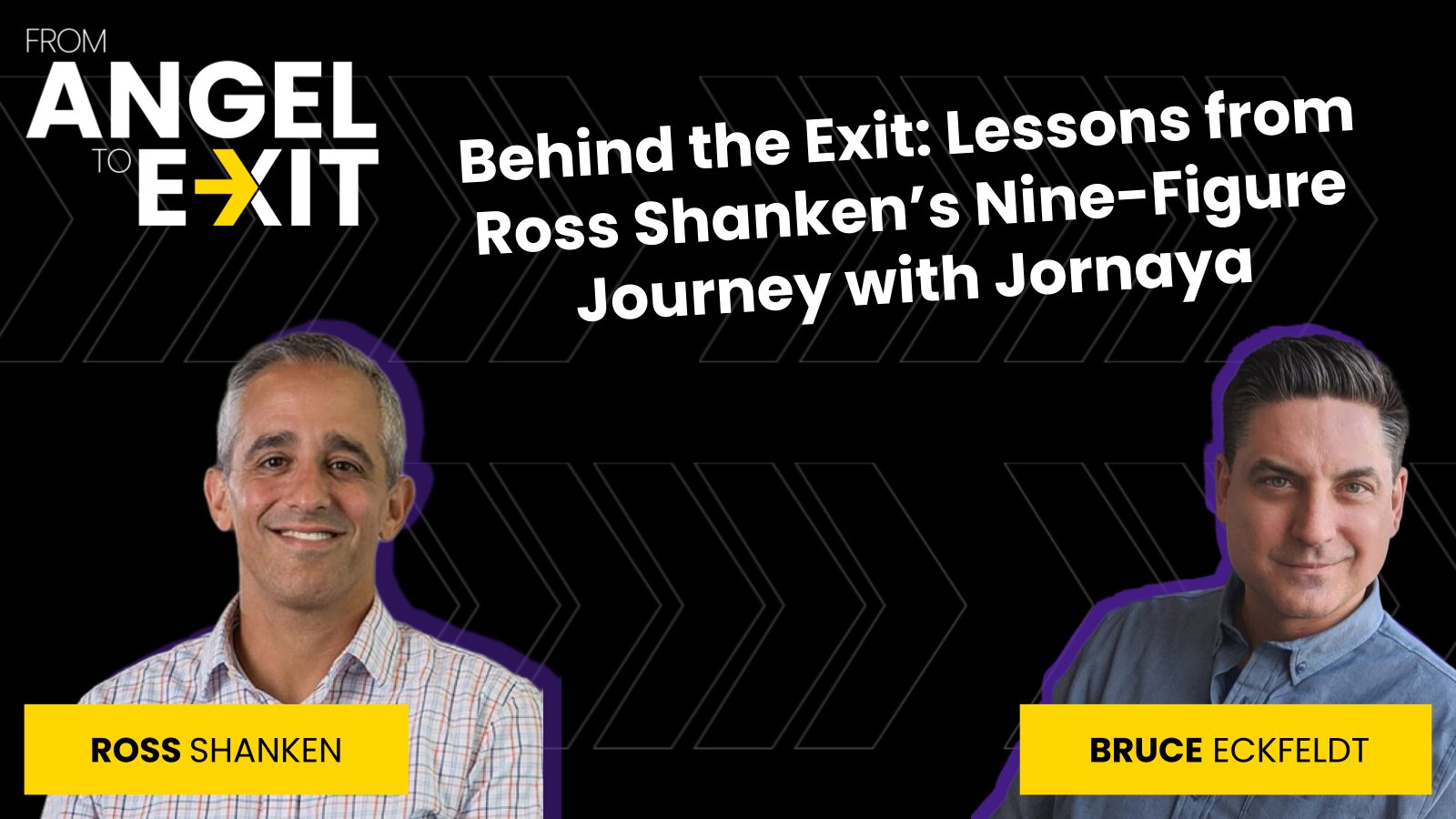
Behind the Exit: Lessons from Ross Shanken's Nine-Figure Journey with Jornaya
Ross ShankenFounder and former CEO, Jornaya
Listen to the Episode.
Play the full conversation right here, or pick a chapter to jump straight to that moment. Prefer your own app? Every episode is on Spotify, Apple Podcasts, and the rest.
About This Episode.
Start with the key takeaways, the ideas worth bringing back to your leadership team. Then read the full story of the conversation, or use the chapters above to jump straight to the moment that matters most to you.
- Establish your financial model early and revisit it often to inform strategic decisions.
- Align your leadership team using shared vision exercises like “headline planning.”
- Avoid exiting on investor-driven timelines, run your own deal process.
- Bring on key roles (like CFO) earlier than you think you need them.
- Use backcasting: start from your ideal exit and work backwards operationally.
- Honest internal dialogue creates stronger strategic alignment and execution.
- Validate your market thesis with early feedback loops from prospective acquirers.
- Sitting in discomfort post-exit can be a powerful period of personal growth.
Ross Shanken, founder and former CEO of Jornaya, shares the story behind building a pioneering lead verification platform and guiding it to a nine-figure exit. In this episode of From Angel to Exit, Ross unpacks the strategic frameworks, operational challenges, and personal insights that fueled his success, from initial market entry to final acquisition. It's a must-listen for founder-CEOs aiming to scale confidently and exit smartly.
Watch the Video.
Prefer to see the conversation? The full episode plays right here on the page, so you can watch while you follow the takeaways or read along with the transcript. Every episode of From Angel to Exit is also on my YouTube channel, along with short clips from each conversation.
About the Guest.
The background behind the conversation, and where to find this guest online.
Ross Shanken
Founder and former CEO, Jornaya
Ross Shanken founded Jornaya, a lead verification platform, and guided it to a nine-figure exit.
- Website
- vojomo.com
- linkedin.com/in/rossshanken
- ross@vojomo.com
Full Transcript.
The complete conversation, lightly edited for readability. Open it to read along, or search the page for a topic or a name.
Read the full transcript
Bruce EckfeldtWelcome, everyone. This is From Angel to Exit. I'm Bruce Eckfeldt, I'm your host. Our guest today is Ross Shanken. He is the founder and former CEO of Jornaya, and we're going to hear that story. He's doing some interesting stuff today, and I'll let him explain his current ventures. We're going to hear a little of his background and his journey, and really talk about what he's learned as a founder and CEO who has exited. I'm excited for this. Ross has had some really amazing experiences and is doing some interesting work, and I'm sure there will be lots of great nuggets in here. So with all that, Ross, welcome to the program.
Ross ShankenIt's great to be here, Bruce.
Bruce EckfeldtThank you for being on. Before we dig into the exit story, Jornaya, and the work you're doing today, I'd love to get some background and hear about your professional experience as an entrepreneur. What inspired you to become an entrepreneur and a CEO? I'd really like to understand what that journey was like for you before you even started things. Give us a little background and tell us the story.
Ross ShankenSure. Coming out of college, a lot of my college friends were heading to Wall Street or consulting or professional careers, going to law school or med school. Those were the tracks, and they were pretty attractive tracks if they worked for you. Good money coming out of college, and your parents were happy they'd spent that money on education. You got a "good job," in quotes.
So there was a gravitational pull toward that. And I was fortunate in one way: I had a supportive father who understood that I wasn't feeling my own personal pull toward those things. They were tempting because the track was set for you. But I felt like I wanted to create. I wouldn't have used that word back then. I think I would have said, "I don't want to be on someone else's track." But looking back, I really wanted to create, innovate, and ultimately build something from nothing. That's where my energy just naturally went, or was conditioned to go through my upbringing, whatever it was.
Bruce EckfeldtI'm curious, were there any role models specifically? "I want to be like so-and-so," or some kind of vision you had early?
Ross ShankenProbably, looking back. It's a good question, because I don't know that I've ever really asked myself that. There were a couple of uncles who were in business. They weren't necessarily put on pedestals in our family. Some things were, and some things weren't. So I was trying to figure it out, but I was drawn toward it. These were people who really blazed their own path, with all the good and bad of that.
Some of my family was maybe almost discouraging it: "Yeah, it seems really sexy and fun, and you're seeing them on the other end of it with money and nice cars, but I'm not sure you understand what can happen there. It's risky." But on the other side, I was always drawn toward it for those reasons at that young age.
Bruce EckfeldtSurvivor bias.
Ross ShankenOutside of that, I had a natural pull toward some of the big names, like Bill Gates and Steve Jobs. Back then, those were probably the two. I just thought it was so cool that they didn't go to school, or dropped out of school, and just did their own thing. So there's a recurring theme you're already hearing about doing your own thing and blazing your own trail.
Technology was also an early interest. Those two things came together. When I was about 10 years old, my dad had the foresight to buy a TRS-80. I don't know if you remember Radio Shack. I was programming in BASIC, and I always loved that stuff. Early in my career, I got involved in data, learning how to use information and technology together, and that ultimately led to some business success. So it was the coming together of my pull toward tech, the people I knew who were in business but not in technology, and the people I didn't know who were in technology and had built great businesses around it. That gives more color.
Bruce EckfeldtWhat was your education? How did that play into the business world?
Ross ShankenPublic high school, and then Haverford College, a small liberal arts school outside Philadelphia, if you've heard of it. That was about the extent of it. I majored in political science, so it's kind of like, "How did you end up here?" But I always say I learned at Haverford how to write and how to speak. I did take some computer science and math classes, but not a ton. I knew enough to be dangerous. I had maybe some natural mind for it, but I didn't want to live inside math and computer science every day and code. But I liked it.
And I really liked business. I had a business at Haverford importing clothing. A cousin of mine had figured out this import from Pakistan, these sweaters and booties, and I was always trying to sell stuff. I don't think I had put two and two together yet that to sell more and more of that, you have to set up shop, get people to come, and live with good days and bad days. It hadn't clicked yet that software is what I now know how to describe as making money while you sleep. But I learned that shortly after college, as I started looking at jobs.
Bruce EckfeldtHow did you get into the business world? Tell us a little about your professional experience.
Ross ShankenI had all these tracks available to me, and I just didn't take any of them. I spent my senior summer down the shore, the Jersey Shore, where I'd been every summer in college, just making money and having fun. I came back without a job, and most of my friends were in New York. So I was trying to figure it out, and I started going to some Haverford alumni meetups. I went to one in New York, and there was a graduate from 10 years earlier who was working at his father's investment bank. He'd started a company out of his father's bank with a few of his friends, trying to take excess money and invest it in the stock market.
I knew a little about the stock market from my dad and the newspaper. If you dial all the way back to the early '90s, the only way to invest was this: you looked at the newspaper every day to see the ticker symbols, and you had to wait until the next morning. You could go to the library, or pay money to get a Dun & Bradstreet report or an S&P report. That was the extent of investment research. And if you wanted to buy or sell, you had to pick up a phone, which you didn't have on you, call your broker, and pay a fee to buy or sell stock. That was not that long ago, about 30 years ago.
What this guy had figured out was that the fax machine, this is just pre-internet, a year or two before the internet, was a much faster way to transmit data. So he'd started, I would say almost as a hobby, a little company called Wall Street by Fax.
Bruce EckfeldtVery innovative name.
Ross ShankenIt's very descriptive. They later changed it to Wall Street on Demand, once it was converted to an internet company, and it did pretty well. He was talking to me about it, and I was fascinated, because it was technology. It was your own business, your own path. I thought, "This is cool." And they were looking for somebody to join them, even without all the skills.
I was also interviewing for trading jobs, and they needed Lotus 1-2-3 experts. This was just pre-Excel, and I had to learn Lotus to interview for those jobs. I got a lot of offers, but this one intrigued me, and I ended up working for him for a couple of years in New York. So I moved to New York, and that got my start in data and technology. There are some really cool stories about the unusual way he onboarded somebody, which I can get into if it's interesting.
Bruce EckfeldtI'm fascinated, because I always find that these early experiences end up having a huge influence. What are some things you learned there that really gave you direction, or gave you strategies and an approach to doing business and managing people?
Ross ShankenIf I separate it into two parts, one is just me. I'm a 22-year-old, sort of cocky, pretty smart kid, but I think I'm smarter than I am. I think I know more than I do. Meanwhile, he's 10 years my senior, and he was very kind in his approach. I would say not nice, but kind, the distinction being that he wasn't going to baby me or glad-hand me.
I show up for my first week of work, and he says, "Do you know how to use Microsoft Word?" I'm like, "Yeah, I'm an expert." He says, "Do you write macros?" "What are those?" They did everything using Microsoft Word macros, Microsoft Access, database servers. I didn't even know how to spell these things back then. SQL Server, "sequel." So it was an indoctrination.
I'll give you a couple of examples. Wall Street by Fax had a fax cover page. You would dial in on your touch-tone phone, there were no mobile phones, enter a ticker symbol, and say, "I want an earnings estimate report from First Call and an S&P report, and I have so many credits on my account, and I'm going to use these credits for these reports." And 90 seconds later, they'd show up on your fax machine. So they'd built the guts of this thing.
But take something as simple as a fax cover page. I'm like, "Yeah, I can gin that up in Word." He says, "I know you can, but I'm not looking for you to gin it up in Word. I'm looking for you to create a Word document that has data fields in it and macros to pull from the SQL server where we have this data." And I'm like, "Did you say sequel? What are you talking about?"
He said, "Build the document. Here's a Microsoft Word book. I'm down the hall if you have any questions. This is the fax cover page I want to see, but it has to be dynamic. Here are all the fields that have to come from our database. You can't have two spaces anywhere. You have to stylize everything." I'm like, "How do you do styles?" He says, "It's chapter seven in the book. You'll figure it out." So I learned about styles, which are today's CSS. It took me a week to do things that later took me 10 minutes, but I learned them, and he was very helpful.
That's just one example. Once I got that done, he set me off on Microsoft Access, learning about databases and SQL queries. "Here's the report I want. You have to figure out how to do it in Access. Here's a book." And I did it again. I really learned these concepts thoroughly.
Bruce EckfeldtI always say entrepreneurs need to be a little delusional about their capabilities to start a business. Being willing to play at the edge a little, but then learn quickly and backfill. Do you feel that attitude and approach is common among entrepreneurs? I'm curious what qualities you have in common with other people you know in the space.
Ross ShankenIt's an interesting question. I think there are maybe a couple of pieces there. Entrepreneurs who are drawn to building or creating something do maybe have a general tendency to say, "All right, we're going to figure it out. I don't even know exactly what we're going to figure out, but we're going to figure it out." And maybe a confidence that, even though we may not know what the outcome is... At a young age, I had blind confidence: "Of course it's going to work." Then I started learning that it's not really healthy to say that. We have no idea if it's going to work, but we know we can figure stuff out. That started to become a theme. And I see that theme across a lot of founders: it's less about how we're going to figure it out, and more about what we're trying to figure out, and whether we can all get clarity on the vision and on the same things we're trying to figure out.
When I fast forward to my story at Jornaya, which started as LeadID and then became Jornaya through some rebranding, for good reasons, one of the lessons of the later years was this. You have this confidence. We always had confidence. "We're going to figure stuff out. Something's going to happen here. There's something here." It's just challenging to figure out what and how.
But then the big challenges come with the team, because the team isn't all founders. They don't all have that same mentality. They're saying, "No, this is how I've learned how to do products." And it's like, "I don't really care how you've learned. What I care about is that this is where we're going. Figure out how to help us get there with the product. But if you're going there and I'm going here, we have a problem." Founders do tend to have that blind confidence, or at least good confidence: "I don't know how, I don't know when, I don't know what, but we're going to figure it out."
Bruce EckfeldtWhen did you realize you were going to start your own company? Did that come into play generally, and then specifically, "My gosh, I've got something"?
Ross ShankenI was at Wall Street by Fax, and then at another company near Philadelphia for a few years. I was 27 years old, and I had this burning desire to start my own company. Looking back, I thought I was further along than I was, but that probably helped me get where I was going. I was 27 and going to leave my company and start a company.
The second company after Wall Street by Fax was an interactive voice response company. We also used data, and I thought, "I have a lot of knowledge," and I'd learned that a lot of companies didn't know how to use any of that tech. So the idea was to start a kind of general contracting company where I'm the expert. I know how to pull all this stuff together and create phone applications for companies. I'll get my costs on this side, build in profit, charge this much over here, and be the integrator that does all that. That was my desire. I was going to leave once I figured out my first client.
It turned out my first big prospect was a guy who had started a company called Targus Information Corporation, Targus Info, down in Northern Virginia. It's 1997, and I'm pitching this guy on why he should become my client. He's an Irish guy, very charming and very open. "Send me a proposal." I sent it to him. He said, "Hey, come on down to Virginia. We'd love to meet about this." I had a partner I was going to do this with, and he said, "You don't need to bring your partner. Just come down." So I met with him, and he had three other people with him, and it turned out that was their entire company. There were four people.
About three and a half hours in, everybody left, and George Moore stayed and said, "Ross, would you like us to become your client, or would you like to come work with us?" I said, "What do you mean? Is this a job interview?" He was a very savvy guy, because if he'd started there, I would have said, "No, I'm not interested in another job."
Bruce EckfeldtThis is going down a different path.
Ross ShankenThe long story short is that he convinced me to come work for him at 27. So I started out saying, "I'm going out on my own at 27," and 13 years later, I was still working at Targus Info. We went from that small company to about $150 million in revenue, and we sold for $650 million in 2011. I was part of that from almost the beginning to the end. George became my business mentor, almost like a business father, a super individual and a big part of my life.
Then, before we'd actually sold, I was getting impatient. Very impatient. It was August of 2009. I thought, "I just have to go. I can't keep doing this thing of a job." I went to talk to him and said, "I have to leave." He said, "Okay." He's a very savvy guy. I learned a lot from him. He said, "What's your timeline?" I said, "I don't have one yet." I saw his wheels turning. "Okay, can you give me until the end of the year, 2009?" Okay.
The end of the year was approaching, and I said, "George, what are we doing here?" He said, "Well, I'm just thinking about things." In December, he came to me and said, "Ross, next year we're going to sell, and I want you to be on the deal team." So I stayed another year. And it turns out you can't be on the deal team if they know you're leaving. These were all ways to keep me in a little longer. Looking back, I'm happy about it, because I stayed until about nine months before the exit, and I got a big dividend check, because we were a cash cow.
So December 31st, 2010, a Friday, was my last day, and on Monday, January 3rd, 2011, I started LeadID. I was 40 years old. I had some money, I had the expertise, I had the network, and I started this concept called LeadID. That's what finally pushed me over the edge, and George gave me his blessing.
Bruce EckfeldtIt's funny. I always find that, at the end, these things make sense, or there was a reason it had to play out that way. Tell me about LeadID. Was it an idea you'd been working on for a while, or just something you saw as having potential? How did you actually get started on it?
Ross ShankenAt Targus Info, we had opened up a certain application of our data in the lead generation market, B2C lead generation: mortgages, insurance, education programs. Online lead generation is a multibillion-dollar industry. At Targus, we did a lot of lead verification. And as I got to know all the companies in that space, I learned there was everything from fraud on one side, fraudulent leads being sold, all the way to perfect, pristine, compliant leads, and everything in between.
There was no good governing system, because the leads were being sold offline. "This guy Bruce Eckfeldt, with this phone number and this email, says he's in the market for a mortgage." There was no way to know if that was actually true, or if someone was just trying to make 50 bucks by selling your information. A lot of people were doing that, and there was everything in between.
There were a lot of compliance issues, like Do Not Call, and a regulation called the TCPA, which says you're not allowed to call someone's mobile phone or text them unless you have explicit consent to do so. So if you're buying a lead, you have to take the risk, and you don't know whether the seller got consent. There were all these problems with knowing the origin and history of a lead.
I uncovered this with a couple of people in the industry, and there was one guy who said, "There's a technology solution to this." He explained it all to me. He talked about a GUID. I said, "What's a GUID?" This is 2008, 2009. A globally unique identifier. Imagine if every lead in the world had a globally unique identifier, a lead ID.
I said, "That would be cool, but how would you do it?" He said, "If you could put code on the websites where these leads are being filled out, you'd be there at the origin and creation of the lead. You could create a globally unique identifier at that time and give it to the website. And then, if you could get the market to demand that everybody who sells leads include this little lead ID, then you'd have a standard across the industry, and you'd know a lot about the origin and history of that lead, to make sure it's compliant, that it's a true lead with intent, and all kinds of other information we could build later on."
I had a couple of other ideas I was thinking about. I knew I wanted to leave and start something from nothing, and this was the one I thought made the most sense. I knew a lot about it. I knew a lot of people. And I just walked in on a Monday morning and said, "All right, what do we do now?"
Bruce EckfeldtGet going. Give us a sense of the journey. Were you raising money for this? How did you capitalize the business? What did you need to capitalize it? Tell us about that.
Ross ShankenI had made some money. I'd made decent money through compensation. I came up at Targus Info through sales and then executive management. But I went to Targus Info with no kids and ended my time there with three young kids, and schools and colleges coming, and houses, all of that. So a lot of the compensation went to that. I wasn't living a high lifestyle, but not a low lifestyle either. We had done some equity monetizations before we sold the company, so I had some piles of cash come in all at once that I was able to put aside. But I wasn't wealthy enough to feel like I could just go do this without funding and without any risk.
I talked to my wife and a couple of mentors. I didn't want to raise money at all, because Targus never raised money until much later, when it was private equity. I thought, "I'd rather not. I know the horror stories. I'd rather stay away from it. So let's not raise money, but how much money can I put aside?" So I put a chunk of money aside so I didn't have to pay myself and my family could live for two years, and estimated the expenses and things like that.
I was a good sales guy, but it took a year to get our first paying clients. Then we got two back to back, two days in a row, and it was, "All right, this thing's starting to happen." But just to give you a sense, that first year was even harder than in a traditional business. You're selling software, and you've got to get buyers. That's hard enough. But we had to get websites to put our code on their sites, or else we didn't have a product to sell. And then we had to get people to buy that product. So it was both of those things.
The websites didn't really want us, because they said, "I'm making money. I don't want to upset the apple cart." The buyers said, "Well, if no one's using it, I have nothing to buy from you." So that first year was all about convincing the buyers that there's a better world out there, and then convincing some of the good sellers: "You'll be able to stand out from the crowd if you're willing to do this and put your seal of approval on it. And by the way, if you don't, you're going to start to look conspicuous by your absence," because I was talking to all the buyers and kind of had them on my side.
Bruce EckfeldtIt's a two-sided market you're trying to put in place at the same time.
Ross ShankenSo it started to take shape in that first year. We had a couple of early-adopter buyers who said, "I'm going to force the market to do this. I'm spending millions of dollars. They have to do this. You're not charging the websites, Ross, so they have no excuse not to." We had to work through technology issues, privacy issues, all these things, but it started to happen.
In year two, it was me and one technical co-founder, so we started hiring engineers to keep up. Then, in April of 2012, I hired a guy who's working with me now, who knew the market inside and out. He did biz dev, sales, support, marketing, everything. And we started to really be able to grow in the marketplace.
In parallel, I had a local investor named Gil Beyda. He was an early co-founder of Tacoda, which was bought by AOL, and of 24/7 Real Media. He was a seed investor, and he kept wanting to invest, and I kept saying no. Finally, around April or May of 2012, at a trade show, he said, "Ross, what would you do if you had a million dollars?"
Bruce Eckfeldt"Take my money."
Ross ShankenI said, "I'd probably hire some engineers and some salespeople." He said, "And wouldn't that help you grow faster?" I said, "Yeah, but you sound really charming right now. What's going to happen when you're on my board?" Anyway, we became really good friends. I didn't even shop it. That's when I first took outside funding, from Gil Beyda. There was some other funding along the way, but that got me to that point.
Bruce EckfeldtDid you have a particular exit plan, time frame, or vision when you started, and how did that adjust once you took on some real outside money?
Ross ShankenI really didn't. I would have said I did, and I wouldn't have been lying, but it was fuzzy. One of the things I learned in the later years of Jornaya, and one of the things we really teach now, is the importance of forcing yourself to sit down and get your team together to form a view of what you're targeting for your exit. Or, if you're not targeting an exit, be clear about that. How are we thinking about the future? You can always adjust, but if you don't take the time to do it, you all have different thoughts, and none of them are fully baked.
I went in with the common wisdom: "Don't have an exit plan. Have an entry plan and a value plan." And I had all those things. That's not a bad way to do it, especially early on. "Look, I don't know. But I do know I just came out of Targus Info, where we had this incredible run, an incredible exit, an incredible team, and I'd like to do that again, if you want to be part of that." A lot of people wanted to be part of something like that, no guarantees, and that was good enough.
I wouldn't recommend just that. I'd recommend doing that plus having some kind of five-, eight-, or 10-year headline. We do this headline exercise with clients now, where we ask the team independently: what is the headline, when is it published, and what is it published in? We get all the answers, and they're different. And we say, "Okay, let's try to get one answer, at least for now, that we can all point toward." Then everything comes from that.
We didn't have that. I learned the headline exercise later in my journey there. But we had the other components. We knew what we were trying to do in the market, and we knew what would happen if we were successful, which is what eventually led to LeadID expanding into Jornaya. Once we had a presence across the web and were seeing millions of interactions every day, there were other things we could do with that data to bring value to the market, and that became the broader company, Jornaya.
Bruce EckfeldtWhen did you feel like, "Okay, now we've got an exit goal, we've got a time frame, maybe a valuation"? When did you really set the summit you were all climbing toward, and how did things play out? What adjusted along the way?
Ross ShankenIt was a little messy, because I didn't know what I know now in terms of experience and, hopefully, wisdom. I'm still learning.
Bruce EckfeldtWe all are.
Ross ShankenWe used to have offsites, and they were always good. But one of the patterns I started to see was that they're good, and then you get back to work, and you're working in the same place with the same habits you had before. You didn't necessarily change all that much. That doesn't take away from the value of those retreats or planning sessions. But in the later years, I started to get some momentum around a question I took advantage of: how do you create staying power to change habits and systems within the team? Because if you don't, it's not a bad thing to do those sessions. It's nice, and you learn some things and change some things. But you're not really changing the system, and you're expecting different results.
In 2015, we had an offsite with a group called Agile Trailblazers that was all about Agile, and the practitioner, who I know to this day, did this headline exercise. That was the first time I thought, "Wow, we're all pointed differently. We have different things that are important to us, and we're not even talking to each other about what they are. How can we possibly all be moving toward the same thing if we're all moving toward different things?" That was the beginning of that realization.
But I wouldn't say things really started changing in 2015. They started changing in 2017, when I met another mentor, who is a friend to this day. I'm invested in his new company. Super guy. Our last investment had been from Edison Venture Partners in Princeton, New Jersey, and they used to have these CEO summits, which I loved. I felt the same phenomenon there. It was great, and I'd come back and try to teach everybody, but it was hard to get the whole team behind things and really change things.
I met this guy, Mehdi, at a CEO summit they held at Harvard Business School in 2017. He started talking to me about operational planning techniques and strategic planning, and what he was saying really resonated with me. Then he said, "I think we ought to have a three-day planning session with your team." I said, "Mehdi, I'm all for it. I'm worried, because it's going to be great, and then you're going to leave, and things are going to revert back to the way they were." He said, "Well, we're going to have to make sure that doesn't happen." I said, "Okay, I don't know how we're going to do that." He said, "I'm not so sure either, but we'll figure it out." So that was the beginning.
The one thing I did differently was go to my team ahead of time and say, "I've got this new friend, Mehdi. I've been talking with him for a couple of months. I'd like to bring him in to help us facilitate these sessions, and I'm asking for your trust. I know we've done these things before, and they're always good. But I also know there's some frustration that our team embraces the future the same way it embraced the past." Which isn't bad, by the way. We weren't in a bad place. I said to the team, "We're not in a bad place. But are we on a path to get where we want to go?" And they said, "Probably not. We're not set up to really have the kind of exit we want," because I had already started talking about a common exit and things like that. So we started that process, and that's when things really started changing.
I just got your email yesterday or today about strategy, and how it's the CEO's job to ensure we have good strategic planning. It resonates with this conversation, because I realized I had to change. I had to ensure this wasn't just another great three-day planning session without lasting impact. That was hard, so I had to ask my team for help. Are we going to make sure these great things we're talking about aren't just in the ether, and don't disappear on Monday morning when we get back into our grind?
And we started figuring out some things to do differently. We started documenting things differently. We started tying things together differently. That's ultimately what led to the company we just launched this year, where we're trying to bring all of that together under a technology roof. But I'm getting ahead of myself.
Bruce EckfeldtSo things started to change, and you actually started focusing on an exit. How did that play out once you decided, "Yes, we are really driving toward an exit, and this is the time frame"? Did you set particular valuation targets? And how did you get to the point of, "Okay, we're actually ready to start some kind of deal process"?
Ross ShankenGreat question. I wish I could say we did it all perfectly starting in 2017.
Bruce EckfeldtIt was textbook.
Ross ShankenOf course, because that's the way it works. We made some great moves. But we still didn't say, "We want to exit by the end of 2020 for this much money." We started talking about that informally. What we did in our operational planning was this. I started learning about the process of starting from the end and working your way back. There was a great quote from the CEO of Moderna a couple of years ago in HBR. He said most people start from today and plan forward. They've got their list of action items and things they want to do. But that's not the productive way to do it. It's a lot more productive to start at the end and work your way back to today. Then whatever you're doing today is, by definition, at least in your best effort, helping you progress toward day two, day four, and then year 10, or whatever.
Part of that process was getting really clear on our vision and mission, and on the definitions of those things, because people use them loosely, and we wanted a really tight understanding of what they actually are, and to keep them front and center. Then we worked our way back to three-year objectives. Really SMART objectives: specific, measurable, and all that. And we didn't want them to be those raw, aspirational goals where, "Yeah, we don't make our goals." So we changed that: "No, these are the things we must achieve if we want to achieve the big thing. So let's not make them crazy. Let's make them achievable, and feel good about that, and not say, 'They should have been bigger, it would have made us work harder.'" We said, "No, I think we're working pretty hard. Let's just get where we're trying to go."
So we did that. We had seven three-year objectives. I'll go to the end and then work my way back to how we got there. We achieved six out of the seven in three years. In the 36th month of that three-year plan, we were acquired for nine figures, and it was a great exit. Our target was a minimum of, I think, $75 million. At that time, my CFO and I were saying, "We'd be happy with 80." And we got well over a hundred. Six out of seven, because we were so focused on it. You almost manifest it into being.
So we're going through the process in 2018. We're getting better at this process and at practicing these habits. They're new: building spreadsheets and documents that aren't living disparately, but are integrated in one place, and we all work with them. But we're still newbies at the gym. Our muscles are sore. We're still making mistakes. We're learning.
We get into 2019, and this is another lesson. There was some pressure from some of the investors to go out to market, because of their funds and where they needed liquidity and so on. And I didn't know that. So I was operating on someone else's agenda, and I learned the lesson of that as well. They convinced me that it was a great time to go out. And it was.
So we went out to market. We chose an investment banker, which I didn't know how to do, because I hadn't learned to start at the end for that as well. With everything, starting at the end is best. We got a Palo Alto investment banker, because it seemed sexy. And the one thing I didn't want, and as a sales guy I knew this intrinsically, was for them to throw our book around and have me talk to a bunch of people and end up disappointed.
Bruce EckfeldtFlooding the market.
Ross ShankenBut that's exactly what they did, and I couldn't stop the momentum. By the middle of 2019, our company was doing fine. We had launched a new product from Jornaya. It was early. We were getting some really good returns on it, but there were some problems too, not technical ones, but with the value proposition. Someone looks at us and says, "Great new product, but it's not really sticking." So we weren't really ready to go to market. If I did it again, I wouldn't have gone out.
That said, that failed process really taught me a lot. So I punted. In the middle of 2019, I said, "Guys, we've got three offers, but they aren't rock solid yet, and they aren't high enough. Why are we doing this? Our company's fine. We have plenty of cash. Let's punt and regroup." My investors were sort of saying, "Well, no, we want this." And I said, "No, I've learned that. This is not right for us right now."
Part of the regroup was going back to half a dozen of the people we'd talked to in that process and asking them, "What was your take on us? Why did you pass, or why didn't you bid what we thought we'd be getting? Just be honest." A couple of private equity firms came back with some good feedback, and a couple of strategics came back with good feedback.
The one that ended up acquiring us 18 months later said, "Look, we're a big public company. You're not profitable. We can see in your financials that it wouldn't be hard for you to be profitable. You have huge gross margins. And you want a big number. For us to run this up the food chain, a big number, not profitable, when we're a public company... And we don't know exactly what the thesis is. We're also not partners. We've known you guys informally for a while, but we're not partners. If we were partners, we could say, 'Hey, we've worked with them.'"
So we did three things. We got profitable very quickly. It wasn't that hard for us to do at that time. We created a partnership with them and with some other big data companies. And now they knew us, and they knew what we could do and what they couldn't do without us.
The long story short: we kick off 2020, and 2020 looks like it's going to be a great year. Then, of course, in March, the pandemic hits. Well, the pandemic turned out to be good for our business. Insurance and mortgage were great, and those were big markets for us. So in the summer, we kicked off a quiet process again, but we did it our way. I picked a great bank. I'd talked to people at other data companies they had sold, and they said, "Yeah, these people won't pimp you out. They'll get you what you want." There are some great stories in there, but I'll stop there.
Bruce EckfeldtWhat's really interesting to me is starting with the end in mind: figuring out what that end is and then really driving the process. I think this happens to a lot of companies. "Yeah, I think I want to sell." Then you get all these people involved, you get this momentum, and it goes down a path on their terms, not your terms. And those might be quite different. I think the more deals you do, the more you realize everyone has some kind of stake or angle in the game. Unless you really understand those things and set up a situation where your game is front and center, you're going to end up on someone else's path, not your own.
What are a couple of things you feel you did, either intentionally or fortuitously, earlier on that set you up for a good exit? And what are one or two things that, if you could go back and do them differently, would have helped you even more?
Ross ShankenThat's a great question. I'd say there were some things we did well deliberately, and there's always some fortune, because it's easy to see in hindsight and harder to see when you're in it.
We figured out our financial model really early. So when I said it wouldn't be hard for us to get profitable, it actually wouldn't have been. We knew it, because we had done the analysis. I had a really good CFO, whom I'd hired before we needed one. He's the same CFO I mentioned. He was willing to roll up his sleeves and be a really operational CFO early on, in 2013. We'd just gotten our first funding from Gil, and Gil introduced me to this guy and said, "He can help with contracts and different things." And I said, "Yeah, but a CFO? We're 15 people." Then I got to know him.
That was a really good move, because he helped us and wasn't afraid to roll up his sleeves and do the things that needed to be done. And then, when the time came, we had a CFO who knew how to do the big-boy CFO things too. He knew our business cold, and he liked our business. He and I had a great relationship, and the team had a great relationship with him. So that was somewhat fortuitous and somewhat deliberate early on.
As we got closer to the exit and to planning for it, we implemented some of these new strategies and recognized that there was some honesty missing. It wasn't that we were dishonest with each other. We just lacked it. I always say the fish rots from the head. So I looked at myself and said, "Sometimes I want to be a nice guy." And I started to learn that it's not always kind to be a sweet, nice guy. It's kind to be honest and really look each other in the eye and ask, "Are we on a path we think is going to get us where we're going?"
My CFO said, "No." And I said, "No wonder you've been so crabby." Because he was thinking, "We have this great company and these great people, but we're not going to get there, man." I said, "That's your opinion." He said, "No, let's look at the numbers." I said, "You're right." And we had to get the team into that honest, hard dialogue. You don't have to be jerks to each other to be honest. You can be really kind. We shifted a lot of that in 2017 and 2018. Some team members didn't like it, and they left. They selected out. Some started self-destructing, whatever. And it's like, "Okay, this isn't for you." So those were some good things.
Looking back, what I might have done differently: there's the whole "founder mode" discussion on LinkedIn. Do you do what other people say you should do, or do you do you? There was a podcast with one of the founders of HubSpot, and he said you've got to be you. He said, "I'm a quirky, weird guy, and it's a lot easier to be you than to be somebody else." Be in sync with your team, do the things you're really strong at, and let the universe take care of the rest.
I think one of the founder challenges is just letting go and letting other people do more. It's scary, because you feel they might screw it up. It's your baby, and all those things. If I'd had the frame of mind to do that better earlier, I would have liked to. I think it would have panned out better for everybody, including my own health.
There are so many of those things. But the honest dialogue led us to do things like pick a good investment banker the second time around, one who had our interests at heart, and figure out the story we were telling together, so buyers really understood what they were buying. I think if you talk to the people at Verisk, who acquired us, it was an incredible acquisition for everybody. It was great for everybody, and that was one of the things I wanted. I wanted it to be great for everybody.
Bruce EckfeldtGood ones should be that way.
Ross ShankenAnd I left eight months later, but it was great for me too. It was great for everybody.
Bruce EckfeldtLet's talk about that. What was it like for you personally? I see a lot of founders who have put decades, sometimes, into these companies, and then they exit, and without a clear plan or a real sense of who they are and what they want to do, it can be an existential crisis. How did you navigate the shift personally? And how have you parlayed that into the next venture?
Ross ShankenAgain, really good questions. You've lived it, and you've seen it across other folks. I was so excited about this planning stuff that I started saying, "I can plan my life the same way." I started doing that, but I never really finished. Part of me was just saying, "Let me breathe for a minute."
I left in August of 2021 and took a nice vacation with my family, and I wasn't getting work email for the first time in my entire life. It was, "This is okay." I started reading some things, like The Daily Stoic, and stoicism. We came back from our Hawaii trip, the kids went back to school, everybody got back to life, and I didn't. And I said, on purpose, "I just want to sit in that space. And it's okay."
Very quickly, I had people calling me for help, and I said, "Yeah, I'll help you," and I did it pro bono for months. It was all about planning, which sounds really boring. I was traveling around, because some of these people were friends of mine who had businesses, and I thought, "Let me try to help." I started learning that it's actually harder, in some ways, to help others learn new tricks than to learn them yourself. And it just started taking shape. I found I had a lot of energy anytime I was in those settings. But I didn't want to make it anything formal for a while. Mehdi, the guy I talked about, said, "Don't jump into anything too quickly. I got back into something too quickly."
Bruce EckfeldtExactly. You've got 12 months where you can't make any big commitments.
Ross ShankenExactly. For me, it was probably two years before I really started getting serious about anything. I was also writing checks, and I wasn't very good at it, but I was learning how. So those two years were an exploration. Thankfully, I was old enough, wise enough, or experienced enough. I remember some days thinking, "I'm bored." And I'd say, "Sit in that. Sit in that."
Bruce EckfeldtDon't fight it.
Ross ShankenIsn't it so cool to be able to be bored? That's amazing. Instead of, "I can't be bored. I've got to go run and do this thing." That's how I approached it, philosophically at least, and it's worked out really well. There are ups and downs, like there always are in life, but generally it's a really good approach.
Bruce EckfeldtI love it. Ross, it's been a pleasure. If people want to find out more about you, your story, and the work you're doing today, what's the best way to get that information?
Ross ShankenLinkedIn. Anybody can reach out: Ross Shanken. And Vojomo is our new company: vojomo.com, V-O-J-O-M-O. It's a combination of Esperanto and Latin, meaning "motion on the path." We think about the peak outcome and the motion on the path, because there's one path, and we have to figure out what it is to get to that peak. We also all have to be together on what that peak is. Motion on the path. You can find me at vojomo.com as well.
Bruce EckfeldtI love it. I'll make sure the information is in the show notes so people can get it. Ross, thank you so much for taking the time today. It's been an absolute pleasure.
Ross ShankenThis was awesome, Bruce. Thank you.
Never Miss an Episode.
Know the moment a new episode goes live. Subscribers also get a say in future guests and the topics we cover.
Other Related Episodes.
More conversations that connect to this one. Or browse the full archive by topic or by guest.
Bill Snow
Blunt truths about middle market M&A from nearly two decades on the inside.
Listen and Read
Vlada Lotkina
How a failed deal set up a successful exit for her EdTech company.
Listen and Read
Calvin Johnson
How he built an office supply and coffee delivery company and sold it to a Fortune 500 buyer.
Listen and Read