From Angel to Exit Episode 7
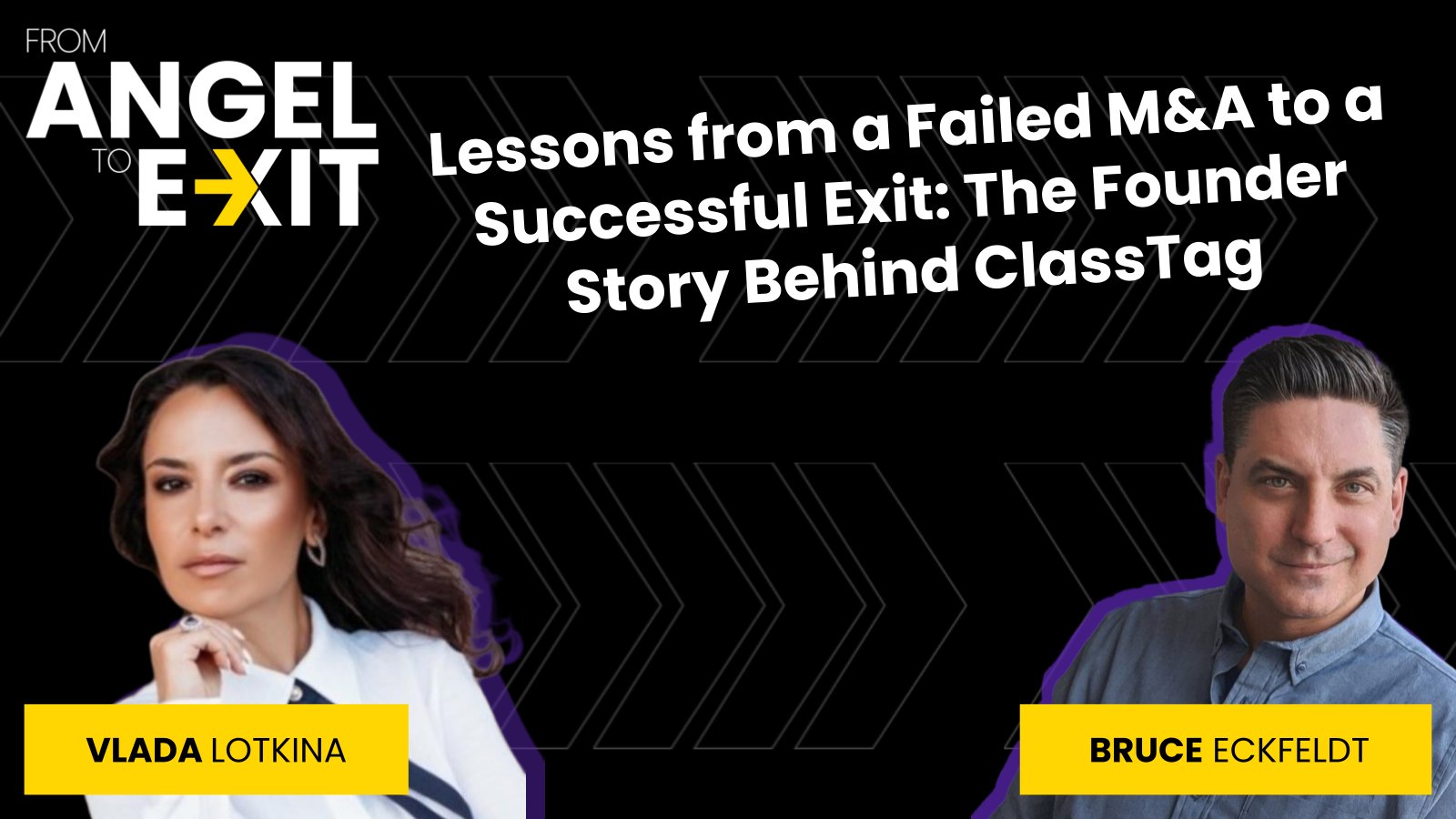
Lessons from a Failed M&A to a Successful Exit: The Founder Story Behind ClassTag
Vlada LotkinaFounder, ClassTag
Listen to the Episode.
Play the full conversation right here, or pick a chapter to jump straight to that moment. Prefer your own app? Every episode is on Spotify, Apple Podcasts, and the rest.
About This Episode.
Start with the key takeaways, the ideas worth bringing back to your leadership team. Then read the full story of the conversation, or use the chapters above to jump straight to the moment that matters most to you.
- Personal conviction helped validate the problem when initial feedback was discouraging.
- Early MVP failures taught resilience and forced creative pivots in product strategy.
- Growth came through teachers marketing to teachers, not parents.
- The business scaled with a unique media model, later bolstered by SaaS.
- A failed M&A taught the importance of running the business regardless of deal progress.
- Private equity deals often depend on external fund dynamics, not founder value.
- Exiting with minimal earn-out allowed smoother transition and founder relief.
- Future ventures are now guided by “following the money” and co-founder alignment.
In this compelling episode of From Angel to Exit, Bruce Eckfeldt interviews Vlada Lotkina, founder of ClassTag, an EdTech platform that transformed parent-teacher communication. From her entrepreneurial upbringing in Ukraine to a successful exit in the U.S., Vlada shares the challenges of monetizing in the K-12 sector, navigating a failed M&A, and rethinking her strategy for venture number two. Founder-CEOs will find inspiration and pragmatic lessons in her candid account of scaling a mission-driven business with resilience and clarity.
Watch the Video.
Prefer to see the conversation? The full episode plays right here on the page, so you can watch while you follow the takeaways or read along with the transcript. Every episode of From Angel to Exit is also on my YouTube channel, along with short clips from each conversation.
About the Guest.
The background behind the conversation, and where to find this guest online.
Vlada Lotkina
Founder, ClassTag
Vlada Lotkina founded ClassTag, an EdTech platform for parent-teacher communication, and took it from a failed M&A process to a successful exit. She is now building her next venture.
- linkedin.com/in/vlada-lotkina
- vlada@elev8orlab.com
Full Transcript.
The complete conversation, lightly edited for readability. Open it to read along, or search the page for a topic or a name.
Read the full transcript
Bruce EckfeldtHi, welcome, everyone. This is From Angel to Exit. I'm Bruce Eckfeldt, I'm your host. I'm excited for this episode. Our guest today is Vlada Lotkina, and we're going to hear about her story. I'm excited for this because it's very similar to my story: coming out of consulting, founding a company, exiting a company, and figuring out what to do next. So I'm really excited for the conversation, and to hear what she's learned, not only about business, but about herself as a leader, and where she's going now that she's gone through this process. So with all that, welcome to the program.
Vlada LotkinaThank you, Bruce. I'm excited to be here. And I think you hit it exactly right about your personal evolution through the journey. I think that's the most interesting part, at least to me, on the other side. The gift that keeps on giving.
Bruce EckfeldtExactly. And we realize that the learning process never stops. Before we hear about the exit and the company, let's get a little background. I'm always curious what led people to become entrepreneurs or get into entrepreneurial situations. Give us a little of your personal and professional background before we dig into the company itself.
Vlada LotkinaSure. I'm originally from Ukraine, and I grew up in an entrepreneurial family. Once the USSR collapsed, my dad became a crazy entrepreneur who started probably 10 companies or so, because you could be first to market in pretty much any category. There was no private property until then. That was a fascinating experience growing up as a kid. I went from helping him sell tickets at a cinema he set up with a DVR brought from the US, to running some real estate development projects and a hodgepodge of other things while I was studying in Ukraine.
So I saw and felt the thrill of it. It was a lot of hard work, but it was so fun. I had this feeling of creating something from nothing, and that planted the bug in me. But I also felt I didn't want to do it in Ukraine. Not only did you have to find, as they say, the problem people really want solved and will pay you for, but there were so many other complexities, regulatory and a variety of other things that I won't go into on this podcast. I wanted to build a world of my own, if you will, with the whole world as my playground. That brought me to applying to business schools in the US, which I thought would be a great transition.
I applied to the top three schools, got into Wharton, and shipped myself to the US. Of course, I didn't have the documents yet to be an entrepreneur right away. And back in the day, it wasn't that sexy to be an entrepreneur. Everyone from Wharton went into banking or consulting or whatnot. And I thought, "Now I'm going to learn the proper way," which to me meant the big company way. So of course I went to Boston Consulting Group, so I could help big companies become bigger.
Soon I realized how much of what's dreamt up never gets implemented, and there are a lot of issues with that. Then I had an opportunity to join the internal strategy team at EMC, which was then bought by Dell, and climb the corporate ladder, actually two levels down from Michael Dell. That was a fantastic, more hands-on experience. It was still strategy work and product growth work, but inside a tech company.
And then finally I had my green card. I had my documents, and I thought, "I'm ready. I'm ready to go back to my roots." I felt it was a now-or-never moment, because I think at a certain point you get comfortable with what they call golden handcuffs. You have this great salary and benefits and all of this. You work, but not with the kind of endless stress you go through as an entrepreneur to meet payroll every month and whatnot. For some reason, I felt that was the moment when I was still crazy enough to just do it, despite having a small daughter at home and living in the middle of Manhattan, which is obviously not the cheapest place to live.
The problem I found as an entrepreneur was related to being a mom. I started receiving communications from her preschool at the time: email, flyers, papers jammed in the backpack, sign-up sheets on the door, the red folders. And I thought, "This is crazy. I'm in the middle of New York, and this is what it looks like. I can only imagine the rest of the country." That's what brought me to starting ClassTag, which was my idea-to-exit journey in edtech.
Bruce EckfeldtThe red folder you have to open up when they get home. I'm curious, when you were in Ukraine, watching your father and parents go through this process as a family, it seems like on one hand it inspired you to become an entrepreneur. Were there any downsides? Were there any reservations about getting into entrepreneurship because of what you saw or experienced early?
Vlada LotkinaThat's a great question. I would say that in Ukraine, generally speaking, back in the day, the only way to make good money was to be an entrepreneur. There was no other option. You couldn't go and become a CEO or an executive and just make a good living. Those opportunities didn't exist. So for a long time, that was the only way I saw, until I got to the US.
What I love about entrepreneurship, and it's perhaps a bit of a masochistic answer, is that I think it's very honest work, if you will. Maybe that's not the right expression, but the reason I say honest is that nobody cares what's on your resume. Wharton, BCG, whatever awards and accolades, doesn't matter. What matters is how good your last month was, how good your last quarter was, how happy your customers are, what your hockey stick is. Can you do it or can you not? You can throw your resume in the garbage can.
There's something thrilling about that. Again, I think it's a very masochistic way to look at the world, but that's what attracted me to it. It was the same pain I saw with my dad, but I guess I saw the joy in that pain, if you will.
Bruce EckfeldtI always say entrepreneurs have to be both delusional and masochistic. If they were rational and really didn't like pain, they would never get into this. I'm curious, because I've had a couple of conversations with folks coming from other countries and cultures into the US and becoming entrepreneurs. Was there a particular draw to the US? That's a strong thread in US culture: everyone has an opportunity, the American dream. Anyone can become an entrepreneur. It doesn't matter what your background is. If you can come up with a good idea and persevere, you'll make a business. How much did that play into coming to the US, being part of that culture, or seeing the culture here as supportive of that?
Vlada LotkinaWell, I think the US is the land of opportunity and the land of dreams, and I'm certainly very grateful to this country for having me and allowing me to learn, and to win sometimes. I didn't come here with a specific long-term plan to become an entrepreneur in the US. It just happened that as I was building a corporate career, I found it unfulfilling, and I wanted to go back to my roots. So it was more of a process of self-discovery.
But every time I talk to my European friends or go back to Europe, it's just not there. First of all, every market is a smaller market. If you talk about Europe in totality, it becomes an interesting market, but that's not the reality. In the US, yes, there are regional differences, but it's one market, and one market that speaks English. And the fascinating thing about the US, obviously, is that however obscure your problem or solution, there are tens of thousands of people who want it. Today you can come up with the wildest idea, go to the App Store, and there are already 10 people doing it. That tells you there's demand, but it also says this is perhaps the most competitive market, so it's harder to stand out. There's more access to capital. So there are obviously pros and cons, but if you have the ambition to really build in one of the biggest and most competitive markets in the world, the US is the place to be.
Bruce EckfeldtI want to hear a little about the moment, or the process, when you decided to really start the company. I'm always curious. Is it that you wake up one morning and say, "That's it, I'm doing this, I'm done with these things"? Or is there a lot of back and forth, testing the waters, figuring out the right time to make the jump? What was that process like for you?
Vlada LotkinaIt's actually really funny, because in a way I'm going through a somewhat similar experience now, but with way more information and less ignorance than I had back then. The process was not that quick, I would say. I started thinking that I wanted to go back to entrepreneurship. Obviously it's a very different world from corporate, and that's why I think hiring corporate people into a startup never works. There are very few people, not to toot my own horn, who can do both, because it's a very different DNA, the early stages of a startup.
So I probably explored four or five different ideas that I dismissed for one reason or another. Some of them were also in education. Others were in what was trendy at the time, which was crowdfunding, equity crowdfunding. I read books on regulation, and then I thought, "Why in the world would I be the person who revolutionizes crowdfunding? I know nothing about it. I read a book." So I went through a lot of discovery about which idea to pursue. Now it all feels funny and different, of course, having gone through the journey. But back then, every time I saw competitors, whatever red flags I saw, I turned away.
The funny thing is that this idea came from my own experience. I experienced it. I didn't think about the business model at all, which is silly for a BCG consultant of many years.
Bruce EckfeldtThrow it out the window.
Vlada LotkinaRight, throw it out the window. Who cares about money? We'll just build a business out of solving problems. I think I got frustrated with myself for finding all the problems, and I said, "I'm not going to look for problems. I'm just going to do it." That was my process. It took me about a year to get there, and I decided I was going to do it because it was something I'd experienced myself, and I couldn't unsee the problem.
Bruce EckfeldtIt's kind of a strategic delusional approach. It doesn't make sense to do it, but you have to suspend disbelief around some of this stuff, go into it, see what happens, and see where you get traction. How much do you feel the personal connection to the problem helped you understand the problem, find a solution, or just stay motivated to solve it? I've seen both cases. I've seen entrepreneurs where it's very personal, sometimes with really intense backstories. Other times it's, "I looked through 100 ideas, and this one seemed to have the best potential, but I don't know anything about it. It's just a problem that I think, if we solve it, we'll make a lot of money." Those are very different approaches to starting companies.
Vlada LotkinaFor me, it certainly gave me conviction that the problem exists. I've told a number of stories about how much it truly mattered. I know the reason I feel I was successful in my career leading up to entrepreneurship is that I had access to a great education back in Ukraine, and I had tremendously supportive and engaged parents. And by the way, there's so much that goes into parent engagement, from showing up at school, because it shows you value education, to setting high expectations. There's a whole science, decades or even hundreds of years old, about what it takes. And yet a lot of these things don't happen for many children, with well-meaning parents, because the parents just don't know better.
Bruce EckfeldtThey don't have the skills and understanding.
Vlada LotkinaRight. So when I thought about what made me me, that was a meaningful part of my story, and I wanted to do the same for my daughter. So I did have my motivation, though perhaps in the moment I exaggerated it a bit to make for good storytelling.
But first and foremost, it gave me conviction. It gave me conviction that this problem exists, because I felt it. With a problem someone else tells me about, it will probably take talking to a thousand people, or a hundred people, before I say, "This is real, because a hundred people told me so." So that conviction part was really key.
And the funny thing is that we started ClassTag to help parents become more involved in their kids' education. In the earliest days, I interviewed hundreds of parents through mommy groups, et cetera. I had a lot of access to different moms, and that was my entry point. But the funny thing was that none of that actually helped our growth. It turned out that parents are absolutely powerless when it comes to schools, or at least they feel powerless, so they would not introduce a tool or an app or a solution to their teachers and schools. That was a fun fact about solving my own problem, and it brings me back to doing discovery properly.
Bruce EckfeldtSo that was the early stage: figuring out the problem, the fit, how you were going to solve it, who the players and stakeholders were. At what point did you feel like, "I've got something I can scale"? Tell us a little about that journey. When did you reach the point of "I'm running with this thing"?
Vlada LotkinaWell, one of my qualities, which is both really great and really bad, is that once I make up my mind about something, you can't stop me. There's no single obstacle. That's a good and a bad thing, like many things in life. But in this case, once I decided I was doing it, there was no stopping me.
Not the fact that 100 parents were absolutely useless at introducing me. Not the fact that for my first MVP, I paid, I think, $20,000 to an agency in New York that outsourced somewhere else and never produced anything, because they went bankrupt before they created my MVP. That was my early experience. Not the fact that I went to some investors I knew through Wharton connections and whatnot, and they all basically told me, "Hey, you have three competitors that have already raised tens of millions of dollars. Why are you doing this? What a silly idea." I had investors in the early days telling me they would fund any other idea, because I looked like a good founder, any idea except this one. All sorts of unhelpful things that I think would probably have stopped many people from moving forward. But I just looked at them as stepping stones on the way.
Bruce Eckfeldt"I'll give you money, just don't do this one." Oh, boy. And in terms of scaling: you got some traction, and you realized, "Okay, I'm in market with this thing." How did you go from local wins, the small wins that validate things, to actually scaling it? I always find that becomes a different set of challenges: how do I grow and scale, whether it's talent or marketing or outreach. What were the things you had to overcome?
Vlada LotkinaAbsolutely. One of the things I see a lot of entrepreneurs get wrong is product-market fit. Everyone says, "People can't get enough of your product. They're just pulling the product from you." They talk about this magical La La Land where all this magic is happening. It sounds fantastic, but I think it does a disservice to entrepreneurs, because yes, that's where you ideally eventually get, but that's not typically where you start.
I really hope those experiences exist, and I'd definitely want to connect with those entrepreneurs and learn more about it. But I've maybe met one, who started and sold four companies, and she said it happened to her in one company. Most experiences are very different. Most of the time, the first 10, 20, 30, or 100 customers, depending on whether you're B2C or B2B and what number you need for your alpha or beta group, you have to get by hand, through brute force.
Whatever that means, whether it's sending thousands of emails, going to a thousand networking events, blowing up LinkedIn, or whatever your approach is, it doesn't matter. It requires a ton of legwork, because your product is shaky. It only does one thing. It's not that pretty or attractive. You have to convince people to take a chance on a startup and be your first customer. There's a lot of convincing that goes into that.
That was my experience: getting the first hundred teachers in New York City by hand. And then I saw these teachers report back to me, saying, "My God, I had 10 times more parents show up to my parent-teacher conference than the teacher next door." And then I saw the teacher next door sign up for our app, because she saw parents voting with their feet. Now you see the impact. You see the engagement. In the earliest stages, especially in a software business, it's all about the value you deliver to your customers. Are the things you promised actually happening? And how do customers get deeper and deeper and form habits with your product?
That's why it's premature scaling until you see those aha moments. It just doesn't make sense, based on resources. And actually, I think one of the biggest mistakes I made in my journey as an entrepreneur was scaling too quickly, as many others have.
Bruce EckfeldtNot the first, maybe not the last.
Vlada LotkinaI think it comes from a lack of clarity about goals. Again, there's this mistake: the whole point of startups is growth, which is correct, but only when you have something worth growing. Not until then.
Bruce EckfeldtI always say you want to scale success, not problems. If you put a whole bunch of money against a solution that has a bunch of problems in it, you're just going to scale the problems as well.
Vlada LotkinaExactly. To answer your question about scaling, that's really where spending time with teachers came in. I got to spend a lot of time with teachers, and I think what actually kept me going in that business was that I fell in love with teachers. Half of the team I hired were teachers. So our whole marketing, sales, and customer success was teachers to teachers. It was all very teacher driven, because I found that teachers trust other teachers.
Bruce EckfeldtIt's the whole influence cycle of your market. That was going to be the way you actually got engagement and support. I'm curious, given your background: I sometimes work with founders who are great at the early stage. They're really good at coming up with an idea, getting scrappy, making things work, and figuring out the early product. Then they get to the scaling stage and they're a fish out of water. It's a whole different set of things. Given your background, with both the early scrappy experience and big corporate experience, how did that serve you as the company grew and the nature of the problems changed: strategy, organizational development, hiring? Did you feel you were pulling on different experiences, or where did you feel challenges?
Vlada LotkinaThat's a great question, Bruce. When I started doing zero to one, I actually had to unlearn a lot of what I'd learned over the previous decade, because there were all these corporate experiences that actually hurt me. But then, once we crossed maybe 15 or 20 people, that's when I got to do the all-hands and the annual planning.
Bruce EckfeldtFlex those muscles.
Vlada LotkinaNow I was feeling confident in what I was doing. All of that stuff came back: OKRs, goal setting, alignment, all of those things. I think it started being helpful to some extent after maybe six people. But around 15 or 20 is when you start actually creating more proper org charts and all those things. It was funny. I definitely remember that moment: "Let me pull that from that book."
Bruce EckfeldtI love it. So you started this company with some investors, and there's obviously a very specific expectation of an exit at some point. Tell me a little about when you felt, "I now need to start thinking about exactly how and when we're going to exit this company." When did that sense of a time frame start coming into play for you?
Vlada LotkinaI think entrepreneurship is very opportunistic. You have your strategy, but then there are opportunities. So you have to be focused, but also open-minded enough to see those opportunities when they present themselves. Pretty much at every point after the seed round, when we were raising, it was always a natural question to ask. Increasingly, there are also some investors who represent corporate VCs, for example, that might have an interest in more strategic alignment, if you will. So it was something we talked about at various junctures.
In the journey, and this is something I share openly, I went through one failed M&A. It was opportunistic. It dropped into my inbox at a time when I was raising. Pretty much a week before the war in Ukraine unfolded, where my entire development team was, the private equity fund pulled out. That was a very devastating experience. From then on, I felt it made sense to sell, because I'd already gone through all the logic of why it made sense. We sold 18 months later to a different company.
Bruce EckfeldtI'm curious about the failed exit. What did you learn from it? What did that process teach you about what you needed to do differently the next time an exit opportunity came up?
Vlada LotkinaIsn't it crazy how much we learn from failures? I think I'm almost at the point in my life where I'm grateful for that one. It was so painful that it took me a really long time to feel gratitude for it, but I think I'm almost there.
What I learned is that you run your business no matter what's going on. Fundraising, M&A, a hurricane, whatever. Your sole purpose is to continue to grow that business and to hit and exceed the milestones you have. You can never take your eyes off that goal. That was one key lesson, because either the M&A breaks, or a renegotiation will happen. And if you're not performing according to whatever you put forth as your projections, there's always going to be a downside for you. So that was one.
Bruce EckfeldtYou're going to get a haircut.
Vlada LotkinaTwo, the private equity world in particular is made up of people who have a particular profile. They do whatever the ROI dictates, and the other considerations have nothing to do with your company. They have to do with the performance of maybe another company they want to roll you up with, or the performance of their fund, or whatever. A hundred things, market dynamics, nothing to do with you. You can't control that, and you should expect it. There are no nice guys in that business. They might be nice guys in their private lives, but they will do what they do.
What happened to us was that I had a purchase agreement I was circulating to investors, because we were literally days from signing, and they just walked away. And I know at least five other founders who had similar experiences with different private equity firms. Just because you're in some process doesn't mean anything. Which goes back to the first point.
And the last bit is not involving your team. In my second process, I said, "You only get me, and maybe my CTO, until I decide, and that's it. No one else is involved. They have a business to run."
Bruce EckfeldtIt's fascinating. You're bringing up a couple of points that are so consistent across the stories I've heard and the companies I've worked with. There's this dichotomy, this dialectical situation: you need to be running the company as if you're going to run it forever, but be prepared to sell at any moment. Keeping those two things true is hard. Being prepared to sell, you want to optimize the company, to hit this peak, but you can't guarantee it. You need to be running it. Whether the deal falls through and you need to keep running, or they come back wanting a haircut and you want to be able to say no. If you've taken your eye off the ball and had a down quarter, now it's, "Do I need to sell?" That's the worst situation.
Vlada LotkinaExactly. And they smell blood. They smell blood right away.
Bruce EckfeldtAnd the other thing about private equity is that it's just hard. For many entrepreneurs, this is a once-in-a-lifetime event, and for private equity, it's Tuesday. The differences in mindset and situation can lead to a lot of pain and frustration. The more entrepreneurs can realize that's the case, the less personally they take it. They have to be aware of it and deal with it, but it's less personal, and it's so easy to make these things personal.
Vlada LotkinaAbsolutely. I'm thinking about other big lessons, and there are certainly many. But I think once you persevere through one of those, you're good. You can do it.
Bruce EckfeldtGive us a few details on the exit in terms of the structure. Did you stay on? Were there earnouts? Give me a sense of the nature of the deal and why it landed that way. Was there anything you were trying to get that you didn't get? I'm curious how they actually set things up for you.
Vlada LotkinaIt was actually a great process. I'd known the CEO and the private equity firm for a while, because we were operating in the same market, and it made sense strategically. They had a broader ambition to focus on student success, and they were putting together a number of assets to achieve that. They were lacking the consumer, family-facing front end to those assets, and ClassTag was really great for that. They'd approached us a number of times before. So that was when we did run the process, and I had a banker involved as well.
Strategically it made sense, and financially it made sense. And they didn't insist on a long earnout, which was good. Frankly, by then I was tired. It had been eight years of solving parent engagement, and I was ready to solve something else. But my co-founder and CTO was really excited to stay, and I think they needed him way more than me. I was honestly happy to help the team transition. I was in a dual role, ensuring nothing dropped and that the transition was smooth. And probably nine months or so after that, it was time to go.
Bruce EckfeldtYou were ready to move on.
Vlada LotkinaReady to move on. It was a great experience for me.
Bruce EckfeldtThat's good, because they're not always great.
Vlada LotkinaIt was basically an upfront purchase. There wasn't a big contingency.
Bruce EckfeldtSo it was a pretty clean transaction. You weren't tied up for a long time on earnouts or equity. I'm curious, reflecting on that process, is there anything you'd go back and tell your earlier self, eight years prior, to do or not do, that you realize would have made it easier?
Vlada LotkinaYou mean the whole idea-to-exit process?
Bruce EckfeldtYes. Early decisions you made in the company, or ways you approached things, that you wish you had done differently.
Vlada LotkinaI think the one fundamental thing, and we'll see how it works out, as I'm starting to think about my next venture, is the idea of following the money. It sounds so basic and fundamental to building a business, but it's a different starting point from "I've experienced this problem, let me go solve it," without thinking about monetization. So now I'm starting from that. I'm looking at the big pockets of money: who can pay? That helps me figure out the "who." Then I ask, "Do I like that who? How do I feel about them?" Because I have to spend a lot of time with those people, like I did with teachers. So I need to genuinely like them at some level. From there, I spend my time doing discovery, but I start from where the money is. I built a business in K-12 education, which is one of the toughest places to build a business. So clearly that's one thing I didn't do. I didn't follow the money.
Bruce EckfeldtAnd when we say follow the money, we mean finding people who have problems I can impact, and who are willing and able to compensate me for solving them. There are lots of problems in the world, and a lot of need to solve them, but not all those problems can compensate you for the cost of solving them.
Vlada LotkinaExactly. In my experience in education, I saw this problem in parent-teacher communication and collaboration. Well, teachers don't have any money. Not in terms of their budgets, and not in terms of their personal wealth. They don't go into the profession for fame and wealth. There are other things that drive them to it, which is another story. So for us, the path to monetization was very long.
We were creative, and we figured it out. We actually built the first media business in education, which allowed brand sponsors to sponsor these communities of parents and teachers on ClassTag. That was absolutely unique. The only company that does something like it is Scholastic, and they do it for themselves, with their book fairs and all their competitions and whatnot. Or maybe Box Tops, which is like a nonprofit. Anyway, it was a unique model, but it meant we had about two years from the beginning until the first monetization, because you can't do sponsorship with a hundred people. You need tens of thousands, or hundreds of thousands, or later millions. When we scaled ClassTag to five million parents and teachers, that was another story, but it took a minute to get there. And then we turned on SaaS as well.
Bruce EckfeldtGot it. As you're working on your next company, what lessons are you applying, either strategically, in how you're approaching things, or more personally, in how you're deciding to show up as a leader? What shifts are you making, either to be more effective or to make it more personally satisfying? I find that the second time around, it's a little less "I'm hungry and I need to win." You can choose to do it a little differently. You've got some resources and some experience, and it can be a little more nuanced in terms of what you're going after and why.
Vlada LotkinaAbsolutely. One thing I'd say is that over the last nine months or so, I've been working with a lot of entrepreneurs at the zero-to-one stage. I'm offering a program that goes through the very steps I'm going through now with my second venture, which I've found, ironically, so helpful. Not only did I go back and reflect on my own experience, I also got a lot of perspective, because it forced me to do the proper theory work and package those best practices. As a kind of transition business, I think I'll keep mentoring startup founders for a while. It's so rewarding for me, and very therapeutic as well.
Beyond that, one thing I realized is that the most important thing for me was that I had an amazing co-founder. I really loved working with him, because he was an amazing person and an amazing professional. So as I started thinking about the ventures I want to do, and doing a bit of digging on my own, I said, "The right person is going to come into my life."
Bruce EckfeldtYou'll manifest it.
Vlada LotkinaYes, the magic. I trust that the person will show up, and I'll meet someone who has complementary skills and maybe expertise in a particular area I don't have, which has the money potential, and other things. It's very early days, but I realize how important that co-founder is. I wouldn't want to do a business alone, because it's a very lonely journey, and I certainly benefited from having that incredible partner in crime. So that's one realization.
The second realization is that, knowing that once I decide I can't be stopped, I'd better spend a bit more time actually doing the research. Not just jump in, but actually do it. But also be realistic that every business has some wrinkles. There may be a bit more competition than you'd like, or a little less of this or that. I know a lot of people doing their second or third company who have problems because they want things to be bigger and perfect, and that level of perfection doesn't really exist.
Bruce EckfeldtThere's hair on everything.
Vlada LotkinaAnd I think it still requires the same amount of work, or more. It would be very naive to think that just because I know more, the work is somehow going to get done by itself. You still have to jump through the hoops, walk through walls, and do all the good stuff.
Bruce EckfeldtI think sometimes it's even harder, because now you know what it really takes. The first time around, you're naive and ignorant, so you just do it anyway. Now it's, "God, I know what this is. I've climbed this mountain. I don't know if I want to climb another one." You can't delude yourself.
Vlada LotkinaI know. That's why the burden of proof is higher, because it has to be worthwhile to go do that. But I realized I just don't see myself being an employee. I can't do it anymore.
Bruce EckfeldtI think most exited founders are unemployable. You just can't go back to that. This has been a pleasure. We've covered a lot, with some great insights. Thank you so much for taking the time to share your stories. If people want to find out more about you and the work you're doing, what's the best way to get that information?
Vlada LotkinaThank you, Bruce. It was super fun. The best way to reach me is on LinkedIn. I'm fairly active there. You can find Vlada Lotkina. It's a rare combination of first and last name. I'm the only one, I think. Or you can also email me at vlada@elevatrolab.com.
Bruce EckfeldtI'll get your LinkedIn profile in the show notes so people can find it. Thank you so much for taking the time today. It's been an absolute pleasure.
Vlada LotkinaThank you, Bruce.
Never Miss an Episode.
Know the moment a new episode goes live. Subscribers also get a say in future guests and the topics we cover.
Other Related Episodes.
More conversations that connect to this one. Or browse the full archive by topic or by guest.
Bill Snow
Blunt truths about middle market M&A from nearly two decades on the inside.
Listen and Read
Eddie Geller
The road from early web services to a high-stakes M&A exit.
Listen and Read
Ross Shanken
The frameworks and hard moments behind building Jornaya and guiding it to a nine-figure exit.
Listen and Read