From Angel to Exit Episode 6
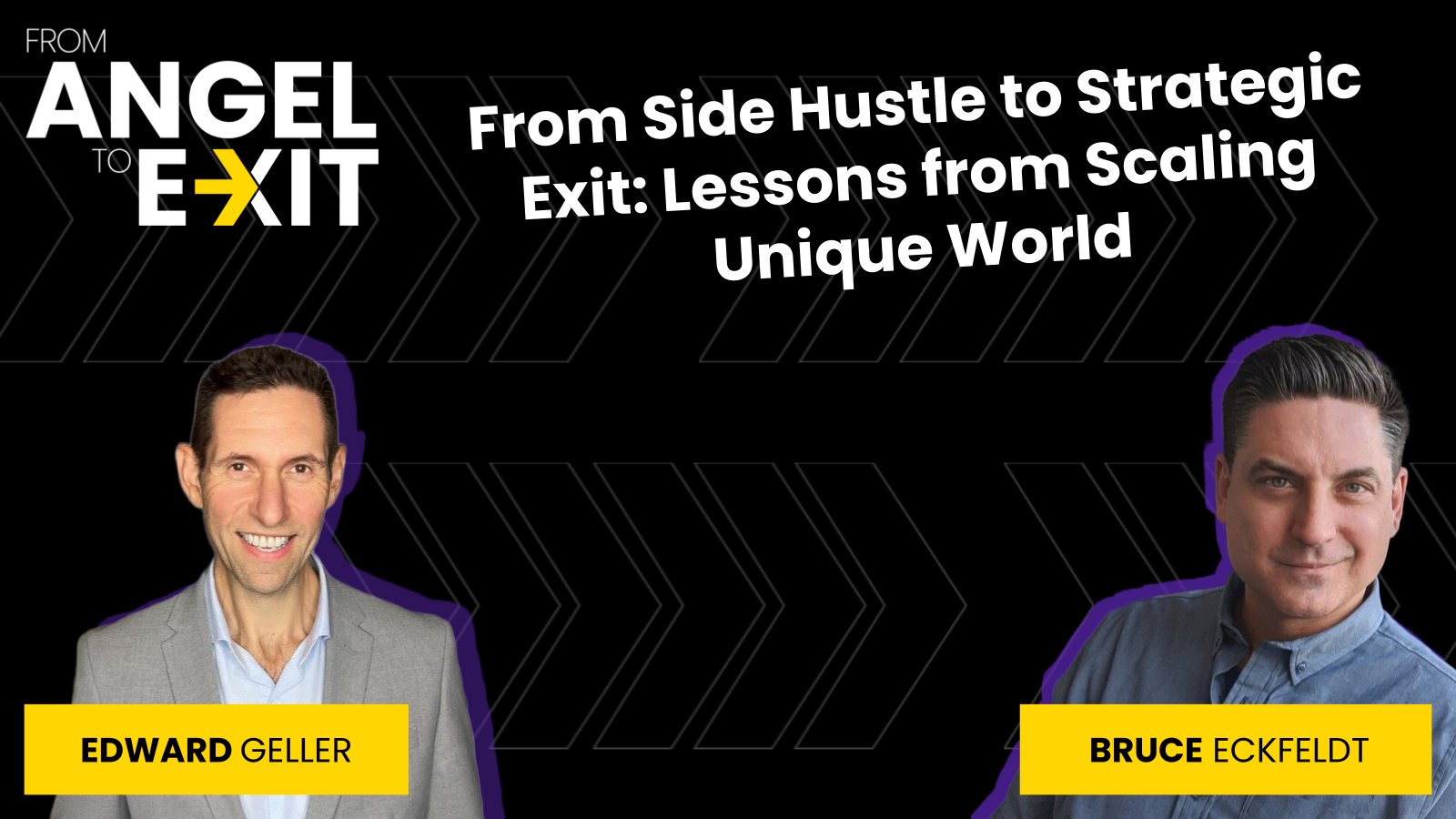
From Side Hustle to Strategic Exit: Lessons from Scaling Unique World
Eddie GellerFounder, Unique World
Listen to the Episode.
Play the full conversation right here, or pick a chapter to jump straight to that moment. Prefer your own app? Every episode is on Spotify, Apple Podcasts, and the rest.
About This Episode.
Start with the key takeaways, the ideas worth bringing back to your leadership team. Then read the full story of the conversation, or use the chapters above to jump straight to the moment that matters most to you.
- Declining a $30M offer taught the importance of realistic valuations and market timing.
- Relying on a single client base can cripple a business, diversification is key.
- Open-book management rebuilt trust and performance post-2008 crash.
- A company must be operationally independent from its founder to be sellable.
- Hiring based on assumed influence, not proven impact, can backfire.
- All-cash deals require clean operations and attractive growth metrics.
- Cultural mismatch post-acquisition can derail team retention and value.
- Measuring culture (via SKOR) can be a driver of business performance.
In this episode of From Angel to Exit, host Bruce Eckfeldt sits down with Eddie Geller, serial entrepreneur and founder of Unique World, to unpack the gritty, insightful journey from launching early web services to a high-stakes M&A exit. Geller candidly shares the highs and lows of scaling a business, from client concentration pitfalls to post-acquisition culture clashes. This episode is rich with takeaways for founder-CEOs aiming to build, scale, and eventually exit their businesses strategically and successfully.
Watch the Video.
Prefer to see the conversation? The full episode plays right here on the page, so you can watch while you follow the takeaways or read along with the transcript. Every episode of From Angel to Exit is also on my YouTube channel, along with short clips from each conversation.
About the Guest.
The background behind the conversation, and where to find this guest online.
Eddie Geller
Founder, Unique World
Eddie Geller is a serial entrepreneur and the founder of Unique World. He built the business from early web services through to an M&A exit.
- Website
- cultureskor.com
- linkedin.com/in/eddiegeller
Full Transcript.
The complete conversation, lightly edited for readability. Open it to read along, or search the page for a topic or a name.
Read the full transcript
Bruce EckfeldtHey, welcome, everyone. This is From Angel to Exit. I'm Bruce Eckfeldt, I'm your host. We're here to talk with Eddie Geller. Eddie has a long history of entrepreneurial experiences. We've been prepping for this and chatting a little, and there are some funny ones we're going to start with. Eddie has been in a couple of different roles at a couple of different companies, and he's doing some really interesting work now based on what he's learned and the experiences he's had. So I'm excited to talk about that and hear how this journey has been unfolding. There are lots of good takeaways, I think, for people who are earlier in this process. With all that, Eddie, welcome to the program.
Eddie GellerBruce, thanks so much for having me. Really excited to be here.
Bruce EckfeldtIt's a pleasure. I always like to start at the beginning, where it all started. In our prep, you mentioned an early business you had, so I certainly want to cover that. When you were young, did you always want to be an entrepreneur? Was this something you were destined to do early? I think how people got into this is always an interesting part of it. So give us a little of that background, then tell us the story of your first entrepreneurial experience, and we can go from there.
Eddie GellerGrowing up, Bruce, I wasn't going through high school thinking, "I'm going to be an entrepreneur. I want to start my own business." Interestingly enough, my mum was a successful entrepreneur. She had a deli, a delicatessen, with her sister. They built it from nothing and then sold it nicely. Clearly a deli isn't a big exit, but it sold nicely.
My father, who was really good with tools, was a carpenter and could build anything. In about 1986, he went into his own joinery business, building kitchens, wardrobes, everything. Sadly, his entrepreneurial journey wasn't as successful. He ended up losing his business in 1991, and my parents lost the house, frankly. So it was a really tough time. But it's interesting to see what my mum went through and what she did, and what my dad went through. As I'm sure you've seen many times, you learn far more from the failures. I think I learned far more from seeing my dad sadly fail than from my mum.
But I wasn't a very good student, Bruce, I have to say. I was one of those kids for whom school was much more a means to an end. My parents came from Ukraine, so it was, "We didn't come to this country for you to not go to university." So I ended up going to university, and I hated it. University was not for me. I didn't understand it.
Bruce EckfeldtInteresting. Did you hate the structure, or the education process? What didn't you like about university?
Eddie GellerGood question. Upon reflection, I've learned that I learn through doing, not just by listening. When things are taught to me from a textbook, I'm not digesting them. I'm not understanding them. And when I've tried to apply them, I struggle.
Actually, that was the catalyst for me getting into the internet in 1994 or '95. I remember buying a book called HTML Programming in 24 Hours and thinking, "Well, maybe I can learn this." My first website was called the Hypercool Funk Cafe, because I was into music. I was a musician. We had a bunch of friends who would get together on the weekend and write our own stuff, and I was in a bar mitzvah band, all those things. So I thought, "How do I get into building websites?" In 1994 and '95, when HTML had just come out, it was, "What the hell is this?" So I did this site, the Hypercool Funk Cafe, learning how to create a website, and that's when I really fell in love with the internet. I learned through reading and doing, reading and doing, as opposed to just reading. That was my learning about how I learn in general.
Bruce EckfeldtWhat was the first moment when you thought, "Hey, I want to start a business," or, "Hey, I just started a business"? What was the first moment for you when you got into the business world?
Eddie GellerAbsolutely. I think it was a collection of different interactions with my parents. I'd want money for different things, and they'd give me a little bit, and after a while my dad said, "That's all I've got. If you need more money for whatever, you need to go and get a job." That's when I first got a job, at 14 or 15. I liked spending. I liked buying stuff. So of course, if I wanted to do that and control my destiny, I had to get a job. So I was always working. I always had two or three jobs at any one time, even while I was at university.
When the internet was first coming out, I got into the web pretty easily. I found it easy to get into computers and websites and Gopher and FTP and all those other wonderful things of those days. My friends were like, "What's the internet? Can you help me get set up?" So I started setting up the internet for my friends. That was the catalyst for starting a business, if I can call it a business. It was called Eddie's Internet Solutions, Bruce.
Clearly I sucked at marketing. But the product was the internet, and the product was me. I was selling me and the internet. So I guess I nailed Marketing 101. I remember creating these leaflets that said at the top, "Get on the information superhighway in less than 60 minutes," I think it was. I was handing out leaflets at train stations and putting them under windscreen wipers, getting people set up with the internet and selling computers.
I don't know if I actively said, "This is my first business. I'm an entrepreneur." I was doing it while I was working elsewhere as well. It was more of a side hustle. And I became an internet programmer very early on, in '96, '97, '98, building websites for people. Back-end development was pretty tough for a lot of website developers back then. Building websites was all about static images, and I did a lot more programming and back-end stuff and built a lot of capability around that. Before I knew it, I had all this work and contracting, and I thought, "Let's start a business properly."
One interesting lesson I think is worth sharing: I worked for a few other companies. For one, I ended up deferring my university degree, which I've still deferred. I still tell my parents it's deferred. That was in 1996, and I've not gone back. Although, as you know, it's not really deferred, but I told my parents it was.
I joined this company as a web developer, a web engineer, and three months in, Bruce, they went out of business. The company closed, purely because they relied on one client. That was my first lesson that you can't rely on one client. Then I joined another company, and they did the same thing three months later. I thought, "This is crazy." That's when I started doing more contracting on my own. But I learned lessons at every interaction point, that's for sure.
Bruce EckfeldtI laugh about the Gopher space. My father was a doctor at the University of Minnesota, so he had a U of M account, and I could get into the Gopher space through his account. I'm sure someone in IT was flagging his account: "What is this guy doing, dialing in on the modem at home?" So I chuckle at that.
So how did that set you up for becoming an entrepreneur? Obviously you learned a couple of things, like client concentration, and obviously branding and marketing. When did you start to feel like, "Ooh, I'm learning some things that I can actually build a business around"?
Eddie GellerAbsolutely. Through '97 and '98, I was contracting for a bunch of companies, building sites for them and building their back end, and I just had too much demand. I had a few contractors helping me, but the internet was obviously accelerating. Tom, Dick, and Harry wanted a website. I thought, "Now's the time." So at the start of 1999, January 25th, I opened the doors of a web development company. At the time it was called Unique Web Developments. That was the name. Better marketing. I'd learned a few things.
Bruce EckfeldtAnother marketing powerhouse name here.
Eddie GellerClearly. And I thought, "Well, what's unique about us?" It was that we did the back end. That was pretty unique at the time, because everyone was focused on design and front end. Hence Web Developments. That was the original name. I remember interviewing people in my home, telling them the office was being set up, and I didn't even have an office. The whole "fake it till you make it" thing.
I opened the doors in January of '99, and we grew to 25 people that year. We just boomed, because everyone was asking, "Where's our website?" It was all customer funded. I had no idea about investors. It was all good old-fashioned project work. That was my first real experience. In 1999 I was 24. That was the next venture, building websites and all the rest of it. That's when I realized, "Let's build a company here, and it's going to be worth a billion dollars," like every other dot-com story at the time. And I've got lots of horror stories throughout, trust me, if we get to that part of the interview.
But that was definitely my first foray into "I now have a real income. I'm sustaining a business. I'm employing people. We have great clients." We won great brands early on, Kraft and Catalog, really great brands, and it was something real. So 1999 was when it all started to happen.
Bruce EckfeldtYou mentioned "We're going to be a billion dollars," like all these startups. When did you first start thinking, "Okay, what do I do with this? What's the future? Do I exit?" Were there visions of sugarplum fairies dancing in your head about all the money you were going to have? How did that happen for you?
Eddie GellerWell, I've got another war story to share, sadly. In the middle of 2000, so 18 months into our journey, investors approached us, because we had a good brand fairly early on and we'd built some great sites and great platforms. They offered, on paper, $30 million for the business, 18 months in. And I was 25. So what did I say? I've got lots of words to describe what I did at the time. I said, "That's not enough. We're worth way more than 30." And of course, as the story goes, the dot-com crash happened the year after, and 60% of our clients didn't exist anymore. And we were worth zero.
We were never worth 30. The whole thing was BS. Obviously you look at it and think, "Imagine if we'd taken the money, where we'd be today." But I don't really think about it like that. It was a moment in time, and it wasn't exactly "Here's a check." It was, "Okay, this is what you're worth, and let's make it happen." And I pushed them away. So it's not as if it definitely could have happened. But what a stupid idiot. You're an absolute idiot. But you go through lots of ups and downs.
Bruce EckfeldtBut why? Because you had a different sense of valuation? Or no understanding of the future? It's easy in retrospect to say, "I should have taken the money and run." But what was really the error in your thinking at that point?
Eddie GellerTotally. Well, at the time, first of all, there were internet websites, and everyone wanted a website. We had such high demand we couldn't keep up with it. We won really exciting brands, we had great references, we had a mentor at Microsoft. We had tailwinds in a market that, frankly, at the time we thought was never going to end. And clearly it did, as we all know.
I think I was naive. It was my first experience on this bandwagon of hype, and I think all of that galvanized into what clearly wasn't the right outcome at the time. And I can't imagine what would have happened to me at 25 if that had happened. It's all part of the journey: getting on a wave, riding it, and being a beneficiary of that wave, but not really doing anything special to earn it.
Bruce EckfeldtSo 18 months later, 60% of your clients don't exist anymore. How did you work through that? How did that lead to the next venture?
Eddie GellerIt was tough. We had some tough times. I remember having to let go of the first employees I had hired and cut staff. That's the rawness of leadership I really had to learn. My first employee was in Sydney, and I moved him to Melbourne to set up the Melbourne office. That was in the first year. Two years later, because we had to cut costs, one of the cuts was the Melbourne office. I remember flying down and having to let him and a few other people go. He understood, but that was a really tough personal challenge. It was a coming-of-age period for me in the journey of a leader.
Then you rebuild. You focus, you get a smaller team, you focus on the core value prop, and we started to rebuild through 2003. Then we had another challenging phase, and this is a lesson I'm going to share, because it was my mistake. We were doing a lot of things with Microsoft, so I hired a guy who had been at Microsoft for 15 years and knew anyone and everyone in enterprise, government, et cetera. I thought, "He's going to bring us these incredible deals, because he knows all these people." He was very expensive, and I brought him on board because I thought he was going to make it happen.
You probably know how this story goes, but sadly, most entrepreneurs don't. When he was with me, he wasn't walking around with a Microsoft business card anymore. He was walking around with a Unique World card. We'd changed the name from Unique Web Developments to Unique World. And guess what? People said, "This is great, but I want you at Microsoft." Sadly, that did not play out well.
After six months, things went south, and we went through a very tough time rebuilding. Again, it was a key lesson in trying to figure out how we could grow. I thought external credibility and brand could help us, but that failed. It failed for me. I remember having to put the house on the line to get a line of credit, Bruce, to pay salaries to get through that 2003 challenge. That's another coming-of-age moment in the entrepreneur's journey, where you have to put your personal money and security on the line to pay salaries. That was pretty tough, but it's all part of the journey of being an entrepreneur.
Bruce EckfeldtI did a similar thing: hiring what I thought were these amazing rainmaker salespeople and paying them a lot of money. Six months later, nothing. Then you question your own judgment: "How did I get this wrong? Why did this not work out?" Then you're gun-shy, and you're not taking advantage of opportunities when they come up. It can become a vicious cycle.
Eddie GellerTotally.
Bruce EckfeldtSo when did you feel like you started to get things right? When did you move from that earlier stage, still figuring things out, into the mode of a leader who's actually figured some things out? "I know what works. I understand what doesn't. I've got some real ability to strategize and execute on the business."
Eddie GellerAbsolutely. Through 2005 to 2007, we rebuilt again and grew the business from probably 25 people back up to 85. We were billable consultants doing high-end work. We'd evolved the value prop from being software developers to being business consultants. And we thought we were on fire. We thought the culture was awesome. We thought things were good.
Then, I don't know if you remember what happened on September 29th, 2008. As we all know, the financial crisis. Well, guess what? We weren't too crash hot. Four of our biggest clients terminated their contracts, and we halved the business within a week. So we went through another tough time, figuring out what was next while bleeding cash.
That's when someone shared with me the book The Great Game of Business, by Jack Stack. I read the book, and I fell in love with the philosophy of open-book management, transparency, and engaging the people. If you ask me what my biggest evolution as a leader was, it was the years 2008 to 2011: rebuilding from nothing, but rebuilding with this culture of transparency and servant leadership, engaging all the people. I flipped the switch from being a boss to being a servant. The people aren't there for me. I'm there to serve them, rather than the other way around.
We went through incredible years of growth, and we ended up being so successful that in 2011 we exited the business. I sold the company. That 2008 to 2011 period was my biggest learning. But frankly, the prior eight years were small, incremental nuggets of life experience that helped me get there. Those last three years probably taught me the most. Maybe it took enough mistakes for me to be ready to listen. That was probably the key bit, Bruce.
Bruce EckfeldtI was just going to ask how much you feel you needed to go through those other experiences to actually take the lessons and make the changes you needed.
Eddie GellerYou're totally right. I'm one to admit that I'm really bad at taking advice. I'm really bad at hearing advice. I'm really good at learning the hard way. That's definitely a superpower, learning the hard way. I suck at someone telling me, "You should do it this way," and me going, "No, no, I disagree," when they're clearly right. I've gotten better as I've gotten older, I have to say, but I'm still not great at it. It's a muscle you consciously develop. But to your point, I really needed those other hurdles to overcome and challenges to deal with to get to that point and then be able to exit. Clearly I've still made lots of mistakes since, so this is not a silver bullet solution, as you know.
Bruce EckfeldtLet's talk a little about the exit. When was the first time you thought this company could be something you could exit? When did it enter your mind that "Maybe I'll sell this someday"?
Eddie GellerGreat question. I think it was this learning that I'd missed out before. I felt like I'd missed out in the dot-com times through my own stupidity. In 2007 and 2008, prior to the financial crisis, I missed out because I don't think the business was ready. I wasn't ready. I had grander ambitions for it. So I thought, "I'm not going to miss out a third time." When the business was going so well in 2010 and 2011, I thought, "Now's the time," because you've got to sell on the way up, not on the way down.
So in January of 2011, we started a process. We engaged a banker to go through the process of finding someone to acquire the company. We knew 2011 was going to be a fantastic year. We had locked-in contracts, we had great growth, we had headwinds in our space. So we kicked off a process to sell the company, and although it took a lot longer than we thought, as it always does, we sold in December of that year, thankfully. It was "Now or never, because I missed out before." That was my approach to how I thought about it.
Bruce EckfeldtDid you have a sense of how you were going to sell and who you were going to sell to? How much of this was "Okay, I'm ready to sell," and how much was "I've got some players lined up, and we've really tuned the business to get ready for this"? Give us a sense of how you saw the challenge and the opportunity and how you approached it.
Eddie GellerThat's a great question. Leading up to 2009 and 2010, I was getting the business ready to sell. We were having board meetings. I had external board members. We had independent accounts. I grew up on open-book management, so we had lots of transparency with the financials. It wasn't just me. Lots of people were losing sleep over the numbers.
I was really intentional about setting up the company so that when it was acquired, you wouldn't be acquiring Eddie. You'd be acquiring the company, and Eddie would actually be unrelated to the company moving forward. We positioned it to sell a services business, which is actually quite difficult, all cash up front with no earnout. I really wanted to tell the story that you're buying a company with contracts and wonderful relationships, and a system by which we run the business, not something where you need Eddie to be the conductor and orchestrate it all. That was the whole intention. When we started the process, we had many companies looking to acquire us, and of course, by the end, thankfully we had one, and we only needed one.
Bruce EckfeldtYou only need one left.
Eddie GellerWe started with a much bigger list, but we ended up with one, thank God. They were buying a business with a system to scale, not Eddie with a dependent leadership team. So that was great. There's another part of the story, post-acquisition. But that's what we did in the lead-up to the acquisition to prepare for the sale process. If someone wanted to buy us, it was a very clean picture. There wasn't any of the noise: loans, unclear salaries, a messy shareholder structure. It was very clean.
Bruce EckfeldtWhat inspired you and guided you to do that work? Thinking about a company as an asset you're going to sell can be quite different from thinking about a company you're operating, figuring out how to maximize revenue and profits. What was the source of the insight that helped you actually do that work?
Eddie GellerAbsolutely. Through the journey, I had different advisors and board members come in at different points to share perspectives and lessons learned through their journeys of building companies. In the dot-com times, to resuscitate the business, we ended up merging with another company that was a dot-com bomb, frankly. But it brought on board some investors and directors who helped with the evolution and maturity of the business.
So there was a sense of advice-giving, and when we were setting up the process to sell, the substance behind the narrative had been put in place for years, given that we had to have this independence about us. That helped us tell the story and convey the value prop externally, successfully. But really it was the internal advice from directors and investors who had played this game before. That's really what I put it down to.
Bruce EckfeldtYou mentioned finding a banker to help facilitate, guide, and drive the process. Tell me a little about how you selected that banker. And then we'd love to hear some details on starting with a pretty broad field and getting down to one remaining player. Give us a little insight into the actual process of working with an investment banker and creating a set of potential buyers.
Eddie GellerSure. We had a bit of a dog and pony show from January through March of that year, with three bankers pitching us. The one we engaged was the one we liked best and who had the most experience in our space of technology services. And I liked that it was just a team of three, so you knew you were going to get lots of loving, as opposed to being part of a 500-person company, where yes, you get a lot of dedicated people, but you're really not that important to them. We were important to this small group, and they seemed to really get the business and the dynamics of what we'd tried to create.
They did a global search for companies that might be interested in buying us. Interestingly enough, the company that ended up buying us was not on the original list. Another company we'd invited introduced us to the company that bought us. The company that bought us was Jacobs Engineering, a publicly traded company in the US. They'd acquired another company, and then they ended up acquiring us. They got involved during the process, not late, but during. We had three or four in the last mile, and in the last half mile, two. We tried to get them all to the finish line, and it took lots of hard work to get there. It took much longer than expected. We expected it to close July 1st. It closed December 1st. No surprise, of course. It always takes longer.
But the business did really well, and I think that also helped us, because, as you know, Bruce, time kills all deals, and the longer it takes on both ends, the harder it is to get a deal done. Even weeks before the deal closed, there was still a risk, but it obviously ended up closing.
The company I thought was going to buy us did not buy us, and the company I thought was not going to buy us ended up buying us. You never know. I think that's probably the biggest learning: you never know, and don't assume anything. Don't think, "Why bother with this pitch, because they won't buy us anyway." Ironically, they could be the one that ends up buying you, and that's what happened to me. I'd thought, "These guys won't go anywhere. They won't go far." They ended up going far, and we were bought by them. I'm sure these are well-worn lessons for people, but it was really felt in that final stage.
Bruce EckfeldtYou mentioned you had an all-cash deal, and that was a requirement on your side. Why? Especially for a services company, there are big trade-offs there. Most deals for services companies have some kind of performance component or earnout, and all cash usually means you're just not getting a great valuation. How did you navigate that? What was the decision there?
Eddie GellerAbsolutely. 50% of the shareholding was owned by external investors, and 50% was owned by operators. The external investors were not interested in a structured buyout, and among the operators, me, I was not interested in getting nothing for a while. So we aligned on needing someone to pay us all up front. It was a multiple of EBITDA, and it was great. It was market, probably a bit of a premium to the market.
And I loved the philosophy of the company when they bought us. Most acquirers provide a structure with disincentives to leave, whereas this company's approach was incentives to stay. It was, "We're going to buy the business, but we want to put out some carrots, because we want to build a really big business together," rather than sticks. And sticks aren't really a motivator, frankly, a lot of the time, because most entrepreneurs can't wait to leave. So for us, it worked out really nicely on the deal. If you want to know more about the post-deal, I can talk about that, but in terms of the deal itself, that was it.
Bruce EckfeldtWhy don't we talk about that? There's always post-deal drama. I had my post-deal drama. Everyone's had it. I'd be curious to hear about it. But going into post-deal, signing the deal, what was your mindset? Were you thinking, "I can't wait to stay with this company for another five years and build it"? Or was it, "I'm here as long as it makes sense, I've already got my other thing going, and I'm going to switch over as quickly as possible"?
Eddie GellerGreat question. I'd never worked for a large company before, and Jacobs Engineering was a global company. I thought, "Maybe this is an opportunity to learn." The Australian CEO of Jacobs at the time ran a business similar to ours in Australia, but mostly in government, not commercial. And he was kind of retiring. He said, "Eddie, I want to buy your business, and in six months' time I'm going to retire, and you'll take it over." I thought, "That's pretty cool. I've never run an Australian business that's part of a global business. That would be pretty awesome." That was the intent.
For the first six months, or maybe five months actually, they largely left us alone. Then he woke up one day in the middle of May and said, "Okay, things have changed." "What do you mean?" "Well, all the things you do, this open-book management, this weekly blog, this empowerment stuff, we don't need that anymore. We don't do that here. And I don't think you're ready to run a bigger business. I'm going to stay on for longer." So everything he had promised me was meant to happen, he reneged on 100%.
Then, after a few months, the business wasn't going particularly well, and they needed to cut costs, so I put myself up as a key cost to cut, because I was expensive. Sorry, I'm not sure if you can hear a very annoying dog in the background. She's yapping at people in the backyard. Hopefully she'll be quiet shortly.
Bruce EckfeldtIt's not the first dog we've had on the show.
Eddie GellerIn a nutshell, we were about 100 people when we sold, and after the first 12 months, I think half the people had left. Two years later, maybe 10 people were left. The last thing I want to say on this is that, to his credit, there was a lot of intention to integrate very well. We had an offsite. We had an external facilitator. It was all about how we integrate the cultures. But we were an open-book, transparent culture and they were not, and I learned that one has to colonize the other, and I was on the receiving end of that. Our people had choice, they could go anywhere, and they did. Sadly, I don't think it worked out well for them, but I think we all had the right intentions at the start.
Bruce EckfeldtThese things play out in all sorts of different ways, and it's tough to guarantee any particular outcome. I think it's about getting clear with yourself: what do you want, and what is going to make you thrive? And ultimately making the decision: is this the best place for me or not? The other thing is that having an all-cash deal makes it really simple. I've seen too many situations where people still have half the value or more in the company, and culturally they don't want to be there. It's not the place where they're going to thrive, but they have to stay because they've got these handcuffs. One of my principles is that you want to be able to walk away with the cash you have on hand at signing and be happy. If you choose to stay, great, but you should be able to walk away any morning and have it be okay.
Eddie GellerI agree. And look, it's super tough with a services business, to your point. Obviously a software product business is far easier to some degree. But I certainly think we stitched it up nicely. I'd really hoped to work for a big company, but sadly it wasn't to be. And I had no idea what I was going to do next, Bruce, that's for sure, except take some time off.
Bruce EckfeldtTell me more about that, because I think it's always fascinating going into these deals. What was the future for you professionally? You weren't retiring. You weren't going to go sit on a beach and drink piña coladas. How did you envision your future, and how did you envision this transaction feeding into it in some positive, springboard way? What was your thinking at that point?
Eddie GellerAbsolutely. I definitely needed the time off, because we'd been through some pretty hard years. We'd also started a family through that. By the time I exited in 2011, my wife and I had four kids together. We have four boys. I think our youngest was one when we sold, and our eldest was nine. The family journey of entrepreneurship is one thing, and the business, as you know, is something else. So I needed the time off.
Through that lens, in that last year after we'd sold, I started getting involved with some startups, doing some advisory work with incubators, getting involved with pitch nights, just getting connected into the ecosystem behind the scenes. I thought that would be useful to understand the new products out there and the new problems people were solving, because I wasn't in that game at all.
Then I took time off. I remember vividly, Bruce, the family went to Thailand for two weeks over December. This was about four months after I'd exited operationally. And in the second week of the holiday, instead of sitting by the pool, I went into the room and opened up my laptop. I thought, "That's it. That's the sign. Four months is enough. I now need to figure out what's next."
So I didn't intentionally decide to take a year off or six months off and then find something. I almost let nature take its course, until my mind was bored enough, and rejuvenated enough, to think about what's next. That's really when I came back to Sydney and said, "Okay, now I want to get into something." So I got involved with a bunch of businesses, much more actively and operationally, and I did angel investing. That was the start of my next chapter of entrepreneurship, which brought me to the US, which I'm happy to go into. But that was the event where I thought, "I'm now ready for the next thing."
Bruce EckfeldtI'd love to hear about it. How has this next venture been the stacking of learnings from the previous ones, whether in terms of your role, how you've approached it, or where you see the business opportunity? How have you used your previous experience as a springboard to what you're doing now?
Eddie GellerAbsolutely. I think it's exactly to your point. It's all those experiences: Unique World, the first company, and the second company, Tinybeans, a consumer app, which was the catalyst for me moving from Australia to the US. I've called New York home for 10 years now. I finished with that about 18 months ago.
It's that classic thing of learning about yourself through reflection. I love building teams. I love engaging with people. I love creating an environment in which people feel they can really do their best work, where they're learning and engaged and failing and trying and all the other things. I love that personally. Even reflecting back to when I was leading a band, or when I try to get people to do Spartan races with me, I'm always trying to persuade people toward the collective good of something, a collective belief in some goal.
So what I'm doing now with SKOR is about how I convince leaders to invest in their people and create that environment. As you know, there's a great set of leaders who do that naturally, but so many more leaders don't invest in their people and culture. They don't think it's needed. They don't think there's a return on investment. They don't get it. They're like, "This is the old school, and that's the way it's going to be."
The genesis of SKOR is trying to convince the millions of leaders out there that they have to invest in their people. And thinking about how I'm going to persuade them, it's got to be with a business case. It's got to be with numbers, with real metrics. That's really what SKOR is about. My vision is that every company has a score, a measurable way of describing how your company operates its culture. So it's a culture score. Through that lens, if it's objective, you can figure out whether you're a laggard or a leader, and then figure out how much potential profit you're leaving on the table by not investing in your culture.
So again, the crazy entrepreneur in me is trying to solve the "why" for thousands and thousands of leaders who disagree. But I think it goes right to the center of what I'm about as a human. And to your point before, it's all the lead-up of 25 years of leading and building teams that has come together in what I'm up to today. All those experiences have been critical in helping me create what I'm doing today, because I don't think I'd be doing it otherwise.
Bruce EckfeldtWhat's your vision for the future of this company? What does an exit look like for SKOR? Do you have a vision, a plan, a time frame? Give us some insight.
Eddie GellerSure, absolutely. The reason I spell it SKOR, Bruce, is that I want it to be part of the vernacular. When you speak to leaders and organizations, I want you to be able to ask them, "What's your SKOR?" and know straight away what they're like as leaders and how they engage their people. Because you ask people, "Describe your culture," and they'll say, "It's awesome. The holiday parties are cool. We've got foosball tables and Friday pizza." What? That's not culture. So I want SKOR to be an objective measure of what culture is.
My vision is that every company's About page has a SKOR, rather than marketing around your mission and core values and nice photos. None of that is measurable. It's just marketing. But if it's measurable, and candidates see it, and your company is proud of its SKOR and proud of its culture, then you can objectively become an employer of choice. You'll have people lined up who want to work for you, and you'll have incredible financial success, because, as you know, high-performing teams lead to high-performing outcomes. So my vision is that companies around the world all have a SKOR on their About page, and there are obviously millions of companies out there.
I don't really think about an exit. I just want to have impact. My last company wasn't a big financial fairy tale. I learned a hell of a lot through the journey, and I'm very proud of the platform and the brand we built, with millions of people using it, but it wasn't a big financial fairy tale. With this, I'm not looking for a financial fairy tale. I'm looking to build a brand and a company that has an impact on society. If I do that well, then there might be a financial reward. I'm still too young. I'm not even 50 yet. I'd be bored otherwise. There's only so much golf you can play in any given week. For the next 10 years, I really want to have a red-hot go at this, and then the rest, we'll see.
Bruce EckfeldtI get it. Thinking back on your early experiences, is there anything you'd go back and tell yourself, handing out flyers or starting your first business? What learnings would you go back and advise him on?
Eddie GellerThere's so much, I don't know if you have enough time on this podcast, Bruce. Look, one thing is to listen more and try more, early. That's definitely one.
And one thing I've learned: one of my superpowers, I've been told, and I've reflected on this, is that I have extreme optimism. Most people are glass half full. I can see the positives in frankly anything, even when things aren't good. I don't know why. That's just how I'm wired. And clearly a lot of entrepreneurs have optimism, otherwise we wouldn't be entrepreneurs. The downside, the weakness, is that I don't manage contingencies or red flags well. If someone says to me, "You've got to watch out for this," or "Maybe think about it this way," I'm like, "We'll be fine. It'll be fine. Don't worry about it," because of that optimism.
So the advice I'd give myself, or anyone at that age, is: yes, be optimistic, but let's roll a scenario out. What happens if it doesn't go well? What's your contingency plan? What happens if that doesn't go well? What happens if it screws up? I wish someone had been in my ear on my journey, so I could still be optimistic but also think through the downside, the mitigating factors, and what I could do about them. That's one thing I would tell myself, and frankly any entrepreneur: have someone who plays devil's advocate and can help you think through the contingency of your path not working out. That's probably the single biggest thing I'd tell myself.
Bruce EckfeldtIt's "hope for the best, plan for the worst." Make sure you've got a plan. Yes, we can put all our eggs in that basket, but we need a plan B, just in case.
Eddie GellerTotally. Just in case. That's probably the biggest thing I'd say.
Bruce EckfeldtThat was great. Eddie, thank you so much for taking the time today. If people want to find out more about you and about SKOR, what's the best way to get that information?
Eddie GellerAbsolutely, Bruce. Super fun conversation. I really appreciate you having me on the show. Anyone can hit me up on LinkedIn. I'm Eddie Geller on LinkedIn. Or go to the website at cultureskor.com. But LinkedIn is probably the easiest way to get to me, and I'm pretty responsive.
Bruce EckfeldtThat's great. I'll make sure the information is in the show notes. Eddie, thank you so much for taking the time today.
Eddie GellerReally good fun, Bruce. Thanks so much for having me.
Never Miss an Episode.
Know the moment a new episode goes live. Subscribers also get a say in future guests and the topics we cover.
Other Related Episodes.
More conversations that connect to this one. Or browse the full archive by topic or by guest.
Vlada Lotkina
How a failed deal set up a successful exit for her EdTech company.
Listen and Read
Bill Snow
Blunt truths about middle market M&A from nearly two decades on the inside.
Listen and Read
Ross Shanken
The frameworks and hard moments behind building Jornaya and guiding it to a nine-figure exit.
Listen and Read