From Angel to Exit Episode 14
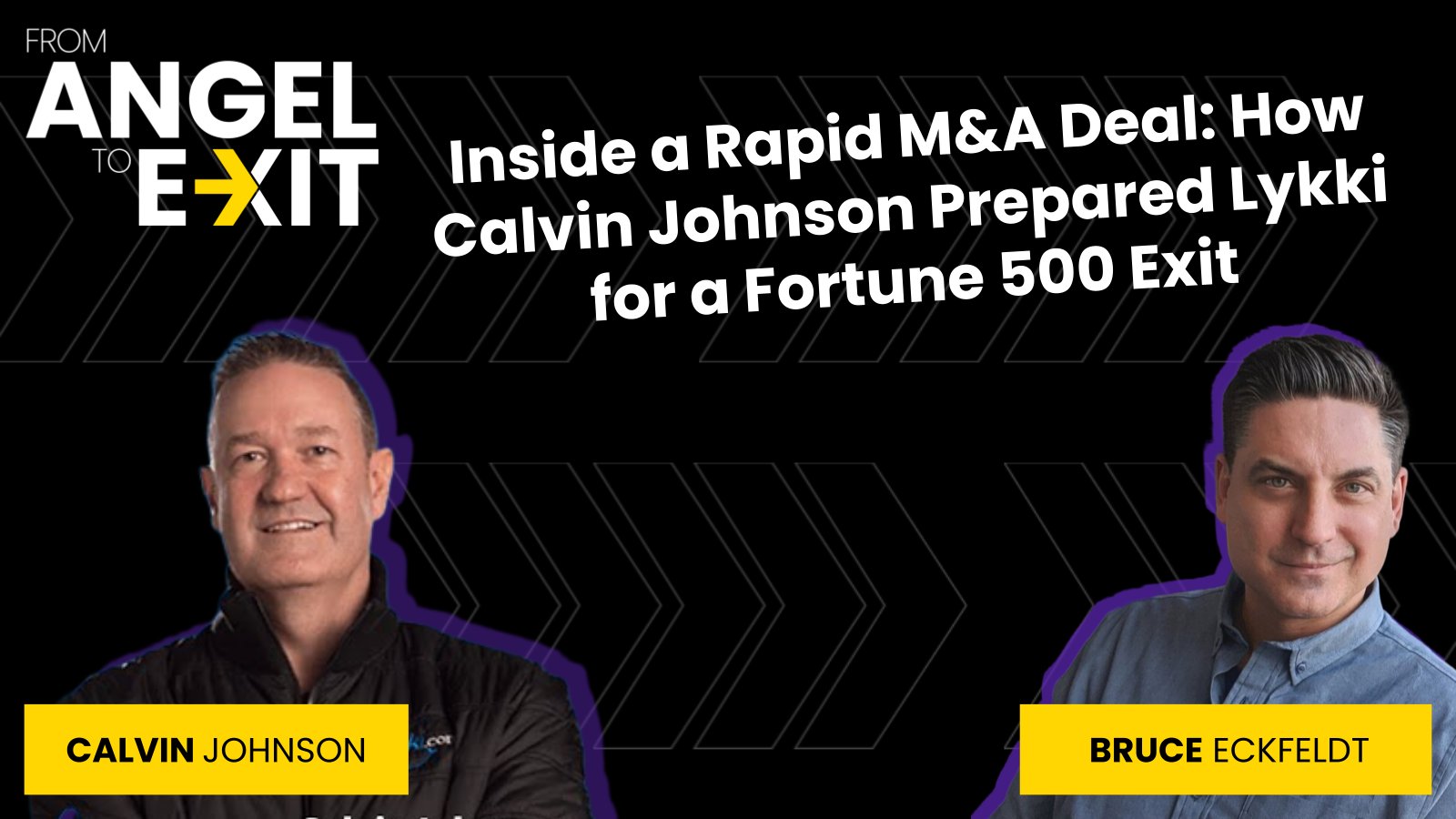
Inside a Rapid M&A Deal: How Calvin Johnson Prepared Lykki for a Fortune 500 Exit
Calvin JohnsonFounder, Lykki
Listen to the Episode.
Play the full conversation right here, or pick a chapter to jump straight to that moment. Prefer your own app? Every episode is on Spotify, Apple Podcasts, and the rest.
About This Episode.
Start with the key takeaways, the ideas worth bringing back to your leadership team. Then read the full story of the conversation, or use the chapters above to jump straight to the moment that matters most to you.
- Start building your M&A data vault 1, 2 years in advance for deal-readiness
- Culture-first hiring and top-tier talent drive long-term operational success
- Combining related services (coffee + supplies) can create a defensible market edge
- Earnouts often underdeliver, opt for cash deals when possible
- A top-notch M&A lawyer is more valuable than a flashy M&A firm
- Understanding your acquirer’s needs can dramatically increase valuation
- Exiting a business doesn’t mean retiring, plan a purpose-driven next chapter
- Post-exit, your identity may shift, prepare emotionally, not just financially
From washing cars as a teen to selling a business with over $290M in sales, Calvin Johnson’s entrepreneurial journey is nothing short of remarkable. In this episode, Calvin shares how he built and exited Lykki, an office supply and coffee delivery company, and the key lessons he learned around culture, technology, and timing. Founders looking to scale smart and exit well will gain real-world insights into M&A strategy, deal preparation, and post-exit purpose.
Watch the Video.
Prefer to see the conversation? The full episode plays right here on the page, so you can watch while you follow the takeaways or read along with the transcript. Every episode of From Angel to Exit is also on my YouTube channel, along with short clips from each conversation.
About the Guest.
The background behind the conversation, and where to find this guest online.
Calvin Johnson
Founder, Lykki
Calvin Johnson built and sold Lykki, an office supply and coffee delivery company with more than $290M in sales, to a Fortune 500 buyer. He shares lessons on culture, technology, and timing.
Full Transcript.
The complete conversation, lightly edited for readability. Open it to read along, or search the page for a topic or a name.
Read the full transcript
Bruce EckfeldtWelcome, everyone, to From Angel to Exit. I'm Bruce Eckfeldt, I'm your host. Our guest today is Calvin Johnson. He is founder and CEO of Lykki. We're going to hear about that experience, about that exit, and what he's doing today and what he's learned. Hopefully there are a few nuggets for people early in the process so they can have a good, solid exit, achieve their goals, and do great things after that. So with all that, Calvin, welcome to the program.
Calvin JohnsonWelcome. Glad to be here.
Bruce EckfeldtThanks for taking some time. Before we dive into the business and all the exit stories, I would love to get a little background, personal and professional. Give us the story of becoming a founder. What led up to that?
Calvin JohnsonI guess I didn't know I was an entrepreneur from a very young age. I grew up quite poor, with a single mother. So if you wanted those Adidas running shoes, you had to go out and hustle yourself, whether collecting beer bottles or washing cars. But I didn't know at the time that I was an entrepreneur.
I was fortunate enough in my teens to work with a couple of friends and build out a fitness retail store. I was 17 or 18 years old, and we grew it to three stores. Then one guy bought us out, I got this check, and I thought, "Wow, that's pretty cool. Man, this is great." I blew it all. Cars and furniture and girls.
Bruce EckfeldtInteresting.
Calvin JohnsonI started another business, which was the home delivery service for Costco Wholesale in Canada. We delivered fridges and stoves, and I grew that. Then I learned the difference between B2B and B2C. I really didn't like B2C.
So I pivoted again and ended up with the business I had until I exited in the last few years. I had that for over 20 years: office supplies and office coffee. All those big office towers downtown, they all need that stuff. I spent time growing that business, and it did quite well. Over 20 years, we delivered about 1.3 million orders, and the total was around $290 million in sales collectively. Some good years and some bad years.
I really enjoyed the journey of being an entrepreneur and learning along the way. One of the shout-outs I have to give is to Entrepreneurs' Organization, or EO. I'm sure a lot of your people are in that. I've learned a ton being a part of it, and I was quite active in it for a long time.
Bruce EckfeldtIt's impressive. Same with me. That was a big change for me in terms of being a leader and being an entrepreneur: surrounding myself with the right people. It really changed my perspective. If you look back on some of these earlier entrepreneurial experiences, what were some of the learnings, but also some of the things that really got you jazzed about being an entrepreneur that you were able to carry through to the next business?
Calvin JohnsonThere are so many learning lessons. The one that stood out most for me was understanding corporate culture: building a great team, being around great people. In the early days I was probably a terrible manager. Well, not probably. I was a terrible manager. Dictated authority, that kind of thing. That doesn't really work. "Why are people quitting?"
So I really leaned into that and enjoyed building a great culture, a great work environment, happiness in the workplace. I spent a lot of time reading about it, studying it, applying it in my business, and seeing how that made a difference: that people can have fun at work and be inspired. And also the people who don't fit. If you have a strong, clearly defined culture, it's pretty clear right away who isn't going to fit in your organization. I really enjoyed that.
Bruce EckfeldtTell me more about that. How did you define the culture in a way that allowed you to make that clear and use it to focus staff and talent?
Calvin JohnsonIf there's one area that really stands out, it's the hiring process. There's a book called Topgrading. It's about this thick, but you can take away a lot of little nuggets from it that I'm sure you've heard: hire slow, fire fast. You really want people to want to be there, so we would spend a ton of time on the hiring process.
And then there are just a million little things. I have two teenage sons now, and they get to the three-month mark at their new jobs, and I say, "Hey, did you get a three-month review?" And they're like, "I don't know, they kind of talked about it, and maybe I'm supposed to get a raise." There are a million little things in a business that can make employees love you or want to leave.
Bruce EckfeldtWhen you started, did you have particular ambitions of exiting? How did you capitalize things? I'm curious about your vision for the future of the company in the early days.
Calvin JohnsonIn the early days of building out a business, at least for me, I didn't think about the exit. You're just trying to grow it or get a paycheck. If I could go back and do it again, and I'm from Vancouver, so maybe this doesn't apply everywhere, but it sort of does, I would have built the business around real estate.
I have a few friends who did that. They right-sized their business in lockstep with investing in real estate, or used the business as a real estate investment tool. We were always in 20,000 or 30,000 square foot warehouses that cost way more than I could afford. If I had just sized the business correctly, then, fast-forwarding to the exit, right now I would have real estate as part of my portfolio. That's something I would go back and do again.
In the years leading up to selling, what I really wanted to do was a roll-up that I saw in our industry. We were about $8 to $10 million a year, 30 or 40 staff, and I think we were the most sophisticated in our market. I saw other competitors struggling, and I thought, "Man, if we could just roll them into our building." Our ERP was too big and our warehouse was too big, so it would have been a great roll-up. A shocking lesson I learned early was that a lot of the mid-sized players, maybe $2, $3, $4 million players, just didn't want to sell.
Bruce EckfeldtWhy?
Calvin JohnsonIt was really their identity. It was their livelihood. They were holding out, thinking, "I'll exit when I retire." And I already saw work from home coming in our market. This was before COVID. I thought, "This is going to get tougher. If I could roll up and get to, say, $30 million, then private equity or maybe a bigger player like Staples would come in." They'd been known to buy, but they're not going to buy anybody under $10 million.
That was my first foray into thinking, "I don't know where this industry is going to go. How am I going to grow this?" I thought it would be really exciting if I could grow it through a roll-up. We hired M&A people, put together packages, and couldn't get any takers. But this story will come back to benefit me later.
Bruce EckfeldtNo takers. I'd like to go back to the beginning phase. How did you identify the need? You said you were solving it in a way that was better than some of the competitors. What allowed you to do that? Was there an insight? Was there a capability? What gave you that advantage?
Calvin JohnsonThis goes to the story of selling that bit me in the ass. Our business was two industries combined: office supplies and office coffee. But in office coffee there's actually a lot of food. We did everything from fruit and milk to frozen. And we were serving, again in Vancouver, Amazon's head office, 5,000 people, Microsoft, all those big companies, and they would spend money like crazy. Nobody worked from home at the time, so these kitchens were beautiful.
Actually, a bigger portion of our business was food and beverage compared to office supplies. So we could be more efficient with our trucks, a single point of delivery, warehousing, all those kinds of things. I was looking at bringing in different people to grow those categories, whereas a lot of the other competitors were very focused on one thing, office supplies only or just coffee.
Bruce EckfeldtSo combining those gave you operational efficiencies that allowed you to be better at both.
Calvin JohnsonFrom the customer's standpoint, we had a slogan: one order, one delivery, one invoice. Instead of having 10 different suppliers, the coffee guy, the water guy, the toner guy, we could deliver it all in one truck. That helped us grow, and it was a unique selling proposition.
Bruce EckfeldtWas there any product segment you tried that didn't turn out so well? I'm curious, as you looked at where the opportunities were, what the experiments were and what you learned.
Calvin JohnsonAlcohol and flowers. One day I was with a client, a fancy law firm, and there was this huge bouquet in their lobby. I said, "Those are fresh flowers. That's impressive." And they said, "We get that every week." It's like $500 a week. And I said, "Well, can I bid on that? It can't be that hard to deliver flowers." Then I talked to the drivers, and they were like, "What? How are we going to deliver flowers?" They'd tip them over and things.
And some customers wanted us to deliver alcohol. They would have happy hour Fridays and give out booze. Our ops team said, "Hell no. No booze."
Bruce EckfeldtWhy, just from a...
Calvin JohnsonTwo reasons. One, just the breakage, or people stealing it. Inventory control: you probably have to lock it up. And also in Canada, at least in British Columbia, we would have to buy it from a liquor store because we're not a distributor, and you can't mark it up and resell it. So you'd have to sell it at cost and then charge a picking fee or something.
So anyway, I'm the idea guy. Every time I'd go to a conference and come back, the team would say, "Calvin's coming back. God, what has he learned now?"
Bruce EckfeldtThis is a classic EO thing. The CEO goes off to some EO event, and the team knows Monday is going to be crazy because he's going to come back with 50 ideas.
Calvin JohnsonExactly. But it was a fun platform to try a lot of new things. I really enjoyed it.
Bruce EckfeldtAny other big challenges around growth? I'm curious how you capitalized things. Did you just bootstrap this? What was that like?
Calvin JohnsonI talked to another guy just a few days ago about bringing on partners in his business. I said, "Especially through EO, I've never heard a good story about partnerships. If you can keep all the equity yourself, you can hire great people. Just don't give them equity." Luckily, I didn't bring in any partners. But of course, it's always hard to raise money.
Probably the biggest challenge, especially being in business 20 years, is constant change in technology. You buy a phone system, and all of a sudden there are VoIP phone systems. You buy an ERP system, and then it's out of date. You buy CRMs, and that's no good, you need the next CRM. Then it's cloud-based. And websites. It's never-ending.
As much as we sound like a bricks-and-mortar, inventory, delivery-trucks kind of company, I tried to be very technologically advanced internally. But you invest in something, you take out a big loan, I'd take out half-million-dollar loans, and, funny enough, about the time you've paid it all off, all this stuff is irrelevant. It's brutal.
When we changed our one big ERP platform, people told me, "Just don't do it. For all the bells and whistles you get, it will slow your business down so much." And sure enough, that's the advice I've given to other people. If you can live with it, even if it's not perfect, don't go for the shiny new penny. It's way too much effort to keep changing. Or wait one or two cycles and then leapfrog. Now it's AI, right? So skip the other stuff, and maybe two years from now there's some amazing AI CRM that does it all for you.
Bruce EckfeldtIt's always a challenge. In my own business, we did a lot of development work for companies building these things, and I've coached many companies around these issues. Generally what I find is that it depends how strategic the tool or system is to the business. If it's really driving differentiation, then it's something you want to invest in and be on top of the market with. Everything else just needs to be good enough. Whatever basic system you can get, don't mess with it, and keep it running. With limited resources and limited cash, you can't be top of the market in everything. You have to pick and choose and focus on the things that really drive differentiation. What else do you feel you really invested in that allowed you to be a good player, grow the business, and be valuable?
Calvin JohnsonBack to culture. Investing in culture and trying to pay top of the market to find great people, once we learned that. I still wonder if it was worth the money, but we had Google-like offices. It looked like a Caribbean beach town, with free food. We emulated a lot of what I saw in these big companies.
And it was great. It was definitely a great hiring tool. But it was expensive, and a lot of people looked at it and said, "Do you need that? Do you need fancy chairs? Why do you need to give them food all the time?" And it's like, it works.
Bruce EckfeldtHow did you make those decisions? There are lots of things you could do to create an incredible office or an incredible culture. Why those particular ones? What did you find really drove engagement and talent?
Calvin JohnsonI would visit a lot of my larger clients, whether it's Adobe or Industrial Light & Magic, the Star Wars stuff. Vancouver is a super hotspot for all that. So I'd tour their offices and get my ideas from that.
Again, I own it, so I could just spend the money, try it, and see if it works. A lot of it came back to this: if we put on a big Halloween party and people didn't dress up, maybe I'm judgmental, but I'd think, "Are you really a fit in this company?" I can't force people to have fun, obviously. But a lot of the culture stuff we spent on either brought the team together or separated out the people who just weren't a fit.
Bruce EckfeldtWhen did you first think about the idea that you might exit the company, one way or another? When did this first cross your mind?
Calvin JohnsonI took a bit of a sabbatical and went to Denmark and studied happiness, and went to Bhutan. When I came back, I thought, "It's just rinse and repeat. Is money really everything?" That whole existential crisis thing. Of course, it was my 50th birthday.
But I thought, "Okay, I've got to go big or go home." That's when I thought, "I've got to roll this thing up and then sell it." At our level, I could sell it and be okay, but I thought if I could grow it to $30 or $40 million with a roll-up, then exit.
Bruce EckfeldtOnce you made that decision, what did you have to do differently? Once you decided, "I'm going to exit, and a roll-up is my strategy," what were your priorities?
Calvin JohnsonLeaning on EO, for sure. Finding people who had exited, calling them up, and getting tons of great advice. One thing that stood out very early, which almost everybody said, was that there's a big difference between cash and an earnout. Cash is cash, and an earnout is vapor. Somebody would say, "I did this deal with some type of earnout," and the chances were very limited.
A couple of others I learned along the way, rapid fire. Finding an M&A firm is like finding a realtor. Pay attention to what you're getting. They're not necessarily the bee's knees. But probably the most important person, and I learned this in my deal too, is an M&A lawyer. The M&A lawyer is the one actually negotiating. The M&A firm you're hiring is just making phone calls, and they just want their 5%.
Bruce EckfeldtExactly. They just want to do a deal and get their cut.
Calvin JohnsonThey don't really care. The guy who brought the most value, and luckily I was introduced to him, was a firecracker of an M&A lawyer. He's the one who really haggled the deal.
Bruce EckfeldtTell me more about that. What were the points being haggled?
Calvin JohnsonA lot of stuff: getting the LOI deal points worked out, or whether he would talk to their team. We got bought out by a Fortune 500 company, so they had a large deal team. He spoke that language, kept the ball moving, and knew when to push back.
He asked me a great question early on: "How aggressive do you want me to be?" I said, "Well, I don't want to lose the deal. I don't want to be an asshole about it." And he said, "Okay, I just need to know what tone to take. Do you want me to be a pussycat or a killer?" I said, "In the middle." And he said, "Okay. If there's something where I think they're taking advantage of you, then we'll decide who's going to call and work out that deal point."
I had an M&A company for a little bit. They made some intros, and then I realized they just weren't bringing great value. And as I was doing this roll-up, COVID hit, and our sales dropped 85% overnight. So that was dead. I remember sitting with my wife, who worked in the business too, and we were talking to two lawyers, an M&A lawyer and a bankruptcy lawyer. It was going to go one way or the other.
I thought, "Well, I'm just going to get on the phone with these CEOs we had dabbled with during this roll-up." I called them directly. And luckily, there was one Fortune 500 CEO. He was the CEO for Canada, just brought in from a big company in the States, and his goal was to grow Canada. They weren't in Canada, and he was given a huge war chest. In the end, the story goes, he bought 50 companies in Canada.
Luckily, we were ready to go. In my market, I know he reached out to other people and asked them exactly what he asked me: "Are you ready to sell?" And they said no. This was during COVID, and they were still telling him no, and he's got a huge war chest. Not only was I ready to sell, I had already prepared my entire data vault. For your listeners, I think this is the critical thing. You need to start a year or two in advance.
Bruce EckfeldtExplain this one, because I think a lot of people miss it.
Calvin JohnsonThe M&A company gave me a template that I had to fill in, and it took hundreds and hundreds of hours. Every little detail you could think of: lease agreements, employment agreements, passwords, everything. Even the drawings for the sprinkler system in the warehouse.
When it came time, this was during COVID, our sales were tanking, and this CEO had a big war chest. We literally haggled out some numbers on the phone, and he said, "Okay, I'll put you onto my team." From that phone call to money in the bank: three months. I had it done in three months.
We got put onto their team in Chicago. There were 10 or 12 people there doing these deals, and remember, their job was to buy companies not only in Canada but all over. They said, "We just love talking to you guys. We love talking to Lykki. Every time we ask a question, you're giving it back to us in hours." In the end, we gave them the whole data vault and said, "Here. If you need help finding something, we'll find it for you, but you can serve yourself."
And they said, "You wouldn't believe how many deals collapse with this team." That team goes back to the CEO and says, "Don't do this deal. These guys don't know what they're doing." And the CEO just makes a phone call one day and says the deal's off. They said, "But we love you guys. You're literally within hours, where other times it takes weeks." And I'm like, "Why wouldn't I do it now? I want my money as fast as possible."
Bruce EckfeldtAbsolutely. Anything else you feel you did well, either lucky or fortunate or intentional, that made the actual transaction process easier?
Calvin JohnsonJust being open and available. I've talked to other people, and they didn't realize that it's basically your full-time job. You have to put everything else on hold if you want to do the deal.
We did an asset sale. This really pissed me off, too, because the M&A guys really pushed for a share sale. I don't know why. Then I talked to a specialized M&A tax accountant, and he said, "No, it's not as bad as you think." At least in Canada, you could use your capital gains exemption on a share sale. But he said, "There are ways that are going to be almost just as advantageous. Don't make that a deal breaker." Otherwise I might have gone to that CEO and said, "If it's not a share sale, I'm not interested."
So it was an asset sale. We had to wind down to the brooms. We had to get rid of all our inventory ourselves and sell all our trucks. That took a while, but we were able to maximize it. We collected every penny of our AR. That was great. And we found jobs with the acquiring company for any of our employees who wanted them. That was great too.
Bruce EckfeldtHow did that discussion go? Was that something they were willing to do? Did it take a lot of leverage?
Calvin JohnsonI got some other great advice there. The acquiring company had our payroll, and they wanted us to sit down and ask these people. They said they'd take anybody who wanted to come, because they were building a 100,000 square foot warehouse just down the street and rolling everybody in.
With advice from this other guy, I said, "It's going to be really, really hard to get these people to move. But with a 25% pay increase, it'll be better." So it was great. I could say, "Hey, times are tough, and we've been acquired. If you want to move over there, you get a 25% raise. Here's the paperwork, but you have to sign it right now." And they said, "Thanks. Great. Where do I sign?"
Bruce EckfeldtWin, win, win.
Calvin JohnsonOtherwise I would have had to go through all the legal stuff with exiting employees, and it could have been super expensive. I think I was on the hook for something like half a million dollars, and I had people who had been with me 20 years. Instead, they all just moved over, and it didn't cost me a penny.
Bruce EckfeldtDid the acquiring company want the people? So they needed the team.
Calvin JohnsonYes, because they were coming into Canada and built out a big distribution center. In Vancouver, they'd say, "We need X amount of sales, so we'll buy these five companies." And they had 20 to choose from. When they bought us, they said, "We need all your people." They took my ops people, and for a while they were even using our website. So it turned out great.
Bruce EckfeldtInteresting. It goes to show, and this is what I've found in most of the deals I've been involved in, that you have to know what the acquirer really wants. What are their goals, their objectives, their mandates? How do you position yourself strategically to achieve those? If you can do that, that's what drives valuation. Regardless of what the comps are in the market, you're talking about a specific deal and a specific company. If you can understand those things and align, that's where you drive value.
Calvin JohnsonBingo. Once I realized that this CEO had recently been brought in as president for Canada with a war chest of money, I thought, "Well, I've got something he needs. He needs me."
Bruce EckfeldtExactly. Was there anything he didn't like? As you looked at your business, what wasn't a fit, that you had to figure out how to reposition, or that you were going to take a hit on?
Calvin JohnsonBack to what we were talking about: my business was really two businesses, the food, beverage, and coffee side and the office supply side. This Fortune 500 company was all food, beverage, and coffee. They looked at the office supplies and said, "We don't want that." So in the deal numbers, they were basically discounting a big portion. I thought, "Wow, there's a lot of value there." But I couldn't talk them into it. They didn't want it.
Friends and the lawyers said, "Possibly you could sell that segment." It wasn't a division by any means. But I called up an office supply company that might be an acquirer and said, "Here's what's going on." And they said, "But we're going to have the same customer list. Why would I want to do that?" I said, "They're coffee and you're office supplies. You're two different things." In the end, I was able to negotiate between both CEOs to get them both to sign off that they would each buy, at different valuations, the same customer list. Even the M&A lawyer, who was a great guy, said, "I don't think this is going to work. Why would this work?"
The office supply side was an okay valuation, but it was free money, really. There was an earnout segment, and sure enough, they shit the bed and I got zero. They took some of my salespeople, and the salespeople got over there and said, "This is a shit show. This is not like Lykki."
And on that note, with earnouts, I stayed on a little bit as a consultant and didn't really do a lot. But imagine taking five small companies and putting them together in one warehouse. It was a disaster. We stayed in touch with some of our drivers, and they said orders were delayed. I always thought these big companies were so efficient. It was terrible.
Bruce EckfeldtIt's so surprising. I go in and do strategy work for big companies, and I think, "Okay, big company, they've got it down." And then I'm like, "My gosh, this is worse than the $5 million company I'm working with." Just because they're big, and just because they're successful in many ways, doesn't mean they've got it all figured out.
Calvin JohnsonThe person who won was another competitor of mine, about my size, who just said no. I think he won because it basically took five of his competitors out of the market, threw them into a building, it was a shit show, and then he swooped in. I heard he took Amazon and a few other of my big customers. He was just waiting to phone them up. He knew it was going to happen.
Bruce EckfeldtHe was left standing. Give it six months.
Calvin JohnsonThe service level is going to tank, and we're going to come in like the white knight. So clever of him. That's another strategy: just don't sell. Let the other guys buy and crash and burn.
Bruce EckfeldtInteresting. I'm curious about you personally. As you came to the realization that you were going to exit this thing, how did it shape your vision for yourself and your future? A lot of founder-CEOs get their egos very caught up in the business. How did you grapple with this, and how did it become a springboard to your next venture?
Calvin JohnsonLooking back now, a couple of things I've shared with people. Stress is a huge killer, and you don't realize how much stress you're under. You go, go, go all the time. There are statistics about people who retire and are dead in two years. When you get a chance to slow down or switch off, and a holiday doesn't count, you really realize how much stress you can build up in your life in a business.
But for me, I had a plan anyway. In about the last 10 years of my business, we built an internal charity. We'd always been doing stuff locally, hospitals and food banks and things like that. But I was fortunate enough to go to Nicaragua and build some houses, and I saw there was a way to maybe incorporate this into my business.
So for many years we had this internal charity where for every dollar a customer spent, we would donate a liter of safe, clean drinking water. We had a wall in our office that showed this garbage dump area in Nicaragua, 10,000 people, and we would supply them water, and there were all these great stories. Of course, it helped with culture.
Then I did a bit of a spin-off from that with a travel company. People would see the pictures and say, "This is really cool." Other EO people would come tour our offices and say, "Hey, I want to do something similar. I want to come to Nicaragua. How can I do one-for-one water in my business?" So I had this little side thing going. I knew that if I could get out of the rat race of office supplies and coffee, maybe I could focus more on this charity component and working with corporate donors. So I already had something lined up. I think if I didn't, you'd go crazy.
Bruce EckfeldtA lot of people do go crazy. There can be an existential crisis if you don't have a bit of a plan. I always talk about pull versus push. I want something pulling me into the next thing, not being pushed out of a situation. And I've seen more than one deal go south because the founder realizes at some point, "I really don't want to sell." Then you're dealing with unwinding deals, or deals that don't follow through, and that can be pretty dramatic as well.
Calvin JohnsonIt was a big part of my identity, and I was really proud of it. But with COVID, man, I did the right thing for sure. We were all about bums in seats, offices. There's no way to service the at-home worker. This whole business I was in has been decimated. Now other people are calling me saying, "I'm trying to sell." And I'm like, "I don't know, dude. I think you're too late."
Bruce EckfeldtObviously COVID was hard to anticipate or predict, but a lot of businesses are in markets with big shifts, and some of those shifts you can see. Generally operating the business well, having the systems in place, the data vault, being well organized to sell at any point, can be a real advantage. If the writing's on the wall and you've got 12 months to make a move, you can't do that if you don't have things in place and you're not ready to go through a transaction.
Calvin JohnsonShout-out to Traction, if you do the Traction stuff, or the Rockefeller Habits. Systematize your business. 100%. When I see a business that isn't systematized like this, I think, "What are you doing? It's so easy. It's right there. Just read this."
Bruce EckfeldtGet something in place: some kind of rhythm, some kind of process, a strategic planning system, quarterly planning, and the SOPs and the supporting technology to drive them. I talk a lot about how the things that help you scale will also help you sell, if you do them right. Getting those things organized so you're ready is half the battle.
Calvin Johnson100%.
Bruce EckfeldtCalvin, any other advice or insights you can give folks who are earlier in this process, either thinking about selling or not sure what they want to do? Things they should think about in their business or for themselves as founders?
Calvin JohnsonEarly on for me, again, it was leveraging EO. Talk to people who have exited and people who haven't, and have enough of those conversations. Everybody's life is different. Once you see other stories and how they play out, building a team, all the mechanics of it, you obviously learn that. But it's all the soft-skill stuff you don't understand. Like you said, you think you want to sell, you get halfway through the deal, and even if there's going to be a big payday, you think, "This isn't for me." I was highly motivated.
Bruce EckfeldtI can tell. Excellent. Calvin, this has been a pleasure. If people want to find out more about you and the work you're doing now, what's the best way to get that information?
Calvin JohnsonThe corporate social giving platform I've developed now is called Club Need, at clubneed.org. If you go there, you'll learn all about it, and I'd love to get some support. We also have travel where we go down and build homes. We just had a trip of all EO members, and they brought their kids. One guy brought his nine-year-old girl, just beautiful, a sheltered princess, and her dad was so shocked. She was right in there, up to her elbows in concrete. That's clubneedtravel.com. Just think Club Need and you'll find me.
Bruce EckfeldtThat's great. I'll put the links in the show notes so people can get them. Calvin, thank you so much for taking the time today. It's been a pleasure.
Calvin JohnsonIt's my pleasure too. Thanks, Bruce.
Never Miss an Episode.
Know the moment a new episode goes live. Subscribers also get a say in future guests and the topics we cover.
Other Related Episodes.
More conversations that connect to this one. Or browse the full archive by topic or by guest.
Sam Arman
How he built and sold several companies, some under pressure and one for a 10x private equity exit.
Listen and Read
Ross Shanken
The frameworks and hard moments behind building Jornaya and guiding it to a nine-figure exit.
Listen and Read
Bill Snow
Blunt truths about middle market M&A from nearly two decades on the inside.
Listen and Read