From Angel to Exit Episode 18
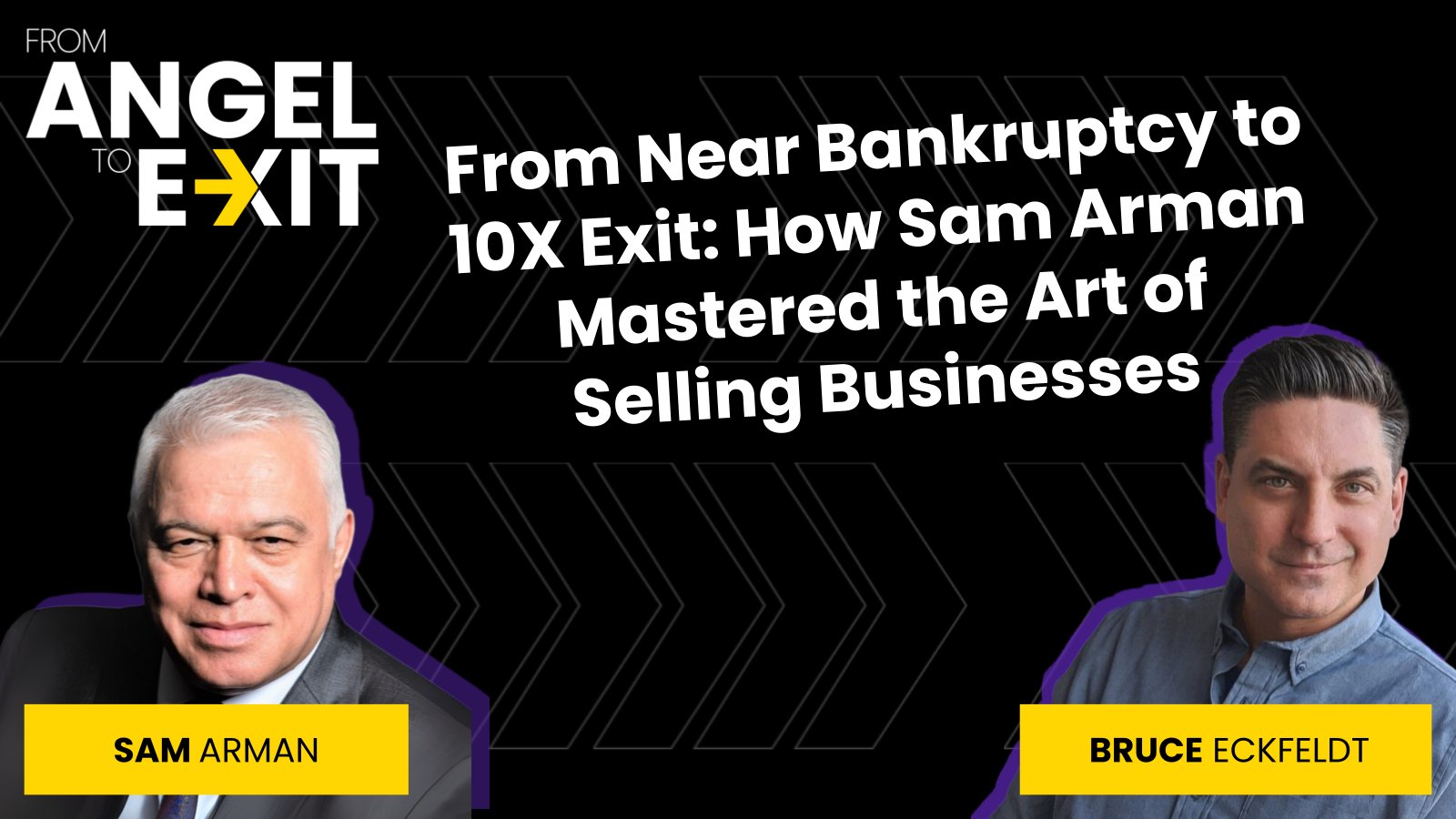
From Near Bankruptcy to 10X Exit: How Sam Arman Mastered the Art of Selling Businesses
Sam ArmanSerial entrepreneur
Listen to the Episode.
Play the full conversation right here, or pick a chapter to jump straight to that moment. Prefer your own app? Every episode is on Spotify, Apple Podcasts, and the rest.
About This Episode.
Start with the key takeaways, the ideas worth bringing back to your leadership team. Then read the full story of the conversation, or use the chapters above to jump straight to the moment that matters most to you.
- Plan your exit strategy from the moment you start your business.
- Treat your company as an asset, not an emotional extension.
- Understand deal structures and align them with your “why.”
- Limit internal disclosure to protect morale and operations.
- Vet buyers for both financial capacity and strategic fit.
- Use private equity partnerships to fund post-sale growth.
- Walk away from deals with unfavorable or uncontrollable terms.
- Build a specialized M&A advisory team, not just general counsel.
In this episode of From Angel to Exit, serial entrepreneur Sam Arman shares how he built and sold multiple companies, sometimes under pressure, sometimes for massive wins. From his first computer assembly business disrupted by Dell to a 10X private equity-backed exit during COVID, Sam reveals the emotional and strategic pitfalls founders face in M&A. He dives into how to choose the right buyer, protect your team’s morale, and leverage “second bites of the apple” to multiply your returns. His hard-earned lessons give founder-CEOs a blueprint for maximizing value while avoiding costly mistakes in high-stakes exits.
Watch the Video.
Prefer to see the conversation? The full episode plays right here on the page, so you can watch while you follow the takeaways or read along with the transcript. Every episode of From Angel to Exit is also on my YouTube channel, along with short clips from each conversation.
About the Guest.
The background behind the conversation, and where to find this guest online.
Sam Arman
Serial entrepreneur
Sam Arman has built and sold several companies, from a computer assembly business disrupted by Dell to a 10x private equity-backed exit during COVID. He shares how to choose the right buyer and get a second bite of the apple.
- linkedin.com/in/samarman
Full Transcript.
The complete conversation, lightly edited for readability. Open it to read along, or search the page for a topic or a name.
Read the full transcript
Bruce EckfeldtWelcome, everyone, to From Angel to Exit. I'm Bruce Eckfeldt, I'm your host. Our guest today is Sam Arman. He is a serial entrepreneur who has exited multiple times. We're going to talk about a whole bunch of things, and I think we're going to have a great conversation. I'm excited for this, given Sam's background and having been through this process a couple of times. I'm sure he has learned lots of things in multiple ways, hopefully not more than once, and he has a lot of experience doing this not only for himself but working with companies going through this process. I think there's going to be a lot of great information. So with that, Sam, welcome to the program.
Sam ArmanThank you, Bruce. Glad to be here.
Bruce EckfeldtIt's a pleasure. I would love to start at the beginning. Not only do you have a great professional business background, but you've got a great personal story. I'd love to start there and understand how that set you up to become an entrepreneur and a business leader. Give us a little of that story, and then we can dig into your entrepreneurial endeavors.
Sam ArmanWell, it all started when I was two. I'm kidding. On a serious note, I was born in Iran, and I went to college for civil engineering. I dealt with some social issues over there. There was a new government, the revolution. To make a long story short, I had to run and get out of Iran after the revolution. I went to Pakistan and was a refugee there for almost 15 months. Then I secured a scholarship that brought me to the Ohio State University in Columbus, Ohio.
In Iran I did civil engineering. Here, my advisor tells me there's no money in civil engineering. So I said, "What should I do?" And she said, "Computers." I said, "I don't know anything about computers." And I will never forget this: "That's your problem." So I made it my problem, and I switched to computer science. I finished my engineering degree in two and a half years.
I got out of school looking for a job, and I couldn't find anything I liked. And I had zero business experience. This is the challenge. For those who want to get into the entrepreneurial realm, I would say please get some experience. I was an engineer, and I think I was a good one, but with zero business experience, it's so hard to learn everything from scratch and reinvent every wheel by yourself.
To make a long story short, in 1986 I started the company by putting pieces of computers together and selling them. I ordered parts through mail order, because I didn't know there was such a thing as a distributor or wholesaler. I didn't know anything about accounting, profitability, nothing. Marketing and sales: I remember talking to a gentleman who spent two hours trying to explain to me the difference between marketing and sales, and my engineering brain could not understand. "Why do you call it marketing? Sales is marketing. Why do you call it sales?" I had to learn everything through the school of hard knocks.
We did one company, then a second company, and a third. To make a long story short, I sold three companies. One of them was a dot-com, USA.com. I sold two of them in '99 and one in 2000. And that got me into selling businesses. I sold two of my companies to a company that was doing an IPO on NASDAQ, so that experience was good. Again, I was an entrepreneur who didn't know anything. I was swimming with sharks, literally. These guys had been on Wall Street for 15 years, and I was negotiating with them using my Persian skills and all that. It was all good.
After that, I'd had enough of IT. Because of my engineering background, that's what my business was. All three of my companies were in technology and IT, managed services and so forth. My brother, by the way, through all of this, who's two years younger than I am, was my partner in crime. We did everything together. And that's another note for you guys. If you know someone you have a good, trusting relationship with, an ethical, trusting relationship, those two key things are really essential. In my case, I was lucky, because I knew my partner's parents. He was my brother. So all of that helped, and he was my partner in everything.
Come 2000, I'm done with IT. I said, "I want to do mergers and acquisitions," which is the topic of your podcast. My brother didn't want to do anything with it. He said, "No, I want to do another IT company." So he started another IT company, and I became an equity owner. But I said, "I'm done. I'll be an owner, but I don't want to do operations."
So I went and did M&A, and boy, was it a blast. I had to learn a lot. I had to go back to school. I remember going to Chicago and sitting in classes, understanding business valuation, understanding how deals are structured, all the nuts and bolts. I learned all of it and went through it, and everything was kosher and nice, all the way to 2011. During this time I had moved to Florida.
I came back to Ohio to see my parents, and I realized they didn't need visits. They needed care. I had remarried, and I told my new bride, "Let's go. We've got to be close to Mom and Dad." She supported me, and we came here. And my brother got me back into IT. So I put my M&A business on hold. This is 2012, and we got into IT, and here's the challenge.
This is another lesson for entrepreneurs out there. Remember, Alan and I, this was our fifth IT company together. We had built some startups that I haven't even explained. But even with that background, this company was about to go bust. It had started in '01, when I became an equity owner, and come 2012, the company was in flames. We had made some sales, and everything looked good, but it was going to blow up, or implode, depending on how you look at it. So we came in and fired everybody with the exception of three people. Back to basics.
Bruce EckfeldtWow. How many people were in the company to start with?
Sam ArmanIt was like starting a company from scratch. And this brings up the topic you and I are going to discuss. When I did this, now I'm a little bit of an age, and 2012 wasn't too long ago, I said, "Okay, this time we're going to plan for the exit from day one."
So in 2012 I joined my brother. In 2014, because of my M&A background, I went and found a private equity firm in Boston and said, "Can you please buy me?" And they looked at me and said, "Not right now." Then 2016, 2018, and in 2019 I did the deal. On March 2nd we closed the deal. On March 13th, we sent our employees home after the merger because of COVID. Talk about good timing. So that brings me up to here. I hope that gives you a good picture.
Bruce EckfeldtIt paints a really good picture of you personally and what drives you. It's clear you light up around a couple of these topics. And it shows the types of experiences you've had. I love that it's not just, "I've been super successful at everything I've done, and it's always been a cakewalk." I'm curious to go back to when you started the first company. When did you feel like you knew you were going to be an entrepreneur, the idea of starting and running a business versus being an engineer? Has that always been with you? When did that bug get planted, "I want to own and run businesses"?
Sam ArmanVery good question. I have to tell you a story from age 12. By the way, you and I are both EO members, Entrepreneurs' Organization, and I call EO "Alcoholics Anonymous for entrepreneurs." But that's the caveat. Entrepreneurship, in my opinion, is a bug. Either you have it or you don't. There are a lot of people who do entrepreneurship because they've more or less been pushed into it or got into it. But there are those of us who, no matter how much money you give us, no matter how much comfort you give us, have to do it. If we go on a vacation, we enjoy the first 10 minutes, and then for the last two days we're looking: "Can I start something else? Who can I partner with? What property is available to buy?" All I'm saying is that the entrepreneurship bug was in me.
Here's a story from when I was 12 years old. I'm 12, and I'm selling candy. I have this little box hanging off my neck, and I go to these buses that come through town. I'm in Iran. I'm a kid. I didn't speak one word of English. I buy three candies for one of our money, and then I sell them for one each, so I made 66% profit. It was good.
My dad sees me, and he's against any of this. Study, study, study. Academics, academics. So I got a beating for doing that, and I wasn't allowed to do it. The next day, our neighbor's kid had that box around his neck, and my dad sees me walking with him. He says, "What's going on?" I said, "You told me not to do it. Now he's doing it, and I'm losing all the money." And all I was doing was walking. The truth is, that was my box on his neck.
Bruce EckfeldtYou just outsourced.
Sam ArmanSo you have the entrepreneurship. To answer your question: when I got out of college, I genuinely looked for a good job. In fact, I delayed my graduation for six months, because I wanted to be a graduating senior rather than an unemployed graduate. I wanted to enhance my position: "I don't need your job. There are a lot of other options for me." I didn't like anything I looked at. It just didn't sit well with me. So I said, "Okay, I'm going to start something."
Then I saw an ad in a paper for mail order, because again, I didn't know what a distributor or wholesaler was. I didn't know what I didn't know. And I started this. Honestly, that's why my first piece of advice to anyone is to go learn on somebody else's dime. If you want to get into an industry, get an internship, get two years, five years into it, understand the ins and outs of the industry, then think entrepreneurially and go. Don't do what I did. I did it because I didn't have a good coach or mentor. I had nobody but me and my shadow, so I had to learn it.
I remember paying for a group called SCORE, S-C-O-R-E. These are retired senior execs who volunteer their time. It was $35 a class, and they teach you accounting 101, marketing 101. I took about 30 or 40 of those hours, because I didn't know.
Bruce EckfeldtThat's great. Let's talk about that first business, how it evolved, and when you got to the exit point. What was the arc or process you went through in developing this business around computer assembly and sales? When did you first think about actually exiting or selling that business? How did that play out?
Sam ArmanThat business is a good example. We started the company in '86, and 14 years went by. This is the part I want to make sure the listeners take away. During the first 10 years, if somebody asked me about selling my company, I would feel like somebody was making a pass at my daughter. She's my daughter. This is mine. "You want to own this? Did you see a for sale sign? I didn't see one." I would get offended that people were thinking about buying my business, because this was my baby.
Then towards the end, and this is the caveat: I was in the business of building custom computers, heavy-duty ones for really serious users. Back then there was no Dell. Because of my engineering background, I would build a custom, souped-up, heavy-duty computer for the physics department at Ohio State and sell it. That was my business model. Everything was good until it wasn't. This little company called Dell came in and destroyed the model. They produced high-end computers, went with low margins, and understood marketing a lot better than what I learned in a $35-an-hour class.
To make a long story short, I couldn't compete. By then I had about 40 employees, sales of about $6.5 to $7 million a year, and large overhead. And I realized, "My God, I have to think about exit." That was the indicator that I wasn't going to keep doing this. I'll give your listeners a phrase I've used: when the going gets tough, the smart choose a different path. Don't keep going. When I realized I couldn't compete with Dell, I didn't want to say, "Okay, I'm going to find a way." No. I found a partner, somebody suitable. The conversation took about a year and a half before I could sell the company.
But I would not have sold it had I not gone through that hardship and realized the business model was changing and the industry was changing. To every one of your listeners getting into a business: I promise you, your business plan on day one is very different from day four, or year 10. You have to be flexible and look at it on an ongoing basis. The lesson I learned, and I used it in my other two businesses: the minute you get into a business, plan for the exit.
Bruce EckfeldtIn that first one, you said it took about a year and a half to exit. I'm assuming you would have loved to make that shorter. Why did it take so long? What do you wish you had done differently, and what did you learn about how to make that process go more smoothly?
Sam ArmanVery good question, Bruce. The first answer is that I did not have a good mentor and coach, so I did not make the exit a priority, and financially it cost me a lot. The second part is that because the industry was going through a change, suitors were few. It's like trying to sell your house when there's a lot of inventory. My company at that time did not look sexy, so I might be talking to 10 buyers. I had to use diligence and patience, and that's why it took about a year and a half.
Bruce EckfeldtWas it around the financial structure? The performance of the company? Leadership gaps?
Sam ArmanThe industry changed. The whole business model had to change, and I wasn't ready to reinvent it. I realized I couldn't sell it to the national players, so I had to find somebody like me: another local competitor in town. They were ready to modify the business and go forward. But guess what? Even after they bought it, after two years they had to fold it, because they couldn't make it work.
Again, I saw the writing on the wall. My entrepreneurial journey has really taught me to learn through the school of hard knocks: your eyes are closed and you keep banging your head against the wall. That was one of those. I should have sold it sooner. I should not have taken it personally that somebody wanted to buy my company.
Because I did M&A for so many years, I use this line with entrepreneurs who have the same mindset I had. It's illegal and immoral to sell babies. I know your company is your baby. But businesses aren't illegal to sell, just very difficult. It feels like a baby, but guess what? It's not your baby. It needs to be passed on, and you have to plan for it. That was a lesson I learned the hard way.
Bruce EckfeldtWhat did you do differently in your next company? How did you apply those learnings?
Sam ArmanThe company we sold after seven years was faster. I also had a dot-com company, USA.com, and I sold it in one year. Once I set my mind that I had to get it sold, the only reason it took that long was that I was haggling to get the best bang for the buck. That was a good reason. That was a good wait. I'm glad I did it.
Bruce EckfeldtInteresting. How do you, either in your personal experience or with companies you've worked with, balance "Let's get the decent deal in front of us done" versus "If we spend another six or 12 months, we can grow a little more, get a couple of bigger clients, increase valuation"? But now I have risk. I'm continuing to own the company, with the market risk associated. How do you balance that decision?
Sam ArmanVery good question, Bruce. The answer is this. The entrepreneur, the management team, whoever owns the company and wants to sell it, has to be crystal clear about why they're doing it. I went through that exercise myself, and I'll give you the example of my last company. Sometimes you sell your company not because you're tired and not because you want to get out. You realize the company is not going to get where it should go on your own efforts. You need extra resources.
The perfect example is my last company, the one where my brother was running it and I was an equity owner, and I came back and rebuilt it. Remember, I was knocking on the buyer's door: "Can you buy me? Can you buy me?" The only reason I was knocking on their door is that they were a private equity group. A private equity group doesn't buy the company and wish you goodbye. Many of them understand your core competencies. They realize that if you do a transaction with them, they can bring additional resources: money, marketing dollars, connections, clients, vendors. They can enhance your business model.
So when I sold my company in 2020, the last one, during COVID, I made sure we kept some equity in the company. In M&A, they refer to that as the second bite of the apple. Within four years, we grew the company, and this time not with our money but with the private equity firm's money. We kept buying companies and kept enhancing the business plan, and I really applied all the lessons I had learned through all those times. To make a long story short, that was a very good exit. We had a nice 10x success in four years on the second bite of the apple. So that answers your question about the process: know why you want to sell.
Bruce EckfeldtNot to get too technical, but I find there are a couple of different opportunities owners have when they go through an exit process. There's deferred comp: "We're going to hold on to some of the money and pay you out over, say, three to five years in structured payments." It's usually guaranteed, often backed by the asset itself, which is a little sketchy, but it's a fixed, deferred payment. Then you have an earnout: some kind of payment structure over the next three to five years that depends on the company's ongoing performance. You may or may not be in a management position influencing that performance. It may just be, "I get a little more if the company does well, and less if it doesn't." And then you have the second bite of the apple, where you retain equity and, if there's a second transaction, you get that. How would you advise owners to think about those different options and which one they want, based on their own situation and how you're analyzing the deal? Because those have different risks and rewards.
Sam ArmanAbsolutely. There are several factors. The most important one is why the entrepreneur wants to sell. If the entrepreneur is burned out, we have to structure the deal very differently. But if the entrepreneur says, "No, I can do a lot more. I just need more resources. I need some money behind me, more staff, this or that," then that's a different game. That's where you decide: do we put more emphasis on a second bite of the apple? Do we make it all cash up front, with a little bit of earnout?
An earnout, by the way, is something buyers ask for, because they want assurance that they're not buying a dud. They buy the company and say, "You're telling us this is the greatest thing on the planet. We're going to trust you, but we're going to put some money between us and our trust. If we meet these KPIs and goals, on the first anniversary you get X, on the second anniversary you get Y." They usually don't go more than three anniversaries. That's the earnout.
If you want guaranteed cash payments, not an earnout, over a number of anniversaries, the seller should be really concerned about whether this buyer can actually pay. A lot of times you have to do a lot of due diligence to make sure the buyer has the ability to pay, so you don't end up a year later paying all the money to lawyers and not getting anything for the company. So most importantly, you look at why you want to sell and what your role is afterwards. Then you look at who your buyer is, what they can bring to the table, and to what degree that's in line with what you want from the deal.
Bruce EckfeldtParticularly on a performance-based earnout, you really have to look at how much control you have. Once you sell a company, most times you're giving up management control. How do you help sellers make this decision and calculate that risk? "The second bite of the apple could be amazing, but you're giving up control." How do you manage that with sellers?
Sam ArmanVery good question, and I'll give you another real-life example. I'll just use myself, not other deals I've been involved in. Remember, I said I started talking to the buyer, the private equity group, in '14, '16, '18, and then in '19 we closed. In '18, I got tired of this private equity group. So I got in touch with another company, a regional company. Not a private equity group. A third-generation family-owned company with a lot of money. The father, the son, the whole family was involved. They were a big company, and they decided to buy us.
We negotiated, and it was good. Then we got to terms, and this is where it really addresses your question. The terms these guys put in were unreasonable. The buyer basically wanted to say, "I buy your company, and anything I find wrong with it, you have to pay me. And I'm also going to put in these earnouts with these conditions." You look at those conditions and realize there's zero chance you're going to hit them. And even if there's a chance, you have no control over it. All the control is passed on to the buyer, and if you agree to that, you're doing yourself a disservice.
To make a long story short, we got to the 11th hour, and I had to tell my brother, my partner, "In my opinion," and I really wanted that deal to happen, "we're going to say no." And we said no.
But here's the other part. You have to do this in a very careful way, because if you don't manage the process properly and your employees sense that you want to sell the business, they start prioritizing their own plans. They're going to say, "This guy's heart is not in the business. I've got to go find myself another job." All of a sudden you're sabotaging your company because you were trying to be sincere and honest and you just couldn't hold it: "We're talking to these guys. They're going to buy us." Don't.
Get a good M&A guy who, like me, has some white hair, is patient, can calm you down, and can take you through the process. And get a good attorney. This is another part. A lot of companies have a company attorney, and when they go to do a deal, guess what? They want him to do it. He's not qualified. In the situation I had with these guys, it was exactly that. The corporate attorney was trying to draft the M&A terms. He was making a fuss about stuff that wasn't material, and he was missing stuff he should have been putting in. It's like dealing with an amateur attorney. I've seen it.
Bruce EckfeldtI phrase this one as having your general practitioner perform heart surgery. They're a great doctor for general things, but they've never done a heart transplant. You want someone who does five of these a week.
Sam ArmanExactly. You don't want a general doctor to pick up a knife and try to work on your eye. It doesn't work well. It's really surprising how entrepreneurs put friendship and trust in their current attorney and go with it. It costs them before the transaction, because they don't get favorable terms or good money. And it costs them afterwards, because a year after the transaction they're dealing with exactly the points you brought up.
Bruce EckfeldtI want to pick up on what you mentioned about telling people in the company. Once it gets out, people start looking for jobs. That's the risk. How do you decide who to tell and when? Some people you're going to need to involve. If you have senior-level folks who need to provide information, or the buying company wants to talk to them, you'll need to bring some in. How do you decide who to let in on the process and when? Give us some guidance on that.
Sam ArmanAwesome. The goal is to keep it as minimal as possible. In other words, go out of your way, and the other side, the buyers, should understand that they cannot talk. Make sure you have a rock-solid NDA, and make sure you tell them the NDA is not just paper. They really need to mean it.
This is really essential until you have a firm letter of intent signed. The LOI is a summary version of the deal. It highlights the key terms. It's not a 100-page agreement. It's basically two or three pages, and it highlights everything you need to know. Up to that point, my advice is not to get anybody from your team involved, as much as you can. If you have to, for example if you have a scientist on your team who must be in, those are exceptions, and sometimes you can't avoid them. My short answer: if you can avoid it, avoid it. Get people involved only as a last resort. The fewer, the better. And even after you sign the letter of intent and move forward, try to bring in only the people who are necessary.
Sometimes you can also create a cover story. The cover story is, "We want to do a joint venture partnership with these guys." So it's not a sale. That way, if you need reports prepared, you can go to your controller and say, "I need these reports for those guys," without saying why. "This is a joint venture, and we need to make sure it's done right so nobody gets in trouble. We have to disclose stuff so they can't say we didn't, but it's going to be good. We're going to be working closely with these people." So it's not a full acquisition.
The challenge is that the minute you say it's an acquisition, a lot of alarms go off in employees' minds. They tell each other, everything falls into the rumor mill, and that's where it becomes counterproductive.
I'll give you a good example. In the situation with that company, nobody other than my partner and I knew about the deal. That's why, when we realized their term sheet was crap, it didn't hurt us. Remember, they gave us a good LOI, but the devil was in the details of the term sheet. I looked at it and said, "This is crazy. Who wrote this?" Their argument was, "We've given it to everybody." I said, "I'm not everybody. You can't ask me to do this." My point is, if it hadn't been just my brother and me, it would have cost us. Employees get involved, clients get spooked, and it becomes really counterproductive and demoralizing.
In fact, my own partner and brother was ticked off. He came back after the deal fell apart and said, "You took seven months of our time. You know how much I stressed over this for nothing?" And I said, "Yes, but no deal is better than a bad deal." He recognized it, but he was really upset that we lost seven months. But we're grown-ups and could deal with it. Many employees can't. So the short answer is to involve as few people as you can and push it all to the end. When you're in the final stages of a deal, a good buyer will want to talk to your top key clients. You only allow that when you know you're 99.49% there.
Bruce EckfeldtExactly. The deal is basically done. They just have to check a couple of boxes.
Sam ArmanExactly. And also, who is your buyer, and to what degree do you trust them? And who is your advisor on your side? With clients I've had, I literally had to hang up on a client because he had bought a story from his attorney, and I was yelling at him.
Here's a good example. We had a closing the next morning at 11 a.m., and my client was in Toronto, Canada. I asked, "What time are you coming into town?" He said, "I'm not coming." I said, "Why?" "Because these guys changed that term. I'm not happy with it, so I'm not going to come." I had to educate him: "You're going to get sued. There's a bank involved. There's a lot of stuff involved." He said, "My attorney says I'm not going to be sued." And remember, this is the one using the corporate attorney. I said, "I don't care where the attorney comes from. Do you think the bank and these guys are just going to say okay? You're going to be paying damages. If you don't want to do the deal, come here and raise your concern during the closing meeting. Then don't do the deal."
You need advisors on your side who give you advice and aren't yes-men. You need that, because for most entrepreneurs this is the biggest transaction of their life. You owe it to yourself, your employees, and your clients to have the best team on your side, because you really can't make mistakes.
Bruce EckfeldtWhen you do get some of these folks involved, and I've had people on the program with different recommendations around this, I'm curious about your take. How can you incentivize the people you need to involve so you get a good deal done, not just any deal? Are there strategies you've used or seen in terms of compensation, bonus, equity, or phantom equity, including them somehow in the deal proceeds? If they're going to help get this deal done, they're incentivized financially in some way. Have you seen that work, and where?
Sam ArmanYou're talking about employees on your side, when you want to do the transaction, and you want to give them incentives to cooperate during the deal or after?
Bruce EckfeldtJust "Help me get this deal done. If we get it done, you're going to get a $50,000 bonus," or some financial reward. Have you seen this work? A couple of people on the program have mentioned it.
Sam ArmanYes, we have. In fact, we've done it. My advice would be: don't promise it. If you promise it up front and the deal falls through, now they're upset. You killed the deal, and they lost the $50,000 you promised them, I'm just using it as a round number, because you didn't know how to negotiate or your attorney was a jerk or whatever.
Nobody will be mad at you if you go to them afterwards and say, "We've been through this transaction. I really like what you've done, and this is for you." They're going to love it. On the flip side, if you tell them, "I'm going to give you $50,000," and then you go back and say, "I told you $50,000, but now it's going to be $49,000 because we had this other expense," they'll say, "You're taking a thousand away from me." So don't promise it.
If you want to talk to them, tell them this is going to be good, and at most, if you really want to give them a lot, say, "I'm going to take care of you." Don't put a dollar amount on it, because the minute you put a dollar amount on it, you have to live by it. Sometimes the dollar amount isn't enough for them, so they may not even cooperate during the deal. Or when the deal is done, "$50,000 is all I'm going to get?" "Sorry, this is it." Whereas if you hadn't said anything on day one, they wouldn't even come to you about it.
Bruce EckfeldtExactly. The other thing you mentioned that I wanted to talk about is the LOI versus the term sheet and the purchase and sale agreement. My philosophy is that I want to see basically every material term defined in the LOI, so that diligence is really only a verification of things we've already agreed in the LOI. I don't want to get into a situation where, in diligence, the buyer starts changing the deal terms because they're finding things. How have you seen good LOIs and bad LOIs structured? What's not in the LOI that happens later and causes drama, or potentially hurts valuation or leads to haircuts? What do you look for in an LOI to make sure it's going to work well?
Sam ArmanAgain, seriously, it's about having not just an attorney, because an attorney looks at it from a legal perspective. A lot of times it's not legal. It's the business side: the effective, on-the-ground impact of a sentence being in an LOI or not. That's where having a good advisor on your side really helps, because one comma, one sentence, can make a difference.
Going back to your point, two things. You cannot have your LOI be 100 pages. Nobody does that. It has to be two or three pages. The key is that if you know it yourself, or you have good advisors, they look at those two or three pages, and because of what they know is going to happen, they leave some sentences broad and discuss scenarios. They close certain things and leave some things open. They leave open the ones that could be to their advantage, and they close the ones that aren't.
For example, you could say, and I'm just using this as an example, "We are not willing to give reps and warranties for more than 18 months, period." You need to say that in the LOI, not wait for the term sheet. Why? Because you don't want to deal with them if it's going to be more than 18 months. The buyers prefer not to put it in there. They like to go to the 11th hour and then tell you, "This is what we want."
So my two cents: anything you think could be material or important, negotiate up front, and at least put a sentence or two in the LOI. You can't make the LOI that detailed. If you're concerned about due diligence, for example, you could put a sentence in your LOI that says, "If we do the due diligence and the numbers are less by up to this dollar amount, we're not going to worry about it. If it's more than that, we'll address it." So you leave areas open where you can still continue the deal and not have a problem.
Bruce EckfeldtWhat have you seen blow up deals? When deals go into diligence and you get under the covers and into the nature of the company, what typically comes up that has hurt a deal in terms of valuation or terms, or actually scuttled it?
Sam ArmanNot to sound like a broken record, but honestly, 90% of it is not having a good, seasoned team on your side. You go into a deal with your eyes kind of closed because you don't have good advisors, and then in the middle you say, "I can't do this," and everything falls apart.
Besides that, let me get to very specific things that entrepreneur sellers should really be concerned about. First, know how you're going to come through due diligence. Know that if these guys come in and turn everything over, they're not going to find a skeleton in the closet. If there are skeletons in the closet, don't hide them. Don't expect the buyer to be a stupid buyer, because they're not. Many of these buyers are sophisticated, and even if they don't look sophisticated to you, they use sophisticated advisors. You get to the 11th hour, the thing you tried to hide comes out, and you look bad. The minute that happens, you break trust, and there's no deal. So build everything on trust. Understand what you have. If you have skeletons in your closet, disclose them. Let them know.
Bruce EckfeldtEveryone has them. There are always skeletons in closets. Just get them out there early.
Sam ArmanExactly, but you have to tell them. If you don't, and it's a serious skeleton, that's what torpedoes the deal. And even worse is when the skeleton doesn't come out, the deal closes, six months go by, you have an earnout, and then the skeleton comes up. Now everybody goes back to the reps and warranties and the agreement, everybody turns on you, and guess what? You're doomed. Because now the deal has happened and everybody knows about it. You've told the world you sold your company, and it's not going to work. That's why a lot of companies end up in a legal mess.
So the short answer is: be ethical, be straightforward, be firm, and be candid. If you have a skeleton in your closet, say, "I've got this skeleton, so I'm giving you this discount. Done." Get those out of the way. And for things that are important to you, like reps and warranties, their attorney is going to ask for more. If you're not comfortable with it, tell them.
When the deal fell apart in 2018 and I had to go tell my brother, he was mad. He said, "We just wasted seven months. I'm tired of doing this. We took our eyes off the ball of growing organically. If we want to grow inorganically, let's go buy some companies, but I'm done selling my company." So we went about three or four months, and nothing happened. Then I went back to the private equity company I'd been tapping on the shoulder since 2014, and now they wanted to do the deal.
Because of Alan's experience, the sour taste that the previous deal had left in his mouth, I went to these guys and said, "Guys, these are the top three things that were a problem with the previous transaction. Every one of them needs to be addressed in the LOI." I made sure they were proactively addressed from day one. Then I went to my brother and said, "Remember you told me we're not going to do a deal? We're going to do a deal because of this." I put the term sheet in front of him: "Remember that? They're saying yes, yes, yes." So make sure anything that's a concern, or that you or your advisor think would be a point of contention, gets out of the way early on. The sooner you do it, the better and the easier.
Bruce EckfeldtAs you've proceeded in your entrepreneurial journey and set up new businesses, you've mentioned a couple of times starting businesses from day one with the idea of exiting and selling. What does that mean practically? When you start a new business, what do you do to make sure it's more sellable or will get a better valuation?
Sam ArmanVery good question. Basically, start with the end in mind. I'll give you a very real-life example. I work with a lot of startups, and a few days ago a gentleman reached out to me through some people we know. He knows I invest, so he wanted me to invest in his company. The first thing I asked was how long he'd been doing this. I wanted to know if this guy was green. He'd been doing it for 11 years. "Oh my gosh, that's good. He has some experience under his belt."
So we go through the conversation, and he tells me what he's offering investors: this much equity for this much money in a convertible note. Then I ask, "Are there any other investors in your company?" "Yeah, there are, but I'm going to buy them out." "Can you tell me more about them?" He says, "I have three investors. They've put $1.1 million into this over the past 11 years, and they own 30% of the company. Because they own that much equity, I can't raise any money. So I've gone to them and said I'll buy all of the 30% for $50,000 and they have to go away, and they've agreed."
I said, "Wow, so you treat your investors that nicely? And you want me to be the next investor?" "Yeah, but this is different, because now my business plan has changed," blah, blah, blah. I said, "Where are you going to get the $50,000?" He says, "From the new investors. They'll pay me so I can buy those guys out and bring that 30% equity back to the company."
Nothing about this makes sense. If you raise some money, and I'm one of those who own some of the company, I'm going to say, "You sold 2% of this company for $200,000, and you want to buy my 30% for $50,000? I'm not going to sell." "Do you have it in writing that they're going to sell?" "Yeah, I got some emails from them." Oh my gosh.
Then I asked him something very different. "You've been with these guys for 11 years, and you don't have an exit. Your only exit for them is that they paid you $1.1 million and you give them $50,000, which is insulting, and push them away. What's your exit plan? When are you going to exit next?" He says, "I don't know. I have to grow the company first." "Okay, are you planning for this company to get to a point where it could be sold in three years, five years, 10 years? You're the entrepreneur. What is it?" "I don't know." I said, "Well, you took money from those guys for 11 years, and now you're telling them to go to hell, and you want to come to new guys and ask for money. And when they ask if you're going to sell, you say you don't know."
My point is, know why you're getting into something. If you want to build startups, know where you want to start and where you want to go. At some point you don't necessarily have to sell. You might merge with a larger organization, take a position with them, and do a second or third bite of the apple. But know why you're getting into it. Going into something because it's cool and getting some money from friends and family doesn't help you or them.
You have to be emotionally comfortable with the fact that someday ownership of that company may go 100%, or more than 90%, to somebody else. Come to peace with that, understand it, create KPIs for yourself for when you want to do it, and go about this with purpose. Why are you doing this? Why are you starting this startup? If you want to make a difference, okay, how are you going to scale it? At least think about it and plan for it. Don't say, "Let's try this thing, we'll worry about it later." The sooner you know, the better. Your game plan can change, but you have to have a plan.
Like many things, when you have a plan, it happens as planned. When you don't have a plan, it still happens, but without a plan, and that's a disaster. That's why so many businesses fail: on day one, they don't really think about why. That why is a big question. Why am I doing this? Why am I not getting a job? Sometimes you get a job because you want to go start a company. But once you want to start a company, why are you starting it? What's your game plan? When are you going to get out? What's the next step? When is the next phase where you want to change something?
Bruce EckfeldtIt's whether you're controlling it or it's controlling you. It's going to get done one way or the other. What's the outcome you want? Sam, this has been a pleasure. If people want to find out more about you, your background, and the work you do, what's the best way to get that information?
Sam ArmanThe best way would be LinkedIn. I hope you can put some information in so they can find it. LinkedIn, Sam Arman. I joke about my name: it's Armani without the I. And as my wife corrected me, Armani without the style. My picture will be there. I'd love to connect with people. Thank you so much. It's been a pleasure.
Bruce EckfeldtI love it. I'll make sure that link is in the show notes. Sam, it's been a pleasure. Thank you so much for taking the time today.
Never Miss an Episode.
Know the moment a new episode goes live. Subscribers also get a say in future guests and the topics we cover.
Other Related Episodes.
More conversations that connect to this one. Or browse the full archive by topic or by guest.
Roy Vella
How his team kept the company alive after a lost funding round and still reached an acquisition.
Listen and Read
Calvin Johnson
How he built an office supply and coffee delivery company and sold it to a Fortune 500 buyer.
Listen and Read
John Ratliff
How a call center business grew through 24 acquisitions and sold at a 14x multiple.
Listen and Read