From Angel to Exit Episode 21
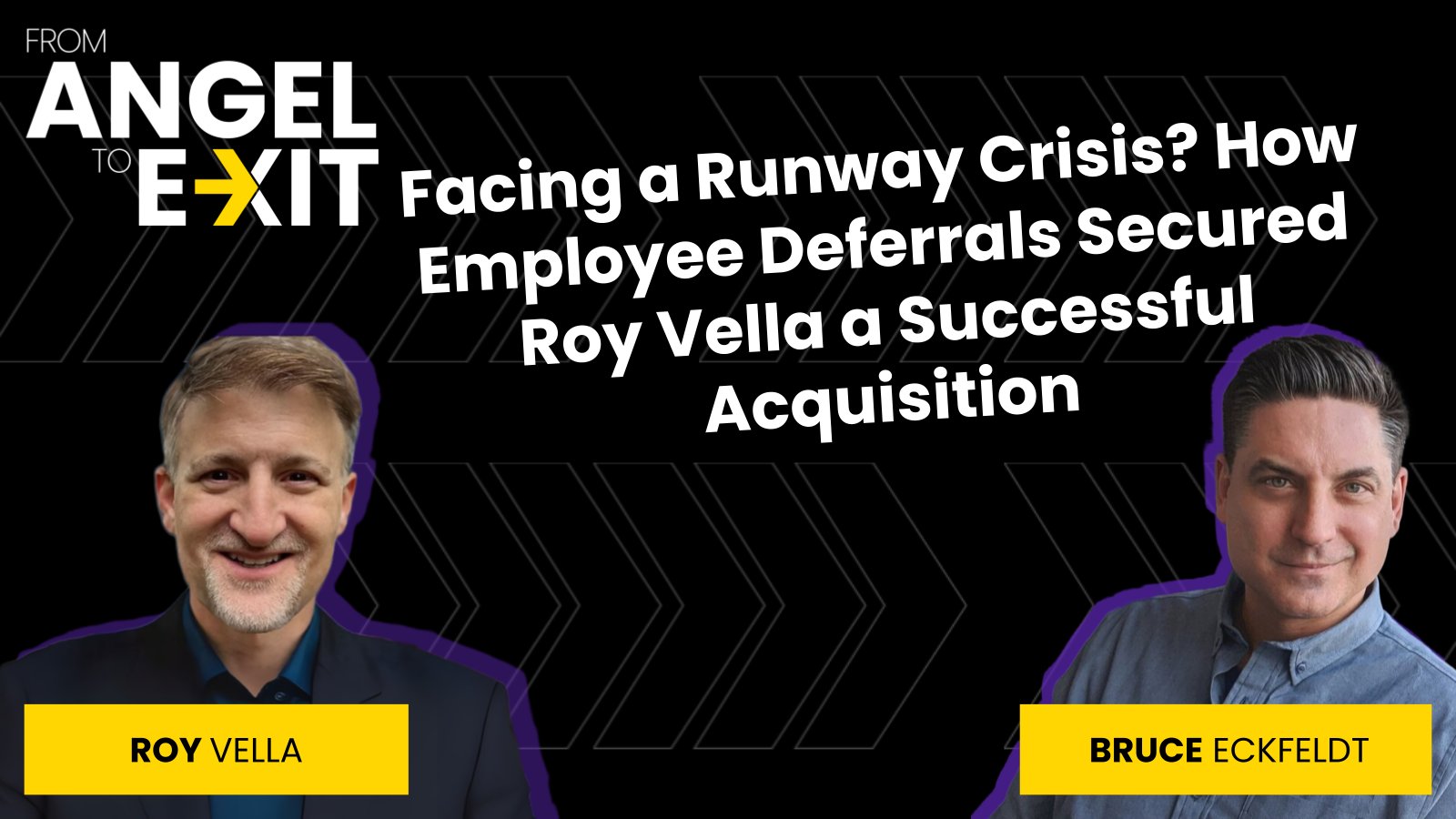
Facing a Runway Crisis? How Employee Deferrals Secured Roy Vella a Successful Acquisition
Roy VellaCo-founder, NetAbacus
Listen to the Episode.
Play the full conversation right here, or pick a chapter to jump straight to that moment. Prefer your own app? Every episode is on Spotify, Apple Podcasts, and the rest.
About This Episode.
Start with the key takeaways, the ideas worth bringing back to your leadership team. Then read the full story of the conversation, or use the chapters above to jump straight to the moment that matters most to you.
- Crises demand creativity: salary deferral saved months of runway and impressed acquirers.
- Transparency builds trust and accelerates deal-making during tough markets.
- Employee commitment and culture directly affect perceived acquisition value.
- Founders must embrace external visibility, storytelling is as critical as strategy.
- Integration-friendly businesses (API mindset) are far more attractive to buyers.
- Co-opetition often unlocks unexpected deal opportunities.
- Post-exit transitions can be jarring; expect emotional and cultural shifts.
- Strategic investor targeting includes competitors’ backers, who often want diversification.
What do you do when the dot-com bust kills your $15M funding round just two weeks before closing? In this episode, Bruce Eckfeldt speaks with Roy Vella, co-founder of NetAbacus (later Rivio), who faced a sudden capital crisis in 2000. Instead of folding, he created an employee salary deferral program that extended runway and impressed potential buyers. Roy shares how transparency, co-opetition, and integratable business models shaped the acquisition and his later career at PayPal and beyond. Founders will learn hard-earned lessons about resilience, deal-making, and preparing companies to thrive even when markets collapse.
Watch the Video.
Prefer to see the conversation? The full episode plays right here on the page, so you can watch while you follow the takeaways or read along with the transcript. Every episode of From Angel to Exit is also on my YouTube channel, along with short clips from each conversation.
About the Guest.
The background behind the conversation, and where to find this guest online.
Roy Vella
Co-founder, NetAbacus
Roy Vella co-founded NetAbacus, later Rivio, and kept it alive through the dot-com bust with an employee salary deferral program before it was acquired. He went on to work at PayPal and beyond.
- linkedin.com/in/royvella
Full Transcript.
The complete conversation, lightly edited for readability. Open it to read along, or search the page for a topic or a name.
Read the full transcript
Bruce EckfeldtWelcome, everyone, to From Angel to Exit. I'm Bruce Eckfeldt, I'm your host. Our guest today is Roy Vella. We're going to talk to him about his exit story, his exit journey, and what he's doing today. He's got a lot of different experiences, both as a founder who exited a company and from working with lots of companies and other founders in their process. So there's a lot of good learning here, and I'm excited for the conversation. With all that, Roy, welcome to the program.
Roy VellaThanks, Bruce. Good to see you.
Bruce EckfeldtIt's a pleasure. Before we dig into the exit, I'd love to get a little professional background. Give us the backstory on how you got into business and what the founding was like, and then we can talk about the growth and the exit.
Roy VellaSure. Deep tech geek. I was a math major undergrad, went to grad school, and got a JD/MBA. Always entrepreneurial. I started a company with my brother in high school to pave driveways, you name it. All that kind of stuff. And I think a bit of that is cultural. I'm an inner-city Brooklyn kid. My origin story is New York in the '70s and '80s, which was a bit rough and tumble. A bit scrappy, let's put it that way. I think everything you see in the movies about Brooklyn in that time is not inaccurate.
Bruce EckfeldtI'm curious, because I find this sometimes with entrepreneurs. Did you have family members who started or ran their own companies?
Roy VellaMy dad has always been very entrepreneurial. He ran his own consultancy in the early days of computers and the internet. I wouldn't say it's a family business in that regard, although insatiable curiosity is a family business. There's no question about that. Being a deep tech geek is about this: I can't help but be curious about everything.
Bruce EckfeldtSomething in the DNA.
Roy VellaI'll have calls with people where at the end they say, "I don't know anything about you. You just quizzed the shit out of me." And I can't help myself. "Wait, so how did that happen? Then you did this, but I don't understand how these two connect." I should have been a television interviewer, because I'll just go and go and go.
Bruce EckfeldtI think I remember feeling that way in one of our first conversations.
Roy VellaRight. People are fascinating, and it's across the board. I'm a firm believer that I have something to learn from everybody. I just do not have your lens, by definition. I don't care who you are across the table. You could be a kid in university. You still have a lens I don't have. And I think that's part of the entrepreneurial journey: you're constantly looking, you're curious. How do I fix that problem?
The startup we're talking about in terms of the exit was right out of business school. I tell younger folks especially that your risk profile, almost by definition, decreases over time. Your highest ability to take risk is now, and every moment from now it's getting lower. That's not totally true. Some people retire and then take risks. But generally, in that 20-to-40 range, every day your risk tolerance goes down, because you have bills to pay and family and kids. When you're in school or right out of school, you're pretty much the only person you're feeding.
Bruce EckfeldtYour obligations mount up. So tell us how it came up. Was it a business plan competition that you turned into a business? A side hustle?
Roy VellaNo, and there probably weren't even business plan competitions. This was back in the day, like '98. A classmate from business school had an idea and came to me, and I liked it. The company was called NetAbacus, and it was QuickBooks Online about five years before QuickBooks went online. These were the early days of the internet, and I'll tell you, we were probably about five years early.
But it went well. We raised a friends and family round, had some other co-founders, and the company got up to around 35 people. We were closing a $15 million VC round right at the cusp of April 2000.
Bruce EckfeldtNice timing.
Roy VellaRight. That's where the exit story comes in. Two weeks before the close, we kept going to the VC: "Everything good? Everything good?" "We're good." But the market, this was the first dot-com bust. Two weeks before the close, they said, "We've got to hold off. We want to see what's happening." And we said, "We can't hold off. What do you mean? That's not a thing."
We got together as founders, and this is where my JD came in handy. We designed an employee compensation deferral program. We told our team, "We cannot raise now. We had $15 million two weeks away. There's no way to get another raise in a reasonable amount of time. So we're going to sell the company. Whatever you defer of your salary, we're going to give you a 50% bonus on it when we sell the company."
Ninety-five percent of our employees deferred an average of 90% of their salary, and the founders stopped taking salary. So our runway went from six weeks to six months. Frankly, that's why we were able to sell the company. We went out to about a dozen players we thought would be a fit, got into serious conversations with five or six, had three offers, and took one. And the ones that got to the offer stage were like, "So your team wants to stay together so badly that they stopped taking salary? What is that?"
Bruce EckfeldtSo do you think that actually impressed them, and drove their interest in the company? "These are dedicated people."
Roy VellaYes, and we had a great team. It was a solid team who loved coming to work, who were hopping out of bed to make it happen. The product was solid, the team was solid, and that was an overt demonstration of it. They were saying, "We want this to continue. We don't want this to die."
We were called NetAbacus at the beginning, and I was running a rebranding to Rivio. Rivio was the name, we had the URL, and workflows was the process. The acquirer was a company called Biztro that was basically doing the rest of the back office for small and medium-sized businesses, but they weren't doing accounting. We had actually focused on payments and invoicing, because the idea of putting your accounts online was still too early. But payments between companies were already, by definition, online, and we had a couple of big contracts that made that work.
So it fit really well with Biztro. They were acquiring the technology and the team, but also the name. They said, "Rivio workflows. We like that." So NetAbacus and Biztro, post-acquisition, became Rivio.
Bruce EckfeldtInteresting. So they took it because you had the rights to the name and the branding already done.
Roy VellaWe had everything they needed for that.
Bruce EckfeldtDigging into that a little: when you realized you had to sell, there are two parts I'm most curious about. One, how did you identify the potential buyers? How did you think about what you actually had, what was valuable, and who would see that value or where there was an opportunity? And then, because you were on a timeline, what was the actual process of reaching out and saying, "Hey, do you want to buy us?" That's a delicate conversation, or at least a delicate pitch.
Roy VellaTotally. So one, everyone was aware of the market dynamic. There was no question about that. It was a bit of musical chairs. People heard the music stopping, and everyone was thinking, "Do I have a chair to sit in?"
Bruce EckfeldtThe volume's going lower and lower.
Roy VellaExactly. So it wasn't far-fetched. A bunch of different companies were trying to figure out what the market downturn meant to them. You have a list of competitors and collaborators in your business plan, hopefully. And it was Silicon Valley. We were in Silicon Valley, and all the acquirers were pretty much in the Valley. It's a small community at the end of the day. So you're using your network from grad school, your local community, people in the competitive set. You're at events all the time, pitching your stuff and seeing what people are doing.
The other thing I tell people is that co-opetition is a real thing. The biggest deal I did after that was when I was at PayPal, and half the people at PayPal thought I was crazy to be talking to the other company. On both sides, there were huge groups who thought we were direct competitors. And I said, "Yes and no. Their focus is back-end processing. Our focus is the front-end consumer. Do we do back-end processing? Yes. Do they do front-end consumer? Yes."
It's really about opening your mind to what's possible, where you're focused, and what you're good at. And the funny part is that it's more about a deep understanding of the operations of what you're doing: what's necessary versus what's sufficient.
There's a great story about that necessary-and-sufficient thing. People know TransferWise, a huge company. You'd say TransferWise is a currency conversion company. They do money transfer. They did that themselves for about six months, and then TransferWise realized it was a nightmare. You had to have accounts on both sides, regulatory status on both sides, and balances on both sides. What TransferWise was really good at was app development, customer acquisition, and customer service and support. About six months in, they gave the entire back end to a company called Currencycloud.
Bruce EckfeldtInteresting.
Roy VellaNo one's ever heard of Currencycloud. Currencycloud is the back-end processor for a ton of front-end money transfer providers. If you looked at it, you'd say TransferWise and Currencycloud are competitors. They both do money transfer. Not really. So understanding the dynamics of the market and where the focus really lies inside a company makes things more apparent. And as I said, Biztro was not looking at any sort of payments, invoicing, or accounting. They did not want to touch money. They were doing HR and that kind of stuff. So the fit was pretty good.
Bruce EckfeldtWhat was the outreach like? Did you use back channels? Did you just ping CEOs? How did you actually talk to these people and say, "We're interested in being acquired. Here's the deal"?
Roy VellaLook, I tell everyone that trust is about a feeling of transparency. So the more up front you are, the better. Now, other people will tell you that's a bad negotiating tactic. But if time is not on your side, you want to be transparent. And by the way, our story was excellent up until April 2000. We had a term sheet for $15 million. We were on a path. So being transparent was in our favor. "This is the situation. But we have a solid team, here's what we're doing, here's what we expect to do, and here are our plans. And by the way, our staff really wants to stay together. Look at this employee compensation deferral program we have."
And a lot of it, in the early days of an acquisition, and we were an early company with a few dozen people, is fit. There are a lot of fit questions about how you integrate into the other company and all that. As for reaching out, you have your list, and then how do you know them? LinkedIn was in its early days, but we could still connect the dots. "Okay, I'm going to go talk to this person." We put feelers out and started having conversations.
We merged with a company that was slightly bigger and slightly further down the road, and they saw this as an accelerator. They brought in another team that would work to grow their business and expand their footprint.
Bruce EckfeldtIt moved them another six months down their path quickly. What was your cap table like at that point? What was the ownership structure?
Roy VellaExactly. It was friends and family at the time, because we hadn't brought in the VC money.
Bruce EckfeldtSo there wasn't a lot of complexity in aligning your owners. Everyone was fine with getting some money.
Roy VellaRight. And again, market dynamics. Everyone was aware: "Crap, what's going on in the Valley now?" Things had shifted, and everybody felt it. It was an earthquake. You couldn't avoid it. "Did you feel that?" "I felt that."
Bruce EckfeldtAny particularly interesting or complicated parts of the deal terms, in terms of transfer of things, staying on, integration, or post-transaction?
Roy VellaPost-transaction, you go from being a founder of the company to being an employee of a new company. That's an adjustment, and some people don't make it well. You also go from sitting at the top table to sitting at a middle table somewhere. We took executive positions, but I wouldn't say any of us founders were on the leadership team of the company. And we operated independently for a while.
This is the other interesting thing about acquisitions: the personal dynamics make a difference. Some acquisitions merge right in, and there's no trace of the other company. We were very separate for most of the time I was there. Most of us had a one-year earnout, and most of us stayed for the whole thing. One of our original employees, and I'm not certain right now if she's still there, was there for decades after. Crazy.
Bruce EckfeldtFound a home.
Roy VellaFound a home and just stayed. So it varied a little, but it's a shift. It's a shift from knowing all the key things that are happening to not really knowing. You have to let your baby go, to a certain extent. "This is not my baby anymore. This is their baby. Now you're adopted into the family." You're a bit of a foster child. So that dynamic changes for sure.
Bruce EckfeldtWhen you originally did the deal with that one-year term, what was your mindset? "I'm going to do this and then move on to something else"? Or "I'll do that, and then maybe I'll stay, maybe I'll go"? How committed were you beyond that one year?
Roy VellaI think we all went in open-minded. It also depended on where you were in the new organization. I was reporting to the CMO, and I actually left because he left and recruited me out. He took me with him. I wouldn't have predicted that in advance. I didn't even know him when I first went in. You never know what dynamics are going to happen. And the acquirer is trying to figure some of that out too. Is our CTO better than the CTO they have right now or not? There's all sorts of integration stuff.
Bruce EckfeldtA little bit of a bake-off.
Roy VellaI tell people that when eBay bought PayPal, Meg Whitman wasn't happy about it. PayPal was Siberia. We were the ugly stepchild. When Meg wanted to punish someone at eBay, she sent them to PayPal. I'm not even joking. We had open positions at PayPal that eBay people would apply to through an internal application process. And openly, not hidden, when we recruited someone, we'd say, "Okay, great, you got the job. It's going to take two or three months to de-eBay you, but you'll be fine after that."
Bruce EckfeldtThat's like delousing somebody.
Roy VellaThe cultures were very different and never changed. They just stayed separate. And by the way, that's why PayPal could be spun out: it was never integrated.
Bruce EckfeldtDo you feel that was strategic? Did someone look at it and say, "We want to keep this separate because we may want to unwind it at some point"?
Roy VellaYou'd love to say in retrospect that it was strategic. It was also a bit personal. Meg made an offer to PayPal, PayPal declined it and went public, and a year later Meg had to buy it for twice the price she had initially offered. She wasn't happy. There are a lot of personal dynamics. But then of course eBay bought PayPal, eBay bought Skype, and then spun them both out again.
Bruce EckfeldtYou never know where it's going to go.
Roy VellaSometimes it's strategic, and sometimes it's just people being people.
Bruce EckfeldtWith this whole experience at the first company, what were some of the positive things you learned that you were able to apply successfully to subsequent decisions? And was there anything that left a bad taste in your mouth or gave you pause about taking risks or getting back in the game? I'm curious how these things affect people's decision-making and how they approach new ventures.
Roy VellaHumans are humans, and emotions are an essential part of humans, and emotions are part of the game. A lot of entrepreneurs come in with a very analytical, logic-based lens. And I'm talking about Silicon Valley and technology.
Bruce EckfeldtCertainly tech folks. If you're a fashion startup or something like that, it's all emotion.
Roy VellaRight. But even in tech, the personalities matter, the interpersonal dynamics matter, and people's perception of themselves and others matters. The interpersonal dynamics are essential. I was just chair of a company in Amsterdam, and when I agreed to be chair, it all looked rosy. Then the two founders just collided like rams with horns, and it made a mess. You wouldn't have predicted that in advance. So the interpersonal dynamics are real.
People may not realize it. The bulk of your neurons are between your ears, but you have neurons in your heart and in your gut. So this whole old wives' thing about gut feel and what you feel in your heart: there's real processing going on there. There's input. I tell people you have to trust your gut. If something feels off, can you go for it anyway? Yes, but be aware you've introduced risk into the equation. It's as simple as that.
Bruce EckfeldtThere's actual sensor input. I think that's great general advice. Is there anything you do systematically to check in? A set of questions you ask yourself? Taking a walk around the block and letting it soak? Is there some way you actually check in with some of those things? I think it's really interesting.
Roy VellaTalking it out, to your partner, to your co-founders. I tell people you want to be as transparent up front as possible, in the sense of, "I'm all in, but I'm concerned about this. I see our biggest risk as this. I don't think it's a deal breaker, but I want you to know." Maybe it's a stylistic thing, and maybe it's a Brooklyn thing. I'm just going to tell you what I think. I think it reduces risk moving forward, because other people then feel free to talk about it. They say, "You know what? I had the same feeling. How do we address it?" How do we try to be proactive? You can be reactive, ignore your gut, and wait for the shit to hit the fan. Or you can be proactive and say, "Maybe we should move the fan. What do you think?" In my experience, the more transparent you can be, the better.
I'm not saying it's for everyone. Some people like to hold their cards close to their chest, but that's because they think of a fixed pie. I'm much more of an entrepreneurial mindset: we can all win in this scenario. The pie will grow tremendously. Holding your cards close to your vest is more of a fixed mindset. If you get it, I don't get it.
Bruce EckfeldtA zero-sum game. Let's make a bigger pie.
Roy VellaYes. And look, it's an emotional roller coaster. That's the other thing. It's not only a commercial roller coaster. There are good days and bad days. But the truth is, I tell people you should be hopping out of bed. In fact, I tell everyone I work with, "Beware of what you enjoy around me, because I'm going to give you more of that. And what you suffer with? Guess what. He loves the thing you're suffering over, so I'm going to give it to him." You should be hopping out of bed. I'm not saying there aren't parts of your job you just have to do. Maybe you have to do your expense reports because we don't have someone doing that for you at the moment. But you should be excited, because when you're excited, time stops, you enter flow, and off you go. If you're miserable, life's too short. Misery doesn't put you into flow and make you productive. And I think that applies to yourself as well. Outsource. Send what you're not good at to others, because they're good at it and they love it.
Bruce EckfeldtAbsolutely. I'm constantly finding ways to offload to a VA, to somebody. My general rule is a 10-to-1 ratio. Even if it's going to take them 10 times as long as it would take me, I still have them do it, because the value I get from that hour back more than pays for whatever it costs to have them spend 10 hours on it.
Roy VellaRight. And by the way, that's hard to do. I'll tell you a story that's less entrepreneurial. RBS, the Royal Bank of Scotland, recruited me out of PayPal. I was a senior executive, so I had to have an assistant. In the Valley, very few people had assistants at that point. You ran your own show. Maybe the CEO had a chief of staff or an assistant. So I said, "Nah, I don't need an assistant." And they said, "No, it's a requirement." It was cultural too. I was in London.
My assistant was awesome. She pulled my calendar out of my hands. And once that happened, I would come in and she'd say, "It's his birthday," or "They're having a challenging day." Her ability to take things off my plate without me even wanting her to was incredible.
Bruce EckfeldtIt's like a mind meld.
Roy VellaIt's a mind meld. And I was very reluctant. But after I learned my lesson, I thought, "Wow." It's just what you said: it gives you back an hour you didn't realize you were wasting. I liked owning my calendar and my email and everything. But the calendar I went to bed with was different from the one I woke up with. I'd say, "What's going on?" And she'd say, "I had to bump them to move this." And I'd say, "Great." Again, that's trust.
Bruce EckfeldtAbsolutely. 100%. Trust.
Roy VellaThat's transparency. We were clear about that. So even at the startup phase, you can get someone who can be your right hand and do that kind of stuff, and that can be invaluable.
Bruce EckfeldtEspecially in today's world. It's so easy to find remote resources, and I do it for all sorts of things. I pick an area of my life and find different people to do different things so I can optimize and create process. I'm curious, from the experience you had with the whole sale process, what has carried with you in how you approach business and entrepreneurship? Whether it's your own companies or advising other people, how has it shifted your approach to strategy, to preparing for and thinking about exits, and to managing that process?
Roy VellaThat's a big question. One is definitely co-opetition. I almost never look at anybody as a competitor I can't talk to, because there's always room for a deal. That's my overall perspective.
The other thing: with fundraising, for instance, I often tell startups, "You have a competitive list." Most people avoid the investors of the companies on that list, and I think that's kind of insane.
Bruce EckfeldtInteresting. Because they figure those investors won't invest in them because they're invested in a competitor, or there will be some conflict?
Roy VellaI tell people all the time: you can go talk to the people in Kathmandu, or people all over the globe, but you really want to talk to the people at base camp. The people at base camp know what they're in for, and they're looking to diversify. They're investors. Granted, a lead investor who's got a board seat, maybe not. But everyone else understands your space, and you're different from the other company in these ways. Diversification is good for the investor. They believe in the horse race. They just don't know which horse is going to win. So that's your starting list. If you're very, very close, maybe not. But the truth is, you think you're the same, but you're different companies. And there may be an opportunity for a deal or a merger where that investor is the key element in both companies.
Most companies, by the way, brag about their investors on their about page. So go to their about page and get the list, or go to Crunchbase or LinkedIn. You can find out who invested in a company. It's somewhat similar to my competition perspective. At the end of the day, those are the people who get it. Having to explain mountain climbing to someone in Kathmandu, or even in New York, is a waste of time. You'd have to bring them up to the level the people at base camp are already at.
Bruce EckfeldtI love that idea. Not only is it probably easier to make the pitch, because they get the fundamentals and can see the angle you're taking, but they're actually more valuable, because they have a lot of experience and insight and the context. The idea that they could broker some kind of JV, merger, or acquisition down the road is hugely valuable.
Roy VellaTotally. So I'd say I'm much more open-minded about the possibility set. There are very few conversations I won't have.
Bruce EckfeldtWhat advice do you give earlier-stage founder-CEOs who are more on the scaling side? Things to do or not do that will help with valuation, with being sellable, or just keep their options open and their possibilities for success down the road. Anything you tend to focus on?
Roy VellaRegardless of your business, I'd almost say keep the API in mind. You should be integratable. You have hooks. I'm talking in technical language, but at the end of the day, having hooks in and out of you that are plug and play makes things so much easier. If you're using off-the-shelf tools, whatever you can do to match some sort of industry standard in whatever you're doing makes it way easier. If the plugs all look the same and I don't need my UK adapter to make it work, great. You make life simpler and easier if you have that integration mindset already.
And by the way, I also say that for sales. I'm a huge fan of a channel to market.
Bruce EckfeldtTell me more about that.
Roy VellaBecause trust commutes. Bruce trusts Bob, so I can trust Bob. So with your channel to market, whatever it happens to be, whether they're a retail front end and you're the back-end manufacturer or whatever: you can always go direct to people, but direct means building a bridge from scratch, and that's a pain. I'd much rather you have built a bridge and I just send goods over it. It's much more valuable to give you 10%, 20%, maybe 30% of revenue to use your bridge.
Bruce EckfeldtThat's interesting. I do a lot of strategy work with companies, and I always say you want to invest in uniqueness, in the proprietary stuff you really own, on the core things that make you different. For everything else, find the off-the-shelf solution, find the open source. Otherwise you're spending valuable effort, time, and money on things that aren't differentiating. Focus on the things that are different.
Roy VellaDon't reinvent the wheel.
Bruce EckfeldtExactly. If your expertise is an amazing lubricant, don't build a wheel. Use other people's ball bearings. Just focus on the lubricant, because that's your unique difference. And it actually makes it easier to get out to market, because it's standard and you're able to plug into everything, like you said.
Roy VellaAnd that's super valuable. Humans' trust does commute. You make an intro, and my baseline level of "Can I trust this person?" goes up, because relationships are contiguous. I think that's part of the mindset in the early stage especially: the less you have to do to deliver the value you provide, the better. It goes back to the assistant thing we were talking about. Focus on what you're hopping out of bed for, let other people do the rest, and recognize and appreciate that. It's a go-to lubricant. It lubricates the channel to market, and it makes you more buyable.
It also makes partnerships easier. The more you have an industry-standard format in whatever you're doing, the more palatable you look, both to work with and to acquire. And I also say that the most likely acquirer, if you're not going to go public, is someone you already work with. It's already your channel partner.
Bruce EckfeldtLet's talk about that a little, because I find a lot of earlier-stage companies, particularly first-time founders, are so focused on the internals of the business that they haven't developed a good external view and set of relationships. And like you said, that's often where you'll find buyers, or access to buyers. What do you see good founders, executives, and leaders do to develop those external relationships? Any patterns or routines that help them build those networks?
Roy VellaAs a founder, you are the lead salesperson of your company. So go on podcasts, go out to events. Literally get out there and talk about the business. Be at the conferences, out on the street. Pounding the pavement is a huge part of the whole thing, whether it's investors, partners, channels to market, or employees. The public presence is essential.
I tell people you want to be a comfortable, confident public speaker. I only half-jokingly tell people that of all my higher education, improv training was by far the most valuable. Because we are storytelling and story-digesting creatures. That's what we do. We've been doing it for hundreds of thousands of years, and we used to practice every night. The fire would go up, and everyone was telling and receiving stories. Then came radio and television and movies and TikTok, and we have become largely receivers. Most people do not practice their storytelling skills.
And as a founder, you're the master storyteller. From the very beginning, when you get your first employee or co-founder or your first angel or friends and family, you're telling a story. And stories are well-understood, well-structured things: the arc of a story, status, language, speed, cadence. So improv training alone is almost entrepreneurial training, in my view. I'm not saying every improviser is an entrepreneur, or vice versa, but that training works. Understanding status, stillness, silence. There are so many dynamics to a story that are about how you present yourself and your company.
And by the way, you could be a founder and not have any of those abilities. But then you have to hire the front man. Maybe it's a co-founder, maybe not. Maybe it's your chief marketing officer. But someone has to do it. That job is a real and essential job that has to happen.
Bruce EckfeldtSomeone's got to do it. I'll post it to the podcast newsletter when we launch the Improv for Founders program. I sense that coming.
Roy VellaAgain, it's how you leave people feeling that makes them say, "Wow, okay, I want to get on that train." That's the essential element. It's not your chart showing your five- or 10-year projection of the future. It's more, "Okay, this is going to happen, and I want to be part of it."
Bruce EckfeldtWe're at time here, Roy. This has been a pleasure. We've covered a lot. Thank you so much for the stories and the conversation. There are a lot of great takeaways for folks. If people want to get hold of you or get more information, what's the best way to do that?
Roy VellaI'm blessed with a very unique name, so it's pretty much Roy Vella at anything. Just take the space out. You'll find me on LinkedIn, it's royvella. On Twitter, it's royvella. royvella at Gmail. You name it. I'm pretty easy to find in that regard. And we didn't talk about AI at all. That's a miracle. That's all I talk about these days.
Bruce EckfeldtWe'll do another episode.
Roy VellaHappy to connect. I love creative problem solving. I'm not sure I said this before, but mentor, advisor, board member, angel, I do all of that, and I love it. I'm sort of industry independent. I've ended up on boards I never would have expected, just because the founder said, "Can we talk more?" I was on the board of a maternity clothing company. I know nothing about fashion.
Bruce EckfeldtFirsthand experience, I can tell.
Roy VellaRight. So you never know. But I love to help. If I can help, I can help. And as I said, I feel like I've got more to learn. So I'm happy to have conversations with whomever.
Bruce EckfeldtThat's perfect. I highly encourage everyone to go check out your sources of information. There's a lot more to you than we got a chance to get into here. I appreciate it so much. Thanks for taking the time today.
Roy VellaGreat. Thanks, Bruce. Pleasure.
Never Miss an Episode.
Know the moment a new episode goes live. Subscribers also get a say in future guests and the topics we cover.
Other Related Episodes.
More conversations that connect to this one. Or browse the full archive by topic or by guest.
Sam Arman
How he built and sold several companies, some under pressure and one for a 10x private equity exit.
Listen and Read
John Ratliff
How a call center business grew through 24 acquisitions and sold at a 14x multiple.
Listen and Read
Matthew Porter
How he bootstrapped a data center company, grew it through acquisition, and sold it twice.
Listen and Read