From Angel to Exit Episode 25
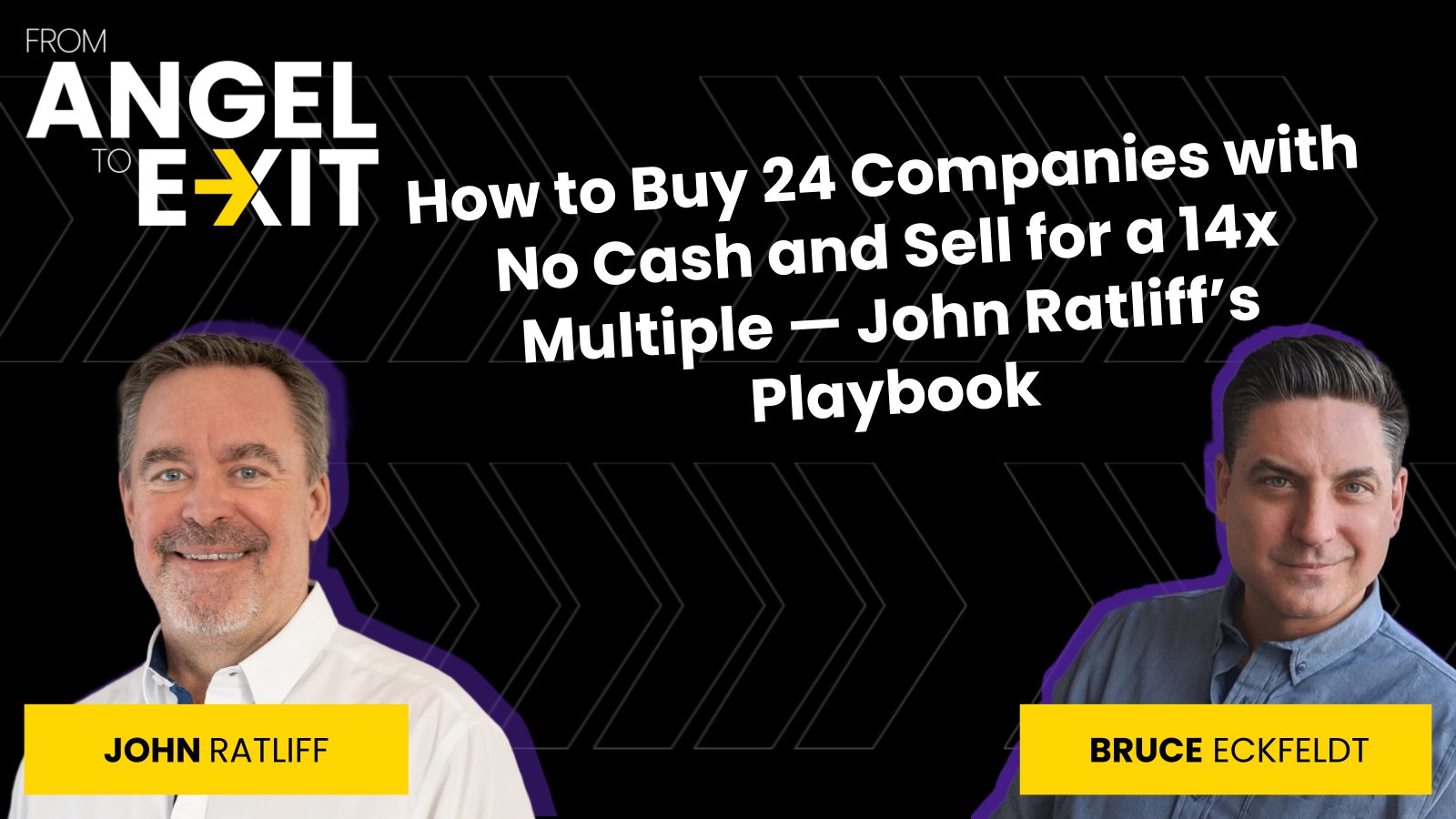
How to Buy 24 Companies with No Cash and Sell for a 14x Multiple: John Ratliff's Playbook
John RatliffFounder, Appletree Answers
Listen to the Episode.
Play the full conversation right here, or pick a chapter to jump straight to that moment. Prefer your own app? Every episode is on Spotify, Apple Podcasts, and the rest.
About This Episode.
Start with the key takeaways, the ideas worth bringing back to your leadership team. Then read the full story of the conversation, or use the chapters above to jump straight to the moment that matters most to you.
- You can scale through acquisitions without raising outside capital, if you master bank relationships.
- Know your strategic value inside the buyer’s ecosystem, it’s often worth more than your financials show.
- A strong exit multiple (14x) is possible when you’re the most coveted asset in a fragmented market.
- Bank relationships should be treated like partnerships, not vendor agreements.
- Your personal finances and lifestyle must be exit-ready before the deal closes.
- Never use your company email as your personal email, it could be gone post-exit.
- Build acquisition teams internally with cross-functional talent, not full-time M&A staff.
- Think like a buyer: reverse engineer how your capabilities create value after acquisition.
In this episode, Bruce Eckfeldt sits down with John Ratliff, founder of Appletree Answers and now a partner at Align5 and advisor at STS Capital Partners. John shares the behind-the-scenes story of growing a call center business through 24 acquisitions, all without outside capital, and selling at a 14x EBITDA multiple. He also reveals how founders get taken advantage of by sophisticated buyers, and what you must do to avoid selling for less than you're worth.
Watch the Video.
Prefer to see the conversation? The full episode plays right here on the page, so you can watch while you follow the takeaways or read along with the transcript. Every episode of From Angel to Exit is also on my YouTube channel, along with short clips from each conversation.
About the Guest.
The background behind the conversation, and where to find this guest online.
John Ratliff
Founder, Appletree Answers
John Ratliff founded Appletree Answers and grew it through 24 acquisitions without outside capital before selling at a 14x EBITDA multiple. He is now a partner at Align5 and an advisor at STS Capital Partners.
Full Transcript.
The complete conversation, lightly edited for readability. Open it to read along, or search the page for a topic or a name.
Read the full transcript
Bruce EckfeldtWelcome, everyone, to From Angel to Exit. I'm Bruce Eckfeldt, I'm your host. Our guest today is John Ratliff. He is founder and CEO of Appletree Answers. We're going to hear that story, and also his story as an advisor with Align5, and his experiences in private equity with STS Capital Partners. John has a lot of experience in this area. I've known John for quite some time, and I'm excited for this. I've heard bits and pieces of these stories in different ways, so it's fun to sit down and actually hear some of the details. With all that, John, welcome to the program.
John RatliffThanks for having me. Happy to be here.
Bruce EckfeldtIt's a pleasure. Before we get into the entrepreneurial story and all the things you're doing with advisory work, I'd love to get a little background on what you were doing before you got into business, professionally and education-wise. And tell me a little about how the first business started.
John RatliffThat's a good place to start. I was that kid who always knew. I didn't know the word "entrepreneur" when I was 10, but when I got the question, "What do you want to do?", it was never policeman or fireman. My stock answer was always, "I want to own a business." I was literally the 10-year-old with a paper route who got other kids to be on the paper route. I cut lawns, but I got five other guys to mow lawns with me and went out and sold everything. I was always that.
And funny, I forget about this from time to time, but right in our backyard was a tiny little ski area. After school we'd come home, put our stuff on, and go ski until dinnertime. When I was 15, I started working there. Because it was such a short season and such a small place, they'd bring a manager in every year to run it. But what kind of great talent are you going to find to work 75 days a year? So they really struggled with finding people, and by 16 I was running the place.
They had a snack bar there. The owners were two chemists from DuPont, originally from Taiwan, who didn't speak a lot of English and didn't really have a lot of business sense. So I convinced them to let me run the snack bar, and we'd split the profit. I was always doing these wildly entrepreneurial things.
In college, I started a marketing company. We sold ads to bars and restaurants. And when I say "we," Bruce, "we" means me. I don't know why I use the ubiquitous "we," but when you hear me say "we," what I should say is "I." I did that in college.
Then, right out of college, my only real job, minus the ski area, was working on commission only as a salesperson for a little wireless phone store, for about five months. I decided I could do that better on my own, so I left, opened my own store, then opened a second store, and sold that at the tender age of 22 or 23 to open Appletree, the call center company. That consumed the next 18 years. So that was the entree. But I was always that entrepreneurial kid. Drove my parents nuts.
Bruce EckfeldtWith Appletree, did you know at the time, "This is going to be the big play"? Were you intentionally going into a really big play? How did that unfold? I'm always curious how things start.
John RatliffNo, it was actually the exact opposite. At my second wireless store, my landlord had this little old-fashioned answering service where you literally took notes on a piece of paper. It's a long story we don't have time for today, but when I was selling the wireless stores, he convinced me to get into the call center business, but in Delaware, not in southeastern Pennsylvania, because at that time, and I'm going to show my age, you couldn't compete across state lines in the call center business. It's hilarious in hindsight, but back then you couldn't. So he set me up with the guy who made all his equipment, and I ended up in that business totally by accident. I didn't think it was ever going to turn into anything at all.
It took seven years for us to get to $1 million in revenue. Then a buddy of mine, I was actually the best man at his wedding, and he was our CPA, asked, "Have you ever thought about doing acquisitions?" I thought, "Acquisitions? We don't have any money. We can barely afford to keep the lights on. No, I haven't thought about that." But that led to building a relationship with a banker and with a business broker. We bought a company, then a second company, and 24 acquisitions later, Appletree did turn into my life's work.
But no, I never for one moment thought that when I started it. In the beginning, I answered the phone. We literally had one employee. The business was 24/7, which is really dumb. I had a big buzzer next to my bed. When the phone rang in the middle of the night, the buzzer would go off and wake me up, and I'd have to stumble out, answer the phone, and then try to go back to sleep. In the beginning, when we didn't have a lot of customers, it wasn't so bad, but it reached a point where that was not a good idea. I don't remember most of 1997. I was so sleep-deprived that it was total chaos.
Bruce EckfeldtIt's classic scaling chaos. Do you still have the pager?
John RatliffNo, but to this day, when I hear that ringtone, it triggers a PTSD response in me. Fortunately, it's not a popular one anymore, but if I hear it, it literally changes my physiology. It was bad. There were some dark years in there, for sure.
Bruce EckfeldtWe won't say what that ringtone was. I think every entrepreneur has been through at least a couple of dark years.
John RatliffTolerance for pain gets underappreciated among the skills needed to be an entrepreneur. That one gets lost sometimes.
Bruce EckfeldtIt definitely has a shadow side. I see a lot of entrepreneurs who are willing to tolerate a lot of pain they probably shouldn't, just because they can.
John RatliffRight. Annie Duke, the poker player, wrote the book Quit. Sometimes it's time to quit. There was no quit in me, and it worked out, but there were moments where I probably should have quit the call center business, for sure.
Bruce EckfeldtWas there an inflection point for you, where this went from "This is really hard" to "I think we could do this. There's a real opportunity for scaling here"?
John RatliffThe inflection point story I tell a lot publicly, and I'm fascinated by this concept, is that in most companies, if not almost all, there's a moment where one seemingly innocuous decision changed everything, and it could have gone either way. For me, again, I'll take you back to 1997, totally sleep-deprived.
At that point I had a handful of people who would come in and take four hours here or there so I could sleep a little. But on weekends, I'd say goodbye to whatever employees we had at five o'clock on Friday, work the entire weekend with the buzzer and all, and then on Monday someone would come in and I'd actually sleep Monday morning. The company had gotten big enough that my longest stretch of sleep was probably about two hours for the whole weekend. I joke that I don't remember '97, but I really don't remember 1997.
So it's four in the morning on Monday. I've been up all weekend, I'm exhausted, and the buzzer goes off again. I get up and I think, "I'm done. I can't do it anymore." The way I had it set up, I was in a two-bedroom apartment. It was zoned commercial, but it was an apartment. I had a little office with a twin bed, and to take the calls I had to walk across what would be the living room and into the dining room, where the workstations were set up. That gave me about 30 seconds to wake up from a zombie-like dead sleep.
I had to walk by the closet where all the telecom equipment was. As I walked by, I looked in and thought, "All that equipment is literally what's ruining my life." Without even realizing what I was doing, I walked into the closet and put my hands on our telecom switch, which looked like a small filing cabinet. I was literally going to yank it off the wall, throw it on the floor, and go back to bed. That's where I was.
I reached out and grabbed it, and I had that "your life flashes before your eyes" moment. My business life flashed before my eyes. And I realized, in that weird stupor, that if I just stayed with it, it would turn around and be okay. I could hire employees and do all the things. But I'll tell you, I was really close to ending it all in that moment. So that was the first real watershed. I came to a fork in the road, made a decision, and in hindsight it turned out.
The next big one was when we had paired up with a broker, and we had a banker who must have been, I don't know, drunk when he agreed to lend us money to buy companies. Again, I'm going to date myself, but when a company was for sale, the listing would come in on our fax machine. And not even on regular paper.
Bruce EckfeldtOh, nice. That glossy paper that comes in rolls.
John RatliffWith all the smears and everything. We had made offers on four or five companies and kept missing. Finally, my CPA, the one who talked me into doing this, said, "Listen, the next one that comes through, let's just offer full price, whatever it is, wherever it is." Back then, the price was on the listing sheet.
So a deal came through in Pensacola, Florida. We offered full price, and we won. They said, "It's yours if you want it." We ended up buying that business. It probably took four or five months to get it done, and, for way more reasons than we can cover today, we learned a ton in the process.
While we were closing on that business, this was 2003, we were sitting at a picnic table in Pensacola at Smokey's Barbecue, I'll never forget it, signing the documents, and my cell phone rang. It was the broker. We'd made a bid on a company in Portland, Maine, that we lost, and the deal had fallen through. The broker said, "Hey, Maine is back on the table."
Ralph was the CFO, so I turned to Ralph and said, "Hey, Maine's back on the table." We're literally pen in hand. Again, this is 2003. We had bid $1.1 million and lost to a bid of $1.2 million. Ralph says, "Well, tell them we could do $1 million." I'm thinking, "No, we can't," but okay.
Bruce EckfeldtWhat are you doing?
John RatliffSo I said, "Steve, we could come back at $1 million." He said, "All right, I'll call you back." Five minutes later the phone rings again. "Okay, they accept." I turned around like, "Oh no, what the hell are we going to do?"
So we convinced our drunk banker to lend us more money in 2003 than our gross revenue was in 2002. It was a cool story how we did it. They actually put us in front of the director of credit, who's the guy at the bank you're never allowed to talk to, because if he interacts with humans he might get biased. We got a meeting with him and laid it out: "Here's the collateral. Here's what would happen in a fire sale. And here's why this is a good idea for the bank." And shockingly, they agreed to lend us the money. We closed on those two transactions within 60 days of each other, for more than our gross, not net, gross revenue the prior year. And we were off to the races at that point.
It did a lot of things. One, it gave us the discipline to really understand deal structure, how much to pay, and how to be responsible. But it also gave us the opportunity to really build a relationship with the bank. I talk about that all the time. You need to think about your bank as a partner, not a vendor. Especially if you're going to be acquisitive, but even if you're not, the time for every entrepreneur to start building bank relationships is right now. Start thinking about them like a partner, treat them like a partner, and inform them as if they were partners. That bank relationship was literally the key that unlocked everything for us. So that was it: Smokey's Barbecue in Pensacola, when the phone rang and we said we'd pay $1 million. I still don't fully comprehend how we got that across the finish line, but we did.
The last thing the director of credit said after a two-hour grilling about why this was a good idea was, "We don't want to see you back here for at least a year." So we waited a year and did our third deal. We ended up buying 24 companies, all 100% bank and seller financed. We never took a penny of capital out of our pocket to do a deal, which is crazy.
Bruce EckfeldtWas that strategic, or was it necessity? I'm curious how much of this was intentional and how much was situational.
John RatliffIt was so much dumb luck and full-on necessity, because we just didn't have any money. We ran the business and reinvested, ran the business and reinvested. There was no cash. The first day we had any real cash was the day we sold the company, 18 years later. "Oh, this is what it's like to have cash in the bank." We always ran with a line of credit. We were super disciplined about how we ran the company, but we ran it from a really lean cash position, because we invested heavily in growth.
Bruce EckfeldtI'm curious about your role and where your skills and focus went. How much was operating the business versus finding and doing these deals on the acquisition side? How did you split your time?
John RatliffInterestingly, in the beginning, the acquisition side was obviously pretty consuming. We did our first deal in '03 and sold in 2012: 24 deals in that eight-year stretch. And we never had a single person on our team, that whole way, with direct accountability for M&A. Everything was done with a makeshift transition team, deal by deal. The rule was, "You can be on the M&A team. You'll learn a lot, it's fun, and you get to travel, but you're still responsible for your core job functions." People volunteered like crazy. It was a coveted spot to get on a deal team.
We would typically do a six- to eight-week on-site transition. Some of our core team would travel to the acquired company. We kept them all intact. Normally we'd move them to better office space. Most of the companies we bought were in awful, terrible office space.
Bruce EckfeldtClass C.
John RatliffClass F. Of the 24, I'd say we probably moved 17 or 18 within the first year to 18 months. We'd be on site about six to eight weeks and bring everyone along, get them bought into our culture and how we do things. All of that function was core team members who just added it to their to-do list.
Then, maybe 14 or 15 deals in, I got out of the way. I stopped going. I'd negotiate the deals and help find them, but I wouldn't do any of the transition work. We sold in '12, and in probably '10, '11, '12, I really looked at my role as eight days a year where I had to show up and do my best work. You're part of the Scaling Up ecosystem, so this will make perfect sense. We did a two-day annual planning session and then three two-day quarterlies. Those eight days were my days to really play my part in the success of the company. Outside of that, I got out of the way and let the team run the business. There were times, a crisis or this or that, where I had to swoop back in, but by and large it was pretty much self-managed for the last several years.
Bruce EckfeldtIn terms of the deals themselves, was there a strategic framework you used to identify the types of deals you were looking for and evaluate them? Geography, size? What were your parameters for finding acquisition opportunities?
John RatliffInterestingly, and again, most of what we learned was anecdotal. I'm a reader and a student. You work with lots of entrepreneurs who are students of the game, students of the process, and I was that for sure. But most of what we learned, we learned by making dumb mistakes. We learned over time that there was an optimal size.
Just to be clear, when we say call center, we did really high-touch, boutique customer service. Our gross margins were in the 60s. In the call center world, at a 25% to 30% gross margin, you're killing it. We were at 60% to 63% in any given year. So it was really high-touch, priced accordingly.
And we knew, based on our particular model, that there was a perfect size. There was value in being local, because a lot of what we did was in the community we were in: hospice organizations, property management companies, home health care. It mattered. I'm from Philadelphia. There's a town outside Philadelphia spelled B-A-L-A and then another word, C-Y-N-W-Y-D. Everyone from Philly knows you pronounce it "Bala Kinwood." But if you're somewhere else and you see Bala Cynwyd, there are a million ways to pronounce it, and normally it's not "Bala Kinwood." So there's value in being local in that high-touch world.
We knew that if we could be, and this was 2008, 2009, 2010, at about $1.5 to $3 million in revenue at the local level, we could run it with one operations manager, one customer service manager, and one senior team leader, and that was it for that site. We could get site-level profitability to about 40% to 45%. As soon as we got above $3 or $3.5 million, all of a sudden you've got an assistant ops manager, an assistant customer service manager, a couple more team leads, and someone needs an admin, and suddenly we're at 25% at the site level. Which is great, but not when you know you can optimize for 45%.
It was interesting, because we sold to a public company, and we were looked at by a bunch of private equity firms as well. When we sold, the first question we always got was, "Why don't you consolidate into one or two big call centers?" I'd lay it out just like I did for you, and every time they'd say, "Yeah, we don't see that." But our rent was only about 4% of our revenue, and we were pushing 45% site-level EBITDA. If you're optimizing a 4% expense item on the P&L to try to get it to 2.5%, and it does any damage anywhere else in the model, you're way behind from the beginning. And the company that bought us consolidated down to four, turnover went up, costs went up, and all this bad stuff happened.
So when we looked to buy, we wanted companies that were moderately profitable. Fifteen percent was our sweet spot. We didn't do turnarounds. We didn't fire anybody on the way in. We had a bunch of unbreakable rules. We wouldn't cut anybody's benefits. If they had some weird benefit, we'd grandfather it in. Health insurance was sometimes a little harder. We were a 15-year-old company with people who had 30 years of seniority, because you got to keep your seniority from the old company. We had all these hard-and-fast unbreakables, and we optimized our search around some of them.
We had also standardized on one equipment platform, a company called Amtelco. If we found a company running on Amtelco, it was way more valuable to us than one running on a competitor's platform, like Startel or others, because we knew we'd have to migrate those.
Bruce EckfeldtInteresting. Were you able to use that customer list on the technology side, to go through it and source actual deals?
John RatliffWhat we did was get really active in our trade associations and in the users groups for those equipment platforms. If you were a Startel user, you belonged to SNUG, the Startel National Users Group, so we were active in SNUG. We were active in NAEO, the National Amtelco Equipment Owners. I was on the board. I was the president of NAEO.
We did a lot of giving value with no expectation of return. We shared our operating model with everybody. We shared our acquisition model with everybody. We spoke at conferences. We did all sorts of stuff, my team and I both. It was always, "How can we help you run your business better? And if one day you think about selling, maybe you'll call us."
Bruce EckfeldtReputation.
John RatliffMost of our deals were either sole source through the brokers, or eventually people would just call. They weren't competitive. There weren't bids. We had a formula we paid, and we'd pay based on that formula. Our bank dictated a bit of the formula, because ultimately we ended up with an acquisition line of credit. The bank said, "As long as you stay inside these guardrails you've established, buy whoever you want. You don't need approval." That was great for us. We could say, "Here's what we can pay. We can't pay any more because the bank won't let us."
Bruce EckfeldtIt's a great negotiating tool.
John RatliffAnd a lot of these businesses were 20, 30, 40 years old, mom-and-pop, with original founder-owners who cared a lot about what happened. And we took unbelievably good care of their people afterward.
Bruce EckfeldtIt sounds like you had a pretty good thing going. Why sell? What was the series of events that led to wanting to sell the business?
John RatliffA couple of things. One, there was a publicly traded buyer in our industry. They had a thesis that turned out not to pan out, and they were a little bit in drunken-sailor mode. And we were the shining-star example in the market. We were buying companies for three to four times EBITDA. That was our bank constraint. And these guys were paying 10 to 12. We ended up knowing we were probably their most coveted target. We almost got them to 15. I think we were at 14 and change as a multiple of EBITDA.
I felt really strongly that the opportunity wasn't going to be around forever. I was 18 years in, and all my net worth was tied up in the business, because we reinvested so heavily in growth. It was the right time. I had kind of run out my runway. It was a confluence of events that all showed up at the right time.
Bruce EckfeldtGiven how much time you'd spent on the acquisition side, when you went to do the sale, what gave you confidence on the sell side, and where did you find yourself in unfamiliar territory or less comfortable?
John RatliffSelling to a public company definitely comes with a whole additional set of challenges, so that was new. We used STS, and that's how my relationship with STS started. I was probably the most confident of all of us on the deal team. Normally the banker is the most confident, and you're thinking, "I hope we can get to that point." We were a little bit the opposite. I knew what these guys were paying.
To this day, I'm a big believer in this, and this was kind of the first version of it. If you're an entrepreneur contemplating a sale to a strategic buyer, or even to private equity, there are the base-level financial multiples. We were paying three to four. You can argue up to about five or five and a half as a financial multiple. For anything over five or five and a half, a buyer is going to have to pay for some desired outcome they expect in the future that isn't happening today. That can come in a tremendous variety of forms. But I'm a huge believer that when you walk in the buyer's shoes and look at your company through their lens, you should be constantly reverse-engineering the value of those strategic add-ons.
So in this scenario, I knew with fairly good certainty what I thought we brought to the table for this particular buyer. They were in the medical waste recycling space. You can probably triangulate who it is. They had done 250 deals in medical waste, but only a handful in the call center world. Their original thesis called for buying medical-only call centers. They quickly realized there weren't very many of those, and that even the ones that seemed most medical-only still had some commercial business mixed in. And if you blended medical and commercial together, the total market was substantially bigger than medical only.
So I knew they were probably going to want to do combined commercial and medical transactions. I knew our track record with transactions in the call center space. And they told us very clearly how much capital they had to spend over a period of time, which was board-mandated. So I was able to really reverse-engineer how much we were worth to that buyer in their ecosystem, and I was really confident in the number we'd put forward. We played very, very high-stakes chicken, but I was totally fine with it.
I think any entrepreneur contemplating a sale always needs to do this, even if you only have one prospective buyer: you have to be the other buyer. You have to bid against that buyer. Not selling your company is the equivalent of buying your company for that price. Turning down an offer means you bought the company for the equivalent of that offer. So I was the other bidder in our deal, and I was totally willing to walk away from what was a ridiculously big number, because I knew we were worth more than that inside their ecosystem. When we got to a number I was comfortable with, I was able to say yes, and we did the deal.
You always need to know the value you bring: not just the inherent, intrinsic value, but really reverse-engineer what it can be if the acquirer owns it. I think of companies as collections of assets and capabilities. If the acquirer owns your assets and capabilities, what does that mean in their ecosystem? Many times it has nothing to do with what you're able to turn it into. That gets lost so much in M&A, even by institutional-level professionals. They always seem to look at target companies through the lens of the seller and the seller's core business, and forget what it means inside the buyer's ecosystem. Sophisticated buyers like private equity think about nothing but that: what can we do with this collection of assets and capabilities, not what was it doing yesterday. So it's a weird kind of paradox, but a really important one.
Bruce EckfeldtI certainly see that. If I take the assets and capabilities and figure out how to reconfigure them, or add them to the sets I have, there's combinatorial value there that may not be initially perceived. If you can figure that out, it gives you a much better negotiating position in the process.
John RatliffA thousand percent. And it can be as simple as: your products and services plus my customer list add up to more than your products and services without my customer list, or my customer list without your products and services. You're never going to know the exact number, but you want a rough estimate of what it could look like. I'm more interested in that kind of thing than in, "You have a CFO and we have a CFO, so we'll cut one and save some money." That's not where the intrinsic value lies. It lies in what the combination is able to unlock when we put your capabilities and our capabilities, or your assets and our assets, together.
Bruce EckfeldtYou can only get so far doing those other things. I'm always curious, with people who have gone through an exit, how much did you envision or think about what you were going to do next, and how did that affect the nature of the deal? We always talk about valuations and how much money is involved, but there are often terms: whether you're going to do earnouts, whether you're going to stay on, whether you're going to leave equity in. The answer always depends on what you're going to do. If you don't really have a plan and you want to stay involved in the company, great. But if you want to start another business or you have some other passion to focus on, that may really affect the terms of the deal, and you may want to prioritize some of those things over money at times. How much did you think about life post-exit?
John RatliffI did a terrible job of that. I was sort of along for the ride, and I think it's one of the great lessons from my deal. One of the pieces of advice I give now to any entrepreneur, whether they're 10 years or 10 minutes from their exit, is to really think about the passive income side of their world.
Just using simple math: if you're doing $1 million a year in EBITDA and you get a 10x multiple, which would be a great multiple on $1 million a year, you get $10 million. Let's say you get it all at close, which is unusual. Then you pay tax, which with capital gains we'll call about 30%, so you're left with $7 million. Even if you invest the $7 million at 10%, from a net cash flow standpoint you're still not at your original $1 million. And if you had a $1 million lifestyle to match that $1 million of EBITDA, all of a sudden you're going to have to use some of the principal. That leaves a smaller pool to generate the return, so either the returns have to go up or your principal declines, because your lifestyle outstrips your cash flow. It creates this really weird psychology: you just got this big pile, but now you have to use it to do what you were doing before, when it was coming out of the business.
Bruce EckfeldtA vicious cycle.
John RatliffSo I'm a huge believer in either paring down your lifestyle before the transaction or having other passive income streams that can support your lifestyle, so that all, or the bulk, of the proceeds from the transaction can be set aside and aren't necessary for your day-to-day lifestyle and choices. Nobody takes that advice. Everybody wakes up the day after the deal is done jubilant. Then six months later they're writing a check out of the principal for something, and they have that moment of, "Uh-oh. If this continues, I'm going to run out at some point." Doing that thinking ahead of time is really, really important.
Another simple thing: for a lot of entrepreneurs, their CFO is sort of their quasi-EA, or maybe they have an EA, and their personal and business lives get blended a bit. Some of the people on their business team support them personally. Then deal day comes, and all of a sudden you can't really do that anymore.
Bruce EckfeldtPoof.
John RatliffSo make the decisions early. Are you going to have a financial advisor who operates like your CFO? Are you going to have an EA or a PA? Those decisions are better made pre-transaction than post.
And then the throwaway one I always put out there, where people shake their heads and say, "I never thought of that." You probably don't do this, but a lot of entrepreneurs use their business email address as their personal one. I started my company in '95, and my business email address was absolutely my personal email address, because back then, who had two? You had one. I had 18 years of history there, and that's the email everybody knew. And the day you sell your company, if you sell the domain that goes with your website, and that's your email domain, you just sold your email address.
This one is a huge one for me. Tomorrow, get all your personal stuff off your business email. Think of your business email address as something you don't even own, that someone else is reading, and be really careful about what's in there. I learned this the hard way. We sold the company, the domain, the website, everything with it. I committed to stay on for a year and got fired after seven months. That's another funny story. But I knew they were reading my email. I was pretty sure, so I actually set them up by sending a fake email, and someone asked me a question about something they could only have known if they'd read it. So get your personal stuff off your business email. It's throwaway advice.
Bruce EckfeldtI have a whole process for that. I call it disentanglement. The more you can do while you actually own the company, the better, because it's going to be really hard to do post-transaction.
John RatliffYes. Every time I've done this in a room of people who are a blend of "I've already exited" and "I'm contemplating an exit," the contemplating crowd says, "I never thought of that," and half of the already-exited crowd is shaking their heads: "That's exactly what happened to me." So I end up looking like I know what I'm talking about, but I just learned it through a really bad experience.
Bruce EckfeldtI think most of the advice I've seen in the exit planning world comes from bad experiences. The reason people tell you is because they did something.
John RatliffAnd it actually brings up something more sobering, even though we're on a lighthearted topic. Private equity especially, but sophisticated buyers in general, have gotten really, really good at buying companies. When private equity was first contemplated, it was more centered around centers of excellence: "We're really good at sales and marketing, so we can buy companies that aren't so good at it, make them better, and get an arbitrage." Or, "We're really good on the HR side, and we know how to bring in talent." That's what typically drove the thesis at a lot of private equity firms.
Today, the core thesis at just about all of them is, "We're really good at getting unsuspecting entrepreneurs to sell their companies for way less than they're worth." Unfortunately, that's creating a lot of bad stories, bad outcomes, and bad experiences. I hate that it's true, and I wake up every day trying to be in service to entrepreneurs, to help them avoid that fate, which is why I do stuff like this. But sadly, it's the rule right now, not the exception, that entrepreneurs are getting taken advantage of every single day by very sophisticated buyers in a myriad of unsavory ways.
Bruce EckfeldtUnfortunate but true. John, we're at time here. This has been a pleasure. If people want to find out more about you and the work you do, what's the best way to get that information?
John RatliffProbably the best bet is my email address: jratliff@align5.com. That's A-L-I-G-N and the number 5, dot com. That's our URL as well. It's the holding company for most of what we do. We're in the process of redoing our website. I actually hate our website, but it'll be better in the midterm, I think. It's got most of the backstory on what we do.
Bruce EckfeldtPerfect. I'll make sure the URL and information are in the show notes so people can click through. I highly encourage people to check out the website. There are some great services and great work with many entrepreneurs I know. So thank you.
John RatliffI'm a terrible self-promoter, Bruce, but that's how you can find us.
Bruce EckfeldtThank you so much, John. It's been a pleasure.
John RatliffEnjoyed it. Thanks for having me.
Never Miss an Episode.
Know the moment a new episode goes live. Subscribers also get a say in future guests and the topics we cover.
Other Related Episodes.
More conversations that connect to this one. Or browse the full archive by topic or by guest.
Matthew Porter
How he bootstrapped a data center company, grew it through acquisition, and sold it twice.
Listen and Read
Roy Vella
How his team kept the company alive after a lost funding round and still reached an acquisition.
Listen and Read
Chad Williams
Why every founder needs an M&A lawyer, and how to handle LOIs, earnouts, and non-competes.
Listen and Read