From Angel to Exit Episode 26
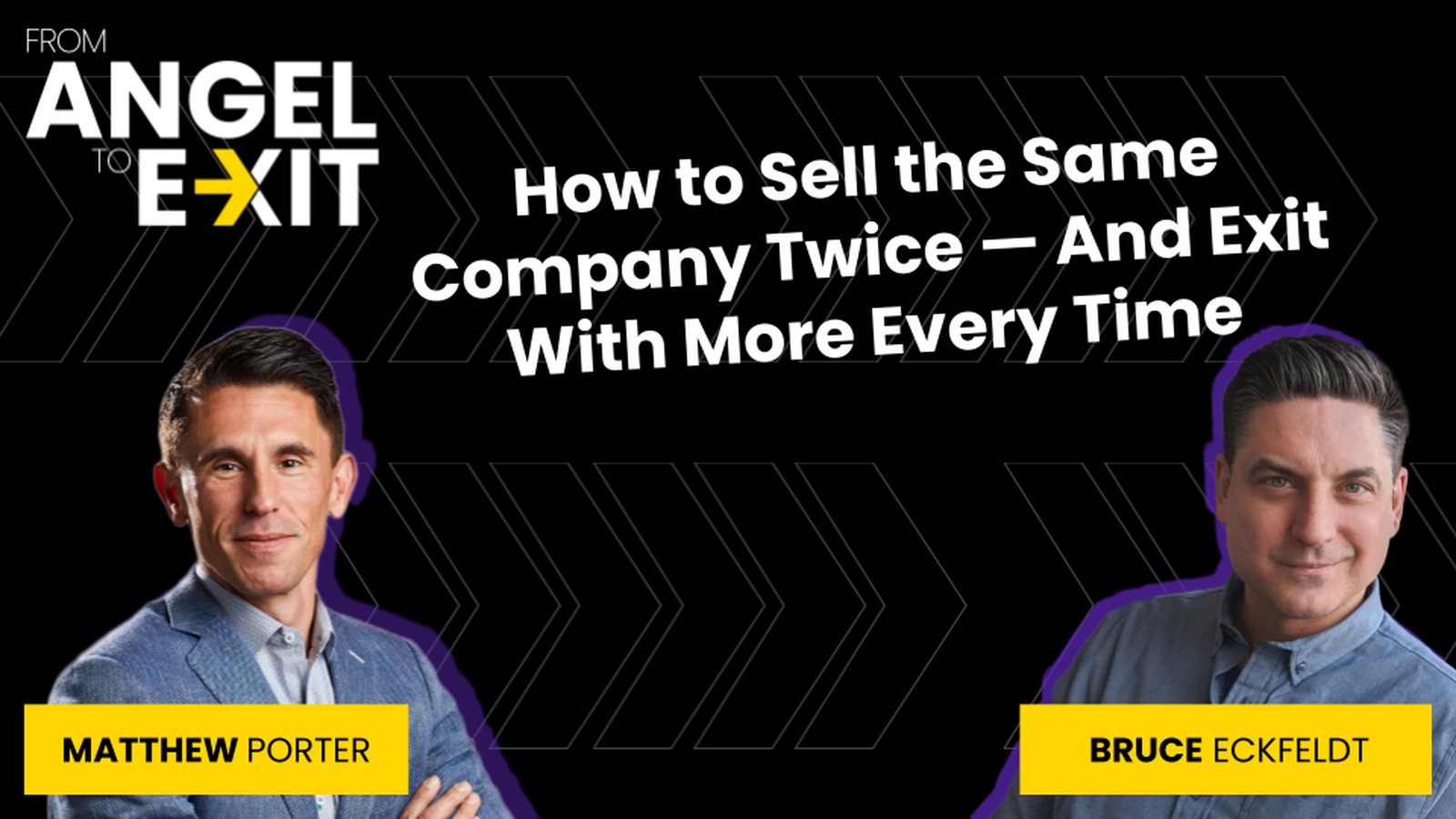
How to Sell the Same Company Twice, and Exit With More Every Time
Matthew PorterCo-founder, EONOVA
Listen to the Episode.
Play the full conversation right here, or pick a chapter to jump straight to that moment. Prefer your own app? Every episode is on Spotify, Apple Podcasts, and the rest.
About This Episode.
Start with the key takeaways, the ideas worth bringing back to your leadership team. Then read the full story of the conversation, or use the chapters above to jump straight to the moment that matters most to you.
- You can sell your company twice, if you structure the first exit with a second in mind.
- Founder identity and mental health are critical in long-term exit strategy.
- Private equity isn’t the enemy, but you must understand their value model.
- Second exits offer a rare chance to fix what you missed the first time.
- Growth through acquisition drives both scale and valuation.
- Negotiate your role, not just your price, post-exit.
- Build with optionality: prepare for a sale, even if you’re not planning one.
- Fit and alignment often matter more than the highest bidder.
What if you could sell your company, twice? In this episode, Bruce Eckfeldt talks with Matthew Porter, founder of Contegix and now Partner & Co-Founder at EONOVA, about how he bootstrapped a data center company, scaled it through acquisition, and sold to private equity, twice. Matthew shares the behind-the-scenes of deal negotiations, what he learned from his first exit, and how a second sale turned lessons into leverage.
Watch the Video.
Prefer to see the conversation? The full episode plays right here on the page, so you can watch while you follow the takeaways or read along with the transcript. Every episode of From Angel to Exit is also on my YouTube channel, along with short clips from each conversation.
About the Guest.
The background behind the conversation, and where to find this guest online.
Matthew Porter
Co-founder, EONOVA
Matthew Porter founded Contegix, a data center company he bootstrapped, grew through acquisition, and sold to private equity twice. He is now a Partner and Co-Founder at EONOVA.
- linkedin.com/in/meporter
- mporter@enova.co
Full Transcript.
The complete conversation, lightly edited for readability. Open it to read along, or search the page for a topic or a name.
Read the full transcript
Bruce EckfeldtWelcome, everyone, to From Angel to Exit. I'm Bruce Eckfeldt, I'm your host. Our guest today is Matthew Porter. He is currently partner and co-founder at Eonova, a boutique advisory firm, and we're going to learn about that. Previously he was founder and chief executive officer at Contegix, a technology company in cloud computing that did hosting work and Atlassian consulting. We'll hear about that, and we'll hear his story. He's got a really fascinating business story and personal story, which we're going to weave into the conversation.
I'm excited for this, because I think it's a great conversation about the bigger picture: how these events of founding, growing, scaling, and exiting companies fit into the bigger picture of life and of professional growth, where things go, and the things you need to think about. Hopefully people listening will get a little perspective, a little insight, and learn a bit. So with all that, Matthew, welcome to the program.
Matthew PorterThanks for having me, Bruce. This will be fun.
Bruce EckfeldtIt will be. We did a prep call on this earlier. Let's start with the professional side. Give us a little backstory on how you got into business. What was your training? How did you start your company? Let's do some of that, and then we'll talk about the story.
Matthew PorterI think it's important to understand that I grew up in a very modest family, a modest household. We had our own financial struggles. My parents both worked for the same company, which was interesting, because I also saw them go on strike. I saw my mom have to cross my dad's picket line.
Bruce EckfeldtInteresting. Wow.
Matthew PorterThose were uncomfortable family dinner conversations that night, just to be clear. And I have to respect my mom and dad for what they did and how they did it. I saw that as a kid and thought, "I can't do this. This does not work."
My parents had the mindset of "Don't ever try to start a business." In fact, when I started Contegix, my grandma asked me what the hell I was doing, because "We don't do that." The way I looked at it, Bruce, was that my parents had a single customer, their employer, and that was risky. I didn't want that.
So I went to university and got a degree in computer science, and then started my career at, believe it or not, IBM Global Services, literally across the street from my parents' factory. I mean that: it was one stoplight to go into IBM or into their factory. When I switched my major to computer science, my mom said, "You'll never make more than $28,000 a year." And on a per-hour basis, the day I started at IBM as an intern co-op, I made more per hour than either of my parents.
Bruce EckfeldtI'm curious about that early childhood experience. Did you look at it and say, "No, I have to be an entrepreneur"? How did it affect you, and what was the thinking behind going down that path, which seems so contradictory to the values or ideas your parents and grandparents had?
Matthew PorterIt'll probably sound a little odd. As an entrepreneur, I take risks. But as a human being, having a single employer was too risky. I became very risk-averse from that.
My parents handled strikes well. They handled that process really well. But there were people they were friends with, also in the union, whom I saw lose everything, partly because they had no preparation for a strike. They were living paycheck to paycheck. I watched one of my dad's friends go buy a new car, a used car, but new to him, and then put new wheels on it in the middle of a strike. My dad said, "Where the hell are you going? You don't need a new car to get to the picket line. I'll drive your ass." I just saw that as too risky for me. And I also saw the constraint on my parents' time as something I didn't want.
Bruce EckfeldtIt's fascinating. I find these early childhood experiences affect people in all sorts of different ways, and then there's the series of choices you make. This whole frame of risk is fascinating. We always talk about risk in early-stage ventures, and even later-stage ventures, and how people calculate and emotionally deal with risk. It sounds like it led you to be highly tolerant of certain types of risk and less tolerant of others.
So you studied computer science and got into this world. How did that play out? When you started at IBM, did you know you were going to found a company and eventually get out and do something on your own? How did that thinking play out?
Matthew PorterI had what we then called side work, and now call side hustles. I was doing other stuff. I ended up going to a company based here in St. Louis, where I was born, raised, and educated, and where my own children are now, called World Wide Technology. At the time it was about 175 employees. I think they're now approaching a $20 billion privately held company based here.
I went there, and eventually I left and went to a startup, and that startup utterly failed. But I knew I wanted that entrepreneurial journey. Something was drawing me to it, and maybe it went back to that risk. I always felt that as an entrepreneur, I could control my situation more than if an employer was dictating it. And hopefully I incorporated that philosophy of letting people have control as I built companies. I truly do hope I did.
So that startup utterly failed, and I called my boss at World Wide Technology. I was in my early 20s, in the first year of my marriage, the honeymoon phase, and I'd just been laid off. The company owed me $15,000 that I didn't have, and my credit cards were maxed out. It wasn't even my company. I was working for two entrepreneurs at a startup. And I said, "I really want to come back."
My boss at World Wide said, "Matthew, you're a really, really smart kid, and my life would be easier if you came back here, despite you being a pain in the ass. But this is part of the entrepreneurial journey you want to be on. So don't call me back." And he hung up the phone on me.
Bruce, 20 years later I ran into him and brought this story up. I may have had a cocktail and felt comfortable enough to bring it up. And the funny thing is, it's one of those things I remember vividly. I remember where I was in my apartment. And Bob, my boss from World Wide, said, "I have no idea what the hell you're talking about."
Bruce EckfeldtCompletely forgot about it. He just had a bad day or something.
Matthew PorterSo I ended up going to another company and dragged a coworker from World Wide with me. Eventually, the company my business partner Craig and I were working for was bought out, and we had our side hustle going. He had a daughter who was nine and a half months old, and I had a daughter who was nine months old, and a few months later we turned the side hustle into a full-time gig. We said, "We'll give it a year. We can only afford to pay ourselves $22,000, and we'll see what happens."
Bruce EckfeldtDo you feel that kind of experience is necessary to be a good entrepreneur at some level? There's always a struggle story with a lot of entrepreneurs. Do you think it's necessary? What do you learn from it? What does it do for you that gets you to the next phase?
Matthew PorterI think struggle is a natural part of it. In fact, I'll tell you that I think pain is a natural part of it. Pain is what drives most growth. That's a better way to put it. It doesn't matter if you're the caterpillar that dissolves itself down to just a few cells to become the butterfly, or it's a situation where the pain is injected by you, by a choice you make because the pain of the status quo is no longer acceptable.
On that note, I didn't want to take Contegix full-time. I was scared to. I'd been laid off before, after the company we worked at was acquired, but this time I still had a job. I was tossing and turning. And my wife, who, by the way, besides us having a baby, was pregnant again...
Bruce EckfeldtOh, jeez.
Matthew PorterShe looked at me one night and said, "What's going on?" I said, "I think I want to do this, but I'm afraid," and all this stuff. And she said, "You do not get to tell our daughter, and your son who's about to be born, to follow their dreams if you don't follow yours. That just makes you a hypocrite or a liar."
So to me, there was the pain of that idea, and the pain of, "My gosh, I'm going through all the crap my parents went through that I was trying to avoid in my life." Okay, the pain of the status quo was no longer acceptable. So making $22,000 a year, maxing out credit cards, taking a home equity loan to buy groceries at some point, seemed a lot less painful, because I could take charge of that. I could control that destiny more than any other way.
Bruce EckfeldtThat autonomy is huge. You can tolerate a lot when you have it. Is this where we talk about you being an ultramarathoner as well? I do think this whole idea of using pain intentionally and strategically to drive change is fascinating. I'm similar. I've been doing all this crazy Ironman stuff and Himalayan mountain climbs. I think it's a similar kind of thinking: in that discomfort there's an opportunity to find an edge, find where you have a weakness, and figure out how to work on it to build strength. Is the ultramarathoning all part of the same core for you? How do you relate the work you do as an entrepreneur to the ultra-endurance stuff? Where is it similar?
Matthew PorterI do think they're similar, especially when I look at it this way. Anytime I've done a 100-miler, I can't do it alone. I need people there. There's a team. It's not employees. And that's actually what we all want in our companies and organizations. We don't want employees. We want teammates, even when, hierarchically, we're the one who makes the choices and the decisions.
All the people who've shown up for the ultramarathons I've done have shown up of their own accord. I might provide some housing or some food, but they're flying to Leadville, Colorado, to help me. So it's a team. Second, we're all aligned on a single goal. I've been both the runner and the crew pacer, and the one thing you're there to do is get your runner to the next step, no matter what. Your entire single goal is to get them across the finish line. Your sacrifices are for that endeavor.
And third, it takes a certain amount of pain to go through it, push your limits, test them, and figure out where you may or may not break. And I've broken in these 100-milers. I've broken coming out of them. At one point I tore my right hip labrum nine miles into a 103-mile run, then tore my left calf at 48 miles, and pushed to 103. I was like Derek Zoolander for a month. I could only turn in one direction.
Bruce EckfeldtOh, jeez. I cringe just thinking about it. Everything's right turns for a while. Let's go back to the business. It sounds like there was a decision point where you really had to push: "I'm going to do this. There's this opportunity, but I'm uncomfortable. There are risks." When did it go from something you had to push through to feeling like you had momentum, like "This is going to go somewhere"? What happened, and how long did it take?
Matthew PorterIt took about five and a half months, believe it or not, which in retrospect feels very, very fast. This was 20-something years ago, before cloud computing as you know it now. We had signed up a customer, and the customer paid two years in advance. So I had this check for $41,000 or $43,000, and I thought, "Man, I've made it."
Bruce EckfeldtJackpot.
Matthew PorterMy business partner said, "We have made it." Basically, it was two more man-years of salary, so we were going to have to stick this out at least another year. And the funniest part of the story is that we went to the bank together, like little kids with this check. I don't know if we were expecting balloons and streamers to fall on us. We went to the teller to deposit the check, and she just looked at us like, "Okay, this is creepy. These two idiots are holding a check, depositing it, and smiling." We were staring at the deposit receipt thinking, "My gosh, this is the real deal. We're going to have to do this."
We walked out of the bank, and I kid you not, Bruce, this is not an exaggeration, because we still have the evidence. I looked down on the ground outside the bank and thought, "Oh my gosh, they must have given us two deposit slips. There's one on the ground." I reached down and picked it up, and that deposit slip was for just under $200,000. And I thought, "Okay, we've got some work to do." This guy discarded a $200,000 deposit slip, and Craig and I were like idiots holding this $42,000 one. That was deflating, but we knew we were onto something then.
The next big thing was that about a year and a half later we signed a contract with United Airlines. We were running their travel club systems in our data center. That was, "My gosh, we really have to do this." Bruce, I remember signing that contract and going out with buddies, and they said, "My gosh, you made it. You signed this big customer. This is a top-tier customer. You should probably buy dinner tonight." And all I kept thinking was, "I have millions of dollars of liabilities on my shoulders now. I have to make this work."
Bruce EckfeldtOf course. That's the flip side of signing these contracts: we've got to deliver. I'm curious, as things grew, at what point did the question "What do I do with this?" start to come to mind? You had some traction and picked up some of these clients. When did you start thinking, "Where's this going to go? Am I going to do this for the next 50 years?" When did thinking about the end of this, or its life cycle, occur to you?
Matthew PorterMy business partner Craig and I thought we'd get to about $1 million in revenue and just sell it and move on or do something else. We blew past that within about a year. We were on a massive run rate. We were growing 400% or 500% every year. At some point we were growing 200% a month. It was nonstop.
I got exposed to the Entrepreneurs' Organization and to YPO, and that took me to, "My gosh, maybe there's something bigger here." It also meant, and maybe this draws a through line to the pain conversation, that Craig and I were going to have to change. I learned years later that organizations only grow to the size of their leader. It doesn't matter if it's a five-person team or a 5,000-person company. They only grow to the size of their leader. And Contegix at the time was bigger than Craig and me.
So, thankfully, I got exposed to EO and their Accelerator program, and I heard for the first time the idea of working on the business, not just in it. I had examples, mentors, and accountability people. Some of those people I still call. There's one person I call every April, on the anniversary, and I've done it now for almost 20 years, of when she gave me some of the harshest advice and then offered to help. I wouldn't be here if it weren't for her and half a dozen others.
That showed me this could be bigger. And part of it wasn't just the top line or the bottom line. It was the concept that we could actually impact people's lives, our teammates' lives. We ended up adopting a core value called "rapid accelerated growth." Everybody in the outside world thought it was about the top line or bottom line, and it never was. It was about the rapid accelerated growth of our talent. That's what we called our folks: talent. We called them teammates. We didn't want to call them employees. They were at the top of that core value.
Bruce EckfeldtTell us a little of the growth story, and when exiting became more real, something you started planning, something on your runway or your roadmap for where the business was going.
Matthew PorterUnfortunately, we entered into a dispute with our minority shareholders in 2012. That put us on a path, while we resolved the legal dispute between us, with lawsuits and countersuits. And it's unfortunate, because the minority shareholders will never actually know this, and it really does bother me that they won't, but that lawsuit spurred our growth. And I don't just mean the top line and bottom line. It spurred my growth.
I had hired some extremely smart, successful talent, bigger than Contegix, and I wasn't letting them do their jobs. The lawsuit became the one problem I could tackle and solve that nobody else in the company could. That meant I had to let go of the reins and let Tom really run marketing and let Mike truly be our CFO. That spurred so much growth in me. And we actually continued to grow through the lawsuit, which is not common. I won't say it's unheard of, but it's definitely not common when you've got a shareholder lawsuit and you're risking all this stuff.
After we resolved the lawsuits, it became clear that this relationship was no longer tenable. We would hit a cap, and it really did feel that way. So we started doing all the stuff I now do professionally to help our clients. But it took years and years, because the lawsuit was in 2012, and our first exit, to private equity, was in 2016.
Bruce EckfeldtFour years of working through those things.
Matthew PorterFour years of grinding and still trying to grow. You're adding on to the boat while you're putting more passengers on and trying to figure out what the destination is.
Bruce EckfeldtI always say you haven't really been successful in business until you've been sued. These lawsuit stories come up in just about every conversation I have around this. I've had them as well. It certainly helps you focus and realize where your strengths and weaknesses are, where your risks are, and what you really need to do to create value across the chain. So through this growth process, you enabled some of these other leaders to step into their leadership and grow, and that really scaled the company.
Tell me a little about the acquisitions, because you were doing some acquisitions as part of that process. Why do acquisitions? What drove that, and what were the big learnings about being the acquirer?
Matthew PorterCorrect. We had started looking at acquiring other companies in order to build a bigger platform. We knew we had to get past some barriers. And it was going to be something my business partner and I would have to take on personally and merge, more or less, into Contegix, because our minority shareholders were saying, "Listen, we're kind of done." Once trust was broken, it was really hard for all of us. A lot of that has honestly been repaired over the past few years, but at the time it was a very, very harsh period.
We knew we had gaps in what we were trying to take to market for our customers. When I talk at my alma mater, or to people who want to be entrepreneurs, they always ask, "How do you get to be an entrepreneur?" And my answer is: write down problems. Every day, write down five problems. Then after a month or three months, go back and see where there are similarities, and say, "Okay, nobody solved this in 90 days. Maybe I should solve it." Well, we were hearing things like that from our customers over and over again. So we began the process of asking, "How do we bring these other companies in with us?"
That rolled up into our private equity transaction, one big transaction where we effectively merged three companies into Contegix, and that became the bundle. It's funny, because you go back and look at the articles, and anybody who's done a deal knows how timelines really work. Anybody who hasn't says, "Wow, you guys hired a new CEO, and a week and a half after he took over, he acquired a company."
Bruce EckfeldtExactly.
Matthew PorterYeah, that's exactly how it happened. Just like in the movies. They were probably at a restaurant and did a handshake deal.
Bruce EckfeldtThe reality, the truth. But what did you learn about that? As you were doing these acquisitions, what skills or experience were you gathering?
Matthew PorterThe biggest part was how you acquire companies with similar cultures, or cultures that aren't so dissimilar that they end up fighting. That mattered more than anything else we did. The other part is that when you're dealing with entrepreneurs, myself included at one point, these CEO-founders, it's impressive how much we can wind our identity into three little letters. That's a very harsh thing, because now you're not just buying somebody's company. You're buying a piece of their identity and possibly their soul.
Bruce EckfeldtIt's like a limb. Maybe a major organ, depending on how tied up they are.
Matthew PorterSo those were two of the biggest lessons: culture, and the identity of that person. We also hired a new CEO to run Contegix after the private equity transaction, and we didn't hit the mark on it. Great guy, and he's gone on to be successful. We missed the mark, though. That's not a critique of him. It's not a critique of Contegix or of the companies we acquired. It's a critique of a bad match, and we should have done better.
I say this whenever I'm hiring anybody, or helping my daughter as she interviews for jobs: you have to figure out if it's the right match. While it's not as selective as my marriage, I'm a really good husband to Courtney. I'd be a poor husband to 3 billion other women. That doesn't make me a bad husband. It makes it a bad match. My wife's a better person. She'd be a great wife for lots of people.
Bruce EckfeldtThat match thing is so interesting. I've seen very successful executives at one company go to another and really struggle. The context they're operating in changes, and their performance suffers greatly. I think it's very underappreciated how much context drives performance. Put the right person in the wrong context, and they won't succeed.
So what drove your exit? You're doing these deals and rolling things up. At what point did you decide, "Hey, I personally want to get out of this," or "The business needs to move on, and I need to find something else to do"? What was that transition like, and what drove it?
Matthew PorterWe had hit the limit with our shareholder structure, our cap table. That's really the big thing that drove it. We also saw the market changing, and we knew we needed a strategic injection of capital, truly for the first time ever. Our minority shareholders got in for hundreds of dollars, just to be clear. We were young and dumb. They provided some expertise. But we were going to need our first real injection of capital, especially if we wanted to keep delivering for our customers, which was ingrained in our core value: "Wow the customer every time, every engagement, with integrity and zero exceptions." Otherwise we were going to limit the rapid accelerated growth of our talent and all our stakeholders: our people, our talent, our vendors, and eventually our shareholders, though they were way down on the list for rapid accelerated growth.
So we knew we were coming to that end, and the dynamics of the market were changing so fast. You hear this all the time: there are really three things in the world that are resources: time, talent, and treasure. We needed treasure in order to buy more time, and we didn't have that capability.
We got lucky in some ways. We had developed a relationship with the folks at Stratum Capital. I think we talked to Bob Morris, one of the managing partners and founders there, when he may still have been at Oak Hill. When Bob Morris and Adrian Pollock spun off to start Stratum, we kept our conversations going, and at the right time they called us. I think I told Adrian, in a semi-professional way, "I would love to talk to you, but you guys can't understand what we're doing, so go away." Thankfully, he was relentless. Eventually he said, "Well, we're going to be in St. Louis in a couple of weeks. Let's talk more about this." And I said, "Well, I guess so."
Frankly, they have been a great partner, and consistently so. We've been on this path with them for eight and a half, nine years now. We had our final exit late in 2024, but they have been a great partner, and it's been a great relationship.
Bruce EckfeldtWhat has it meant for you personally, in terms of the shifts and growth you've had to make? How have things changed for you as you've gone through this process and made these transitions with the business?
Matthew PorterOne of the biggest things was early on, after I stepped away as CEO following the private equity transaction and moved to our board. I joined a board with a whole bunch of Stanford MBAs on it. Very smart people. Extremely smart people. And I almost decided to go get my MBA from Stanford. I almost moved two of my three children to California. Bruce, I was filling out applications. I was on the phone with Stanford: "Here's how much it's going to be. You're going to do the Sloan Fellows program. You're going to live on campus." And I'm thinking, "My two teenage boys are going to love it. They're going to live on a college campus." My wife was looking at me like I was crazy. My daughter, who had just started at a new high school, was looking at me like I was crazy.
Bruce EckfeldtOh my gosh.
Matthew PorterThankfully, somebody connected me with someone who'd had a similar path. He said, "Yeah, I felt the same way after I sold my tech company and was on the board with all these people with MBAs. I did the MIT MBA program." And he gave me two pieces of advice based on his experience.
One, "Let me guess. You're in that boardroom, and whenever there's a tech question, when everybody's done talking and the executives leave, they basically ask you, 'Is what they just said bullshit, or is that real?'" And I said, "That's true." And then he said something else: "Here's what you need to understand. All those MBAs who have never done a startup or founded a company know how to turn $1 into $5, because they can do multiplication. But they can't figure out how you went from zero to one, because every time they multiply zero, they get zero. That's your role. We've got enough damn MBAs. We don't need another MBA."
So that was my first lesson: I needed to learn where my role was going to be. The second thing I had to learn, and I tested this in other endeavors afterward, was how much of this was luck and how much was that I was good.
A year after I sold, I took on a role as conservator and trustee of somebody else's company, where the owners were suing each other. The court put in a conservator trustee, and the company was in a very awkward, stressed situation by every measure: finances, culture, every single thing. So I got put in, and I donated all the money they paid me to charity, which removed my conflict of interest. It was a way for me to test how good I was. A hundred percent, I believe there was luck. I also wanted to find out how good I was.
Bruce EckfeldtThat's amazing. And how good are you?
Matthew PorterWe grew cash flow by 320%. We resolved most of the outstanding lawsuits. Employees got benefits for the first time ever. I did end up canceling cable TV, which stressed one of the people in the office, because they couldn't watch their stories anymore. I also mandated that you had to wear shoes, or at least socks, in the office.
And I got to help the two shareholders, because they would ask me, "Okay, so how does this end?" And I said, "I've been in a shareholder lawsuit. I'm just giving you my experience. My experience is that I wanted control over the future and didn't want somebody else determining it. So if you feel the same way, you'll inevitably end up talking." And they ended up talking, and one bought the other out.
Bruce EckfeldtResolved. So let's talk about today. What does life look like now? You have this exit, this experience. What do you focus on? What's important? What are you doing today, now that you're on the other side of the transaction?
Matthew PorterYou're hinting at it. In late 2024, we sold all of Contegix to a company out of Paris, France. On a Friday morning, knowing the transaction was going through, to be clear, my phone beeps: "Your resignation as a board member has been accepted, and your transaction is complete. Thank you for your service. Have a nice day."
It was freeing. Emotionally, there was this sense of a weight being lifted off me. At the same time, I felt like I'd almost been using it as a security blanket. It had always had this success. I was Matthew Porter, the guy who founded Contegix, and it's still around. Now I'm Matthew Porter, who founded a company that will probably disappear in name. I don't know. I'm not at the company.
The interesting part of what I'm doing today is that there are two other friends of mine who are YPO members here in St. Louis, Young Presidents' Organization members. We all had exits around the same time. I'm the only one who's gotten a second bite of the apple so far. The other two are still on their path. And the three of us kept getting calls from people. Some were friends, some were YPO members, some were EO members we'd known for years, and some were, "Hey, I saw you at a Starbucks in 2013. Can we grab coffee?"
When they called, it was about, "Tell me how you sold your company. Tell me about the process. Tell me what you did to get prepared." Half of my calls were like that. The other half were because I have multiple sclerosis. I'm very public about it, and I've ended up coaching and mentoring people who've been diagnosed with MS.
So those two guys, who are now my business partners, Aaron Stone and Ross Toohey, and I would get together and say, "Hey, did you hear from Bob?" "Yeah, I heard from Bob." "Did you hear from Jane?" "Yeah, I heard from Jane." "What do you think?" All these people were reaching out to the three of us. And finally we said, "Okay, we keep hearing this problem. The market is speaking. What if we built an advisory firm that does all the stuff a private equity firm really wants to do when they buy a company, or that an investment banker wants to do when they represent you, but they don't have the time?" The investment banker doesn't have the time, because they've got six months, maybe 12. You can't make fundamental changes in a company that fast, or you'll wreck it and possibly decrease its value. "So what if we do this, take all the pain and experience we have, and help others?"
So today, that's what we do. We start with an evaluation of your company, and it's not just "Here's the dollar figure it's worth." It's "Here's where best in class is, and here's where your challenges are." We break it down and say, "Here's where you are." We spend eight to 12 weeks working with you on that. At that point, we figure out whether you like us and we like you, and whether we can really work together. Then we may decide together to start a multiyear process where we really help strengthen, scale, and help the business thrive. Whether that means that in three to five years they sell, or they realize the house doesn't have to be on fire. "I don't have to have the house on fire, and I probably shouldn't be walking around with gasoline and matches while it's on fire. I just want to keep running it."
So that's what we do today. The company is called Eonova, and it stems from Latin. We reversed the two Latin words for "new era." Everybody who's exited at some point has hired people who were probably bigger than they were, bigger than the company. That was the pain, and that was a cost, and those people helped them get where they needed to be. That's kind of what we're doing, but as an outside advisory firm.
Bruce EckfeldtFascinating. You mentioned MS. I'm curious how that's framed things. When did it present? When did it come into your life, and how has it shaped your decision-making or prioritization? I've worked with a few folks who have had medical conditions, and it's interesting to see how that frames how they approach some of these things. How has it shaped you?
Matthew PorterIt made me more capable of asking people for help, which I honestly think, and I've preached this to my children, is a superpower. Figure out how to use it. Life is much easier.
The big thing it did is that I feel the weight of time in a way I didn't before. A person who's diagnosed with MS is going to lose 10 to 15 years of life, and another seven to 12 or so quality years. If you make it five years without a relapse, those numbers get cut roughly in half. This is from actuarial tables, irrespective of gender, the age you were diagnosed, or how many lesions you have on your brain and spine. So I feel the weight of time differently than I did before, and that forces me to treat time as what it actually is: a nonreplenishable resource. I did that before, but not to this level.
The interesting part is that, fast-forwarding to us starting Eonova, as we looked at what the market actually says, it'll tell you that 50% of exits are involuntary. People are forced into them. It's what are often referred to as the five Ds: death, divorce, disagreement, distress, and disability. And while today, by all indications, you would never think of me as disabled, technically and legally, I am disabled by having MS. I still run 100-mile ultramarathons, nonstop.
Bruce EckfeldtThe contrast.
Matthew PorterThe contrast. Somebody asked me the other day, "Is your health deteriorating?" And I said, "Well, in all fairness, I was pushing hard. I can usually get 75 pull-ups done, but I moved them to the end of my workout, and I really tanked out at 72. So I guess technically it is." I know that sounds braggadocious, but whatever, I'm disabled.
So it's funny: here I am trying to help people, and I got hit by one of the Ds. It didn't force me to exit. It didn't force the exit in 2016, and it didn't force the sale of Contegix in 2024. What it does do is give me empathy in a different way. When you're talking about entrepreneurs and CEOs whose identities are tied up in the title and all that crap, maybe this is a little bit of pain I can stop others from having.
Bruce EckfeldtIs that the message? I'm thinking about people who are earlier in this process, in a bit of that struggle phase, figuring out how to navigate some of these things. What guidance, frame, or heuristic would you give them to help them stay focused or make better decisions? What do you think people need at that earlier stage?
Matthew PorterOne of the biggest rules I've heard, and I don't see it talked about enough, is what I've heard referred to as the law of ones and threes, or the rule of three and 10. When you're growing an organization, and it could be a business, a charity group you run, or a Bible study group you run, things change when a number starts with a one or a three, and you need to be prepared for the next number.
At $1 million, you look drastically different than at $300,000 of annual revenue. At $1 million, you should start preparing for $3 million. At $3 million, for $10 million. At $10 million, for $30 million. And at $30 million, for $100 million. The same goes for people. Three people in an organization is drastically different from 10, which is drastically different from 30. Anybody who's run an organization will tell you that somewhere a little past 30, you stop knowing who everybody is. You have to build the systems, policies, processes, procedures, and structure around it.
If you do that, it makes it easier to get on the path of saying, "What if I exited in three years?" Even if you don't want to, it's a three-year process. Prepare now. And if you're worried about the message you're sending your team, let me assure you, and I heard this afterward: if you're the sole owner of an organization, your team is actually nervous about this. They're nervous about whether their livelihood is affected if something happens to you. They're not going to tell you. But even in the back of their minds, even if they're not saying it to themselves, they're nervous. So putting yourself on a path to potentially exit is actually putting yourself on a path to scale and build a thriving business.
Heaven forbid something horrible happens to you. You don't want it to be your spouse stepping in and saying, "Well, I'm going to run this organization."
Bruce Eckfeldt"I'll take the wheel. I've never driven before."
Matthew PorterMy wife is amazing. She's a nurse practitioner in medical oncology. She's curing cancer every day. I just made flashy, blinky lights flash and blink. She's a better human being who probably has a better job than I've ever had, in terms of impact on people. She should never have run Contegix, and she would say that.
Bruce EckfeldtThis has been a pleasure. There's so much more we could go on about, but we're going to hit time. If people want to learn more about you, find out what you're doing, and get more information, what's the best way to do that?
Matthew PorterThe easiest way is two websites. One: my last name is Porter, and we have porterhome.com, P-O-R-T-E-R-H-O-M-E dot com. I've talked a lot with other people about our family having a mission statement, vision, and values, just like an organization does. And yes, we do have those, and yes, they're plastered all over our house, just like an organization would do. My three adult children all know them.
For what we're doing at Eonova, it's eonova.co, E-O. We'll tell you in 15 minutes what we think your business is probably valued at in the marketplace, and maybe give you some indication of what you might want to fix. You don't have to hire us. Just don't exit blindly. That's like taking the exit ramp with your eyes closed. You might make it, but I'd watch the bumper and the guardrail.
Bruce EckfeldtIt could be a nasty ride. Matthew, it's been a pleasure. I'll make sure all that information is in the show notes so people can get it. Thank you so much for taking the time today. It's been a great conversation.
Matthew PorterThanks, Bruce. Thanks for what you're doing for everybody, for doing this, and for spreading all the information you're getting from all these people on your podcast.
Bruce EckfeldtMy pleasure.
Never Miss an Episode.
Know the moment a new episode goes live. Subscribers also get a say in future guests and the topics we cover.
Other Related Episodes.
More conversations that connect to this one. Or browse the full archive by topic or by guest.
John Ratliff
How a call center business grew through 24 acquisitions and sold at a 14x multiple.
Listen and Read
Chad Williams
Why every founder needs an M&A lawyer, and how to handle LOIs, earnouts, and non-competes.
Listen and Read
Roy Vella
How his team kept the company alive after a lost funding round and still reached an acquisition.
Listen and Read