From Angel to Exit Episode 17
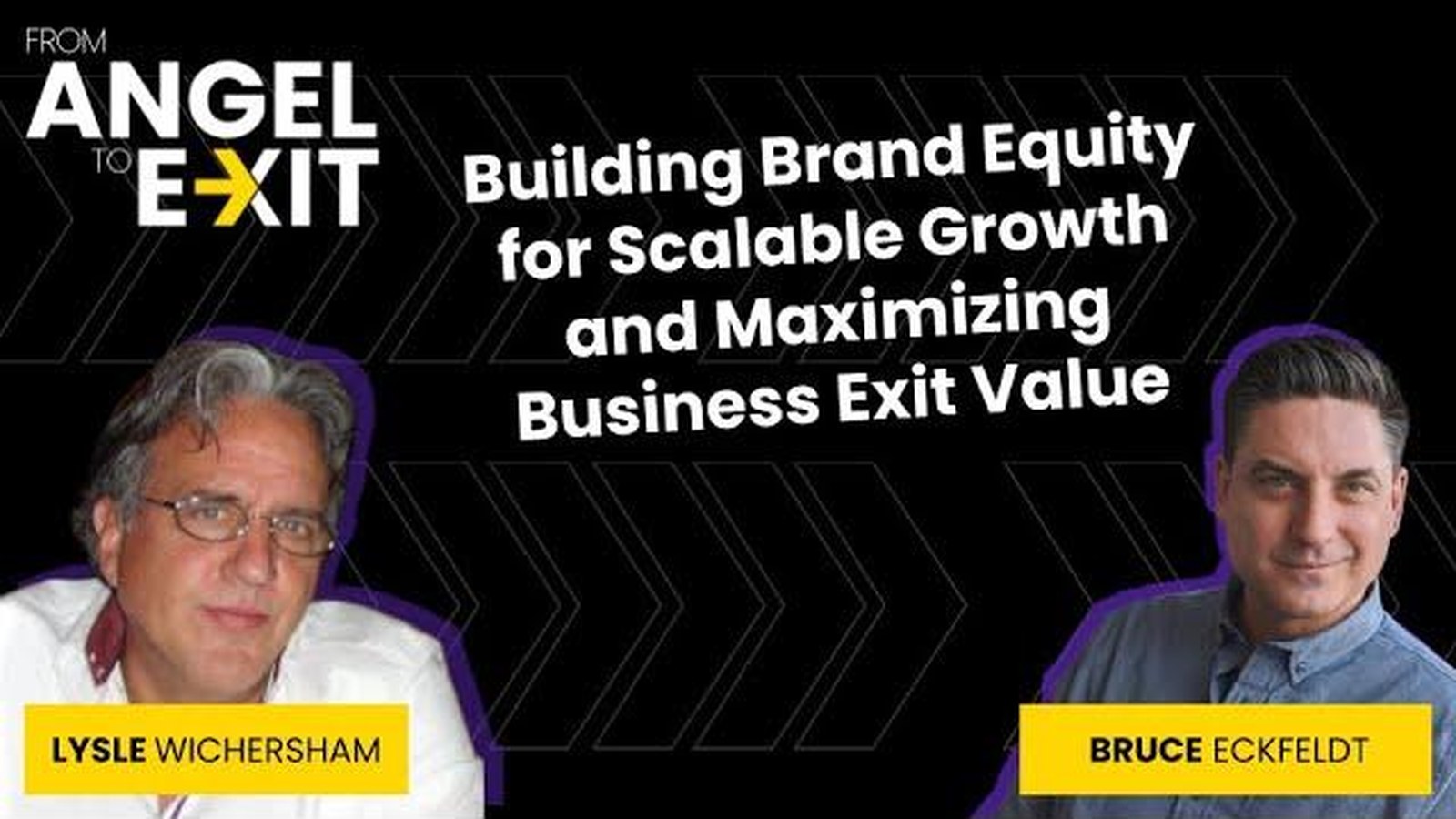
Building Brand Equity for Scalable Growth and Maximizing Business Exit Value
Lysle WickershamAgency founder
Listen to the Episode.
Play the full conversation right here, or pick a chapter to jump straight to that moment. Prefer your own app? Every episode is on Spotify, Apple Podcasts, and the rest.
About This Episode.
Start with the key takeaways, the ideas worth bringing back to your leadership team. Then read the full story of the conversation, or use the chapters above to jump straight to the moment that matters most to you.
- Build brand equity early; consistent positioning over time drives long-term enterprise and exit value.
- Emotional brand attributes can differentiate in crowded markets and influence transaction multiples.
- Prepare five years ahead for an exit to maximize valuation and minimize equity dilution.
- Treat employees as your first “customers” to align culture with brand promise during scaling.
- Balance passion for your product with the capitalistic goal of creating a sellable business.
- Align positioning, operations, and branding to create negotiating leverage at the exit table.
- Simplicity and clarity in brand positioning lead to stronger alignment and sustainable growth.
- Intangible brand equity can account for significant market capitalization and shareholder value.
In this episode, Lysle Wickersham shares his journey from creative director to scaling a $170M agency and navigating multiple exits. As founder and CEO, he emphasizes the power of brand equity in driving enterprise value and achieving successful exits. Lysle breaks down how early-stage businesses can align positioning, brand strategy, and operations to create sustainable growth and higher transaction multiples. His insights bridge the gap between creativity and financial value, offering practical strategies for founder-CEOs preparing to scale or exit.
Watch the Video.
Prefer to see the conversation? The full episode plays right here on the page, so you can watch while you follow the takeaways or read along with the transcript. Every episode of From Angel to Exit is also on my YouTube channel, along with short clips from each conversation.
About the Guest.
The background behind the conversation, and where to find this guest online.
Lysle Wickersham
Agency founder
Lysle Wickersham went from creative director to scaling a $170M agency through multiple exits. He helps companies use brand equity to drive enterprise value.
- Website
- brandthink.biz
- linkedin.com/in/wickersham
Full Transcript.
The complete conversation, lightly edited for readability. Open it to read along, or search the page for a topic or a name.
Read the full transcript
Bruce EckfeldtWelcome, everyone, to From Angel to Exit. I'm Bruce Eckfeldt, I'm your host. Our guest today is Lysle Wickersham. He is a founder and a CEO, and we're going to hear his stories. He's had a couple, and he's doing some really interesting things today. One of the things I like to cover on this program is what happens afterwards, and Lysle has had some interesting experiences and put together a really interesting new company that's very much related to the journey he's been on. So I'm excited to hear how things have come together, what he's learned, and what he can pass along. Lots of interesting things are going to come up, I'm sure. So with all that, welcome to the program.
Lysle WickershamThank you. Great to be here, Bruce. I appreciate it.
Bruce EckfeldtIt's a pleasure. Before we dig into the entrepreneurial experience, I'd love to get a little background. I like the question of when you first knew you were going to be an entrepreneur. Was it something you knew in grade school? Did it come up later? Tell us a little about that.
Lysle WickershamI'm never really clear that I ever defined "entrepreneur" anyway. When I got out of school, I went into the communications business and got into the advertising space, and I knew I wanted to have my name on the door at some point. So the focus and goal was building an agency. I ended up building an agency from about three people to 120 people, and it grew to about $170 million in billings. That was an incredible ride, during a time when the agency world was really thriving.
The company was sold, with Arnold Worldwide, to Havas. Actually, we were sold twice in a two-year period, so that was quite a journey: becoming a public company, then being sold again.
I took a strange pivot at that point. I got recruited by a venture capital colleague to run a tech company back in the dot-com boom. I ran a tech company, pulled one out of receivership, sold it to another platform, took on another early-stage startup based in Germany, and watched that blow up in the bubble. So I've seen both sides, the good and the bad.
That journey really got me interested in working with early-stage businesses, value creation, driving growth and equity value. And I founded an investment bank, which is a very weird pivot for somebody who grew up in the creative world. But it was a natural connection for me to leverage strategy and brand development, building equity as a key form of value creation and helping businesses scale. I did that for quite a while. I did a lot of M&A, worked with private equity and venture on investment placement with Sylvan Ventures in Baltimore, and ended up coming to New York. I consulted with Rockefeller for a while and then founded BrandThink.
The secret sauce behind BrandThink is really the ability to integrate the pragmatic side of value creation, operations, and scaling businesses with a strong focus on building the intangible brand equity that drives enterprise and shareholder value. For me, creativity, strategy, and value creation are wholly integrated. You can't break them apart. It's an unusual approach for a consulting company to have such a strong focus on building the intangibles.
Bruce EckfeldtThere's a lot to unpack there. I'm curious, why an agency? What gave you the original idea to start in the agency world?
Lysle WickershamI came up as a creative director. So the process of positioning brands to be competitively differentiated, understanding how we build emotional connections with brands, with products, with badges, with things we identify with, and really learning the psychology of how people attach to things. That becomes wholly relevant to early-stage businesses when you're thinking about raising capital, or appealing to somebody who's going to buy you. All these things play a role. That creative journey was really my catalyst.
Bruce EckfeldtWith the first company, what was the impetus to actually start it? When you started, was it, "I'm going to build this thing and sell it in a couple of years"? What was your mindset when you founded it?
Lysle WickershamThe mindset was to build something proprietary and my own, first and foremost. And second, I believed in a positioning that was differentiated, and I wanted to prove out that model. We did that very successfully. We were one of the most awarded integrated agencies in the country for a decade, and we proved out the whole model of not only driving performance for businesses but building brand equity value, and bringing those two things together.
Traditionally, those were very separate philosophies of marketing. And that's actually been exacerbated in the last few years, with performance-based marketing ignoring the intangible side of brand development. People are missing out on a really important part of value creation if they just focus on near-term conversion metrics.
Bruce EckfeldtWe've swung the pendulum so far toward data analytics. In terms of positioning, I find this is the most challenging thing for early-stage companies. They're chasing revenue. They want clients, they want money, and projects and revenue are foremost. That can get them in trouble, because they end up with a mismatched client base and project portfolio. How did you stay on point and focused on your thesis and your positioning while you were scaling, and not get distracted by chasing money?
Lysle WickershamI think the first thing early-stage people should understand is that building equity that translates to financial value is a long game. To do that, you have to establish a core positioning, as well as the values and attributes of a brand, so you can hold on to them consistently over time. If you keep pivoting and moving away from the equity you've established, it's like starting over and reinvesting, and you have to do it again.
A lot of the businesses I work with struggle to define that original core positioning and their brand attributes so they can put a stake in the ground and say, "This is who I am, this is what the brand stands for, and this is what the company's growth path looks like." They don't have something they can hold on to and focus on. I think that's the driver. If you can get that right in the beginning and be consistent over time, that's how you build a consistent point of differentiation, and that's how you rent space in people's minds.
Bruce EckfeldtIs there anything you feel you did particularly well as a founder or CEO in that early stage to beat that drum, create alignment, and stay focused as you brought on people? 120 people is a lot of people to align.
Lysle WickershamIt's a lot of people, and things change when you get past a certain point in your ability to know everybody and connect with everybody. I'm sure I did a lot of things wrong. But one of the things that did go well was that we had a very single-minded vision about what we were trying to be and what we were trying to create. My partners and I were able to unify people around that vision.
One great way to think about it: of all the constituents you're marketing your services to, your first constituents are really your employees. They're the front line. They deliver on the brand promise. They're the people who have to bring it to life. So they need to be unified and aligned with where you're going, and we did that very well. There was a tight culture, and people really embraced the direction. I think that was a huge part of the reason we grew.
Bruce EckfeldtI'm curious about the first exit. When did you first realize you were going to have a transaction and exit the business? How did that work for you personally? And as a company, as a leadership team, as partners, how did you make the decision to actually go to market?
Lysle WickershamIt was an interesting journey, with a couple of twists and turns. We knew there was a lot of merger activity going on in the holding company space in those years, and we knew early on that we were looking to be acquired by a public organization. That meant refining and making sure our brand position was clear, well articulated, and focused, and putting the financials in place that showed a recurring ability to grow, and making sure the numbers worked. All of that, structuring the business and being ready to be acquired to maximize your transaction multiple, was built in. So we were well prepared for it. That was how a lot of agencies grew, and how a lot of owners realized some return on their sweat equity.
We got sold to somebody who was trying to build a competitive holding company. He bought 16 companies and went through a very difficult time trying to scale that. Everybody was locked out, the stock went down, and he consolidated 16 companies into four brands. At that point my company got consolidated into another company, and the whole package was sold a second time, to Havas in Paris.
That's probably one of the scary things about being involved in the public markets: you lose control of where you're going. I got a call one day saying, "Your company is folding into this company, and we're being sold again." The second time around, I had no participation in it. It just happened. I was a passenger.
Bruce EckfeldtYou were a passenger. How did you let go of some of that? I find that's a big challenge for first-time founders who haven't been through the transaction process. There's a lot of attachment to these companies. People put a lot of passion and equity and sweat into these things. People talk about it being their baby, and they're probably even more attached sometimes than to a child. How did you process or navigate that emotional connection to the company?
Lysle WickershamI'm sure it's different for everybody, but for me there was a process of recognizing that I had other skills, abilities, and interests. While I had spent a long time creating brands from the ground up and loved that process, I also learned through it that I had a penchant and a skill for the strategic side of positioning businesses to scale.
So for me, there was a loss in losing the company, but there was also an opportunity in front of me to go in another direction. Because I had made connections in the venture world, I had this opportunity to be involved in positioning a business and a brand from the ground up in a technology company. It was a new way to stretch my brain, leverage what I'd been doing, and add another layer of skill set to that background. So it was an easy transition for me. I've been doing this stuff for a long time, I'm a lifelong learner, and I love the brain food. As long as I'm exercising that muscle and doing those things, I was okay with the transition.
Bruce EckfeldtI'm curious about the deal itself. Were there any interesting complexities in the terms of the deal, or in how you did valuations? It sounds like you were pretty buttoned up on the typical things that go into valuation and the transaction, but I always find there are interesting stories about earnouts or representations and how people make the deal happen.
Lysle WickershamThere was nothing intricate about it. In the agency world, the stronger your client relationships are and the larger the brands you're working with, the more leverage you have when you're negotiating a multiple. The multiple against revenue is usually comp-based. Then the difference in negotiating leverage is the kind of brands you have, the kind of people you have, the kind of talent you have, and those things can make a difference of two or three points on the multiple. But it's pretty straightforward in the transaction.
When you're doing a public company transaction like that, everybody falls into a lockout period, and it's all pretty standard. It's not always in the best interest of guys like me, who got locked out for 16 months and watched the stock underperform. But you have really no control.
Bruce EckfeldtThat's a big part of it. You give up control. Hopefully you get a bit of reward for it.
Lysle WickershamI'll make one comment. A lot of times, founders get so caught up in what they're building that they forget they're building a business, and there's a capitalistic objective to doing this. Yes, you're passionate about what you're doing, you believe in what you're building, and you're going to change the world with it. But at the end of the day, you're also building something where you get a return on that effort and realize some wealth from it. If you can balance that single-minded passion for what you're building with the idea of building a business, then the exit isn't anywhere near as scary. And that's okay. You should be building toward something like that.
Bruce EckfeldtI agree. Tell us a little about the move into the venture capital and private equity world. How did that come about, and what was the process like?
Lysle WickershamIt was fortunate for me. I had a relationship with a gentleman who was an investor in private venture capital. He had a technology company that needed to be repositioned and the brand rebuilt, and they were looking to move it as quickly as possible. For some reason, he thought I could do that job. I had been managing director of a $170 million agency for a long time, so he figured I could pull it off.
And we did. We repositioned that brand. It was a financial portal, an aggregator of global financial information, and we built a sales force around it. We took them out of receivership, repositioned the business, and sold them to another player in that space. So I was going in a completely new direction.
Bruce EckfeldtWhat was interesting about that direction? It's very different from being an entrepreneur.
Lysle WickershamIt is, but it was the beginning of really understanding the importance of the emotional side of building a business as well as the rational side. Strategy and creativity became inextricably connected. You have a positioning, and there's a pragmatic side to it: who's my market, what's my market context, what's my core differential, what are the benefits. And then there's the emotional side: how do you position that and tell a story? At the end of the day, telling the story is just as important as the pragmatic side. If you can't tell the story in a way that resonates and that people remember, you're missing out. A lot of that success was about how the story was told.
So I think that was a catalyst. Then I tried it again, and that didn't work. But that led me to want to build an investment bank focused on helping people strategically position themselves to improve transaction multiples and get more for their businesses.
Bruce EckfeldtGive people a little sense of what it meant to put together an investment bank. Mechanically, what did you have to do? What is it like to actually start one?
Lysle WickershamWe built a relationship with a fund so we had some working capital. We cut our teeth doing a lot of business brokerage work, working with businesses to help them sell, and a lot of that meant preparing them for an exit. Are they properly positioned? Is everything clean? Are their financials buttoned up? Do they have a way to tell their story that's compelling and differentiated in the market?
All those intangible things are where you find negotiating leverage when you're sitting at the table and saying, "Okay, the comp is 10x for these kinds of businesses, but look at how we're positioned. Look at our points of difference, what we're doing, and where we're going. So we're asking 12x for this business." That strategic differential is really a multiple modifier.
Bruce EckfeldtWhat problems did you typically see within companies in terms of those intangibles? What were the typical failure points or mistakes people made?
Lysle WickershamI think it's safe to say the biggest failure point is that people just didn't think about this stuff. Brands are all about creating perception, and that perception is just as impactful to a buyer of a business as it is to the consumer of your products.
Preparing for an exit and putting yourself in a position to maximize equity value takes time. A lot of people say you'd better be thinking about it five years out. Do you have a sustainable point of difference? Do you have a place in the market that's scalable? Is your brand differentiated, and is there preference in the market? These are things you can't put on a P&L and can't really measure very well, but are you doing them? Because at the end of the day, that's negotiating leverage. And for early-stage businesses, it's how you reduce your cost of capital. The better you do it, the less equity you're going to give up when you're raising money.
Bruce EckfeldtHow do you assess these things, come up with objectives, and measure the impact they're going to have, or where a company needs to be to have an impact on valuation?
Lysle WickershamThat's a great question, because there is no definitive analytic process to measure loyalty and preference and all the intangible attributes that actually drive financial value. There's no real way to do it. I think that's where my creative background and my strategic background came together in a natural ability to assess those things. There's discovery: constituent interviews, market interviews, talking to customers, talking to people who don't like you, all that kind of stuff. But then you have to make value judgments. If somebody's assessing brand strength or attributes, there's no specific formula to determine the answers. I think it requires the skills of somebody who's spent a career building brands and understands those things.
Bruce EckfeldtOn the investment banking side, what was your differentiation? How did you approach that market so that when you went out to represent companies or look for companies interested in transactions, you became their go-to offering?
Lysle WickershamWe tried to make it that strategic focus. We'd say, "We have the ability to work with you on a strategic level to help you differentiate, to create a value proposition that's distinct in the space you're in, and to improve what you make when you sell your company."
Bruce EckfeldtWhat was the time frame? You mentioned it takes five years to do a lot of this work. If you could work with a company and really focus on these attributes and factors, how long did it take them to adjust those things and get them to the right point to have good value?
Lysle WickershamI'd say you really can't do it in much less than a couple of years, because equity, again, is a frequency-over-time equation. Owning space in somebody's mind, being recognized as having particular attributes or a particular value proposition, doesn't happen quickly. The same goes for the things that create sustainable growth, preference, price elasticity, and the ability to mitigate risk. In a lot of cases, the stronger your brand is, the more likely the perceived success and the lower the risk profile. To get there, leadership should be thinking about it a few years out and then be really consistent with a cogent positioning from that point forward.
Bruce EckfeldtOn the buyer side, how did you make some of these arguments? "The comp for this market is 10, and we're asking for 12." How do you justify the two points you're asking for? What's the evidence you bring, and how do you make the case?
Lysle WickershamIt's not a tangible conversation. It's competitive analysis. How are you positioned versus somebody else? Do you have the offering, the IP, the technology, the solution that has scalable differentiation? How are you positioned versus what's going on competitively in the market? It's drawing on intangible arguments.
Everybody's going to want to start with the accountants: comp valuations, here are the numbers, the standard multiple against EBITDA or whatever formula they want to use. While you can put some forms of brand value on the P&L, you can't really put brand equity on the P&L. So it becomes a negotiating tactic, and it's a very hard conversation to have with private equity people, because they want tangible stuff. They want to understand, "What's the return on my investment if I build brand?" Of course, building brand is really not about an incremental line item or spending more money. It's about how you run your business. It's a philosophical decision as much as anything else.
Bruce EckfeldtAre there particular companies or industries you've found easier to work with on some of these, and ones that are more difficult?
Lysle WickershamWe're category agnostic, so we work across all spaces. The challenging spaces are the categories or verticals where there's a lot of clutter and a lot of people crowded together trying to say the same thing. Creating a point of difference in that kind of market is difficult. Sometimes it's not rational attributes that differentiate you. It's an emotional attribute, and that's where you're going to hang your hat.
Tech is a particularly crowded area, and you can see it in AI right now. The ecosystem is massive, and everybody is fundamentally saying the same thing about how to leverage AI and automate things in your business. It's very hard to sound different, to be different. Sometimes it's about emotional stuff: relationships, how you're connecting with somebody, how you look and how you feel. Stuff that's not particularly measurable, because I can't necessarily say, "I have this tool nobody else has." Everybody has pretty much the same stuff available to build with. So categories like that are a challenge.
Bruce EckfeldtAny good examples? It might be helpful for folks to hear an example of a company that did a good job of differentiating on some of these emotional attributes. Is there something you can point to, or a way to describe what this looks like in brands?
Lysle WickershamOne example is a company we're working with that's launching a new line of health and wellness supplements. It's a remarkably crowded category. If you're going to buy a bottle of magnesium, there are 100 companies with a bottle. Here's vitamin C, here's magnesium. And everybody's saying the same thing: science-backed, evidence-based, non-GMO, all organic. There was really no way to be different.
And again, this is a very capitalistic thing. This guy wasn't trying to say, "We're creating this incredible supplement nobody else is going to have." He wanted to build a business. He wanted to make some money. So we ended up positioning his brand around healthy living on a healthy planet. We built his positioning around the idea: how can you really live well if you're not living on a planet that's also healthy? So we give a percentage of our income to these causes, you can participate, and here's how.
We're still beginning to roll this out. But that entire position isn't based on rational product attributes. It's based on emotional attributes. We're going to drive affiliation with people. It's going to launch direct-to-consumer, and we're going to build emotional relationships by connecting on values, because you can't compete on any other level. There isn't really anybody out there with that core positioning, so it should be interesting. That's a great example of hanging your hat on something that's not a physical product attribute but an emotional one.
Bruce EckfeldtWhat advice would you give earlier-stage founders? Say I've got a $10, $15, $20 million company that I'm looking to expand, and I'm going to exit at some point. How would I think about these non-rational, more emotional differentiators? How would I discover them, choose them, and enhance them?
Lysle WickershamMy advice would be to first understand what it takes to build equity. It's a simple formula. If you are consistent over time, you will own space in somebody's mind. The only way to be consistent over time is to have alignment. The only way to have alignment is to have a super-clear value proposition, positioning, and definition of who you are as a business, so everybody in the organization can be aligned. Then, as they push that to the market, the market can be aligned. The more alignment you have, the more consistency you have, and the more equity you build.
It's really about removing complexity and getting simple as much as anything else. People's memory systems, neurologically, are only capable of remembering a certain number of things. That's hard sometimes for companies, because they want to be all things to all people: "I've got all these things." But if you understand the neuroscience of it, how people connect, and alignment and consistency, then you realize it's how you run your business.
If you have all that figured out, then every point of engagement, every customer touch, every way somebody experiences your brand or your company or your product or service, reinforces the same thing. Do that well, do it over time, and you build intangible equity. Forty percent of Apple's market capitalization is attributed to intangible equity, and a large percentage of that is brand equity. It's staggering, and there's a huge amount of data that backs this up.
Bruce EckfeldtIt's interesting. With Apple, I can almost understand it. There's a lot of IP and technology, and incredible things they do. But then I look at something like Coca-Cola, and I think, "It's sugar water." And yet it has these massive valuations because of the brand, because of how well it's known and how people associate with it.
Lysle WickershamBut think of the consistency over the years. "Happiness is a Coke." Have they ever really deviated from that? Maybe they've expressed it differently, but that value proposition has always been there. And Apple's value proposition hasn't changed either. Whether you go to the Genius Bar, unbox a product, or experience the beauty of their hardware, it all reinforces the same thing. That's consistency.
Bruce EckfeldtTell me a little about how you went from investment banking to BrandThink and the work you're doing today.
Lysle WickershamNothing lasts forever, and that didn't last forever for me, because I wanted to focus more on strategic relationships. After a lot of years, I parted ways with that company, and my partner went on to focus more on brokerage work. That was really where his strength was, and mine was really on the strategic side, at least that's where my passion was. So I came to New York and did some management consulting for a while as I formulated what the amalgam of my experience could look like as a consulting firm. That's how I got here.
Bruce EckfeldtWhat are you primarily focused on these days?
Lysle WickershamPrimarily working with early-stage businesses to help them figure out how to define their product-market fit and develop a strategic plan to go to market. I don't know if you hear those sirens in the background. I'm sorry. That's New York City. I can't help it.
Bruce EckfeldtIt's definitely New York. Just more authenticity.
Lysle WickershamThat work is very satisfying. Interestingly, most of the startups we work with are people who have been around for a while and have had something they've been trying to figure out. They haven't really figured out the best way to take it to market, and they struggle with distilling everything in their brain into a cogent, focused positioning. And what do they need to put together to build a data room and talk to money? Positioning, creativity, how you tell your story, how you look, how you feel: all of that is just as important for talking to money as it is for going to the marketplace.
So we do a lot of that. We're doing it in transportation manufacturing. We're working with this health supplement company. We're working with a SaaS company that has a product for the education space, which is really interesting. And I just started working with a German consumer packaged goods company that's trying to grow its US operation and figure out how to position the brand in the US. That's a really interesting challenge: a 100-year-old brand with a ton of equity in the EU but zero equity in the United States. It's culturally very different, so it's an interesting dynamic. We're all over the place. That diversity of brain food means I have no category biases and no confirmation biases. I can bring real objectivity to any assignment we get.
Bruce EckfeldtThat's great. Any advice or thoughts you'd give a founder-CEO who's earlier in the process and thinking about an exit at some point? What two or three things would you tell them to focus on as they begin to envision the future of an exit?
Lysle WickershamI touched on it. I think the most important thing is to remember that you're building a company, and that means there are other things you have to think about beyond just what you're building or what the product is. To me, that's the most important piece of advice. Build a great network. Build the right people around you, build the right team. And start early on being focused: find the right positioning and the right vision, the right place to put a stake in the ground, and then own it. Try to have a position that allows you to scale. It's not always easy.
Bruce EckfeldtEveryone would do it otherwise. Well, it's been a pleasure. If people want to find out more about you or get more information, what's the best way to do that?
Lysle WickershamI can be reached at brandthink.biz. That's pretty easy to remember. And I don't think there are any other Lysle Wickershams on LinkedIn, so you should be okay there as well.
Bruce EckfeldtSounds good. I'll make sure the URL is in the show notes so people can get it. Thank you so much for taking the time today. It's been an absolute pleasure.
Lysle WickershamThat's great. Thank you, Bruce. I really enjoyed it.
Never Miss an Episode.
Know the moment a new episode goes live. Subscribers also get a say in future guests and the topics we cover.
Other Related Episodes.
More conversations that connect to this one. Or browse the full archive by topic or by guest.
Leslie Kraatz Adams
How she grew a third-generation family business and carried it through an exit.
Listen and Read
Robert Heil
Lessons from scaling EdTech ventures, leading M&A deals, and taking the CEO seat after a founder exit.
Listen and Read
Alan McLaren
How he scaled two agencies and now helps founders build a personal brand ahead of an exit.
Listen and Read