From Angel to Exit Episode 15
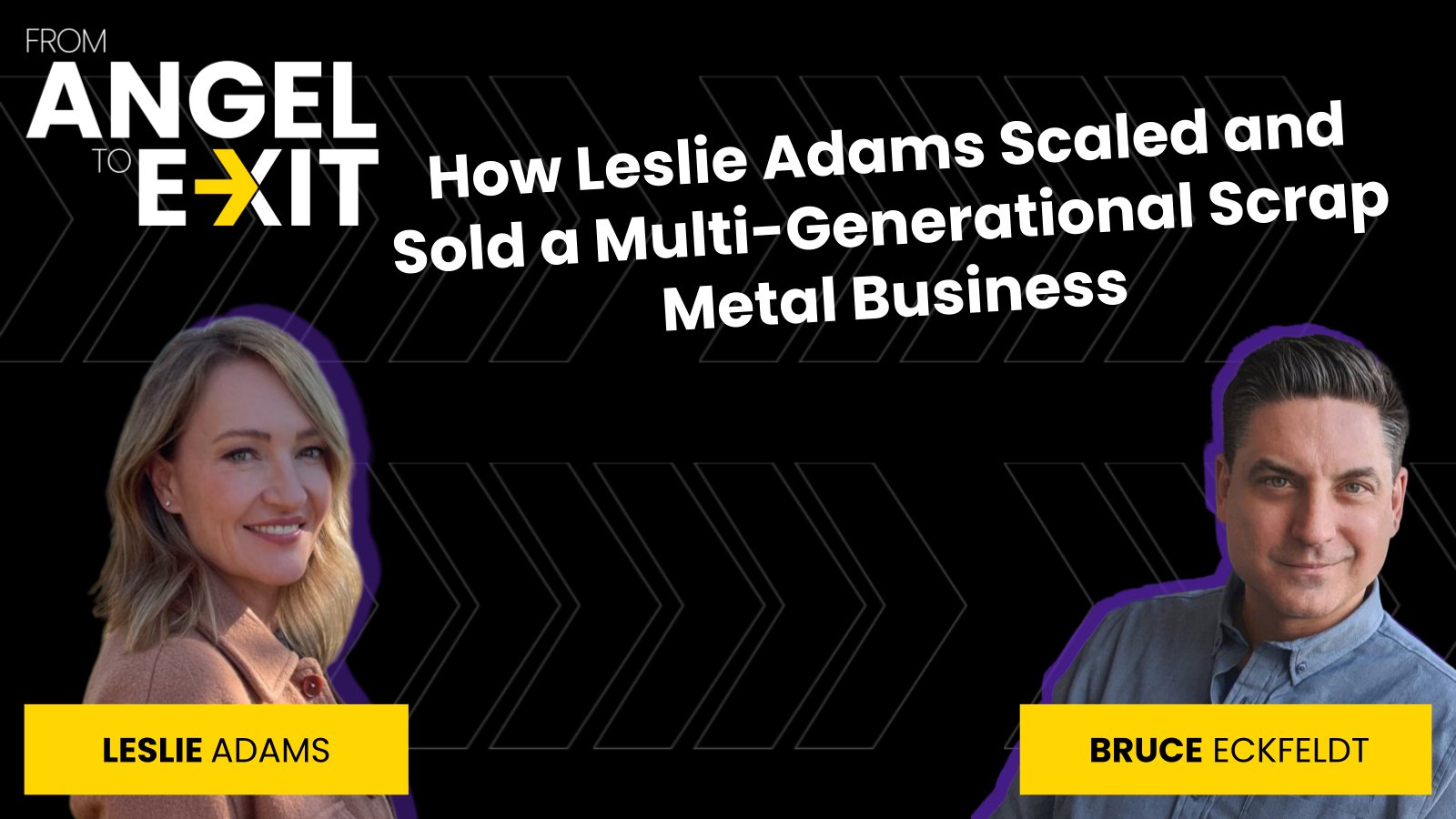
How Leslie Adams Scaled and Sold a Multi-Generational Scrap Metal Business
Leslie Kraatz AdamsFounder, A Work of Heart
Listen to the Episode.
Play the full conversation right here, or pick a chapter to jump straight to that moment. Prefer your own app? Every episode is on Spotify, Apple Podcasts, and the rest.
About This Episode.
Start with the key takeaways, the ideas worth bringing back to your leadership team. Then read the full story of the conversation, or use the chapters above to jump straight to the moment that matters most to you.
- Family dynamics require careful navigation during succession and sale
- Building to sell starts with solid operational foundations and leadership structure
- Industry shifts demand business model agility and innovation
- Emotional resilience is critical for founder wellbeing and decision-making
- Strong relationships and reputation can drive organic exit opportunities
- Certifications and social responsibility increase buyer appea
- Timing the exit strategically is as important as structuring the deal
- Post-exit identity clarity eases the transition into new ventures
In this episode, Leslie Kraatz Adams shares the remarkable journey of scaling and exiting Federal Metals, a third-generation scrap metal business. Starting with deep family roots and evolving industry dynamics, Leslie transformed the company from a local scrapyard into a major regional player in Western Canada. She candidly discusses leadership challenges, navigating family dynamics, preparing for sale, and her pivot into health and wellness entrepreneurship with her new venture, At Work of Heart.
Watch the Video.
Prefer to see the conversation? The full episode plays right here on the page, so you can watch while you follow the takeaways or read along with the transcript. Every episode of From Angel to Exit is also on my YouTube channel, along with short clips from each conversation.
About the Guest.
The background behind the conversation, and where to find this guest online.
Leslie Kraatz Adams
Founder, A Work of Heart
Leslie Kraatz Adams grew Federal Metals, a third-generation family scrap metal business, into a major regional player in Western Canada and led it through a sale. She now runs A Work of Heart, a health and wellness venture.
- Website
- aworkofheart.ca
- linkedin.com/in/lesliekraatz
Full Transcript.
The complete conversation, lightly edited for readability. Open it to read along, or search the page for a topic or a name.
Read the full transcript
Bruce EckfeldtWelcome, everyone, to From Angel to Exit. I'm Bruce Eckfeldt, I'm your host. Our guest today is Leslie Kraatz Adams. Leslie has been involved in a couple of different companies. We're going to talk about her experience with Federal Metals, which was originally a family business that she was able to grow, scale, and ultimately exit. We'll hear all those stories. And she's got some interesting work with a new company called A Work of Heart, so we'll find out how that's been the next stage of her entrepreneurial journey and how she's applying what she learned from Federal Metals.
I always like these stories of people having successful exits and then doing something else, and finding out what they've learned and applied to the next phase of their professional and entrepreneurial career. So with all that, Leslie, welcome to the program.
Leslie Kraatz AdamsThank you, Bruce. I'm excited to be here.
Bruce EckfeldtIt's a pleasure. Why don't we get a little background? I always love hearing how people got into this, in this case a family business. I'd love to hear a little about the background of the business and how you got involved. What was that like? And then talk a little about your role as CEO, having scaled and exited.
Leslie Kraatz AdamsSounds great. Federal Metals was started in 1950 by my grandfather, so I am third generation. He started it in the local Calgary area and grew it from there. My parents took over in 1975, the year I was born. Then I ended up buying it from them in 2008 with my then husband, who was my partner.
Federal Metals is a really interesting company. I was so fortunate to be able to buy a company that had such a strong foundation. It was run really well, so I was able to take this beautiful package and step it forward.
Federal Metals is a scrap yard. I'm a scrap dealer, recycled metal. Our image changed from scrap dealer, junk dealer, to the recycling industry, and that switch happened around when I bought it. We buy scrap metal from peddlers, which are people who come across the scale and bring stuff into the yard. But we also have a larger side of the business where we place bins at companies that have larger amounts of scrap, and we pay them for what they give us. We also had a new steel yard, so we sold new steel as well. That was neat, because we dealt with the end of life and the beginning of life of metal. It was the full circle.
Bruce EckfeldtFor people who don't know, and I only know a little about this tangentially, you need recycled steel to be able to create new steel in some capacity. What's the life cycle? What are you buying, why are you buying it, what do you do to it, and how does it turn into new steel? Just a bit of the business model.
Leslie Kraatz AdamsAbsolutely. We buy ferrous and non-ferrous, which means magnetic and non-magnetic. The great thing about our industry is that we take end-of-life material. For example, a company making window frames has leftover scrap pieces they can't do anything with, so they sell them to us. We process it and send it out to mills, and they reform it into new window frames. That's just one example. It depends: steel, iron, copper. What we're doing is diverting from the landfill, and we're also reducing the amount of mining that has to take place, because we're using metal that's already in the life cycle.
Bruce EckfeldtI'm curious how that market has evolved over time. When the business started back in 1950, were there lots of these? What was the structure of the industry, and how did things change up until the point you bought it?
Leslie Kraatz AdamsThat's a really good question. There's been a lot of change in that business. When my grandpa started it, he would go out to farms and pick up old farm equipment. It was mostly that. People would actually pay him to come out and get their stuff. Even in the city, some companies would pay him to come and pick up their junk. He'd go get it, package it, and get it ready for shipment out to the mills.
At the end of my grandpa's career, when my parents took over, you started having to pay people to buy it. But you could buy it for very little. There was a huge margin they worked on, and there weren't many scrap yards. When my grandpa started, I think there was one, and then there were three: he and a couple of other scrap gentlemen started at the same time. When my dad came into it, there were four. So there wasn't a lot of competition, and again, theirs was based on margin.
By the time I got into it, there were seven in the city, I believe, which is quite a lot considering what you're used to. It went from a margin-based business, where you paid very little and sold for quite a bit, to a volume-based business model. We had to get much more quantity and work on a really tight margin.
Bruce EckfeldtGiven it's a family business, was it front and center in your childhood? Did you know someday you would take over? How did being in a family business affect you when you were young, in terms of your association with it and what role you were going to have? And how did that lead up to actually taking it over? I'm curious what your mindset was and what the plan was.
Leslie Kraatz AdamsFederal Metals was almost like another sibling, another part of the family. We literally grew up there. It was all work. We went down there all the time with my parents. We had a farm, and my dad would have the guys out there on the weekend. It was like a big family.
I actually have an older brother, so it was never meant for me to be in the business. It was always, "You just stand there and look pretty. This business isn't for you." That's how I grew up with it. It was supposed to be my brother's. But one thing led to another, and I ended up in the business anyway, for various reasons. My mom and dad had to sell, and I was there, so I bought it from them.
I learned organically, too. I'm not formally trained in business. I didn't go to business school. You just grow up in the business, and it becomes part of you.
Bruce EckfeldtI'm curious about the nature of the deal, because we're talking about a double transaction. You were involved in buying it, and then you exited as well. Was that a smooth process? Was it complicated? How did you handle the finances? With these generations taking over, how did you structure the deal to make it work both for you and for your parents? A lot of times you're buying from or selling to a somewhat unknown third party, and you can hammer the deal: "I'm going to get the best deal possible." In this case, you're negotiating with family. How do you navigate those dynamics?
Leslie Kraatz AdamsRight, because it's family. Well, they put forth a very fair deal. Obviously I didn't have the money at the time to give them a lump sum, so I was able to buy gradually. I had a seven-year contract with them to buy them out, and I was able to use the profits of the company to do so. They set it up as payments. We had legal contracts. I couldn't miss a payment, stuff like that.
Bruce EckfeldtThe other piece is that when you have parents who have owned and run a company for a long time, and then you're taking it over, what were the dynamics around decision-making, control, and involvement? Who calls the shots now that there are different owners?
Leslie Kraatz AdamsThat was a really challenging situation. I was caught in the middle between my business partner and my parents. My parents are great business people. My dad is a legend in the industry, and he learned from a legend too. And my business partner is a great guy and also a very good businessman. I don't want to throw anyone under the bus, but he wanted to be the boss, and my dad didn't want to give up the position. So that was difficult, and I was in between, navigating that.
Relationship-wise, because it's a family business and they're my parents, I always put the relationship before anything else. And at the time it was my husband, so I was like, "My God." It was tough. Egos at play, a lot of mitigating both sides. It was so challenging.
Bruce EckfeldtYou've got family all around. When you took over the business, did you see yourself continuing to run it as it was, or were there big changes you wanted to make? You mentioned the market changed quite a bit and you had to move to much more of a volume model. How did that awareness happen, and what did you have to implement in the business to make that effective?
Leslie Kraatz AdamsAs much as I'm saying my partner wanted to do all this stuff, I did too. I totally did. But I wanted to wait until my parents were out of the business. So we dug in and paid it off in five years. After that, we did start making changes, and they were necessary changes for the time. Our competition changed. Everything changed out there.
So we switched to a volume-based model. That was an interesting transition with cash flow, because we were a cash business. Cash management is absolutely essential in our business. Fortunately, I grew up with it, so I knew how to manage cash the way my parents ran the business. But we did run into a lot of tight spots with the volume, trying to get paid in time to pay our customers. We had a lot of times where we had to dip into our own money to make that happen.
We also wanted to grow the new steel, so we did that. We ended up buying new equipment. My parents' philosophy was to buy old stuff and fix it. At one time that worked, when machinery was built a specific way. But as soon as computers and technology started coming into it, it got more and more expensive to do that. So we started buying new equipment, but strategically, one piece at a time, again maintaining our cash flow. We also had to develop credit with our bank, a good credit score. So we were strategic in buying new equipment that way.
We also started milling copper. We wanted to take over a specific market. Everyone was in the ferrous market. It was easy. It's capital intensive, you just buy the equipment, but there's much less risk when you buy and sell. It held its price a lot longer. Whereas we said, "Hey, no one's in this non-ferrous market. Let's get into it and get bigger." So we did. We had a lot of ups and downs with that. We made some huge mistakes, but we also came back from it and learned a lot, and we ended up becoming a Western Canada mill for copper. We were the first ones.
Bruce EckfeldtFascinating. You said you didn't have any formal business training getting into this. How much of this was the school of hard knocks, just trying and doing and learning, versus how much did you intentionally develop and polish formal business skills as part of this journey once you bought the company?
Leslie Kraatz AdamsOnce I bought the company, it was definitely the school of hard knocks. That's when I decided to join business groups. One of the most challenging things was trying to take it from a mom-and-pop operation to a corporation. So I joined business groups to learn from other business people in different industries and refine myself, so I could lead the company in a really positive direction and be taken seriously.
Bruce EckfeldtSo groups like YPO became pretty important for you.
Leslie Kraatz AdamsThat's right. EO, YPO. I learned a lot. I took a lot of classes. I bought a lot of books just to learn the lingo. I had to read so that when I was sitting in my forum groups, I could understand what they were talking about. They'd throw out words and acronyms, and I'd be like, "Yeah, totally," and then think, "My God, I don't know about that."
Bruce EckfeldtI have stacks of books on my counter here. I'm still buying books. Lots of EBITDA everywhere.
Leslie Kraatz AdamsExactly. But it was really important. I'm so happy I joined those groups, although I had a difficult time integrating myself, because I felt very different from everybody, coming from a tough industry. But it was so helpful. I found people I could relate to, and that was new for me, because as a business owner I didn't have anyone I could talk to outside of my partner and my parents. It was lovely that there were other people out there experiencing similar things in totally different industries.
Bruce EckfeldtIt's fascinating. With the CEOs I work with, it's always, "How do I get information, feedback, perspective?" Whether it's my own leadership style or management style, or my business, my industry. "This is the way we do things here, but how do other industries handle these things? How do we deal with talent? How do we deal with financing?" These kinds of groups are an amazing opportunity to get that perspective from people who don't have a dog in the fight. They're not a business partner, they're not your bank, they're not trying to sell you services. They're just curious and want to help and be supportive. What were some of the things that came up for you as you got into this? Realizations about things you wanted to do differently as a leader or manager? What epiphanies did you have as part of that experience?
Leslie Kraatz AdamsI really learned how to set my business up for sale, to be honest. That was the main reason I went in there. I also learned about the changing industry by talking to people. A lot of them could have been my customers. They owned various businesses that had scrap metal. So I could understand what was important to them as owners or CEOs when they're looking for someone to deal with their scrap metal. What are they looking for? For example, certifications: a COR certification, safety certifications. They want to know there's a strong management team in place.
All of these things were new to me, and it was eye-opening. I really appreciated the feedback, and I got right on it. It was great, because I could bring them into my facility and say, "Hey, take a look at this place. What would you like to see? What can I do to improve?" It was awesome.
Bruce EckfeldtYou mentioned you went from being a local player, at least on the copper side, to being a Western Canada player. What were some of the choices, decisions, or steps you took to go through that growth process?
Leslie Kraatz AdamsThe scrap business is unique in that there was a very tumultuous relationship between law enforcement and scrap dealers. Theft is a huge thing. Copper theft specifically is a major problem. So I started working with the police on that, we made a couple of huge busts, and the word got out.
CARI, the Canadian Association of Recycling Industries, which is the organization for scrap dealers across Canada, heard that we did all this good stuff and asked us to be on the board. That was the first step in a giant leap forward for us in putting ourselves on the map in the scrap industry, even us as the owners. It was fantastic.
Then some people from the government and from various electrical companies reached out. They formed a board called the Provincial Electrical Physical Security Working Group, and we got to sit on it with CSIS, massive heads of electrical companies, the government, police, and the RCMP. We were the insiders. We educated them on how copper comes in, what gets stolen, how it gets disguised, and how it's processed. It was so exciting listening to them, and it was fun learning how to catch people in the act. It was really fascinating.
Bruce EckfeldtFascinating. Like the CIA of metals.
Leslie Kraatz AdamsKind of, right? So we ended up opening our scrap yard to law enforcement to come in, and we started educating them about the whole cycle: the theft and getting rid of the material. That was another great thing that got us out there. We wanted to put ourselves on the map as people in the community, with the community, versus the little back-door guys everyone can go sell their stuff to. We wanted our image to come out spick-and-span. The scrap industry was kind of gangster back in the day, so bringing it forward was unique and a bit of a challenge, but it worked.
Bruce EckfeldtAt what point did you make a decision or have a plan for actually exiting the business? When you first took it over, was it, "I'm in here for 10 years, and then I'm going to flip this thing and make a bunch of money"? Or did it evolve over time? You were third generation. Did you have any ambitions of handing it over to someone else in the family? I'm curious about that set of decisions.
Leslie Kraatz AdamsGreat question. Third generation carries a lot of weight on your shoulders, because everyone's expecting you to mess it up. Or you want to sell, and it's, "My God, if you sell, that's a failure." I talked to my parents about that.
The industry itself changed, and the players in the game changed. In the East there are massive scrap yards. The amount of scrap they deal with is so much greater than ours, and they've slowly been making their way out West. We had a little taste of that here and there. So when we bought the company, I wanted to make sure we bought it with the mindset that we were going to build it to sell it. It's better to be the bright, shiny object they look at first than to fight the sharks. We'd be a tiny tadpole in this huge pool of sharks.
Bruce EckfeldtNot something you wanted to set yourself up for. So you were very intentional from the beginning that you were going to have a transaction and sell the company at some point. When you say you set it up for sale early, what did that mean for you practically? What did it mean for you energetically or emotionally? How did you approach this so you were actually in a position to sell?
Leslie Kraatz AdamsI did get into the company with the mindset to sell. It didn't mean I was necessarily going to sell it, but I had the mindset of getting it ready to sell. Build it, build it.
So what got me there? There's an awesome article I read, you probably know it: "Will it make the boat go faster?" I was super focused on only that, the foundational health of the company, in order to move it forward. We did not take risks that put that at risk. We didn't take big steps that would ever risk the foundation of the company. We'd get close sometimes: "Okay, our boat is sinking. Water's starting to come over the edge. Let's take a step back, get back to the foundation, reinforce what we've just built, and move forward from there." I think I might have lost sight of your question. Would you mind repeating it?
Bruce EckfeldtWhat are some of the things you did to make the business ready to sell, or optimize the business for selling?
Leslie Kraatz AdamsOptimize the business. Got it. We hired more staff. We put a management team in place, because before it was just us. If we were gone, there was no business. So we put a management team in place and got more people. We organized the yard.
We built the new steel business. That was a huge part of it too. When scrap was slow, new steel was hopping, and when new steel was slow, scrap was hopping. So they balanced and supported each other.
What else did we do? Environmental. We did a lot of environmental cleanup. My dad started that, and we continued it. And we built copper processing for milling. In that non-ferrous market there was a lot of competition for the littler stuff. So instead of being part of that competitive environment, we started milling the copper and started a B2B business. We started working with the other dealers and buying the copper from them. That took us out of the competition, and we ended up getting it all anyway. It was beautiful, and it worked really well for all of us. It minimized our shipping costs. We got actuals on our recovery of copper instead of guesstimates. So everyone ended up making more at the end of the day, including the customers we buy from at our yard, because with so much volume we were able to give them a much better price.
Bruce EckfeldtFascinating. What are some of the things you wish you had done differently earlier to help you be more prepared? What did you miss, or what did you not get done that you would have liked to?
Leslie Kraatz AdamsI don't feel like I was missing anything. I feel very, very lucky with this sale. I shouldn't say lucky. I worked for it. I stuck it out. I made some great decisions, and not just me, my business partner too. We were really good business partners in that sense. And I would say we sold it at exactly the right time, exactly the way we wanted. It wasn't too big, which would have taken us out of the market, and it wasn't so small that we weren't enough for someone to come buy. It was just right, and the right time in life too. I'm 49 now, and I was 46 when we sold it. Still tons of life ahead.
Bruce EckfeldtLet's talk about the sale process itself. You had grown the company, added these other services, gotten into the non-ferrous world. At what point did you decide, "Okay, we're going to start looking for buyers. We're going to start this process and put together a team"? Tell us a little about what that looked like.
Leslie Kraatz AdamsAbout five years before we actually put it up for sale, we started asking questions of potential buyers. "Hey, if you were going to buy us, what would you want?" Hypothetically.
Bruce EckfeldtHypothetically. "Say there was a company interested in selling that looked kind of like this."
Leslie Kraatz AdamsExactly. Then we took what they said seriously and implemented it.
Bruce EckfeldtWhat kind of stuff came up? What feedback were you getting?
Leslie Kraatz AdamsManagement team. COR. Safety certifications. Those were the main ones.
Bruce EckfeldtSo basically things that de-risk the business, make sure things are run professionally, and make it easier to actually do the purchase.
Leslie Kraatz AdamsThat's right. To be honest, it was pretty new for all of us in the industry. We were like the Wild West. We just did what we wanted, and no one seemed to care. But then things started to change. The companies we'd buy from started having regulations that they had to deal with companies that had specific certifications. So we had to step up and do that, for sure.
And also social give-back. I think they were looking for companies that gave back. To be honest, we gave back a lot with our customers, giving some of them deals and letting them borrow money, but not in the bigger picture, in the community.
Bruce EckfeldtCommunity reinvestment and things like that. Did you run a big deal process, with dozens of bids, lots of LOIs, big due diligence? What was the process of creating a market for the company and finding potential buyers like?
Leslie Kraatz AdamsAt first we were trying to decide whether or not to go with a broker. A lot of people were advising me to go with a broker. "They're so important. They know all the details." I understand why they said that. But our industry is a little different, and we had pegged the people we wanted to buy us, and they were already scrap yards. So it would be a clean deal, as clean as it can be, and they knew what they were doing. We did have LOIs.
Bruce EckfeldtHow many suitors did you entertain as part of the process? And were they local? Where were they geographically?
Leslie Kraatz AdamsWe entertained three. They actually weren't local. One was from the States. One was out of Montreal and Saskatchewan, the same company. And the other was from Edmonton. So we put it out there. I think the most difficult thing was trying to keep it a secret from everyone else, like our customers.
Bruce EckfeldtA lot of times the benefit of having brokers or investment bankers is, one, they can make the market if it's not clear who the potential buyer is going to be, or it's a very disrupted or complicated industry. And two, they can help manage the process and create a bit of a buffer with the leadership team and with the industry, so you're not just putting yourself out there. It's very exposing to put yourself on the market and have all this data out there. So you identified these players. I'm assuming you had relationships with them at some level already, because they're players in the industry.
Leslie Kraatz AdamsWe all have really tight relationships when we're not in the same city. Really good, close relationships. We had dealt with them before, and we had lots of family history. We didn't deal with them specifically a lot, because at the time they were also a scrap yard, not a mill. But my dad and his grandpa or his dad did some business. So we knew each other.
We wanted to keep it in the scrap business, if that makes sense. We didn't want to sell to a corporation or a bunch of investors. We wanted it to stay a scrap yard, purchased by a scrap yard, a scrap dealer. We thought that was fair for the industry.
Bruce EckfeldtDid you have a pretty clear idea of what you wanted in terms of valuation, terms, and the nature of the deal? How specific were you going into that process?
Leslie Kraatz AdamsWe went in very specifically. We did an asset sale. That was our best move. The people buying us also wanted an asset sale, but it actually made sense because we're an asset-based industry, and we found we had more value in that space. Right or wrong, that's what we did.
Bruce EckfeldtAnything about the valuation you were expecting and the structure? How much was going to be up front? Were there going to be earnouts or guaranteed payments? How did you navigate and negotiate those things?
Leslie Kraatz AdamsHow did we navigate? We just told them what we wanted, and it seemed to work out. Honestly, we sold a really solid business, and they knew it. They knew it was a great opportunity for them.
Bruce EckfeldtYou just dictated the terms and they said yes. I think that's a great point. If you've done your work, you've put together a solid business, you know what the market wants, and you know what the valuations are, you should be able to go out there and say, "Look, I want X," and people say, "Yep, X is fair. I'll give you X."
The drama typically comes when you haven't made it clear, or it's really difficult for a buyer to assess the value or the risk, or the projections are, "I don't know. That's what you think it's going to do. I think it's going to do Y." All these deltas. But if you can lay down a pretty clear plan and show there's a high level of confidence that the business will continue, and that the buyer will reap the benefits you've created in the business, it should be a much easier transaction. Anything in the due diligence process that was particularly easy or particularly difficult?
Leslie Kraatz AdamsThe due diligence was pretty easy. We had everything set up, and they knew how we were operating. So, no problems with due diligence. But I think another thing that helped us was that we weren't desperate, because we were still young. We could pull it and say, "Fine, then we won't sell." We could have reinvested and grown the business ourselves, or brought in other people from outside. We like to keep it private, but worst case, that's what we would have done. Or just bought another scrap yard. I think the fact that there was zero desperation on our side helped.
Bruce EckfeldtNot needing the deal is the best way to get a deal done. Was it a clean cash transaction? Were you involved in the company post-sale, or did you have a pretty clean break?
Leslie Kraatz AdamsWe were involved for a little bit. They set it up so that we had an earnout. They wanted both of us to be in the earnout, but I got myself off of it, because I didn't think it was necessary to have both of us on it. I didn't want to stay. I recognized there was a time when I was no longer passionate about it, and I knew it was time for me to get out.
Bruce EckfeldtYou were ready.
Leslie Kraatz AdamsI convinced them to keep my partner in that earnout, and I would just stay on. They said, "Okay, we'll give you a one-year contract." So I stayed on for that. I didn't make it. They fired me, which makes sense. I've heard that happens. So I didn't get that full year, but that's okay. I'm okay with that.
There was a large lump sum of cash up front, and the rest was paid off over a term of five years, connected to that earnout. If he quit, which he ended up doing, we still got the money, but it was paid out over seven years instead of five.
Bruce EckfeldtSo they basically extended the guaranteed payments, or you got an accelerated payment for being involved in the company if that ended. It's interesting. I've seen all these crazy formulas for earnouts and bonuses and rollover equity. You can come up with all sorts of interesting deal structures based on what each party is trying to do and what risks they're trying to offset and manage.
Leslie Kraatz AdamsExactly. We just kept it simple.
Bruce EckfeldtI'm curious, on reflection, what were the more personal, emotional, or experiential challenges for you? How did it feel to take this company that had been in your family for a couple of generations, that you'd been involved with, and actually go through the sale process and get to the other side? How did that land for you personally and professionally?
Leslie Kraatz AdamsI had a lot of guilt. But I did talk with my parents. I told them what was going on and said, "This is what's going to happen. Are you guys okay with that? Do you understand why?" And they were like, "My goodness, finally. Thank God we're getting out." I'm like, "Okay." Not that it's a bad business. It is not a bad business. It's just rough. It's tough. They saw it too, so they were pleased with it, and I think that helped me a lot.
But an interesting dynamic was that I grew up in the business, and a few of the guys there had been there since I was a little kid. So it felt like deceiving family. I took it very personally, and I struggled with myself on that. I felt some shame. But I also knew that the people we were selling to understood the importance of the scrap business and the people there and the history. It has changed. They have to do what they have to do. Some have left, some have stayed, but it is what it is.
At the end of the day, I have a difficult time separating myself from business. So doing that for myself, and not thinking about how it affects anyone else, was really difficult. There was also the dynamic that my business partner was also my ex-husband. We got divorced not long after we bought the yard. So we had to manage that divorce and keep it quiet for as long as we could, so our staff would be okay and still feel the security of the company.
And our customers, some had been coming in since I was a little kid. They were like family to me too. So it kind of felt like divorcing all of them.
Bruce EckfeldtComplicated, to say the least. A lot of relationships, a lot of dynamics. So you got to the other side: sold the company, got out of your active role. There were still some payouts, but you were free and clear professionally. At that point, did you have a very clear idea of what you wanted to do next? Was it, "Great, now I can pursue this other business, this other dream"? I always find that's a difficult moment for a lot of founders and CEOs post-sale. "Okay, now what?" Where were you, and how did you figure that out?
Leslie Kraatz AdamsAnd then "Who am I?" too, right? The one great thing about watching my parents go through it and retire is that I saw how attached they were to the business. Their identities were attached to it, and it was really difficult for them to let go. They did end up transitioning beautifully and doing great things, and that's awesome. But I saw that. So I made sure I never really attached who I was to my role at the scrap yard.
It's funny, I never really felt like an owner. I felt like one of the guys. I felt like we were all in it together. Maybe that's because I grew up in it and was the kid. Even though I'm a full-grown woman, I'm still just the kid in the business. So I never really attached myself to that.
Not to mention, I'm not such a nerd in the scrap business, but I am such a nerd in the health and wellness industry. Behind the scenes, I have always been studying health and wellness. I'm a certified nutritionist, a hypnotherapist, a yoga instructor, a personal trainer. I specialize in heart rate variability. Just the function of the body, the health of the body. I always thought it was very important as a business owner, because your health reflects on everybody around you. I wanted to make sure my parents were healthy doing what they were doing with all the stress they had. I've always been that way. I grew up a dancer, so I've always been physically active and into healthy living.
Bruce EckfeldtDo you think that really helped you? I certainly know a lot of founder-CEOs who don't have anything else going on. The business is literally everything about them, so when they exit, they're really left with nothing. It sounds like you had another thread of passion and interests and things you wanted to accomplish outside the business that became important as you finished the sale.
Leslie Kraatz AdamsI think it's so important. But even though I had that, I did have moments where I thought, "My God, I don't have a business." The biggest thing for me was a paycheck. I didn't have a paycheck. I was like, "I'm unemployed. I don't even have a job. What's going on?"
Bruce EckfeldtBurning through all this money I just made. And probably unemployable, too. That's the other thing I find about founders.
Leslie Kraatz AdamsThank you for saying that. I was thinking about that the other day. So unemployable. No one would employ me. So if I want to do something, I have to create it.
But I did end up reconnecting to the fact that, hey, I've got this other thing I absolutely love doing, and I can make something of it. It's not that I want to be a super successful business person with it. It's actually my give-back. It's what I've always wanted to do.
You can imagine the people who came across the scale at the scrap yard. It definitely changed over time, but there were some people for whom nothing was going right. I always felt like they left the yard feeling better, because we were always so happy to see everyone. They were our customers, and we were so grateful. And they were just blown away: "First of all, you're not insulting me. You're not yelling at me." There's so much out there that people need, just giving of your positive energy. So I came back around to it eventually.
Bruce EckfeldtTell us about the new business. What are you focused on today?
Leslie Kraatz AdamsI focus on emotional resilience, and I tell you, I could sure have used that through my career. When you asked if there's something I regret or wish I had, I wish I'd had emotional resilience training at the beginning of my career. I think it would have been an easier go for me and perhaps everyone around me at times.
Bruce EckfeldtIf only we could go back in time and coach ourselves.
Leslie Kraatz AdamsMy business now is called A Work of Heart, and I'm an advocate for lifestyle medicine. I specialize in areas of lifestyle medicine, so there's the fitness aspect. But my real specialization is heart rate variability and emotional resiliency, because I feel like that influences every other aspect of lifestyle medicine. Once you can control yourself, your reactions, your emotions, it affects your physiology. You control your world, basically, your own personal world.
Bruce EckfeldtIf you can manage your nervous system, then you manage life, how you navigate the world. That's great. We're at time here, Leslie. This has been a pleasure. Thank you so much for sharing your story and for being on the program. If people want to find out more about you and what you're doing, what's the best way to get that information?
Leslie Kraatz AdamsIf they go to aworkofheart.ca, that's my website. My email and phone number are on there. That's a great way to get in contact with me. Or Leslie Adams on LinkedIn is another great spot to get in touch.
Bruce EckfeldtI'll make sure those links are in the show notes. Thank you so much for taking the time today. It's been an absolute pleasure.
Leslie Kraatz AdamsThank you.
Never Miss an Episode.
Know the moment a new episode goes live. Subscribers also get a say in future guests and the topics we cover.
Other Related Episodes.
More conversations that connect to this one. Or browse the full archive by topic or by guest.
Lysle Wickersham
How brand equity drives enterprise value, from scaling a $170M agency through several exits.
Listen and Read
Alan McLaren
How he scaled two agencies and now helps founders build a personal brand ahead of an exit.
Listen and Read
Joshua Maidan
How he built a premium coffee brand, and what good governance means for scaling and exiting.
Listen and Read