From Angel to Exit Episode 9
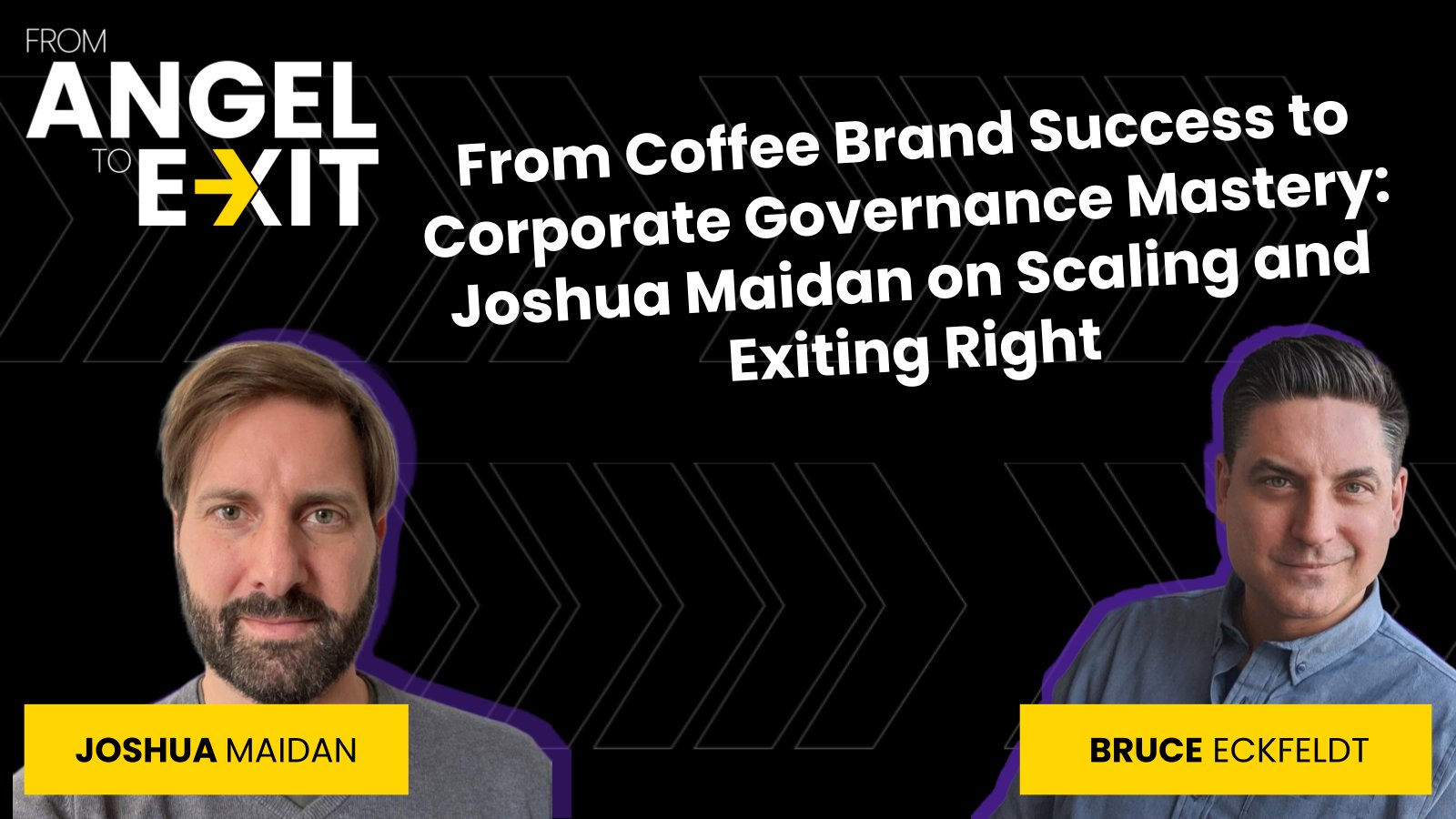
From Coffee Brand Success to Corporate Governance Mastery: Joshua Maidan on Scaling and Exiting Right
Joshua MaidanEntrepreneur and investor
Listen to the Episode.
Play the full conversation right here, or pick a chapter to jump straight to that moment. Prefer your own app? Every episode is on Spotify, Apple Podcasts, and the rest.
About This Episode.
Start with the key takeaways, the ideas worth bringing back to your leadership team. Then read the full story of the conversation, or use the chapters above to jump straight to the moment that matters most to you.
- Corporate governance is vital from day one, misalignment can kill promising ventures.
- A shared brand vision must be backed by aligned operating agreements.
- Clear exit mechanisms save time, stress, and future litigation risk.
- High design and product quality can’t overcome partner misalignment.
- Early board involvement separates day-to-day operations from strategy.
- Documented roles and responsibilities avoid equity vs. contribution conflicts.
- External investors bring discipline, and force professional governance.
- Strong operational systems and clarity make exits seamless and scalable.
In this episode of From Angel to Exit, Bruce Eckfeldt speaks with entrepreneur and investor Joshua Maidan, whose journey from Colombia to New York led to the creation of a high-end coffee brand with international acclaim. Maidan shares how he scaled the business using real estate savvy, aggressive strategy, and deep operational structure. The episode centers on how misaligned visions and lack of corporate governance led to a pivotal exit, and how those lessons now guide his investment philosophy and deal execution.
Watch the Video.
Prefer to see the conversation? The full episode plays right here on the page, so you can watch while you follow the takeaways or read along with the transcript. Every episode of From Angel to Exit is also on my YouTube channel, along with short clips from each conversation.
About the Guest.
The background behind the conversation, and where to find this guest online.
Joshua Maidan
Entrepreneur and investor
Joshua Maidan moved from Colombia to New York and built a premium coffee brand with international acclaim. Lessons from that company's exit now shape his work as an investor.
Full Transcript.
The complete conversation, lightly edited for readability. Open it to read along, or search the page for a topic or a name.
Read the full transcript
Bruce EckfeldtWelcome, everyone. This is From Angel to Exit. I'm Bruce Eckfeldt, I'm your host. Our guest today is Joshua Maidan. He is an entrepreneur and an investor. We're going to hear a couple of his stories about getting involved in companies, running them, growing and scaling them, and exiting them, along with some of his takeaways and learnings. Joshua has a really interesting background and some really interesting experiences, so I'm excited to hear what he has to say. So with all that, Joshua, welcome to the program.
Joshua MaidanThank you for having me.
Bruce EckfeldtIt's a pleasure. Before we get into the entrepreneurial experiences and the investing you're doing, I'd love to get a little background, a little of your personal story and business story. How did you get into this space? What was the history?
Joshua MaidanSure. I do a lot of private equity deals and a lot of real estate, but I've also been involved with brands: buying, building, and selling brands. I really got into this through an opportunity I saw walking around Brooklyn, New York, where I saw boutique coffee shops selling $6 and $7 coffees.
Bruce EckfeldtThe math in your head was just too good to pass up.
Joshua MaidanPretty much. I knew somebody who was in the business in Colombia, where I partially grew up. At the beginning I wanted to do distribution, and I ended up just partnering in the whole business. I moved back to Colombia and really got knee deep into fixing everything that was there and creating an operation to bring to the United States, to New York specifically. We were successful, and we grew the company, and I sold it.
Bruce EckfeldtI'm curious, was getting involved in businesses, investing, entrepreneurship, and growth something you always wanted to do? Were you in kindergarten talking about how you wanted to own a business someday? What was your background with business ownership and entrepreneurship?
Joshua MaidanI don't think it was in my plans. I think I kind of stumbled into it, went with it, and kept growing from there. Even the following businesses all spiraled from it a bit. Now I'm incorporating a bit more of my real estate background into operating businesses. But I kind of look at opportunities as they come.
Bruce EckfeldtSo a combination of a little strategy and a lot of fortuitousness: what are the opportunities in front of me? Tell us more about the coffee business. You saw this opportunity. Did you see it as a trend? You saw all these coffee shops coming up, people spending this kind of money on coffee, and thought, "Hey, there's an opportunity here"? How much of it was seeing the trend, and how much of it was, "I've got a unique opportunity, with some relationships I have, to source coffee"?
Joshua MaidanThere definitely was a trend. I saw what's now called the third wave of coffee, which is the boutique world, specialty coffee, I should say. And I saw an opportunity, because I had the connections to really source the coffee directly. We were able to create an experience that didn't exist at the time, which was the way we were shipping coffee by air, and the time it would take us to get from the farm all the way to the cup.
Bruce EckfeldtAnd how were the other coffee brands doing it? What was the innovation you saw?
Joshua MaidanIn most, I would say 99.9%, of retail coffee shops, you're going to see a "freshly roasted" stamp. It might say it was freshly roasted a couple of weeks ago, but that coffee was harvested at least a year ago. Coffee changes state depending on the different processes it goes through, and it loses consistency because it loses weight. You're taking away the shell, then you're drying it, then you're taking off another parchment. Once that last piece of the puzzle, the parchment, is milled off into the green state, that's the first contact the coffee has with oxidation, and you start losing the taste.
So we adapted a process used for flowers, because they're a very perishable product that's shipped by air. Pretty much everybody else ships by sea. They send the green coffee in a container, and they also source through distribution companies. We were sourcing directly from the farmers. So we would go from farm to cup in between 10 days and a month.
Bruce EckfeldtAnd how did that change the experience or the taste of the coffee?
Joshua MaidanThere was definitely more consistency. Think of any product you consume in your household. With more time, it starts losing taste. It's a very easy comparison to coffee. So the taste was very good. But obviously there's much more than just the coffee. There's the infrastructure, the design, the branding, the marketing. We invested a lot in all these different areas to really create a full experience that resonated, and we were able to position ourselves very well in New York.
Bruce EckfeldtTell me about the brand, because you mentioned brands. What was your experience building brands? How did that apply to the early stages of this company? And where did you see the brand positioning, given all the retail coffee shops coming up in the area?
Joshua MaidanI think this came from a general consensus in business. If you're concentrating on retail, brand is the big aspect. That's really where everything is. Where consumers spend their money is on brand recognition. Look at all these luxury brands. Maybe the cost is really minimal, but you're not buying the cost. You're buying the brand. So we knew where the focus had to be.
We did a really big rebranding process. The company was actually called Devotion, and we hired a very cool company here in New York. They came to us and said, "You know what? You've got to change it to Spanish. It's a Colombian company. What are you doing?" And we went for it. We had a couple of concepts we wanted to work with, especially for the retail experience, and it all came out great.
Bruce EckfeldtDid you already have retail locations picked out, or was finding actual locations a big part of the lift?
Joshua MaidanNo, we didn't. We had the idea. I moved back to Colombia and focused on the infrastructure and the branding, just making sure that whatever we were going to present to New York was right. You have a one-time opportunity. It has to be a bullseye. That was really my focus for about two years.
Then, from my real estate background, we started looking at spaces. We were actually going to purchase a space, or lease it. And luckily that didn't happen. It was a great place in Clinton Hill. The retail traffic wasn't optimal. It was good, but the focus there was more on the roaster.
Bruce EckfeldtWhy luckily?
Joshua MaidanThat deal fell through, and everything was moving. There was a lot of pressure. So I just got in a car and started driving around, and I passed a retail space that was empty, in an area where I knew what was happening. It's right around the corner from the Domino factory project, which is a Two Trees project. I knew how many apartments were coming. I knew what was happening in the area, and the timing was great, and it worked out.
Bruce EckfeldtTell us a little about getting the operations right, getting the retail location up and running. What were some of the challenges you had to get through?
Joshua MaidanI guess this comes from the training I got from my family, which is heavily involved in manufacturing, where you really have to think about every little step of the process. But it really starts with something that's a huge oversight in businesses, all the way up to multinationals sometimes, which is corporate governance. And that's really what led to my decision to exit.
That's one side of it, and I think it's very important. If there's one takeaway from this talk, it's how important corporate governance is, and making sure the partners are completely aligned. Now I would put that at number one. I knew my ex-partner, and we said, "We'll work through it." And when we got to it and started seeing that there were a lot of differences in where we wanted to take this and what I wanted out of it, that was when I decided to exit.
Bruce EckfeldtLet's dig into this, because I have a similar personal story, where everything starts on good terms. In fact, I think everyone goes in with initial alignment. The problem is that life happens, and things change over time, and trying to keep that alignment can be difficult. Maybe give us a sense of the structure going into it. You had a partner. What was the situation? How did you get involved? What was the ownership structure you started with?
Joshua MaidanIt was pretty simple. It was just a straight-up partnership where we shared the equity. It was personal investment, so we didn't really have to deal with investors at the time.
Bruce EckfeldtWhat did you own? Was it the facility in Colombia, the retail location, IP? What were the actual assets at the start?
Joshua MaidanMainly, there was a smaller processing plant in Colombia with a small roaster, and the IP. There was some brand recognition in Colombia. They didn't really do a lot of exports. It was more of a future cash flow valuation that I did, and just opportunity. I knew the numbers in New York specifically, which is where the first retail location was set to open. So I underwrote the business in that sense.
Bruce EckfeldtHow did that grow or change? Did you eventually take on investors, or how did you capitalize the retail expansion?
Joshua MaidanNo, it was all done by us. We were going to capitalize the business ourselves for the investment in the expansion.
Bruce EckfeldtAnd what were those plans like?
Joshua MaidanFortuitously, everything happened pretty much according to plan. There was a shift here and there. The main thing was getting the brand ready to operate in the United States, because the way you operate in Colombia is not the way you operate in the United States. You can get away with a lot of things in Colombia, whereas here, your competition is the best and the latest, and they're all very well capitalized.
So my first task was, number one, to understand the operation and the processes. I did a really deep dive into all the systems. I implemented an SAP ERP system. We immediately started creating processes for every little task at hand, in all the different departments. Then we invested in a larger processing plant, where we bought a parchment mill, so we could do the parchment milling in-house alongside the roaster. In parallel, we started working on the brand. What's it going to look like? What's the retail location going to be? What's the experience we want?
At that time, we started talking about distribution and how we were going to do it. We had this idea to change the way coffee was being distributed all over the world. And me being the crazy-minded guy, I just went to the FedEx offices and started knocking on doors: "Hey, I've got this crazy idea." I was able to get them on board. They gave me multinational rates. We did a case study with them, which in the first month had about 160,000 views on YouTube.
We went for it, and we opened in New York, and it went great. In the first year, we got voted best coffee shop in New York by the Village Voice. It's still in Architectural Digest as the best-designed coffee shop in New York, and in the country. So it did really well.
Bruce EckfeldtKudos. What was the original plan? Where did you hope to get to in terms of size, locations, or impact?
Joshua MaidanI always look at the businesses I take part in very aggressively. I don't know if that's correct or not. I was looking at what a couple of the competitors were doing and the level of investment being poured into them, and that's where I wanted to take the company. I was very aware that retail is a very cash-intensive business, and you have to be aggressive. It's about replicating the business model as many times as you can. My aim was a very aggressive US expansion. And I guess that's where my partner and I had a bit of a different vision. They were a bit shy about that aggressiveness.
Bruce EckfeldtAs you started to realize you had some difference of opinion, how did that come up, and how did you initially navigate it? Did it become an issue right away, or was it a slow build that became more of an issue over time?
Joshua MaidanIt was a slow build. Everything started coming up because one of the things I'd been pushing for was to start a board of directors. There was no board of directors, and I wanted outside participants, just to have a different point of view. That's when we were dealing with strategy and started to see the differences. We hired a company that came in, and we did a couple of sessions to really build corporate governance. That's when the issues started coming up: the differences in where we wanted to take it and how we wanted to take it, especially bringing in outside investors instead of using our own capital.
Bruce EckfeldtSo why the board? Give us a little more insight into why you wanted to get a board involved and what it really meant. For companies that don't have a board or haven't thought about one, what does it mean, and what did it mean to you?
Joshua MaidanThe way I see business in general, it doesn't matter what size it is. There are different stages where you need different elements to manage the business, but I feel you have to treat every business as if it's a massive corporation. Think about the processes and how you make decisions. That's why I think the first focus should really be corporate governance, which is understanding not only what the strategy is, but how you're going to make decisions, from partners to management to employees. It's not about hierarchy. It's just a way of making decisions.
So I wanted to create an entity that would take away the day-to-day decisions, which my partner and I were making at the time, and start thinking about strategy and the big picture. Those are very different conversations from the day-to-day, where you're just dealing with whatever's at hand at the moment.
Bruce EckfeldtOrders and customers and operations.
Joshua MaidanCorrect. So to me, a very important piece of the puzzle was separating the day-to-day business from big-picture strategy and big decisions. That's why we decided to start the board.
Bruce EckfeldtWhat was your plan in terms of an exit when you first started? Did you have a plan like, "We want to scale this a certain amount in five or 10 years, and then take it public or get acquired"? Did you have particular visions or plans for how you were going to exit the business?
Joshua MaidanI had a very clear vision, and I was always very vocal about it. I guess my partner played along with it at the time: "Okay, sounds good, sounds nice, let's do it." Like I said a couple of minutes ago, I was very clear that it's a very capital-intensive business, especially opening up retail. Rents, deposits, buildouts. You need a lot of cash flow. You need that muscle.
I was looking at two companies in particular, Blue Bottle and Intelligentsia. I did a lot of research on them and how much money they were getting from investors. What I really wanted was to open up to seed investors, start growing from there, and build our valuation very aggressively. Eventually somebody was going to come along and give us the valuation we wanted, and I'd move on to the next business. But for my partner it was a bit different, because it was his brainchild, his little baby.
Bruce EckfeldtI'm curious about that. You were coming into an existing entity and doing a fair amount of transformation and then scaling. It sounds like your partner had an attachment that was different from yours. When did you first realize that, or when did it first start coming up?
Joshua MaidanWhen we finished the corporate governance workshop, it was very clear to me that there was a difference in the outcome we wanted, and it was a simpler decision for me to exit at that point. Luckily, the business was doing well and the brand recognition was great, so that worked out pretty well for me.
Bruce EckfeldtI see cases like this where you've got partners and there's a rift, some difference of opinion. But it isn't always easy to exit these things, figure out the valuation, or have people buy each other out. It sounds like your case was reasonably fortunate in that the business was going well. How did you actually do the exit? What were the mechanics of getting out of the business?
Joshua MaidanI was very clear. We hired a third party, an investment bank, to come in and give us a valuation, which was agreed upon.
Bruce EckfeldtWas that process in your operating agreement, your partnership agreement?
Joshua MaidanYes and no. We had an initial operating agreement that we were going to work on, and that took a wrong turn. Then we modified it and implemented an exit strategy into the new operating agreement, and that's how we went about it.
Bruce EckfeldtDo you feel the operating agreement served you well in dealing with this situation? Or are there changes you wish you'd made to it?
Joshua MaidanI wish we'd had this a little clearer from the beginning. I think I might have had a little more leverage at the time. But it went all right, because at the end of the day a third party came in and gave us a valuation. We had a couple of points we could have rebutted, but it came out fine.
Bruce EckfeldtYou got through it. Where did it leave you? Did you feel you were made whole, happy with the way things turned out, and ready to go on to the next thing? Was there disappointment? These are big changes for people.
Joshua MaidanThe process was a little difficult, because it's consuming. You go through valuations and spend a lot of time on due diligence to really get to that point. And I'm going to keep going back to corporate governance, because these are things you can put in place up front. In the businesses I started after this company, that's the first step I take, and it's already mapped out. I already have my exit mapped out, so it's very clear.
Because, look, there are all different sorts of exits. What if you just wake up one day and say, "I want to leave"? Okay, how do you leave? Those are questions people don't ask themselves at the beginning, especially in smaller companies, and I think they're crucial. You have to ask yourself, "Am I going to be here forever? Are our visions aligned? Even if they're aligned, where are the differences? What happens if life changes?" You never know. You might want to move. There are so many variables. So now I work all the way through to succession, which I think is a key element of corporate governance that gets overlooked very easily. Even very difficult conversations, like what happens if a partner dies. How do you deal with it?
Bruce EckfeldtIt sounds like you're pretty thorough on this stuff now. Most companies, I would say, are not. I don't know what your experience is with the general population of companies. Why do you think they're not? What are the hindrances for most early-stage companies around thinking about, talking about, and actually documenting some of these things?
Joshua MaidanI really think it's that they don't see the importance of it. A lot of the old-timers' philosophy, especially with succession, is, "When it's my kids' turn, they'll deal with it." I think that's the worst kind of strategy. I also learned a lot from my wife's family, who are very organized. They have their family protocol and how they work. It's so important to really think about these things.
And I've seen the outcome after this business. It's been fantastic. The next company I bought, grew, and sold was seamless. We had absolutely no issues. The board meeting when we got the offer was quick. Everything went very smoothly, because all these topics were ironed out at the beginning.
Bruce EckfeldtWhat are some of those topics? Do you have particular strategies for dealing with this stuff, like differences of opinion, life events, the unfortunate demise of partners? Is there anything you've figured out to make these workable but not overly complicated to implement? Because I have seen the other case, where operating agreements become so crazy, with all these put and call options, and people have to get insurance, and it can be onerous for an early-stage company. Have you figured out how to make this reasonable?
Joshua MaidanOne great takeaway from the corporate governance workshop I did was dividing corporate governance into a few areas. The first area is shareholder rights. What are the rights of the shareholders? Major decision rights, buying and selling, any right of first refusal, tag-along, drag-along, succession. Who can you sell to, and how can you sell? Those types of options.
Then there are the rights reserved for a board of directors, because I do think it's important, no matter how large or small you are, to have something outside the day-to-day, even if it's an advisory board, where you can discuss strategy on a much larger level. It's so positive for a business to have that input at a macro level. So: what rights are reserved for the board, what can they decide, and how are they going to be a bridge to management?
Then there's management and hiring. Who can be what? Can anybody be a manager? Can partners work in the business, or not? Who is part of the business? Contracts for upper management.
And the last one, which is really the most difficult part, where you have to talk through a lot of negative scenarios, is conflict resolution. How do you deal with a dispute or a deadlock, where the last thing you want is to end up in litigation? Do you work with a mediator? Is there a cool-down period? I think that's a positive. You put in a two-week cool-down period.
And on the positive side, there's the whole exit strategy. How do I exit? You ask the questions: What are the mechanisms for me to exit? How do we value the company? Do we just make up numbers, or do we hire a third party?
I think all those points are very important to think about when you're starting any partnership. Or even when you're already in a partnership or a business and developing it, put a pause on things and work on it. If you look at the most successful companies and the most successful families in the world, they have very strong corporate governance.
Look at succession, which again is so overlooked, at different levels. It can be at the beginning or all the way at the end. Look at all the big multinationals and tech companies thinking about succession now. I'll give you a perfect example: how do you follow whoever's leading Apple? Who's the next guy? That's very difficult. So you have to think about those things at the beginning.
You start a company and you're sweeping the floors, you're in sales, you're doing all this stuff. But do you want to do that forever? The question people have to ask themselves is: what position do you see yourself in? How many roles do you want to be doing, in terms of how you allocate your time? You have to think about who's going to take your job. A philosophy I use is that I hire people so that in five years they come in and fire me.
Bruce EckfeldtYou've touched on two areas I'd love to get more insight on. One is a board of directors versus a board of advisors. How do you deal with fiduciary duty and actual control? What power do these entities have, and how do they relate to management and investors? Do you have any good rules of thumb for how to set up boards like this, either as directors or advisors, and how you decide between them?
Joshua MaidanI think the main distinction is really who votes and who doesn't. Generally, a board of directors votes on major decisions, and an advisory board is really just a support system for the board of directors or the shareholders. So I see them as very different.
I'll start with the one with fewer implications, the advisory board, because generally there's no voting involved. It's more about strategy and ideas. It's kind of a creative session where you bounce around strategy and ask, "What can we do?" I think it's important for an advisory board to have very different profiles, profiles that aren't in your toolbox, to really help you get to that other place.
A board of directors is a bit different, because there are major decisions. I'll give a great example. If you ask me, the reason Silicon Valley Bank failed is that, if you look at their board of directors, there was one banker. How can a bank have a board of directors with only one banker, and the rest were marketing and this and that and sales? Great, but it's a bank. You need people who understand how to run whatever business you're running. When I was reading those articles, I couldn't believe it. I really had to read more, because I did not believe it. It was incredible.
And that comes back to corporate governance: the rules about who can be on your board of directors. That falls on the shareholders, because they have to set the rules and set the tone. Of course, the bare basics: you need an odd number, just to make sure the votes work. And it depends on the equity structure among the shareholders: who has more equity, or if it's 50-50. Then you might give one or two seats to each partner, so each one can bring in another member, and then there's a third, outside member, mutually decided.
I feel it's important to pay board members, because then they're committed to it. It's a job. It doesn't matter if it's a hundred bucks or a thousand bucks or 10,000. It's about the commitment. You want people to be serious about it. If not, just do an advisory board. It doesn't carry as much weight as a board of directors.
Bruce EckfeldtI also wanted to ask about the operating agreement. I run into this a lot: you've got various partners or owners in the business who may have very different operational involvement. Some people are working full time in leadership roles. Somebody else may be more in a management role. And then there may be owners who aren't operating in the business but have some kind of sales, marketing, or thought leadership role on a part-time basis. How do you handle the ownership versus contribution versus compensation drama that can happen inside early-stage companies?
Joshua MaidanI think the most important piece of the puzzle is understanding, number one, what each role is and what the responsibilities are. So transparency is number one. For example, in a company I invested in, I had equity in the deal. I wasn't doing day-to-day work, but I had a business development role, where I would bring in business, and I was bringing in 15% of the company's sales. And I didn't have a day-to-day role. So it's about structuring that particular role: what are my responsibilities, what are my limitations, and how do I utilize the other teams for the benefit of the company?
At the end of the day, I think the number one philosophy should always be to make decisions that benefit the company, because if the company does well, everything else does well. So it's very important to take the ego and put it aside. It's not about the person. I don't even put names on positions. I put the position, because it's about the position: what the role is, what the responsibilities are, what you have to do, what you want out of it, and how much time you're going to put into it. The good thing is that most of these things are very quantifiable. So just put it on paper and start figuring it out. It ends up being simple math.
Bruce EckfeldtIs there a frequency at which you suggest that stuff gets reviewed or updated? I've seen companies evolve and scale quickly, and all of a sudden it's two or three years after the original structure, things are really different, and now there's so much delta that it becomes an issue. What do you recommend in terms of reviewing these corporate governance documents?
Joshua MaidanIf you have really solid corporate governance from the beginning, I think the revisions will really come when you bring on new investors or new equity partners and things change. And having that corporate governance in place helps attract investors to your business, because they come in and see how decisions are made, and it makes it much easier to bring on investors.
Very recently, I was underwriting a business, and I knew I could have killed it, but the structure behind the business...
Bruce EckfeldtA rat's nest.
Joshua MaidanYes. Sure, they could have hired me, and it would have cost a ton of money to fix all their systems, but I decided to shy away, because the business itself wasn't able to operate to these standards. I think it's a mindset. It's very important to have that mindset of processes, controls, and strategy.
Bruce EckfeldtFor early-stage companies, or people just starting companies and putting some of this stuff together, clearly corporate governance is a big one for you. What else do you recommend a company do early in the process to make future transactions easier, whether it's taking on money, selling equity, exiting, bringing in private equity, whatever kind of deal? What else should they really think about and do early?
Joshua MaidanI think the most important thing is a clean business: the processes. A lot of people are, as I call it, running without shoes, and then they start getting calluses. Put the socks on, put the shoes on, spend the time, tie your laces. A lot of people overlook these little details.
I'll give you a very quick, easy example. I do cycles of business. I say, "Okay, I'm going to ship a package from here to there. How does it get packaged? What are the quality controls?" I put it in a list. It could be a Word document. "For this process, to get it from point A to point B, I have to do all these things." That's where I spend most of my time revising. You have a process, and suddenly there's a variable, something happens, and you say, "Wait a minute." You go back to the drawing board: what happened? And you rebuild that little piece. Put a quality control here, put a blocker here, because this didn't work. Build processes. I think that's the key.
And of course, if you can automate the process with systems, that's the ultimate goal. You're bound by cash flow at that point in terms of what you can do. But there are a lot of very good tools and solutions you can use to organize yourself, to be very thorough with project management. Just be very organized. I think that's one of the elements that gets overlooked day to day. You get stuck in the grind of the day-to-day, and you're not putting a pause on things and organizing yourself and your business.
And if you want to exit, that's all people look at. Nobody wants to come in and fix things up. I'll tell you from my experience, because I like to get involved in companies that need a little fixing, since sometimes they don't have the tools or the knowledge. I have a sweet spot for that. But there has to be a willingness to be open, to really make impactful change in your company and spend time on all these processes. With a CRM or a core ERP system, you need to spend time inputting data. It doesn't do it by itself. You need to figure things out and keep going.
That's what companies and investors look at: how fine-tuned the operation is, the people behind it, and all the rules set in place. When you have all those elements, it makes it much easier. That other company I invested in was very smooth, because we had all these little pieces in place. So it was a simple transition.
Bruce EckfeldtJoshua, this has been great. If people want to find out more about you and the work you're doing, what's the best way to get that?
Joshua MaidanMaybe LinkedIn.
Bruce EckfeldtSure. I'll make sure your LinkedIn profile is in the show notes. You're doing a lot of interesting work, and I encourage people to check you out and see what you're working on. Thank you so much for taking the time today, Joshua. It's been a pleasure.
Joshua MaidanThank you so much. I really enjoyed sharing what I know, and hopefully other people can learn from it and benefit from it.
Never Miss an Episode.
Know the moment a new episode goes live. Subscribers also get a say in future guests and the topics we cover.
Other Related Episodes.
More conversations that connect to this one. Or browse the full archive by topic or by guest.
Alan McLaren
How he scaled two agencies and now helps founders build a personal brand ahead of an exit.
Listen and Read
Shreesha Ramdas
His startup fitness framework and lessons from building and selling several tech companies.
Listen and Read
Shawn Freeman
How a tech side hustle became a $5M managed services business and sold at 1.4x revenue.
Listen and Read