From Angel to Exit Episode 5
From Bootstrap to Buyout: Scaling Tech Startups with Strategic Go-to-Market and Exit Fit
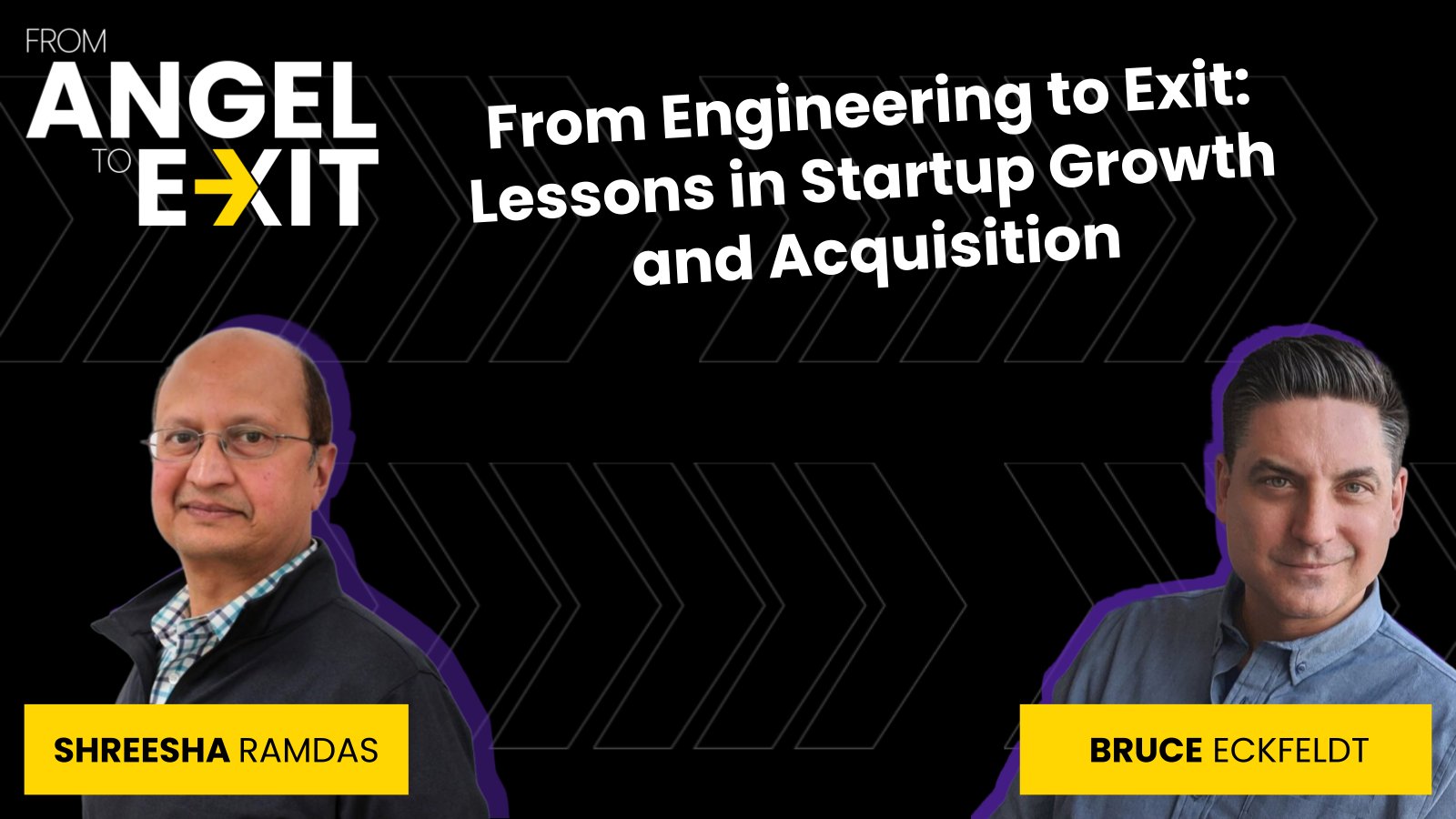
Shreesha RamdasSerial entrepreneur
Listen to the Episode.
Play the full conversation right here, or pick a chapter to jump straight to that moment. Prefer your own app? Every episode is on Spotify, Apple Podcasts, and the rest.
About This Episode.
Start with the key takeaways, the ideas worth bringing back to your leadership team. Then read the full story of the conversation, or use the chapters above to jump straight to the moment that matters most to you.
- Don’t build for an exit, build for value; exits follow strong growth trajectories.
- Develop sales and cross-functional exposure early to become a well-rounded founder.
- Use the “startup fitness” framework to navigate each phase of startup growth methodically.
- Identify and engage potential acquirers early through partnerships, not pitches.
- Bootstrap when possible to stay close to customer pain points and retain control.
- Keep an organized data room from day one, be always ready for diligence.
- Avoid open-source licensing pitfalls that can derail acquisition deals.
- Invest in company culture and cross-functional hires from the outset for scalable execution.
In this episode of From Angel to Exit, Bruce Eckfeldt speaks with serial entrepreneur Shreesha Ramdas about his journey from risk-averse engineer to founder of multiple successful startups. Shreesha shares his unique “startup fitness” framework, lessons from bootstrapping LeadFormix through to its acquisition by SAP, and his current work with Lumber, a workforce optimization platform for the construction industry. Founders will gain deep insight into scaling deliberately, building with an exit in mind, and leveraging partnerships for strategic growth.
Watch the Video.
Prefer to see the conversation? The full episode plays right here on the page, so you can watch while you follow the takeaways or read along with the transcript. Every episode of From Angel to Exit is also on my YouTube channel, along with short clips from each conversation.
About the Guest.
The background behind the conversation, and where to find this guest online.
Shreesha Ramdas
Serial entrepreneur
Shreesha Ramdas is a former engineer who founded several startups, including LeadFormix, which he bootstrapped and sold to SAP. He now works on Lumber, a workforce platform for construction.
- linkedin.com/in/shreesharamdas
Full Transcript.
The complete conversation, lightly edited for readability. Open it to read along, or search the page for a topic or a name.
Read the full transcript
Bruce EckfeldtWelcome, everyone. This is From Angel to Exit. I'm Bruce Eckfeldt, I'm your host. Our guest today is Shreesha Ramdas, and we're going to talk to him about his experience. He's had several exits, and I'm excited for this. There were a lot of interesting insights in our prep calls. I thought, "We're probably going to need six episodes to cover everything," but we're going to try to cover as much as we can today. He's also doing some really interesting stuff, applying all the information, resources, and learning from his exits to his new company. I'm excited to talk about that and about what founders can learn during the process and how they improve. I love entrepreneurs because they're always looking to sharpen the axe and figure out how to do it better, and Shreesha has definitely done that. So with all that, Shreesha, welcome to the program.
Shreesha RamdasThank you, Bruce. I appreciate the opportunity to come and talk to you about my journey.
Bruce EckfeldtThank you so much for being on. Let's go back in time a little. What was your professional background? How did you get into a position of actually being a founder? Give us the build-up to that and what you learned as part of that process.
Shreesha RamdasAs I was growing up, Bruce, I never thought I'd be an entrepreneur or a founder. My parents always told me to watch every step I take. So that gives you an idea of my risk mindset back then. I think the inflection point was landing in California.
This is the place where the evolution happened. Initially I thought, "I cannot come up with an idea, but I can work hard for somebody else." Then it morphed into, "I can contribute ideas here and there." And eventually it morphed into, "I can come up with an idea as well."
One thing that helped me early in my career, and this goes out to all the next-gen entrepreneurs, is that I focused on developing my skill set and didn't chase the dollars. I always felt that if I continued to hone my skills, eventually I would get rewarded with what I deserve. But if I chased a high-salary job, I might be compromising elsewhere.
Bruce EckfeldtTell me more. What's an example?
Shreesha RamdasI would rather go for a job that gave me the exposure to develop a skill, and then eventually the dollars would follow. That's the mindset I always had. To give you some perspective, early on I was an engineer, managing engineering groups. Then I realized that to be a good entrepreneur, I needed to understand more than engineering. So I took a bold step and transitioned over to sales. When I transitioned to sales, I had to take a salary cut, because I didn't have any experience to show. That's what I'm talking about: going after the job that gives you the right exposure is very important, because the more exposure you get, the better you will do as a founder.
Bruce EckfeldtHow did you figure out what exposure you wanted or needed? Obviously, having engineering skills is hugely valuable, but there are lots of other things you could have gone into. Was sales a deliberate choice, "I really need to learn sales"? Or was sales just the opportunity, and you realized it would be a good chance to expand your horizons?
Shreesha RamdasI'll share one of my favorite statements, which is that I learn more from people than from a browser. When you meet people and hear their experiences and stories, you internalize them more than when you just read a book or read something in a browser. So I've always tried to meet as many people as possible and leverage the wisdom of the crowd.
Once it dawned on me that I could come up with an idea, I asked, "How do I ensure I can take this idea to success?" So I set up a lot of coffee meetings with startup founders to understand what they had learned. One thing I realized is that having all-around experience goes a long way.
If you look at founders or CEOs of companies, early on a lot of the CEOs came from the sales function. It's changing a little now. A lot more product people are becoming CEOs. I looked at those stats and realized that I'm good at building stuff, good at doing engineering things, but I needed to understand sales, and I needed to understand marketing. That's basically what resulted in me chasing a sales opportunity.
Bruce EckfeldtYou mentioned that at some point you realized, "Hey, I can come up with an idea." How did you go from that realization to actually developing the idea? What was that gap like?
Shreesha RamdasOnce I realized I could come up with an idea, I went back to first principles: how can I take the idea to success? I realized a few things. One, as I mentioned, I needed all-around experience: engineering, product, sales, marketing.
Second, having a good team and a good co-founder is important. There are founders who fly solo and do really well. I know my strengths and weaknesses, and I'm not one of them. I love having a partner as a sounding board, and the distribution of roles, all of that goes a long way. So finding the right partner is really important. If you're starting a startup with another founder or multiple founders, it's like a marriage. You have to have that chemistry. You have to understand that it's okay to argue, but never disrespect. And how do you augment each other's strengths? That's really, really important.
So finding the right co-founder and figuring out who would be part of the early team was an important aspect. Once you have all these on the table and you're feeling confident, you just get started. Now, obviously, there are two ways to get started. Either you bootstrap it, Bruce, or you find an investor. I decided to bootstrap it. We leveraged a bit of the services background we had to generate some revenue so we could sustain ourselves for a long time.
When you start, the initial journey is about finding product-market fit. The framework I use, and this could be useful for all founders, is that a startup is essentially a fitness journey. Initially, you have to determine market fit: is the idea you're choosing going after a large TAM? After market fit, you do problem fit: is the problem you're going after truly solving an intense pain, or can the buying decision be postponed? Basically, painkiller versus vitamin. The decision about a painkiller is imminent. A vitamin can be postponed.
So figure that out and go after the right problem. After that, it's product-market fit. Whatever prototype or solution you've conceived, is it resonating? After product-market fit, there's go-to-market fit. Is the product you've built, and the messaging you've developed around it, about the pain, the need, the solution, resonating with the market?
And the last step is scale fit. As you get product-market fit and go-to-market fit, and you're now generating revenue, at what point do you keep going, and at what point do you think, "I've reached my max limit. Now it's time to exit"? That's the framework I use.
Bruce EckfeldtI have a question. Is this a framework you've developed in retrospect? Or when you were sitting down and starting the company, were you thinking, "We've got a series of gates we need to get through"? How much of this is how you look back at it, versus how you were actually thinking at the time?
Shreesha RamdasIn the context of the first startup, it's retrospective. But I would say that intuitively, you know what milestones you've reached. As a founder, you always evolve. In each subsequent startup, you tend to have more wisdom when you go and build it. The only way, Bruce, to short-circuit the experience curve you need is to get the exposure. Either you learn through experience or you learn through exposure. Either you put in the number of years, or, if you don't want to put in the years, you have to get the exposure to understand it.
That's why I pushed myself. As an engineer, it was incredibly hard to move over to sales. I still remember the first call I made, where I froze. I was actually wishing it would go to voicemail. It didn't. The person picked up the call, and I still remember the name of the person who picked up. It was incredibly tough, but it was important that I get that exposure and understand what dialing means.
As engineers, we always used to curse the sales guys: "These guys bring in deals, and then we have to do customization and additional software, and all of that is imposed on us." But when I moved over to sales, that's when I learned how tough the sales world is. First of all, you hear no more than you hear yes, and that always brings you down. You have to figure out a way to motivate yourself. Second, sales is the only function in the organization where you have to influence people outside your organization, which is not in your control.
Bruce EckfeldtTell us a little about your first startup. Give us more detail on the original model and how things evolved.
Shreesha RamdasThough I was part of the early founding team at Yodlee, a fintech platform where I got a lot of exposure, the first startup where I was a founder was LeadFormix, a marketing automation platform that eventually exited to Callidus and then SAP. We started as services. That was a phase, Bruce, when things were coming online. A lot of stuff was coming online, and people realized that print media as we knew it back then, newspapers, was going to face an existential crisis, and more and more publications would move online.
My co-founder and I thought, "If things are moving digital, it's basically ones and zeros. So as engineers, we can determine what will work." But we hadn't had much exposure to chief marketing officers and the different marketers out there. So we said, "Let's do one thing. Let's implement online SEO, search engine optimization, and paid campaigns, and that way provide something of value to marketers. In return, we'll ask them what tools they want and what gaps they're seeing in the market." That's why we started with services, and it also helped us get some revenue to sustain ourselves.
In that whole context, we realized that marketers actually needed a marketing platform where they could run their campaigns and measure the results, and that didn't exist. So we started building the platform. While we were building it, we realized that Marketo had started its journey just a few months before, and there was also a legacy player called Eloqua. The reason I mention them is that it's one thing to build out a new category, and it's another when, while you're building out a new category, you also have competitors. As they say, at any time, seven people have a similar idea.
So when I was developing LeadFormix, marketing automation suddenly became an extremely hot category. Every marketer wanted to buy a marketing platform. In year one, when we called marketers, we used to get the question, "What is marketing automation?" Soon it turned into, "How do you differentiate?" The next year it was, "How do you differentiate within that category?" And by the third year it was, "How do you differentiate from all these guys?" So there was a lot of learning there, especially about how you run the company when there are a lot of competitors and the overall category is constantly being developed.
Bruce EckfeldtI'm curious how much of the decision to bootstrap and focus on services to generate revenue and cash was necessity, and how much was that you just didn't want to go out and raise money, because it's a pain and it's hard. And then, how did it help you? It sounds like it was a fairly quick-moving market at the time. Did providing services give you an advantage in some way? I'm curious about these decisions.
Shreesha RamdasGreat question, Bruce. I think it was a function of the time. I was coming out of a previous experience where we had raised a lot of capital, and then the dot-com bust happened, and I saw the negative consequences of that. Maybe it left a bit of a bad taste in my mouth, and I thought, "Let me bootstrap and see how that goes." That was one. Second, the economy was just coming out of the dot-com bust, so raising capital was not easy either. That led to us bootstrapping. The philosophy that exists today, that raising enough capital can itself serve as a moat against your competitors, didn't exist back then. So I feel like bootstrapping was much more respected back then than now.
Bruce EckfeldtInteresting. And how do you feel it helped you? Did having that direct, transactional services experience with customers give you unique insights or understanding of the market that you were able to bring back into the business and the product model?
Shreesha RamdasThe earlier you can get to customers, the better it will serve you. Because we started with services, we were with the customers. We used to go on site, be at their offices, and spend a lot of time actually running the campaigns. That definitely gave us enough experience and expertise to develop a marketing automation platform that was more user friendly and more outcome driven. So for sure. But remember, Bruce, it does come at a cost. The cost is time. You are going to take much more time than you otherwise would to develop the product and then to actually generate revenue from your customer base.
Bruce EckfeldtSo you were coming out of a venture-backed company, and you had a lot of experience in that space. When you started your first company, how did you envision your exit? Did you have a very particular plan? Did you know when you wanted to exit, how much you wanted to exit for, who you were going to exit to? How much of this was predetermined before you even started, and how much did you figure out as you went?
Shreesha RamdasI'll make some statements based on what I know now, after doing a few startups. My philosophy right from the start, Bruce, has been to never build a company for an exit. Remember the framework I described: scale fit. Only once you start seeing limitations, once you start seeing your growth getting stalled, or you can see that expanding into other categories is going to be more challenging, only then think about an exit path. That's something I truly believe all founders should embrace. You should never design for exit.
At the same time, you should always know who the potential players in your category are who could acquire you. Then you're always looking at what they have, where they lack, and what gaps they have in their product roadmap right now, so that you're covering them. That not only gives you an edge when competing against them, it will also help you when the acquisition conversations eventually happen.
Bruce EckfeldtSo you become a good strategic acquisition for them, because you've got a unique capability or you're filling a gap they don't have.
Shreesha RamdasAbsolutely. When we were building LeadFormix, we knew the potential acquirers would be the large enterprise ERP players: Oracle, SAP, Salesforce. Those were the main three potential acquirers. So we reached out to them for partnerships early on. We were working with Salesforce. We could not get a conversation with Oracle. And we started talking to SAP. That's how the eventual acquisition happened.
Bruce EckfeldtTwo questions, then. One, how do you identify and keep track of these bigger competitors or potential acquirers? Sometimes it can be difficult to get insight into their products and services publicly. Is there any way to get more of these insights to help guide your strategic development? And two, tell me more about reaching out early for partnerships. How do you balance staying under the radar, getting as far as you can before you get on their map or their competitive list, versus the benefits of establishing a relationship and getting some of that insight early?
Shreesha RamdasStaying under the radar, I'm not a big believer in that, Bruce, because in this day and age, everything is out in the open. Everybody knows about everybody. So never hesitate because you want to be in stealth. Of course, until your product is fully developed, be in stealth mode. But once your product is out there, once you're building your revenue function and your marketing is running campaigns, everything is out there. Then there's no point in hiding.
The key is to understand the category players really well, and you should do that even before you start building the product. Who are the players in this category? What solutions do they have? What are they not doing? If they're a public company, download their quarterly reports. Understand what they're promising for next year, so that you constantly understand their strategy and their product intent really well.
I also believe in the concept of a tugboat. If there's a medium to large player that's doing incredibly well, and you somehow figure out how to attach yourself to them, it can really help your revenue trajectory. Salesforce is an example. When Salesforce launched its marketplace early on, there were a few companies that took an aggressive stance in the marketplace. They poured dollars into advertising in the marketplace. They participated in Dreamforce in a big way, and that really helped them grow their revenue.
There was a company like Apttus, for example, which did CPQ, that was on the Salesforce marketplace early on. They invested their marketing budget there. I remember it used to be over $5 million just on Dreamforce. They would take over a cafe near Dreamforce. Along with being top sponsors, they would have their own big event. And that really helped take their revenue upward.
So figure out how you reach out to players and how you structure the early relationship. To structure the relationship, it's very, very important that you show them the value you bring to the table. That value could be innovation, a new solution, or expertise on top of their platform. Something they don't have. Show them that their win rate will go up because your product gets attached to their platform. If you're able to establish that, that's how you develop the relationship, and eventually it gets to M&A.
Bruce EckfeldtIn your first startup, when did you realize you were ready, or that it was time to exit, or that a real exit was starting to appear on the horizon? What transpired? What did you learn, or what happened, to get you into that mode?
Shreesha RamdasAs I mentioned, we were competing with Marketo at that time, and Marketo had raised a lot of capital. So we were thinking that either we had to respond in a similar way by raising a lot of capital, or attach ourselves to a larger player. That's when we reached out to the three players I mentioned: SAP, Oracle, and Salesforce. We didn't get much love from Salesforce, because they were doing a lot of joint campaigns with Marketo. Oracle was taking a lot of time.
Surprisingly, SAP at that time was thinking about its online strategy, given the market pull Salesforce had seen. They had brought in experienced people at the leadership level and mandated that they do incredibly well with the online cloud version of their product. This leader was looking for innovative solutions to bring home, and that's why, almost in the second meeting, he expressed his desire to work closely with our platform. For a small company, SAP expressing interest is a big thing. We didn't have much experience before that, so we were incredibly excited about potentially being acquired by SAP. That's how the conversations started.
But, Bruce, we didn't know that SAP is a big, big giant, and they take time to do everything. It took multiple trips to Walldorf for me to understand the culture and how much time it would take for an acquisition to happen. That brought home a realization that is really, really important for all founders. When an acquisition offer comes, founders get really excited, as I mentioned, and they go all in on the acquisition. Then revenue falls, and a lot of acquisitions don't happen. The stats tell us there's a high percentage of acquisitions that don't happen. So if the acquisition doesn't happen and your revenue has plummeted, it's a bad, bad situation to be in.
After a couple of trips to Walldorf, we realized this. We were three co-founders back then, so we decided that only one co-founder would dedicate time to pursuing the acquisition, while the other two would focus on product development and revenue.
Bruce EckfeldtThe classic scenario: either it falls apart, or you get these big haircuts, and the deal you thought was amazing in the beginning becomes half of what you end up signing. You mentioned earlier that you noticed the shift in the market, with Marketo making its moves, and you needed to start thinking about acquisitions, so you started to reach out. How did you actually reach out? How does this process work when you identify that there are clearly half a dozen big players in this market that could be acquirers? It's about establishing the connection and the communication, but you also don't want to tip your hand too much. How did you actually make the connections and navigate the information and exposure that comes with it?
Shreesha RamdasBruce, I've already explained the LeadFormix scenario. I'll bring this home with my next company, Strikedeck, which was doing customer success automation. Again, I was thinking about the tugboat and about distribution. I never had an acquisition in mind. It was all about how we take the revenue forward.
At Strikedeck, I was competing against Gainsight, which, similar to Marketo, was a well-capitalized startup. The players I reached out to at that time were Segment, Pendo, and Medallia, from the perspective of channel partnerships. The way I was thinking about it, Segment does segmentation, and they were looking at various tools that could push data into their data warehouse, pull data out, and generate value on top of the aggregated data. Segment was just thinking about a marketplace. So from a timing perspective, I thought it was the right time to reach out to Segment, and the conversation should be about the marketplace they were going to launch and how we could be among the first few players in it. That was of high interest to them.
So it's about reaching out to people, figuring out what their top interest is, and aligning with it. With Segment, I read on their website and in some of their press releases that the marketplace was going to be a major initiative for them. So it was, "How do I align with their initiative and show them value?"
With Pendo, similarly, Gainsight had acquired a company that did what Pendo did. And I said, "The enemy of my enemy is my friend." So I reached out directly to the Pendo CEO, talking about how the two companies could align and go to prospects together, both of us bringing complementary skills to the table. That appealed to them, and that started the conversation. The two sales teams started working together, and we started seeing some awesome results.
Then with Medallia, almost all of their customers were Fortune 5000 customers. We knew they only dealt with big enterprise companies. I thought Medallia could be a great way for us to get to enterprise customers, because as a small startup, there will always be questions about credibility. Even if we had to co-brand with Medallia, leverage their branding, and exist as a module in their product, that would be of high value, because we'd be able to access a customer segment we otherwise couldn't.
So we reached out to them, and the Medallia team said, "We deal with vast data sets, and you have to prove that your platform can stand up to that challenge." We were ready for that challenge. We did a pilot, and the pilot proved that our platform could ingest that data without compromising performance. That set us up for the next relationships, the next conversations.
Bruce EckfeldtHow much do you advise founders and CEOs to be forward and lead this process, engaging in these ways, reaching out, and finding these opportunities, versus using other professionals, whether it's investment bankers or consultants, to do this kind of market search? It's always a question for me of where a CEO should apply their time and energy: on strategy and running the business, or on looking at market opportunities and potential acquirers. Where do you see the balance? How do you advise folks on where to invest their own time and energy and where to use external professionals?
Shreesha RamdasBruce, I believe in market pull rather than market push. When you hire an investment banker, it's a clear signal to the market that you're in the mood to sell. Then, obviously, when buyers come to you, they'll look to negotiate and push the price down. That's why I believe in pull. When you're thinking about your distribution and your channels, you're thinking about revenue, and you're not proactively thinking about M&A. Down the road, if enough value has been generated and the deal makes sense, then thinking about M&A works.
That's why I believe you should never build a company for an exit. You should build a company for greatness. You should build a company to actually provide value, and M&A could be one of the outcomes you generate along the way. That's why I'm not a big advocate of designing for an exit right from the get-go.
Now, obviously, if a founder reaches a point where they can't see the light at the end of the tunnel, and they feel there's impending doom, and they don't even feel confident doing personal outreach, then you bring in an investment banker. They bring professionalism. They know how to package your story. They know how to prepare the reports, and they have their Rolodex. They'll reach out to people. So they will definitely bring that value to you, and you can leverage it. That's generally useful.
Bruce EckfeldtI think we're on the same page. My own experience, and my experience working with a lot of these folks, is that you always want to have a strategy for continuing to grow and expand the company. If an opportunity comes your way, obviously consider it, but you never want to be in a position where you have to sell. If you're in a position of having to sell, that's not a powerful position to be in. So having the strategy, and making sure the business has a future regardless of whether or not you can sell, is going to be important.
That said, I wanted to ask the other side of this. Are there things, disciplines, that you want to make sure you have in the company so that if an opportunity does come up, you can take advantage of it and you're not caught flat-footed? Either not being able to take an opportunity because you don't have the right pieces in place, or getting hit on valuation because you don't have certain things in place. It's a good deal, you want to do it, but maybe you're taking a 20% haircut because you didn't do certain things. Are there things you suggest founders put into the company so they're prepared for an exit if something comes up?
Shreesha RamdasI'm so glad you asked this question, Bruce, because as you know, I've been an investor and an advisor, and I have my portfolio of startups, and I see a lot of startups not doing this right. Though you're not designing for an exit, you always need to proactively think about how to professionalize every function in your organization so you're prepared if that eventuality comes.
The biggest advice I would give is, from day one, have a data room. This data room could be as simple as a folder in your Google Drive or a Box account, where every NDA you sign, every agreement you have with a customer, every employee agreement, all of that, goes.
Bruce EckfeldtI was just going to say employee agreements. Those are the classic.
Shreesha RamdasIt should all be in that data room. I've seen so many instances where startups realize at the time of the acquisition that they don't have a signed agreement from an employee or a customer. Then they go to the customer or employee, and what comes out is a ransom demand, because the other party knows some event must be happening.
Bruce EckfeldtExactly. They need it for something.
Shreesha RamdasSo I've seen founders be vulnerable at that moment. Why go there? Have a data room, and have the discipline that as soon as an agreement comes in, you upload it to that folder, so it's always there.
The second important thing, from an engineering perspective, Bruce: when you're building the product, it's a very common practice in engineering organizations to use open source components. Check the licensing on that open source. If you're getting acquired by a medium to large company, they will do a source code scan. And a lot of the time, if the product has been built with open source components where the licensing is not proper, I've seen deals break down at that point. So that's the other thing.
And the third important piece of advice: as founders, we're passionate about building the product, and we're consumed by engineering and product roadmap exercises. Make sure all your financial reports, your P&L and all of that, are proper, because that will be the first thing they look at during an acquisition. And if you have time, also keep a spreadsheet where you're extrapolating: one year down the road, where will you be? What are the projections? If you can have that in a spreadsheet, with different scenarios, that will be helpful. But that's something only the top 1% of founders do.
Bruce EckfeldtOne of the reasons I'm really big on my clients doing a rolling three-year plan, where every year we create a new three-year plan, is that we want to be able to show a track record of doing long-term planning and hitting those plans. So when I show them the next three-year plan, they're not just thinking, "This is pie in the sky." No, we can go back five years and show them every three-year plan we've done and how we've executed against it. It's building that capacity for execution. Investors look at it and think, "Now this three-year plan has credibility." If it's just pulled out of the air, it's done.
Shreesha RamdasAbsolutely. It's very difficult to do that when you're in the early phase of your startup, because your focus is on the product and revenue. That's why I said best-in-class founders make sure they have the right finance person, who has a rolling plan in place.
Bruce EckfeldtI wanted to end with this question. You've had a series of companies and a series of exits, so you've had a chance to iterate on this a few different times and learn. What are the big learnings you've applied to your most recent venture? Having done this a couple of times, how are you approaching it now? What's your best approach to getting a company up and running and getting traction and revenue? What have you learned?
Shreesha RamdasThere are a few things I've learned, with all the scars on my back. I'd say I'm fortunate to be able to take my experience and apply it. The first lesson is to dream big. If you don't dream big, nothing will get manifested. It's very important to have big ambition, and big ambition translates into going after a big market, going after generational innovation. You have to think massive.
That's one thing at Lumber. We're thinking about how we positively impact the construction industry, where even if we succeed in meeting 2% of our goals, it's still moving the construction industry forward. It's about the workforce crisis the construction industry is in. Younger talent is not coming into the construction industry. There's a disproportionate number of senior people in the industry. How do you get people to feel committed to the organization? How do you ensure the skills are transferred? That's the big mission we're after. And construction, as you know, is one of the biggest industries in the US, and big even in the world. So if you can go for the jugular, go for it. That's one.
Second is the team. If you're dreaming big and you want to achieve it, you have to have an amazing team with incredible chemistry. While I was doing my last startup and while I was at Medallia, I had my notebook open, and for any incredible performer, in any function, whether sales operations, event management, engineering, or product, I used to write their names down in my notebook. So as soon as I started Lumber, I was able to reach out and bring them in, and now I have incredible bench strength. As I keep raising new rounds, I'll keep bringing in people who are not only incredible at what they do, but also a cultural fit, because big organizations are only built when the culture is extremely strong.
Bruce, for example, at Lumber our culture is defined in just three letters: E-O-E. The first E stands for energy. Bring positive optimism to the table, a can-do attitude, and go at it at an aggressive pace. The O stands for ownership. There's no adult supervision at Lumber. You take the ball and run with it. There's nobody standing over your shoulder handing out instructions. The third E, which is really important, is experimentation. Be experimental. Never hesitate to make a decision. Just remember, don't bring down the company. So make decisions and let the data guide you.
Defining that culture right at the start helps us as we recruit new talent, and it's also motivating for existing employees. So I'd say the third important thing is defining the culture up front. If a founder comes to a meeting 10 minutes late right when you start the startup, that becomes the culture. Then everybody says it's okay, it's kosher to come 10 minutes late, and that spreads. So you have to define the culture, and then you have to practice what you preach.
A few other things have been really helpful at Lumber. Generally, when you do a startup, you do things sequentially. You first think about the solution, you put out the product specs, the engineering team builds the product, then you think about go-to-market, and so on. At Lumber, I started thinking about the go-to-market motion while we were building the product. Our first sales hire was made when I was making my first engineering hire. That allowed us to go beyond our networks in signing up design customers and pilot customers very early on, and those inputs are what helped us create a world-class platform.
So I would say that starting multiple functions early in the game helps you accelerate and helps you build velocity faster and better than other startups. Those are the key things I've done at Lumber, and that's why we're seeing the success we're seeing.
Bruce EckfeldtI'm excited. I know you mentioned you've got some great traction and you're seeing things move quickly. I'm excited to hear how things play out, and to have you back on once you've exited the next one so we can talk more. Shreesha, it's been a pleasure. Thank you so much for taking the time today. If people want to find out more about you, your background, and what you're doing today with Lumber, what's the best way to get that information?
Shreesha RamdasThat would be my LinkedIn. My handle is just my first name and last name together, Shreesha Ramdas. That would be the best way to get connected and keep in touch with what we're doing.
Bruce EckfeldtExcellent. I'll make sure that's in the show notes so people can get it. Thank you so much for taking the time today. It's been an absolute pleasure.
Shreesha RamdasThank you for inviting me to this podcast, Bruce.
Never Miss an Episode.
Know the moment a new episode goes live. Subscribers also get a say in future guests and the topics we cover.
Other Related Episodes.
More conversations that connect to this one. Or browse the full archive by topic or by guest.
Shawn Freeman
How a tech side hustle became a $5M managed services business and sold at 1.4x revenue.
Listen and Read
Joshua Maidan
How he built a premium coffee brand, and what good governance means for scaling and exiting.
Listen and Read
Alan McLaren
How he scaled two agencies and now helps founders build a personal brand ahead of an exit.
Listen and Read