From Angel to Exit Episode 4
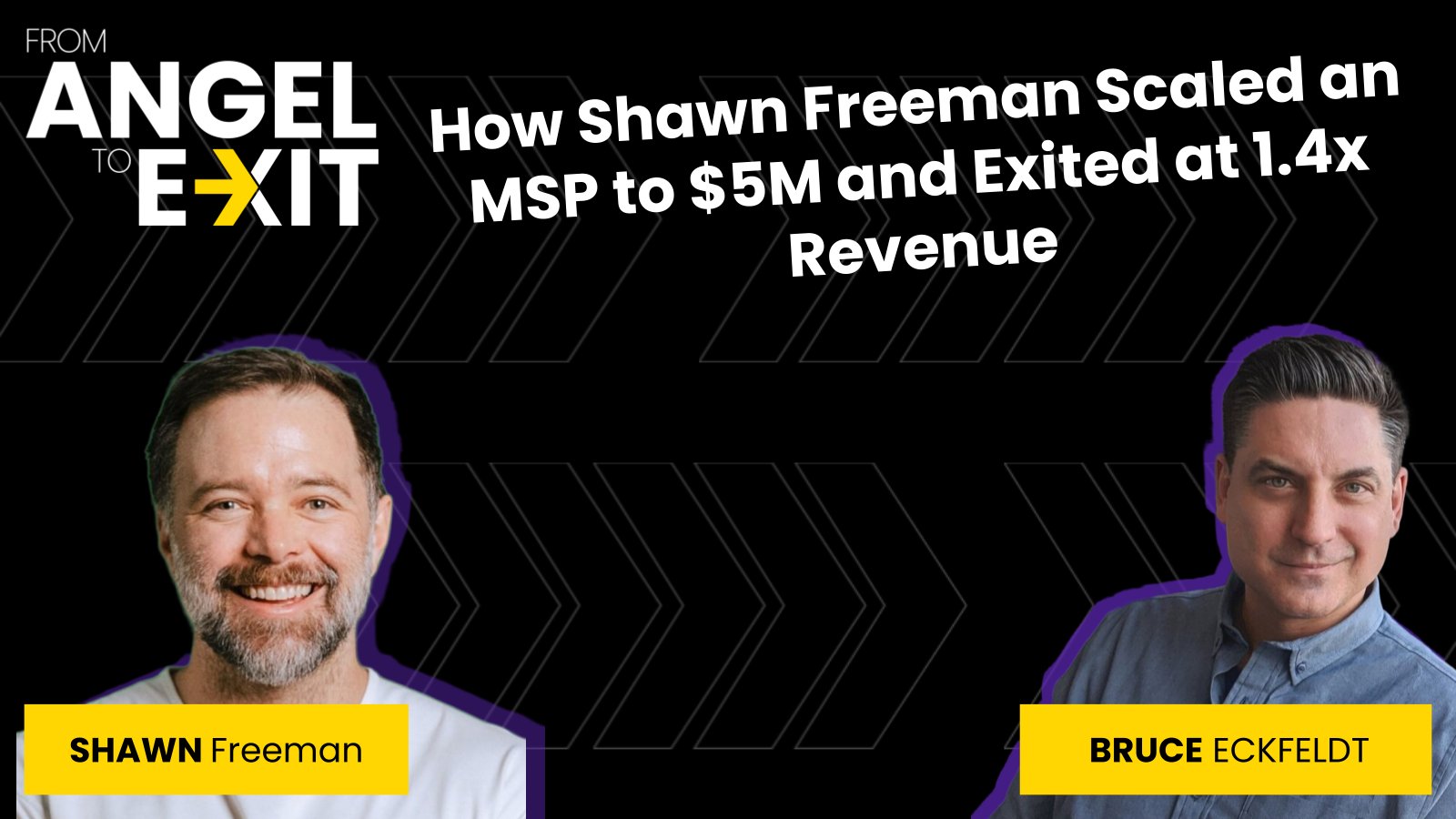
How Shawn Freeman Scaled an MSP to $5M and Exited at 1.4x Revenue
Shawn FreemanMSP founder
Listen to the Episode.
Play the full conversation right here, or pick a chapter to jump straight to that moment. Prefer your own app? Every episode is on Spotify, Apple Podcasts, and the rest.
About This Episode.
Start with the key takeaways, the ideas worth bringing back to your leadership team. Then read the full story of the conversation, or use the chapters above to jump straight to the moment that matters most to you.
- Recurring revenue is essential for building valuation and predictable growth.
- Exit readiness includes tax planning and proper corporate structure from day one.
- Leadership means getting out of your own way and empowering others.
- Always assume key employees may leave, design systems that don’t rely on them.
- Company culture must be intentional, with clear values and psychological safety.
- Be cautious of acquirers unwilling to adapt or integrate new ideas.
- Involve your leadership team early in potential exit conversations.
- A premium service model requires aligned pricing and long-term thinking.
Shawn Freeman, founder of a successful managed service provider (MSP), joins Bruce Eckfeldt to share his journey from launching a tech side hustle to scaling a $5M business and executing a 1.4x revenue exit. He reflects on key inflection points in leadership, recurring revenue strategy, and the emotional and operational complexities of being acquired. Shawn’s insights are essential for founder-CEOs preparing for strategic exits.
Watch the Video.
Prefer to see the conversation? The full episode plays right here on the page, so you can watch while you follow the takeaways or read along with the transcript. Every episode of From Angel to Exit is also on my YouTube channel, along with short clips from each conversation.
About the Guest.
The background behind the conversation, and where to find this guest online.
Shawn Freeman
MSP founder
Shawn Freeman scaled a managed service provider from a side hustle to a $5M business and sold it at 1.4x revenue.
- Website
- leaderstechacademy.com
Full Transcript.
The complete conversation, lightly edited for readability. Open it to read along, or search the page for a topic or a name.
Read the full transcript
Bruce EckfeldtWelcome, everyone. This is From Angel to Exit, where we talk with leaders about their stories of growing, scaling, and exiting their businesses. I'm excited for the conversation today. Our guest is Shawn Freeman, and he's had some really interesting experiences as a founder, as an entrepreneur, and in exiting his company. He's also doing some really interesting stuff today helping leaders manage their technology, so we're going to hear about that. I think most of the folks listening will get some real insights from his experiences. So with all that, Shawn, welcome to the program.
Shawn FreemanThanks for having me on, Bruce. Nice to be here.
Bruce EckfeldtIt's a pleasure. Before we dig into everything you're doing today and how things have turned out, we'd love to go back and get a little of the background, really hear the story. As a founder, what were the beginnings like, and how did you get into this space? Then we can talk a little about the process and what you learned.
Shawn FreemanFor sure. Let's go way back. In university, I took computer science. I kind of stumbled my way into that. In high school, I didn't have great grades, and eventually I found my way to computers and thought, "I love this. This is what I enjoy doing." My grades started to get better, and I started to really have fun.
In university, I got a couple of summer jobs. One was in the IT department at an oil company. That went well, and I learned a lot. Later in my university years, I moved to another oil company, and they were kind of a startup. When I was employed there, they were about 100 people. When I left, about four and a half years later, there were 1,600 people. So we grew a lot. Going through that growth was pretty awesome: learning how to scale a company and seeing it done. And I met a whole bunch of great people along the way.
Once I got to that four-and-a-half-year stage, I thought, "I'd like to progress my career." I was pretty young at the time, 24 or 25. I kept putting my hand up for all these roles that were opening up. The IT department grew from two people, me and my boss, when I started, to 50 people in IT by 2011.
Bruce EckfeldtThat's big.
Shawn FreemanWhat ended up happening is that I kept getting passed over for the more senior roles. They were looking for people who had been there and done that. So I said, "Well, I'm not just going to sit here, do my job, and get little promotions along the way. Maybe I'll take a chance and start my own IT company." I actually got a few clients through some friends while I was still at work. I thought, "I'll just do it in my free time, after hours." I did that for a little bit, and it started to snowball.
So I kind of got pushed out of my job by it, because I couldn't do both, and I didn't feel good about it. I thought, "Okay, I'll leave my job and take a chance. Worst case, I can get another job." And it did work out. Luckily, I left in 2011 to start the company, because in 2012 there was a big oil recession, and there were no jobs to be found. So I was off to the races, doing it on my own, and the rest is history. That was 2011, and we exited in 2020. So it was about eight and a half years, by exact math. We grew the company, and we had a lot of fun doing it.
Bruce EckfeldtI'm curious, at the point when you decided to start the side hustle and get things going, was the idea of actually exiting the business in your mind? Was that a particular goal you had? What expectations did you have for yourself?
Shawn FreemanNot at all. I had no idea it was possible. I wish I had, because I would have done much better tax planning and paid a lot less tax at the end of the day. But that's okay. You live and you learn.
It's funny, I don't think even my accountants realized it. We didn't have any basic tax stuff in place. Once we got going and were doing half a million in revenue, they said, "Maybe we should do a little reorg, put a holdco in place, and do a few basic tax things." We probably could have done more. But I didn't believe we'd get it to $5 million a year and sell for 1.4 times revenue. We did pretty good numbers.
And it's funny, when I started the company, managed services wasn't really even a thing.
Bruce EckfeldtInteresting. It's a big thing now. It's a huge space, with all these roll-ups around it.
Shawn FreemanIt's huge. And what it was in 2011 was break-fix. Everybody would say, "I'll hire an IT guy and put him on a retainer, and he'll bill me hourly." I came out and said, "I'm not doing that at all." I went to my customers and said, "I'm probably going to need to spend this much time on your tech, so why don't we just call it two grand a month?" So I kind of fumbled my way into managed services from the get-go, which was really key for us to grow. As you can imagine, recurring revenue is much easier to grow a business on than lumpy hourly billing. That was one gift. I'm not sure why I did it.
Bruce EckfeldtI was just going to ask why you did that.
Shawn FreemanIt just made sense. More revenue that I can count on is probably better than revenue I can't. So it just worked out that way, and ever since then, everybody's been doing it that way, and it's been great.
I tell people today about the industry: five years ago, three-quarters of our cost was fixing things. Things just broke. Computers sucked. Software wasn't great. Now three-quarters of it is security. Things work, but they get hacked into now. You've got a lot more vulnerabilities with cloud and that sort of thing. So it's shifted a lot. Some people have kept up, some haven't. Some businesses haven't been able to transform using technology, and they may have gone away.
Bruce EckfeldtI'm curious about the growth side. When did you first start making some hires? How did you go from being the primary doer of things to having other people doing things and getting into management and leadership? Tell us a little about that journey.
Shawn FreemanI'm a tech guy, right? So it was a fun journey. I didn't have business experience, and I was doing all the work. I was pretty much fully busy all the time. I was making a few hundred grand in revenue, which is great, and pocketing most of it, because I'm the guy doing all the work. And I went to my accountant and said, "When do I hire? Tell me what my financials need to say for when to hire." He said, "Well, you kind of just hire and hope it works out. You hope the business grows to support it." That's what he said to me.
It's funny, because the answer I actually needed was: once you have predictable sales. If I looked at my business and said, "Okay, I can close another $200,000 in recurring revenue in the next six months, and that can pay for somebody, and I won't be able to do it myself," then we need to hire when that happens.
So I started to fumble my way toward this clarity. I actually reached out to a business coach on LinkedIn. I thought, "Maybe I need a business coach." I asked him, "Hey, can I buy you lunch? I can't afford you right now. You're a few grand a month, and I can't afford that, but I'd love your insights." He gave me a ton of great insights: how to understand my numbers, how to really dig into them, and how to get the insight I needed to make that call.
It's funny. Once you start hiring, it doesn't slow down. It just speeds up from there. You get comfortable with it as your business grows. Obviously, you get a bigger buffer to make more mistakes, so they don't put you out of business and on the street. You can still pay your rent.
Bruce EckfeldtThey're not existential. Tell me about leadership, because I think that's the other big step most companies have to grow through: actually building a team around you to grow and scale the company. When did you feel the need to create other leaders inside the business, around different functions and domains? How did you make that decision?
Shawn FreemanGood question. Really, it's about getting out of your own way. I found that as soon as I started to get the right people on board, build the right culture around them, and instill some values, we really started to hit our stride. I didn't have to be the one making all the decisions once we had those things in place. People felt empowered: "I can make this call, because I know that's how Shawn would think about it, and he's given me the tools to work through the problem myself."
I found that once you do that, you start to get the best out of people. People who were really introverted, and maybe not super outspoken, started to build confidence and become leaders in the business. So my job as the CEO was to mentor them along, help them grow into those roles, and at the same time grow the company.
Bruce EckfeldtWas there a point, or something that came up, that really told you, "I need to hire some other leaders in the business"? When did you make that realization?
Shawn FreemanWhen we sold, we were about 25 people. So somewhere between myself and 25, you need to hire key people to run the business. I found that it was quite natural and organic in our business. Some people just stepped up and said, "I can lead that group of clients, and I'll make that my responsibility." And another would say, "I'll lead that group of clients." So we didn't have a hierarchy. We kept it fairly flat. But people knew their accountabilities. We operated sort of like lawyers and accountants: "We've got our book of business, and we'll make sure they're good. These other people have theirs." That got us to 25. I don't think it would have scaled much further. We would have had to add another layer on top of those folks eventually.
But really, you don't want to put managers in place for the sake of having babysitters. If you need babysitters, then you need new people. That's a bit of the mentality we built into our culture: if I have to babysit you, you're going to be out the door in two months. You're not going to last. Instilling that in our small business really helped the culture and the quality of the company.
Bruce EckfeldtWhen did the idea first come to you that you might be able to exit this business, to sell it? Was there a moment, a situation, a conversation? When did it come into your mind?
Shawn FreemanI was always friendly with most of our competitors who were trying to do a good job. One of them was based in a different city, Vancouver. They didn't have operations in my city, Calgary. So we'd say, "Hey, let's share some ideas. If you're in Calgary, let me know, and we'll grab a drink or lunch." I did the same. So we connected, and eventually they came to me and said, "We've acquired companies across North America. We've got a location in every city in Canada other than Calgary. Do you want to be part of the growth? Here's our vision. We want to go public. We want to do this, this, and this."
It really got my attention, obviously. I said, "Okay, let's explore it." Our cultures looked good. They seemed compatible. We both had similar values, and this could open up opportunity for the team as well. We were 25, and they were 350 at the time, so together we'd be close to 400. My good leaders could step into bigger leadership positions and make a bigger impact.
They also looked up to us, because we were doing an amazing job on the quality of our service delivery. Our clients were super happy. I was of the mindset that I could post my client list publicly, and my competitors would just waste their time. That was how good we were, which is amazing. We accomplished that, and they noticed it and wanted it. So we went through the details. They put a fair offer forward, which let me know they wanted to get a deal done. We put a deal together and set the team up for success. Everybody got options once we closed. All these things really came together.
Bruce EckfeldtDid you feel the need to look at options at that point, or test the market to see if there were other people interested in doing this kind of deal? How broadly did you look?
Shawn FreemanNo, we didn't shop it around. Some people might say, "Well, you're kind of dumb for not doing that." But from talking to people, we got 1.4 times revenue, which is seven times EBITDA, for a $5 million company. I think we did good. We did pretty good.
Bruce EckfeldtI think that's an interesting situation. The reason to shop it around is that you want to test the market and see what the best price is. But you also want to feel good about the deal. Other than the good financials and a reasonable multiple on the table, what else told you this was a deal you wanted to do?
Shawn FreemanIt was about the opportunity we were creating. We were going to grow the company and IPO. I kept some shares in the deal, so I took part of it in cash and part of it in shares, and that worked out great too. So it wasn't just, "Hey, we're going to buy you, and then you're leaving a year later." At the time, I was 34 when I sold the company. So I wasn't retiring, regardless of the number. I thought it was a really good deal.
Plus, layer in the opportunities for the team to grow. That was one of the big things for me. We were a 25-person company. People had been with us for five, six, seven years, and they wanted to go from here to here. We were probably going to be slower at getting them there, and then we might lose them. That was a bit of a fear I had in my head as a business owner: "If we don't do this, we might lose these people anyway, and then what happens? Who knows?" So I thought, "Okay, this kind of solves all those problems." And the potential upside of the vision we had to grow the entire business was pretty cool. So it made sense.
Like I said, when I first started the business, I said, "Well, I could go get another job." When I sold this one, I said, "Well, I could go start another one." Once you've started a business and scaled it to $5 million, you could probably get another one to two or three in a year or two. It becomes a lot easier. Your perspective changes. And obviously you have resources in the bank to do so.
Bruce EckfeldtTell me a little more about that growth for the team. I run into a lot of companies that are hesitant to grow. "We're fine just doing 10% or 15% a year. We don't want to screw up the culture." There are all kinds of rationales for staying the same. One of the big things I think they don't realize is that if they're not growing, they're not creating opportunities for people, and they will lose good people. People want challenge. They want to grow. They want opportunities. When did you realize that growth was imperative for maintaining and retaining the talent you had?
Shawn FreemanFor context's sake, if you're growing a business at 10% or 20%, that's pretty good. But it's not the kind of step increment where you need another layer of management every five years. So the people who are looking for that, you might lose them.
I think my perspective has changed since I did the deal. I think that was something I was telling myself as a reason I had to do the deal. I'm not saying I regret doing the deal, but I see it for what it was now. I think the healthier approach, in my current perspective, is that I need to plan to lose good people. I need to understand that if I'm going to grow 10% or 20%, I'm probably not going to be able to make all of their dreams come true. If I can, amazing. But you can only control so much in your business.
You've got to pick. Do we want to grow organically? Do we want to acquire some businesses so we can grow faster? There are lots of different ways. And then, how does the team fit into that? Really get to know each of their goals. "What's your five-year goal? You want to buy a house? A vacation property? You want to have this much in savings?" If you can engineer that backwards into the business's plans, then that person's going to stay for at least five years. If you don't see that being possible, then you have to start figuring it out. Either have a conversation, "Hey, man, this isn't going to work," or, "We could compensate you with some equity, but that's a longer-term plan, not a five-year plan." Just get creative, I think.
The other thing is, I talk to so many business owners who say, "I'm going to lose my best person." I say, "You should probably plan to."
Bruce EckfeldtYou should have a plan if you do.
Shawn FreemanPlan to lose them, because as a business owner, you don't want to be in handcuffs where your top person leaves, or you have to double their salary because Google's going to. You can't compete with Google. And on the flip side, make sure your vision is big enough to align with your team's goals. If that's true, you've got a really good start. If your vision is, "We're going to grow 5% a year and go from $1 million to $2 million in 10 years," that probably doesn't check a lot of boxes for your team, because that's not a lot of revenue and profit. You're not going to be able to pay them more, and then you're going to have a problem. But if your goal is, "We want to do $25 million in 10 years, and along the way you're going to get some ownership in the company, and in 10 years you'll have hit all the goals you want," perfect. Then you've got a winning combination.
Bruce EckfeldtWhen the deal first came to you, in those initial conversations, how did you relay it to the team? How did you communicate with the team, and when? These can be a little dicey: "We might be selling, but we might not be selling. We need to keep the business going. We might be changing." How did you manage that process?
Shawn FreemanVery poorly, as my team would probably tell you. My EA at the time, my office manager, collected a lot of the due diligence information, so she was in the loop, and that's it. Nobody else on the team knew until the deal closed.
Bruce EckfeldtWhy? What was your thinking around doing it that way?
Shawn FreemanHonestly, not very much good thinking. Looking back, I probably would have brought them in and said, "Hey, guys, how does this sound to you? Here are my thoughts." I had full control of the company, so I could have done whatever I wanted. It's funny, I'm not sure why I did that. It was probably a fear that they were going to say, "No, we don't want to sell," and then I'd have to either convince them or drag them along unwillingly. And they'd have had a whole year to look for another job, right? All that risk would have been brought in. So I didn't go down that path.
But my perspective has changed again. Now everyone's like, "When are we going to sell?" If you start another company, they're just going to say, "Sell this one." Everybody asks. It's the first question they ask you now. It's kind of funny, but I think it's good to have that conversation internally.
We had a great mission. We had great values. We had a great culture. But we didn't have that open conversation about what the future looks like. Honestly, they approached me in April of 2019, and by January we had the deal closed. It was supposed to close in November, but obviously these things always take longer than you hope. It moved fairly quickly. So maybe I just thought I didn't have time, and I was afraid of some backlash. Some people weren't really happy. We settled into it, and things were okay.
Then COVID hit two months later. The company that bought us said, "Keep doing what you're doing, keep making lots of money, and we'll leave you alone." Once that changed, things changed significantly, and it wasn't all sunshine and rainbows.
Bruce EckfeldtLet's talk a little about that, because that's always the fear or anxiety people have around doing deals, particularly something like this, where you're staying on and continuing in leadership and management, working with the acquirer. What did you anticipate? How did you think it was going to go when you were doing the deal? Let's start there, and then we can talk about how things played out.
Shawn FreemanI thought the acquiring company's vision, for us to grow this and potentially go public, was a great vision. I thought they had the things in place to achieve it. I could also see the future for the team. I could say, "These people can move into these positions." We even mapped part of that out in the deal making: "These people go into that leadership position." So we had that figured out, and we made sure they all got options. From my perspective, I could see the three-year plan being great for all of them, regardless of whether we went public or not. All the boxes were checked, and I hadn't been through anything like it before.
Bruce EckfeldtSo it made sense logically when you were doing it.
Shawn FreemanIt made sense logically. I'm a very logical guy. And the fears I had, like the fear that if I didn't do it, I'd maybe lose these people anyway, I didn't really acknowledge until after the deal. And that makes sense. That's just how our brains work when we don't know what we're doing.
Bruce EckfeldtYou do the best you can. You mentioned COVID, which I'm sure threw all sorts of monkey wrenches into plans. How did things play out? What were the surprises in the reality of the merger, post-deal: working out the issues, working out leadership, working out operations? What came up for you?
Shawn FreemanCOVID hit, and the company that bought us said, "Keep doing what you're doing. You know what you're doing. You're doing a great job. The financials are great. Keep doing that." So we did. They gave us the freedom to do what we thought we needed to do. A lot of our clients were shut down. Their revenue went to zero overnight. So we said, "Hey, we're just going to pause your billing. Let us know when things are picking back up, and we'll slowly reintroduce it."
We actually had the freedom to do what we thought was right. Everybody else was afraid, and I was in this unique position where I'd just gotten some big checks. I thought, "This is actually a pretty good opportunity for us to step up and help. We're in a really good spot. I'm in a really good spot. So how do we help?"
We went to all our clients and said, "What do you need? Are things good?" For some of them, things were great, and they needed help to scale. Some of them needed help scaling down. So we said, "Okay, let's help. We'll meet you where you're at." And we did that. I think the team really saw that and was fired up about it too, because, on the other side of the acquisition, we still had the freedom to do that. We weren't saying, "No, you have to pay your bill, because we want to hit some earnout." We didn't care. And not that we had an earnout. It's funny, we almost hit it. But the more important thing was taking care of our clients. So we were still able to follow the values we'd built up, which was really cool.
Once COVID settled, the company that acquired us saw that we were doing things really well, and they said, "We don't want to break what you're doing. Tell us what your secret sauce is, and let's build that out in other places." What really surprised me was the resistance from other parts of the business to trying things we had built up and proven. We were a $5 million company coming into a $50 million company. And I found there was a lot of "That's not scalable." That was a very frequent reason we got: "We can't do that because it's not scalable."
Bruce EckfeldtWas there logic to it, or was it just "not invented here"?
Shawn FreemanI think it just wasn't their idea, and they weren't comfortable with it, and maybe it didn't fit their pricing model. We charged more per user. All of our customers were paying a lot more than their customers were. So there was a disconnect: we were selling a premium service, and they were selling a market-average service.
Looking back, I think it was scalable. The price point just wasn't there for them to make money at it. And I'm always a long-game kind of guy. So I'd look at it and think, "Okay, if we did scale it and lost money short term, how many referrals are you going to get, because you're providing much better service?"
Then, about two and a half years into the acquisition, pretty much every idea I put out there was "Not scalable, not scalable." Meanwhile: "Your clients aren't happy now, because we put in our process instead of the one you were using." They kept asking me, "How do we fix this?" And I said, "Go back to what we were doing." At that point, I'd heard "not scalable" about 300 times. But losing most of your clients is also not scalable, it sounds like.
At some point you just keep repeating yourself. I remember being on a call and saying, "I feel like a broken record. I could just forward you the email I sent last time with my recommendations, none of which you've done." See attached, as per my last email, the whole meme. And that's the point when I knew I had to go. I just wasn't getting anywhere. They obviously weren't buying the things I was saying anymore. Maybe they just didn't trust that I knew what I was doing, but either way, I was out. So I left.
Bruce EckfeldtWas that a difficult decision, either personally or financially? How easy was that?
Shawn FreemanPersonally, the thing I always go back to is that I said to myself, "When I stop caring, I'll leave." And that's exactly when I stopped caring. They kept asking, "What do we do? How do we fix this?" And I kept offering ideas, saying them in different ways, trying to put some sugar coating on them: "Let's try this out. Maybe it's not scalable short term, but we'll at least save the customer for now." None of those things really landed. So then I thought, "Okay, I just don't care anymore, because caring apparently isn't working." If I want to talk to a coroner, I'll go talk to a coroner.
So for me, it was actually a really freeing decision. I just wasn't in a great place going to work every day. It was just an act of frustration by then. Financially, I was fine. So I thought, "I'm out of here, and off we go." And with my team, we'd been three years into the integration, so they were all set up in their positions in the scalable company. So I felt good there too.
Bruce EckfeldtI always say that whatever deal you end up doing, you should be okay walking away from anything you're leaving on the table. Otherwise you get into a bind where you're no longer in control. Once you sell, once you exit, you don't have complete control of your destiny. If you're needing whatever money is left on the table, you're going to be in a bind, and you're not going to be happy.
Shawn FreemanHonestly, it's funny. In the acquiring company, you started to see these pockets of people who were afraid of your ideas, because they had their own, and those were their babies. Navigating that human aspect was obviously the trickiest part, and I think it's why certain things didn't work. I remember one of my people became the manager of a department, and overnight most of the people from the old company left. I know why: because he was going to hold them accountable. They weren't going to get to skate by with the bare minimum anymore. That was funny.
At the end of the day, it's two organizations coming together, one fighting the other, and you see all these friction points. And at the same time, everybody's saying, "We're all steering in the same direction. We're all rowing in the same direction." But really, people are trying to protect themselves. Once you start to lose that psychological safety, the sense of "Your job's okay, but let's listen to some new ideas here," you're in trouble. We never got to that point. I think this is a values thing and a leadership thing. Leadership comes from the top. Leaders need to be able to say, "Look, let's try these ideas out. We can pilot this." But we never got any of our "non-scalable" things piloted.
Bruce EckfeldtLooking back, what are two or three things you either intentionally or accidentally did well in how you set up and structured the company, choices you made that really helped with the exit process, whether in valuation, getting the deal done, the terms of the deal, or navigating the early integration? What can you reflect back on and pat yourself on the back for?
Shawn FreemanI think I could probably go write my CPA exam right now. Understanding the financials deeply: understanding accrual accounting, making sure all your assets are on your balance sheet, and not just expensing a $5,000 thing here and there. All that stuff makes money later when you go to sell. Your numbers look appropriate. They look how they should, and you haven't made those mistakes along the way. I think that was really something, from a tech guy's perspective. I've had bookkeepers come and go, and one of them made a comment: "You know this stuff. You should be an accountant." I said, "No, I'm not that crazy."
Knowing your numbers gives you confidence. It goes back to that question of how I knew when to hire. I had to get that confidence. Knowing my numbers was one part of it, and knowing I could get sales was the second part. Marry those two things together, and I was off to the races. Being that analytical guy helped me overcome my fears of the unknown. Some people just start a company and say, "I'm hiring 10 people," blah, blah, blah, and they're burning cash and have no idea, and then they're gone in three years. I wasn't going to run a business like that. I was definitely more conservative on that front. We didn't have any debt. In an IT managed services business, you shouldn't need a lot of debt unless you're growing a lot. We had 23% EBITDA. We had cash flow, no problem at all.
The second thing we did right was obviously focusing on recurring revenue. We'd have prospects come to us and say, "We've got this project we want you to do. It's 20 grand. Can you do it?" I'd say, "Do you want managed services?" They'd say, "No, we have an in-house team," or "We're happy with our provider. They just don't know how to do this project." And I'd say, "Well, sorry, I can't help you." If there was no recurring revenue, I didn't even care if it was 20 or 200. It's short term. I'd have to hire a team and then fire the team after the project. That's pretty hard to do while keeping the culture up.
I think that's the third part, keeping our culture solid and really building psychological safety. We had such a flat organizational structure because we had super high psychological safety. People could tell me I was wrong, and I loved it, and we put their ideas in place. If they brought up problems, they had to come with a solution. All these things were super effective for us.
Bruce EckfeldtAnd one or two things you wish you had done differently, reflecting back?
Shawn FreemanFor sure, way back at the start. If I could have known where I was going to go with it, getting a family trust set up and better tax planning would have been great. The other thing is that I'd probably start an employee ownership program, so my people had some skin in the game. Obviously, they're not going to own 70% of the company, but give them some skin in the game.
And then I'd say, involve them in the decision to exit. Just have the perspective that if you have a company running today, you're going to exit it. So why not have a conversation with your team and say, "How do we want to exit? What are our must-haves? What are our non-negotiables?" And work on it together as if it were another project. I think that would have been super awesome. It would have been fun to get their input, and I think they would have enjoyed the outcome more for being involved in it.
Bruce EckfeldtI always say you're going to exit your business one way or another. It might be feet first. But you have to have some plan. It doesn't need to mean you're going to take private equity or find a strategic. It might be turning it over to employees. It might be the next generation. It might be winding down. You may decide at some point that the business has run its course. Having that conversation on a somewhat regular basis to see where you're going can be hugely helpful in planning.
How has it affected the next business? As you've gotten involved in new ventures, has this led to founding another business? Investing? How have you springboarded from here into other ventures?
Shawn FreemanA little bit of everything. My next primary venture is called Leaders Tech Academy. The gap I realized, being an MSP, is that with the people buying that service, IT typically just lands on the CFO, or maybe the COO. The CEO doesn't want anything to do with it. And that's a gap, because you've got people who are really great at what they do, but they don't know how to manage technology.
As a CEO of a company today, I want to be the one driving the technology vision. If I'm not, then who is? And if technology isn't part of our overall company strategy, is the company going to last? Is it going to have staying power? Are we going to be able to keep up, or are we just going to be catching up all the time?
So I built out this business, and I think there's a lot of opportunity there as people realize, "My CFO is great at numbers, can raise money for us, and keeps everything paid, but for them technology is just hiring a vendor and checking a box." Well, then you're not going to get as much as you can out of it. You can get a 10x ROI on your technology spend if you do it properly. That's a big thing I see missing right now. And you can't just rely on a vendor to do it for you. They're not in your business. They probably don't care as much as you do about your business. So that's the number one key thing.
And then, investing in other businesses. I'm invested in some other MSPs. I really love the space. It keeps growing, and it has so much potential to make an impact in the world.
Bruce EckfeldtWhat's your exit strategy on this one?
Shawn FreemanFor Leaders Tech Academy, good question. It's pretty small right now. There are three of us on the team. I think the digital side, creating a solution and a product, teaching people through the course, and building a community around it, is huge. I don't know if I would exit it. I think it has a long lifespan. Maybe we'd look at some partnerships with other types of companies that really complement it. But I don't know if I want to exit that one.
It's also scalable. We have a course that people can do on their own time, and then they jump on the mastermind calls and can pick my brain anytime they want. They don't have to pay me $1,000 an hour. So it really helps make it a lot more accessible for people too.
Bruce EckfeldtThat's great. Any last one or two pieces of advice for listeners who are running businesses and starting to think about this process? What would you suggest they do or prioritize?
Shawn FreemanFor sure. It's funny, looking back, if I were still running my company, I would probably try to work on my skill set around acquisition. Should we be the ones to acquire? How do we do that? That's a business in itself. Why do the financials matter? And if we're doing something really special, how do we take our impact, grow it, and be the leader of that, rather than three people make you an offer and you take one?
They're acquiring for a good reason, obviously. Some of them are PE, and they just need to grow it and then sell it, and they don't actually care about the customers. So I think there's an opportunity to be the company that cares about the customers, wants to grow, helps people level up their game, and takes care of the customers better. I think there's a really cool opportunity there.
Bruce EckfeldtShawn, it's been a pleasure. If people want to find out more about you, ask questions, or learn more about Leaders Tech Academy, what's the best way to get that information?
Shawn FreemanFind me on LinkedIn. Just look up Shawn Freeman, and you'll find me there. And leaderstechacademy.com. We're doing a couple of webinars this fall, so you can sign up for those. Just 90 minutes, nice and easy, so check those out. I look forward to talking to you, and thanks for the time, Bruce.
Bruce EckfeldtIt's a pleasure. I'll make sure all the information is in the show notes. Thank you so much for taking the time today. I appreciate it.
Never Miss an Episode.
Know the moment a new episode goes live. Subscribers also get a say in future guests and the topics we cover.
Other Related Episodes.
More conversations that connect to this one. Or browse the full archive by topic or by guest.
Shreesha Ramdas
His startup fitness framework and lessons from building and selling several tech companies.
Listen and Read
Joshua Maidan
How he built a premium coffee brand, and what good governance means for scaling and exiting.
Listen and Read
Alan McLaren
How he scaled two agencies and now helps founders build a personal brand ahead of an exit.
Listen and Read