From Angel to Exit Episode 11
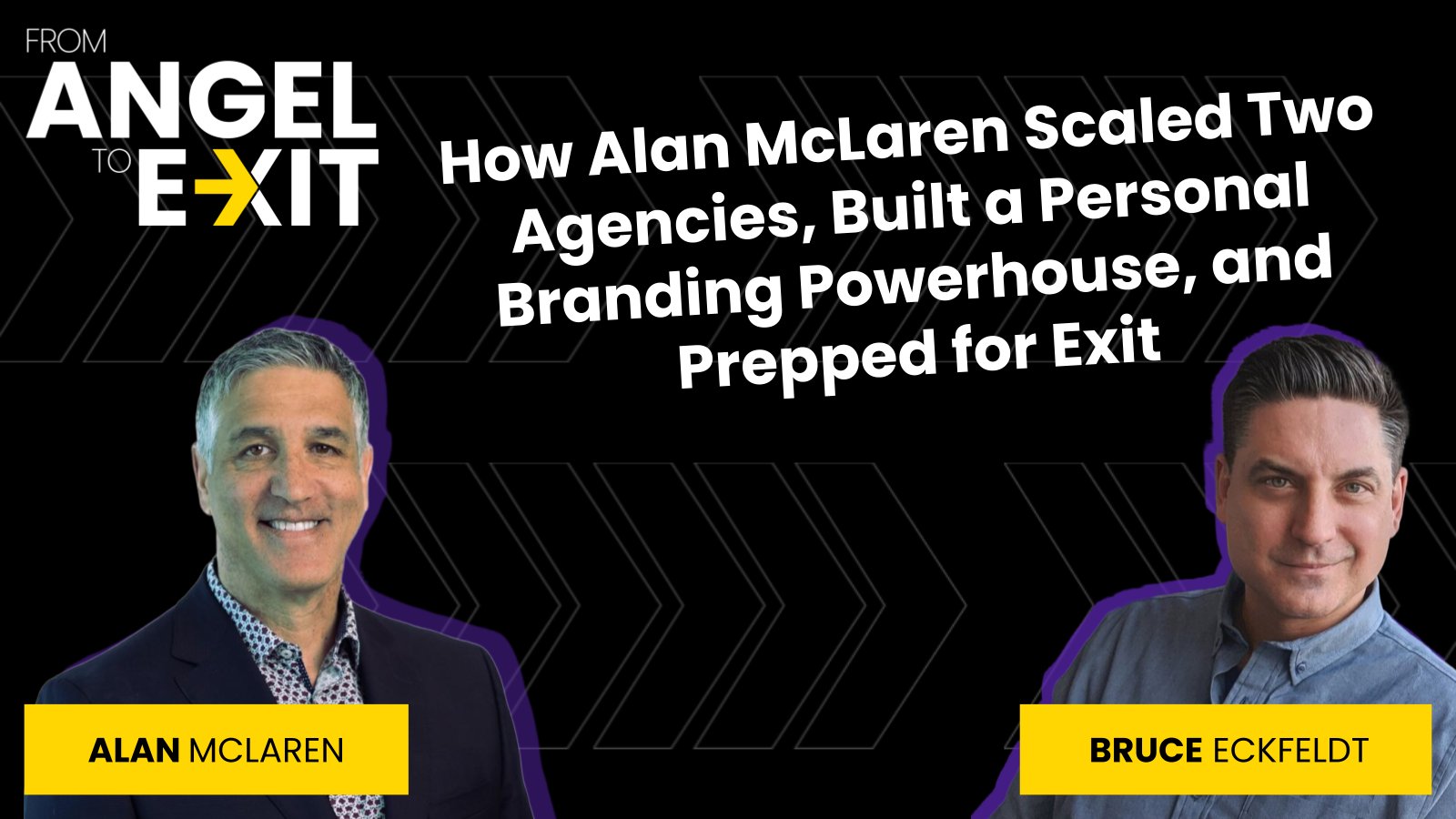
How Alan McLaren Scaled Two Agencies, Built a Personal Branding Powerhouse, and Prepped for Exit
Alan McLarenCo-founder, Strata Originals
Listen to the Episode.
Play the full conversation right here, or pick a chapter to jump straight to that moment. Prefer your own app? Every episode is on Spotify, Apple Podcasts, and the rest.
About This Episode.
Start with the key takeaways, the ideas worth bringing back to your leadership team. Then read the full story of the conversation, or use the chapters above to jump straight to the moment that matters most to you.
- Corporate experience builds foundational skills, but entrepreneurship demands creativity and flexibility.
- Aligning values is critical to sustaining long-term business partnerships.
- Business exits are emotionally complex, founders must prepare mentally, not just financially.
- Personal branding helps founder-CEOs drive visibility, valuation, and thought leadership.
- Successful M&A requires operational performance and expectation management through the entire deal.
- Founders must prioritize health, relationships, and purpose to avoid post-exit burnout.
- Defensible calendars protect time and focus across business and personal priorities.
- Leaders who invest in people, not just transactions, enjoy deeper, lasting success.
Alan McLaren, co-founder of Strata Originals, shares his journey from corporate leadership to entrepreneurial success. In this episode, he reveals how he scaled two marketing agencies, built a powerful personal branding firm, and supports founders preparing for strategic business exits. Alan discusses M&A readiness, founder well-being, and how personal branding plays a crucial role in business growth and exit strategies.
Watch the Video.
Prefer to see the conversation? The full episode plays right here on the page, so you can watch while you follow the takeaways or read along with the transcript. Every episode of From Angel to Exit is also on my YouTube channel, along with short clips from each conversation.
About the Guest.
The background behind the conversation, and where to find this guest online.
Alan McLaren
Co-founder, Strata Originals
Alan McLaren co-founded Strata Originals after scaling two marketing agencies. He helps founders build a personal brand that supports growth and a strategic exit.
- Website
- strataoriginals.com
- linkedin.com/in/alanmclaren
Full Transcript.
The complete conversation, lightly edited for readability. Open it to read along, or search the page for a topic or a name.
Read the full transcript
Bruce EckfeldtWelcome, everyone. This is From Angel to Exit. I'm Bruce Eckfeldt, I'm your host. Our guest today is Alan McLaren. He is co-founder of Strata Originals, has a long history of working with a series of companies, and is a member of YPO. I'm excited to talk with him about his business experience, the companies he's been involved in, his own entrepreneurial experience, and the founders and leaders he's working with to help them with their process, along with the insight he has into this whole journey of scaling and exiting, what that means, and how it works. So with all that, Alan, welcome to the program.
Alan McLarenI'm very excited to be here.
Bruce EckfeldtIt's fun to have you on. Before we dive into the work you're doing today and the details of the insights you've seen in this space, we'd love to get some backstory. What was your professional experience? How did you get into the businesses you were in? Give us a little of the story.
Alan McLarenThe story started way, way back, because I'm not young anymore, as all of you can see. I started with Canon and IKON. I was in the business equipment business to start my career, in corporate Canada and corporate America. As you know, when you move over to the entrepreneurial world, it's not the same as being in a corporation. But the corporate experience, for me anyway, taught me what limitations really mean and how decisions get made. I spent 16 years in that industry, moving around mostly in Canada, and worked my way up the chain to my first president's job in 1999.
Then I moved over to IT security, where I ran a NASDAQ-listed company. That's another experience: running a publicly traded company is a whole other animal. 10-Ks, managing by 90 days, and all that other crappy stuff, which I will never do again. But ultimately, I went into the entrepreneurial world in a partnership in IT security, in one of the businesses we sold off there. It was a nice three-year run, building a business literally from scratch and finding new customers, and that gave me the bug for entrepreneurship.
From there, I opened a marketing agency, believe it or not, because I thought there was a big gap in the world. That was 20 years ago now. Then we moved into this world called personal branding. Over the last two years, we saw a gap in the market and said, "There's so much opportunity for distributing great messages today, but people aren't doing it well. Maybe we can help people through that." That's how we came to where we are today.
Bruce EckfeldtCool. I'm curious, when you were young, did you know you wanted to start a business and exit a business? Did you have any role models?
Alan McLarenNo. You always get that: "Did you have the passion?" No. I was a horrible student. I wanted to be a professional football player, and I was five foot nine and 180 pounds. So I was pretty stupid, or, arguably, I didn't see any limitations. So I could apply whatever I had learned in my life to business, because I had very little fear. I would be the first one in the pool. That helped me on both the corporate side and the entrepreneurial side.
But I never had a vision. As a lot of entrepreneurs will tell you, it's a bit of getting out there and letting stuff hit you. Do things as well as you can, and opportunities will show up on your doorstep. That's what happened to me. I got choices to make. Even the entrepreneurial journey was a little reluctant, because nobody's giving you a salary. You have to eat what you kill. As entrepreneurs know, it's not for the faint of heart. So it was certainly not planned out, but it worked out pretty well in the end.
Bruce EckfeldtYou had a lot of experience in corporate, with some pretty big names, and experience with public companies. What did you learn there that you were able to apply, or that helped you, when you actually got into an entrepreneurial situation?
Alan McLarenProcess. If I look at IKON as an example, they were all GE-trained executives, so they were deep into process and deep into P&Ls. I was never a numbers guy. I was more of a sales guy. But I learned about P&Ls and balance sheets and how critical they are to running a business. So it wasn't a seat-of-the-pants operation when I started as an entrepreneur. I knew the basic things I had to measure, so I knew what was working and what wasn't. When I had my crazy ideas, I'd say, "Okay, let's apply some process and some discipline to it." That's what I learned. I also learned that too much process gets in the way of creativity and design thinking. So allow yourself the freedom to think, but make sure you're measuring it, so you know when to quit or when to push hard.
Bruce EckfeldtPut a few guardrails around it.
Alan McLarenAlways. Because you know what entrepreneurs do, right? We have nobody holding us back. The only people you talk to are your board or your bank. Other than that, you have free rein, which is both good and bad. You could be running into a brick wall and not see it. Thank goodness you have YPO, and those who are in YPO know this. You have a forum to keep you from falling off the cliff when you can't see it. So I think having a great board of advisors around you is also important.
Bruce EckfeldtI think my forum group saved me from a few cliffs, both professionally and personally.
Alan McLarenAbsolutely.
Bruce EckfeldtI'm curious. When you got into the entrepreneurial space, you weren't a 19-year-old coming out of high school with a crazy business idea who could throw caution to the wind. What were some of the considerations, adjustments, or decisions you had to make, personally, going from a corporate world with a lot of structure, certainty, and trappings of professionalism to starting your own venture? What was that decision like?
Alan McLarenI'll blame my business partner, Leanne, for that, 100%. We were together at a company called JAWZ, the IT security firm, where she was responsible for marketing and PR. Then we moved over to one of the companies we'd sold off, and we joined as partners. When we finished our three-year run, she came to me and said, "What are we going to do now?" And I said, "What do you mean, we? I'm going to go find a job somewhere as a CEO. We'll be friends for life." She said, "Why don't we start a business?"
I said, "Well, we don't have any ideas. We don't have any money. Of course, why not do that?" And that's exactly what happened. Leanne really had the idea to say, "We should do something together, because we work well together." And we've been business partners for 25 years now, across two businesses. That's quite a run. But that was it. It was that leap. And of course, going back to my wife and saying, "Here's the idea. Well, there's no idea, but here's the leap of faith."
Bruce EckfeldtPerfect. Sounds great.
Alan McLarenThat was ultimately the goal. We started with a computer and no idea, other than that we thought we had a good way to build a marketing agency, and that's what happened.
Bruce EckfeldtWhat do you think made you two such good partners? I'm always fascinated by companies started by partners. What worked between the two of you that made you feel, "Yes, this is the person to go with"?
Alan McLarenThe first thing is overused, but it's values. You have to be aligned on how to treat a customer and how to treat your employees. Those things are table stakes that most entrepreneurs don't talk about. They get into it and figure out their styles.
What's also unique is that we learned how to work together, because she's full-on ADHD and I'm kind of a process guy. So I had to come a little her way, and she had to come a little my way. I know I came a little more her way than she came my way. What we learned was that when we looked at a problem together, we were coming at it from two really different places, and each of our brains would make it better. We had to learn to work together, because we're both very passionate about our ideas. We learned that we needed to respect each other, because working on it together would make the idea better.
To this day, we still get frustrated with each other, but it's because we're so passionate about solving the problem. It's not really with each other. It's about how we're thinking about it differently. And then at the end, we go, "Wow, that was magic." Sometimes it takes a while. But the key really was trusting each other, caring about each other, and, of course, caring about the business. And we've done that for 25 years.
Bruce EckfeldtYou mentioned you didn't necessarily have the idea or a business model. Tell me a little about that process. What was the exploration? When did you feel you first had an idea you could actually get traction with and start scaling?
Alan McLarenThe first thing we did was look at marketing agencies, and we saw the bait and switch in that world, where the big guys would come in and pitch and then hand you a junior person. We said, "We don't want to build that kind of agency." So the vision was that we wanted to be front and center with our clients strategically. Of course we'd have a team behind us, but you would never lose contact with us. That's how we built it.
We purposely wanted to keep it small, a lifestyle business, however you want to define it, with no more than a certain number of employees, so we could actually do it that way. And we did. We targeted small to medium-sized businesses and ended up servicing a couple of billion-dollar businesses, because we did such good work that they said, "We want to work with you." We were saying, "No, no, no, you're too big and too crazy," but we found the right situation to do it.
So the idea was really about making sure we could serve our customers effectively, and we got a lot out of it, because our thrill was when they were successful. That was the win for us. Money was important, and building the business was important, but that came as a result of getting good results for our clients.
Bruce EckfeldtHow have you approached this whole topic of exiting over the course of your career? Has it always been something you've thought about? When you start or get involved in things, is it, "Okay, we're going to put together a five- or 10-year plan, and then we're going to be out, and this is the valuation we want"? How does this work for you?
Alan McLarenThis needs to be honest, right? Okay, let's be honest. The truth is, no, we didn't start with the end in mind in that respect. John Warrillow writes some good stuff on that kind of work. But we decided we would just do the best job we could and let the results fall where they may.
But funny enough, with the clients we work with, we have exactly that conversation. When you're dealing with agencies, agencies are tough, especially in today's world. When all your intellectual property is in your brain, that's tough to scale, and you end up being part of it for 10 years. So we decided we'd build some good businesses and take the money from that, and if we had an exit, that would be great, but it wasn't that big a deal.
With our clients, though, it's a different conversation. In the world of personal branding, which is where we are today, we're shaping people's narratives. If they're an angel today and they're heading to an exit, that's an intentional process. And if it's a technology business, well, we know that has to exit. That's the reason you get into that kind of thing. So not for us, but for every one of our clients, there's definitely a conversation around that.
Bruce EckfeldtI think that's an interesting one, because there are different types of businesses. You end up with these lifestyle, personal service businesses, versus venture-backed startups that are on a runway. You have to get them exited at some point so the investors can get their money out. How does that change things? Have you noticed patterns in the different types of entrepreneurs, or the different types of people who get involved in these businesses?
Alan McLarenThat's right. The pattern is that they're losing their minds every single day. I'm not joking about that. They end up focusing so intently on their business that they forget about the other things that older guys recognize: making deposits in the other parts of your life, your physical and mental health, your family, all those things. They get caught up in the hockey stick, to use a Canadian analogy, the runway, which is fine. You could have that success and have an exit, and then what do you have left? You've just burned everything behind you.
So what I try to do, with our clients and when I mentor younger people, is say, "Look, if you're choosing to do 80-hour weeks, that's your choice. But carve out 10 hours for your family. Carve out five hours for yourself, because you don't want to be 45 and overweight and have heart problems because of all the stress of the last 20 years." Balance is such a bad word, but find a way to get back to balance, whatever that is. You can still be successful, and if it takes you another year, you're doing it healthily, and hopefully with a loving family, because your kids are only young once, and you don't want to lose that.
Bruce EckfeldtThey're only kids for a while.
Alan McLarenRight. I find them very myopic. What I try to say is, "Yes, be myopic when you need to be myopic, but don't forget there's a life. You're here to build a life, not just a business."
Bruce EckfeldtIt's interesting. I find there are three buckets here. You've got people who really struggle. Everything's in the business, and they don't put any investment anywhere else. The best case is that they exit, and now they've got all the resources, and they try to make up for it. They go back and try to fill in the gaps and repair as much as they can.
Alan McLarenCatch up.
Bruce EckfeldtThen you've got people who balance a bit: "Okay, I'm going to work maybe 70, not 80, hours a week. I'm going to go out with my wife or partner or husband once a week. I'm going to do the bare minimum and try to keep it going as best I can."
And I've met several folks who've been impressive in that they've figured it out. I think it's partly mindset and partly strategy, but the mindset is, "I have to do both. Investing in my physical fitness, my mental fitness, my relationships, my family, my kids actually helps me be a better entrepreneur, a better leader, a better CEO." I'm curious whether you see some of these folks integrating these things in a really positive way, not as a trade-off, but as something reinforcing and synergistic. Have you noticed that, and what are they doing?
Alan McLarenI think it comes back to your earlier point. It depends on the type of business and who your bosses are. As Bob Dylan once said, you've got to serve somebody. The devil or the Lord, you've got to serve somebody. If you're VC backed, you don't have that control. They're expecting you to be on time with everything you do. And very few of those firms are saying, "Just invest in your family. Invest in yourself." They're just not.
Bruce Eckfeldt"Take another year."
Alan McLarenBut if you have some autonomy... Because I think you're right, there is a formula for success, but you need the strength and conviction to push back on these folks and say, "Listen, man, you could crush me in three years and have a crappy investment, or you're going to allow me the time to do this." But it's hard to have those conversations with people who are older than you, have more experience than you, and have exited a hundred times. So it's rare that you find an entrepreneur with that balance unless they're on their third or fourth business, because now they have the experience, and people say, "I'm just going to leave Bruce alone. This person knows what they're talking about." So I think when they're very young, they just don't have the fortitude to do that. They might be incredibly talented.
I was just having a conversation with a very successful founder. He's almost at a billion dollars. You know what his biggest problem was? His partner. That was it. So I started talking him through that. We weren't talking about the business. The business is doing well. He was saying, "My God, I feel so bad." I said, "That's dragging you away from what's important. So find a way." I gave him a little advice. I'm not a psychologist, but I've been married a long time, so I understand the drill. They've got to work out what's good for them, for their business, for their health, and all the other stuff.
Bruce EckfeldtMaybe not obviously, but some of these folks who have had a couple of nice exits have resources. They're not beholden to the situation nearly as much as a first-time entrepreneur, particularly one who has put everything into this business: their financial future, their personal future, their professional reputation, and who hasn't created a good set of relationships around them otherwise. It becomes so overwhelming, and it's so critical for them to be successful at this one thing. They don't have a choice, and they really get stuck in these situations.
Alan McLarenAnd we know there's a mental health crisis today. CEOs are not happy today. Founders are not happy today. You deal with them all the time in your work. I see it from a different context, but it's the same thing. They're just struggling. So how do we get people to some sort of central balance, or purpose, or something that allows them to live their lives? It's not easy to build a business, but I would hope you'd try to enjoy parts of it. Or why are you doing it? Just for money? We know that's not the answer.
Bruce EckfeldtExactly. We've talked to a couple of people on this program already about how, if all you're doing it for is the money, you're probably going to run into problems. You're probably going to have some pretty big things to work through after the exit, because money is a great resource, but it is not, in and of itself, fulfilling. Do you have any thoughts or recommendations, or things you've seen, for earlier-stage founders on how to practically answer or grapple with some of these questions and create a bit more balance in the earlier stages?
Alan McLarenIt sounds a little simplistic, but you lay out the goals for the business and the goals for your life. You've seen those wheels before, where you set business, spirituality, whatever those things are. Find out the things that matter to you. You might be single and a wild child, and then good, you're good. But if you want to settle down at some point, then you have to figure out where that wedge of the pie is.
I think health and wellness has to be in everybody's bucket. You're a big health guy. You get that, because it makes you a better CEO when you're healthy and energetic. So find those four or five buckets, and make sure you're time-blocking them and investing in them.
I time-block yoga for me. Yoga is four times a week, 4:30 to 5:30, and I very rarely miss it. People ask, "How do you do that?" My calendar just doesn't allow people to book me during that time. There are exceptions when there are emergencies, but they're very rare. Then I block off these other things: "Okay, I'm going to dinner. I'm doing this." And I try to treat them as sacred. Business is no more important than personal.
That's what I would say to people. If you decide you want to work 80 hours a week, work backwards from the 165 hours you have. Recognize, "I've got to sleep six or eight hours, or whatever it is. Fitness, five." And then you can say, "Okay, now I've got something I can work with," as opposed to just flying by the seat of your pants, getting to the office at six, leaving at 10, and letting the chips fall where they may. That's not how you live a life of enjoyment, at least in my view.
Bruce EckfeldtI do a lot of this work. I call it a defensible calendar: building a calendar that's the right allocation of your time and energy based on your priorities and goals, and then creating systems and structures to defend it. Time is your ultimate resource. I can make more money. I can't create more time, unfortunately.
Alan McLarenPerfect. And you know, Bruce, we all talk about this thing called presence. When you're running around like a chicken with its head cut off, and a staff member is talking to you while you're on your phone or half distracted, you're not a good leader. When your spouse or partner is talking to you and your head's in a spreadsheet, you're not listening to them, and you have to pay for that.
So you've got to decide: "When I'm spending a minute with someone, it's a minute, and it's their minute." Or five minutes or 10 minutes, end of story. That's a skill you need to learn, in your life and your marriage and with your kids, whatever it is. And then people make excuses for them: "Well, he's really busy," or "She's really busy. They work really hard." Yes, but you have to make deposits with humans in life.
That's where I find the challenge. You have a good plan, and you might throw off the plan every once in a while. That's okay. You're on a money raise, so you're 60 days full-out for that. That's great. But your partner knows that and is okay with it, because you've made the deposits before.
Bruce EckfeldtExactly. You can do that without significant consequences, because you've made the investment and you've got the deposits already. If you haven't, that's where these things become really critical and existential.
Alan McLaren100%. And then they wonder why they get in trouble when they come home and then go play golf for two days, drinking with their buddies. I don't want to sound like a psychologist, but a business is part of your life, the biggest part of your life. You've got to enjoy your life, I think. Maybe it's an old man's perspective. I don't know.
Bruce EckfeldtIt probably is, but it probably should be a younger person's perspective as well. I'm curious about the exit side, in your own experience and the work you've done with some of these folks. What really drives successful exits, whether on the valuation side, or in terms of the drama around the exit, or clarity, or what it gets somebody in their post-exit professional or personal situation? What have you noticed successful leaders doing early in the process?
Alan McLarenLet me work backwards from the exit, if I may. I have never seen someone exit and say, "That was amazing." I don't care how much money they have in the bank, $20 million, $100 million. It was like they were put through the wringer. You know this. You've dealt with these folks all the time. And I'm sitting there thinking, "You've got $30 million in liquid cash in the bank, and you're no happier than before you started this process. Something's wrong with that."
I don't necessarily have the answers on what you can do, but understand that you're going to pay a price for this exit in some way. You've just got to understand, going into the exit, what that's going to be about. Because it's not a happy... You get the LOI and you go, "Look at me." Well, the LOI is just a little baby step. It's not, "We're done." No, no, no. There's a little bit of due diligence happening.
Bruce EckfeldtThe LOI tends to be the peak. It just goes downhill from there.
Alan McLarenIt is. That peak of happiness. One thing I would say, and one of our clients is an M&A lawyer: get yourself a great M&A lawyer or a great investment banker, whatever it is, who will do the dirty work for you, and make sure you understand the expectations up front, because it can get pretty ugly, as you know. The idea is to make it as un-ugly as possible, because there is a beautiful thing at the end, and it's cash.
You've got to really know your best outcome. It's back to your BATNA. What is your best alternative? What is that for you? And then let everybody else do the dirty work. It's really hard. Don't spend the $20 million, because it may be 10, or maybe five.
So I think it's expectations management, emotional management, fitness, mental health. And the other thing I'll say is a huge mistake: don't take your eye off the performance ball while you're going through this. Because if you do and things drop, they can adjust the price. You're thinking, "I know my valuation today." Yes, but they don't have a check on your desk yet. So make sure you're performing.
Bruce EckfeldtYou haven't signed the deal.
Alan McLarenRight. The deal's not the deal until the money is in your bank account. So continue to perform, and don't be dreaming about getting out and taking a breath. It's not over till it's over, and that could take six, seven, or eight months. That would be my advice.
Bruce EckfeldtI do find there's this hard balance. Yes, I want to sell, but I have to be willing to continue with the business at the same time. If I'm too caught up in selling, not even taking my eye off the ball, but just mentally checked out, and I don't have a vision for the future of the business, now I have to sell. That's a horrible negotiating situation. But I also want to be able to sell on a good offer. If I get an offer, I want to be able to sell, and I want to have a plan, because if I don't have a plan for what I'd do next, I can't sell, because I'm so caught up in the future. Have you seen folks who can manage or balance that well?
Alan McLaren100%. They balance it well when they understand themselves. Are they going to be checked out? Are they tired? You have to be really self-reflective about that. Forget about the money part. That usually works itself out. But if you're passionate about the business, understand that your role could change. You may not be the CEO anymore. You might be chief technology officer. They might move you to the side, because they want you around but don't want you running it anymore.
So I think you've got to know what you want out of this, and recognize that you've got to give to get. You might have a three-year commitment, and maybe there's a shotgun clause so you can get out at some point, whatever the terms are. Just make sure you know what you want out of this, both personally and professionally, and make sure that's part of the deal, not just the money part. Because when you're checked out... I've just seen this. They're depressed, and they've got the potential of $20 or $30 or $40 million in the bank. "Why should you be depressed? Look what's coming." Because humans are humans. We're emotional beings, so we've got to fulfill that part of our lives.
Bruce EckfeldtI've worked with a couple of folks where that actually makes it worse. Now they've had this big financial success, and the fact that they're not happy with all this money makes it even more problematic. So it ends up being a double whammy for them. Now they don't have the company, they're not really happy with the money, and they realize they've got to figure something else out. I work with folks on that kind of existential crisis, and we find all sorts of work we have to do around it.
Alan McLarenAt the end of the day, as humans, it's the same argument you can make for retirement. What happens when you retire? There are lots of books written on this. Is it the money? Is it the work? No, it's the relationships. You sell your business, and all those 200 people who revered you are gone, and they're not your friends. "I didn't make investments in my family. I don't know my kids. Every relationship I've had is transactional, and that's gone. Now what do I do?"
As opposed to investing in all those parts of your life we talked about earlier, including friendships, relationships, forum mates, whatever you want. That softens the blow a bit. And then, on the other side, with whatever cash you have, you're saying, "Okay, I've got more time to focus on this, this, and this part of my life," as opposed to standing at the starting line going, "Now what do I do?" That's a horrible thing for those entrepreneurs, because they should enjoy the fruits of their labor. Some of them do, but they're very rare. They need a year to reset. I'm saying you should be a bit more balanced before you get to that place. From what I've seen, the folks who figure it out are so much happier when they exit.
Bruce EckfeldtYou mentioned yoga. Is there anything else you do in terms of practices, or ways you find balance? You're still going strong with the business, but I get the sense you've created some balance in your life around this stuff. What other strategies do you have?
Alan McLarenMy goals are pretty simple. Golf is my competitive outlet. I need something to drive me, or drive me crazy, I guess, would be the best phrase, because golf is that kind of thing. And yoga is both fitness and spiritual, not in the religious sense, but in terms of centering myself and focusing on myself. I think that's important. Those are the two activities I have.
And of course, learning. I'm just thirsty for learning and learning and learning new ways to do things. And I invest in people. Relationships matter to me. You know I'm a personal branding guy, but I believe in investing in the people I want to spend time with. So I nurture relationships. I have virtual coffee with people. I have coffee with people, whatever it is, because that stuff matters. Most people only network for transactions, not transformation. I network because I care about the people I want to have in my world.
And by the way, I've shed all the bad people in my life. I don't want you. If you're a taker, I don't need you in my life. I want givers, people like me who love life, love people, and want to help people. I've got a lot of that in my life, and I'm so fortunate and so grateful, because that gives you pleasures you just can't buy.
Bruce EckfeldtThat really is true. Tell me a little about where you want to take your business at this point. You mentioned you're doing some good personal branding work. What's your vision?
Alan McLarenOur vision is really simple. It's simple, and it's big. We want to change the world. What does that mean? There are two or three million CEOs in the world, and probably 10 million leaders. You work in the leadership space, so you understand this. The impact a leader has on the people they touch is monstrous. Look at YPO as an example: 35,000 leaders in 140-odd countries. If all of them were doing their job the way we'd hope, in other words, helping people and helping the world through their stories, they would touch tens of millions of people.
So our job is to inspire leaders to be the best of themselves. You do that work yourself. You're very good at building your personal brand, but you do it for a very express reason, because it's part of your business. There are others, and I've got to tell you, Bruce, the stories we have would shake the very foundations. Every leader who has made it to a certain place has a story. And they can help others through those stories, or grow their business. So our work is to inspire as many people as possible to get out on LinkedIn and X, or Twitter, and share their knowledge and their perspectives with the world. That will change the world.
As for the business itself, we're just trying to grow it, so that in the next five years it's in a place where we could either sell it to our employees or exit, or I'll just continue doing speaking gigs, or whatever. I have no plans to retire. We're having a blast, because it's such fun work.
Bruce EckfeldtThat's great. Alan, it's been a pleasure. If people want to find out more about you, the work you're doing, and the agency, what's the best way to get that information?
Alan McLarenYou can look me up on LinkedIn. Alan McLaren, simple, you can find me there. Or strataoriginals.com. There are lots of resources there for people to learn about personal branding. And if you're an angel, just understand one thing: good things happen when people know you, and when they don't know you, it's harder for good things to happen. So just make sure you're out there, and then all those other things happen a little more easily.
Bruce EckfeldtWell said. Alan, thank you so much for taking the time today. It's been a pleasure.
Alan McLarenThanks, Bruce. Good to be with you, as usual.
Never Miss an Episode.
Know the moment a new episode goes live. Subscribers also get a say in future guests and the topics we cover.
Other Related Episodes.
More conversations that connect to this one. Or browse the full archive by topic or by guest.
Joshua Maidan
How he built a premium coffee brand, and what good governance means for scaling and exiting.
Listen and Read
Leslie Kraatz Adams
How she grew a third-generation family business and carried it through an exit.
Listen and Read
Lysle Wickersham
How brand equity drives enterprise value, from scaling a $170M agency through several exits.
Listen and Read